
 Sat Feb 02 2019 18:41 January Film Roundup:
- Raising Arizona (1987): This one's on the 'goofy' side, and it's fun. IMDB trivia says this was made to be as different from Blood Simple as possible, and those two movies do span the early Coen dramatic range.
I initially assumed that Gale and Evelle were a gay couple and was disappointed when it turned out they were brothers.
- Barton Fink (1991): I saw this in, like 1998, and then I saw it again with Sumana in July 2012, just before I started Film Roundup as a regular series. So I almost Film Rounduped it last time, but not quite. A little frustrating. But Barton Fink is a great arthouse movie, and it's fun to watch up to three times. The first time you're going in cold. The second time you know the trajectory and you catch all the foreshadowing and symbolism on the way. The third time you know what you're going to catch and there's a kind of second-order pleasure in seeing it all come together.
Don't get me wrong: I'd rather be watching it for the second time or even the first. But Barton Fink remains a real pleasure. The Buscemi/Goodman/Turturro triumvirate is in full flower, and it's great.
- Inside Llewyn Davis (2013): I love the period-ness but I can't stand the main character. Like if the Dude just complained in the bowling alley instead of trying to get his rug back. This guy's got a bunch of friends he doesn't deserve and he mistreats 'em all, but not in an innovative way, just regular entitled jerkiness. And I'm not into the music. This is a movie that shows you the ending first because that's the only part with any action, and doesn't even make it clear it's a flash-forward—seems like a decision made in the editing room.
John Goodman as Roland Turner steals what little of the show he's in. A weird side note: Turner's henchman is named Johnny Five, an anachronistic, irrelevant reference to another movie that I don't think even Thomas Pynchon would try. It's just inexplicable. If I'm ever at a Q&A with the Coens I should make this my Q.
- A Serious Man (2009): The project finale! Another period piece, more enjoyable overall than Llewyn Davis. Takes a while to get going and the main character is another sad sack, but at least he's trying. Or maybe it's not even that he's "trying" but that bad things really are happening to him.
- Main Hoon Na (2004): a.k.a. "I'm Always Here." A Bollywood classic that blatantly mixes Tom Clancy-type thriller and goofy college romcom. It... is okay, but if I'm going to sit through a three-hour movie I want more than "okay". Sumana and I had more fun riffing than watching the movie itself. There is a really good part during the closing credits, where the crew gets to be on-camera goofing off. The producer signs a big novelty check, etc.
Fun, spoileriffic fact: the main villain in this movie dies the same way as the main villain in Raising Arizona.
- Manikarnika: The Queen of Jansi (2019): This movie's got an undercurrent of Hindu nationalism that's kind of disturbing. Sort of reminded me of Ken (1964), but it's a live grenade instead of a museum piece. The action scenes are not all that was promised; we expected more aunties with swords. Also the British accents were all over the place, which was very distracting. During the movie I thought they'd cast a group of Eastern European backpackers as the British officers. But from what I can tell, those parts went to American and Australian actors living in India. Not that my British accent is great. I'm not volunteering.
And now, the conclusion. For the first time in Film Roundup history I'm giving rough numeric scores to movies, just so I can compare my overall opinion of the Coens' works against the IMDB consensus:
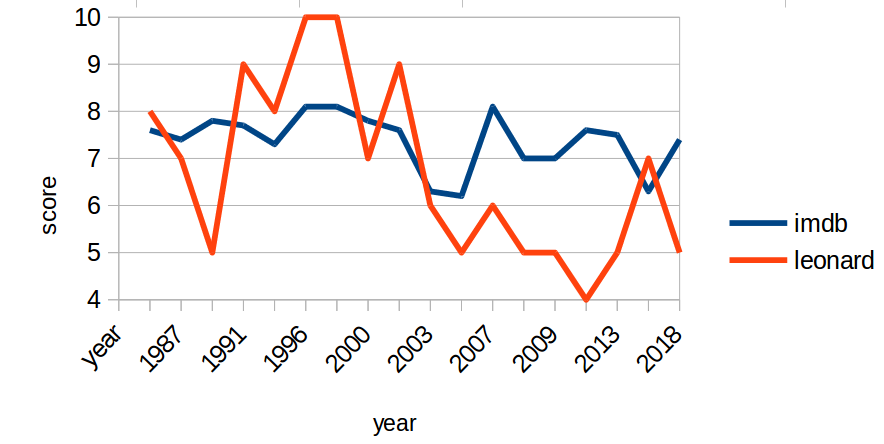
Survey says the Coens consistently produce above-average work but had a slight dip in the 2000s. What I learned from this project is how much value I put on the 1990s Coens in particular. The six movies from 1991 (Barton Fink) to 2001 (The Man Who Wasn't There) are my favorites by far, and include some of my favorite movies of all time. But apart from that ten-year stretch they're not really making movies for me. I don't think these movies are "bad" necessarily, but I like specific things and there was a magical period where the Coens were really into those same things.
For the record, here's my ranking, with my faves at the top:
- The Big Lebowski (1998)
- Fargo (1996)
- The Man Who Wasn’t There (2001)
- Barton Fink (1991)
- The Hudsucker Proxy (1994)
- Blood Simple (1984)
- O Brother, Where Art Thou? (2000)
- Hail, Caesar! (2016)
- Raising Arizona (1987)
- Intolerable Cruelty (2003)
- No Country For Old Men (2007)
- Burn After Reading (2008)
- The Ladykillers (2004)
- A Serious Man (2009)
- Miller’s Crossing (1990)
- The Ballad of Buster Scruggs (2018)
- Inside Llewyn Davis (2013)
- True Grit (2010)
Some miscellaneous notes on the films as a whole:
- There's a stock character who I really like whenever they show up: the highly eloquent, super-polite character. Buster Scruggs, Professor Dorr, Ulysses Everett McGill, Charlie Meadows and Maude Lebowski to some extent. Maybe there's a character like that in The Hudsucker Proxy, it's been a while. Most of the time this character is a villain, but Troy Nelson is my favorite thing about Inside Llewyn Davis—just a really nice square with his head screwed on straight. Which I guess makes him the villain in that topsy-turvy movie.
- In the moral calculus of Coen Brothers movies, the worst thing you can do is leave someone to die. It doesn't come up every single movie, but I believe there's a consistent pattern. This is how you find out Buster Scruggs is a bad guy. Llewelyn Moss leaves someone to die in No Country for Old Men and it's the only thing that makes him feel bad in the whole movie. The only non-self-centered thing Llewyn Davis does in his whole movie is check on Roland Turner when he ODs. Arguably "leaving someone to die" is what kicks off all the problems in A Serious Man, if you're determined to make the prologue have something to do with the movie.
In real life, actively killing someone is worse then leaving them to die, but in Coen movies homicide doesn't usually have a moral dimension—it's the "shit" in "shit happens". Most of the body count is accidental, or else caused by Bad People like Anton Chigurh, characters who we know won't have any moral growth. The morality play happens afterwards, in how the survivors deal with it. The leaving-for-dead scenario is a good way to give big dilemmas to characters who would never realistically kill someone.
No comments yet.