Sat Oct 03 2026 10:35 September Film Roundup:
- Bells are Ringing (1960): Judy Holliday does it again! A light, fun movie that only makes sense to the extent it's based on a true story. We also got another 1960s dental office. What's with all the dentists in these old movies? I theorize "dentist" is a super-networker character. You don't need to explain why someone would visit a dentist, or why a dentist might know any random person.
Anyway, Judy's great as always. The all-classic moment in this movie is when Dean Martin asks "Are you psychic?" and she mentally fumbles for a bit before saying "...Yes?" We coulda had Judy Holliday as Sean Spencer, folks.
- The Birdcage (1996): Nothing brightens up movie night like a surprise "Screenplay by Elaine May" credit. The main thing I think could have been improved here is the characters of the kids who are getting married. Right now they're defined primarily by their rebellion against their parents, and it's like watching the romantic subplot of a Marx Brothers movie while the older actors are chewing scenery left and right. But the chewing is definitely entertaining.
I haven't seen the French/Italian movie this is based on and supposedly May's adaptation was really close to the original, but there's a suspicious amount of The Heartbreak Kid (1972) in this one.
According to a contemporary interview in The Advocate, Gene Hackman "relished the chance to return to his roots in improvisational comedy." I've seen several Gene Hackman movies and suffice to say that's not where I thought his roots were. But there is a part in this movie where he delivers a long rambling monologue that's not very funny, so maybe? Oh, and in honor of the end of this movie we came up with the perfect drag name for him: Jean Hackwoman. Tip your waitresses!
film
Mon Sep 07 2026 11:46 August Film Roundup:
- Coyote vs. Acme (2026): Saw in a preview at the museum with two of the stars talking afterwards. This was a fun movie that has a couple of really emotional moments and pretty clear signs of studio interference (beyond the fact that the studio killed the movie and we're only seeing it due to a rare win for the "angry nerds on the Internet" community). Whose idea was it to limit Bugs and Daffy to one scene each? Sounds like the nefarious work of a studio that smells a big round Acme bomb and wants to keep their prime assets in reserve for a Super Bowl yogurt ad or something.
The thing I keep coming back to is what a quisling Foghorn Leghorn is. He responds angrily to racial slights in private, then aw-shuckses away the same slights in public, in the service of selling out his fellow toons. A bit of intentional depth in what's mostly a "don't think about it too hard" movie.
film
Sat Aug 08 2026 20:15 July Film Roundup:
- The Hunt for Red October (1990): Really enjoyable thriller. I was thinking there might be an extra twist vis-a-vis what Sean Connery's character really intended to do with the sub, but then there was a scene where Jack Ryan was putting forth his theory and all the brass were shitting on it, and I was like "well, the protagonist has spoken, that's it for twists." Still a fun film. Gates McFadden has a blink-and-you'll-miss-it role as Jack Ryan's wife.
I think Sumana would want me to mention that Jack Ryan has a bad habit of leaking sensitive national security information when he talks to himself in infodumps. You can fix this plot hole and restore your enjoyment of the movie by simply putting your finger in front of your face to cover Alec Baldwin's mouth, so that it looks like he's doing an internal monologue in voiceover.
- Listers (2025): Watch it on Youtube! A charming documentary about birdwatching, brotherhood, and mistaking the measurement for the thing being measured. The bit that sticks with me is the cautionary tale of the guy who's so competitive that he saw on the news somebody had the biggest Christmas light display in the area, and he got really into Christmas lights just to outdo that guy. I hate to think of what happens when he watches the Olympics. PS: there's a California condor in this movie, one of my favorite birds.
- Knightriders (1981): Like many moviegoers, I watched this on the strength of the awesome poster, and was disappointed by the lack of time travel. Also the movie's way too long. Like a lot of baby boomers (Peter David, J. Michael Straczynski), George Romero has a self-indulgent fascination with Arthurian romance. Maybe if I, too, was a successful director or comics writer, I'd feel the lure of comparing myself to the semi-mythological leader of a team of knights. But more likely Monty Python and the Holy Grail just made it impossible for anyone of my generation to take it seriously.
After the initial disappointment wore off, I liked the first 30 minutes of Knightriders quite a bit. It was cool to see an old-timey ren faire, the stunts were cool, and Steven King(!) was fun as the strawman rube. But pretty soon I tired of it and the main thing the film had going for it was its out-of-nowhere beef with Bakersfield.
See, Knightriders is clearly filmed in Pennsylvania and equally clearly takes place in Pennsylvania. But very important to the plot is a real crappy place called Bakersfield, with corrupt law enforcement like you wouldn't believe. In the climax of the movie, the sheriff of Bakersfield is given a swirlie from a soft-serve ice cream machine. So I have to assume George Romero had a bad experience with Bakersfield (understandable) and decided to make it the laughingstock of this long, weird movie. Sometimes they say the location is a character in a movie, but rarely is that character the comic relief.
film
Sat Jul 11 2026 16:03 June Film Roundup:
Possibly the latest Roundup in Film history. We just did a big product launch at work and I've had no energy. Before that happened, though, I was able to get it together enough to sit on the couch and watch some movies:
film
Wed Jun 10 2026 19:39 May Film Roundup:
- Cops vs. Thugs (1975): How much of a movie can you carry with a lead actor who looks really, really cool? The answer is: about 25%. Bunta Sugawara (previously known to me as the boiler operator from Spirited Away) looks like a badass this whole movie, but it's not enough. There are also cool car stunts, which often involve cars driving right up into a crowd of regular, non-stunt actors. Still not enough. A Taxing Woman has the same police-war-room feel and is a much better movie, without the showiness.
Director Kinji Fukasaku directed a lot of movies with great titles, most notably Battles Without Honor and Humanity (1973) which is definitely on my to-watch list. Not currently on my list: Hepcat in the Funky Hat: The 20,000,000 Yen Arm (1971), and The Green Slime (1968), which formed the basis for the pilot episode of MST3K!
- K-Pop Demon Hunters (2025): Watched, effectively, on a dare. Sumana auctioned off our Monday morning at a Wiscon charity auction, and the Wiscon-going public shelled out for us to see this movie, while reacting in real time on Discord. Final verdict: it's a fine kids movie. I liked the animal sidekicks. I was totally convinced Celine was going to have a villain turn at the start of act 3, but in the end she was merely misguided. So... well played?
Except now I'm not sure why Celine was in the story at all if she's not going to have a villain turn. It feels like part of her story was cut from the original screenplay. No doubt because the rising cost of 3D graphics hardware made it impractical to render whatever cool thing was going to be shown on screen.
- Conclave (2024): Sumana has been wanting to watch this since the recent real-world conclave, and we finally went for it. It's a fun political thriller with very little (but not zero) violence. This may fade over time, but I'm finally able to visualize Ralph Fiennes and Stanley Tucci in my mind rather than seeing them as indistinguishable actor-shaped blobs.
I think they should follow up the success of this movie with a sequel modeled after the super-long conclave of 1268-1271, where the staff starts making things more and more uncomfortable for the cardinals. People are setting up bootleg wi-fi routers, smuggling food in with drones, etc. Could get kind of Ballardian.
film
Thu May 07 2026 21:34 April Film Roundup:
- Queen of Katwe (2016): The second in our film festival of movies tied to Zohran Mamdani's life. This one has a cameo from the big Z himself, playing "Student Bookie" in a very 90s shirt. The rest of the movie is a pretty standard heartwarming based-on-a-true-story sports movie. I really liked the ending credits where they paired the actors with the real people they played. It really drives home the fact that there is no villain in this movie; nobody objected to the way they were portrayed. Except, perhaps, the Student Bookie.
- Project Hail Mary (2026): Saw on a date with Sumana, and in honor of her going in without knowing the Big Spoiler, if you don't know it I won't reveal it in this paragraph. But it was excellent. As someone who's created a Big Wacky Spoiler or two in his fiction I thought they did a good job of creating a Big Spoiler that...
You know what? It's a new paragraph, and the people who wanted to not be spoiled have moved on to the next movie. I'll say it: Rocky is great. A cool design, a great practical effect, a fun character. The scenes without Rocky... I could take or leave 'em.
- We watched some old public domain cartoons by Winsor McKay, inventor of the animated GIF. The best one, I would say, is The Pet (1921), which features both classic kaiju action and the immortal line "Say Doc — my wife as you know is a bug on pets — how can I murder the latest one she's found?"
Also, this went right over my head while watching it, but The Pet is a pre-Code film and this review points out that, as an entry in the Rarebit Fiend Cinematic Universe, it necessarily makes heavy use of a couple in bed together.
- Cactus Flower (1969): I sold Sumana on this as "like The Apartment but ten years later and not as good." And that is how it starts, but it quickly finds its own groove and turns into something really nice: a movie about two middle-aged people falling in love for the first time. It's a sweet rom-com that just happens to start with an attempted suicide and jokes about infidelity. The rare movie I'm glad Billy Wilder didn't direct, because it's just enough askew from his worldview that he never would have done anything so wholesome.
BTW, how about that 1969 dental practice? They've got a little darkroom for developing the X-rays. Really cool.
Bonus Kal Ho Na Ho connection: this film mentions a nonexistent address in Jackson Heights.
film
 Sat Feb 07 2026 11:55 January Film Roundup:
- An Unmarried Woman (1978): Like Claudine, one of those hidden gem '70s rom-coms that's now forgotten because a) all old movies have been forgotten, b) it doesn't fit the post Nora Ephron rom-com formula. I feel like Judd Apatow tried to give the genre a raunchier spin in the 2000s but I haven't seen any of his movies and if he changed the heading of the USS Rom-Com, it wasn't by more than a few degrees. Anyway, this is a really fun, romantic and somewhat raunchy (by 1970s non-porno standards) movie.
Saw this on a date with Sumana and we were both primed by modern rom-coms for the psychologist to be portrayed as a comic-relief blowhard, but her advice was actually pretty sensible! Later on we learned from IMDB trivia that the psychologist was played by a real therapist who was improvising a therapy session with Jill Clayburgh. Classic '70s improv/Method acting; I love it. The therapist, Penelope Russianoff, also cashed out on her sudden fame with a tie-in self-help book. Another classic move!
- Blithe Spirit (1945): A Noel Coward play... in movie form? Maybe he figured he was doing his bit for the war effort. It's entertaining, but mostly because of the visual effects and Margaret Rutherford's kooky old crone, the only character who doesn't know she's in a Noel Coward play. The other characters are content to waft timelessly around their country house like the holodeck people in Celine and Julie Go Boating. In fact, I think the holodeck people in that movie are made up to resemble the ghost from Blithe Spirit.
Coward was pretty cranky about the adaptation of his screenplay and claims the ending ruined the best thing he ever wrote, which a) the movie ending is way better than his original ending, b) if I thought this was my best work I wouldn't brag about it.
- One Battle After Another (2025): An exciting thriller with the huge thematic problem that the first part really wants to take place in the early '70s, and they barely make it look like 2007. I assume this is a requirement of the source material (which I'm reading now and it's hilarious). Would it have cost that much extra to make this a period piece? Then you wouldn't need to add cell phones to the story and then clumsily take them out again. Or just claim the second part of the movie is taking place in 1990 and bluff your way through it, the way Uncut Gems is set in 2012 but any New Yorker can tell it was filmed much later. What am I going to do, post a nitpicky three-hour rant on Youtube? I don't have the time!
The most thriller-y part of the movie was the exciting middle sequence with Guillermo del Toro. And the part I hope comes directly from Vineland is that the protagonist bumbles through the entire movie having no idea what's happening and no effect on the plot, but ends up saving the day retroactively by having been a loving and supportive father.
- What Did the Lady Forget? (1937): A charming "brassy dame" kind of family comedy goes sour near the end with an act of domestic violence that was acceptable in a 1937 movie but won't fly today. The dame is brassy the whole way through, to the point of becoming a kinda unlikable antihero—itself, a brassy move.
This month the Television Spotlight shines on both versions of Guy Montgomery's Guy Mont-Spelling Bee, a comedian panel show themed as a volatile and often unfair spelling bee. Sumana and I met Guy with the infamous season 2 of Taskmaster NZ and he has the same kind of sinister charm necessary to be a Taskmaster himself, or (as seen here) any kind of game show host. Since the entire New Zealand comedy scene seems to be about as big as Dropout, it was a relief when Guy moved the show to Australia and got a wider variety of... wait, people are showing up in both versions? I just don't know, man.
film
Mon Jan 19 2026 11:30 The Crummy.com Review Of Things 2025:
Review of Things 2025? Yeah, I'll review some things 2025: generally speaking, 2025 sucked. And 2026 doesn't look much better. At least we have art. In 2025 I watched 40 films for the first time and almost half of them were good enough to be recommended on
Film Roundup Roundup. Here's my top ten for the year:
- Paperhouse (1988)
- Grosse Point Blank (1997)
- Quick Change (1990)
- Born Yesterday (1950)
- Sinners (2025)
- After Hours (1984)
- The Iron Sheriff (1957)
- Minbo: The Gentle Art of Japanese Extortion (1992)
- The Phoenician Scheme (2025)
- Claudine (1974)
Paperhouse isn't the kind of film I usually watch, but it was so creative and such a pleasant surprise that I had to give it the nod.
Games
The Crummy.com Game of the year is my new anti-doomscrolling game, Lost For Swords. It's a real hidden gem of tactical positioning. Apart from that I haven't spent much time playing new games. I'm glad Caves of Qud made it to 1.0 though.
Literature
The Crummy.com Book of the Year is Shadow and Claw by Gene Wolfe. I'm not wild about the plot but the worldbuilding is amazing and he's so damn good at putting sentences together. I've had the tetralogy on my shelf for a while and will probably read the other two books this year.
Runners-up:
- Shadow Ticket by Thomas Pynchon. Another banger from another master of sentence construction. The detective novel is a perfect match for Pynchon's sensibility and I'm glad he's found it.
- Godzilla and Godzilla Raids Again, the original novelizations by screenwriter Shigeru Kayama. The Godzilla-worshiping death cult was an interesting idea that didn't make it into the movie.
- Gaming the Iron Curtain by Jaroslav Švelch. This very readable academic work combines two of my top current interests: old computers and surviving a repressive regime.
My accomplishments
I dunno, not a lot, it feels like. I kept the lights on. I sold a Ravy Uvana story, "People of the Consortium of Worlds v. Rax, God of Misery", to Analog, and it was published in the final issue of the year. Two already published Ravy Uvana stories ("Stress Response", and "Meat") appeared in Chinese translation in Science Fiction World.
My procedural work appeared in Output, edited by Lillian-Yvonne Bertram and Nick Montfort.
I now work full-time at Bookshop.org and in 2025 I worked on a couple big projects, primarily the ebook store and reading system.
Thanks to the deadlines of my writing group I finished three new stories: "The Spare", "The Arcade, The Marble, The Door", and "We're From The Help and We're Here to Government". The Constellation Speedrun is still sitting around waiting for me to get an agent. I've got two new novel ideas but it's a struggle to get anything on the page.
film
writing
Thu Jan 01 2026 19:29 December Film Roundup:
- Samurai Shifters (2019): Like Shall We Dance? I've been looking for this one for a while ever since I missed it at the 2019 Japan Cuts festival. Finally got a chance to see it and... it's all right. A fun and goofy take on a samurai flick, mixed with too much overt sentimentality for my taste.
- The Perfect Furlough (1958): Dames, dames, dames! Who doesn't love 'em? The boys up at the Arctic research station sure do, especially that hot tamale they've discovered crashed in an ancient alien spacecraft. Va-va-voom! ... Wait, I've gotten this movie mixed up with The Thing (1982).
Anyway, dames. This movie's got 'em, and it's even a bit wholesome in a comedically sexist 1958 way, since Tony Curtis is lusting after his real-life wife. But even as the actors on screen went through their shenanigans and mixups that could have been avoided with some basic communication, I couldn't stop thinking about the Arctic research station and the stir-crazy flyboys we see in the first part of the movie. Even if you don't go full The Thing, there's got to be a more interesting movie there.
- Hundreds of Beavers (2022): Saw it on the big screen at IFC and in doing so discovered that Hundreds of Beavers is on its way to becoming a Rocky Horror-type cult film. Well-deserved, I say. It's always fun to be in a theater full of people who can't stop laughing.
In my original #💯🦫 review I complained that the first 30 minutes of the film are "an aimless mess of laughs" and that's true if you haven't seen the movie before—i.e. it's still basically true. But this time I can see the aim: the first 30 minutes are the movie's tutorial. Sort of like in What's Up, Doc? the first act is there to show you that this movie operates by Looney Tunes cartoon logic. That's why you have rabbits at the start of the movie even though they don't play a big role later on: rabbits are the tutorial animal.
I'm pointing today's Television Spotlight on Pluribus, the beautiful and depressing show where they give Vince Gilligan Apple TV money. I recommend Pluribus, but having completed the first season, I think you can wait a while to get into it. It goes at its own rate, and the two-year-or-longer wait while they write and film the second season is really messing up the pacing.
This month Sumana and I also watched the 2002 PBS reality miniseries Frontier House, and had a good time watching people put up log cabins and mow hay. Pretty interesting to watch people from the dial-up era talk about getting away from the distractions of modern life. It was ever thus, I guess.
film
Tue Dec 02 2025 21:42 November Film Roundup:
- Butch Cassidy and the Sundance Kid (1969) One of those
post-Bonnie and Clyde films that defies conventional notions of
story structure. Save the cat? There's no cat here at all! Just
senseless violence, though fortunately depicted with spectacular
stunts rather than gore effects. I loved the train robbery scenes,
loved the language-barrier bank robberies when BC&tSK move to
Bolivia. I dunno what's up with the bicycle scene or the bouncy Henry
Mancini tune, seems tonally inconsistent, but that's the New Hollywood
for ya.
- Claudine (1974): A really nice romcom with good attention
paid to character development, especially Claudine's oldest son. James
Earl Jones is great as the love interest. The scenes with the social
worker go alongside the unemployment office scene in Fun with Dick
and Jane (1977) as satirical indictments of the now-dismantled
welfare state.
I've mentioned before that I often go to the Museum of the Moving
Image looking for hidden gems, films I've never heard of but which
turn out to be something really special, and Claudine is one of
those for me.
- Please Turn Over (1959): When it comes to double entendres,
this is of those postwar British movies that wants to have it both
ways. (Nudge nudge, wink wink.) It's absolutely loaded with phwoar,
but the phwoar is smothered in layers of framing devices so that
nothing dirty actually happens. It's a movie, guys! We know it's
fiction. It's a lot of cinematic work to go through just to show a woman en deshabille.
Halfway through Please Turn Over, safely ensconced in
framing devices, the actors get to do some Unfaithfully
Yours-style acting and play the polar opposites of the milquetoast
characters they established outside of the framing devices. This is
the most fun part of the film... except, I would argue, the
ending. That's where Jo's parents tell her that although she has
slandered them and her entire town, ruining everyone's reputation,
they're proud of her for getting her novel published. Now that's
supportive!
- What's Up, Doc? (1972): Peter Bogdanovich, man, what a
director! When he wants to make a drama, he makes a boring
slice-of-life thing like The Last Picture Show that wins all
the serious awards. When he switches to comedy, he knocks it out of
the park with this and its immediate follow-up Paper Moon,
which are among the funniest movies I've ever seen. You've got to
admire that level of talent.
I saw What's Up, Doc? at the museum and it was pretty much
nonstop laughs from the audience. It includes a car chase that's so
funny it took a good three minutes before I noticed "this is a car
chase in a 20th-century Hollywood comedy, those are boring" and
another two minutes until I actually got bored. Unfortunately, it kept
going for like three minutes after that. Apart from that, a stellar
movie that accomplishes something normally thought
impossible—recapturing a dead genre of film without emplying
revisionism, nostalgia, or ironic distance. This isn't even a
period piece: it's a real screwball comedy set in 1972. It's great
stuff. Barbra Streisand really elevates the comedy, a phenomenon I've
dubbed "the Streisand Effect."
I did find one part of the movie hard to read initially: I didn't get why Judy is so cruel to
Eunice. The movie itself isn't cruel to Eunice—she and Howard
achieve a Billy Wilder-esque mutual cheating arrangement and she ends
up with Max from The Muppet Movie. Then it clicked: Judy is
Bugs Bunny, and Eunice is her Elmer Fudd. I spent the whole
movie thinking Howard was Elmer Fudd, but he's actually... a really
big carrot, I guess?
film
Wed Nov 05 2025 20:36 October Film Roundup:
- Hopscotch (1980): Yes, a film I saw a long time ago and forgot to review. It wasn't that memorable, to be honest. In particular I don't think I ever felt like Walter Matthau's character was in danger.
- Truck Rascals (1975): This was entertaining enough but it felt a little bit... high-budget. The fight scenes and vehicular stunts were suspiciously well-produced for what I'd assumed was a random B-movie comedy. Then I did my usual post-film investigation and found that there were ten of these movies produced by Toei and released in a four-year time span! I guess the CB radio craze made everyone a bit truck-focused in the 70s.
Between this and Tampopo and Supermarket Woman I feel like I'm getting a glimpse at a hidden Japanese trucker culture that only shows up in movies. I don't remember any highly customized trucks or restaurant brawls from my trip to Japan, although there was a poster at a rest stop asking you not to park your compact car into a parking space intended for a bus. Exactly the sort of thing a "Compact Car Rascal" would do.
Anyway, the movie's fun, but I don't think I could handle nine more in the series since Wikipedia says they all have the same plot. I have watched a ton of Fast and the Furious movies though, and those don't have any plot at all, so who knows?
- Joysticks (1983): Surprisingly, this 80s sex comedy about arcade games is not a good movie. The most enjoyable things about it are all bad things. Like the very first scene, where I was thinking "it doesn't look like they got a permit for this" and yes, they were just filming a movie with topless nudity in the middle of an LA street.
Then there's the brief flight of fancy where the arcade owner (who's not sleazy enough to be funny and not emotion-y enough to be sympathetic) claims to the town worthies that his arcade is no den of sin, but a place of learning where he teaches computer science to underprivileged girls, creating new opportunities for women in STEM. The chalkboard behind him has a flowchart of the sort you'd draw if you'd looked at a book about data processing several weeks ago.
The games themselves are filmed well, and it's pretty cool to have a tournament machine where the competitors must control a joystick that's as big as they are. But... the only joke in this supposed comedy which I would classify as "funny" is the way King Vidiot's groupies mutter the Burgertime song in unison as they shuffle around like zombies. That's, like, a Futurama-level joke.
- Paperhouse (1988): A child's magical drawing powers are rendered horrific and grotesque by the fact that kids can't draw for crap. This was a really pleasant surprise, not only in the clever concept and the Tiny Art Director-esque set and prop design, but in the screenplay's sympathy for the way everything seems emotionally huge and super important when you're a kid. Anna's dad shows up as a horrifying slasher-movie monster in the dream world, but in real life he's just a normal father who's absent and a bit distant.
In possibly the greatest movie endorsement in cinema history, first-time actress Charlotte Burke never appeared in another film because (via the director via IMDB trivia) "she really loved Paperhouse so much, that she never wanted to do anything else and was done with acting."
- Minbo: The Gentle Art of Japanese Extortion (1992): Saw it with Sumana as part of our gradual Jūzō Itami catalog watch. This is a really didactic movie, in that it is structured to train you, a random civilian, how to deal with blustery yakuza. This means that there's a lot of wimpiness in the first part of the movie as the characters find their bearings. Eventually it picks up though and you get some good solidarity as the entire hotel staff, from the cleaning women to the Uncle Pennybags-looking chairman, stand together. Sumana posted her thoughts on the film to Metafilter.
- Tree of Life (2011): I admit I wanted to not like this movie. It's such a pretentious concept. I wouldn't have watched, except I wanted to get out of the house and that's what was playing at the museum. But... it's pretty good! I was engaged the whole time, even though most of the scenes would sound really slow if I were to describe them to you. The dinosaur scene, in particular, really moved me in a way I'm not sure how to articulate. (Not the plesiosaur scene, plesiosaurs aren't dinosaurs.) I was also getting an Omega Point vibe from the ending, which is... underutilized in film, I would say.
I also love that they brought Douglas Trumbull out of retirement for one... more... job. Although I don't think this movie came up when I saw him in person at the ST:TMP screening in 2020. Disjunct audiences, I guess.
film
Tue Oct 07 2025 20:44 September Film Roundup:
- A League of Their Own (1992): Forgot to review this when we watched it, and that was so long ago I don't think I can do a really detailed review. This was fun, though. Lots of star power, the look of that distinctively 1990s version of the 1940s... it's a feel-good classic! Come on, you probably watched this movie before I did, you know how it goes.
- After Hours (1985): Remember how "computer" used to be a job that people had? Well, Paul, the main character in this movie, is a word processor. You can hear him shout it near the end: "I'm just a word processor!" As such, Martin Scorsese has some pre-Wolf of Wall Street fun lovingly panning through Paul's midtown office with all of its cool 1985 technology. (I'm guessing those are dumb terminals connected to an on-site mainframe.) But then Paul decides to go out and have some nighttime fun in the Big Apple, and his trouble begins.
Overall this was fun; I was thinking it would be a fast-paced picaresque trip through Soho, but it went slowly back and forth between just a few different locations, adding layers of complexity to the characters each time.
I'm reminded of Very Bad Things (1998), a comedy that has a similar relentless focus on everything going wrong, which I really disliked when I saw it on a free student preview ticket. After coming out of the theater having enjoyed After Hours I wondered if I just wasn't in the mental space to enjoy a comedy as dark as Very Bad Things.
But After Hours, although dark, isn't misanthropic. When the worst thing in this movie happens, the community rallies. When someone incorrectly thinks Paul is a burglar, the community rallies again (admittedly, by forming a lynch mob and hunting him down). It's much more positive. My point is that Very Bad Things still sucks, 27 years later. I'll never forget!
In news of TV Spotlight, Sumana and I have caught up on "For All Mankind", Ron Moore's second TV show about how you should never install the software updates. We're enjoying the alt-history even though its treatment of the Internet got really weird in the fourth season. I will say I like the "this space base is really cramped and we're starving/going crazy" setups better than the "there are a lot of people on this space base and we're causing soap opera drama for each other" setups, but they are switching back and forth between them pretty reliably as humanity expands through the solar system.
film
Sun Sep 07 2025 09:41 August Film Roundup:
- Grosse Pointe Blank (1997): Every scene in this movie made me happy. It's not the tightest screenplay, it's got a lot of minor characters and backstory that aren't relevant to the plot, and you don't need the feds at all, but all of it is fun and I'm glad they put it in. If the screenplay was really tight it wouldn't fit the emotional mood; you'd expect something more action-forward like Die Hard.
Old video game watch: as soon as I saw the Doom II arcade game in the convenience store I thought "this prop that had to be created specifically for the movie does not bode well for this convenience store in a film that both critiques and celebrates action-movie violence." Maybe not in those words.
- Tumbling Tumbleweeds (1935): On a slow evening I picked this movie for the obvious Lebowski connection reasons. This 61-minute film felt more like a serial than a "movie", though such distinctions were still fuzzy in 1935. Gene Autry plays a character named "Gene Autry" which I guess implies that the evil dad in this movie is his actual dad?
I dunno. The whole thing makes very little sense, but the music was good, and in that respect it sets the tone for the entire "singing cowboy" genre. I would judge the old movie racism level in this one as medium, but I think their heart was in the right place?
film
Sun Aug 10 2025 11:20 July Film Roundup:
- Parade (1974): The scene: Jacques Tati is in movie jail
after Playtime cost one gazillion francs, so he turns to
sources of foreign funding. By this point—his final
film—he's reduced to doing his nightclub act for Swedish
television. There is some astonishing juggling in this movie, and some
more of Tati's philosophy that we are all little kids playing dress-up
and pretending through life. But as for the rest of it... "mime of
sporting events" isn't even a comedy category anymore, and for good
reason.
- The Phoenician Scheme (2025): Love the graphic design as
always. The madcap, sketchlike quest plot keeps things moving. But in
classic "Leonard goes in imagining the movie he wishes he'd made"
style, the trailer made me believe that the titular scheme was to
unite the greater Middle East into a recreation of the ancient
Phoenician civilization, a scheme that would naturally have
great-power geopolitical implications and lead to a lot of violent pushback. But actually this film takes
place in an alternate universe where the Middle East has already been
conveniently unified into a single* country as of the 1960s, allowing
Wes Anderson to make his usual goofy Wes Anderson film without it
getting all heavy and topical.
- Ocean's Eleven (2001): There is a Merry and Pippin in
this movie. In fact, this movie's almost beat-for-beat the same as
Logan Lucky (2017) which I saw first and like better. It's not
bad by any means, just not as good as Logan Lucky.
- Superman (2025): I've remained aggressively normcore about
superhero stuff even as it takes over more and more of pop culture. My
takes are the most middling ones you can imagine. I liked Iron
Man (2008) and then I thought the trend went out of control. I
think Batman is goofy and that Batman stories should lean into the
inherent goofiness. And when it comes to Superman, my tastes are
simple: I want to see a powerful, well-intentioned person wrestling
with the fact that enormous power and good intentions aren't enough to
solve every problem. Suffice to say that this movie delivered.
- Ruggles of Red Gap (1935): Definitely not a B
picture. Charles Laughton mixes a feel-good American immigrant story
with a helping of humorous British culture-clash snobbery. Ruggles is
a great character, someone who can deeply believe both "All men are
created equal" and "Blood will tell". The book is on Project
Gutenberg if you want more of that style of humor.
- Ragtag (2023): I have a fondness for films that are
supercuts of clips from other films. Though it's becoming really easy
to put such films together without doing any substantive creative
work, so as a viewer you gotta be careful. In The Afterlight
(2021) the idea was to show the same kind of scene from many
different movies. Here it's more like stretching video out, playing it
back and forth, turning cinema into something closer to an animated
GIF.
Also like The Afterlight, Ragtag was born of a
director deciding to watch a ton of movies during lockdown. And
presumably torrenting them all because how else are you going to get
all that footage into Final Cut Pro? Hey, I'm not judging.
- Born Yesterday (1950): Continuing our Holliday holiday with
this lighthearted tale of political corruption. I hypothesized this in
an earlier review, but Holliday's character in this one is a direct
antecedent to Elle in Legally Blonde: a smart person who's
never had to be smart before. Really enjoyable.
film
Sun Jul 06 2025 09:03 June Film Roundup:
- The Solid Gold Cadillac (1956): Another film where Judy Holliday brasses her way into getting what she wants because she's worth it. Her film persona is often described as a "ditz". I haven't seen Born Yesterday, whose title implies it has something to say on the issue, but I feel like that's not quite right, or maybe the meaning of "ditz" has changed over the years.
I feel like "ditz" implies a level of absent-mindedness, like Lucy Ricardo. But so far the distinguishing feature of Judy Holliday's characters is that they believe women are equal to men. Not in an overtly militant way, just always acting from a position of equality with all other human beings. The world throws a lot of bullshit in their path to try to dissuade them from this attitude, but they ignore or plow through it. A more recent version of this character might be Elle from Legally Blonde (2001).
You could say that this belief is fine in 2001 but naive in 1956, and Laura in The Solid Gold Cadillac is pretty easy to manipulate, which I guess is where "ditz" comes from. But since these are feel-good comedies and not the real 1950s, Laura's stubbornness wins through and she is proven correct. So really, she has an accurate view of the universe in which she lives.
- Three Ages (1923): Sort of a proto-History of the World, Part I but I didn't like that movie very much either. Some slapstick, a couple of great stunts, a soupçon of 1920s racism. There is a laugh-out-loud joke right at the end, but does this film really need to be four reels long? You're just making more work for the preservationists, Buster.
- Full of Life (1956): We're surely going to watch every Judy Holliday movie, so this won't dissuade me, but she wasn't very wacky in this one. It turns out her all-too-brief career is not an uninterrupted streak of inspired comedy chaos, and thus this was only kinda enjoyable.
Apparently the screenplay was toned down from something more "frank", so you're left with a kitchen-sink dramedy that's extremely tame by today's mega-frank standards. Whereas The Solid Gold Cadillac still feels fresh, and It Should Happen To You feels maybe even more transgressive than before in its portrayal of low-stakes feminine obsession.
film
Thu Jun 05 2025 07:05 May Film Roundup:
I've been putting off writing this for several days now, so short reviews written first thing in the morning will have to do.
- Sinners (2025): This movie has one of the best individual movie scenes I've ever seen. If you've seen it you know which scene. It's a transcendent standout in what is otherwise a pretty good monster movie. A little crowded, maybe. I liked the first half (talky setup) more than the second half (monsters) but I think that's how I feel about horror movies in general.
Fun monsters, though. The vampires in Sinners are very zombie-ish, and seem to have some kind of hive mind, which makes them pleasingly Borg-like and also feeds into their creepy Manson Family thing.
- The Great Waldo Pepper (1975): Here's a fun trick: watch this movie and then watch The Right Stuff (1983). They're very similar movies, but film nerds still remember The Right Stuff and nobody's ever heard of this flick, even though it's a big Robert Redford action spectacular. That's because Star Wars happened in 1977 and changed moviemaking, and now nobody makes this kind of movie anymore, they only make Right Stuff-type movies. Waldo Pepper is full of amazing, ill-advised live aerial stunts that don't feel as exciting as they must have pre-Star Wars.
Bonus: I can't think of another movie that makes you look at the title of the movie for as much screentime as this one does, because it's painted on the side of Waldo's biplane. This film is famous for coining the unforgettable catchphrase, "There's Waldo!"
- Rogue One: A Star Wars Story (2016): Speaking of Star Wars, you dig that Andor season 2? Good stuff. We did a Rogue One rewatch and it really highlights how much better Andor was than even good Star Wars movies. Rogue One feels like a rough draft now. Great art direction as always.
film
Sat May 03 2025 14:19 April Film Roundup:
- Johnny Dangerously (1984): The first 30 minutes of this movie are really, really funny; a nonstop gag assault in the style of Airplane!. Then the plot happens, and the comedy kind of loses momentum. It's still pretty funny though, and if you're one of the few living people who still watches old gangster movies you'll appreciate this long-overdue parody. I do think this movie would have been more successful if it had come out in the mid-1960s, but Hollywood was in one of its periodic "comedies don't need to be funny" phases.
film
Tue Apr 01 2025 19:02 March Film Roundup:
One of those months where I realize I'd better see a movie quick if I want to have a Film Roundup, and here's the movie:
- Midnight Diner (2014): Kind of saw this one out of order. I thought the TV series came afterwards but looking at Wikipedia I see that the series and movies are intermingled. Oh well!
Though this wasn't the only thing the movie was going for, I thought it was at its best in scenes like the opening one, achieving a cozy feeling of being in a quiet restaurant with colorful characters from different walks of life. It's a bit anthology-ish, and felt hit-and-miss in a way that I think bodes well for just watching the TV show.
Since this was a short one, I'll also mention that Sumana and I have been watching a lot of the now-on-hiatus ABC show "Holey Moley," which features a real sports anchor commentating an infernokrusher miniature golf tournament. It's a real "America: The Good Parts" kind of show: a celebration of different kinds of people with diverse skills, who can improvise in ridiculous situations and are willing to charge headlong into seemingly impossible problems. The contrast between the fine motor control necessary to sink a putt and the broad slapstick involved in running up a glycerin-soaked ramp never gets old, or at least it hasn't yet.
film
Sun Mar 09 2025 10:29 February Film Roundup:
- The Iron Sheriff (1957): Above-average western focusing on the psychological stress of being the only sheriff in town but having a major conflict of interest during an investigation. A little bit of noir and mystery in there. Good stuff.
- The Quiller Memorandum (1966): George Segal as a spy? I was dubious. But the sort of spy he plays is the kind who pretends to be a doofy backslapping George Segal American, which made for some fun interrogation scenes. Was it really an act, though? I have serious doubts about Quiller's tradecraft, like when he sets up a timed explosion without making sure he has a clear escape route. Also, I don't think he ever writes the titular memorandum.
Great location shots of 1960s West Berlin, similar to what you see in Assignment K but in a better movie.
- Quick Change (1990): Saw this on a date with Sumana and we both loved it. Like Working Girl and Something Wild, this is one of those excellent 80s comedies that have slipped through history's cracks despite having big stars and big laughs. They could be considered rom-coms, but they don't fit the Nora Ephron formula which has persisted to the present day. And they're not designed to appeal to teenage boys who are now middle-aged, like Big Trouble in Little China or Ghostbusters. But man, this is a great movie, full of minor characters who get their time to shine. I've been seing Jason Robards a lot in his "handsome leading man" phase (A Million Clowns, Once Upon A Time In The West) and it's good to see him still getting work in his "crusty police chief" era.
While discussing this film with Sumana afterwards I had cause to look at the Film Roundup Roundup films for 1990, and I hereby propose that Quick Change, Mo' Better Blues and Gremlins 2: The New Batch are all taking place at the same place and the same time. IMDB trivia backs me up: "The bank was located at 101 Park Avenue, just across the street from 100 Park Avenue were Gremlins 2 was filmed." Quite a busy weekend at 40th and Park!
IMDB trivia also says that Ron Howard turned down the chance to direct because he couldn't find a character to root for in this movie. This explains Ron Howard's directorial style as much as the Ron Howard/Billy Wilder anecdote explains Billy Wilder's. PS: if you're stuck, you can always root for the punctilious bus driver. He's just trying to keep the city running!
film
Mon Feb 03 2025 12:05 January Film Roundup:
- Wallace & Gromit: Vengeance Most Fowl (2024): A fun movie, but I wish they'd come up with a brand new villain. Instead they brought back Feathers McGraw, who's enjoyable, but I think this trend of creative people mining their past triumphs is getting a little worrisome. If we must mine the past for Wallace & Gromit villains, why not bring back the stop-motion monstrosities from the Peter Gabriel "Sledgehammer" music video? Just throwing out ideas here.
- Thirty-Day Princess (1934): With a title like that you'd expect this to be a Lifetime original from 2015, but with a screenplay credit for Preston Sturges you'd expect it to be better than that, and it is. A Prince and the Pauper-type screwball farce with a pretty long automat scene. Cary Grant hasn't got The Voice down yet. It's all right.
- The Last Married Couple in America (1980): George Segal and Natalie Wood are always fun but this was more successful as a time capsule than as a comedy. Also, I have to point out the shadow hypothesis that this movie never dares to mention: Jeff and Mari may actually be causing their friends' marriages to break up, draining their compatibility energy to keep their own relationship afloat. I think this is a really strong possibility, given that at the end of the movie they're able to destroy another couple's marriage just by spending five minutes alone in a room with them. The power of their love vampirism can't be overstated.
- Inspector Ike (2020): A "loving parody", as they say, of 70s detective shows, which is also a decent Columbo-style mystery. I really enjoyed this because... well, it's a goofy version of Columbo. Nuff said. Can't wait for Poker Face season 2? Check this out. I do wish Aparna Nancherla had a bigger part, but it feels like a "I'll do one day of filming as a favor" kind of part.
- One, Two, Three (1961): Rewatch with James. Still a hilarious movie, an all-time great at making me laugh. Almost 20 years after we first saw this film, Scarlett's "Well, bye!" is still a common reference in our household.
- It Happened Tomorrow (1944): The strange sequel to It Happened One Night. A fun light fantasy story, with the fantasy element being slightly more fantastic than It's A Wonderful Life. I thought the most fun part of this movie was its illustration of how an artifact from the future swiftly ceases to be interesting or valuable once your timeline catches up with the time of its production. It's not from the future anymore!
- Batman Returns (1992): I wasn't expecting this, but this is way better than the 1989 Batman, and it's completely down to Danny DeVito and Michelle Pfeiffer. It's a movie all about the villains, with Batman himself being almost absent. Batman (1989) was also all about the villain, but with an annoying amount of time dedicated to Batman himself.
The Batman Returns screenplay doesn't really need Batman at all, though the marketing surely does. This could easily be the story of Catwoman and Penguin attempting to team up and then destroying one another. When he is on screen, Michael Douglas has the same blasé attitude towards the part which he'd display (I have to admit) to greater effect in Birdman (2014).
I didn't know Christopher Walken was in this, but he Walkens his way through this movie and it's a treat. One of the most Tim Burton-compatible actors. Speaking of Burton, I've seen enough of his movies now that certain aesthetic choices are repeating. I guess I'd classify him as a wackier version of David Lynch? He really puts his id on the screen, but not in a way that's terribly hard to figure out. Spirals and stripes; the guy loves spirals and stripes.
And I just realized this while writing this Film Roundup: the scene in Wallace & Gromit: Vengeance Most Fowl where they're tracking the gnomes through the sewers is a clear reference to the part of Batman Returns where Batman is tracking the penguins through the city streets. The UI is the same and really, the penguins in this movie should've used the sewers. Good call, Feathers McGraw.
film
Sun Jan 05 2025 12:51 2024 Film Roundup Roundup:
I saw 73 movies in 2024, and twenty were good enough to be added to
Film Roundup Roundup, my ever-growing list of over 300 really good movies.
Here's my top ten for 2024. A very big year for Japanese movies, but Hundreds of Beavers takes the gold home for the U.S. of A.
- Hundreds of Beavers (2022)
- Supermarket Woman (1996)
- River (2023)
- Tokyo Olympiad (1965)
- Slacker (1990)
- Dance With Me (2019)
- The Big Clock (1948)
- A Taxing Woman (1987)
- Something Wild (1986)
- The Fastest Gun Alive (1956)
film
Wed Jan 01 2025 15:46 December Film Roundup:
-
Leah's Perfect Gift (2024): I had a part in making this movie! It's based on Leah's Perfect Christmas by Catherine Beck, the pen name of a member of my writing group.
Near the beginning of the film the story train is visibly shunted off the generic "Hallmark Christmas movie" setup into a story that is, at best, poking loving fun at Hallmark Christmas movies, and then it's shunted back onto the track at the end for a Hallmark Christmas movie conclusion. In the middle the movie's all right, but the book spends a lot more time on Leah's outsider's view of Christmas in a way that really rings true. Also, in the book they take the Metro North up to Connecticut rather than driving, which makes way more sense.
The book is better, is what I'm saying. In a Film Roundup first, I will reproduce some of my old notes from the meeting of our writing group where we went over Leah's Perfect Christmas:
Really cute, I don't have a lot to change.
The best part was the dinner where Leah takes Gavin's bleu cheese
because his mom won't make a meal accommodation, and then his mom
makes a completely unnecessary meal accommodation for Maddie.
The parents are ridiculous stereotypes, but I didn't reliably find them ridiculous to the point of satire. I'd like to see more of that.
The main issue I felt was a kind of emotional monotony through the
middle of the book. Often a rom-com has a red herring romantic partner. I would either introduce a red herring or make the Christmas
experience—not necessarily the parents—less uniformly
unbearable. There needs to be something to distract Leah from Gavin,
because I'm not being brought through the story solely by the idea
that Gavin isn't the guy he seems to be when they're in New
York.
I haven't read the final version of the book, but in the movie they chose door #2, giving Leah a variety of Christmasy side quests that let them showcase the many, many colorful sets and props available to the production.
- Beaches (1988): The chick flicks continue! On my way back from Japan I stopped in LA to see Susanna and family. She and I walked around Crystal Cove State Park, where the beach house seen in Beaches has been preserved as a miniature film museum. (According to the museum, that house was used in a lot of movies, but most of them were silent movies in the early days of Hollywood, so nobody cares anymore.)
This reminded me that our mom loved the soundtrack to Beaches, or at least kept the tape in her car for a really long time until we knew all the songs. (Other albums I assume Mom loved from the same evidence: Neil Diamond: His 12 Greatest Hits.) So I told Susanna I'd watch the movie with Sumana when I got back.
And... it's pretty good. The critical consensus is negative, but I thought it did a good job of showing a long-lasting friendship between two women, a friendship that is strained but never breaks. And there are a lot of good songs on that soundtrack. In the 20+ years since I last heard the Beaches soundtrack I've grown more able to recognize the musical homages going on in the songs. In particular, I correctly identified "Oh Industry" as "a Laurie Anderson thing."
And now, it's time to send off another Star Trek series with this month's Television Spotlight.
- Star Trek: Lower Decks (2020-2024): A standout of the Stream Trek era. I looked forward to every episode and thoroughly enjoyed the mixture of fan callbacks and traditional Trek stories. But there's one thing I didn't enjoy, and it's summed up by Sumana's common refrain while we were watching: "No one's making you be in Starfleet, Mariner." I griped about this in my roundup of season 1 and it never stopped being a problem. Beckett Mariner, the main character of the show, acts like a sulking draftee for nearly the entire series, even though she's a graduate of an elite military academy and a member of a post-scarcity civilization devoted entirely to personal betterment.
She sulks on a ship whose crew starts out mediocre but improves in cohesion over time. She sulks on her punitive assignment to a crappy space station, which we later see get turned around by crew who came in with a more positive attitude. Other people improve, but she doesn't. There's a blissful couple of episodes when she actually leaves Starfleet and seems to be living the life she wants, but she comes right back. I can sorta make this make sense based on the exposition we get—mommy issues plus Dominion War PTSD, basically—but the series kept showing Mariner grow as a person, only to hit her reset button at the end of an episode or season. (Tendi did have sustained, persistent growth throughout the series, so it is possible.)
The versions of Mariner and Boimler in the Strange New Worlds crossover were much more appealing than the cartoon versions, which probably indicates that the characters' flaws are exaggerated for comic effect vis-a-vis what they'd be like in a live-action show. But I don't find it funny to see people learn the same lessons over and over. It is a tribute to the writing of Lower Decks and the charisma of the actors that I loved the show despite this really annoying problem they never fixed.
film
Sun Dec 08 2024 14:19 November Film Roundup:
- The Big Clock (1948): A great thriller driven by the grey-flannel trappings of postwar America. Having the detective lead a manhunt for himself is the sort of thing that feels like it should be a really common plot twist, but I can't think of another example.
- 90 Years Old - So What? (2024): A lighthearted movie about Aiko Sato, Japan's own Andy Rooney. Saw it on a plane and enjoyed how it sped along the passage of time. I didn't know this was based on a true story until the end of the movie. It just never occurred to me. If anything, I assumed it was a vehicle for the 90-year-old lead actress, Mitsuko Kusabue.
- The Asphalt Jungle (1950): Excellent heist film which blends in some noir, in that many of the criminals meet their Hays Code-required ends due to the humanizing weaknesses that made their characters more than cardboard thugs in the first part of the movie.
- Once Upon A Time in the West (1968): I liked this movie, especially the ballsy opening that introduces stars only to kill them off, but it was so long I started falling asleep in Act 3. I think there's a good 45 minutes in the middle you could cut.
- What If Tokugawa Ieyasu Became Prime Minister? (2024): It wouldn't be good, I tell you, and neither is this movie. I wasn't really following all of the historical heroes, but I recently learned about Ryōma Sakamoto, and when one of the samurai pulled out a revolver and started shooting I thought "That's gotta be Sakamoto."
Emblematic of the conceptual problems with this movie is a scene where it's explained that the AI-generated heroes have been programmed not to pursue their ideological clashes/historical rivalries with one another. This would basically require removing their opinions about what is best for Japan--that is, their ability to do politics. It's a technocratic fantasy that, even though it falls apart inside the movie, doesn't fall apart quickly or disastrously enough to satisfy my cranky ass. To put it in American terms, if you brought back Thomas Jefferson and FDR and Ronald Reagan to rule the country, what course of action would they agree on?
Nonetheless, I saw this film on an airplane, so it gets my near-universal bad movie pass.
film
Sat Nov 02 2024 22:02 November Film Roundup:
Hey, how you doing? Me? Not so good. Lots of anxiety. But one of the things that keeps me going is the pleasure of films, and the rounding up thereof, so here we go:
- Ride Lonesome (1959): Perhaps the ultimate Western title. Sometimes a man's just gotta... ride lonesome. A decent story marred by the sort of lazy Native American stereotypes that most Westerns manage to avoid.
- TiMER (2009): Gonna bring up my groundbreaking Sleepless in Seattle review once again, because TiMER takes the core concept in an interesting direction. See, what we perceive as the rules of rom-coms appear to the inhabitans of rom-coms as laws of physics. They don't make sense, but quantum mechanics doesn't make sense either. We can build technology based on quantum mechanics, and the people in TiMER build technology based on rom-com physics.
However, I have to say those fictional people in a fictional world don't go far enough. What we see in TiMER is not technically a rom-com (it's light on the -com, among other things) but pretty close. I think we should lean more into the sci-fi premise here, because scientists in a rom-com universe wouldn't stop at inventing the TiMER. That's because the TiMER creates a wide variety of natural experiments that anyone can conduct, though any given person can only conduct one.
The TiMER reveals a universe in which people have free will most of the time, but lose a chunk of their free will starting at midnight on the day they're destined to find their One. (I'll ignore the time zone problem here, lest a Gremlin pop out of my computer and savage me.) What's more, you have to apply an opt-in prosthetic to have your free will suppressed! If you remove your TiMER on the day when you lose your free will, you and your true love both get your free will back! Amazing! It's spooky action at a distance, scaled up to a macroscopic level!
When discussing the film afterwards Sumana and I proposed a subreddit where people post on the day their TiMER goes off, find their One online, and then hide in bed all day. Since the process is rom-com love-at-first-sight, it requires eye contact, just like in Sleepless in Seattle. What happens when people start doing this? Does the universe perform increasingly ridiculous feats of quantum teleportation to force the lovers together? Do you end up in a Groundhog Day situation, forced to relive the day over and over until you cooperate with physics?
Uh, the movie's pretty fun. Lots of little variations on the theme. May I recommend Brendan's 2011 review if you want a review that covers, I dunno, the plot of the movie.
- Mothra vs. Godzilla (1964): Definitely one on the goofy side, with its villainous tycoons and egg-munching reporters and kid-friendly ecological message—but also has a couple scenes of human-on-human violence which are surprisingly shocking in a kaiju movie. The big G seems more clumsy than hostile in this outing, with his tail frequently getting stuck in things and generally proving a liability.
In a possible first, I though the human characters were more interesting than the monsters here. I was prepared to dislike the fairy twins, but I found them charming when they weren't singing. The fight scenes aren't the best because Godzilla is never matched up against a kaiju with similar powers. Mothra just swoops around his head a lot.
I will now never forget that "たまご" means "egg" because they say it so many times in this movie.
film
Thu Oct 10 2024 18:28 September Film Roundup:
- Tokyo Olympiad (1965): An incredible narrative film made from documentary footage. I did not think I would enjoy a movie about the Olympics but I saw this movie, now I'm a believer. Sumana also watched O Sport, You Are Peace! (1981) and 16 Days of Glory (1985) and I watched some of those films as well, but there's no comparison in terms of quality. Tokyo Olympiad has a continuous focus on the people at the Olympics, especially but not only the athletes. Other films document the spectacle to please the IOC and the host country; Tokyo Olympics keeps pointing out that all the spectacle is made up of individual people doing stuff.
Incidentally, I have a strong memory of my dad taking me to watch Greg Louganis compete at the 1984 Olympics, but there's footage of this in 16 Days of Glory, and it's happening in the afternoon; I remember it being dark out. Maybe we went to the qualifying heats or something?
- Being Two Isn't Easy (1962): Kon Ichikawa impressed us so much that we decided to check out this pre-Tokyo Olympiad dramedy. Not incredible, but very enjoyable, especially the wry sense of humor they give the Look Who's Talking-esque two-year-old. The parents are believably harried, obaachan is both infuriating and sympathetic, and everyone's just doing their best.
- The Hired Hand (1971): A good, lonesome western from Hollywood's all-too-brief "give the director total creative control" period. Dramatizes the west with a complete absence of glamor, but without relying too much on shock value and violence. (There is a little, but it's not, like, Unforgiven.)
film
Wed Sep 04 2024 23:15 August Film Roundup:
Sumana was gone for much of the month, and you know what that means: lots of movies from the 60s and 70s with below-average IMDB ratings!
- Christmas in July (1940): One for the "we can't agree on a title" files. A fun screwball comedy with twists you can see coming 1.2 miles away. At this point I can say that Preston Sturges movies just give me a good feeling. Not because they're warm and fuzzy—they tend to be the opposite—but because they posit that the human capability to fuck things up is limited, that we do good despite ourselves.
- Shack Out on 101 (1955): Like Raiders of San Joaquin, a film I chose because its title made me nostalgic for my childhood. It's got a fun Cannery Row vibe going on, and I didn't even mind the escalation into an action-ish noir movie, but my credulity was strained when basically every character in the film turned out to be a spy. It was like watching the final ending of Clue.
- The Swimmer (1968): I had heard of this movie, but suffered from a major misapprehension about the plot. I thought this guy literally swims from pool to pool, traversing underwater tunnels like in a Mario game. I'm not saying I didn't also recognize it as a highbrow metaphor for the human condition, but when Burt Lancaster got out of the pool and started walking to the next one I was drastically disappointed.
I dunno, it's still OK. I feel like I don't encounter many movies like this, movies that are nominally mimetic but operate on a mythic or archetypal level. Most likely these movies are still around but I actively avoid them. Like, Evil Does Not Exist (2023) and The Killing of a Sacred Deer (2017) seem like they're going for a similar feel but I have no desire to see either one of those movies.
- The Facts of Life (1960): Maybe Lucille Ball will make Bob Hope seem funny, I thought. And... she kinda does? It helps that this isn't a fake-divorce film, like you'd have to make to tell this kind of story in the 1950s. It depicts real suburban desperation and genuine, Billy Wilder-approved infidelity. I never thought I'd see the day, but here's a movie where Bob Hope has some actual chemistry with his lead actress.
Overall I didn't think this was great, but the ending was sweet. I guess what I'm saying is you take the good, you take the bad, you take them all, and... no, wait... sixty years ago we had Ball and Hope, and now... where was I going with this?
- The Bank Shot (1974): Another movie adaptation from my Donald Westlake kick, and the best I can say for this is it really shows how the adaptation of a good source material can fall short. The Hot Rock (1972) takes a lot of liberties with the book, but they're all in the service of making the story move fast enough to hit an unusual number of plot beats in a normal-length film. The Bank Shot feels like they wanted to do a different movie with the same central gimmick. (It's a great gimmick.) The scenes where they execute the gimmick are great; the others are lousy and it doesn't help that oom-pah circus music is playing during every action scene to tell you it's funny.
The characters are unrecognizable as well (just as well that most of them are renamed from the book). The point of the book is that Dortmunder's genius at planning and staffing heists is exactly balanced out by his terrible luck. In this movie he's a super-criminal abetted by, and going up against, buffoons. They moved the setting from Long Island to LA just because it was easier to film. Not enjoyable.
What was enjoyable was discovering, while writing this entry, that Donald Westlake wrote the screenplay for Cops and Robbers (1973)—a darkly comic heist with a great gimmick that's also a good movie.
- Salt and Pepper (1968): This movie's bad, but it does give a sense of what it would be like if they'd started making Austin Powers movies in 1968. In that respect it's sort of like Will Success Spoil Rock Hunter? from 1957—contemporaneous proof that the people who lived in a ridiculous part of the past were in on the joke. However, most of the actual jokes in this movie are not good, and the action scenes are like Austin Powers fight scenes but played straight. The best gag is near the beginning when Sammy Davis Jr. does the longest-delayed double take I think I've seen in a movie.
- Rafferty and the Gold Dust Twins (1975): Crime and grime, baby. When your response to being kidnapped is to just go with the flow, you know it's the 70s. Less watchable than The Bank Shot but has more indie cred. Looking up this movie after watching it, I saw that star Alan Arkin directed Little Murders, another "who cares, I'm already dead inside" movie. He also played the title character in Simon (1980). The guy had some issues, is what I'm insinuating.
- The Questor Tapes (1974): As soon as I saw "teleplay by Gene Roddenberry" on this pilot-cum-made-for-TV-movie, I knew it was only a matter of time before Majel Barrett showed up. (It was about 45 seconds.) But what I didn't expect was seeing a whole dry run for Star Trek: The Next Generation. Others have mentioned that Robert Foxworth's Questor is a prototype of Data, down to really specific 1st-season-of-TNG stuff like the "fully functional" gag. What I haven't seen others mention is that The Questor Tapes also prototypes the Data/Geordi relationship, with Jerry as Questor's friend/maintenance guy.
And man, this movie has Gene Roddenberry humanism sermonizing like nobody's business. "An insane creator? Good thing humans don't have an insane creator! How horrible that would be!" (Not a direct quote.) I would not watch this if it had been picked up as a series, but as a time capsule showing an early draft of one of my favorite things, I loved it.
PS: Ol' Gene reuses the Vulcan nerve pinch in this one. It's a low-violence way to put your enemies out of action—perfect for network TV!
- One Cut of the Dead (2017): I enjoyed this, but not as much as I was expecting. The recent Japanese mini-trend of long-take movies like this, River, Beyond the Infinite Two Minutes, etc. is very heartening. It's a genre of film that requires a lot of skill but very little money. However, this one was a bit disappointing because the description of the movie you see on IMDB and whatnot is actually a description of the movie-within-a-movie (True Fear) you see in act 1. There are definitely twists in act 3 that recontextualize True Fear, but... there are no actual zombies in this film. Sorry. It's just a triumph-of-the-human-spirit kind of thing.
If there was some way to skip act 2 altogether I'd be more sanguine about recommending this film. It kind of drags, but you can't just cut it, because it's setting up all the character development for act 3.
film
Sun Aug 11 2024 15:56 July Film Roundup:
Pressed for time this month so I'm just gonna write some quick reviews and head off to resume my apparently busy life.
- Seven Samurai (1954): I know I said no more Kurosawa films that take place before the Meiji Restoration, but I really needed to get out of the house for a day, so I saw this at Film Forum. It's good. I'm always apprehensive about sitting down for a three-hour movie, but due to selection bias they have a pretty good track record. The only super-long movie I've actually bailed out on was Reds (1981).
Reading IMDB trivia about the different drafts this screenplay went through was comforting to me, as I go through my own creative struggles. Adding the wacky peasant-pretending-to-be-a-samurai was a good decision.
- Slacker (1990): A hell of a movie. Really impressive how it's able to keep its conceit going the whole time. Sumana proposed this one and I was skeptical, mainly because of the title, but it turns out the movie originally had a super-pretentious title and the studio made Richard Linklater change it. Speaking of which, that guy really loves his walk-and-talks, huh? Great dialogue, stylized but still seeming naturalistic.
Now that I think of it, you could film an X-Files episode entirely running in the background of this movie. Many of the characters have a "wacky but sinister X-Files side character" feel. I guess that really was the vibe of the 90s.
Since Slacker and X-Files now have me in the conspiracy mindset, time for me to share one of my patented cinematic conspiracy theories with you. I believe Richard Linklater has been secretly working on a film since 1990, with the cast and crew sworn to secrecy, to be released only after he dies.
- Noises Off (1992) - A fun farce with a tacked-on framing device we moviegoers probably didn't need. While planning this Film Roundup I kept thinking Steve Martin was in this, that's how fun it is. I don't even know what role I was mentally casting Steve Martin in. Maybe Christopher Reeve?
Anyway, fun movie, especially if you like the Goes Wrong Show type of chaos. Probably not as fun as the original play, but the great thing about movies is you can now watch them anytime, without spending thousands of dollars to stage a new production.
- Inside Out 2 (2024) - I dunno. I read an article that framed this movie as specifically being about anxiety, and I guess through that lens it's a good guide for teens and their parents to get real about important topics. But I watched the whole movie, not just the anxiety part, and there's a lot that didn't work for me.
Rather than harp on this, I want to present another crackpot cinematic theory, this time about an earlier draft of the Inside Out 2 screenplay. I believe that the new emotions introduced by Riley's puberty were originally intended as warped versions of the original five Inside Out emotions, rather than brand new characters. Disgust→Envy, Fear→Embarrassment, Sadness→Ennui, Anger→Anxiety. This plan fell apart when it became clear that the warped version of Joy could only be Horniness, and nobody wants that.
- It Happened To Jane (1959): One of the most generic movie titles ever, just below It Happened One Night and It. What happened to Jane, you ask? Fortunately, there's a song at the beginning of the movie that... no, the song explains nothing! Jane falls in love, okay? With young puppy-dog lawyer Jack Lemmon, no less. What a catch!
I don't have a way to quantify this, but my gut says that older comedies like this have more stuff than modern ones. This movie has detailed technical subplots about running a mail-order business, the legal system, small town democracy, and railroad freight logistics; on top of the usual rom-com antics about mercenary journalists and sex segregation of lobsters. Also a song about the Cub Scouts, which has lyrics written by the director and which I must assume was included as some sort of residuals scam. I wouldn't say all of this comes together in a cohesive whole, but it definitely all happened to Jane.
- Supermarket Woman (1996) - We loved this story of user research and continuous incremental improvement. The best film of the month, I think. Showing recurring interactions with the same customers over time was a neat trick to kind of create recurring guest stars in a movie. Also did a great job showing the clash between craftspeople, who want to do the best job possible, and people trying to run a damn store, who need to give the people what they want at the cheapest price.
Japanese question: the owner of the rival supermarket Discount Demon is referred to by the feudal title "daimyo". I am pretty sure this is a joke, but what kind of joke is it? Is Discount Demon doing a kind of Medieval Times thing, what with the old-timey demon mascot and the military-style discipline? Is this guy just really egotistical?
PS: I think the supermarket shootout in Hot Fuzz was inspired by the chase scene in Supermarket Woman.
- A Taxing Woman (1987) - She's back! This is the point where we realized that Juzo Itami and Nobuko Miyamoto have a Joel Coen/Frances McDormand type of relationship. Not as joyous as Supermarket Woman but a fun crime drama, sort of a tax fraud Columbo. We do plan to see all of Itami's films eventually, or at least I do.
Old video game watch: there's some classic (I must assume) MSX non-game software on display in the love hotel, but the real prize is the scene where Itakura sees the villain's son playing Super Mario Bros. on the family Famicom computer. There's no generic Atari beeps or disinclination to show anything but the back of the TV, the way there would be in an American movie of the period. It's shot very naturally, and when Itakura takes over, she's realistically good at the game!
Capcom released a visual novel of A Taxing Woman for Famicom, making this the only movie I'm aware of that had a video game adaptation published on a game system also seen in use in the movie. This probably happens all the time now, but the closest I can come to another example is the Wii adaptation of Iron Man (2008). Tony Stark has a Wii in his modernist house, but you don't ever see him flinging around the Wiimote playing Twilight Princess.
- My Cousin Vinny (1992): This film is often praised by those in the legal profession. I guess that makes sense because there's no villain, the things happening in the courtroom are all things that happen in real courtrooms, and it flatters the legal mind by depicting the justice system as actually seeking justice. Unfortunately, as a non-lawyer, I must say there is a huge problem with this movie, and it's the titular Vinny.
I mean, do you want this guy as your lawyer? I seriously thought the second-act twist was that oops, Vinny actually isn't a lawyer. He failed the bar again, he's been lying to his family for months, and now he's in over his head. There's a recurring cycle early in the movie where Vinny gets humiliated in court, over and over again, seemingly learning nothing. Not only does it feel like he didn't go to law school, it feels like he's never seen a courtroom drama. If you cut all but one of these cycles, and skipped quickly to the part where he starts interviewing witnesses, I'd be a lot more sympathetic to the movie.
- The Art of War (2000): Sumana saw this in the theater, way back when, and remembered it as being full of bad computer stuff. But like with Antitrust (2001), the perspective of years shows that the computer stuff, though hardly prophetic, isn't that bad. When it is bad, it's because the filmmakers came up with a bunch of roundabout hacker/spy crap instead of, I dunno, figuring out how to dramatize the use of PGP. It's pretty simple, guys: just show a "Decrypting..." status bar.
The Wesley Snipes action is fun, and this film has the same outsized impression of the UN's influence that you find in much earlier films like A Global Affair (1964). I don't think I recommend this, exactly, but you could do worse.
One of the first films that needs to manufacture a cell phone malfunction for the plot to work out.
film
Wed Jul 10 2024 10:50 June Film Roundup:
A little late this month since everything sucks and Sumana and I have been watching a lot of TV shows instead of movies. But that just means you'll get a big
Television Spotlight at the end of this post.
- The Big Lebowski (1998): Possibly the first time I've ever seen a movie in a theater where everyone in the theater had seen the movie before. Since this was my seventh viewing of The Big Lebowski, I decided to do something different by sitting way up in front and focusing on small background details. Here's what I noticed that I hadn't noticed before:
- The last thing Jeffrey Lebowski does in the movie is hit a dog.
- On the porch of the unit opposite the Dude's apartment there's a huge pile of shoes. Shoe-free household, I guess. Was it set up as part of set dressing or is that just the situation of whoever actually lived there?
- The Dude's landlord seems like a Prop 13 guy who inherited the apartment complex and is able to live his LA artist lifestyle on the irregular proceeds of the rent.
- In the scene on the beach near the end, you can see someone just walking around on the cliff up above, unaware that they've become an extra in Leonard's favorite movie of all time.
- The Long Goodbye (1973): Why not, while Lebowski is fresh in my mind? This started out as a lot of fun but made the mistake of really caring about the plot and the mystery. I loved the early adventure to find cat food, Marlowe giving a pep talk to the hood assigned to trail him, but lost interest when he started taking his job seriously. Not bad for my first Robert Altman film, though.
- The War Between Men and Women (1974): Jack Lemmon plays James Thurber, if Thurber was Lemmon's age in 1974. (He was actually 80 and had been dead for 13 years.) Thurber's brand of quippy sexism is on its way out in 1974, but it still kinda works. The animated scenes distinguish this a bit from the average Women's Lib-era sex comedy, but otherwise I wasn't enthralled.
- Streets of Fire (1984): A goofy, over the top attempt to create a big movie musical that the kids will like, but it was made by baby boomers whose idea of cool is stuck in the James Dean era. There's just not enough punk rock in this; in particular it's much less cool than The Warriors, directed by the same director (Walter Hill) four years earlier. However, Streets of Fire is so wacky and off the wall that Sumana and I had a great time watching it. It's a classic good bad movie: a bizarre idea competently made and greenlight because hey, who knows what will be a hit?
I think you could have made a big movie musical enjoyed by kids in 1984, but the kids in question would have been theater kids, right? Not the punks. This movie and Pennies From Heaven (1981) are off the mark with their fixation on recreating a time in the past when musicals had mass appeal. You need modern sleaze and transgression, a la Rocky Horror Picture Show.
I made a bet that at some point in the movie a street would be literally lit on fire. Reader, I won that bet. There's also a classic "make this character a woman but change nothing else about the screenplay" character here, a la Ellen Ripley, which creates a sadly compelling female character by 1984 movie standards.
- Bullet for a Badman (1964): I don't have much to say about this generic 60s western. I remember that the location sites are beautiful, and the horses do a lot of good stunt work, falling over when their riders are shot and whatnot. I mean, I hope that's stunt work.
And here is the promised Television Spotlight:
- Franklin (2024): I think me and Sumana might be the only people who have ever watched this. It seems like an Apple TV honeypot designed solely to collect award nominations. I do recommend it if you're a major Franklinhead, as it's full of snappy quips. Probably way too slow and ponderous for the general public. We both thought Thibault de Montalembert was outstanding as the Comte de Vergennes.
- Star Trek: Discovery (2017-2024): Time to bid adieu to the weird eldest child of the rapidly-closing Stream Trek era. Unlike Star Trek: Picard, Discovery had tons of great episodes and a really good season. Unfortunately, it was season 3, four years ago. Season 5 was all right, so I'm not super disappointed, but only because my expectations have been well lowered by this point.
I haven't looked into this in detail, but I have to assume there was major turmoil behind the scenes at Discovery, since the showrunner kept changing early on and the show kept lurching in different creative directions, occasionally doing things like casually spinning off a much better Star Trek series. But Discovery never lost sight of its pole star: the belief that Michael Burnham is the most important person in history and has to save the universe all by herself once a year. Honorable mention to the way Star Trek's traditional countdown-to-everything-blowing-up timers would inexplicably pause for minutes at a time so that everyone could have their character beat, though they did tone that down in the final season.
My biggest Discovery regret is that Michelle Yeoh and Jason Isaacs spent so much time playing contemptible Mirror Universe characters that we barely or never got to see their (presumably) heroic, Star Trek-y Prime Universe equivalents. Doing a show that doesn't focus on the captain was a bold experiment but it left a void at the core of the show that took a really long time for Michael and Saru to grow to fill... by becoming captains.
Oh yeah, Saru! One of my favorite Trek characters, period. Especially in the early seasons, he was a believable and sensitive portrayal of a sentient prey animal. And... yeah, I like most of the other characters (not you, Burnham's various love interests) but Saru is the standout here. The secondary cast was neglected from the start and it feels like they never recovered. I love the eventual Chekhov-Sulu bromance between Owosekun and Detmer but it was such a long road, getting from there to here.
- The Prisoner (1967): I believe "hot mess" would be an appropriate term. This is so stylish and has tons of good ideas, many of which remain quotable 55 years later, but the impetus for the series in the first place—Patrick McGoohan's weariness of being typecast in spy shit—also drives it over the cliff at the end, with the last few episodes willing to put complete nonsense onscreen as long as the cliches of the spy genre are averted or mocked. We enjoyed seeing the titular Prisoner become more and more adept at using his environment, manipulating the Village and its government to his advantage. Definitely worth a watch.
I've mentioned before Dave Hutchinson's "Fractured Europe" series of books and how they have a MEGA TWIST which, now that I think on it, seems strongly inspired by the setting of The Prisoner. This makes me feel a little better about my inevitable theft and adaptation of Hutchinson's twist.
film
Wed Jun 05 2024 22:11 May Film Roundup:
- Rollerball (1975): The film that dares to showcase the dangers of relying on centralized archives for cultural memory. LOCKSS, people!
If the megacorps really wanted to turn their bloodthirsty audience against Rollerball, they should have gotten Jonathan to take a knee during the corporate anthem.
I do have more than jokes, let me check my notes. Oh yeah, I was spellbound by the bits of this movie that are just people setting up the arena for a fictional sport (e.g. the first few minutes). Unlike most fictional sports, Rollerball has consistent rules that make perfect sense. The Rollerball scenes are shot like a sporting event, not a feature film—it reminds me of footage of stock car races and the like. The only reason Rollerball isn't played in real life is that the creator refused to sell the rights to people who didn't get that it's a satire, you dolt, on the "sickness and insanity of contact sports and their allure." All of that's pretty unique, even if the film is a little slow.
- Mr. Thank You (1936): A.k.a. 有りがたうさん, which I can now read and understand thanks to my progress learning Japanese. This movie dares to combine lighthearted fun with the darkness that pervades the human experience, which is what you'd expect from an honest slice-of-life movie made in Depression-era Japan. It's enjoyable...? Like, it really is very enjoyable, but there also all these time bombs ticking in the background. Wikipedia says "Mr. Thank You marries the daughter to save her from her fate," but that's not the impression I got at all.
This is filmed on the Izu Peninsula, where Laid-Back Camp also takes place, eighty years later. Both have shots of cars driving on the same seaside cliffs. I've seen lots of old movies filmed in vanished versions of places I've lived, New York and San Francisco and Los Angeles, but I've never been conscious of so much difference in the way life has changed than when I compare Mr. Thank You and Laid-Back Camp.
- A Star Athlete (1937): In the runup to war, Hiroshi Shimizu has now gone into making full-fledged if half-hearted propaganda movies. There's a sequence in this movie that's apparently very impressive for cinematographers. They can have it, I say. I knew it was coming, I've seen a few movies, and I couldn't even tell you where it started or ended. A couple jokey town-vs.gown bits, and then we're back to the half-hearted propaganda. The scene at the end where the con artists think they're being hunted down by the students they cheated is a funny sequence.
- Some Like It Hot (1939): Watched solely for the title. Between this and The Ghost Breakers (1940), Bob Hope has a tremendous knack for almost starring in great movies. This one's nothing special, but it does show the frantic Tinpan Alley hustling behind those elegant club floor shows you see in 1930s movies.
- A Thousand Clowns (1965): At last, the true story of Balatro can be told. Really enjoyable, and inspirational if you're in that mood. The montages are like a capitalist version of Man With A Movie Camera. Other actors can't really share the same space with the overly charming lead.
Jake Berendes sampled a couple of lines from this movie for his song "What Is The Mind", notably the absurd "I'll have a hamburger and a flashlight." I just about jumped out of my seat when that line happened, I tell you. Also it took me a while to figure out it was one of Jake's songs, because originally I thought I was thinking of "Where Is My Mind?" by The Pixies. I'm not a big Pixies fan, is what I'm saying.
The kid in this movie is like a young Robert de Niro. As in, if De Niro was a child actor in 1965.
- Repo Man (1984): "Ordinary fuckin' people. I hate 'em." This has a lot of first-movie problems, but I can see why it's a cult classic. A ton of weird stuff happens, the filmmakers get a lot of cool images on the screen, but all of the jokes and commentary are at the approximate level of a Frank Zappa song (which, I admit, I used to be super into). I thought it was cheesy, but I ended up missing the cheese when it turned into an action movie.
I grew up with those Ralphs generic brand products (you see an updated version of the design in the opening scene of The Big Lebowski), so I had trouble distinguishing between the items that signified frugality and the ones intended to be satirical. Also, what kind of liquor store stocks so many grocery products? Anyway, I don't think I'm going to join the cult, but it was a fun movie.
- Bobbie Joe and the Outlaw (1976): Yeah, yeah, everybody wants to make their low budget post-Bonnie and Clyde nihilistic road trip shootout movie. The only mystery about this one is how they got Linda Carter to not only star in this movie, but show her boobs. That sold a few tickets, you bet. I guess the movie was released just as Carter's career took off—she doesn't have top billing on the movie poster.
There are a couple really good scenes in here, or at least scenes with eloquent dialogue, but they're disconnected from the rest of the story. I think the screenwriter had a few little pearls of genius that he stuffed into the screenplay because otherwise they'd never see film. Smart move, in my opinion. The editor couldn't cut them because the movie's only 89 minutes long as it is.
- The Kremlin Letter (1970): I thought this was going to be a serious thriller, and it sort of was, but I was misled by some goofy James Bond shit near the beginning, then further misled by a scene where the boss spy yelled at the new recruit: "You think this is going to be like your fancy spy college? Here on the streets it's nothing but goofy James Bond shit all day long!" It got a little more Le Carré-y after that. All in all, a decent popcorn thriller.
Actually I just looked up the release year to put at the beginning of this entry, and it's a very good spy thriller for 1970. I've revised my opinion upwards at the very last moment. What a thrill ride!
- Heathers (1988): Gonna rain on the parade of this all-time classic, or at least the second half of the parade, after the big bands have come by and it's just the Shriners and the Boy Scouts marching past. The first half of this movie is amazing. I loved the snappy dialogue, the psychological manipulation, the bleak view of humanity. Then the second set of killings happened and, like Repo Man before it, it changed from something special into an action movie; in this case a slow-paced thriller about stopping a serial killer before he strikes again.
Basically, we had a very girly murder comedy, and then a guy ran away with it and it became all about the guy and his emotional needs. To me the through-line of Heathers is encapsulated in the line "I've cut off Heather Chandler's head and Heather Duke's head has sprouted back in its place." You can't change a social structure by replacing the people who enforce it. I think if (say) Tina Fey had written the Heathers screenplay, it would have stayed on that track.
Incidentally, I decided to watch Heathers because one of the beta readers for The Constellation Speedrun referred to one character in the book as "such a believable boyfriend-in-Heathers skeeze" and I had no idea what she was talking about. Now I understand!
film
Sat May 04 2024 11:27 April Film Roundup:
Quite a few films this month despite work and two out-of-town trips: to Ohio to see the solar eclipse (spectacular!) and upstate to Storm King to see modernist sculpture too big to fit in a gallery (big!). I can recommend Arlene Schechet's
Girl Group sculptures mentioned in
this recent NYT article. The exhibit hadn't opened yet, but you can't exactly hide art at Storm King.
Anyway, gasp as Films are Rounded Up before your eyes:
- Much Ado About Nothing (1993): Staging a Shakespeare play as a movie? I don't think that's ever been done before. A fun production that really plays up the hedonism. Lots of 90s butt-focused nudity, is what I'm saying. Denzel Washington is as likeable as ever. Pre-Speed Keanu Reeves is well cast as one of those Shakespeare villains who keeps monologuing about his own villainry.
- The Fastest Gun Alive (1956): I have a confession to make: sometimes I don't pay 100% attention to the black-and-white Westerns I review. They're so stereotypical that I can put them on in the background, play a game on the Steam Deck, and just tune in for the interesting bits.
Well, an interesting bit happened pretty quickly in The Fastest Gun Alive—a classic puppy-kick scene, but well executed—and I started paying full attention and never stopped. This is really good! It plays like a noir drama, with its exploration of human weakness, but it's not a noir with Western trappings: it's specifically focused on the interaction between masculinity and firearms, which is as Western as it gets.
It took me a while to figure all of this out, because The Fastest Gun Alive is also the kind of movie that's padded with an unnecessary tap-dance number. So for a while I was baffled by this movie that seemed to be veering back and forth between Double Indemnity and Oklahoma!. (IMDB trivia: "Glenn Ford at first demanded that Russ Tamblyn's choreography not be included in the film. But at the premiere, the audience noticed that the choreography, performed by Russ Tamblyn, was written into the credits. They asked why there was no choreography in the movie and the studio eventually put it back." Easier than re-filming the credits, I guess!)
Glenn Ford does a very good sort of Martin Freeman everyman in the lead, but the quality of the underlying story probably comes from the chemistry between noir director Russell Rouse and screenwriter Frank D. Gilroy.
- I'm All Right, Jack (1959): Another surprisingly good movie made from less than inspiring parts: in this case, the slightly bawdy postwar British comedy. What starts out with a goofy series of pre-Monty Python "job hunt" sketches becomes a relatively biting satire of labo[u]r, management, and the bargaining table where they meet. I find Peter Sellers a bit hit-and-miss, but he's great as the shop steward.
Like Dentist on the Job, I only found out after watching this that it's a sequel and we're supposed to remember the characters from the previous movie instead of just reading the stereotypes (which totally worked). I assumed that "as you know, Bob, you served in the war with these unbearable secondary characters" was a common enough plot device not to need a whole other movie backing it up. And although those secondary characters can get pretty unbearable, they each get a scene in I'm All Right, Jack that humanizes them and makes them more sympathetic—something American comedies generally don't bother with.
- What Did You Do In The War, Daddy? (1966): According to Wikipedia, "The title of the film came to [Blake] Edwards when he was asked the question by his son Geoffrey." I don't know why he didn't go on to make a movie about the Coast Guard, but instead we got this. It's all right. I like how the Italian villagers are completely done with the war despite seemingly being unaffected by its ravages.
This film is kind of America's version of The Corporal and the Others (1965), in that we've all agreed the Nazis were the real bad guys in WWII and what side everyone else was on (the Hungarians, the Italians) isn't really relevant. Once the Germans show up this does lose a bit of the farce and become a more typical war movie. Or maybe the farce moves up a level of abstraction: one fun thing about the last act of this movie is the ridiculous extreme to which it takes the old "knock out the enemy and wear their uniform" gag.
- Hundreds of Beavers (2022): This movie is just insane. It's like Guy Maddin made a feature-length live-action Looney Tunes cartoon, and I mean that completely literally. There's one breathtaking moment where it plays with a classic Buster Keaton gag (you know the one) and immediately follows it up with a postmodern twist on the exact same gag. Brilliant.
Nonstop sight gags for two hours straight does get a little exhausting, but I noticed a couple of tricks that the film uses to structure your attention. The unifying concept of the middle of the film is the trapline (Wikipedia: "a route along which a trapper sets traps for their quarry"). One common trick I use in SF worldbuilding is to introduce a simplified version of an idea and gradually make it more and more complex. Hundreds of Beavers does the opposite: it shows a trapline that is way too complicated for either the protagonist or the audience to understand; then destroys it, replaces it with a much simpler trapline, and then starts gradually making it more complex, illustrating each complication with helpful video game-style graphics.
The different types of trap on the trapline also provide structure to the gags in the middle of the film. As the trapper moves around and around the route, you sort of check in with each gag, so it's not just a formless mess of laughs... the way the first 30 minutes of this movie is. Maybe the first bit should be treated like an animated short shown before the movie proper, with a break in between for a reel change.
Weird, funny, surprising, and different from almost any other movie (by which I mean, exactly like the funny parts of Guy Maddin's movies). A big recommendation from me.
film
Wed Apr 03 2024 12:47 March Film Roundup:
- Mimang (2023): I went into this knowing it was inspired by the Before series, and would have been a little bit disappointed were it not for the discussion afterwards with the director, where he explained that for him it's less about the changes in the characters over time, and more about the changes in the streets they're walking on.
There's some of what I call "Cornetto trilogy foreshadowing" at the beginning, but it foreshadows the way the film is shot and edited, rather than the plot. (The director brought this up in the discussion afterwards, so for once it's not just me spouting off on something I think I noticed.)
- The Hot Rock (1972): I've been reading 20th-century heist novels as research for a novel idea, and here's a movie based on such a novel (by Donald Westlake), which I read right after finishing the novel. I think it does a great job of taking the exciting cinematic set pieces from the novel, while not even trying to capture the more cerebral humor the novel gets from its wry omniscient narrator. Great fun, big recommendation. Another novel in the same heist-comedy series was made into a movie (What's the Worst That Could Happen?), but not until 2001. That one doesn't seem very good or faithful to the book at all; the common fate of novel adaptations in the blockbuster era when not every movie was based on a novel.
Other 20th-century crime authors I've been trying out, BTW: Kyril Bonfiglioli (hilarious!), Dick Francis (meh).
- Assignment K (1968): Amazing European location shots and some fun spycraft liven up a by-the-numbers espionage thriller. The agent's cover story (buyer for a toy company) is more interesting than his secret missions. I really wanted to see more about the challenges of onshoring manufacturing!
- Raiders of San Joaquin (1943): A forgettable Western that I've already forgotten most of. I chose it out of some idea that it might take place in the San Joaquin Valley, but it's actually San Joaquin County, up by Stockton. Of course it's actually whatever random place in California Universal filmed their westerns, pretending to be Stockton.
- Something Wild (1986): A PSA for middle-aged guys on not getting mixed up with Manic Pixie Dream Girls. Not quite like any other movie I've seen, which is its own kind of recommendation: until the last bit, I really had no idea what was going to happen next. This movie also effectively pulls one of my favorite dramatic tricks: A is trying to hide something really horrible/bizarre from B and you think there's going to be tense moments; but then it turns out B already knows and is cool with it, or at least resigned.
Overall a real comedic surprise from a director I associate with Philadelphia and Silence of the Lambs.
This movie has more arcade games than any movie I can think of that doesn't actually feature a video arcade. It's 1986, the peak year for arcade games being in (and outside!) every random convenience store and gas station. A period piece set in 1986 would make sure to feature classics like Ms. Pac-Man and Defender, but only a movie shot in real 1986 convenience stores would showcase Yie Ar Kung-Fu.
(In case you weren't there, as I recall the outdoor arcade games were usually chained to something; you couldn't just pull up with a pickup truck after hours and steal them.)
film
Sun Mar 03 2024 11:55 February Film Roundup:
- Dentist on the Job (1961): Dull black-and-white Carry On-style comedy is livened up somewhat in the last act, where the lads hijack Britain's first satellite launch. That was entertaining.
I thought the setup was somewhat preposterous, and upon reflection, it is exceedingly preposterous. But afterwards I discovered this is a sequel to Dentist in the Chair (1960), so I'm a little less weirded out by the casual "I'm trying to find a sinecure for these two incompetent dentists who are best friends with a thief" setup in the opening scenes. Those characters have already had a whole movie to set their dynamic, and we're just shoehorning them in to this one.
- Moving Violation (1976): A movie full of car chases and carefully arranged stunts. I can't decide if it's a terrible or great idea to show a long shot demonstrating how unlikely it is that Car A would randomly hit Car B, but it was a cool shot.
Kay Lenz reminds me of my sister Susanna, and Eddie Albert has another great role (cf. The Heartbreak Kid) that I really didn't expect from "the Green Acres guy." Of course, Fred MacMurray is best known for being in a dull sitcom, but he was great in noir and western roles. Actors take the jobs they can get, is what I'm saying.
- Dance With Me (2019): One thing I haven't mentioned on this blog is that I've started learning Japanese as a hobby. In support of this, Sumana suggested we watch some Japanese media to help me practice reading hiragana and katakana, which explains the rest of this Film Roundup. First up: a film I wanted to watch at the Japan Cuts festival in 2019, missed my chance, and then couldn't find this movie for years. It was worth the wait--a funny setup that goes in really weird directions instead of becoming repetitive. Big recommendation.
- River (2023): Dance With Me was good, but this is the best film we saw this month, by far: a time loop movie where each loop is shot in a single continuous take. Highly character-driven, but with a bonkers twist so you don't leave the theater thinking you accidentally saw an arthouse movie.
- Beyond the Infinite Two Minutes (2021): Turns out there's a boom of Japanese time loop movies right now, so we watched a couple more. This is a precursor to River, made by pretty much all of the same people, and with the same long takes of people going up or down stairs. It's kind of a simpler, easier-to-understand version of Primer (2004), but setup took way too long, with seemingly scene after scene involving new characters being introduced to the conceit of the movie. Compared to River where pretty much everyone's on board by the third loop.
- Mondays: See You 'This' Week! (2022): Office comedy as time loop movie. Pretty fun but it passes up some obvious critiques about office work... or sets it up and leaves you to finish the critique yourself, but in my experience most movies ain't that subtle. Like, the advertising agency in this movie is coming up with a campaign for a carbonated miso soup tablet--the sort of obviously unsuitable product you'd see in a filmed SNL skit.
Good news for Leonard's Japanese reading practice, but bad news for any gaijin trying to watch this movie: there is so much on-screen Japanese text in this one that subtitles weren't enough to follow the story. When it was just corporate emails and text messages, it was usually clear from context what was happening, but once we started getting "we're in a time loop" Powerpoint presentations and Ken Burns pans over pages of manga, Sumana and I were pausing a lot and making heavy use of Google Lens.
The only other movie I can think of that's so text-heavy was Shin Godzilla (2016) and there the details of the text, like all human efforts to thwart Godzilla, turned out not to matter. Also, as I recall there was an English translation layer superimposed over the Japanese text, like what you see in subtitled anime, so if you read quick enough you could catch it all.
Speaking of which, the Television Spotlight this month shines on Laid-Back Camp, a relaxing anime series that Sumana and I both enjoyed watching, and she didn't mind me constantly pausing to sound out signs or text messages. Fun and calming, with lots of katakana on the signs so I felt like I'd figured out what they were saying once I decoded the sounds.
BTW there's another movie I regret missing in the 2019 Japan Cuts festival: Samurai Shifters, the nerdy samurai librarian story, which I still haven't found anywhere. Just putting that here for my own future reference.
film
Sat Feb 03 2024 12:30 January Film Roundup:
- Future '38 (2016): A very divisive film according to user reviews, but Sumana and I both loved the screwball comedy banter, the old-timey sci-fi slang, and the fact that it seems to have been filmed over by the Trader Joe's in Long Island City. It's kind of the perfect Film Roundup movie, because it combines the aesthetics of old comedies and low-budget SF.
- Boy, Did I Get A Wrong Number! (1966): Another Midcentury Modern sex comedy with no sex. Bob Hope is actually properly cast in this one, as a middle-aged father who's tempted... to bring leftover fried chicken to a hungry starlet. He should just cheat on his wife with his housekeeper Phyllis Diller, like a normal 1960s real estate broker.
Even dull movies like this usually have a couple interesting bits, and I think Diller is the interesting bit here—I'd never seen her act before and she's got a lot of what I think of as "Kate McKinnon energy."
Oh yeah, here's another thing: a while ago I mentioned that there's a span of decades where Hollywood movies don't seem to have car chases. Well, they definitely do by 1966. This is one of those comedies that ends with a wacky car chase that I find boring (see also: A Funny Thing Happened on the Way to the Forum). You do get to see Bob Hope hijack a cop car, which I thought I'd only be able to see in the alternate universe of The Man in the High Castle.
Something must have happened in the early 60s to make car chases safer or cheaper to film. Maybe a technological advancement, maybe a streamlined permitting system, maybe the formation of the Stuntmen's Association in 1961. Maybe it was simply a lost technique rediscovered so they could film It's a Mad, Mad, Mad, Mad World (1963). I don't know. Someone's got to have a master's thesis on this, I'm just going by what I see in the movies.
- The Corporal and the Others (1965): a.k.a.. "A tizedes meg a többiek". As the author of Situation Normal, the story spoke to me: people trying to opt out of a war take refuge in a seemingly abandoned place that quickly becomes a hotspot; farce ensures. Not as much of The Good Soldier Schweik as I perhaps stereotypically expected from an Eastern European war comedy, but it was a good time overall.
I imagine Hungary in 1965 was a tetchy place to make a WWII movie, and the balancing act here is quite noticeable: the Nazis are portrayed as monstrous buffoons and the regular Hungarian army isn't that much better, while the advancing Soviets (Hungary's nominal enemy) are mainly represented by one hapless draftee. I think this works in the movie's favor as a comedy, driving home the fact that nobody is going to help these desertees, they've got to help each other. This enthusiastic IMDB user review gives some historical context.
- Bad Day in Black Rock (1955): This film promises unity of time and doesn't quite deliver, although I guess the "bad day" could be the one that Spencer Tracy has arrived to investigate. This was a decent drama that had much less "classic Western" than I expected based on the description. But it had way more "Asteroid City" than I expected based on the description, which was a pleasant surprise.
- With Six You Get Eggroll (1968): For some reason I thought this rom-com came out in 1978 and I kept thinking "this is really outdated, it could have been made ten years earlier." The joke's on me! This was all right; I liked the role-reversal, with the parents escaping to the drive-in to get away from their judgmental children. George Carlin's first film role is as the waiter! Some good banter between the leads, and unlike modern rom-coms it doesn't end when they get married. Unfortunately, the comedy does end (in both senses) with a big car chase that's not very funny.
- Mr. Majestyk (1974): Like watching First Blood, if Rambo was my grandpa Dalton. This guy just wants to get his crop in, and he's going to fuck up the whole crime syndicate to do it. The Elmore Leonard screenplay elevates it above the usual 1970s action fare, I think.
Includes a great, messy scene where a bunch of watermelons are shot up, like The Untouchables meets Double Dare. Also includes a good, exciting car chase scene. Maybe they just shouldn't be in comedies?
- Decision At Sundown (1957): A strangely bloodless title. "I'm gonna need a decision by sundown, Tex." This movie's one big seige/hostage situation and maybe if I'd been in more of a Dog Day Afternoon mood I would have liked it more. But probably not, judging from the amazingly dull final line. ("I'll tell you one thing, none of us will ever forget the day that Bart Allison spent in Sundown.") It's the kind of bad line that now sounds like it came out of an LLM. In fact, while writing this review I asked Rob Dubbin's LLM to come up with a better final line, and it just didn't give me any output, silently admitting defeat. Richard Deacon provides some welcome comic relief.
- The Wrong Arm of the Law (1963): A good concept, I always like a good cinematic police/criminal team-up, but only intermittently fun to watch. I hesitate to mention this since this isn't a Hollywood picture and I don't know where it fits my theory, but... this 1963 comedy ends with a big car chase that's not very funny.
- The Long Good Friday (1980): Loved it. A better, non-comedy version of The Wrong Arm of the Law. The classic tale of a criminal whose life is spiraling out of control and doesn't see that he's facing threats that are way above his level. Before seeing this movie, I didn't know Bob Hoskins was British, because I'd only seen him play characters with perfect American accents; here, he perfectly straddles the line between genial and thuggish, which is where you want your movie crime bosses. A young Helen Mirren has a couple of intense scenes.
- Simon (1980): A Woody Allen movie with no Woody Allen; Alan Arkin plays the part instead. Unfortunately, Woody passed on this one for a reason: the film is a mess. But it's a mess full of the aesthetic I love: Modernist buildings, creepy think tanks, scientists who dress like Carl Sagan, the Space Shuttle back when it was an untested and mysterious spacecraft. All that good stuff. The rest of the film? Well, there are some jokes, and Wallace Shawn's in it.
The Indian scientist in this film is credited as simply "Jayant." There is an Indian actor who acted under the name Jayant, but he died in 1975. This is Nikil Jayant, an actual scientist who ended up playing an evil scientist in a movie about evil scientists. He was at Bell Labs at the time, and I have to assume Marshall Brickman met him there while researching the film.
Apart from Simon (1980), Dr. Jayant is known for his work on data compression. Here's an IEEE paper from him from around the time of Simon, a paper that apparently came with a vinyl record so you could hear the examples! This guy's a triple threat!
- The Lawnmower Man (1992): Speaking of sci-fi messes. What I didn't know until just before I saw this film is that it's not a normal Hollywood production; it's a low-budget movie made by a VR booster to get the public psyched up about VR. As a creative work, it's a B-movie that unexpectedly made it big. As a piece of cinema, it's kind of an industry propaganda film, like Hats Off To Soup or Telephones: When You Need To Talk To Someone But They're In Another Town. Go in with this knowledge, and the movie makes sense. It's not as boostery as Hats Off To Soup, because the director also cares about telling a story, but that's why the VR segments are the way they are.
Do I recommend this film? Not really, no. The goofy CGI isn't funny out of context, and the contextual matter is too slow and predictable to be interesting on its own. However, there is some nice-looking old tech, and if you can get over the "cheese" factor and the "total nonsense" factor, there are still some chills to be found in the scenes where human beings are transformed into human-shaped collections of POV-Ray balls. Also, young Dean Norris was a nice surprise.
film
Mon Jan 01 2024 14:27 The Crummy.com Review of Things, Part 1: Film:
2024 already, eh? Well, I'll do the easy part. I've updated
Film Roundup Roundup with the best 25 films I saw in 2023. Actually 27, since I'm counting the entire
Before trilogy as one entry. After 10 years of Film Roundup, there are nearly 300 movies in my "recommended" list. Amazing!
And as long as I'm messing around with this spreadsheet, here's a top ten of the films I first saw in 2023:
- Before Sunrise/Before Sunset/Before Midnight (1995/2003/2013)
- Godzilla Minus One (2023)
- When Harry Met Sally (1989)
- Polite Society (2023)
- Barbie (2023)
- Oppenheimer (2023)
- The French Dispatch (2021)
- Eat Drink Man Woman (1994)
- What's So Bad About Feeling Good? (1968)
- The Blind Man Who Did Not Want To See Titanic (2021)
- Asteroid City (2023)
film
Sun Dec 31 2023 14:48 December Film Roundup:
Happy new year! While doing some end-of-year housekeeping I discovered a pretty large number of movies I'd seen this year but not reviewed in Film Roundup. The downside is that I generally forgot these movies because they're not very good. Anyway, here we are! Let's start 2024 with a (probably) clean slate:
- Danger Flight (1939): I can barely remember this movie but I know we watched it and I anti-recommend it highly enough that the details don't matter much. It was trying to bring a wartime level of airborne action-movie excitement to a world that was not yet at war. So the plane is a mail plane, and the threats are bad weather and hoodlums.
Maybe this was even a serial pasted together into a feature? I don't remember and won't look it up, but it had that feeling.
- Goverment Girl (1943): This one wasn't great either but it gives an interesting glimpse into the extreme housing shortages of wartime Washington.
There's a car chase sequence in this film that was actually filmed on the streets of D.C., and while watching it I was struck by how rarely I've seen such a thing in Code-era movie. It's not technically impossible; Buster Keaton was filming car chases in the 1920s. But I feel like from the invention of talkies until 196x, car chases were done in the studio with rear projection and are thus not very exciting. In fact, I think the only reason they filmed this one on location is that it's a motorcycle, not a car, so rear projection wouldn't work.
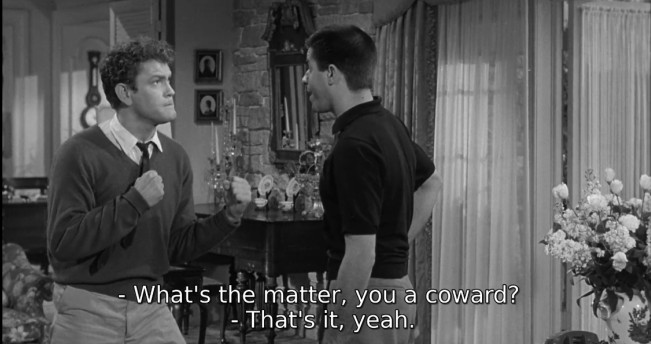 Visit to a Small Planet (1960): "Maybe a science fiction theme will make dorky Jerry Lewis comedy more bearable," I thought. Oh, what an innocent fool was I! It's bad. I remember some alien/beatnik interactions that were kinda funny. Oh, and the moment in the nearby screenshot had a great Jerry Lewis delivery.
- The Secret Life of Walter Mitty (1947): This film does not have the courage of its convictions. After a few fun fantasy sequences a la the original source material, Walter Mitty is quickly thrown into a world of real thrills and excitement and excuses for Danny Kaye patter songs. At that point it turns into a fish-out-of-water scenario, like North by Northwest or something. When Walter Mitty is about a fish who wishes he was out of water and never will be. James Thurber hated this movie, but presumably not enough to tear up his big check from Samuel Goldwyn. I merely found it a bit dull, and got no check from Goldwyn whatsoever.
OK, now for the movies I saw this month:
- Before Sunset (2004) and Before Midnight (2013): Excellent continuation and conclusion to the trilogy. The naturalistic, conversational style continues. Before Sunset perfectly captures the long lingering when you really need to go, but you're with the one you want to be with. Good stuff.
- Luv (1967): The Elaine May/Jack Lemmon/Peter Falk collaboration we needed to heal our nation. Pretty sure nothing bad happened after 1967, but there's still time. From the period when Broadway plays were routinely turned into movies, this has very heavy "play" marks on it and it's not exactly a great comedy, but we were in the mood for dark madcap humor and this delivered.
The neurotic late-60s Neil Simon-ness of the characters in this movie brought to mind the elevator scene from Sweet Charity (1969). That scene is a lot funnier than anything in Luv, but it was nice to be reminded of it.
- The Philadelphia Story (1940): Can you be more specific? I thought I was going to see Rocky. I'm going to go against the moviegoer grain here and say this was just okay. So much sitcom-style misunderstanding! Admittedly this movie predates sitcoms, but at this point I'm tired of it. Just communicate, people! I'm pretty sure I fell asleep for about 10 minutes and missed nothing.
Yeah, good thing Film Roundup isn't one of the inputs into the Rotten Tomatoes aggregator, or this review would spoil its 100% rating and I'd have the hardcore Storyheads coming after me.
- Scrooged (1988): I finally understand why people my age claim Die Hard (1988) as a Christmas movie; because otherwise they'd have to watch Scrooged every year. A decent concept with great practical effects becomes disappointingly random due to countless script rewrites, self-indulgence, and Bill Murray's insistence on improvising important bits. Sure, that speech at the end is an impressive feat, but we have large language models now, so the burden of rattling off vague sentiments can now be lifted from humanity's shoulders. Elaine May had an uncredited writing pass on this movie; they should had just filmed whatever she wrote.
- The Boy and the Heron (2023): This may be the most controversial sentiment I've shared on Film Roundup, but this movie is not good. It's the kind of thing you make when you're so famous and important that you bypass an agonizing but essential part of the creative process: having someone else look at your draft and tell you that there's really good stuff in here but it's too big and sloppy, and you need to figure out what story you want to tell and focus on that.
The good movie inside this one is something self-critical with evil Totoroid parakeets, something about the juggernaut Miyazaki has created, the immortal images in his films and the limits of art's ability to change the world. But that new idea doesn't show up for a long time and it's in there with so much more typical stuff, that I wasn't feeling it at all.
There's the very slight chance that this is awesome in Japanese and a bum translation screwed everything up, but reviews of this movie sound like people trying to convince themselves that a bad movie is good.
- Our Hospitality (1923): This (now public domain!) film apparently invented the idea of clogging up a hilarious short with a bunch of dramatic plot elements to pad it out to feature length. Yes, Buster Keaton's innovations have always been a double-edged sword. The stunts are great as always, and the parts where Buster's running in and out of the house like a deadly game of freezetag are quite funny, so overall I do recommend this one. I mean, the "padding" takes it to 73 minutes, it's not that bad.
- Cup of Cheer (2020): This film is a mess. But we enjoyed finally seeing a Christmas romance parody that swings for the hard R rating, especially given its Zucker and Zucker-like insistence on playing everything straight. But it's a mess. It feels like much of the screenplay was improvised and typed up without polishing. Really funny moments sit side-by-side with obvious clunkers and entire subplots that aren't funny and don't add anything.
If you read IMDB reviews you'll see the movie's natural audience have been turned off by all the swearing and filthy dialogue, and you'd think this would drag down its rating beyond what it should be, but a 5.5 is exactly what Cup of Cheer deserves.
- Oppenheimer (2023): I was engaged for three hours despite already knowing the story, so objectively speaking I have to count this movie as a success. Creatively, the most interesting part for me was the junction between the second and third acts, right after the Trinity test. Oppenheimer sees his world-historical importance slipping out of his fingers, never to return, until he's just a schmoe like the rest of us. The key scene IMO was the one where the A-bombs are loaded into trucks and the trucks drive out of Los Alamos and the camera doesn't follow them.
This month, Television Spotlight focuses on Taskmaster, a show that combines the collegiality of British panel shows with the sadism of Japanese game shows. We're slowly going through the show, we're on series 9 or something, occasionally re-meeting someone we recognize from the small and incestuous world of British comedy. You were in Footlights, eh? Interesting, interesting.
We've also started going through the international spinoffs, notably Kongen Befaler, the Norwegian edition. Kongen Befaler contestants are all notably more handy than their British counterparts, possibly because Norway has universal compulsory military service. Update: This is not true, I misread an ambiguous document. Only about 10% of Norwegians actually undergo military training. However, according to Norwegian Wikipedia, Calle Hellevang-Larsen, one of the handier participants, is "a trained marine telegrapher from the Norwegian Navy."
film
Mon Dec 04 2023 08:36 November Film Roundup:
It's been one of those months where the Roundup is scrambling to catch up with the Films, so let's make this quick before I watch another movie!
- Miss Congeniality (2000): 2000? Seriously? I would have guessed earlier. I forgot to mention this one, which I watched with my uncle Leonard last month. I never thought of this before but Sandra Bullock is one of those actors who seems to choose roles with an eye towards living cool Hollywood fantasies. She's an astronaut, a hacker, she gets to drive a bus real fast... In this movie, she gets to fire a gun and undergo the Mousy Girl Makeover, all while complaining about beauty standards.
Have you, Film Roundup reader, watched a movie before? You will be able to see who the villain is pretty quickly. Tragically, not a skill they teach at Quantico. An enjoyable flick.
- You've Got Mail (1998): We've seen enough Nora Ephron screenplays now that her go-to tactics are becoming visible. In my review of 1993's Sleepless in Seattle I projected that movies' technologically mediated rom-com world into the future, where mobile apps flash thousands of faces at you until they find the one that triggers the "love at first sight" rom-com spark. You've Got Mail can be seen as the groundbreaking experiment that disproves this model of the rom-com spark.
With the introduction of dial-up online services into the rom-com-verse, You've Got Mail presents two characters who fell in love online but dislike each other IRL. They encounter each other several times without triggering the spark or showing any awareness of it. This, Ephron concludes, is because the spark requires a connection to be made between personalities, not persons. The masks we wear in public make our true selves invisible to each other, and it's only in AOL chat rooms that we can truly be known.
Oh, something about the movie itself? It was fun, but a better ending would have had Kathleen falling out with Joe, then founding amazon.com to destroy his stippled brick-and-mortar empire.
- That Thing You Do! (1996): Like the previous movie, this is part of our traditional celebration of Hanksgiving, and we watch it every November 2023. I remember seeing the end of this movie on a VCR stand in high school, which spoiled the ending, but maybe that's a good thing. My viewing partner (Lady S— of G— Manor) was afraid the whole time that this was a movie where the evil record industry guy screws over the up-and-coming band. I tried to reassure her, but to no effect. Anyway, a fun way to bathe in someone else's nostalgia, if you go in knowing there's no real villain.
In the closing credits they play some of the hundreds of songs called "That Thing You Do" that were submitted for consideration as the fictional band's hit song. Possibly the largest number of songs ever written with the same title. At the time, I remember hearing that They Might Be Giants was one of the auditioners, and thinking that this represented a rather forlorn hope due to TMBG's rather distinctive style.
I assumed that sometime between 1996 and now, this song had made it onto some compilation album that I'd missed, but looking it up just now I see that that is not the case! Maybe because they signed over the rights when they submitted the song or something. It lingered unheard until 2021, when the TMBG "That Thing You Do" was leaked onto YouTube. I've heard it now and... they tried, but Tom Hanks (who surely made this decision personally) was right to go with Adam Schlesinger's version.
- Eat Drink Man Woman (1994): A fun movie, an early entry in the "multiple rom-coms going at once" subgenre that I saw later in Love In Space. The scenes in the big restaurant kitchen blew me away, especially that first long shot, which felt like a scene from a thriller. There was even some classic DOS laptop gaming action and Microsoft Paint 3.1. I must deduct a fraction of a point for not originating the "Sir, this is a Wendy's" joke. Harsh, I know, but those are the rules. Of course, it cancels out, since all movies ever made suffer the same penalty.
- A Global Affair (1964): Did you know that Bob Hope was a data scientist responsible for drafting the United Nations Convention on the Rights of the Child? Or at least, his character in this movie was, and we all know there's no real daylight between Bob Hope and the character he plays in his movies. In this one he's pushed into caring for an abandoned baby who's... the Messiah? The Antichrist? I dunno, the postwar internationalism of this movie forms a real Rorschach test when placed in a modern political context.
The marketing for this gender swap of The Lady Is Willing (not to mention the name of the movie) presents Bob as lecherous and vaguely Jack Nicholson-ish as delegations of ladies make eyes at him. But the actual movie, like all 1960s sex movies, shows him as nothing but put-upon and upset by the attentions of these international dames. They're seriously interfering with his golf game and his regression analysis!
In general I'm detecting an awkward changing of the guard in the 1960s, as Danny Kaye and Bob Hope hang on to roles that should have gone to Jerry Lewis and Jack Lemmon. At least Cary Grant had the good sense not to be in Man's Favorite Sport?. Hope is sixty years old in this movie, and he looks great for sixty, but by this time definitely seems more the "confirmed" kind of bachelor than the "swinging" kind.
PS: This movie's full of random UN factoids, some of which still apply. I didn't know that the UN headquarters is an extraterritorial exclave and not part of the United States or any other country. I'm pretty sure it's just that and Antarctica.
- Polite Society (2023): Loved this movie in a very particular way: this is the closest I've seen to a movie that captures the cinema-junkie fun of the Cornetto Trilogy movies. It starts out a slice-of-life movie full of references to genre movies, and then weird things start happening and it turns out to be a real live genre movie. Lots of fun. Sumana and I were also reminded of Sorry to Bother You (2018) in the specific way this one escalates.
- The Talk of the Town (1942): The kind of title you only use when you're desperate. They came up with twelve possible titles for this movie, and most of them were generic and dull, with The Talk of the Town being the dullest of all. The worst part is that The Talk of the Town was registered to Universal at the time, and Columbia had to trade away Sin Town (a better title!) to use it. So presumably this movie was originally going to be called The Talk of the Town.
This raises so many questions, some of which might be answered in my review of the bizarrely-named Upstream (1927), which lifts the curtain on a lost world of preregistered movie titles. But one question we may never see the answer to is: did Universal say "Send us whatever title you want, but it has to have 'Town' in the name. We're doing a picture about a town, by gum, and we can't lose that! Sin Town? Sure, we'll throw some sin in there."?
The movie itself certainly isn't dull, although it is somewhat dilg. Yes, my favorite pastime as the drama unfurled was making jokes about a character's unusual name. "Wow, Cary Grant is a real DILG." "He likes his borscht with a lot of dilg." "His favorite Babylon 5 alien species is the Dilgar." Sorry, I just had to get my dilgs in. Dilg is a very uncommon name but not unheard of: for example, Peter Dilg of Long Island "has one of the largest private collections in the country of windup phonographs and gramophones."
Anyway, the movie's fine. The best parts are Grant and Ronald Colman going at it like Socrates and Thrasymachus.
- Miss Grant Takes Richmond (1949): We really enjoyed this Lucille Ball YIMBY comedy. I wasn't really expecting to, because my preexisting opinion about Lucille Ball was that she was a really good producer but her comedy hasn't aged well. After watching this movie, I think she's fine, and what hasn't aged well is the sitcom format.
See, in Miss Grant Takes Richmond, Ball's character is a clumsy ditz who gets in over her head, sort of like her character in I Love Lucy. If this was a sitcom, "clumsy ditz" would be the extent of her character development. Since this is a movie, we get to see her discover that being a clumsy ditz doesn't preclude you being really good at other things, like customer service and managing real estate developments. It's a more satisfying ending. Also, there's some great slapstick in this film which I don't think would have been allowed on television at the time.
- Godzilla Minus One (2023): This is very good, one of the best Godzilla movies, not least because of its refusal to zoom out from its focus on a few people who are having very bad days. Godzilla only shows up four times! This decision frustrated me while I was watching the movie, since I liked the grand (if incompetent) sweep of 2016's Shin Godzilla. But in retrospect it keeps the stakes at human scale in a movie about a very big thing (Godzilla).
This focus on the individual does mean the movie tips into cornball melodrama at a couple points, but maybe it's just a matter of degree. Maybe some people don't like seeing any level of human emotion in the hapless people who flee from Godzilla by running away in the same direction he's walking in, without really considering the possibilities of alleyways or crossstreets. (Not saying those are guaranteed safe, but give it a try, folks!) Maybe those people are at a 1, and people who really loved all the corny personal drama in this movie are at a 10, and I'm, let's say, at an 8.
Overall, I have to say I left the theater totally mystified and overwhelmed by Godzilla's invincibility.
film
Thu Nov 02 2023 16:09 October Film Roundup:
- His Excellency (1952): This film seems a bit spiteful with its "fine, YOU run the colonies, ya lousy working class" attitude. It's also not very funny. An Ealing disappointment.
- The Admirable Crichton (1957): Another class-conscious comedy of manners, less realistic but funnier than His Excellency. There's an act break in this movie where British people decide to upend class conventions because the alternative is certain death, and I gotta say, that act break is doing a lot of work.
- When Harry Met Sally (1989): Sumana and I both loved this canonical rom-com, from the serially foiled meet-cutes to the heartwarming ending. Carrie Fisher is a hoot in a supporting role and really sells her comedy; she does something tiny like dog-ear a corner of an index card and I crack up.
- Contact (1997): This is a good movie but I thought it was way too slow. Robert Zemeckis probably would have paced it a little faster if the very famous and beloved screenwriters hadn't been so heavily involved. As it is, it ends up at two-and-a-half hours. Who has time for that? Movies should be 90 minutes long!
I dunno, it's probably fine. The early scenes in Arecibo and at the VLA are the ones that could most easily be cut, and those were quite fun. Lots of driving up in Jeeps like this is Jurassic Park. Contact also really shoved in my face how heavily Hollywood movies use old family photos as a narrative device. I knew about this before, of course, but now I can't let it pass by. My mind always fixes on it. However, I've watched a grand total of two movies since then, so maybe it'll fade.
- The Super Mario Bros. Movie (2023): I watched this on an airplane, which is realistically the only way I was gonna see it, but the tiny screen foiled the main reason I wanted to see this movie, which was to catch all the little background references. But after skimming a few "We Found Every Easter Egg In The Super Mario Bros. Movie And Put A Bunch of Ads On The Page" websites, I don't think I missed very much. I did like the Mario Kart 64 speedrunning reference and the doomer Luma.
Unfortunately this movie has a running time of 92 minutes, which is way too short for on a boring plane ride, so I also watched...
- Indiana Jones and the Dial of Destiny (2023): Yes, two and a half hours of nonsensical action. The perfect length for a movie. The opening set piece was great. The artifact was great. Evil Werner von Braun was great...ly evil. The ending was great. Not the very end, that sucked, but the ending Indy thought he was getting before the final fake-out. In between: nonsensical action as the miles slipped away beneath my feet.
film
Mon Oct 02 2023 13:18 September Film Roundup:
A few years ago I praised a company I have little positive to say about, Amazon, for keeping alive the tradition of video rental in a video-on-demand world. The medium of film has an enormous midlist and backlist that is culturally important but apparently has has no economic value. The video store used to be the cineaste's low-cost ticket to this endless backlog. Now I'm here to praise another company I have little positive to say about, Fox, for upping the ante by acquiring
Tubi.
Tubi has monetized thousands of classic films by giving them the cable TV treatment. Occasional commercials for DoorDash will interrupt your viewing of that 1971 sex comedy, but you can watch a ton of obscure and sometimes good! movies whenever you want, without doing something tacky like resorting to piracy or spending money. I think just about everything we saw this month, we saw on Tubi. Big recommendation if it's available in your area.
- Moulin Rouge! (2001): If you were 15 years too young for Phantom, your ride has arrived. After watching it I said "I bet Rachel loved that one." One text later, here's Rachel's review: "I was obsessed with that film when it came out. It's the same old story though (La Boheme, Rent)." Nailed it!
I liked the fast-paced bits and thought the rest was boring. But apparently moviegoers in 2001 just weren't ready for a feature film cut like a music video, and there was some Rite of Spring-like unrest at the Cannes premiere.
When Nicole Kidman gave her first tiny cough, Sumana and I just looked at each other. Nothing needed to be said; this chick is doomed! Susanna (who also saw the movie recently) said she had to explain that to her kids.
While I'm here... the quote from "Smells Like Teen Spirit" in this movie reminded me that when I was in college I saw "Here we are now, entertain us," verbatim, in a book from the 1960s about hosting parties, which I bought from Goodwill. (Ie. "Your guests will arrive and immediately expect your attention, with an attitude of 'here we are now, entertain us.'") I've never been able to find that quote or that book again; it's not the kind of book that gets held in university libraries, which is how old books get into Hathi Trust or Google Books. But I remember it jumping out at me, and I've always wondered if it was independent invention, or if Kurt Cobain also saw that book and swiped the line, the way he took the title of the song from the graffiti Kathleen Hanna wrote on his bedroom wall.
- Phfft! (1954): Even Dreamworks Entertainment wouldn't dare name a movie after a fart noise today, but Columbia Pictures boldly went forward into the Flatulent Fifties. (A well-known nickname for the decade, which is now forgotten, but likely to be revived in a mere 27 years!) Jack Lemmon and Judy Holliday were pretty fun as the temporarily divorced couple, but Kim Novak really stole the show with her horny weirdo character. This movie also features a timely warning about dames:

- It Should Happen To You (1954): Judy Holliday and Jack Lemmon... together at first! In the story of a woman who just wants a totally random thing and won't take no for an answer. This was the highlight of the month, because of its oddball premise and the chemistry between the leads, which is stronger than it would be in Phfft! since they're not playing divorced. Judy Holliday is a powerhouse and it's a huge loss that she died so young.
In retrospect it is not surprising that the part of Gladys Glover was originally written for Danny Kaye. Gladys is way more stubborn than your average 1950s female lead would be. The traditional "taming of the shrew" section, where the ambitious woman learns to get with the program and settle down, is completely earned for once, because Gladys's ambitions are goofy and she has realized them, far past the point where they brought her any happiness.
It Should Happen To You includes one of the best negotiation scenes I've seen in a movie:
"Now, what I had in mind was this: that we share the sign. Then we'd all be happy."
"I'm happy now!"
Gotta remember that one.
- Who's Minding The Mint? (1967): Stupid, stupid movie with the '60s look I love. I can't get enough of these beautifully shot, not-that-funny comedies, and they all seem to star Jim Hutton; he was also in The Horizontal Lieutenant (1962). One good thing I'll say about this movie is: it starts off showing Hutton's character committing borderline fraud by exploiting free trials of luxury goods (presumably a new innovation at the time), but this is portrayed as a harmless, lighthearted it-sticking to the man. Rather than the minor character flaw that pulls him, over the course of this movie, deeper and deeper into a very serious federal crime.
Perfect riff no one will get: "This was the original Dogecoin rugpull." Wait, I can link to the movie on Tubi! Perfect riff is at 1:07:20. You might have to endure a DoorDash ad.
- Man's Favorite Sport? (1964): I've seen sly in-jokes in Rock Hudson movies about the star's homosexuality, but this just seems cruel. In Man's Favorite Sport? Hudson plays a famous fisherman, a respected author of fishing books and model for anglers everywhere, a guy whose claim to fame is his ability to reel 'em in like nobody's business... but he's never been fishing and he hates fish! Of course, the part was originally written for Cary Grant, so I might be reading too much into this.
Oh, yeah, another problem: the part was originally written for Cary Grant, but it's 1964. Howard Hawks wanted to do a follow-up to Bringing Up Baby, his prior animal-themed screwball comedy. But that was twenty-five years earlier! By 1964 everyone was too old and didn't want to do it and it would have made no sense, so Howard Hawks got Rock Hudson to do a Cary Grant impression (it's terrible) and cast Paula Prentiss in the Katharine Hepburn role (she's all right).
Although this is funnier and much more sophisticated than Who's Minding The Mint?, it's is ultimately another 1960s sex-comedy train wreck with amazing Midcentury Modern set design. Rated F for some cruelty to stunt fish.
- The Blind Man Who Did Not Want To See Titanic (2021): In a rare occurrence for me, I watched this movie without knowing the genre, and was pleasantly surprised when what seemed like a slow slice-of-life thing became something very different. (I won't go into specifics; read a review if you want.) Showcases Leonard's golden rule of garnering audience sympathy: you know what your audience is doing right now (watching a movie), so get on their side with a character who also likes doing that. This is why everybody sympathizes with Myrus in Situation Normal, BTW: he loves reading speculative fiction.
- It's Trad, Dad! (1962): a.k.a. Ring-A-Ding Rhythm, but who can resist the idea of reactionaries revolting against something called "trad"? A remarkable document of American soft power immediately before the Beatles counterattacked. These Brit kids are totally obsessed with jazz and American pop culture. Why? Don't make me tap the sign. [Sign says: IT'S TRAD, DAD!]
The film is a series of skits interrupted by musical numbers, like SNL with more music, but the skits are mostly fun and the music's all right. A lightweight but entertaining debut for... the guy who'd be directing A Hard Day's Night two years later. Sometimes you wonder "whatever happened to them?", and sometimes the answer is obvious.
I should mention we came to this movie via its star Helen Shapiro; we heard her singing a song on Heardle Decades and really liked her voice. She was so big, the Beatles opened for her! Now that's trad, dad!
- The Lady Is Willing (1942): I have to think this is a misleadingly saucy title for a movie designed to juice ticket sales. The movie poster has a random baby (BABY COREY) on it, and we all know that babies mean sex—if only in a flashback.
Unfortunately, Marlene Dietrich isn't the right actress for this part—it's more a Judy Holliday sort of ditz part—and the screenplay's not that funny anyway. Its romantic view of how the maternal instinct leads to hilarious kidnapping and tender child endangerment hasn't aged well. Admittedly that makes this movie sound like Raising Arizona, which would have been a pretty cool picture show in 1942, but that wasn't what they were going for.
Fred MacMurray is all right as the Vulcan-like pediatrician who hates kids... until he comes into close proximity to BABY COREY! Who could have guessed?
Finally, a Television Spotlight from another online streaming service; specifically, Freevee and its Emmy-nominated original series Jury Duty. I started out a reluctant watcher, but was ultimately charmed by the way Ronald, the patsy in this hyper-orchestrated reality show, keeps showing compassion and decency even as he's confronted by one weird reality show twist after another. If not for that anchoring, I would definitely have dropped out. I also appreciated how the last episode is basically a behind-the-scenes documentary.
film
Mon Sep 04 2023 11:04 August Film Roundup:
- 3 Nuts in Search of a Bolt (1964): The traditional film seen a while ago that I forgot to round up until Sumana reminded me. A low-budget sex comedy with a brilliant premise (illicit timesharing of an expensive psychiatrist), some Mamie Van Doren jiggle, and maybe three funny jokes. The sort of film you'd see on an R-rated MST3K.
The "three funny jokes" thing makes me think there's a lot of these old movies that could be edited down to the length of a TikTok video. It'd be the film school equivalent of those one-page summaries of business books so you don't have to read the book. "But Leonard," you might say, "that only works because those business books only have about one page of real content in the first place. It has to be padded into book form because that's how such insights are sold in modern society." To you I say: I have some bad news about movies.
- Winny (2023): A decent biopic of a piece of software which IMO lionizes developers too much. Maybe that's a side effect of the dramatization because the issues are complex, but if any nation's film industry can make "This approach to law enforcement would criminalize basic research!" exciting, it would be Japan's. Rise to the challenge, I say.
- Free Guy (2021): I saw this movie and it was pretty fun but I really don't have much to say about it because I already said it all in "Dana no Chousen".
Early in the story, Guy obtains an extra pair of magic sunglasses, but nothing comes of it and it never gets used. Most scholars see this as evidence of editorial fatigue on the part of the redactor as they excised a scene from the film—itself a copy of a parable from the Carpenter Scrolls—in which Buddy gets his own pair of sunglasses.
- Barbie (2023): Very clever and fun. Everything from the actors' body language to the random and inexplicable plot twists indicate that the director is playing with the Barbie franchise the way a child plays with an individual Barbie doll. The normal Hollywood movie beats happen, but the film's so chaotic that an act break acts as a kind of refresher, like the quiet catch-your-breath scene following a chase in an action movie. I do not usually laugh out loud (or LOL, as the handy abbreviation puts it) while watching movies, but Barbie got me several times.
- The Band's Visit (2007): Although I scoff at the traditional Hollywood three-act structure (and just did) I do prefer movies with a through-line. I rarely enjoy the type of film that presents a series of disconnected, nearly stochastic skits, but this one was really fun. I think the unity of time on display gives it a sort of through-line, and the decision to focus on just a couple of the many quirky characters stops it from getting scattershot the way Muppet movies are these days. This was made into a stage musical, but I think the amount of music here is just right: the bulky instruments are basically just big inconvenient pieces of luggage until the final scene.
- Kittu Puttu (1977): DNF, as they say. This was on a DVD Sumana brought back from India and we could not find English subtitles for it anywhere, so Sumana tried translating the dialogue for a while, but it wasn't very rewarding so we gave up. Supposedly there's a split-screen dual role later on, which could provide some gags, or at least cheesy low-budget fun.
- Starman (1984): John Carpenter tries to deliver a heartwarming rom-com, and only reveals the horror movie at the heart of every rom-com. It's like a pre-deconstruction of the Hallmark Channel genre, where the new lover and the creepy stalker and the dead husband are all the same guy.
I'm always here for a Carl Sagan pastiche and SF that uses the Voyager record as a plot element. And I suspect Jeff Bridges' performance here (for which he got a Best Actor nomination) was an inspiration for Brent Spiner's portrayal of Data. Would I recommend this movie? I dunno, but I always like whenever Carpenter tries something different.
- Impromptu (1991): I reluctantly agreed to watch this Masterpiece Theatre-ass movie because Sumana remembered seeing it on Masterpiece Theatre in 1993 and enjoyed it. Thirty years later, I have enjoyed it too! It's really funny! Hugh Grant is funny and frail; Judy Davis is funny and brassy. I must say that this film has one of the clearest examples I've seen of the old adage that the difference between a happy ending and a sad ending is when you stop telling the story.
- Badhaai Do (2022): A misleadingly humorous poster led us to expect a more comedic rom-com than we got, but this was all right, I thought. Rajkummar Rao continues his trend of being one of this household's favorite actors, partly because of his insistence on only taking non-generic roles.
- The Celluloid Closet (1996): Sumana saw that this was leaving Tubi and I suggested that we watch it for one reason only: so I could confirm my hypothesis that Algie the Miner (1912) is included in the movie but not the book the movie is based on. Well, it is, and looking at that old post it looks like I'd already confirmed this hypothesis. But, a good overview of (among other things) the changing techniques used to circumvent the Hays Code and the effects those circumlocutions had on people for whom they were the only source of representation seen in movies. Sumana pointed that most of the Hays censorship involved approval of scripts, so once the script was approved, there was all sorts of nonverbal stuff you could do when filming the script to get your point across.
Gore Vidal and Susan Sarandon are a hoot, and Tom Hanks is refreshingly frank about the source of his success: "I have never been one to strike fear into anyone's hearts when I enter the room." Tell that to Sony CEO Howard Stringer, Tom.
Finally, it's a Television Spotlight on Guns & Gulaabs (2023), a crime comedy that recreates the nostalgic (for Sumana) atmosphere of India of the 90s. Which is not that different from rural California in the 80s, so I got a bit of the bittersweet air as well. Gulshan Devaiah is so sinister as the bemulleted jean-jacket assassin in this, that it was a pleasant surprise when we saw him later in the month, pursuing Rajkummar Rao once again as the goofy gay lawyer in Badhaii Do.
The series was a lot of fun and led up to a cool heist, but I don't know about calling it a comedy. Breaking Bad (clearly a big influence) has a lot of similar humor to it, but nobody tags that show as "comedy." A lot of what I think was meant to read as comedy here was actually people making stupid choices, which I don't find all that funny. You can try and make it funny to lampshade a weak plot point, but that's not what was happening here.
film
Tue Aug 01 2023 00:23 July Film Roundup:
Sumana was out for most of the month, so it was back to my usual tricks of watching obscure crime films from the 1960s and 1970s.
-
The Moonshine War (1970): Hollywood studios in 1970 know that audiences crave antiheroes! I like a good antihero but I did not like this at all, possibly because it pitted antihero against antihero. Who do you root for at that point?
- There Was A Crooked Man... (1970): Hollywood studios in 1970 know that audiences crave Midcentury Medieval! Also, antiheroes. I am closing in on Bonnie and Clyde (1967) from both directions and it does seem to be the watershed people say it was. (Haven't seen it yet.) This, by contrast, was an okay Western that is front-loaded with its best scene by far. Just watch the first scene, I'd say. It also has the earliest sympathetic portrayal of a gay couple I've seen, so you could watch it for that. Oh, there's a food fight, too, but it's too cynical to feel fun.
This film was filmed inside a national park and involved the very careful creation and demolition of one of the biggest location sets ever to avoid ecological impact. Was it really worth it?
- Asteroid City (2023): If you go to see a Wes Anderson movie in the theater and you don't sit in the middle seat, I don't even know why you're going. Everyone else in the theater with me disagreed, which gave me an unobstructed view of all those neatly organized tool racks and tidy diner menuboards. Basically, this was a fun series of sketches with gorgeous typography.
Asteroid City is also the rare comedy that dares to drive all of the characters crazy during the movie. (cf. Down By Law) The driving-everyone-crazy is obviously inspired by the real-world experience of the pandemic, but I'll take it. However, now that I'm writing the review, a negative aspect of the film is coming back to me, which is that this sucker is layered under so many layers of metafiction and lampshading that it feels like a defense mechanism. Is there a serious point here? Should I be feeling some kind of way or are we just having fun with a live-action Road Runner cartoon? Is this secretly Birdman?
- The French Dispatch (2021): Yes, I came out of Asteroid City and needed more Wes Anderson, I'm not ashamed to admit it. This held together a lot better than Asteroid City, possibly because the sketches were well-defined by the framing device. Recommended.
- After the Fox (1966): I came for the Peter Sellers heist, I stayed for the film industry parody, but I didn't enjoy either one a whole lot, so I don't recommend you come for either. The Neil Simon screenplay has some great gags, including the final shot, but there's so much stuff in between the gags that I think this one is best left in the vault. So instead of going into detail I'll highlight two of the less famous actors:
First, I was really struck by how much Victor Mature's role in this movie reminded me of that ingratiating fidgety character Martin Short is always doing. I don't know what part of this is intentional but it feels like there's something there. Second, I want to put a word in for Martin Balsam, a "that guy" character actor I first saw in the MST3K Mitchell episode. I've seen him in a couple other things since and he's always solid. I think this is the first comedic role I've seen him in and he does a good job as the one reasonable guy in an insane situation. In our house we call this the Mikey Day role, after all the SNL sketches where Mikey Day is the straight man who spends the whole sketch saying "What is happening?" in an ever more exasperated tone.
- How to Steal a Million (1966): 1966 was just a year for mediocre heist movies. Audrey Hepburn and Peter O'Toole wanted one too, and they got this one. The best thing I'll say about this one is that the basic premise—hiring a fake art thief to steal a fake statue to avoid an insurance examination—is nice and twisted; even Coen-ish, if the Coens were in a playful mood.
- What's So Bad About Feeling Good? (1968): Taken in the cinematic context of the time, this is old Hollywood desperately trying to win the youth back over by saying that beatniks aren't cool, cutting your hair and getting married is cool. But the youth have already seen Bonnie and Clyde and there's no going back. Nothing special. However, taken in the context of our time, this is a mind-blowing comedy about the incompetent government response to an epidemic.
OK, call it whatever you want. Beat by beat, the plot reveals one echo after another, including some now-sinister moments as America's cutie-pie Mary Tyler Moore does her best to infect everyone in New York City with the virus by sabotaging masks and encouraging large gatherings. If I had to explain the existence of this movie I'd point out that both of the screenwriters probably had childhood memories of living in large cities during the 1918 flu pandemic.
Characters who are obvious parodies of J. Edgar Hoover aren't uncommon in movies from this period; Dom Deluise has his J. Gardner Monroe in this film, but there's also Sheldon Leonard in The Brinks Job, who plays a laughable buffoon named "J. Edgar Hoover." Mayor John Lindsay, now largely forgotten, is the reason so many movies of the period are filmed in New York, and his feeding hand gets bitten by a (from our perspective) disproportionate number of filmmakers. But What's So Bad About Feeling Good? dares to take on the true power broker, depicting a virus-infected Robert Moses pastiche and his proposal to tear down the New York Stock Exchange and replace it with a playground.
The trained toucan in this movie was cute and had good comic timing. And finally, I have to say the movie has a point. There was a lot of bullshit in the 1960s counterculture, and although What's So Bad About Feeling Good? is soaked in the same cultural cesspit and not equipped to make an effective critique, it does at least notice the problem.
- The Duchess and the Dirtwater Fox (1976): I don't usually have this problem but I couldn't see George Segal as a womanizing card sharp in Gold Rush California. I kept seeing him as his laid-off aerospace exec character from Fun with Dick and Jane (1977), giving this movie the appearance of a surreal midlife crisis. That said, this was a decent Western/rom-com, a mix of genres that would never be greenlit as a movie today but makes perfect sense in the experimental 70s. Not great, but I don't watch movies no one remembers looking for "great." (It's fun when it happens, though.)
Goldie Hawn is fun in this and I'm starting to get the feeling that she should have gotten more quality comedic roles than she did. I also wanted to note that this movie resurrects a Western stereotype last seen in Wagon Master (1950), by portraying Mormons as stern, disapproving Puritans who really love music. There's also a Jewish wedding in this movie. Not a movie that ignores the presence of religious minorities in the Old West, is what I'm saying.
- Boeing Boeing (1965): Not a crime movie, unless sexism be a crime. I've seen movies that never get better than their first scene, but the best part of Boeing Boeing is the title. Most of the movie is a static shot of a room with people running in and out of the doors... wait a minute... yes, this was based on a play. And not a good play. Pretty dull all around. To say some good things: Thelma Ritter's all right, and Jerry Lewis is bearable (a noteworthy occasion around these Film Roundup parts). And the idea of someone's philandering plans being thrown off by advances in aviation technology is at least theoretically funny.
I'll leave you with an animation I made from What's So Bad About Feeling Good?. I like to think this shot is an homage to one of my favorite film shots of all time: Brigitte Helm as the robot winking at the camera in Metropolis.
See you next time...
film
Wed Jul 05 2023 13:00 June Film Roundup:
- Mr. and Mrs. Smith (2005): Sumana reminded me that we saw this a long time ago and I didn't Round it Up, so it gets pride of place in this month's edition. This film has a great premise—I'd say almost timeless. The only restriction is whether the censorship regime allows it. You might be able to get away with it in 1925, and you could definitely do it in 1975—it's not that much different from Fun with Dick and Jane (1977). But this story would have made a better film in 1975 than in 2005. It could work in 2005 but only if it had a much smaller budget, just enough to pay its pretty leads.
Basically my issue is that the bigger this film gets, the more it becomes like a generic action flick and less like a darkly comedic rom-com. The fight scene where the Smiths are destroying their yuppie house while trying to kill each other is about the level of slapstick violence I was hoping for.
- Rope (1948): A filming gimmick lets Hitchcock distract the audience from how gay this movie is, but modern audiences won't be fooled. Making us watch a big chunk of the movie with a coffin blocking the action? Nice try, Hitch, we're not terribly disturbed by that either. Now, if this film starred the Five Nights at Freddy's gang? Jumpscares galore!
I have to say, Jimmy Stewart's character is kind of wishy-washy. He seems totally serious about his Nietzschean philosophy until he's faced with a single, obvious real-world implication, and then he immediately crumbles and starts sounding like the Hays Code. Either he should have just been making over-the-top cocktail-party chatter (in which case his character arc makes sense, and the movie becomes a commentary on Alfred Hitchcock's sense of humor), he should approve of the murder once he learns about it, or he should berate the two murderers for killing another ubermensch instead of one of the lesser specimens of humanity.
- Our Nixon (2013): Soundless home video of the Nixon White House (seized by the Feds during the Watergate investigation) is matched with the videoless recordings of Nixon's secret home taping system, creating that audiovisual brew we call a "movie". I don't know how well the two match up a lot of the time, but there are some stunning just-backstage shots, and I'm always a sucker for "contemporary documentary made from footage that got stuck in a government vault for 40 years"—see Apollo 11 (2019) for more Nixon-era excitement.
- The Preacher's Wife (1996): A fun remake with good songs. I sensed a little bit of The Angel Levine in the way Denzel Washington's angel character is wistful for his pre-death life, and a bit of Wings of Desire in his love for the sensual pleasures of street food. I was struck by how little theodicy you have to do in these lighthearted spiritual movies. Near the beginning, Courtney B. Vance's preacher has a moment of Job-like aggravation at the horrors of the world, and from then we're emotionally on board with an all-powerful God giving light supernatural help as long as He can maintain plausible deniability.
It doesn't really fit with the rest of the movie, but I liked Dudley's angelic handbook that includes information on how to use Windows 95. I can't remember if the handbook was present in the original, but it feels like a palimpsest, offering a glance into either the original movie or an earlier draft of the screenplay.
- Spider-Man: Across the Spider-Verse (2023): The whole time I was thinking "this pacing's a little weird", and then the pacing got very weird and it turns out this is only half a movie. This has happened to me before but it was the Lord of the Rings movies and I knew what I was getting into.
As entertaining as the visual spectacle was, I have to question whether a multiverse based on a character defined as a rebel and an outcast would cohere around the cliche of the fortress run by a Bond villain with tons of obedient henchmen. I hear people make good money (well, bad money) making very long Youtube videos where they complain about this stuff, but you know that's not my style.
It was cool to see some Jeff Koons sculptures get destroyed, a la Constellation Games. Sometimes the family stuff would get boring, and I'd just remind myself that this is a movie for kids. Enjoy it, kids! The nostalgia clock starts now!
- The Great Train Robbery (1978): This film provides value for money by turning the preparations for the heist into a series of mini-heists. You could do a fractal heist story in which every step of the heist preparation requires another, smaller heist, recursively. In fact, that's a good way to enjoy those dull dramas where nothing much happens: you're actually seeing a complex series of nanoheists.
I wouldn't want to live there, but I love the look of the 1970s-studio-film version of Victorian London. (See also The Private Life of Sherlock Holmes.) All that facial hair and crushed velvet. You see it in the indoors scenes in westerns of the period, as well.
- Hobson's Choice (1954): When we were watching Ted Lasso Sumana really hated the character of Rupert. He's an unsympathetic character, you're supposed to dislike him, but Sumana has a visceral and vocal dislike for that kind of sexist, manipulative blowhard. We brainstormed an ending for Ted Lasso in which Rupert dies in the most humiliating, un-masculine way possible: shitting himself to death while straining to open a jar of Marmite. At his funeral, Bex delivers the touching eulogy: "He loosened it for all of us."
Unfortunately(?) that's not how Ted Lasso ended. But Hobson's Choice does fulfill the desire to see that kind of character exposed as a buffoon and humiliated, and it throws in another crowd-pleaser, assuming Sumana is in the crowd: a woman who doesn't care about oppressive societal conventions and either manipulates or ignores them. A fun film overall.
And now, a Television Spotlight brought to you by the letter M:
- The Marvelous Mrs. Maisel: Sometimes a show is cancelled prematurely and has to hustle to tell its story in its final season. Sometimes it gets that other season after all and the true final season is awkward and extraneous, like Babylon 5, or Arrested Development. Sometimes it says "screw it" and spends the final season goofing off, like Star Trek: Enterprise. Mrs. Maisel does a really good job telling two seasons worth of story in one season; making heavy use of flash-forwards, quickly shunting off characters who became too expensive due to their actors starring in a Best Picture winner, and using impressive but cheap-to-film set pieces like a low-budget stage show and a Friar's Club roast. Characters get their arcs completed and Midge completes her transformation into Joan Rivers. It works.
- The Muppets Mayhem: Very much on the kid side of Muppetainment, but with a few deep cut references thrown in for the adults. (Meet the Feebles, of all things, and is that a reference to the instant-classic SNL skit at the end?)
film
Fri Jun 02 2023 12:55 May Film Roundup:
- The Thomas Crown Affair (1968): Like many crime movies of the 1960s, this film starts with a tense, exciting heist executed by characters about which we know nothing. In fact, we barely see any of those characters again. It's great stuff, because the characters we do meet aren't super exciting. Their archetypes are fun—bored playboy versus sultry insurance investigator—and I did have a good time while I was watching the movie, but looking back at the end of the month, it's not more than popcorn. Not even the despair of American noir or the French New Wave crime films are present.
I guess the lesson to take from this movie is that if you're setting up a stochastic crime wave, you won't be able to vet your heist team as fully as you ought to. Food for thought!
- Major League (1989): I was amazed at how similar this film is to Ted Lasso. You might just say, that's how sports movies are, but I've seen at least three sports movies, including sports movies of the "coach teaches players to be better men" variety, and none of them are nearly this close. The setup is the same, the mustache is... pretty similar. Case closed! The inspiration is clear.
This was before rom-coms were quite so woman-focused, so the romance subplot—a vanilla rom-com right down to the decoy boyfriend—fits in with the macho, raunchy comedy of the rest of the movie. Overall, the film is... okay. I've spent a few enjoyable days in Cleveland and it was good to see the city again.
I first encountered Corbin Bernsen as Shawn's dad on Psych so it's fun to encounter him in his leading-man, pre-"main character's dad" phase. He's always got an understated comedic exasperation in the characters he plays.
This is more of a personal connection, but James Gammon in this movie looks and sounds exactly like my uncle Garry did in 1989. Uncanny!
Speaking of which, let's do a Television Spotlight on Ted Lasso, which just concluded. Overall, really solid and funny. It got a little self-indulgent in the third season, but its self-indulgence mostly took the form of long character studies of characters we liked (Rebecca), or at least had grown not to dislike (Jamie).
However there is one big exception: Nate's third season story arc. We spent quite a lot of time with Nate after his heel turn at the end of season two, and if season three was Nate's season, it would have been justified. But all those leisurely studies of other characters created a major pacing problem with Nate's arc, making it drag on until he made an undramatized face turn near the very end of the show. This violates my storytelling motto: show, or tell, but do one or the other, for gosh sakes! We weren't shown this dramatic moment in Nate's life, nor we were told anything about the mental processes that led to a very consequential decision. For a show that enthusiastically wears its emotions on its sleeve, this pulling back felt very strange.
PS: Trent Crimm 4evah. Breakout character of the show. Fun IMDB fact: Crimm actor James Lance also played Richard, Daisy's boyfriend in Spaced, way back when.
And finally, a rarely seen Live Theater Showcase, starring Khan!!! The Musical!. I saw this play twice during May, and really enjoyed the mix of Trek fanservice and deep musical theater cuts which I only get thanks to reading the Playbill recaps of Schmigadoon! that explain all the references. The show is closing this weekend, but we're talking The Wrath of Khan here, so we're likely to see one remake after another over the next few decades as everyone in off-Broadway tries to recapture the original magic.
Probably my favorite gag is the way the actor playing Spock maintains Vulcan posture and body language even while tap-dancing. And the first song is a great Starfleet recruitment pitch. ("Our socialistic, low-key atheistic, both futuristic and anachronistic Starfleeeeet!") It's that kind of show.
film
Mon May 01 2023 21:40 April Film Roundup:
Sumana was out of town for Pycon, so I saw a few films from my "Sumana probably won't like this" queue of movies from the 60s and 70s.
- The Drowning Pool (1975): Paul Newman is an actor I only recently discovered. He did all his big films before I started watching movies, or (in most cases) was born. So, like Marilyn Monroe, I mainly experienced Newman through the medium of a low-fidelity black and white picture of him used in a commercial context. Well, he's lots of fun, charismatic, charming, and he's the second-best thing about The Drowning Pool. The best thing is that the climax of this tense noir thriller is an epic slapstick set piece. The whole time they were setting up the pieces of the set piece I kept thinking "Are they really going with the slapstick? That's so awesome/tonally jarring!" It was as if the flashbacks in The Godfather Part II showed Vito Corleone carefully assembling a giant banana cream pie. Recommended, I guess?
- A Guide For the Married Man (1967): I'm kind of angry at this movie for not having the courage of its Billy Wilder convictions. Ed spends the whole movie teaching Paul how to cheat on his perfect wife Ruth without getting caught. It seems like good, practical advice, I wouldn't know. Ed keeps mentioning how highly he thinks of Ruth, and how cheating discreetly is the best way to protect her feelings.
At the climax of the film, Paul's fumbling, jowly Walter Matthau attempt at infidelity is foiled when Ed is noisily discovered in the motel room across the court, cheating on his own wife with... some blonde. C'mon! He should have been cheating with Ruth! It's so obvious! Do I have to do everything around here?
As you can tell, loosening Hollywood restrictions are on full display in this film. Nowhere is this more visible than the set design. Since this is a bedroom farce, we see a whole lot of bedrooms, and most of them follow the traditional Hays Code rule of separate beds. However, it's now the swinging 60s, and you are apparently allowed to do one scene where two people share a bed without one having one foot firmly on the ground. Sort of like how PG-13 movies today are allowed a single F-bomb. They use a double bed for that scene, as well as for a joke about tearing up a bed looking for something, which prefigures Gene Hackman's paranoid search in The Conversation.
Includes a huge number of celebrity cameos, plus one cameo that wasn't known to be a celebrity at the time: a nearly silent role for Majel Barrett. As a bizarre bonus, all of the celebrities are credited as "Technical Advisers," not their character names, leading to IMDB quotes page entries like this:
Technical Adviser: Joe?
Technical Adviser: Yeah. Hi, baby.
Technical Adviser: Hi, honey.
Technical Adviser: How are the kids?
Technical Adviser: Fine.
- The Prisoner of Second Avenue (1975): When I was watching this it didn't seem nearly as funny as I was expecting, but in retrospect it was pretty funny; just more of a character study and less of the wacky Jack Lemmon farce I was expecting. In fact, if you squint this could be a crime-and-grime sequel to The Apartment (1960).
Did you know that Peter Falk played the lead role when The Prisoner of Second Avenue was nothing but a humble Neil Simon play on Broadway? He couldn't appear in the film because he was busy doing Columbo. Just one of the many interesting facts I learned from David Koenig's behind-the-scenes book Shooting Columbo.
Now, it's time for a Spring Television Spotlight, highlighting interesting episodic serials we've enjoyed over these cold winter months:
- Poker Face (2023-): You know I love Columbo, if only from the paragraph I just wrote. Poker Face is designed to bring back everything good about Columbo, and it delivers: the class warfare, the convoluted coverups, the physical tics and gimmicks, the 70s font, and polite good triumphing over rude evil. Of course, it's 2023 and you can't have this kind of cop show feature an actual cop, so you also get a lead character who isn't even supposed to be solving these mysteries; she's just that nice. This opens up the best innovation of all over the Columbo formula: the retroactive insertion of Charlie into the story via flashback.
See, Lieutenant Columbo doesn't show up until there's been a murder. This makes logical sense and avoids Murder, She Wrote-esque suspicions that he is some kind of murder magnet, but it also means the cat and mouse between him and the villain of the week takes a while to get started. In Poker Face, you see the villain set up and carry off the killing as usual, but then you see the same events from Charlie's perspective; she was there the whole time, conveniently just out of frame, ignorable and ignored. It probably takes the same screen time as the getting-to-know-you phase of a Columbo, but the viewer is pleasantly occupied the whole time, recontextualizing everything they saw up to that point.
Like the original Columbo, this pushes a mystery-lover's intellectual buttons without actually being a mystery at all. Once we discovered that this was part of the formula, Sumana and I started playing the "where is Charlie?" game in the first part of the episodes, trying to find her in the lacunae of the narrative.
If I had to complain, I'd say the season finale really bit off more than it could chew; maybe it was originally longer and it got edited down.
- Hello Tomorrow! (2023-) Beautiful visuals kept us coming back for yet another entry-level story about a con artist who's caught feelings and is now in over his head. Everyone looks great, the acting is good, and Alison Pill brings her trademark insane smile. Recommended, even though you could just watch it with the sound off.
- Star Trek: Picard (2020-2023) Now that it's over, I'm comfortable saying this is the weakest Star Trek series so far. It never had a great season, and it was too arc-driven to have standout episodes. It had a few outstanding ideas, mainly around using the Borg and positronic androids to explore the fuzzy edges of identity in a networked world, but there'd always be some boring Romulans or previously unknown child or Chosen One narrative to bring it down. It was more successful as a character study and a fanservice nostalgia trip.
As a final complaint, I'm annoyed how huge, entirely relevant, interesting things would just get Memory-Alpha-holed between seasons when they switched showrunners. Where's Dr. Jurati in season 3? Really seems like she could help with this problem! I'm not just being an annoying Star Trek nerd: they came up with a really good idea for the Borg in season 2 and then immediately went back to the same-old same-old. Sumana sent me an appropriate meme for this situation. Anyway, the best treatment of the Borg continues to be found in Star Trek: Door Repair Guy.
Actually, let's end this on a positive note. My three favorite breakout characters from Star Trek: Picard: Agnes Jurati, Cristóbal Rios, Liam Shaw. All of them staying true to the Star Trek tradition while also bringing in character traits we haven't seen much of.
film
Tue Apr 04 2023 22:36 March Film Roundup:
- Guarding Tess (1994): Watched this in a previous month and forgot about it. Don't blame me; just as the credits rolled, a guy from New Jersey passed by my window and shouted "Fuhgeddaboudit!" What could I do? It was post-hypnotic suggestion. Anyway, I remember it now. A fun movie with Nicolas Cage trying out a more buttoned-down persona—in fact, excessively buttoned-down in a very intense way. I really think this goes off the deep end into thriller territory in act three, but you can't have this kind of Hollywood movie in 1994 without it either turning into a romance or a thriller, so would I rather it be a romance? You bet I would! A May-December romance between Nicolas Cage and Shirley MacLaine sounds great!
- The 5,000 Fingers of Dr. T (1953): Way too long, and indifferently edited. Great Dr. Seuss props, but the cinematic vision seems to be "build sets for a German Expressionism musical and then shoot non-musical scenes on it". Possibly this is an effect of selection bias, since a lot of songs were filmed and then cut, leaving a still-too-long film that's no longer much of a musical.
There's a really weird thing visible in an early chase scene that later on turns out to be easily explained—it's a prop that's out of continuity. After cutting most of the songs, someone took a long chase scene from the end of the movie and spliced it into the beginning, just to pep up the beginning with some more action. That's the kind of movie this is: scenes don't need to be in any particular order. I didn't like it in The Last Picture Show and I don't like it here.
- Brewster's Millions (1985): Some books get lots of movie adaptations because the books are really famous, like Dracula. Some books have no movie adaptations at all, like Constellation Games. (Call me, Spielberg!) And then there are books like Brewster's Millions, which has been made into thirteen movies and two plays without the book ever being super famous. It's just a great, simple premise for a comedy that transcends time and culture. In fact, one final version of this movie could be made as humanity transitions to a post-scarcity economy. Who am I kidding, post-scarcity just makes this concept more interesting! How can you possibly spend a million dollars when nobody needs money anymore? The comedic premise is immortal!
Miscellaneous notes: this is the kind of movie where characters break out into applause just because someone spent a lot of money. From internal evidence in the screenplay, I believe the John Candy part was originally written for Dan Aykroyd. And see Sumana's blog post on the definition of an asset to get a feel for what it's like when we watch movies.
Finally, my preferred Brewster's Millions strategy would be to buy the rights to works of literature and then put them in the public domain. In fact, I've already done this, with the original Brewster's Millions—you're welcome.
- Dinosaur 13 (2014): A bit of a letdown after watching the director's astounding and similarly-named Apollo 11 (2019). I felt like this film picks the most severely wronged parties in a story featuring bad behavior from everyone, and treats them as uncomplicated heroes. I admire the restraint in not blowing the budget on bad CGI animations of dinosaurs.
One interesting glimpse behind some curtain or other: they interview the guy from Sotheby's who ran the auction for Sue, and he talks a lot about wanting to make sure the skeleton went to a good home, rather than ending up in a private collection. Dude, you're running an auction, the highest bidder is going to get the skeleton, it's pretty simple. What exactly did he do? Negotiate the McDonalds sponsorship to boost the Field Museum's bid? Surreptitiously kick undesirable bidders off of the conference call?
N.b. this is also the kind of movie where people applaud when someone spends a lot of money, though here it happened in real life.
film
Fri Mar 03 2023 17:10 February Film Roundup:
- Love in Space (2011): Gives you more for your money by cutting between four different rom-coms going simultaneously. This was fun, except the astronaut couple are incredibly incompetent in un-astronautish ways, which really took us out of the story. Simple solution: they're not really astronauts! They're wacky space pirates who stole a spacecraft and don't know what they're doing. Problem solved, the movie is fun again.
In related news, I do not believe the Love in Space Wikipedia page that any portion of this movie was shot on the International Space Station. You can see the Hong Kong wire work in the microgravity scenes. But that's one of those assertions like the supposed ARPAnet reference in The Computer Wore Tennis Shoes, easy to make and difficult to dispel.
This is a good time to mention (or rather, there will probably not be a better time to mention) that I've now seen the 1985 episode of Benson ("Scenario") that supposedly has an ARPAnet reference, and it doesn't have one either. There is someone using a computer to communicate with the Department of Defense, which is pretty close, but the ARPAnet isn't mentioned, no IMPs are seen, and they clearly got the whole idea from Wargames.
- Dirty Dancing (1987): You know I love the midcentury Catskills resort lifestyle (in media, probably not in real life), so this was a lot of fun. Very reminiscent of Footloose, with Jerry Orbach excelling in the John Lithgow role. He really switches between "I'm a doctor and I've got to help this patient without being judgemental" and "I'm a dad and I'm going to be very judgemental about my daughter's choices."
film
Wed Feb 01 2023 18:26 January Film Roundup:
- Pathogen (2006): This was entertaining, though I'm grading on a huge curve here since the director was a teenager (she's now a non-teenager horror writer and director). The actors differed dramatically in talent, with some bringing real creepiness to their scenes and others not convincing me that knew the camera was on.
I love a good zombie attack in a store, partly because it serves as an inadvertent document of consumer culture at the time and place the movie was made. There was a scene in Father of the Bride that needlessly took place in a Vons, but I loved the trip back to 1990s California. Could have used some zombies, though. Take note, filmmakers!
- A Funny Thing Happened on the Way to the Forum (1966): You know what's so far removed from our current-day context that it's no longer entertaining? The comedies of Plautus! Their stock characters and farcical scenarios are simple and dirty enough to entertain modern audiences, but the language and cultural barriers are so big that it's easier to write something new that conveys the same feel. A Funny Thing Happened on the Way to the Forum does a great job of starting over, using the "remake" logic that would become more common starting in the 90s: pick a bunch of the most memorable moments from the original and jumble them together.
I saw this film in high school, which means that about as much time elapsed between its release and my first viewing as between my first viewing and my second. I remembered that it was pretty funny and that "Comedy Tonight" is a great song, but it didn't register to me how well the film captures the squalor of antiquity; everything's gross and the food is crawling with flies, and through it all people are just trying to live their pathetic little lives. I find it creatively inspiring.
Of course, A Funny Thing Happened on the Way to the Forum embeds 20th-century American attitudes about what's funny and what you can joke about, so the clock has already started again. For instance, that incredibly long chase sequence at the end needs to go. It makes a Roman chariot race look like the Indy 500 (i.e., very boring to watch). Also the pointless harem girl dancing. The male love interest is very Zeppo-ish, and I'm not sure if that's supposed to be a joke, but it ain't funny.
PS: Sumana was very pleased to discover the referent of a clip from the ST:TNG/Reading Rainbow crossover where Michael Dorn steps out of his dressing room in Worf makeup and says "Stand aside; I take large steps."
- How to Succeed in Business Without Really Trying (1967): More 1960s musical adaptation fun, featuring sumptuous midcentury modern sets and Robert Morse Jerry Lewising his way across them. Good satire, good songs. Ending is kind of a cop-out but they get a good song out of it. Ends with an LBJ impersonator, which I feel like you rarely get in movies amidst the many Kennedies and Nixons. Good fun overall.
- Rancho Deluxe (1975): I was excited because I misread the description of this movie and thought it starred Jeff Bridges and Sam Elliot, which would make it a Big Lebowski pre-meet. In my defense, who casts Sam Waterston in a western? Louis DiGiaimo, casting director of Rancho Deluxe, that's who.
This movie has a 6.3 on IMDB, which is mediocre at best, but most days I'd rather watch a 6.3 movie from the 1970s over a 7.3 from the last ten years. Rancho Deluxe has a decent neo-western idea, the plot way more complicated than the comedy can support, lots of nice location shots. Ultimately nothing mindblowing, except...
There's a lengthy scene where Jeff Bridges and Harry Dean Stanton engage in pothead-level mind games with each other while playing Pong in a bar. The scene is shot so you see the game of Pong with the actors reflected in the monitor, making it perhaps the world's first Let's Play, and showing William A. Fraker developing the skills he would later use on Wargames. Simultaneously, the soundtrack features probably the only Jimmy Buffet song that mentions Pong.
- Fun with Dick and Jane (1977): Hey, look, a movie from the 1970s with an IMDB rating in the low sixes. Sometimes when preparing these reviews, I look at Roger Ebert's review of the same movie, and then regret it because he's just got the movie dead to rights and I can't think of much to add.
In this case, Ebert points out that the first half of Fun with Dick and Jane is biting social satire, as the privileged attitudes of the George Segal/Jane Fonda yuppie couple collide with the cruelty and bureaucracy of the American welfare state. Then the satire fizzles out and it turns into a silly crime comedy that's about as satirical as Breaking Bad, albeit much funnier. I would recommend this one, there are a lot of good jokes, but there's a lot of untapped potential here.
In my role as unofficial content note provider for old movies, I feel obligated to point out that this movie has brief, pointless blackface; and a Taxi Driver-like sequence of unexpectedly tolerant transphobia. In my role as raconteur of my own personal experiences, I want to mention that I was very excited when Dick and Jane parked their murder car outside the famous Tower Records on the Sunset Strip, a place I remember visiting (though not regularly) to buy CDs. But then we see them rob some other random record store! I guess they couldn't film in the Tower; a big disappointment.
After writing that I decided to look up what Roger Ebert thought of Rancho Deluxe: He hated it, and I can't find much to disagree with, but I still had a good time.
film
Mon Jan 02 2023 15:53 December Film Roundup:
- Paddington 2 (2017): Watched based on an in-movie recommendation in The Unbearable Weight of Massive Talent. It's fine. Fun kids movie.
- Moonstruck (1987): More fallout from Massive Talent, though this time taking the form of "I've been wanting to watch that Nicolas Cage movie." A rom-com from before the formula was fixed in the 90s, with a tighter focus on the other family members and a little less on the main couple. In fact my favorite part of Moonstruck was the interlocking stories it told of different romances in different stages of life. Olympia Dukakis is great in this, and John Mahoney is a pleasant surprise.
There's always a sacrificial or decoy boyfriend in these movies, and I always feel bad for the guy. The most pitiful victim of this trope is Bill Pullman's character in Sleepless in Seattle, whose disqualifying problem is serious allergies. The guy has trouble sleeping! He's practically your title character!
- Glass Onion (2022): A fun addition to the franchise. The setting was a lot less interesting than the cool old house in Knives Out, but the obnoxious douchebags were a lot more colorful and fun.
- A Christmas Movie Christmas (2019): A big missed opportunity. Sometimes when I can see a better movie conceptually near the less-good one that got made, it's understandable what happened: the better movie would have cost a lot more or taken longer to shoot or required better actors. But a Christmas romance parody doesn't need a bunch of expensive Zucker and Zucker one-off gags. You could shoot it in the same time and budget as a regular Christmas romance, with the same equipment and sets and actors. The magic is all in the screenplay.
This screenplay starts off really promising, but it loses its way quickly and we just get a cornier than usual Christmas romance with an extra dose of creepiness. That was possibly a commentary on Christmas romance movie creepiness, but it's hard to say for sure--again, a screenplay problem. The good news is that the space of concepts used in Christmas romances inhabits a vague public domain, so nothing's stopping people from ripping off this idea and doing five new Christmas romance parodies every year until someone gets it right... and then ripping it off ten times a year.
- Made in Heaven (1952): We watched this after Sumana's Wikipedia browsing turned up the old British "flitch of bacon" tradition/incentive for marital harmony. Like a lot of old British traditions, the flitch trial fell into disuse until it was revived in a Victorian-era work of fiction, and like a lot of old British movies, this is a cheesy farce where people scheme about cheating on their partners and evading postwar rationing. Everyone in this movie is stupid, and the higher-status they are, the stupider. As opposed to the Ealing comedies where everyone is smart but the high-status people are too smart for their own good. Recommended, but only in hopes that a better, modern comedy will be produced to take its place as the champion of bacon rom-coms.
- Here Comes Mr. Jordan (1941): Yes indeed, here he comes, played by Claude Rains. This was based on the same play that became Heaven Can Wait (it also has a sequel and a second 2001 remake with Chris Rock). It's a cool concept but how many of these do we need? I'm concerned that we're about due for another one.
Admittedly, in 1977 I would have said "Do we really need to go here again?" and then the Elaine May/Warren Beatty version would have blown me away. I feel like the characterization of the trainer is done better in the 1941 version, but the most crucial dramatic issue--a character dropping dead in the final act for no good reason--is handled even worse here. A reason is given for the death, a reason that really ought to result in significant changes to everyone's behavior, but nope, everyone just ignores it. It's like they noticed the problem in the screenplay and patched it with duct tape. Anyway, this was fun for its genteel 1940s approach to death, but I'm on team Elaine May 4 life.
film
Fri Dec 09 2022 14:22 November Film Roundup:
One of the biggest months for Film Roundup yet! I'm including a movie from early December, but that only makes it slightly larger!
- Ballet 422 (2013) - At first I thought this was just a random documentary about a random guy, but it seems Justin Peck is the hot young thing of ballet choreography. Nice twist at the end. I enjoyed the focus on the logistics of setting up a ballet performance, especially the costume design. Don't think I didn't notice how licensing concerns shaped what parts of the performance we see!
- Now You See Me (2013): A fun heist movie that's utterly undone by an insistence on having an unguessable twist ending. It's unguessable because it's stupid! Just go with one of the other possibilities; we don't know which one it is! It was fun to see the pre-condo 5 Pointz show up in a movie.
- Reign of Fire (2002): Unlike Now You See Me, this movie makes no sense from the get-go, and it's better for it. Still not a good movie, but at this point in history it's enjoyable to see an action movie that's not based on a preexisting media property. They tried to make Reign of Fire into a media property but failed, probably due to a wyvern's curse or something cool like that.
After watching this film we discovered that Sumana and I pronounce "wyvern" differently; she says it sort of like "given" and I say it more like "my turn." Although the so-called dictionary sides with me, I prefer Sumana's pronunciation, so that's the way we say the word in our household. Also because of this movie we say "wyvern" a lot more than we used to.
- Weird (2022): A fun musical biopic that becomes increasingly unhinged until it finally sides entirely with the "pic" over the "bio", but as cool as Weird Al is, do we need this movie and the much funnier Walk Hard? Need or not, we have them both.
- Six Degrees of Separation (1993): I really don't know what this movie is trying to say. Some movies scold you for watching them, but this movie scolds you for something the characters and the screenwriter are doing but you're not! The dialogue was great, which makes sense since this is an adaptation of a play.
- WarGames (1983): A pleasant surprise, a hacking movie where the hacking feels naturalistic and real. This movie had a real (and not entirely positive) effect on cybersecurity policy, from the time when policy was determined by making a movie and hoping Ronald Reagan watched it. The third-act mad scientist is not really necessary, but I have to admit his lair was pretty damn cool. The clueless parents are also fun.
- Wedding Banquet (1993): Another enjoyable New York immigrant rom-com. I really enjoyed the big party; it feels like they had an actual party once they finished filming, since they'd already rented the space. Or maybe they filmed the party, I don't know if that's plausible logistically, but it seems easier to actually have the party since you're not going to have to do a lot of retakes.
- Wyrm (2019): This movie chosen partly because of its name, as we were in the grips of wyvernmania. A fun indie film with a vaporwave aesthetic and an aggressively awkward Napoleon Dynamite feel. Just as I said "I hope we don't spend the whole movie on this premise," the thing I was afraid wouldn't happen til the end of the movie happened, and the movie started focusing on the aftermath. So, great timing.
- John Wick (2014): We watched half of this movie before deciding the cleverness/gruesome violence ratio was way out of whack and giving up. I'm kind of interested in the third movie where John apparently picks up a book at the 40th Street research branch of the NYPL, but just that scene.
OK, I've watched that scene on YouTube, so I'm good now. It looks like they actually filmed the action scene on location, as opposed to Ghostbusters where the Rose Reading Room is real but the stacks are in a set in LA. I have to deduct one point, though, as NYPL employees are seen not wearing their employee badges.
- Dirty Rotten Scoundrels (1988): Now here's a movie that doesn't care that you can guess the twist: it just keeps you guessing when the twist will be sprung, Hitchcock style. Fun performances from everyone, and an extra bonus twist at the end which we did not guess. That's the other secret to great drama, BTW: spring the twist the audience was guessing as soon as they guess it, then hit them with another.
- The Unbearable Weight of Massive Talent (2022): Adaptation (2002) is one of those pre-Film-Roundup films that I didn't review in NYCB, but I remember it fondly and have occasionally returned to it for comparisons. This movie practically demands a comparison, as it takes the most comedic parts of a fairly serious comedy and uses them as fuel for an infernocrusher romp. A lot of fun.
- The Train (1964): We watched Andor, the Star Wars series for people who think Star Wars is silly. (That's right, a Television Spotlight embedded in this movie review! What will I think of next?) It was really good, so good that we started looking into its cinematic inspirations, like this movie and the next one. The Train is a counterheist movie, with the thrill and pacing of a heist but with the theft being carried off in broad daylight and the heroes responsible for stopping it—without damaging the goods, which gives it an air of those fight scenes where Jackie Chan is juggling an expensive vase. I went in hoping something a bit more like The General, but maybe that's true of every film I see.
- Stalag 17 (1953): The most violent Billy Wilder film I've seen, but it's still got plenty of space for banter. Specifically the masculine jocularity found in military pocket guides, which is a perfect match for Wilder's style. There's also more space for slapstick than in a typical Wilder movie. The wartime setting allows for a happy ending while still letting Wilder get his ultimate wish of making a movie where almost every character fails to fulfill their dream. Highly recommended.
- Father of the Bride (1991): I remember writing an article for my high school newspaper decrying the state of Hollywood comedies, with this movie being Exhibit A. I said this unfairly, based on the trailer, without having actually seen the film, and having no real sense of the cinematic traditions I was supposedly hearkening back to. Now that I have seen the film, I'd like to offer a crucial correction: I was actually talking shit based on the trailer for the 1995 sequel to this movie. Everything else I remember is accurate.
This is a character-driven comedy which gets its humor by putting bland characters in moderately aggravating circumstances—the scourge of mediocre comedies then and now. It's especially noticeable because it stars Steve Friggin Martin and Diane Friggin Keaton, in the same year Martin does the hilarious L. A. Story. That's the clearest example of "one for you, one for me" I'm aware of. The best thing I can say about this is you don't often see a rom-com from the perspective of someone who's not a party to the romance.
I kind of feel bad slamming Father of the Bride because it's not terrible, just kind of a nonentity. It's not terribly funny, and it's sentimental in a way that requires a lot of humor to balance it out. Roxanne, for example, was great, because its love story was intertwined with an over-the-top farce. Who's going to uphold these standards, if not me? I've been fighting this rearguard action for almost thirty years and I'm way too invested to stop now!
film
Fri Nov 04 2022 21:37 October Film Roundup:
- The Man from the Diner's Club (1963): Who says product placement is new? This movie is product placement. Gets a decent amount of comedy out of the concept of credit cards, some out of super inaccurate models of how 1960s computers work (Desk Set is way more forward-thinking), and there's a whole gamut of pratfalls and physical comedy. A fun watch overall. IMDB trivia spreads rumors that the film was originally intended as a Jerry Lewis vehicle, and Danny Kaye is maybe a little too old for this shit, but I just can't believe Jerry Lewis in any kind of white-collar profession. Even when his character's rich, like in The King of Comedy, it's clear he got rich being a clown.
Sumana recently showed me an old Mad About You episode where Jerry Lewis plays a billionaire, but it's very unclear how this "billionaire" acquired his wealth because he never shows any business acumen; he's always goofing off at his desk, trolling people and buying social media sites and so on. You see how Jerry Lewis has taken over this review of a movie he's not even in? Ludicrous.
The poster slogan for this movie is "You'll be hanging from the laffters at the funniest picture since money went out of style!", and I want to register that you can reuse this slogan when making comedies in a post-scarcity society. I may not live to see if, but I know it'll happen one day.
- The Cutting Edge (1992): A fun film that combines the two cinematic obsessions of the 1990s: Howard Hawks-esque hate-to-love rom-coms, and athletes playing the wrong sport. More training montages and less actual figure skating than Yuri on Ice kept me from getting sports bored. One of the rare films that suffered the "surely the Soviet Union will still exist by the time out movie comes out" problem.
- Gorky Park (1983): This film did not have that problem. I liked the police procedural elements but once the political conspiracy is revealed it seems relatively penny-ante, though I guess that too is realistic. The sets (indoor and outdoor) are great and there are a number of excellent comic relief characters, including Ian McDiarmid as a nutty professor.
- Titanic (1997): The film I felt like I'd seen, but I'd really only seen a big chunk of the first, less interesting half. The epic runtime of Titanic makes more sense if you see it as two movies: an upstairs-downstairs romance followed by a Miracle Mile-esque thriller of betrayal, personal cowardice and societal collapse. That second movie is really compelling, the first movie I found a little dull, but I admired how it carefully shows you everything that's going to be destroyed in the second half.
- The Afterlight (2021): The film with no IMDB page, and the first once I saw in the theater (at the museum, natch) since Gravity in March 2020. There are certain scenes that get written into one screenplay after another, certain shots that are reused verbatim across the history of film, and this movie mashes a lot of those up into something that can get pretty hypnotic. The unique constraints around the showing of this movie make it difficult to see, but it's worth seeing if it comes to your town; there's a fun twist at the end and the closing credits are touching.
film
Sun Oct 02 2022 21:04 September Film Roundup:
It's an rom-com Roundup this month, with lovers being reunited and old public domain British source material galore!
- Saving Face (2004): I keep forgetting to mention this film, which we saw months ago, and this is a good month to remember it. I don't remember much about it but it was a good watch, and as I recall the family dynamics were treated very realistically.
When I was thinking of this movie it really reminded me of Kal Ho Na Ho, but I think that's mostly because they were both set in Queens in the early 2000s. Saving Face was actually filmed in Flushing!
- Fire Island (2022): I'll be very disappointed if it turns out the working title of this movie was not Prejudice and Pride, and that it changed to its current, boring title by studio interference. I have not read the source material, and had a lot of fun during the movie listening to Sumana speculate about who was who.
I was intrigued by the scene where Bowen Yang's character cringes out at a party by narrating a 'gay Star Trek' SNL sketch starring Jason Bateman. I assumed this was a meta reference to an actual SNL sketch Bowen Yang was in, but it looks like it's referring to a sketch from 2005 that is not viewable online. This implies Howie saw that sketch on broadcast TV when he was, like, 15, and it was formative for him. It took some research to unravel this, but I can now say that was a good character beat and not just an in-joke.
PS: There is a Merry and Pippin in this movie.
- 10 Things I Hate About You (1999): The Taming of the Shrew is one of the trickier Shakespeare plays to adapt into a modern setting, and although I thought this movie as a whole was only so-so, I liked its approach to the central issue of shrews and their taming. The two main characters effectively 'tame' each other by adapting into more suitable partners for each other, and isn't that what happens in a lot of rom-coms, and real relationships?
The film ends with a helicopter shot of a band playing on the roof of a building, but it's not like the Beatles rooftop concert, they're way up there and there's no way anyone can hear them on the ground. And then the helicopter swoops towards the band in what IMDB trivia confirms was a terrifying experience for them. Where are they going to run? They're on a roof!
10 Things I Hate About You was turned into a TV show, but the only actor to reprise his movie role was Larry Miller, who plays the Baptista role. This seems to happen pretty often. I assume everyone gets right of first refusal, but the stars see it as an imposition on their time and only the character actors see it as a regular paycheck.
Finally, I want to note that during this film I came up with an all-time great riff: "I've found her celebrity crush list! Jack Nicholson, Mark Hamil... Cesar Romero?"
A quick Television Spotlight: we watched Only Murders in the Building, which I think gets much better in season 2 as they stop trying so hard to ape the form they're parodying (which resulted in lots of boring subplots) and lean in to wacky, nonsensical comedy (which resulted in me enjoying a Martin Short performance for the first time ever). I will say that season 1 was more effective at the Hitchcockian finger-wagging where they try to shame you for enjoying the thing they're showing you, but no one actually enjoys that—you're being shamed!
We also watched all of The Goes Wrong Show in the space of a coupel days, and see Sumana's review for that. Just really, really funny. I appreciate that the fictional actors all have consistent characters that lead to different styles of comedy as things Go Wrong.
film
Thu Sep 01 2022 21:15 August Film Roundup:
By chance I ended up watching all of August's films without Sumana, so this is a bunch of films from my huge cinematic pile of "Sumana probably won't like these." And I think I was right!
- The Horizontal Lieutenant (1962): I admit I mainly watched this movie because the title sounded kinda dirty for a 1962 Hollywood film, and I wanted to see what they'd try to get away with. In fact, I suspect this is why most of the people who've ever watched this movie decided to watch it. They don't try to get away with very much. There are some good jokes, but if you watch to the opening credits you've seen a lot of them. Then you can enjoy the classic 1960s animated opening credit sequence, and move on with your evening.
- Raffles (1939): Another film watched in the spirit of "how much can they get away with?" I read The Amateur Cracksman in the early 2000s and liked it a lot, but the mood of the stories—jewel thieves are awesome and jewel owners have it coming to 'em—seems irreconcilable with the Hays Office diktat that Crime Doesn't Pay. How would the film end? Would they tack on a jarring ending that restored the tottering edifice of conventional morality? Sort of: the ending is ambiguous. A decent ending, though. Way better than the ambiguous ending of The Devil And Miss Jones. David Niven is fun, and I enjoyed the odd moment where the cops take a break from not solving crimes to watch cricket on the office TV. Relatable!
Rififi (1955) is famous for its 30-minute silent heist sequence, but there's an eight-minute heist sequence in Raffles that's got just one line of dialogue—kind of a test run.
- The Black Godfather (1974): What if Michael Corleone had a social conscience? I guess it might go like this, but this film's "get the drugs off the streets" plotline seems copied from other blaxploitation movies and not an attempt to critique or rip off The Godfather (1972). (The other guy's definitely Vito Corleone, though.) Although this isn't a good movie overall, there are certain parts that are disproportionately good given the low budget. Half the stunts are cheesy MST3K fare, but half are really impressive and well-executed. There's a sequence shot in a coffin warehouse (SYMBOLISM) where the titular Black Godfather makes heavy use of his portable suitcase phone. They built a sci-fi Dick Tracy-esque prop out of a suitcase and a telephone and a tape recorder, and it looks pretty believable. Stuff like that.
- Repeater (1979): I forgot everything about this movie, including why it was in my queue, and I stayed mystified for the first five minutes (7% of the running time!) but eventually I figured out that Repeater is a British parody of/homage to the French New Wave. It's got a strong Celine and Julie go Boating feel, and if you start both movies Repeater will end around the time Celine and Julie gets interesting, so it's got that going for it. But it's always got a little bit of British snark that isn't present in the very sincere Celine and Julie or, let's say, Truffaut's parodies of American genre film, which is what they were really going for here. That said, I had a good time. There are bits that are super pretentious and some that didn't seem to fit the movie at all, but also some really good... I don't know the filmmaking term for those little vignettes that you string together when your movie doesn't have a through-line, but some good ones of those. Bonus: a pre-Young Ones Alexei Sayle.
Old video game notice: there's a pretty long montage set in an arcade in (I assume) Wales with lots of fruit machines and novelty games as well as some kind of Space Invaders electronic thing and a Cinematronic Space Wars cabinet.
film
Sat Aug 06 2022 14:48 July Film Roundup:
- Romancing the Stone (1984): I said I wanted to watch this last month, and we did, and it was a disappointment all around. Diane Thomas had a really good idea and would have gone on to improve the state of 1990s rom-coms if she hadn't died, but The Lost City, directly inspired by this film, does a better job in every respect except for some excellent set dressing in Joan's apartment. Danny DeVito's fun, too.
I keep thinking of cool scenes from this film but they're actually scenes that fill the same plot beats in The Lost City, that's how closely related the two movies are.
- Everything Everywhere All at Once (2022): Loved it! The first film of the pandemic era to give me an intense "movie" thrill. Fun, silly, heartwarming, lots of action. The idea of picking a Chosen One based on her all-around mediocrity is brilliant. "I'm learning how to fight like you." is a perfect line.
This was so good I'm seriously considering watching the directors' previous film, Swiss Army Man (2016), which I'd previously consigned to Trash Humpers territory.
- The Lebanese Rocket Society (2012): An interesting documentary covering the often-interlinked topics of "how did this thing happen?" and "how did everyone immediately forget that this happened?" It also starkly exposes the divide between what space travel means for average people (cool optimism) and what it means for governments (blowing up the other guy). At the end there's an elaborate counterfactual flight of fancy of the sort you don't normally see in documentaries, but I can't complain, I wrote "Panspermia Cannon".
- Dinner at Eight (1933): A very pre-Code film based on a play that's wacky and lighthearted all the way through except for one BIG HONKING SUBPLOT that's dark as hell. As if William Faulkner guest-wrote one chapter of a P. G. Wodehouse novel. Really enjoyable overall with its Wilder-esque cynical/sincere attitude towards romance.
- Chicken People (2016): A decent documentary about a weird hobby disrupted by an epidemic. Yes, at last, it's Film Roundup: The Movie! This was all right. The chickens were cute, and it didn't feel patronizing the way some "weird hobby" documentaries do.
- All of Me (1984): Our expedition into Steve Martin's golden-age comedies continues. This one has Lily Tomlin too, so it's gotta be good, though Tomlin's character spends the first act of the movie bedridden and the rest of the movie only visible in mirrors. Not her best physical comedy outing, is what I'm saying. Enjoyable overall, and also features a pretty big part for my mom's old friend Michael Ensign. (nb. this has not been independently confirmed, and my mom was known for telling tall tales, but "I was friends with that ST:TNG guest star" is a really weird thing for her to walk into the living room and lie about)
We recognized the mansion in this movie from a Columbo episode, looked it up, and found that it's the Greystone Mansion in Beverly Hills, Hollywood's go-to rental when they need to shoot on location in a real mansion. In addition to that Columbo episode, it's the mansion in There Will Be Blood and Jeffrey Lebowski's place in The Big Lebowski--though for obvious reasons Lebowski didn't film in the rooms with the huge staircases that I associate with the place.
- 50 First Dates (2004): Saw this on an airplane, making this the first film I saw outside the house since Gravity in 2020. It was a great movie for killing time on an airplane. In another example of weird Hollywood synchronicity, this is basically a much lower-brow version of Eternal Sunshine of the Spotless Mind (also 2004), but its endless iterations get at a point that I don't think Eternal Sunshine touches: there's something special about the act of falling in love, as distinct from being in love, and there's something appealing about repeating just that bit over and over. After all, romance novels usually focus on the "falling in love" bit and leave the rest to an implicit HEA.
- Encanto (2021): And I saw this on the way back. This was fun and I'm not complaining that it ran way longer than 90 minutes (airplane), but the pacing seemed off, or at least different from other animated kids' movies. We spend a whole lot of time meeting a whole lot of characters and not much time doing things. I guess it's just more psychological than similar movies that are more quest-focused, more of an Arrested Development kind of thing.
- Odds Against Tomorrow (1959): Between this and The Breaking Point (1950) it seems clear to me that just a really basic racial consciousness can really improve your film noir. This was really good, with great moments of tension, but in the finale chase it gets incredibly didactic, a cardinal noir sin in my book. As soon as you see a road sign saying "STOP DEAD END", you know what you're in for. We get it! Admittedly it's the same kind of unsubtlety you see in Star Trek ten years later, so I guess audiences do need to be hit over the head with this stuff.
- Pick of the Litter (2018): A bonus movie that we saw maybe a year ago and I kept forgetting to put in Film Roundup despite Sumana's occasional reminders to write up "the guide dog movie". No more! This is a movie that knows its audience well enough to make it clear that all the dogs end up fine. A wholesome movie, the dogs are all good, and some interesting logistical bits around their training.
film
Fri Jul 01 2022 20:33 June Film Roundup:
In June, the theme was "wacky comedies." I am pushing for the theme for July to also be "wacky comedies," but running into some resistance. We may end up splitting the month, Solomon-style.
- Bill & Ted's Excellent Adventure (1989): Silly and fun, and I didn't expect what a big heart this movie has. My mental stereotype of Bill and Ted was that they were idiots, a more lovable version of Beavis and Butt-Head, but they're not idiots at all; they just have a learning style that flourishes under independent study instead of classroom lectures. I'm also down for any movie that features chaos in a mall (e.g. Dawn of the Dead (1978), which I didn't put in Film Roundup because I didn't see the whole thing, only the mall part; such is my commitment to mall chaos).
- Bill & Ted's Bogus Journey (1991): Another pleasant surprise! I'm grateful whenever a successful franchise really shakes things up and goes into a different direction for the second outing, like with Castlevania II: Simon's Quest. Speaking of which, Sumana and I are both big fans of William Sadler as Death. I will venture that working a big in-joke into your screenplay based on a typographical error in an earlier draft of your screenplay is a very bad idea... and yet this is somehow a stone I'm not comfortable throwing.
- Bill & Ted Face the Music (2020): This one was not that surprising, but it was definitely enjoyable and they came up with some new time travel gags along with resurrecting old favorites from the first film. I loved how they showed that really nice people don't need to become cynical as they age, but that relentless niceness and positivity can become suffocating. Basically this movie did a good job tying up loose ends that most people probably didn't feel needed tying.
There's a cameo in this film that's quite brief—I think this person is on screen for about two seconds—but acts as a perfect punchline and solution to a plot puzzle. Great cameo. Now that I type this out, though, there was also space for a cameo by Cameo; a missed opportunity.
Possibly the best line in the film is "Welcome to, and sorry about, Hell." Really captures the handoff from one generation to another.
- Hindi Medium (2017): A departure from the month's theme, more of a dark comedy, with lots and lots of unsubtle social commentary. A lot of Indian movies are loose remakes of American or European movies, but you could adapt this into an American movie without changing much at all, since India and the US have the same relevant problem.
Adding to the growing list of "stock characters Leonard likes": the secretly corrupt or hypocritical authority figure who talks the talk well enough that for a couple of scenes you think they might be for real; e.g. Principal Lodha in this movie.
- Coming 2 America (2021): Very similar feeling to Face the Music, with a father learning to pass the torch to his children and unnecessarily tying up loose ends. It was definitely good to see Cleo McDowell return with his trademark skirting of trademark law. I bet his influence means that Zamunda's intellectual property laws aren't that strict... they might not even be in WIPO!
- The Lost City (2022): A very enjoyable film with Sandra Bullock doing her usual action/romance/comedy thing. Mainly made me want to re-watch Romancing the Stone (1984), which was a Mom rental choice in the late 1980s and which I saw before I understood what "romance" was. Kind of an important key to comprehending a romantic comedy! Anyway, all the actors are having a good time, it's fun.
Side note: it seems a lot easier to get Brad Pitt to be in your movie if you can promise his character will be quickly killed off. (See also: Deadpool 2). Sure, it makes sense, but it seems more brutal with Pitt than with other big-name actors. Jeff Goldblum was only in a couple scenes of Thor: Ragnarok, but he accomplished this by stepping offstage for most of the movie and having a long lunch.
Side note #2: Beth, Loretta's publisher, goes way beyond what any of my publishers would ever do for me, and beyond even what I'd imagine Nora Roberts' publisher doing for her. In fact, when I saw a trailer for this movie a while ago, I assumed Beth was Loretta's wife, based on her determination to find her and rescue her. This lead to some intense expectation shear in the first ten minutes of my viewing.
- Royal Wedding (1951): A forgettable cash grab except for a couple interesting things. First, this film is in the public domain because the copyright registration wasn't renewed. Second, that ceiling dancing routine! So fun!
I'd heard of the ceiling routine and remember reading some years ago that the exact mechanism used to film it was a closely kept Hollywood secret, but after seeing it, that seems like a cocktail of hogwash and flimflam. We watched the scene once, formed a hypothesis (they rotated the set and camera in sync), and went back and rewatched. We saw nothing inconsistent with our hypothesis, which we later confirmed through Wikipedia.
Not only that, this solution is telegraphed by an earlier scene where they tilt the set floor during a dance routine to simulate a ship's deck. Basically, this seems like a secret that couldn't have survived the invention of the VCR, or being a projectionist in 1951 and seeing the scene every night. Maybe Fred Astaire was right and it really was a more innocent age.
You know what? It was a more innocent age, because in most Fred Astaire movies, Astaire's dance partner is presented as his girlfriend or his wife, but in this movie Jane Powell is playing his sister. In the show-within-a-show they're billed as "Tom and Ellen Bowen," and the only reference to how weird this looks is one random joke. I'm sure it reads just fine in the screenplay, where the dance sequences are just [DANCE SEQUENCE GOES HERE], but the dance sequences in the finished product have Tom and Ellen Bowen enacting stereotypical pornographic scenarios like "I'm the king and you're the housemaid" and "we are literally a romantic couple." In fairness, royal weddings and incest do traditionally go together.
- Shrek (2001): Yes, we got Shreked. Is that a thing? It is now! See, if you Shrek your downline, then when they Shrek their downline, you get a percentage of all the Shrekitude! This could be you in the bright green Cadillac!
Apparently I'm supposed to review Shrek as a movie? It's bad. The concept is fun, there's some gags, it picks up near the end... But the main characters are annoying and the visuals are ugly. Shrek is the best-looking humanoid in this movie. To be fair, they bit off more than their 2001-era CGI teeth could chew. But when I picture this movie re-modeled with better CGI and rereleased with the same sound track, I don't want to watch that movie either. That hypothetical movie seems worse, because there is a certain charm to bad CGI and I'm impossible to please. That reminds me, I want to watch Lawnmower Man.
- Shrek 2 (2004): Despite the disappointing Shrek Sumana wanted to watch this because of a post she saw on Tumblr that said the sequel was way better than the first movie. That's definitely true! The CGI is much better, as are the gags, and there's even a subtle mystery (what's up with the king). Basically, Shrek walked (made fart jokes) so that Shrek 2 could run (do character comedy).
Actually, there's a joke I didn't get until just now! The fairy godmother is a crime boss... like the Godfather. I didn't notice because they don't hit you over the head with it like in Zootopia. So, good job, Shrek 2.
We will not be watching the other two Shrek movies, because that Tumblr post said they were terrible, but I admit a sick interest in knowing at what point they bring back "All Star" for the meme.
- Roxanne (1987): We closed out the month with another quality Steve Martin rom-com. This and Spaceballs (also 1987) are among the first movies I remember being 'new'—there were ads for it in the paper, and later on it showed up in the video rental place, and that's how I experienced movies until college. I guess what this says about me is, I started reading the newspaper in June 1987. Anyway, decades passed, I've now seen the film and it's quite fun. A little bit tame, maybe, but enjoyable. Good job making the lead character a firefighter rather than a cop, and we also enjoyed the subplot about the discovery of a comet. It's a good all-purpose subplot for a character who needs a little punch-up. Just think how much it would improve Shrek if Shrek and Donkey were rival comet hunters!
Hall of fame riff, when C. D. Bales can't drink from the wineglass and asks for a straw: "He did not expect that."
film
Sat Jun 04 2022 19:07 May Film Roundup:
After nearly ten years, it finally happened: we watched a movie on the last day of the month solely so I'd have something to put in Film Roundup. A busy month, I guess, with our viewing time spent on
Better Call Saul (chilling!) and
Strange New Worlds (excellent!).
- L.A. Story (1991): An excellent, funny, surreal rom-com. I don't know if there's any box-office truth to the stereotype that men only watch rom-coms when obligated to by "the old ball and chain", but I do like this genre a lot better when the humor has some edge (like Remember the Night (1940) or Intolerable Cruelty (2003)), or when it's really weird and goofy, as it is here. Great humor, solid emotional beats, and good chemistry, as you'd hope for when your two leads are married IRL. Also, Muppets-style cameos galore, a tradition that I wish more comedies would adopt, except sometimes bad comedies do it and it just makes me dislike them more.
Tip for screenwriters: early on, this film establishes a platonic friendship between the male lead and a secondary woman character, solving what we in the rom-com-ology business call the "Clark Gable conundrum" and priming the viewer to read his wackiness as eristic.
We saw this on DVD, and the DVD seems to have been made around 1997, which is early enough for not-that-entertaining "special features" and Easter eggs, but not yet in the golden age of historically useful director commentaries.
SanDeE*'s name is not given its proper respect in the credits (Sarah Jessica Parker is just credited as "Sandy"), but it's correct on the IMDB page.
film
Sat May 07 2022 12:04 April Film Roundup:
- The Quiet Earth (1985): Watched this for free on Youtube because Kris mentioned it, and it really is a very Kris movie. The sort of movie you show your kid when they're ten if you're engaged in an experiment to create another Kris. However I can't recommend it wholeheartedly. There is a very distinctive climax to this film about half an hour in, and the rest of the movie is less cool and a bit anticlimactic. Cool ending though.
- Scott Pilgrim vs. the World (2010): We watched this because it came up on Framed and Sumana hadn't seen it. I saw it in the theater, pre-Film Roundup, and it holds up pretty well. In fact some of the cinematography that used to read as explicitly videogamey now just looks like Marvel-style action movie stuff, indicating a Man with a Movie Camera style triumph.
I wasn't the biggest fan of Allison Pill's performance in season 1 of Star Trek: Picard, but I loved her work in season 2 when Dr. Jurati hum-de-dum with the spoiler lady. I guess you could say I've been allisonpilled. Anyway, it was a big surprise and treat to see her as Kim Pine in this film, and to then notice how her performance in Picard uses those same moments of frustration and sarcasm.
- Downhill (2014): We borrowed the DVD from some friends who'd joined Sumana on the Coast-to-Coast Walk dramatized in the movie. As we started to watch the film, Sumana got out her maps and paraphernalia for her walk... which included a postcard advertising this movie! Sadly, that was the highlight of the evening.
Downhill leans heavily on the walk as a natural through-line, and the plot is very episodic and haphazard. Which would be okay except the movie also has the all too common problems of "no one's particularly likeable" and "one super d-bag spoils everything," so why keep watching? The answer proved to be Jeremy Swift (Higgins from Ted Lasso), and the nature views, which were spectacular.
- Departures (2008): I couldn't remember the name of the movie because Passages is a better English name. Even when I knew that wasn't it, my mind kept filling in "Passages" and I had to do some embarrassingly specific search like
japanese film funeral washing best foreign picture. Anyway, this is a nice little film. Also very episodic, but I didn't mind because everyone tried their best instead of being a jerk. There is a lot of scenes where people grieve a dead loved one but they found different ways to show it so it doesn't get repetitive. Content note: it's possible they killed an octopus for this movie. I stopped watching Iron Chef altogether ten seconds after the Chairman unveiled those tanks full of octopus, so I'd want to have known.
film
Sat Apr 02 2022 13:22 March Film Roundup:
A real big month for movies that each parody a lot of other movies. But a real small Roundup of such movies, only two:
- Support Your Local Sheriff (1969): While watching this milquetoast comedy I started to think that Blazing Saddles might specifically be a parody of it, but when looking at IMDB afterwards I decided they're going after the same cliches, and Blazing Saddles gets to the heart of the matter in a way that makes Support Your Local Sheriff hardly seem like a parody.
I've made fun of Mel Brooks's sentimentality before, and I will do so again, but the best parody comes from a place of deep love for the thing being parodied, and I did not feel that love with Support Your Local Sheriff. It felt more like an ancestor of the Scary Movie franchise. There were a few good gags, but damn if I can remember what they were.
I think Blazing Saddles first came to mind while watching this because both films use the technique of letting the joke run way too long—the mud fight in Sheriff, the bean dinner in Saddles. I almost never like this. I guess Space Ghost Coast to Coast pulled it off a couple times.
To say something nice about Support Your Local Sheriff: James Garner's character does try really hard to resolve situations nonviolently, in an almost Star Trek way. But is that supposed to be admirable, or part of the joke?
- Walk Hard: the Dewey Cox Story (2007): From the sunset of the "toss some super offensive gags into this comedy, it's fine" era of Hollywood, to be followed by the dawn of "offensive gags are okay so long as the characters are seen to take offense." Overall this was really fun, less because of the source material and more because it's a wide-ranging comedy that doesn't care about presenting a coherent world because it's parodying other movies.
To draw a comparison to the "let the joke run way too long" thing I mentioned earlier, let's discuss Eddie Vedder's cameo in Walk Hard, where he gives a rambling introduction speech. I can see the argument that this is the same type of joke as the bean dinner in Blazing Saddles, but I beg to differ. In fact, I demand to differ! The screenplay starts off with a few pure repetitions, then starts mixing up the rhetoric as you understand that this is a joke based on repetition, and then ends when it runs out of good ideas. Versus a physical comedy bit that's just the same thing over and over.
film
Sun Mar 06 2022 20:07 February Film Roundup:
- Werewolf of Washington (1973): The summary of this film promised a level of political satire which was not met. An early illustration that quoting the catchphrases and quirks of a hated political figure is not intrinsically satirical or funny. (A lesson that, alas, still eludes us.) The screenwriter/director is well-informed enough to base the main character pretty closely on William Safire, but doesn't really know what the President does, or knows but wasn't able to work it into the screenplay. In this film, POTUS is basically the mayor of Washington, D.C.
Considered as a lowbrow comedy rather than a satire, this is... still pretty bad. But I laughed and laughed at the scene in the White House bowling alley, where the President spouts platitudes as Dean Stockwell's character gets his wolfman fingers stuck in a bowling ball.
- The Laughing Policeman (1973): A pretty good police procedural starring San Francisco public transit. Bolsters my hypothesis that in the early 1970s, it was easier to shoot a "big American city" movie in San Francisco than New York. There are a lot of location shots in this film that would have been really difficult to get in New York. Walter Matthau is nice and jowly, and Bruce Dern makes a plot point out of the fact that the 1970s cop mustache is the same as the 1970s gay mustache.
- Close Encounters of the Third Kind (1977): This is a film where not much happens, and also a film where everyone these days goes in knowing the ending, but damn if it's not engaging for almost all of its nearly two-and-a-half-hour runtime. For a lot of films made between 1975 and 1985 I can be entertained just watching the set dressing, and the set dressing here is top-notch.
I was really skeptical of the decision to give Francois Truffaut a major acting part, but it works. "This character needs a translator" is a dynamic you don't see in films very often, and they play it naturally while also getting some good gags out of it.
- Evolution (2001): Like Spaced Invaders passim, this is one of those bad sci-fi films I've always kind of wanted to watch even though I knew it was bad. The difference is I could have easily seen Evolution when it came out, since I wasn't in high school, but... I just didn't get around to it, I guess. Anyway, I had the right idea. In a sign of my own growth as a critic, if I had seen this in 2001 I would have been very upset by the inaccuracies surrounding the mechanics of evolution, but for me in 2022 that's far from the worst problem with the movie.
It's not bad at the start, when the stakes are no higher than the egos of a couple of professors, but it rapidly escalates into a world-saving thing and I don't care. But then Dan Aykroyd reads the phone book for a while; that's fun.
According to IMDB trivia, it was Julianne Moore's idea to give her character a character trait. Good thinking! PS: Shout-out to the Hallucigenia reference.
- Moon 44 (1990): This is a bad film that is interesting theoretically but not in practice. Roland Emmerich, a German living in West Germany, made a Hollywood-style film in English to try to sell it to Americans. Sort of like if Billy Wilder had directed Bringing Up Baby before fleeing Austria. And it's really believable! Moon 44 looks just like the American movies it's ripping off (Blade Runner, Aliens, and of course the big S. W.). It even does a good job of catching the 1990 Hollywood zeitgeist a la Total Recall. When Moon 44 flopped, Emmerich eliminated the middlecountry and just started directing American movies, including Independence Day, a film that feels like the much better second draft of this boring movie.
I did not finish this and can't recommend it at all. I think I made it about 45 minutes in? I started longing for Mike and the 'bots (Joel wouldn't have bothered with this film), and not long afterwards I bailed out. The visual effects look great, very crunchy and Turnbull-ish, but only so long as you're looking at screenshots and not watching the film itself.
film
Thu Feb 10 2022 19:03 January Film Roundup:
- Local Hero (1983): Another excellent, gentle Bill Forsyth comedy built on a near-Billy Wilder darkness and cynicism. Not saying much about it because you should just watch it.
- Kal Ho Naa Ho (2003): Sumana took a few introductory Hindi classes through the local library, so we watched a lot of Bollywood this month to get a little immersion. Looking back at it, this movie was just okay, but our enjoyment was greatly magnified from being set in New York City and watched in the deep of winter at the height of the Omicron surge. We were constantly pausing it and playing games like "Mock the Geography" and "NYC or Toronto?" For the record, I believe only one shot was actually filmed in Jackson Heights -- the brief vox pop outside the produce market.
Highlight: the epic, hyper-American "Pretty Woman" street party dance number ("They should show this in the line for Customs." - Sumana). Lowlight: everything else Shah Rukh Khan's character does. ("This guy is annoying." - Sumana (paraphrase))
- My Favorite Year (1982): A very fun period comedy of the sort it's hard to imagine anyone making nowadays, partly because the corresponding Favorite Year would be 1994. It's super-sentimental about a bygone era of entertainment in a way that just wouldn't... what's this? My Mel Brooks sense... tingling!
Likewise, the film My Favorite Year (1982) is loosely based on Brooks's experiences as a writer on [Your Show of Shows] including an encounter with the actor Errol Flynn.
That explains that!
- Queen (2013): By far the best Bollywood film we saw this month, a female-empowerment film that's also a fun tour of Europe. Rajkummar Rao takes a villain turn, and is believably obnoxious and entitled.
- Ek Ladki Ko Dekha Toh Aisa Laga (2019): A queer rom-com that builds empathy using a Hamlet-ish play-within-a-play ("can you play The Wedding of Gonzago?") and has a nice twist where you think Rajkummar Rao is the romantic lead unless you already know how act two is gonna go, which Sumana did and I didn't. This was the movie where we noticed that Rao, although good-looking enough to play the romantic lead, seems to prefer roles where "romantic lead" is a psych-out: he's an entitled jerk (Queen), he's wrong about being the romantic lead (this film), or the romance just isn't important to the story (Newton).
- Chandigarh Kare Aashiqui (2021): A second queer rom-com, with a wackier tone than Ek Ladki Ko Dekha Toh Aisa Laga. This one builds empathy by showing you real-world news clips, which is the exact opposite technique of play-within-a-play, and would be like me reviewing this movie by quoting other reviews of it. Always nice to see the stock film character "supportive parent(s) of queer character," whether played serious as it is here or comedically like in Booksmart.
There's another stock film character who always shows up in twos, and I can reliably get a laugh out of Sumana by referring to them as "Merry and Pippin." Anyway, there's a Merry and Pippin in this film. See also, e.g. Logan Lucky (2017).
- Eye of the Needle (1981): A thriller that was all right but gave me a good thrill about halfway through when the two plots joined up. It's one of those "everything goes wrong for our competent main character" films, except, twist: the main character is a Nazi and we're rooting for the "everything goes wrong" side of the ledger. Double twist: everything goes wrong for everyone, resulting in ruined lives all around. At least the timeline is preserved.
- The Friends of Eddie Coyle (1973): What if crime... but very little grime? This is one of the cleanest-looking 1970s crime flicks I've seen. Lots of suburban banks, roadside parks, spacious parking lots... Even the bar, the bowling alley and the diner are clean. (And that bowling alley has a hell of an arcade, though you only see it in a quick pan.) Nothing's stylish like in The Godfather, just shabbily respectable. A good choice for a film on the classic "no real difference between crime and business" thesis, a film where people betray each other without raising their voices and the most objectionable thing that happens is that one of Eddie's guns gets used.
film
Sat Jan 01 2022 21:31 December Film Roundup:
- Hudson Hawk (1991): A case study in exactly what you can and can't get away with simply by being a big movie star. You can get your movie made, and indulge all your midlife-crisis fantasies, and make it pretty much as quirky as you want, so long as the screenplay fits precisely into the standard Hollywood act structure. But the movie won't make money. We had a good time, but a lot of it was MST3K-style cheesy fun rather than "this movie is great" fun, so I understand why it has a bad reputation. Everyone's acting is over the top, but only Sandra Bernhard is hilariously so.
- Looper (2012): Rian Johnson made the bold decision not to license a random Phillip K. Dick novel for this, and I salute him for it. A good, entertaining story, although the secondary characters were more interesting than the primaries.
"Oh no, she's gonna get fridged."
"This is a time travel movie. She can get fridged multiple times!"
- Red Notice (2021): Meaningless fun, with a level of self-indulgent "let's set up fun things for the cast and crew to do" that reminds me of a number of the other films in this month's Roundup. I precisely predicted the timing of the final twist, but not the twist itself, and how much credit can I even take for the timing? This screenplay has the same structure as Hudson Hawk.
- Giants and Toys (1958): I missed my chance to see this in a theater (Film Forum?) before the pandemic, and watching it with Sumana is a reminder that our taste in arthouse films are a bit different. This had a decent satirical edge, but I was hoping for something more in the vein of Will Success Spoil Rock Hunter? (1957)
- Single All The Way (2021): I've now watched enough of these holiday roms-com that they're jumbling together in my mind especially because it feels like they were all filmed on the same sets. This one's pretty fun, it's not the one with the rock climbing, but what does it have? Skiing, I think? Big points on the screenplay innovation of running the "fake boyfriend" play without ever making a character lie to their family.
- A Bigger Splash (1973): I don't have many good things to say about this rather boring film so I'll just go over them: Not many artist biopics dare to show full-frontal nudity of the artist. The film now has a very interesting documentary aspect when it comes to 1970s gay culture. The bits where the subjects of David Hockney paintings recreate the poses in the paintings were always funny.
- Schmigadoon! (2021): This was basically a movie cut into twenty-minute chunks so I'm putting it here rather than giving it a Television Spotlight. This was a lot of fun with its loving mockery of classic musicals. It's no The Good Place but it scratches the same itch—basically Pleasantville for grown-ups. BTW if you like Cecily Strong as a doctor's SO in a musical parody of antique sitting ducks, don't miss this 2018 SNL skit and its sitting duck.
- Guys and Dolls (1955): The film that single-handedly enforced the gender binary throughout the Eisenhower years. Are you guy or doll? Pick a side! Fortunately, we live in more enlightened times.
Obviously Schmigadoon! made us want to watch a real classic musical, and this was at the top of our list: famous, sounded interesting to both of us, neither of us had seen it. We have tickets to a Broadway show that we've been looking forward to for a while, but I'm not feeling super optimistic right now. At least we can enjoy a miscast Marlon Brando and a seething Frank Sinatra in the comfort of our homes.
- Psych 3: This Is Gus (2021): As the title implies, the Psych films have become less mystery-focused and more of a soap opera where we periodically check in on the beloved characters. We'll keep watching but this can't be getting the franchise any new fans, can it? For this one, a number of people Zoom in their performances, including Kurt Fuller. Stay safe out there!
film
Fri Dec 03 2021 21:54 November Film Roundup:
- Harischandra Factory (2009): A light dramedy about the origin of India's film industry and the making of the country's first feature film. It's one of those situations where the question of "first" depends heavily on the WHERE clause of your SQL statement. Official government credit (and first choice of the dramedy biopics) goes to Dhundiraj Phalke rather than Ramchandra Torne because... Torne sent his film overseas to have it developed? If you did that now, would your film cease to be an Indian film? Torne's film wasn't long enough? What does it mean for a film from 1912 to be a "feature", given the different context for film showings? I'm skeptical.
Anyway, this was pretty entertaining and we both got strong "Sumana's dad" vibes from the main character. Bonus: Phalke was inspired by an Alice Guy-Blaché film! Probably this one.
- Zoolander (2001): One of those comedies that leaves it all on the field, with mixed results. You'll be enjoying the ride and be abruptly jarred out of the experience by something horribly offensive, like blackface or Donald Trump. The research I did for Bamboozled indicates that Zoolander was the last mainstream Hollywood movie to do first-order blackface gags (as opposed to meta-jokes about how blackface is offensive, which had a brief vogue around 2008). There are two different blackface gags in here, and they're relatively tame, the end of an era, like those final Roman emperors who can't consolidate power and get overthrown three months later.
This film spawned a couple of memes ("a center for ants" always makes me laugh) but I agree with Sumana that there's a lot of meme material in here that never got mined because it came out right at the beginning of meme culture. It's also interesting that Zoolander came out of a series of skits done for a VH1 award show. Reminded me of how Ted Lasso started as a skit done for a sports promo. Are promos the secret low-stakes breeding ground for comedy? Seems like it fills a similar conceptual niche to the SNL skit.
- Love Hard (2021): Was kind of expecting an Edgar Wright thing given the concept of this Netflix holiday rom-com, and the director has obviously seen Edgar Wright movies, but the material's just not in the screenplay. I'm just going to have to wait for my "Hot Fuzz of rom-coms..." or write the script myself.
It was fun overall, and Sumana and I both loved the centerpiece of this film: a very funny filk of "Baby, It's Cold Outside" that turns the problematic standard into a consent-fest. ("Say, what's in this drink?" / "It's just lemon LaCroix.")
- Baywatch (2017): In this tragedy, a public safety organization gradually takes on more and more of the characteristics of the city's dysfunctional police, culminating in an extrajudicial execution. Funny and deliberately stupid. An interminable dick joke early on effectively conveys "this is a hard R, but not the kind you were hoping for with a Baywatch movie."
I would have made the villains a gang of dolphins who synthesize flakka in their underwater lair, Breaking Bad style. Just an idea for the sequel... or an unrelated movie.
- Catch Me if you Can (2002): Editing this in as I forgot to review it initially, but I don't have much to say about this. A fun period piece with lots of heisty details. It kept me entertained for 140 minutes, a rare quality of movies that shouldn't be underestimated.
- The Mummy (1999): High cheese factor, and Brendan Fraser is likeable enough, but it felt like an expensive MST3K film and the plot beats were more predictable than usual. On the bright side: film debut of Oded Fehr, who I first met as Admiral Vance on Star Trek: Discovery. Probably the most competent Starfleet admiral we didn't first see at a lower rank. (Update: forgot about Admiral Ross! He was quite competent.)
- For
British Your Eyes Only (1981): The festival of "Leonard acquiesces to watching a Bond film" continues with this down-to-earth entry. I liked the ski chalet in On Her Majesty's Secret Service and enjoyed its return with an Olympic-fever twist. I'd love to see this tradition keep going: maybe the next Bond film can have a set piece in Salt Lake City or Lake Placid.
Kind of funny that the filmmakers went all-in on full-frontal caricatures of Margaret Thatcher and her husband, but were too afraid of a lawsuit to show Blofeld's face.
film
Thu Nov 04 2021 20:53 October Film Roundup:
- The Incredible Shrinking Woman (1981): An entertaining
directorial debut from Joel Schumacher. Lily Tomlin is always fun, and
the over-the-top consumer satire here prefigures
Robocop. Tomlin plays a dual role—double the Tomlin,
double the fun!—and also has a cameo as an obnoxious telephone operator. I have since learned that this was
one of her Laugh-In characters, which has merely solidified my
desire to never watch Laugh-In or learn anything about it.
As for Charles Grodin's performance, I'll say that he's never
funnier than when he's playing deep in love with a woman one-fifth his
size. Which brings us to...
- The Great Muppet Caper (1981): I don't think this one holds up
very well. I don't hate it; it has my favorite Muppet celebrity cameo
(a bizarrely uncredited Peter Falk), and the Nicky/Miss Piggy romance
really is transgressive. The secret for human actors in Muppet movies
is to commit 1000%, and Grodin gives at least 1002%. But it's
disjointed (IMDB trivia says it's two screenplays stitched together)
and big sections suffer from the Muppet curse of "too many humans, not
enough jokes."
The famous bicycle scene is really technically impressive, but
looking back on it, how much do I care about
technical accomplishment in a Muppet movie? It's not packed with gags, and it doesn't advance character or plot. When I write a scene with someone on a bicycle it's
because that person really needs to go somewhere, on a bicycle. And I
don't even have a real bicycle! I'm using nothing but words! But you
don't see me showing off.
- We started watching His Girl Friday (1940) but Cary Grant's
character is such a jerk we stopped after about ten minutes. I'm
pretty sure we did this exact same thing back around 2007, so I'm
making a note of it here to avoid a future repeat.
- For The Love of It (1980): A bad title for a bad TV movie
that was more or less fun to watch. We subscribed to Paramount+ for a
month to watch season 2 of Lower Decks (good stuff BTW, but
once again the back half of the season is way better than the front
half). This made it to the top of our movie list based on the very
interesting streaming service description, which I won't reprint here
because it's a) a huge spoiler for the ending, and b) incredibly
inaccurate when applied to the movie as a whole.
That's the kind of slapdash approach to filmmaking you're in for
here. We were scratching our heads the whole time. The screenwriter
wrote a lot of Batman 66, and it shows: there's Batman 66 fight
scenes, Batman 66 chases, Batman 66 villains, and Batman 66 gags. Star
Jeff Conway would go on to play Zack on Babylon 5, the kind of security officer who gets tricked by Kermit the Frog,
a man so guileless that when my memory goes, the last thing to leave
the Babylon 5 wing will be the riff I did of Garibaldi shaking
his head and saying "I need a smarter henchman."
I can't say this movie wasn't fun—it was very fun—but
there's a thousand better ways to spend your time even if you just
want to watch a stupid comedy.
- College (1927): Now here's a stupid comedy that's old, and
therefore highbrow. There's a Pre-Code dirty joke in a
title card, there's some good Buster Keaton gags, and where would we
be without the traditional blackface scene? We'd be in a movie I could
halfheartedly recommend, is where we'd be. As it is... just wait for
it to enter the public domain. It'll only be a few years, and then you
can have a good time watching just the last 20 minutes of this
66-minute movie. For a real challenge, just watch the last 45 seconds,
because this thing goes to warp speed at the end!
film
Tue Oct 05 2021 20:35 September Film Roundup:
Just one film this month, so I'll shake things up by starting with the
Television Spotlight. Sumana started watching the first season of
The Marvelous Mrs. Maisel and when the second season turned out to take place at a 1960s Catskills summer resort, I was interested enough to tag along. Something about that old-timey #resortlife appeals to me in a way that makes it obvious I've never actually experienced anything similar, because I'd probably get bored in fifteen minutes. I enjoyed watching a few hours of it, though.
Season three got a little incoherent with pieces being yanked back and forth across the board, but the character of Susie kept me coming back. My sister's name is Susie and there aren't a lot of Susies in media these days, and it was good to see some Susie representation. I don't think my sister would approve of Susie Myerson, but I don't think much of Leonard from The Big Bang Theory, so whatevs.
And now, our feature presentation:
- To Be Or Not To Be (1942): Great screwball comedy that's got some extremely rough chuckles. There are two different gags where a suicide is played for laughs, and I must admit, one of them is hilarious. Not verbally clever enough to be a Wilder, but definitely up there, and has the same sweet-and-sour "marriage is a bourgeois farce but love is real" feel as The Apartment or Avanti!.
film
Thu Sep 02 2021 22:12 August Film Roundup:
Sumana was unavailable for a lot of this month, so I spent a lot of time watching films she doesn't want to watch. Yes, we're "going stag" to this month's Film Roundup. Lots of violence and dudes doing dudely things.
- Swades (2004): Seen at Sumana's suggestion, this follow-up from the director of Lagaan (2001) is extremely didactic and not terribly exciting dramatically. Also, less NASA content that we hoped for. It does do a good job of finessing transitions between digetic and nondigetic music (really important in a Bollywood movie).
I saw Lagaan like twenty years ago, so it's not officially in Film Roundup, but definitely catch that one if you haven't seen it. It's... I just realized it's an underdog sports movie. Oh well!
- The Warriors (1980): The opening to this film is really incredible. I was kind of laughing at the sight of all these costumed tough dudes buying subway tokens and filing through the turnstiles, but it's explained later on why they're being extra careful not to be picked up for fare evasion at this moment.
The rest of the film... pretty good, I guess? Very style over substance, like a pre-post-apocalyptic Mad Max. The Taking of Pelham One Two Three is the most in-depth film I've seen about running the subway, but this film is really smart about the mechanics of riding the subway.
There's a scene near the end of The Warriors where there's basically a little arcade set up in the middle of a subway station. There's no way something like that would actually exist; there's a pinball machine just sitting there in a 1980 New York subway station with no one keeping an eye on it. It had to be props. But why set up those props? I kept expecting an action scene to break out that would result in the smashing of the props, and there was an action scene shortly thereafter but it was filmed on a sound stage. So, did they just put some props in a subway station to add visual interest to a few shots? Were they going to have an action scene but it was too expensive to film, or it got cut? Was that a real subway-station pinball machine that everyone agreed not to vandalize, out of awe, like the baby in Children of Men? I doubt I'll ever know.
- An American Werewolf in London (1981): I wasn't really into this one but I can see all the pieces working well together and there were a couple really creepy bits. Plus funny-creepy bits like the people David kills sticking around and being really annoyed at him. Also, it was great to see all the period ads in the Tube station. This is what goes on in my head when I watch a movie BTW. "Well, he's a goner. Hey, are those vintage holiday destination ads?"
- Heat (1995): I'm sure there were also complaints about this at the time, but... De Niro and Pacino are in one scene together? C'mon! The worst part is, it's by far the best scene in the movie! The ending doesn't count because they don't have any dialogue or interact at melee range.
From IMDB trivia: "The coffee shop scene sold Robert De Niro on the idea of making the film. He, Al Pacino, and Michael Mann later admitted that they couldn't wait to shoot that one scene." Yeah, no kidding! Just shoot that scene and wrap it, guys. You've had your fun.
Apart from the coffee shop scene and the heartbreaking bit at the end, there was a lot of slogging through this movie for me. I know they put a ton of work into this, but I'd watch something that took an enormous effort to film and think "yeah, if you had a huge shootout with the cops in downtown L.A. it would definitely look like that."
- Sweetie, You Won't Believe It (2020) a.k.a. "Baby, You Won't Believe It" (the title as given in the closing credits), a.k.a. "Zhanym, ty ne poverish". Good to see a raunchy comedy from Kazakhstan that's actually from Kazakhstan. Some good laughs, and in the spirit of international friendship I'll assume there were also some Kazakhstan-specific laughs that didn't translate, but I wasn't wild about this one.
- The Color of Money (1986): What a pleasure, start to finish. Paul Newman is great, Mary Elizabeth Mastrantonio (who I'd never heard of) makes the perfect partner/foil, Tom Cruise is Tom Cruise crazy. Just be glad it's him, not you. A relatively un-violent Martin Scorsese exploration of masculinity, a satisfying and perfectly fair twist that exploits the fact that you are technically watching a sports movie, fancy trick cinematography just for the sake of giving the audience something cool to watch but it's also thematically appropriate... love this film.
I assumed the "Stocker" arcade game was a fictional rebranding of "Super Sprint" or something, but it's real!
- Solaris (2002): I've read the book, I've seen the movie, now... the other movie! This adaptation has a much stronger focus on the internal experience of the Solaris constructs than the 1972 version or (as I recall) the original novel. That was really interesting. And of course the ending was presented using a typical Soderbergh twist that briefly made me wonder if he'd changed the ending. So... a decent film? At the very least I understand why they wanted to do another remake. Good low-budget space station, too.
- Smokey and the Bandit (1977): This is basically a 1970s Fast and Furious movie featuring hot people driving way too fast for no good reason. Very enjoyable, Burt Reynolds and Sally Field really make it fun.
An underappreciated weird aspect of this film is how its country soundtrack periodically brings you up to speed on the (very simple, easy to grasp) plot and characters through the entire movie. Demi Adejuyigbe's parody raps are silly, but at least the conceit is that Will Smith waited for the movie to end before summarizing it. I guess thinking about it from first principles, this is probably a movie people watch while they're drunk and/or high, so it's useful to have an occasional reminder.
I remember multiple times seeing Hal Needham's name in movie credits and thinking "Thank you; this movie really did need a ham." But looking at Needham's IMDB page I don't know what movies these might have been. His stunt work is usually uncredited and I haven't seen any of the other movies he directed. It's a mystery. I swear I've had that exact thought four or five times.
Another name that popped up in the Smokey and the Bandit credits: Michael Mann as a sheriff's deputy. I looked it up and it's a different guy, not the future director of Heat.
- Muppets From Space (1999): Definitely a lesser work from our familiar crew of felt auteurs. On the other hand, this did a great job of distracting my young nephew, last seen by Film Roundupgoers in late 2019 watching Muppet Treasure Island, which was way better than this.
I guess it was fun to see a movie with characters I vaguely remember from Muppets Tonight in the mid-90s? Sort of like going to see a band who staunchly refuse to play their old hits.
This is completely unrelated because I found it researching a hypothesis about this movie that didn't pan out, but there's a page on the Muppet wiki page of pictures of Muppets kissing other Muppets. Be careful! With Muppets, there's a hair's breadth of difference between "kissed by" and "eaten by".
film
Wed Aug 04 2021 12:03 July Film Roundup:
- Portrait of a '60% Perfect Man' (1980): Billy Wilder
rambles about whatever for an hour, in this weird documentary that's
kind of like a reverse Italianamerican (1974). We heard about
it, wanted to watch it, couldn't find it online, but fortunately it's
on one of the DVDs of the Criterion edition of Ace in the
Hole. Due to the director's technique of just following Wilder
around listening to him talk, this film preserves a core sample of some
lesser-seen portions of 1980s LA. As a kid, I spent time in plenty of
old peoples' houses that felt very similar to Wilder's apartment. And
Wilder's screenwriting office at the studio (I'm assuming MGM) is
truly a land of contrasts: an ugly, windowless room covered in
pegboard, on which Wilder has hung priceless works of art from his
collection. At least they gave him an office.
- Furious 7 (2015): I really should have written the review
immediately after seeing the movie because it's now all mixed up with
the others. How many super-hackers does one franchise need? It was
fun, though; good to see Kirk Russell still getting action roles. I
remember being really proud at recognizing "Azerbaijan" as being
filmed in Colorado based on the geology of the road cuts—Mom
would have been proud, too.
I will mention one thing about this movie that's really special:
after Paul Walker's death during filming, the easy route would have
been to change the script to kill off his character as well. But that
would have been a metafictional violation of the themes of the
series. Instead, they put in a lot of effort and CGI to establish that
Walker's character ends up completely happy and no one's going to
bother him with heist stuff ever again.
- The Fate of the Furious (2017): We're not going into a
theater to see F9, but the other day I was at a subway stop where
someone had ripped down layers and layers of ads, I saw an old ad for
this film and it felt fresh. Anyway, we're in flat-out James Bond
territory now, a third super-hacker is in the mix, and
there's no going back. Missiles, submarines, aeroplanes... it's a duck
blur.
This film does have the coolest action scene in the series so far,
and one of the coolest action scenes I've ever seen, period: the
"zombie cars" sequence, which implements a huge amount of vehicular
mayhem with minimal injury to human beings. Thanks, evil super-hacker!
- Spotlight (2015): We're now getting historical recreation films from my adult lifetime. What does this mean for my already precarious mental state? Answer: it's fine. I was originally going to skip out this one due to the heavy subject matter, but it's an effective story of low-tech data journalism. Especially good at dramatizing how learning the full extent of a problem can make it seem like the problem itself is growing out of control. But it was always that bad!
- Trees Lounge (1996): It's the Buscemi-ist! Watched without
Sumana, whose opinion of Steve Buscemi I just realized I don't
actually know. (Sumana: "I guess my opinion is he is a good actor.")
This was all right—pretty typical 90s indie film about losers,
but just watching Buscemi be pathetic/creepy "warms" my heart.
film
Sun Jul 04 2021 21:00 June Film Roundup:
It's been a heist-filled month, and not just because of our continuing
leef-peeping drive through the
Fast & Furious series. Why, just
look behind you—I've stolen your priceless Blue Period Picasso!
Heist-tastic!
- Bob le Flambeur (1955): Minute by minute I didn't have the
best time watching this movie, but that's mainly because of all the
Hamlet cliches. AFAICT Bob le Flambeur invents both the French
New Wave and the modern casino heist movie. On top of that, it's got
an amazing twist ending that you'd only see in a casino heist
movie with a French New Wave sensibility. I respect the movie as a whole, but no Hamlet cliches in that ending; it feels
totally fresh even after 55 years of casino heist movies. Reading up
on the movie afterwards, the twist has been used a couple times since,
but not nearly as often as building the team, practicing on a copy of
the safe, etc.
This film has a lot of low-budget tells I recognize from MST3K
movies. I'm no snob but I do not enjoy a shot of someone at a desk
having a phone conversation in an apparently unfurnished room. Film
pros seem to count this in Bob le Flambeur's favor for reasons
that IMO boil down to "give Jean-Pierre Melville a break, filmmaking
is hard." But I'm gonna double down: although Bob le Flambeur
is a really good movie it would also work well on MST3K. Maybe the
RiffTrax folks should branch out a bit.
- Le Circle Rouge (1970): Melville has a much bigger budget
here than for Bob le Flambeur, and he avoids the MST3K tells,
but this is more on the level of popcorn noir for me. A dialogue-free
jewelry store heist? We've all seen Rififi (1955), my
friend. Melville claims he originally wrote this heist in 1950, which
gets him my sympathies, but that and five francs will buy you a pack of
Gauloises.
- A New York Christmas Wedding (2020): After restoring the
Film Roundup Screening Room to its former glory we found this on our
Netflix list, probably from some late-2020 Happiest
Season-inspired list of queer Christmas romance movies. It's fine
as far as it goes, and gives you a view into what people who live in
Manhattan secretly think of Queens. But the fantastic element, which
combines religion, alternate universes, and time travel,
nerd-sniped us to the point where all I can think about is simpler
ways of telling the story.
Gotta share our best riff, as an angel gives a sappy speech:
L: What is this 'Live, Laugh, Love' crap?
S: He read that on a Celestial Seasonings tea bag. You know, they just call it 'Seasonings'.
- Fast and Furious (2009): The film so forgettable... I forgot about it when I originally wrote this Film Roundup! Probably not fair given that we were watching one of these very similar films every day, rather than treating the series as a reason to go to the mooovies every couple of years. But even now, having refreshed my memory after looking at the Wikipedia page, I don't really have anything to say about this movie except, this is the one with the minecart level.
- Fast Five (2011): OK, now we're heistin'. The Rock finally
shows up to play the likeable antivillain to Vin Diesel's likeable
antihero. It's like a 007 movie where Blofeld is also really
fun.
The downside of the series finally moving from "we drive cars way
too fast" to "we steal huge amounts of money" is the introduction of
firearms and massive body counts. Sumana really dislikes this and I'm
not a huge fan either. I tried to mollify her by pointing out that in
the Fast & The Furious universe it seems impossible to die in a
car crash, per se. Someone has to shoot you or the car has to explode
afterwards. This helped a bit.
Continuing the fine tradition of "crime pals or gay couple?", this
movie hints really strongly that Leo and Santos are a couple, but the
fan wiki says they're just Kashi Good Friends cereal. What is
this, the 1960s?
- Fast & Furious 6 (2013): The escalation of the stakes and
the increasing brutality of the PG-13 violence finally surpass the
limit of my personal suspension of disbelief. A couple movies earlier
I predicted the crew would drive a car out of a cargo plane, and it
happens here but not in the cool way I imagined. Sung Kang is always fun, though, and he's on the F9 poster so I assume they eventually pull a comic-book retcon on Han Lue's death. I'm super comfortable saying this because the same thing just happened in this movie.
film
Fri Jun 04 2021 20:13 May Film Roundup:
- The Mitchells vs The Machines (2021): Fun family animated comedy, good gags and character comedy, not much else to say. I really enjoyed the (rot13 spoilers) Sheol nowhere.
- The Fast and the Furious (2001): "Welcome to Race Wars; sorry about the name." This was all right, but it was basically the same as Point Break, only the stunts were less cool. Pretty sure they even reused one of the locations from Point Break. So they knew what they were doing. Vin Diesel's antihero is very likeable, really carries the film. And, I'm assuming, the whole series.
- 2 Fast 2 Furious (2003): Okay, I guess we're doing this. This one was awful. Paul Walker's character is so boring, and this movie lacks even the excitement created by the act-two discovery that he's an undercover cop. The torture scene is the kind of thing other movies have to cut to get their PG-13. Antibonus: no Vin Diesel at all.
- The Fast and the Furious: Tokyo Drift (2006): The first film in the series that I would say is "good". The cinematography is solid, the plot is all right, the race scenes are legible, and drifting is a totally different thing you can do with a car, so it's not just people driving real fast. Even the title is a reference to a classic Japanese film. Sumana's a big fan of Better Luck Tomorrow (2002) and was super excited to learn that Han Lue in this film is the same Han Lue from Better Luck Tomorrow.
Wikipedia says "The series transitioned towards heists and spying with Fast & Furious (2009)." So I guess we've passed through the crucible and the good stuff is coming up next. I thought it would all be heists and spying, and this whole time I've been squinting at the movies and thinking "I guess ambushing and robbing a semi truck is a kind of heist..."
According to IMDB trivia, this 2006 film takes place in 2013! That's quite a jump for something that's not mentioned in-universe, but it does give Han Lue plenty of time to transition from whatever shady stuff he was doing in Better Luck Tomorrow (I haven't seen it). Also makes it a bit more plausible that people standing on a mountain are able to wirelessly transmit streaming video to each others' flip phones... maybe through an ad hoc peer-to-peer network?
BTW, what was the first American film to show an emoji onscreen? Good luck answering that question with our primitive search engine technology! It probably wasn't this film. IMDB keyword search shows nothing earlier than 2014, but c'mon.
film
Mon May 03 2021 23:00 April Film Roundup: '80s Month: The Revenge:
The TV is still busted, but in April we triumphantly made it through the 1980s thanks to the Film Roundup Auxilliary Portable Screening Room
(my laptop). Technology comes through again!
- Thunder Force (2021): '80s Month started out in a state of
interruption thanks to this Netflix original that, I assume, missed
its theatrical chance thanks to the pandemic. Superhero origin stories
are very 21st-century, but this is a "wacky science" story, so at
least it has an '80s heart. And an '80s soundtrack.
Everyone's game for the comedy, Jason Bateman is delightfully
typecast, and there were a couple of real funny scenes, so it's far
from the worst movie we saw in April. It's a huge idiot plot,
though. I literally realized a huge problem while opening the fridge,
and from that point on enjoyed the movie less.
- Hanky Panky (1982): This was the worst movie we saw
in April. Best thing I can say about Hanky Panky is, we see
some classic slices-of-life due to Sidney Poitier's insistence on
location shoots for scenes that could easily have been done on the
backlot. There's a New York coffee shop called "Disco Donut"!

Otherwise, this feels like a movie destined for heavy Comedy
Central rotation in the '90s: three good slapstick gags, comedians who aren't
super funny on their own and have no chemistry together, reliance on
action-y set pieces, and an overall rejection of both jokes and
character comedy in favor of a vague morass I call "lighthearted
drama".
- Trading Places (1983): An excellent film all around except for an
ill-conceived, monumentally lowbrow section on a
train; a section which can easily be cut for television because it has
no effect on the otherwise superb plot. You can draw a straight line
between the pre-train scene and the post-train scene, predict its
existence without seeing it, and be better off.
Apart from that, really funny overall. Nobody does "smart but not
as smart as he thinks he is" like Dan Aykroyd. I also enjoyed
imagining the Duke brothers as being played by Statler and Waldorf.
- Footloose (1984): We were expecting a superficial feel-good
film, especially as scenery-chewing John Lithgow was revealed as the villain, but it's
actually pretty subtle. Lithgow's performance has some depth, he's by far the
best actor in the film and his character garners some sympathy.
The soundtrack for this movie is something else, I tell you. "Let's
Hear It for the Boy" and "Holding Out for a Hero" were both originally
released on the Footloose soundtrack.
- The Color Purple (1985): A well-done rural
drama, generally depressing but with moments of triumph at the most Speilbergian moments. Whoopi Goldberg in particular is great in this.
I was expecting a good dose of horror in The Color Purple, but I didn't expect the most
horrifying thing in the film to be the clueless comic-relief white
lady. She's a tonal mismatch with the rest of the movie, and Spielberg
admits he was out of his depth directing this thing, but I tell you,
Sumana and I were on the edge of our seats like Miss Millie was the
Jurassic Park T-Rex.
- Ruthless People (1986): The prize of '80s Month! A tightly
written, extremely fun character-driven comedy. A little convoluted
but not too hard to follow. And—this one's just for
Leonard—packed chock full of outrageous '80s L.A. design, with its
bright-colored triangles and impractical furniture shapes.
- Outrageous Fortune (1987): This is basically the good
version of Hanky Panky. The main characters are really fun,
with great dialogue, neurotic in different ways. (Gene Wilder and Gilda Radner were effectively playing gender-swapped versions of each other.) But it's got Hanky Panky's overreliance on action scenes and even the same road-trip from NYC to the Southwest (was
there a tax credit?). I greatly preferred the first part of the film
where the main characters were just being obnoxious to each other.
- Coming to America (1988): A fun, wholesome rom-com of the
type I do not associate with Eddie Murphy's comedy style, but it
works. John Amos is particularly funny as the uptight entrpreneurial
dad; is it too much to hope that in the 2021 sequel he's revealed to
have a Gus Fring side? Recommended.
According to IMDB trivia, "According to John Landis, it was his
idea to have Eddie Murphy wear make-up to play a Jewish man, as a sort
of payback for Jewish comedians wearing blackface in the early 1900s."
Yeah, the early 1900s, how time flies, it's been five whole
years since John Landis directed a scene between Eddie Murphy and
a corked-up Dan Aykroyd in Trading Places. I guess this was
his way of apologizing, and this was far from the worst thing Landis
has done while making a movie (look it up; I won't mention the name of
a crime because he was acquitted, but even without the criminal aspect he was responsible for a workplace where people died).
- Batman (1989): It had to be this to close out the decade; the film that all the boys in my grade were obsessed with for months and I never saw because who drives to Bakersfield and sees movies? Not my family, apparently.
Hard to believe that at the time this was
the "dark" version. With Nolan for comparison this is a bunch of goofy
Tim Burton stuff, effectively a gritty reboot of Pee-Wee's Big
Adventure. Burton doesn't spend too much time in the ball pit and the result
is a fun movie overall. There are a couple characters who are
superfluous to the screenplay, but judging from the voluminous IMDB
trivia this thing was undergoing serious rewrites as it was being
shot, so you'll get loose ends.
Jack Nicholson's a great Joker—by far the best thing about
this movie—but/and his Joker laugh is this Jack Lemmon-esque
bark which distracted me with a million-dollar realization: Jack
Lemmon would have been incredible as an interim Joker in the
1970s. Throw in Walter Matthau as a dad-joke Riddler and you've got
good stuff, hypothetically speaking.
I watched a bit of Cesar Romero's Joker while writing this review, and
learned about a proto-Harley Quinn named Queenie. The Joker's
also got a proto-Harley moll in this movie, though she's one of those superfluous characters I mentioned earlier and has little to do. It's incredible how close to the surface Harley Quinn was for so long without taking a coherent form.
Finally, from my perspective in 2021 I really loved how this movie
doesn't really care about Batman's origins. It assumes you already
know about Batman. After all... he's Batman. If you somehow went in to
this film not knowing that Batman and Bruce Wayne were the same guy,
there's no "reveal", just an inexplicable scene 3/4 of the way through
where Michael Keaton's in the Batcave for some reason.
film
Thu Apr 01 2021 17:24 March Film Roundup: '80s Mo......nth?:
The promised '80s Month came to a crashing halt almost immediately when the Film Roundup Screening Room (our television) stopped working. I guess this means the golden age of blockbusters continues!
- Private Benjamin (1980): One of those unassuming gems that hides in cinema history waiting to pounce on people doing these constrained watching exercises. This is a series of comedy sketches that combine to form a plot that ranges far and wide, extending both before and after the boot-camp sequence we were expecting.
I never heard of Private Benjamin before '80s Month, but it was a deserved hit and started a mini-fad. Turns out that Stripes (1981) is a Private Benjamin copycat: what if men joined the Army? Between this and Nine To Five I feel like 1980 was the high water mark of a Women's Lib trend in women-led comedies that receded until the 2010s.
- Loophole (1981): The only big 1981 film that appealed was Time Bandits, which I couldn't find as a rental. So we rolled the dice on a British heist movie, and those usually reliable dice came up "rather" and "disappointing".
It's always fun when a square with professional qualifications (here Martin Sheen as an architect) gets roped into a heist, but this is ultimately a feature-length dramatization of the "one chalk mark" joke. And the "loophole" isn't a loophole at all.
Sumana zeroed in on the potential: Loophole feels like a war movie, showing the camaraderie of men from different backgrounds isolated from their families, looking out for each other and working towards a common goal. In addition, there is a very exciting climax which would be the ideal place for a double-cross or heist-within-the-heist, maybe employing (just spitballing here) an actual loophole in something. But we just cut away from the climax and the film ended after a short denouement.
In a final indignity, the subtitles for the version we watched were generated by a neural net that had been trained on American TV news. It was not remotely up to the task and gave the impression that 1980s British criminals had words like "Obama" and "podcast" in their vocabulary.
film
Tue Mar 02 2021 22:40 February Film Roundup: '90s Month!:
After we saw
Speed in January, Sumana discovered that she really liked being able to talk to people our age about movies that the other person might have seen or heard about.
We decided that over the course of February, we would watch some big films from the 1990s, one for each year of the decade. These are movies that don't often get programmed nowadays, and we chose ones I hadn't seen back when they were in theaters, since Sumana's more interested in rewatching films than I am.
Preparing for this project was a ton of fun, and we now have a pretty big list of interesting-sounding '90s films for future Roundups. In the end, "big" usually meant "big box office", but for a couple of the years we made a decision based on lasting cultural impact or cult status. I didn't want to watch a bunch of Disney animated features, folks.
- Total Recall (1990): All-time great PKD plot gets a second half that feels like an unused arc from Babylon 5's crummy final season. I would forgive a great deal if it were possible to read the back half as an implanted memory of Verhoevanian excess, and there's even internal evidence for this, but the screenplay must have got muddled in development hell because that explanation doesn't wash. Basically, there are scenes from POVs other than Quaid's; what could that possibly mean? Who's having those experiences?
- Point Break (1991): Over-the-top fun, from the ridiculous/beautiful action sequences to the goofy/sinister character development.
- Sister Act (1992): Fun family comedy with a little action, in the vein of the older Disney comedies we'd rent when I was a kid. The Apple Dumpling Gang and whatnot. I loved the chase scenes through the casino, possibly because "being in a room full of people whose hobby is making bad decisions; also there's a buffet" seems impossibly far away right now.
- Sleepless In Seattle (1993): Meg Ryan's character is a huge stalker, but when you live in a rom-com universe, stalking can be a positive-sum activity! A big feature of these universes is love at first sight, and when Annie hears Sam's voice on the radio she gets clocked by love-at-first-sight. But due to the structure of mass media, Sam doesn't know that Annie exists! The rest of the movie is basically Annie trying to close the love-at-first-sight circuit by making Sam look at her. And it almost works! But it takes a child's faith and pre-9/11 security practices to finally get them both in shot for more than a couple seconds.
Around 2006 in the Sleepless In Seattle universe, a dating website was created that showed you hundreds of pictures a minute to trigger the love-at-first-sight reaction. Once they had identified one side of a match, it was simple to complete the pairing. This website rapidly cleared the market for romance, ensuring that everyone got their Happily Ever After.
Anyway, Sumana and I suspect that a big part of this movie's success was the way it showed technology's ability to mediate romance over long distances. That's old news now, but at various points in Sleepless in Seattle, animation is used to dramatize the physical distance between Seattle and Baltimore in a way that really jumps out now. Why spend that money on animation, and why pick two American cities that are about as far apart as you can get, if that isn't super important to your film?
- The Shawshank Redemption (1994): Of all the films in this list this is the one I really didn't want to watch. It seemed long and monotonous. But if "big" is going to mean anything, it has to include the single highest-rated movie on IMDB.
Anyway, it was fine, and great fun in the final act. It's probably no surprise to anyone that Stephen King occasionally reuses plot points, but I thought I'd casually mention that the core twist of this movie has a lot in common with the twist in The Eyes of the Dragon, King's 1984 foray into high fantasy.
- Friday (1995): This film has a lot of really funny supporting characters (our fave: Bernie Mac's pastor) but it also has two main characters who don't do much. IMO it takes the concept of "audience stand-in" too far to have your main characters sit in the driveway watching the other characters. Maybe I just don't like stoner comedies.
 Twister (1996): I definitely don't like disaster movies, so I didn't care for the action set pieces, except for the rescue from the wrecked house, which I'll justify by saying it's more of a suspense set piece. However, in Twister the disaster is small-scale and repeating, so it turns out to be a pretty fun story of the scientists who study the disaster.
There's also a slobs-vs-snobs storyline which I'm pretty sure makes no difference at all to the plot. I believe every story beat would have happened exactly the same way if the "snob" scientists didn't exist. Maybe they were a late addition to the screenplay? Anyway, the real attraction here is the "slob" scientists, whose personalities and research are rendered very realistically.
Among those slobs was a bit character who's one of the big reasons we chose this movie. Sumana saw this movie in theaters and was captivated by a character who she remembered as an Indian woman with short hair—a rare bit of '90s representation.
We identified the doppelganger pretty quickly (see screenshot) and IMDB let us close the books on this investigation. That part is played by Wendle Josepher, who, unlike No Doubt bassist Tony Kanal, is not Indian. (Also, we'd seen her before, in a small part in Intolerable Cruelty.) Still a representational victory for women scientists with short hair. Please note the floppy hat.
 Air Force One (1997): This is good fun, but equating the President's leadership with his ability to personally kick ass creates obvious perverse incentives, especially given how easy the latter is to fake. I don't think it's a coincidence that Donald Trump used the Air Force One soundtrack at campaign rallies. Not blaming Air Force One for this; it's just taking an attitude that already exists and using it as the premise for a diehardlike.
Breakdown: the stuff on the plane was great, the scenes back at the White House were fun, especially the press pool. ("Madame Vice President! Is the President barefoot?" "Does he have a machine gun yet?") Everything else was pretty dull, especially the ticking time bomb with what's-his-face being released from the Shawshank Redemption prison and sloooowly walking out to the yard like the guy going up the steps in Becket (1964). Just gimme a plane and people exiting the plane in unorthodox ways. William H. Macy was a nice surprise.
I will concede that if the American head of government was separate from the head of state, it'd make sense to have the head of state be someone who's really good at kicking ass and doing patriotic stunts.
- Pleasantville (1998): William H. Macy is no surprise at all in this story of human beings who act like Sphex wasps, a dimension so square that a couple dorky '90s kids can casually start a revolution. This was really fun and creative. Really my only issue with Pleasantville is yet another problem that seems to have come out of multiple screenplay revisions: what's up with the Don Knotts character?
I don't think this movie needs a framing device at all—I'd do this story entirely inside Pleasantville as a B-movie apocalypse story. But I can see how that wouldn't pass muster with '90s studio execs. So fine, framing device, Don Knotts, magic remote control, got it.
Now the issue becomes the actions of that character. Over the course of the movie he becomes more and more angry at our real-world heroes and how they're screwing up his perfect bubble universe. In the climax of the movie, David a) permanently "ruins" Pleasantville and b) reenters the real world where Don Knotts can get to him. That was a mistake! Now he's really going to give him what for! Now he's... driving away? He doesn't even seem mad? This movie shifts a major character offstage at what should be his big scene, and we don't care because the story's over and who needs that guy. That is, to me, an indication that the character did not need to be in the film at all.
BTW, big thumbs-up to Joan Allen, who plays an excellent space alien in this film, coming right after her role in Face/Off (1997).
- Notting Hill (1999): In Sleepless In Seattle, the romance took place almost entirely in the woman's head. Now, here's a rom-com fantasy for the guys, in which a famous woman falls in love with a rando. A great supporting cast and fun dialogue makes the premise believablish. I was impressed by how much work they put into the films-within-the-film.
- Mo' Better Blues (1990): After reaching 1999 near the end of the month, we started back in 1990 with the goal of focusing on smaller movies. But we only got one movie into that plan—turns out February's shorter than other months! Mo' Better Blues isn't perfect—if your film's Wikipedia page has a section called "Anti Defamation League controversy" you've got a big problem—but I liked the plot arc, a nice twist on the "tortured genius" storyline with a sweet resolution. Bleek loses the thing he loves most and is able to come to terms with it because he's got friends and family. Sort of Kieślowskian.
I generally like it when a screenwriter/director writes a part for themselves, and I think it's great here. Spike Lee's character is constantly humiliated and beaten up, but gets one moment of awesome: a scene where he has the perfect opportunity to say "Hey, I'm walkin' here!" Truly, a New York dream.
This was a fun experience and in fact we're keeping it going: we've already deemed March to be '80s Month and watched a fun film from 1980. It does look like I've seen most of the big '80s movies that are still remembered by people my age, so this month is likely to be more of a "forgotten gem" thing. Still fun though!
film
Mon Feb 01 2021 23:46 January Film Roundup:
This month, by popular request (Sumana's pretty popular around here), I'm bringing back my gimmick from
July 2013 where I list a fanciful connection between each pair of movies I reviewed this month. Fortunately this month there are only three movies to connect in a web of fun:
- Quartet (2012): A pretty enjoyable dramedy that gives older actors the chance to ham it up. We got two dramatic characters and two funny characters, the plot hits the beats in the order you think it will, it's fine; the pleasure is mostly in enjoying the British Acting.
- Bonus connection to last month's Irma La Douce: Famous singer comes to town.
- Speed (1994): This is really, really fun, and captures the feel of Los Angeles around the time I was living there in college. In fact, here's a story I've apparently never told before: when I was in college I saw a Santa Monica bus like the one in Speed get hit by a car! No one was hurt, everyone got off the bus and started filling out forms. I actually remember being on the bus when it was hit, and filling out a form with a little stub pencil, but I'm not claiming that because it's easy to confabulate that kind of memory. My point is, Speed takes certain liberties with the sturdiness of that kind of bus. One tap and it's down for the count.
The bigger problem with Speed is that the core middle bit, on the bus, is such a perfect action sequence that it's been raptured straight to Movie Heaven. The subplot about the bad guy and the two completely different transportation-based set pieces that flank the bus sequence are Left Behind, looking cheesy and sheepish by comparison. I mean, you've probably seen Speed and it's probably been a while. Do you remember the elevator sequence? No, I'm pretty sure you're thinking of Die Hard. Or maybe Gremlins 2.
Speed is nearly two hours long. Much as I love any time the LA Metro shows up on screen (hello, Captain Marvel), you coulda cut that whole sequence, saved a bunch of money, and packed in two or three more showings per day of a ninety-minute Speed in a busy multiplex.
It would be great if last year's showing of Gravity and this year's Speed acted as bookends on the pandemic, but it ain't happening. I will point out that Sandra Bullock's Speed character, like her Gravity character, spends a lot of time calling for help from people who can't help her. But that's not the movie I came here to find a connection with! How about:
- Connection with Quartet: Tune man.
- The Devil And Miss Jones (1941): A pretty fun film with some good old-timey New York jokes ("I work at the automat. I have charge of blueberry pies.") falls flat at the last possible minute by setting up a scenario where management recognition of a union is the only realistic way to achieve a happy ending and then... skipping right to the happy ending, letting you draw whatever conclusions you want about how the plot got there. Which side are you on? Which side are you on? Oh, definitely on your side, for sure.
This film has no creative connection to the similarly-named porno classic, to the extent that I wonder whether the director of The Devil In Mrs. Jones had heard the title but never seen the film. It seems like the common situation where you mishear something, decide your mishearing is cooler, and do your own thing based on the mishearing.
- Connection with Quartet: Romance blooms among the elderly.
- Connection with Speed: Bad cops.
film
Sun Jan 03 2021 11:41 December Film Roundup:
To close the year we dug into our crate of Billy Wilder DVDs, with mixed results. So mixed, in fact, that this month's Roundup can illustrate the principle that it's a lot easier to talk about a bad movie than a good movie.
- Kiss Me, Stupid (1964): Fun and acidic. The plot only works because one character is a huge jerk at several crucial points—IMO something to avoid in plots. Can't say much else against it. Not a top-tier Wilder film, but a very good mid-1960s film. In fact I think this could work really well as a dark-and-gritty film reboot of The Dick Van Dyke Show.
We're big fans of star Ray Walston, a.k.a. Boothby—check him out in This "Murder, She Wrote" episode where he basically reprises his "buddy boy" role from The Apartment.
- Irma La Douce (1963): Knowing that this was supposed to be a musical explains a lot of its problems: it's way too long (which would have been okay if it had had 45 minutes of musical numbers), plot develops too slowly (because people can't just do a song to explain their situation), and there are weird setups that are never repaid involving people losing clothes and immediately getting them back (maybe these were hooks for songs?).
According to IMDB this made a lot of money, but there's some other 1960s movie that's way better on any given axis: Billy Wilder directing Jack Lemmon and Shirley MacLaine (The Apartment), Jack Lemmon funny-voice dual role (The Great Race) Billy Wilder sex-worker farce (Kiss Me, Stupid), Shirley MacLaine sex-worker farce (Sweet Charity). On a creative level Wilder should have just tried to direct this as a musical. If it succeeds, it's another feather in his cap. If it's a flop, at least he went down swinging.
I will admit that this film has some really funny bits, but they're lost in the 2:27 run time like bacon bits in a huge salad. It's also got a jaw-dropping final shot, but it's mainly jaw-dropping because it's tonally inconsistent with the rest of the movie and, as far as I know, with every other film Billy Wilder made. Even The Private Life of Sherlock Holmes didn't try anything like that.
I still love Wilder, but as I see more of his stuff I think my impression of him has been distorted by the 1959-1961 seasons, where he directed three of the best movies ever made in three consecutive at-bats.
film
Sun Dec 06 2020 16:20 Music Video Roundup:
Since our concentration is sometimes fragmented these days, Sumana and I will sometimes watch old music videos instead of something more demanding like a movie. By mutual agreement, we've been focusing on the 1980s, especially pop and new wave music. It's amazing how accessible most of this stuff is these days; we've basically been going through the Billboard charts and almost all of it is on Youtube, gated only by geolocation gates and stupid commercials. (We did get some "not available in your country" for some of the British videos, so presumably
mutatis mutandis elsewhere.)
Here are some of our favorites from the past few months, in an easy-to-click list format. Share your favorites in the comments!
- I believe this tradition started with Sumana showing me the 2001 Spike Jonze video for Fatboy Slim's "Weapon of Choice". If you like this (and why wouldn't you), I've found an officially-posted clip of Christopher Walken's striptease from Pennies from Heaven (1981), twenty years before Weapon of Choice. I think there's a straight line between these two videos.
- "Sledgehammer" by Peter Gabriel, a video I'd heard of through MST3K references but... wow, it's amazing. Pretty much every Peter Gabriel video is inventive and fun, but the other really great one has to be "Big Time".
- "King of Wishful Thinking" by Go West, another great example of the "put everything in there" school of music video making. I also want to point out that these guys are surprisingly buff for pop musicians, who judging from other videos tend to be on the scrawny side.
- The Cars have a number of wacky videos, including "You Might Think" and the John Waters-directed sci-fi comedy "You Are The Girl", the video which proves that Ric Ocasek should have played a Vorta on DS9 alongside Iggy Pop.
- Huey Lewis and the News do a lot of fun rom-com music videos like "Stuck With You", but also things like the drumstick POV shots of "Hip to be Square" and the 2020 frontline-workers tribute "I Am There For You".
- Hall and Oates are a group I never really heard songs from or thought about, but "Possession Obsession" and "Method of Modern Love" are both really fun, and they have a number of other good songs that I'm not mentioning because they don't have great videos.
- "You Can Call Me Al" by Paul Simon, feat. Chevy Chase. My mom used to say that when she was single and living in LA in the 1970s, one of her friends had tried to set her up with Paul Simon. Assuming this actually happened (never a safe bet with my mother's stories), it would have been after his 1975 divorce. Simon went on to have relationships with Shelly Duval and Carrie Fisher, and Frances Whitney in 1975 would have fit that type, so who knows?
- Lionel Richie's glorious "Dancing on the Ceiling", which ends with a gratuitious '80s camero and led me to another great song I'd never heard before, "Nightshift" by Richie's former band The Commodores. The video for "Nightshift" isn't terribly memorable, so here's Richie's Technicolor West Side Story-esque video for "All Night Long". At the end of the video someone goes "through" a door and has to just stay behind the door, because it doesn't really lead anywhere and the door won't close! The music video equivalent of just singing softer and softer rather than fading out.
- Through this process we discovered British band ABC, who I only knew from "When Smokey Sings". They have a bunch of playful videos including "The Night You Murdered Love", in which the lead singer is hunted by a female assassin on a skateboard; and "Poison Arrow", in which the lead singer is hunted by a female assassin without a skateboard. They also made a fun animated video for "How To Be A Millionaire" which has a cool Batman: The Animated Series feel, but the only copy I could find on Youtube plays the video in reverse, presumably to avoid the eye of Content ID. This reverses the meaning of the video, showing the band members leading less extravagant lives and returning items to store shelves.
- Thomas Dolby, of science-blinded fame, is to me the archetypal "weird 80s music video" maker; see also his "Hyperactive".
- "Think" by Information Society... unlike the other links here, I don't like this song, but the music video is an incredible taste of the '90s. Anyone can rip off Brazil, but it takes a true Gilliam-phile to also collect Time Bandits.
- "Pop Musik" by M - Super-low-budget work that I feel was really influential in the language of music videos just from having come out so early (1979).
- Berlin's "Metro" has a similar look, as if Rainer Werner Fassbender directed it right after making Kamikaze '89.
- I'm not really into the Pet Shop Boys, but the second music video for Opportunities is great, and director Zbigniew Rybczyński has a solid body of work, including Rush's "Time Stand Still" video.
- Pat Benetar specialized in big female-empowerment action-movie videos, like the Sweet Charity-esque "Love is a Battlefield" and the Nazi-punching adventure "Shadows of the Night"
- Annie Lennox has a number of fun videos, my favorite being "Would I Lie To You?"
- Steve Winwood's "While You See A Chance" illustrates the dichotomy of the '80s pop video. Steve himself is well-dressed and presentable, playing the keyboard in a sound stage where two Suliban are crawling over a giant pyramid! What's going on? Never explained. Steve doesn't seem to mind. Did they go to high school together?
- Two great videos from Men At Work: "It's A Mistake" and "Who Can It Be Now?"
- Dire Straits's "Walk of Life" is a glimpse back into a time when you couldn't just see a bunch of sports bloopers whenever you wanted, it had to be a special thing. Also on Youtube is the Walk of Life Project, which shows the ending of various movies redone with "Walk of Life" as the closing song.
- "Jump" by the Pointer Sisters also includes sports highlights—plus potentially dangerous jumping in high heels.
- "I Can't Wait" by Nu Shooz is the perfect example of the appeal of this project to me. I've probably heard this song twenty times in my life without ever paying attention, and only remembered it because of the catchy hook. But it's got a wacky, surreal music video with corny 1986 CGI effects. The song is fun! It was a big hit! People put a lot of work into this video! But it's just been sitting around in the back of our collective cultural unconciousness, not giving us the enjoyment it could give in a new context.
- The Human League's video for "Don't You Want Me" is nice and metafictional.
- Scandal's "The Warrior" has learned the lessons of Cats. Relatedly, Hall and Oates's "Maneater" and Heart's "Nothing at All" both use a panther to represent the feminine. In fact I'm gonna assume it's the same panther; how many trained panthers are there who can stalk through a music video?
- "No One is to Blame" (melancholy) and "Everlasting Love" (cute) by Howard Jones.
- Calloway's "I Wanna Be Rich"
- Joe Jackson's "Stepping Out" and "Down to London", which is kind of the same video twice.
- Finally, some videos that make me homesick for Manhattan: Bananarama's "Cruel Summer", Glenn Frey's "You Belong To The City", and (again), "Possession Obsession"
film
Sat Dec 05 2020 14:03 November Film Roundup:
And we're back to Youtube presentations of plays that were once shown in theaters by Fathom Events. It seems like these days, I just
can't Fathom Events, you know?
- "Being Shakespeare" (2011): Drama doesn't need a reason to exist, but it feels like this one-man show has a reason that I don't understand. This New York Times review says it's putting forth the case that Shakespeare authored his own damn plays, which, okay, but I already believed that. The biographical reconstruction was pretty interesting.
- "Macbeth" (2010): I remember seeing that Patrick Stewart was doing Macbeth on Broadway, and not going for it because the tickets were too expensive. Now, thanks to a global health disaster, he comes to my living room! We thought this was really solid and the staging gave it a real The Death of Stalin vibe.
BTW when you look up Patrick Stewart on IMDB, his top "Known For" item is Logan (2017). I give you this information to do with what you will. (Probably nothing)
- Happiest Season (2020): I don't watch many recent holiday rom-coms, and I will say this speaks more to today's issues than, say, Christmas in Connecticut, but I liked the "com" more than the "rom". Daniel Levy's comic relief was both welcome and massively oversold by his over-prominent presence in the opening credits.
For the first ten minutes of this movie I was really tense, because it opens almost exactly the same as Get Out. Maybe this is less a fact about Happiest Season and more a reflection on how effectively Get Out evoked the rom-com feeling before subverting it.
As the days get shorter we've gone back to one of our old online-video hobbies, a hobby that deserves (and will get) its own blog post. But I do have a Television Spotlight for you, albeit one I forgot to mention a couple months ago when we watched it: Raw Craft with Anthony Bourdain. It's the most blatant Sponsored Content ever, but it's got the late Anthony Bourdain interviewing and appreciating a lot of interesting craftspeople like Elizabeth Brim and Raul Ojeda.
film
Sun Nov 01 2020 16:08 October Film Roundup:
Here we go! Take a break from your doomscrolling with some fun filmroundupscrolling. Remember, if you don't read the words, your scrolling has all been for naught.
- Stranger Than Fiction (2006): Thought the twist of this rom-com was going to be the fictional character falling in love with his neurotic creator, but that twist would be too creepy for this sweet story full of Will Farrell goofiness. A good time.
Sumana and I both liked the office set for Dustin Hoffman's literature-professor character. All that 1970s concrete and glass made me think of the offices at Cal State Bakersfield where I'd end up babysitting myself while my mom was getting her masters' degree.
Without implying that it affected my enjoyment of the movie, I want to mention that Karen Eiffel's novels seem pretty bad. There's always a reverse-Ishtar problem when one tries to depict great art using ordinary skill. Stranger than Fiction falls flat depicting both the novels themselves and the way critics think about fiction (as opposed to, say, screenplays).
Sometimes Sumana and I play a game where we figure out how early in human history a given story could have been set. We couldn't come up with any "fictional character comes to life" stories (as opposed to, like, "statue comes to life") older than the twentieth century, but I'd think it could have happened in medieval Japan, or in Europe any time after Tristam Shandy. However this particular setup seems best suited to the early 1960s—a mediocre highbrow writer who hasn't finished a book in ten years but is kept on contract with a big publisher for prestige.
- The Lady Eve (1941): I kind of thought I'd seen this one, but it turns out All About Eve (1950) merely has a misleading title. This was another fun rom-com, though made much earlier, at a time when Hollywood was still trying to figure out how to merge the "rom" with the "com". Barbara Stanwyck is always hilarious as the brassy dame who don't need no man, but once the man she don't need enters the picture it always loses a little. At least now they're pairing her with A-list hunks like Henry Fonda instead of that guy from Christmas in Connecticut.
We speculated that the classic A New Leaf (1973) might have started as a gender-swap of Fonda's ditzy rich scientist and Stanwyck's gold-digging schemer. Think about it!
- Betaville (1986): The Alphaville parody/sequel you didn't know you needed. Godard paid tribute to American genre fiction, and America responded with a no-budget short full of great gags that you can watch on Youtube. Big recommendation. Watching black-and-white French New Wave people wander around 1986 New York was a soothing balm for this guy who hasn't been in Manhattan for months.
In Television Spotlight news, we re-upped our CBS All Access account for the new Discovery season, and caught up with the first season of Lower Decks. We were initially very skeptical of the main character—a little "competent asshole" goes a long long way in this household—but the other characters are quite fun, and by the end we were on board and excited for season 2... which is about average for the first season of a Trek show. We loved the continuity deep cuts. My absolute favorite part was how the inhabitants of Beta III went right back to worshipping Landru the minute the Enterprise left and the Federation never followed up.
BTW, this is by no means a novel complaint, but the near-total (but not total!) lack of NCOs and enlisted beings in Starfleet really makes things weird for Lower Decks. All the schmoes and screwups in this show are Starfleet Academy graduates. Theoretically, any one of them could give orders to Chief O'Brien. But there aren't any O'Briens around to do the grunt work.
There is an explanation for the officer-heaviness of Starfleet vessels, which I learned in the "Is Starfleet Military?" episode of the Gimme That Star Trek podcast: it mirrors the structure of a bomber crew like the one Gene Roddenberry served in during WWII. It was great to learn an explanation for this, but when writing Situation Normal I tried to make things a little more realistic. In Trek's defense, I found it really tricky to keep the ranks consistent, and the exact ranks never mattered dramatically—only the distinction between commissioned officers and the rest.
film
Sat Oct 03 2020 18:56 September Film Roundup:
Yeah, so, a couple items for the Television Spotlight. We're in the middle of our Legend of Korra rewatch, and it's is still fun. New fun for us this time around is catching what we now see are a ton of Avatar references.
I forgot to mention this at the time, but we watched Star Trek: Picard as it aired and enjoyed it a lot... but maybe my expectations were too high? Certain very powerful character themes (my favorite being Picard effectively choosing to become Locutus again) were handled so subtly compared to the un-subtle plotting that I question whether they were even there or whether I was writing a better version of the show in my head. Anyway, haven't seen Lower Decks yet but between it and Picard and The Orville it seems like TNG has finally displaced TOS as the official Trek throwback show. Truly, this is my time!
film
Sat Sep 05 2020 08:56 "August" Film Roundup:
Kind of a weird Roundup this month, made up of movies I forgot to review in earlier months and stuff we actually saw in September. That's because the "July" Roundup had a lot of overlap with August, and then instead of movies we spent the rest of August watching
Avatar: The Last Airbender (2005-2008), a really nice kids' show that paved the way for more sophisticated shows like
Steven Universe, not to mention its own sequel,
The Legend of Korra,
which we saw in 2015 and are now rewatching. Time has lost its meaning and there might not be much to show next month, is what I'm saying.
- The Old Guard (2020): Nothing fancy, but a enjoyable action concept leads to a lot of scenes in the Deadpool mold where the heroes can soak up incredible amounts of damage and keep fighting. A conceit similar to the heavy use of tasers in PG-13 movies (and Korra) in that it lets you have more brutality than an audience would otherwise be comfortable with.
- The Rise and Fall of Nokia (2017): Smana wanted to watch this documentary because she was involved in Nokia's mobile-Linux projects of the early 2010s. I enjoyed the parts of the documentary that dealt with the invention of cell phones but I thought it presented the introduction of the iPhone as a fait accompli rather than going into why Nokia's (kinda disorganized) response was inadequate. Not the tone you want to take in a film made to celebrate the centenary of Finland's independence, I suppose.
- Nixon in China (2011): We streamed the Metropolitan Opera's performance for free when they put it up. I really love the libretto but neither of us were wild about the music. We don't really watch opera, so we don't have the reading conventions down. After an Act I which was pretty naturalistic and easy to read, we were totally befuddled by the weird fourth wall breaking in Act II. Act III was not naturalistic at all, but typical of what I think of as opera: people singing out their emotions, you know, like a Broadway musical.
But I keep going back to Act II, which features the Nixons watching another opera (The Red Detachment of Women). Their reactions to the plot lead them to interfere with the performance, but the opera-within-an-opera seems designed to accommodate and work with such audience interference, because of course it's all part of one big opera and the "audience" is just as much performers as the people they're interfering with. That was really interesting but I imagine that's a feature of Act II of Nixon in China and not something special you get from the art form of opera.
film
Fri Aug 14 2020 13:48 July Film Roundup:
As countries I don't live in get the coronavirus under control, National Theatre and the weird musical channel have both died down, so our household is back to watching movies. Also I've been real busy with work and the
Situation Normal proofread, so this Roundup goes well into August. Any concerns? Let me direct you to this humorous painted-script sign I have hanging on my wall: "My Blog, My Rules!" Now, if you'll excuse me, I need to go "Live, Laugh, Love!"
- Joseph And The Amazing Technicolor Dreamcoat (1999) - Back in May I said I regretted missing it the first time it was made available through Youtube, so all I can say now is the grass is always greener. Jesus Christ Superstar is way better. There are some good anachronistic gags here, but I think a lot of the enjoyment of this musical comes from nostalgic memories of the high school production where you played Asher and the butler.
- Amadeus (2017) - We loved this INCREDIBLY FICTIONALIZED story of someone with way more taste than talent. I gotta stress this is FICTIONALIZED, based on romantic myths about Mozart and his death, and apparently none of it happened this way. But what an archetype is created in this play. Great to watch.
Reading about this afterwards I'm glad I saw the play instead of the movie, because the movie introduces a bunch of additional plot elements that doesn't really matter. It won Best Picture, so I guess they know what they're doing?
- Psych 2: Lassie Come Home (2020): Fun for Psych fans, no reason to watch the movie otherwise. Except: let's say one of the actors in your ensemble cast suffers a stroke after the TV show has wrapped. The easy path would be to write them out of the made-for-streaming sequel movies, or else bring in someone else to play the character. Instead, Psych 2 is a film entirely about the character's stroke and its aftermath. This is another way in which Psych feels more like the product of a close-knit team than other shows. Another way is the constant in-joking and bringing back characters who died in season 4, which I'm kind of tired of.
- Christmas in Connecticut (1945): Apparently this film made boffo box office because it was released three days before V-J day. When everyone wanted to celebrate by going to the movies, this is the movie there was to see. Barbara Stanwyck is fun as always, and the scamtastic setup is fun, but the male lead is kinda Zeppo-ish and for the sake of variety I was rooting for the coded-gay architect who's just looking for a beard. (She picks Zeppo.) There was also a little subplot about hostility between different waves of American immigrants which I thought was interesting but didn't go anywhere.
This could definitely be remade as a Hallmark Christmas movie -- look at the super-white title! -- and in fact it was remade in 1992. Today it would be about an Instagram influencer, I guess.
- The Bride Walks Out (1936): Stanwyck-mania continues! Not a great film, although it kind of feels like a trial run for I Love Lucy: wacky neighbors, wife wants to work outside the home. Zeppo would be an improvement over the guy in this movie; he seems to actually dislike his wife and think of her as a burden. So why bother? Maybe it made more sense under Depression-era gender roles. Actually you know what this really reminds me of is Fig Leaves (1926), with the modelling wife and the misogynistic business partner.
Some good one-liners and a surprising amount of unnecessary vaudeville schtick. It's always fun to see a dramatization of the office in New York's City Hall where Sumana and I got our license.
- Door Ke Darshan (2020): An uninspiring Bollywood remake of one of our favorite films, Good Bye, Lenin! (2003) Not just another film with the same idea--they clearly copied some of the shots, reminding us of how powerful/funny those shots were in the original and how they're not those things here. The setup here is totally implausible, which primes us for comedy much wackier than is appropriate to the story. And we don't even get the wacky comedy! Despite the superior videography capabilities of 2019 India vis-a-vis 1989 East Germany, the characters in this movie are only able to muster one fake broadcast.
Rather than go on and on I'll present you with the result of our post-movie fix-it discussion: you can make an Indian version of Good Bye, Lenin!, but it needs to be set in 1947, with Mom a big booster of the Raj. Not in the cards for a low-budget picture like this.
During the fix-it discussion we were brainstorming other big world events that could provide the backdrop for a similar movie.
S: She could be in a coma through the Russian Revolution.
L: Yeah, call it Hello, Lenin!
I'm here all week! Because I can't go anywhere and there's nowhere to go!
film
Sun Jul 05 2020 21:05 June Film Roundup:
More months, more quarantine, more big drama! We started watching the Tom Hiddleston
Coriolanus and weren't into it. Here's what we were into:
- Small Island (2019): A great "immigrant experience" drama... from England? A sure sign of national decline, that other countries are beating us at our own game. Just another reason to watch Hamilton on Disney+!
Seriously, this was probably the best show of the month, with really well-defined characters and well-timed comic relief. Recommended!
- The Madness of George III (2018): Just as Oceans Eight (2018) got me to care about the Met Gala, this movie got Sumana to be sympathetic towards George III. I really liked the political machinations, but what I'd really like is more This House. I also thought this play took a lot of cheap shots at 18th-century medicine. It wasn't super funny and seems like the ultimate soft target. I mean, everyone from that time period is dead... because 18th-century medicine was terrible! Zing!
For someone like me who doesn't really know the history, this play has an interesting happy ending. The king gets better! But then you go to Wikipedia and it turns out ten years later the same thing happened again. As so often happens, it all depends on when you stop telling the story. Brits: do you know what happened with George III or is it a high-school blur of "well, he was mad, and then the Regency happened"?
- A Midsummer Night's Dream (2019): A silly original text made enjoyable by really leaning into the silliness; plus acrobatics, some judicious fourth-wall breaking and a well-executed gender swap (Oberon has all of Titania's lines and vice versa). When combined with having much of the audience as groundlings milling around the stage, this performance really felt like it delivered the modern equivalent to the night out you would have gotten in Shakespeare's time.
Tonight the gala Television Spotlight shines on CanCon production Schitt's Creek, co-starring Film Roundup favorite Dan Levy, who is either playing himself on this show or took his Schitt's Creek character to The Great Canadian Baking Show, because they're the same person wearing the same outfits. The show's fun, low-key Canadian take on "Arrested Development but not mean", the sort of thing we saw with Jane the Virgin.
film
Sun May 31 2020 18:09 May Film Roundup:
More prerecorded live theater, but since all the National Theatre productions etc. have IMDB pages I've decided to just call them "films".
- Frankenstein (2011): We were not big fans. We saw the version with Benedict Cumberbatch as the creature and Jonny Lee Miller as the doctor, rather than vice versa. I don't think it would have made a big difference because my problems were with the super-unsubtle script. Some nice bits of staging... and some super-unsubtle bits of staging. Not subtle, I guess I'm saying.
- By Jeeves (2001): In conversation afterwards, Wodehouse superfan Elisa revealed she'd seen the original London run of Jeeves in 1975. She spun a fantastic tale of the play having originally featured a heavy Roderick Spode fascism subplot, a tale backed up by the Youtube link she sent me of S P O D E, Andrew Lloyd Webber's "Tomorrow Belongs to Me."
That show sounds really interesting but it was a flop, so Webber eventually reworked it into this simpler, fluffier, lower-budget piece with a really awkward framing device. Still kinda funny though. Sumana and I thought Wooster was depicted as way too stupid (and uncharacteristically aware of his own stupidity), and Jeeves as way too snarky, but Elisa says that's in line with the earlier stories, before Wodehouse had a handle on the characters.
Hard for me to complain about the slow start because Webber himself defused the criticism in a wrap-up video where he smiles warmly and thanks the fans for watching all his plays, "even By Jeeves—slow start, I know."
- Antony and Cleopatra (2018): Not much fun apart from the mental pleasure of decoding 500-year-old jokes.
- Moon Zero Two (1969): Rewatch of the MST3K cut during the MST3K LIVE Social Distancing Riff-Along Special with Emily Marsh in the big chair. I really enjoy the underlying movie (it's stupid, but its decent budget gives it a lot of fun sci-fi set dressing), and it was nice to see a good print of it rather than the much-circulated VHS tape I remember watching.
- A Doll's House: this one fell flat for us; not sure how much of the problem is with the original vs. the changes made for the adaptation. Some good Hitchcock-esque suspense with the letter.
- Barber Shop Chronicles (2018): A great play: a convoluted plot that turns out to involve just a few simple human relationships. Big recommendation.
- Cats (1998): I confounded expectations by loving this play. It was exactly as good as Cats. I'm not going to see it again and again, though.
It's hard to beat the book here: the poems are really enjoyable. The staging puts the cats at around Fantastic Mr. Fox on the anthropomorphic animal twee-meter, which is right where I like it. I've never been a huge fan of "Memory", the show's hit single, and next to all the Eliot it really felt out of place, like a practice song for Phantom.
The enjoyability of Cats didn't mean we spared it our acid riffing. Our best one: as the rest of the cast takes their bows, someone busts on stage singing ♬ I'm Chumbyfate, the cat who's always late! ♬
- This House (2013): Engrossing political dramedy with an incredible soundtrack and staging. Probably our favorite of the National Theatre set so far. We started out thinking the play might be entirely fictional; then the wealth of detail convinced us it was probably somewhat historical; then I looked it up afterwards and not only did all the big plot beats happen, all the people portrayed in This House are real people who now have OBEs and Wikipedia pages. Another big recommendation... and since this is the most recent National Theatre production to go online you can still watch it, assuming you reliably read Film Roundup right when I publish it.
film
Sun May 03 2020 16:18 April Theatre Roundup:
For the first time since the institution of Film Roundup, I didn't watch any films last month. Instead, Sumana and I streamed recorded-live theater performances from two British sources. With theatres closed, the
National Theatre has been putting up one play a week from their 2010s archive. So far they've all been excellent. (I'm adding IMDB links where possible, to disambiguate from other performances of the same play.)
- One Man, Two Guvnors (2011): Really enjoyable farce with a good variety of types of comedy. Not a lot to say; we loved it. Big recommendation.
- Jane Eyre (2015): Sumana has read the book and I haven't, so we played a game where Sumana would periodically pause and I'd make up how I thought the story is going to go. I think I did pretty well—I invented an "inspirational teacher" character who was cut from this adaptation but is present in the original novel.
This is where I started noticing that the National Theatre does really cool set design. One Man, Two Guvnors was written as a play and it's got normal British play-staging: a drawing room, then a street, then a pub, etc. But when you're adapting a novel that spans most of someone's lifetime, you need a more abstract space that can be reconfigured on the fly. These sets act like children's playgrounds, providing scaffolding for the imagination. This is probably entry-level stuff, but I don't watch a lot of theatre.
- Treasure Island (2015): Another fun one, with a super-impressive set that transforms from inn to ship to island to cave. How closelyy does this production track Stevenson's original vision, most clearly realized in Muppet Treasure Island (1996)? Well, there are no Muppets, that's a big ding. But Patsy Ferran makes a great Jim Hawkins, and most of the time you're watching Jim, so minute-to-minute I think it's better.
- Twelfth Night (2017): I discovered here that watching Shakespeare with subtitles really helps you understand the play and feel smart. In fact, by the time we finished watching Twelfth Night I was convinced I had written Shakespeare's plays. I mean, look at this acrostic:
Disguise, I see, thou art a wickedness,
Rherein the pregnant enemy does much.
Aow easy is it for the proper-false
Nn women's waxen hearts to set their forms!
Olas, our frailty is the cause, not we!
Eor such as we are made of, such we be.
Low will this fadge? my master loves her dearly
Exactly the sort of stupid stunt I'd pull. Anyway, check out this presentation of one of my classic comedies. Oliver Chris plays Orsino as exactly the kind of amiable public-school dunce he brings to the role of Guvnor #2 in One Man, Two Guvnors.
On a less highbrow note, on the weekends we've been watching Andrew Lloyd Webber shows on The Shows Must Go On!, a YouTube channel created just for this purpose. Despite what I thought going in, it turns out I'm not a big fan of Webber's stuff. I remember liking Evita when I was a kid, and I'm holding out hope for his quirkier shows, like the Jeeves and Wooster musical and the... Thomas the Tank Engine???
- Jesus Christ Superstar (2018-ish?) - My favorite so far of the Webber we saw this month. Great concept, decent songs. I regret missing Joseph and the Amazing Technicolor Dreamcoat the week before, since my sisters like that one.
- The Phantom of the Opera (2011?) - There's a common type of story about a Tormented Man of Genius whose Genius explains/excuses/justifies his antisocial/misogynistic/destructive behavior as he drives away everyone he cares about. You can read The Phantom of the Opera as a gender-swapped version of this story, about a Tormented Woman whose destructive Genius manifests as an abusive, overdemanding partner. That's an interesting story, but probably not the intended reading. The title song is rockin' but watching this felt like buying an album having heard the one hit single.
- Love Never Dies (2012) - The less said the better regarding this Phantom sequel. The best thing to come out of this viewing was our joke that the 'song' the Phantom has written for Christine to sing turns out to be the Doublemint Gum jingle:
♫ Double-double your refreshment ♫
SING!
♫ Double-double your enjoyment ♫
SING FOR ME!
- Andrew Lloyd Webber: The Royal Albert Hall Celebration (1999): Not technically a musical at all. At this point I realized that even front-loading the greatest hits won't do much for me. I will give props to Julian Lloyd Webber for refusing to dress up for his brother's birthday celebration, performing an energetic cello piece wearing what looks like a football jersey from videogame publisher Acclaim.
film
Sat Apr 04 2020 11:39 Film Roundup: "These Trying Times" Edition:
The Television Spotlight is in full force this month; Sumana and I are watching Ken Burns's epic "Baseball" documentary (1994) with all its slow pans and Shelby Foote drawls. PBS is streaming it for free within the US. We're not quite done, but I feel comfortable recommending it. Don't care about baseball? It's for you! I think for people who do care, this documentary may be a little boring. For me, it's nice hearing people really passionate and knowledgeable about the long history of something I don't really care about. And only about 20% of it is depressing, unlike the Civil War documentary. Steven Jay Gould is a nice surprise.
Finally, just a reminder that my Film Roundup Roundup page has over 150 recommendations to tide you over while Film Forum is closed. Take care!
film
Wed Mar 04 2020 17:01 February Film Roundup:
I wasn't kidding about Space February:
- Remember the Night (1940): Really nice rom-com with heart and a satisfying bittersweet ending. Brought down a bit by the stereotypically racist "comic relief valet" role given to Fred Toones at the opening. I dunno, you make this nuanced, funny piece that carries powerful emotions across eighty years and I gotta put a big asterisk on it because of cringey racism. Not to single out this movie in particular; Fred Toones has 223 roles listed on IMDB, thirty-five of which are "Porter (uncredited)". He played "Porter (uncredited)" in Mr. Smith Goes to Washington!
Filmmakers take note: Remember the Night is effectively an edgy Hallmark Channel Christmas movie and could be remade as such.
- Star Trek: The Motion Picture (1979): My first time seeing this on the big screen, and it was preceded by a talk from Film Roundup fave Douglas Trumbull! Some cool photos and juicy special-effects gossip. Then, the movie! It's not great. Reading between the lines of Trumbull's talk I feel like I got an understanding for what went wrong. But I've been reading The Best of Trek, an old series of books assembled from fanzine articles, and fans in that era were pretty hungry. Easy to turn up our noses today, when there's an entire streaming service being kept alive by original Trek programming.
As with Star Trek V, I'm gonna stand up for this "bad" movie as having a heart of pure Star Trek. First, nothing else has the scale of the V'ger flythrough. The Dyson sphere in "Relics" is bigger, but 1) it's just a sphere, 2) the Enterprise barely goes inside. This is klicks and klicks of varied, mysterious organomechanical sensawunda. Great stuff.
Second, it's common knowledge that ST:TMP is a rehash of a TOS episode. But is that so bad? Why not take a classic episode, crank up the humanism, and give it a lavish big-screen makeover? Isn't that better than where we are now: redoing the first "good" Trek movie over and over?
Bonus from discussion: Trumbull is working on a cinematography technique involving filming at very high framerates. He's been working on this for a long time—Brainstorm (1983) was supposed to be a showcase—but the return of 3D movies, which are filmed at high framerates, means movie theaters now have projectors that can show these films.
Trumbull made bold claims about the immersive qualities of films made using this technique, claims I think could be tested relatively easily by reformatting the 2016 Ang Lee movie Billy Lynn's Long Halftime Walk. I haven't seen that film, but it was shot at a high framerate and was panned for problems Trumbull says he has solved. That contemporaneous Slate article paraphrases him as saying that eliminating flicker creates a better film experience—the opposite of what I heard him say in person—so presumably he's learned something from Billy Lynn. Just noticing things from outside the industry here.
- Space is the Place (1974): I was really into the first scene, which takes place on a TOS-like alien planet with weird flora, but they must have used the whole budget on that scene because the rest takes place in hospitals and warehouses and is mostly dull. Big credit for early Afrofuturism, and the nonchalance with which all characters accept the science fictional premise. Sun Ra goes to the youth center to rap with the kids and a lot of them are like "who's this old fogey?" but there's no "I'm skeptical that you just spent several years in space."
If you're a fan of Sun Ra's music then I'm sure the music redeems it, but I'm not (sorry, Jake). In fact, this film made me realize I'm not really into Frank Zappa anymore. When I was in college those long guitar solos seemed like the sort of thing I should like, and would grow into as I matured, but during this movie I kept thinking "I know their styles are polar opposites, but this is boring me in exactly the same way as a thirteen-minute Frank Zappa song." So, it's good that this film got me to examine my preconceptions.
- Alien (1979): Rewatch with Sumana. It's still great! Before showtime I asked Sumana some diagnostic questions to see what she knew about this movie from cultural osmosis. "There's a famous scene in this movie. Do you know what I'm referring to?" She didn't at the time, but during The Scene she gave me a significant elbow nudge.
- Dark Star (1974): Also a rewatch with Sumana, but I originally watched Dark Star in the pre-Film Roundup era, so I'll go into a bit more detail. Like Space is the Place, this has some great scenes, but at feature length it's a slow ride. I was thinking "man, that ending seems really familiar" and chalked it up to having seen the movie before, until Sumana also mentioned finding it familiar. Turns out it's a ripoff of "Kaleidoscope", a really good Ray Bradbury story we'd both read. You thought Stephen King's student-film "Dollar Babies" were a bargain, but plagiarism is even cheaper.
Sumana found the dude-heaviness of Dark Star a bit tiresome after the greater diversity of Alien, which is reasonable, but I think Dark Star gains power if you see it as a movie made by a buncha guys who are worried about being drafted.
film
Sat Feb 01 2020 22:11 January Film Roundup:
Welcome to Space January! Thanks to the museum's new
2001 exhibit and its filmic tie-ins, I got to see lots of space flicks in January. Next up: Space February!
- Apollo 11 (2019): I was blown away by this film, made almost entirely from unused contemporary footage synced with mission audio. There's a little illustrative CGI and on-screen graphics, but it's mostly just amazing shots of people and equipment. Two bits stick in my mind in particular. First, a long, long pan through rows of computers and rows of desks that ends up in what you see in other movies as Launch Control. It was like seeing the whole iceberg. Second, this movie dramatizes the 1202 incident, creating a near-Uncut Gems level of tension, without having to stop and explain what was going on. You just hear the real-life participants dealing with the problem and you get the gist. I may be watching this again at the museum soon; that's how good it is.
- High Life (2018): I was 100% engaged in this Silent Running style story with this guy and his daughter, and then that story turned out to just be a framing device for a J. G. Ballard type of thing in flashback. Claire Denis told the story she wanted to tell, but I was not into it until the flashback ended, at which point my interest abruptly resumed. So not a recommendation overall.
Caution to doesthedogdie.com fans: I don't think I've ever seen this many dead dogs in a movie.
- We saw a bunch of more or less spacy 2001-inspiring shorts. Some of this called back to 2013's computer film festival with droning and strobe lights, but a couple stood out: John Whitney's Catalog, which true to its name felt like a sizzle reel; and Colin Low's special-effects extravaganza Universe, narrated by Douglas Rain and starring a daredevil astronomer. Watch 'em online!
- The Earrings of Madame De... (1953): This is... a film noir. I see why it's not marketed as such: it's super femme and it takes place in the 19th century. But it's the story of someone who makes one bad decision and has to keep hustling and doubling down and improvising until the aftermath ruins her life. Just awesome. Would love to see more stuff like this.
- Dolemite is my Name (2019): Doing a biopic as a comedy is a great idea; there should be more. Pure moviemaking fun. Loved the cameos. One obvious comparison is Ed Wood, but this movie seems to care a lot more about accuracy. The main liberty I found in IMDB trivia was dramatizing the filming of some scenes from the Dolemite sequel as though they were from Dolemite. Presumably just for fun.
- Ikarie XB-1 (1963): For the 1960s this is some impressive psychological sci-fi. Like watching two really good TOS episodes back-to-back. A little heavy-handed, but I repeat myself. I went looking for director/screenwriter Jindrich Polák's other stuff and randomly found a time-travel thriller comedy (Tomorrow I'll Wake Up and Scald Myself with Tea (1977)) and an ET-like family movie (The Octopuses from the Second Floor (1987)). A solid body of work!
But here's the secret to Ikari XB-1's success: it was based on a Lem novel! One of the early ones, the ones that never got translated into English but provided seemlingly endless grist for Eastern Bloc filmmakers (see First Spaceship on Venus, which is basically a bad version of this movie but it's easier to tell the characters apart). It's a little moviegoing treat, like finding a Billy Wilder writing credit.
And the surprises keep coming: when researching this I learned that MIT Press is reissuing six of Lem's books later this month! Including a new translation of The Invincible, which I've never read. Very exciting. Don't sleep on Memoirs of a Space Traveler and His Master's Voice!
Got a hot Television Spotlight tip for ya today: "The Repair Shop", a wholesome BBC reality show where conservationists who normally (I'm assuming) make top £££ restoring Rembrandts and Louis XIV cabinets, turn their skills to family heirlooms brought in by random people. You may have noticed that I only like reality shows where people are nice to each other, and this one's 100% collaborative, very relaxing to watch.
film
Sat Jan 11 2020 09:53 The Crummy.com Review Of Things 2019, Part Two: Film:
Well-covered throughout the year as always; what you're here for (assuming you're here at all) is the top ten!
Most of the movies in this year's top ten come from the 1980s, due in large part to Bill Forsyth's dominance of the scoreboard. Sorry to be the person in the Youtube comments on a rock video saying "Wish I had a time machine! I'd go back to the 80s and relive the same ten-year span over and over until I died! Who's with me? haha!"
- Wings of Desire (1987)
- Knives Out (2019)
- Breaking In (1989)
- Comfort and Joy (1984)
- Face/Off (1997)
- Gregory’s Girl (1980)
- Working Girl (1988)
- Puppy Love (1985)
- Booksmart (2019)
- Sweet Charity (1969)
On a meta level, I love how almost every year my top film of the year has been one I went into without any particular expectations. Keep the surprises coming, I say.
If you only care about recent movies, here's my top list from 2019:
- Knives Out (2019)
- Apollo 11 (2019)
- Booksmart (2019)
- Recorder: The Marion Stokes Project (2019)
- Born Bone Born (2018)
I snuck Apollo 11 in there even though I saw it on January 5th, because it's just that good. As always, I've updated Film Roundup Roundup to include about thirty recommended films that in I either first saw or first reviewed in 2019.
film
Wed Jan 01 2020 11:13 December Film Roundup:
A pretty highbrow month with some well-done films but not a lot of joy. Thank goodness for the Muppets, that's all I can say.
- Knives Out (2019): The highlight of the month, right off! A really fun film that pulls off the delicate dance of not being a traditional murder mystery that we've all seen before, but also turning out to, yes, be a traditional mystery after all. I'm always there for an eccentric detective, and quite often there for the story of a wealthy family who lost everything.
- Ad Astra (2019): I did not enjoy this movie but it had one perfect science-fictional detail, it dramatized a real-life detail I'd never seen dramatized (astronauts being paranoid about their psych evaluations), and its final message was one I've never seen presented in filmed SF, so in some sense it was good? I appreciate it on an academic level but it didn't move me.
I kept thinking Natalie Portman was going to be in this, but that's a whole other 2019 space-madness movie, Lucy in the Sky, which has an oof IMDB rating of 4.5.
- The Stranger (1946): Not quite the "together at last" I was hoping for from an Orson Wells/Edward G. Robinson matchup, but definitely a watchable thriller. I enjoyed the small-town machinations—who will bring the ice cream to the tea social?—as well as Robinson playing a cultured character closer to his real-life persona more than the "thriller" bits, but it's all part of the puzzle.
- Muppet Treasure Island (1996): My nephew's introduction to the Muppets! He was enraptured! However, he was also enraptured by Dr. Seuss' The Grinch (2018) when we slapped that up on the TV to keep him busy, so it's tough to exclude the null hypothesis.
As for myself, it was great to see Tim "the human Muppet" Curry serve up the ham, and I loved the fresh Kermit/Sam relationship where Sam—whose defining characteristic is craven service of power—sees Kermit as "power" rather than a suspicious intruder to be reported on Nextdoor.
Overall, this adaptation made me want to read the book, whereas The Muppet Christmas Carol (1992) makes me feel like I've gotten everything good that the book has to offer. That's an impossibly high bar to expect from a film adaptation, but Christmas Carol meets it.
- Christmas Eve on Sesame Street (1978): Seen at the museum with Rachel, Brett, and nephew. I could lose the ice-skating intro, but what's really nice here is Bert and Ernie's child-logic "Gift of the Magi", and what's really nice is the gentle way Big Bird's Santa obsession is handled. Unlike basically other Santa story I've ever seen, this is a dual-layered story that you can appreciate on its own terms whether or not you Know.
After seeing this we walked through the museum's Jim Henson exhibit, and nephew (again, no previous Muppet experience) instantly recognized and loved the Big Bird puppet. Although we didn't run the experiment, I don't think he would have reacted the same way to the mo-cap dataset used to map Benedict Cumberbatch onto a CGI Grinch.
- The Irishman (2019): Speaking of mo-cap datasets. Saw this on the big screen (at the museum, again) the way Martin Scorsese intended. It was very enjoyable, though the enjoyment was tempered by the interjections of a film-snobbish audience member during the intro. I came here for a movie; I don't need the live show!
Anyway, this was a really solid straight-down-the-middle gangster film, but overall I'd rather see a weirdo entry in the genre, like Comfort and Joy.
I knew going in that The Irishman had a scene that was filmed in a bank in my neighborhood. It's an antique bank building, and I was looking forward to it as a little easter egg. The whole time I expected the old-timey bank scene to show up in the 1960s timeframe, but that scene takes place around the year 2000. My own private plot twist!
- Uncut Gems (2019): The lights went down and the soundtrack let out a big Tangerine Dream BWAAAAAAAM and I thought "oh, shit, this is by the Good Time guys, isn't it?" Yes, it is. This was certainly more fun than Good Time. I expect for a certain type of moviegoer these films are an adrenaline rush like Gravity. For another type of moviegoer these films are way too stressful and you have to walk out. I guess I'm in the middle? I was along for the ride, but I'm probably not going to keep seeing these, assuming I start paying more attention to directors' names.
One cool thing about Uncut Gems is that it's set in 2012 because the plot hinges on real-world events from that year, but if you live in NYC it's pretty easy to see it was filmed recently. Scorsese would have spent millions digitally erasing the LinkNYC kiosks and changing the ads on taxis, but the Safdie brothers are more chill. It's not important to the film!
film
Sun Dec 08 2019 21:09 November Film Roundup:
- Torn Curtain (1966): A fun late Hitchcock except I expected an extra double-cross that never came. This is a pattern for me, and I think I'm just used to post-Hitchcock movies where there's one more twist. Our two main characters are engaged, and the POV doesn't strongly stick with one or the other—each has scenes where the other isn't present—which limits the possibilities for double-crossing. It's a shame as an extra twist could have taken it into North by Northwest territory for me.
Weird detail probably caused by incoherent 1960s sexism: Julie Andrews's character is some kind of space scientist, like her fiancé, but she's treated like his secretary, down to the level of how much she's expected to know about his project: not nothing, as would happen if she worked on a different project altogether, but not so much that the East Germans can get the information from her instead of Paul Newman's character.
I originally wrote the two main characters are "married", because the film starts with them in bed together, but that's Alfie, always pushing the boundaries of film. Whether it's flushing a toilet or implying that people who are almost married are having sex, he's giving a big "shove off, mate" to the squares!
- Bamboozled (2000): This is the most difficult-to-watch movie I've ever seen. I don't value "difficult to watch" per se so this isn't going on my best-of list, but I will put it next to Face/Off on the "so bad it's good" shelf: Bamboozled is bad and good simultaneously and for the same reasons.
A while back I said that you can't make social change by making a movie, but Bamboozled seems to show it's possible, if the society you're trying to change is Hollywood. The same crossed wire that leads filmmakers to romanticize 'the movies' makes them susceptible to arguments delivered via movie—arguments that will not affect the moviegoing public as a whole. Bamboozled is pointing out a lot of problems with Hollywood, most of which are structural, but there is one simple thing that even a lowly bring-me-coffee screenwriter can take to heart: blackface gags are evil and you need to stop it.
Roger Ebert's review of Bamboozled notices the film's systemic critique but says the blackface bit is so offensive as to obscure it. I agree with this, but in 2000, mainstream Hollywood movies were still doing actual blackface gags! A year ago I was shocked to see one in O Brother, Where Art Thou?. I admit the first time I saw that film, it didn't register, just like it it didn't seem to with Ebert.
After seeing Bamboozled I went looking on IMDB, as well as Screen It ("Movie Reviews for Parents"), and it looks like after an O Brother-esque bit in Zoolander (2001), Hollywood blackface gags died out. This surely would have happened eventually, but I'm gonna argue that Bamboozled is the reason they stopped when they did. Movies with systemic critiques are not uncommon: Bamboozled is unusual in that it got some results.
Of course, artists are always pushing the boundaries, and the easiest way to address a topic that becomes taboo is to slather on a layer of indirection or irony. So we do see Jack Black play a character who angers his neighbors with a blackface act in Be Kind, Rewind (2008). We see Robert Downey Jr. play a character who goes way too deep into Method acting in Tropic Thunder (also 2008) and apparently some damn thing or other is going on in The Imaginarium of Dr. Parnassas (2009). But that seems to be about it.
In these post-Bamboozled cases, real people are making a movie in which a fictional character makes the bad decision to wear blackface. (That's the joke.) Then the real people are saying "That wasn't me, it was the dummy!" to soften the blow.
Pre-Bamboozled, the blackface itself was generally not the joke. It was a way of creating a fictional construct, a kind of ventriloquist dummy, that could be used in other jokes. See Silver Streak in last month's Roundup for an example. Bamboozled is saying, over and over with no subtlety, that it is an act of real-world evil to create that ventriloquist dummy, and that any jokes you might have it tell are drawing from a well of evil, not from your comedic genius. So just don't build the evil ventriloquist dummy.
This is why I'm saying so-bad-it's good. To succeed artistically, Bamboozled has to be a bad movie. If it was somehow good, it would enact the nightmare scenario it depicts. As it is, I think there were a bunch of scripts in the early 2000s where a white producer read a draft and said "uh, hey, did you see Bamboozled (2000)?" and long story short, there was a rewrite. Around 2008, Hollywood figured out a workaround: have a fictional character build the evil ventriloquist dummy, just one of many bad decisions a fictional character might take. But it didn't get a lot of traction.
- Ocean's Eleven (1960): Watched as a fluffy palate cleanser after Bamboozled but of course there had to be an O Brother, Where Art Thou? style blackface gag in this movie. Ugggh! Otherwise it was okay. Cesar Romero was a nice surprise. I expected everything would be super stylish, but it's more like the ambient stylishness of 1960 was higher. Frank and Sammy look cool even when they're just hanging out in the rec room.
However, why not watch a stylish 1960 movie that's also really funny, like The Apartment? Oh, look, there's Shirley Maclaine, showing up for a cameo in this movie while filming The Apartment. I'm not saying people should always watch The Apartment instead of watching this, because you gotta have variety, but... maybe the Soderbergh remake is better.
- The Whole Town's Talking (1935): Previously seen in 2012 with a big theater crowd, now seen in the living room with Sumana. There were some great bits but the big, nearly continuous laughs I had in 2012 weren't there. What's the difference? On top of obvious stuff like "laughter is contagious", I think a big part of it is Edward G. Robinson using his face and body language to do the type of physical comedy that's funnier on the big screen: rapid switches between menacing and milquetoast.
- Working Girl (1988): A 1980s corporate comedy a la Big Business, but less purely comedic and with an interesting, realistic business plot. Big recommendation.
Every major character in this movie has a big beefcake/cheesecake scene. Sometimes it's played for laughs: Harrison Ford's changing shirts in his office and all the Wall Street secretaries are looking through the plate glass window like "aww yeah." The public demands tasteful skin!
- Monsieur Verdoux (1947): I'm not a huge fan of Chaplin's films mainly because they're so sentimental, so I figured I'd like his oddball serial killer comedy. And it's pretty good! Except, stop me if you've heard this one, after a crashingly cynical final scene it goes on for like five more minutes and gets a little sentimental for my taste. Overall, a good mixture of tension and comedy that put me in mind of all those Ealing movies where Alec Guinness plays a genteel criminal.
- We went to a Sesame Street Lost and Found event at the museum, but we were sworn to secrecy about the forbidden clips that were screened at the event, which saves me the trouble of having to write it up.
- Recorder: The Marion Stokes Project (2019): Incredible documentary about a person who seems really difficult to be close to, told mainly by her surviving staff—sort of like Filmworker. Soon to be supplemented by the amazing collection of data Marion Stokes spent so much of her life on. I know the feeling: sometimes you get an idea and you gotta run with it and it consumes your whole life.
Content warning: this film includes harrowing recorded-live TV footage of 9/11, which is how I ended up seeing the second plane hit the tower after 18 years of successfully not seeing that footage.
- Kung Fu League (2018): This had some really good comic bits, especially the Batman '66-style relationship between Huo Yuanjia and Chen Zhen. It was also really refreshing how quickly the members of the titular Kung Fu League figured out they'd been transported into the 21st century, and accepted it, allowing the movie to continue.
Unfortunately, nearly every character not in the League was tiresome. If they'd spent ten more minutes running around the movie set (great Blazing Saddles bit here) or figuring out how McDonalds works, that would have been ten fewer minutes spent with the tiresome characters.
While doing research for this post I discovered a big conceptual problem with the nerd wish-fulfillment in this movie. While watching the movie I saw the formation of the League as a magical time-travel thing that brought real historical figures forward in time. But when writing this Roundup I learned that Chen Zhen is a fictional character. I'd assumed that Kwok-Kwan Chan in Kung Fu League was playing Chen Zhen as a parody of Bruce Lee's Chen Zhen from Fist of Fury, but he's playing the fictional character Chen Zhen come to life.
Huo Yuanjia was a real historical figure, but within Kung Fu League he's the Batman to the fictional Chen Zhen's Robin: another Fist of Fury reference. And he and Wong Fei-hung (real person) are rivals for the heart of Thirteenth Aunt (fictional character from Once Upon a Time In China). So I give up on the time travel idea, and figure the magical event at the center of this movie actually calls forth Last Action Hero-style versions of these fictional/fictionalized legends from the Shared Cinematic Universe they all inhabit.
Except a) the nerd in this movie is a comics artist, not a filmmaker, b) at the end of the movie the Kung Fu League "goes back" to... being fictional? and c) there's a joke I don't get about Ip Man which is probably really funny but which seems to make it impossible to formulate any coherent explanation at all. Which, I must admit, good job leaving it all on the field, comedically speaking.
film
Sat Nov 02 2019 13:45 October Film Roundup:
I saw a ton of movies this month and there was something fun or interesting in almost all of them! Here's the scoop:
- Puppy Love (1985): A.k.a. "Dou qi xiao shen xian" Sumana and I watched this on a date back in September and I forgot about it, even though it's really fun! It came back to me because Gregory's Girl (see below) is similar in a lot of ways. It's basically a sequence of skits. The skits are funny and cute, with lots of female eristic energy a la Celine and Julie Go Boating. There seemed to be a strong "you had to be there" element: others in the theater were laughing really hard at what appeared to us as random Hong Kong 1980s stuff.
This movie's pretty obscure, to the point where the best English-language description is on the Metrograph web site announcing the showing we saw. I recommend this film but not sure how you'd go about seeing it.
BTW films I see at Metrograph are at high risk of being forgotten because I don't see a lot of films there and they don't have a convenient "everything we showed" list I can go through at the end of the month. I remember them eventually though!
- Gregory's Girl (1980): This is the same kind of funny, cute, skit-based high-school romcom as Puppy Love, with one big asterisk: there's a skit early on where a teacher talks about his female students in a really gross way. Fortunately this doesn't become a theme, but it changed the tone of the whole movie.
I'm not even talking about the boys being gross. Teenage boys are frequently horny and gross, you can get comedy out of that, and although I'm glad this isn't the main goal of Gregory's Girl—it certainly isn't the high point of its comedy—I think they did an okay job with it.
Because it's so great that so many of the characters in Bill Forsyth movies are good-hearted, the appearance of a creep is more of a bummer than it would be in another movie. Burt Reynolds' character in Breaking In has one moment of creepiness which is earned in a character sense but brings the mood down a bit. Judging from IMDB reviews, my attitude about this doesn't bode well for the 1999 sequel to Gregory's Girl, in which a grown-up Gregory inherits the mantle of the creepy teacher from the original movie! Boo.
Anyway, the last act of Gregory's Girl is ambiguous in a way I don't associate with romcoms, but I think what happened is that another girl has a crush on Gregory and so gets her friends to basically heist Gregory out of his date with Dorothy. And because he's so easygoing and trusting he doesn't even realize he's been heisted. That's really clever. That's the kind of thing I come to a Forsyth movie to see.
- Gaslight (1944): The ultimate trope namer. I feel like you could have explained gaslighting to, say, Shakespeare, and he would have recognized it, but it took the era of the Big Lie to bring it into consciousness and another 25 years for it to become a term of art. BTW I also feel this way about the card game "Dominion". It could only have been invented in the 21st century, but you could explain it to someone from the 1920s and they'd totally get it (although they'd be annoyed by the sheer number of cards).
Anyway, the movie. The first half is masterful in setting up the suspense but the back half is... a police procedural? This dude isn't even manipulating the gaslight to mess with his wife; it happens by accident. On the plus side: Angela Lansbury's film debut!
(TV Tropes claims that Petruchio gaslights Kate in The Taming of the Shrew, and it is a similar form of manipulation, but I don't think he's trying to get her to doubt her own sanity.)
- Beetlejuice (1988): Without a constraint like historical fact (Ed Wood) or a time-consuming filming process (The Nightmare Before Christmas), Tim Burton movies are at risk of heading off into a ball pit of cool but disconnected ideas. This film jumps into the ball pit almost immediately and we get some fun set pieces that make me think this film would have been better as a series of shorts.
The third act, in particular, has a lot of scars on the screenplay where they cut all the exposition. Of course they still had time for Beetlejuice to set up this goth shotgun wedding with Gregory's Girl-age Lydia—just no time to convince the audience that it would solve any plot problem. It's clear Beetlejuice is exactly the sort of person who would do this, so at least it makes logical sense, but it's less clear why they followed up this movie with a children's cartoon—the main thing I remember about Beetlejuice from my childhood—where Beetlejuice and an aged-down Lydia are best pals. I guess that comes from the same place as the Robocop cartoon.
Uh, to say a nice thing about this movie: the main villains are redeemed, and one of them is even redeemed before the ending. I've also heard good things about the Indian remake, Beteljuice.
- The Informant! (2009): Up until the end of the opening credits I was assuming this would be like The Conversation, possibly because of Matt Damon's dorky moustache, but I wasn't disappointed to see a much different film set in the 1990s, in an office culture that I got the barest glimpse of tagging along with my father to clients and working my first summer programming jobs. I liked the twists and enjoyed watching Scott Bakula's long-suffering FBI agent. I laughed really hard at "You don't know how to read a lie detector!"
Sumana had seen this movie already and when I told her I was watching it, provided this Bakula-ready joke: "Archer Daniels Midland is the spot where Captain Archer and Crewman Daniels agreed to meet." Yes, a Crewman Daniels reference every month, that's the Film Roundup promise!
I see why they had to add the exclamation mark to the end of this movie's name. (The book was just called The Informant.) The exclamation mark shows that the film has a strong comedic element; otherwise it looks like a Robert Ludlum adaptation. This got me to thinking: if you have a film with a question mark in its title, but you also add an exclamation mark, does it cancel out the (totally imaginary) question mark curse?!
I found about 30 feature films on IMDB that have adjacent question and exclamation marks in their title, but the only ones I recognize are The Incredibly Strange Creatures Who Stopped Living and Became Mixed-Up Zombies!!? and What the #$*! Do We (K)now!?. So it looks like a reliable signal of a very bad movie.
- My Dinner With Andre (1981) This film hasn't aged well (the subject matter is... very Age of Aquarius) but I was amazed by how natural the dialogue feels. Gave me the vicarious thrill of listening to a smart crackpot present his theories on a topic I don't care about. Maybe his crackpot theories are correct! Who knows? Wallace Shawn was of course the big draw for me, and he doesn't have much to say until the last half-hour, but I was entertained. A production assistance credit for Troma (one of their first credits) was a nice surprise.
- Silver Streak (1976): The disappointing essence of stagflation-era comedy. After a rocky start (primarily caused by movies like this one in heavy rotation on Comedy Central) I've come to appreciate the cinema of the 1970s, but the comedies rarely make me laugh. No matter what they try, I'll never see Gene Wilder as a romantic lead or even a great comic actor. I think I found out about this from a "list of overlooked comedies" and now I'm questioning the judgement of the entire list. Plus, blackface. IMDB trivia: "Richard Pryor was uncomfortable with the scene." No kidding! Oh yeah, Richard Pryor's in this, eventually.
- Hausu (1977): This has a lot of stuff I don't like in horror movies (like... horror...) but it's so over the top and ridiculous I can't stay upset. My favorite scene was at the beginning where the backstory is laid out in a different filmic style. Every Disney animated feature does that now, but it doesn't happen a lot in 1977. And Hausu does it in an unusual way: one character is narrating the backstory, laying down the backbeat for the film-within-a-film we're seeing, but instead of listening to this narration, the other characters are also watching the film-within-a-film and commenting on it, MST3K-style? I guess this is to say that right from the start, Hausu is really weird, moving really fast and demanding a lot of the viewer. Once the blood effects start kicking in I've kinda had my fun.
- The Coca-Cola Kid (1985): I'm gonna put it out there: this, not Mad Max, deserves to be considered the true prequel to The Road Warrior. It was pretty fun, showcasing both the glorious high-tech of the 1980s and steampunk turn-of-the-century low tech. I can't confirm this 100% but this feels like a "low-budget non-American director gets big movie-industry money for the first time" film, a genre I'm becoming interested in after seeing Housekeeping last month.
- Little Caesar (1931): From the golden age of "every screenplay is based on a novel, and we're going to show you a picture of the novel on the title card". Also from the golden age of opening with a Bible quote, perhaps to appease the Hays office. I watched this because I really like Edward G. Robinson in non-gangster roles but I hadn't really seen the gangster roles he's best known for. It's a "great" performance—sixty years later, Robinson's accent still meant "gangster" at my middle school—but I think this movie is now basically obsolete. You got The Godfather series and both versions of Scarface telling this story with better character motivation than "gonna do some crimes, see?"
- Key Largo (1948): "Let's rip off the last scene from Key Largo, Mitchell!" That was going through my head the whole time, so suffice to say I knew how this movie ends. Has aged better than Little Caesar, with some nice noir moments regarding corruption and human weakness. Johnny Rocco has a super-petty speech about how ungrateful are the politicians he buys, which is exactly what I wanted when I went looking for "Edward G. Robinson gangster stuff".
- Re-Animator (1985): Kind of a repeat of my Reservoir Dogs dilemma: I'm not into horror films, but I am a big fan of Jeffrey Combs, who works almost exclusively in horror. I gotta at least watch the movie that started the typecasting, right? For an 80s horror flick you could do a lot worse. Combs met all my expectations: sinister with great comic delivery. The practical effects are goofy, but more "realistic" and less inventive than in Hausu. In further "random unexpected production assistant credits" news, Re-Animator has one for Rick Berman, of all people. Has anyone asked him about this?
- Gaslight (1944): A boring, train-ride-heavy first half sets up a reign of claustrophobic gothic terror in the second. A real thrill to watch. Plus, Angela Lansbury's film debut! Sumana hasn't seen the film but recommends "Just in Spring", a Yuletide fic dealing with the aftermath.
film
Tue Oct 01 2019 21:13 September Film Roundup:
This is not a film, but in September, Sumana and I played
Untitled Goose Game and loved it. Check it out. Honk!
- Dead Men Don't Wear Plaid (1982): In movie terms, this is the Crewman Daniels-esque car that Johnny Cash builds in "One Piece at a Time". The Steve Martin/Carl Reiner brand of comedy is able to drive the weirdo car a pretty good way, but I was left a bit disappointed. Like a Mel Brooks film, this is really sentimental about The Movies in a way that probably touches the hearts of those people who go in to work every day to make The Movies. But most of us have different jobs, and the technical achievement here rarely serves the comedy or the plot (in fact the plot serves it, big time). The one genre of joke I think they really nailed is the "noir narrator" joke. Just off the top of my head I can remember two great gags that came out of fooling with the narration.
As an interesting cross-reference, the mailing list manager Enemies of Carlotta is a reference to this film.
- Steven Universe The Movie (2019): I'm reserving judgement until I see the next season of the TV show because this movie sets up one of my favorite SF conceits -- aliens living alongside humans on Earth, c.f. Constellation Games -- and doesn't do much with it. Wasted opportunity? Not if they go on to spend a large number of ten-minute cartoons exploring the topic! Otherwise... this was a fun kid's movie. I'm not a kid anymore and I know this isn't designed for me, I'm just watching over your metaphorical shoulder.
- Shadow of the Thin Man (1941): At this point we're just watching for the comic relief scenes. Dashiel Hammett doesn't have so much as a "based on an original story by" credit anymore and the mystery bits are pretty dull. Nick and Nora were fun in New York, fun in San Francisco, but in this movie they live in an unnamed split-the-difference city that feels like pure backlot. William Powell's still funny. though.
The only thing that would convince me to watch the rest of this series is 1) Sumana might want to, 2) eventually a young Dean Stockwell starts playing the kid!
- The Phantom Carriage (1921): A century before The Good Place, there was... this. There's some cool technical wizardry (In its day, Dead Men Don't Wear Plaid was hailed as "A new The Phantom Carriage"), and it's always nice to watch a silent film with live accompaniment, but overall I wasn't sold on the melodrama and the moralizing. The museum handout intepreted the whole supernatural element as a metaphor for the main character's alcoholism, and although readings like that generally annoy me, I think it makes a lot of sense here.
Having to drive Death's carriage for a year seems horrible, what with being endlessly confronted with human frailty and misery, but is it really worse than spending that same year in the Bad Place? One of many worldbuilding questions not considered by this movie, perhaps confirming the "metaphor for alcoholism" theory.
- Comfort and Joy (1984): This was my introduction to Bill Forsyth, who's already one of my favorite directors. I'd never heard of him before this month. Now I've seen three of his films (see below) and am eager to see the rest. His work is really consistent, but he doesn't have a ton of credits and hasn't directed since 1999, which made me suspect an Elaine May "movie jail" situation. Best I can see looking around the web is he just got tired of making movies.
Getting down to specifics: Comfort and Joy is a light comedy about mob violence where nobody gets hurt. It's all property damage. I'll say two negative things about it: the ending is really slight and although any resemblance is purely coincidental, etc. etc., there was real ice cream mob violence in Glasgow around this time and it's hard not to see this movie making light of it—a criticism that would have less bite if the movie was more satirical and less fluffy. Apart from that, a really good time.
As in many movies, there's a dream sequence in Comfort and Joy that is shot as though it were actually happening, ending with a smash cut to the sleeper waking up. Unlike most movies that do this, here we've also got a second dream sequence featuring the same characters, in which one of the characters is loudly suspicious that this is a dream, is finally convinced it's not, smash cut—they were right, it was a dream. Pure comedy... I'm gonna say comedy thallium.
- Breaking In (1989): I saw this one with Sumana and it blew us away! Great gags, great performances, a good heart, minor characters get their chance to be funny, awesome Portland locations. Sumana proposed this film as a model for Breaking Bad, and it's very plausible. Unlike a lot of stories of mismatched partners, it's clear here what each party gets out of the relationship, and at the end they both think they've come out ahead. Overall I'd compare this to Big Business—a hilarious but forgotten 80s comedy that's miles ahead of most of the stuff people remember. It's even got some subtle Edgar Wright-style jokes—(Delphine:Carrie::Ernie:Mike):::Shaun:Yvonne. Yes, I had to use parentheses and the rarely seen triple-colon to explain that analogy.
- Housekeeping (1987): This movie was not a laugh-a-minute crime comedy, so I didn't love it as much as Comfort and Joy and Breaking In, but it was solid. I was taken aback by the audacity of flooding the set, something I don't think I've ever seen. Though I imagine most movie ships are sets that can be flooded. Anyway, good mischief—comic and otherwise—in a less comedic universe than the other two Forsyth movies I've seen.
film
Sun Sep 01 2019 20:40 August Film Roundup:
"Our shows" have either ended (
Jane the Virgin, satisfying ending IMO) or are on summer break, so in August, Sumana and I ended up watching a lot of movies together.
- Crouching Tiger, Hidden Dragon (2000): A really fun action movie. Most of the martial arts movies I've seen are either significantly newer or significantly older than this, and after calibrating for that, I think I agree with the givers of prestigious film awards that this is above average for its time period. Not a lot to say beyond that.
- Jupiter Ascending (2015): Bits of this movie have a fun Hitchhiker's Guide vibe but it has a very tight focus on the two things I dislike most in space opera: Chosen One plots and great-house politics. The Wachowskis don't exactly hide their affinity for Chosen One plots, and obviously there's a market for great-house politics. It just feels like a dereliction of duty to use the grand scale of space opera to further explore one of the most heavily-explored societal organization mechanisms. Basically, I wanted this film to take a hard turn at the bees, do some kind of hive mind or something. All I remember from this movie's initial release was people making fun of the bee thing, but the bee thing is great!
This movie has two adjacent action set pieces where Channing Tatum busts in and stops Mila Kunis from signing some paperwork, so if that's your kink, this is the movie you've been waiting for. However, this movie is probably where you developed that kink, back when you saw it in 2015, and it's probably not going to happen again in modern cinema. Good thing there's deep fakes now!
PS: Walter John William's The Praxis does a good job of showcasing the dysfunction you'll find in one of those great-house societies, but even then I didn't finish the series.
- Walk, Don't Run (1966): Dateline: 1964! Cary Grant is lured out of retirement by the promise of a free trip to the Tokyo Olympics, all expenses paid. He just has to do some location shoots for his matchmaker role in this bedroom farce movie, and fill in the rest in a studio Stateside. Seems like a prime opportunity to phone it in. I'd phone it in if it was me. But that's just one of the many reasons why I'm not one of the most beloved actors of the twentieth century. Grant turns in a game performance with a lot of physical comedy, and the overall movie's really fun in a 1960s "international cooperation" way.
But the best part is that pre-Trek George Takei is in this movie! He's only got one scene but it's a pretty good role. I don't think I've ever seen him in a role other than Sulu or George Takei As Himself.
- I Was a Male War Bride (1949): We wanted to see more Cary, and thanks to this movie, our wish was... granted. I missed out on this film in 2013, and I'm pleased to report that it's funny and Cary Grant doesn't try to do a French accent. Easy no-prize explanation: his character speaks really good English which he learned from a Brit, a la Jean-Luc Picard.
There are two distinct phases to this movie. It starts with the typical Howard Hawks rom-com stuff where the two characters who can't stand each other fall in love. Once Grant's character becomes a Male War Bride, we switch to more "Humor in Uniform" jokes and gender stuff. It's all good fun, and there are some really moving bits near the end.
- Goldeneye (1995): The latest in our "Sumana asks Leonard if he wants to watch a James Bond movie and Leonard says sure" series. This was fun. Again, not much to add. Except: before checking IMDB I assumed Joe Don Baker spent 20 years appearing in Bond movies as Jack Wade, but no, he's in two and we happened to watch both of them.
- Three Kings (1999): This was really powerful, but also a good object lesson in exactly what type of power art has. Four years after this movie came out, we started a stupid, pointless follow-up to the Gulf War, at great human cost. At the time there were, in fact, people saying "didn't anyone see Three Kings (1999)?", but it didn't make a difference on a geopolitical level. Not saying a better movie would have gotten a different outcome. The Great Dictator is a great film and it didn't stop anything. Art works on the level of the individual, and there it does have power, for good and evil. We just don't have the counterfactual of all the individual decisions that were made differently because someone saw a movie.
- It Happened One Night (1934): Okay, back to romcoms. Clark Gable rides the knife-edge between "romantic lead" and "obnoxious jerk" in a way that guarantees lesser actors will spend the next 80+ years trying to surf this wave and falling down on the "obnoxious jerk" side. Really enjoyable to see someone who can pull it off, though. I think the key is in his famous striptease, surely the inspiration for Magic Mike, in which he compels behavior from Claudette Colbert's character not by controlling her body but by aggressively making his own body vulnerable.
A line from this movie is currently a catchphrase in our house: "Five Gs, or I crab the works!"
- Finally, we borrowed DVDs of the first four Thin Man movies (1934-1941). As of writing we've watched the first three and I don't think the fourth one is going to hold any big surprises, so I'll sum them all up as though they were one movie. The murder-mystery part is pretty bland but we love the dynamic between Nick and Nora, a dynamic you rarely see in romcoms, which focus on the start of a romance. It's not just that they're happily married: it's a collective power fantasy of being in a relationship so secure and with such good communication that you can pull potentially disastrous pranks on each other and team up to take on society at large.
There's a little of this in It Happened One Night (where it's great), so it doesn't have to rely on a strong preexisting relationship -- it can be one of the building blocks of a relationship. You see a kind of Nick and Nora dynamic between Kim and Jimmy in Better Call Saul, but their relationship isn't actually that strong—an indication that the show's probably not gonna end with a big infodump and everyone tipping back a drinkie.
film
Sun Aug 04 2019 20:41 July Film Roundup:
- Long Day's Journey Into Night (2018): You know I like an arthouse film now and again. I'm glad they tried something different, but I wasn't really feeling this one. I did like the 3D section, but it probably doesn't make sense unless you sit through the first half. The second half felt like an escape room, which is pretty cool, but the first half was the random, disconnected clues written on scraps of paper which you need to assemble to solve the escape room.
- Bathtubs Over Broadway (2018): Recommended by good ol' Pat Rafferty, this documentary is both a survey of a forgotten art form, and the story of a snarky person who discovers sincerity. I was hoping for a lot more in-depth on the survey, but I liked Steve Young's term of "comedy poisoning" for diagnosing his own snark. Really fun overall.
- Any Number Can Win (1963): A.k.a. Melody en sous-sol, a.k.a. The Caper That Sank, a.k.a. Never Steal Anything Wet (just kidding). This had really fun heist planning and aftermath, but the heist itself, a dialogue-light bit clearly inspired by Rififi, was a little dull, and the romance subplot was a snoozefest. I much prefered the noir opening, where the aging heistmaster gets out of prison only to discover that Modernism has consumed the world and Jacques Tati is filming Playtime in his home town. Had a real Reginald Perrin vibe.
- The Burglars (1971): A.k.a. Le Casse. This movie starts with a huge nerd-out as the titular burglars invade a beautiful 1960s mansion and crack the safe with a specialized piece of equipment that, e.g. uses Scantron-like cards to program a key-cutting machine. Includes long sequences where Jean-Paul Belmondo is looking stuff up in the service manual, a manual which is either the most detailed prop in the entire movie, written in good manual English, or... this is a real piece of equipment with a real service manual? I guess they gotta make safe keys somehow. I would love to know more about this machine!
Also, as long as I'm focusing on details most people don't care about, in the granary office at the end of this movie there's a hatrack which strongly resembles what Duchamp's Hat Rack would look like if it were actually a readymade.
Often I focus on these little things because the rest of the movie was boring, but although the heist that opens The Burglars is the best part of the movie, there's a ton of good stuff here. There's a cool car chase, good stunts, excellent cat-and-mouse between Belmondo and Omar Sharif. The fashions and design are swinging '60s throughout. Bad parts: the ending is pretty weak, there's a doesthegoldfishdie.com moment near the beginning, and an ugly scene where Belmondo's character slaps a woman around and it's played for laughs—unnecessary and really hard to stomach.
- The Bishop's Wife (1947): It's no Wings of Desire, but it covers some of the same ground. The minor characters are fun. Cary Grant's character is the ultimate service top, and it's wonderful to watch him be oblivious to society's rules about who does things for whom. One of these gags is reprised twice in a way that reminded me of Billy Wilder. IMDB says uncredited writing credit for... Billy Wilder! Trivia says he was just called in to redo a couple scenes, though. You can tell he didn't have full rein over the screenplay because the characters fulfill their dreams.
film
Mon Jul 01 2019 21:22 June Film Roundup:
- Booksmart (2019): We were pre-sold on this by the screenplay credit for Sarah Haskins, who did a hilarious regular segment called "Target Women" about ten years ago. Booksmart is really funny, but it's also got a dramatic arc that you don't see very often. I'll go into more detail at the end of this review, but I do think you should see this movie and that it's more fun to see this character arc happen than to read about it.
This film reminded us of Brick, another very stylish movie that shows high school through the subjective experience of the students. Maybe you don't think this movie is stylish, but it totally is: every character has a carefully maintained self-image that's within their budget and the movie's budget. It's just that most of the characters are also huge dorks.
Judging from the street address, one of the party houses is just down the block from one of the places I lived in LA as a kid. The
neighborhood really has changed.
OK, here's what I mean about the character arc. At first it seems like Booksmart has cookie-cutter high school movie villains. Then it turns out that no, this is like Clueless and there is no villain. Then, no, this is like Inside Out and the protagonist is the villain. Then, no, there really was no villain, these are all just teenagers making teenager mistakes.
- Face/Off (1997): Sometimes people say a movie is "so bad
it's good". I've said it myself, and I generally mean a bad movie was also
entertaining. Face/Off is more complicated: it's a movie that's
bad and good simultaneously and for the same reasons. Casting the oddest actors of '90s Hollywood in both lead roles? Seems like a bad idea! But Face/Off turns it into an advantage by making Travolta and Cage
effectively play each other's stock characters. Whenever either one of them is on screen (the entire movie, effectively), you get the ACTING power of both.
Face/Off doesn't just do a good job of recreating a bad movie—Mars
Attacks! tried that, and the resulting movie was simply bad. It mixes up the ingredients of a bad movie in an inventive way, creating something special. Like a Five Obstructions kind of deal.
- Born Bone Born (2018): That's the correct English name of this movie and I have the ticket stub to prove it. IMDB has the wrong title (Bone Born Bone). The name sure is confusing, though the ending sorta gives you a mnemonic. It's not a literal translation, which means they could have eliminated all possibility of confusion with a super-verbose title like "Mom Died, But We'll See
Her Again At The Family Reunion? Two Worlds Meet On Okinawa!"
Anyhow, this is a really excellent family dramedy that got much bigger theater laughs than a family dramedy usually does. It's got fun characters, great timing, and it does a good job of putting the audience in the anxious ready-to-laugh state with its up-front treatment of death.
- Set It Off (1996): This had been on my list for a while and it was nice to see it on the big screen with Sumana. I came in expecting an Oceans-style heist, but I got a quality modern noir. The Thelma and Louise-esque authority figure is a little more bearable than in Thelma and Louise, but who goes to these movies to watch the cop?
Addendum: After last month's The Bit Player experiment, I've found that Film Roundup is the best place to list interesting films that I can't put on a wishlist because they're not yet products you can wishlist. This month's entry: Dance with Me, the tragedy (?) of a woman who's cursed to live in a musical. It's showing at the Japan Cuts festival later this month, but I was slow on the draw and all the tickets sold out. We'll see it later... and I'll see you later!
film
Sat Jun 01 2019 11:07 May Film Roundup:
Missed a chance to see Claude Shannon doc
The Bit Player (2018) at the museum, just making a note of it here so I remember to see it later if and when it becomes available online. Here are the movies I did see in May, often to my detriment:
- Spaced Invaders (1990): One evening I had a drink when I maybe should not have had a drink, and I decided to rent a movie whose trailer I had seen on television when I was a kid. For about two weeks in 1990 I really wanted to see Spaced Invaders, but trekking to Bakersfield to see a movie that no other family member wanted to see? The movie might as well have been showing on Mars (where, ironically, it was banned).
It's a shame because I would have liked this movie in 1990, but its time has passed. It's watchable, they really tried, it has some fun miniature effects and set design and a really good Uhura costume, but it's not funny or scary or surprising. Around the 70 minute mark I abruptly started wanting them to wrap it up. That's also when the alcohol wore off, so the booze was probably contributing a lot to my enjoyment. That said, there are a few things to like about this movie:
- It's better than Mars Attacks! (1996), on a much lower budget. Although most people don't like Mars Attacks! I imagine this is a minority opinion. I'll stick with it because I think I hate Mars Attacks! more than average. I mean, Mars Attacks! has Jack Nicholson, Spaced Invaders has an alien doing a Jack Nicholson impression. I ask you: which is funnier?
- Pretty sure this is the only movie I've ever seen where a military unit has a political officer. I'm also pretty sure it happened by accident because they were ripping off something else, but I'll take it.
- The kid in the duck costume is funny; I liked the actor's delivery.
- What We Left Behind: Looking Back at Deep Space Nine (2018): DS9 fans need to see this, non-fans don't care. It's predetermined! Sumana and I are huge fans so we had to see it on the big screen as part of a Fathom Event. Certain bits of this movie (remastering a big space battle in HD) went right past us, although according to IMDB trivia (aka the opinion of someone on the Internet) this whole movie is a ploy "to convince CBS to remaster DS9 in High Definition." That seems like the sort of stunt fans pulled to try to get Nintendo to release Earthbound on Wii Virtual Console, so I'm skeptical. Although Earthbound eventually did happen, so maybe.
Overall this was a great time. Best parts of this were the interviews with actors and producers. In particular, Nana Visitor and Andrew Robinson are great. Speaking as a writer... we don't necessarily work well live. We need time to find the best version. The day where the DS9 writing staff breaks an imaginary season 8 provided representative footage. Some really good ideas and discussion, some good starts that would need refinement after day one, and some end-of-BSG specials—bad ideas that probably can't be fixed precisely because you think they're great. It worked as a behind-the-scenes, but I found it very awkward.
- Aliens (1986): I was really skeptical that some space marines were going to be able to deal with a whole bunch of xenomorphs when the whole point of Alien is that a single one is unstoppable. But Aliens is in a different genre, plus the marines have heavy firepower where the truckers were trying to kill an alien with a mop and a Leatherman. And in the end, they weren't in fact able to "deal with" anything, so it checks out. Alien is a better movie because it did the worldbuilding, but this was fun, and a more even film overall. Paul Rieser a nice surprise.
In my Alien review I made fun of Ridley Scott for an IMDB trivia item saying he'd envisioned the xenomorph peeping on Ripley voyeuristically, but in Aliens trivia I learn: "Sigourney Weaver asked that in the film her character should... have sex with the alien". That's also a bad idea, but at least it's not Porky's bad. Keep it in the subtext, folks.
- The Sting (1973): Scott Joplin is buried in St. Michael's Cemetery in Queens, and every year the cemetery hosts a concert in his honor. I really like this sort of tradition, but Burns Night is the only other example I can think of.
Anyway, Sumana had recently gotten into Joplin, so we went to this year's concert and had a good time. Upon returning home I proposed that we rent The Sting, the film that anachronistically contributed to the Joplin revival of the 1970s. Thus, our watching experience—and my actual review—began.
This was a fun ride full of heisty Hamlet cliches and few surprises. Having read a book on old-timey cons I knew how these things go, but Sumana, who AFAIK has not read a book on old-timey cons, also immediately figured out the climactic twist as soon as it was introduced. But it's fun to see the classic cons put into action without actually losing all your money.
- Five on the Black Hand Side (1973): Sometimes I hear about an interesting obscure movie playing at Film Forum or such, and I can't make the showing so I file away the movie for a later rental. This was such a movie, a fun domestic comedy based on a play. Classic low-budget 1970s fare, but not something you need to pay to see on the big screen.
This movie was shot in L.A., not far from my old neighborhood, but the play clearly takes place in N.Y.C., in what I think is an example of sticking too closely to the original script. But playwright Charlie L. Russell also wrote the screenplay, so he had his chance. Unless they didn't tell him where they were going to shoot? I dunno, feels like there might be a story there.
Godfrey Cambridge (previous Film Roundup appearances: Bye Bye Braverman, Cotton Comes to Harlem) is in one brief scene at the start of this movie, and not only is he given major billing, but in his one scene he rear-ends some other guy's car and the first thing the other guy says is "Hey, you're Godfrey Cambridge!" A true star.
- Blankman (1994): Another movie I wanted to see as a kid. I rented this one sober and maybe that was a mistake, because it's pretty bad. The best I can say is there are some fun "wacky gadget" practical effects and homages to Batman '66. Everything else is awful. I won't enumerate it all because I chose to see this movie, knowing it was probably bad, so I have no cause to act outraged. Curiosity: SATISFIED.
film
Mon May 06 2019 07:54 April Film Roundup:
It's been an action-packed April, as I watched the biggest blockbusters of 22, 28, and 48 years ago!
-
Tomorrow Never Dies (1997): Not a big Bond fan—I've now seen three movies and read one of the novels—but another member of my household enjoys the action set pieces, and these action set pieces were pretty good. I liked how Michelle Yeoh randomly went in and out of scenes before showing up permanently, implying a whole other movie going on in the background. Yeah, it was fun.
According to IMDB trivia this title changed from Tomorrow Never Lies because of a typo. The producers adjusted their monocles and said 'I say, this plucky typo has the right idea!'. I think that's emblematic of how little care the Bond franchise takes with its titles. If they don't care, why should I?
- Thelma and Louise (1991): I usually enjoy movies where the problems start small and escalate out of control, so this was a good time. Really good pacing: the breaks in the action let you breathe but they're also setting up the next escalation. As in Mad Max: Fury Road, the episodic 'road trip' format maps well onto a chase.
I watched this with a friend who was really confident they knew what happens at the end but who was surprised! So I got a nice surprise-by-proxy.
- The French Connection (1971): This movie really puts the 'procedural' in 'police procedural'. Lots of waiting, and running around on crowded sidewalks. I'm not complaining; this is some classic crime-and-grime. Plus, there's a chase scene between car and subway train! But the thing I want to tell you about is the song near the beginning of the film.
This blog post has the movie clip plus a live version of the song that's easier to follow. It's called "Everybody Gets to Go to the Moon", it was written by Jimmy Webb (of "MacArthur Park" fame) and originally sung in 1969 by Thelma Houston in a version that starts out pretty nice but turns way-too-clever in a way that's distracting. Maybe that's why it wasn't a big hit. But the Three Degrees rehabilitate it, speed it up and put a lot of energy and joy into it.
I think this song appears in The French Connection solely to set up a dramatic contrast between space-age optimism and the moral rot of the "real world". But this song is the best thing about the movie! It's almost fifty years later and we've been making gritty cop movies nonstop, some of them are pretty good, but we haven't done much that goes on the same shelf as "Everybody Gets to Go to the Moon".
film
Sun Apr 07 2019 17:26 March Film Roundup:
Just finished some rewrites for a novel, so... time to do more writing! At least you get to see this stuff right away!
- Heaven Can Wait (1978): I saw this a couple months ago but forgot to review it. I remembered it when Sumana mentioned the admiral in Mary Poppins who fires a cannon from the top of his house every day. The millionaire in this movie has his servants fire a cannon every day! Is this a common thing? Is this why rich peoples' houses are spaced so far apart? Or maybe there was one obnoxious dude in Beverly Hills who did this and a lot of movies from the 60s and 70s are mocking him.
Moving on to the film itself: Elaine May's screenplay is really funny and misanthropic, except the last act, which seems written by someone who's a lot less funny and doesn't hate humanity at all. Thus, I left the theater disappointed and in a mood to forget that I'd ever seen this movie. There is a character in the last act who randomly drops dead just so the plot can work out, and I admit that is both funny and misanthropic, but not the kind I want to support with my ticket purchase. But up to, I'm gonna say, the 100 minute mark (the length of a normal, sensible movie), Heaven Can Wait is a great comedy.
- Captain Marvel (2019): Another month, another Marvel movie. I really liked seeing 90s LA—a little bit of home! And I know just enough about Marvel canon (from reading She-Hulk) to appreciate the little twist. Downsides: although this is a space opera Marvel movie it focuses entirely on the parts of that toolkit I don't care about: the galactic empires with their huge cities and clashing militaries. Are these the same people who dragged down Guardians of the Galaxy? (Answer after checking wiki: they are one such group of people. Geez.) Bring back garbage planet! (In fairness, there is a garbage planet here: the Earth.)
Near the end, when the villain... well, he's not 'the' villain, he's pretty minor, sort of an Assistant Undersecretary for Villainry, but real annoying. He's trying to taunt Carol into hand-to-hand combat, clearly setting up an Indiana Jones moment where she bypasses the fight scene by zapping him with her superpowers. The taunting goes on for a while, and before long I was pounding my fists on the theater armrests quietly chanting "Zap! Zap! Zap!" She does zap him eventually and it's cathartic. Anyway, I offer "Zap! Zap! Zap!" as an all-purpose attempt to fast-forward a narrative to its inevitable conclusion. Hasn't worked yet, though.
- Wings of Desire (1987): I was skeptical about this one, and saw it for two reasons: 1) Sumana wanted to see it, 2) Peter Falk. I'm glad I saw it. It's moving, humane, thought-provoking, beautifully shot, Peter Falk is a perfect choice. I don't have a lot to say because (as I feared) this film doesn't have a whole lot of plot. But I loved it anyhow; that's how good this is.
- Some Like It Hot (1959): This was my third viewing, the first on the big screen, and just to get it out of the way, this movie is funny as heck. Okay? That's a given. Top tier comedy. Big recommendation.
Now, I want to discuss two other facets of this movie: one good and one bad. The good is that this movie shows a character discovering their queerness and struggling to understand it, and the attitude of this 1959 Hollywood movie is total acceptance. I won't presume to try to fit Jack Lemmon's character's journey into modern categories, but it's clearly different from what Tony Curtis's character goes through, and Some Like It Hot is 100% sympathetic to it. The last time I saw this, I hadn't seen enough other old movies to realize how unusual this is.
The bad: the gangsters. Compared to the rest of the movie, the gangster plot is sloppy and lazy. The gangsters provide the thanatos that you want in a Wilder movie, but it's not well integrated. Just feels like a bunch of stereotypes and coincidences and references to other movies now forgotten. I'd like to see an edit that loses the gangsters after the speakeasy scene, but I don't know if you could do it without new footage.
- Us (2019): This had a ton of cool ideas, but I'm feeling some regression to the mean after the all-around fave Get Out. This was less science-fictional and more like a normal horror movie, with all the fridge logic that implies. I admit I don't watch a lot of normal horror movies so I don't know whether certain things are innovative here. Like, I have the feeling that a lot of horror movies take place over one night and end with the sunrise. Whereas in this movie, when the sun comes up it's just an act break and a change to a different horror subgenre. There's also some Edgar Wright type stuff where horror is filmed as though it were comedy; that's probably pretty common? Overall this was decent, but my "seeing it live in a theater" experience was nowhere near what I got out of Get Out.
film
Thu Feb 28 2019 23:39 February Film Roundup:
- Black Panther (2018): It's a superhero movie, but with a difference: Wakanda is great! As usual, I have a limited interest in the people solving their problems with fight scenes. But I totally want to see the effect on the MCU of Wakanda stepping onto the world stage! When Iron Man shows up, we know it's a one-off. We're not going to have everyone flying around in suits. But Wakanda is a full scale science-fictional invasion of a world like our own, the sort of thing for which I longed in Thor: Ragnarok. I definitely want to see this.
But apparently everyone dies in Infinity War, so it won't happen and I watched this movie for nothing? Man, no wonder it got snubbed for Best Picture. You think they're going to make a sequel to Green Book where an alien kills everyone?
- The Wandering Earth (2019): a.k.a. "Liu Lang Di
Qiu". Finally, we've found it: a good version of Armageddon. Could
this be the one that heals the wound? It's got the scope: the plotline of the first half of the movie is repeated four thousand
times across the planet, but we only see the struggles of one group. It's got the visuals, solving a common
problem of 'realistic' science fiction by turning Earth into both an
alien planet and a dingy space station. It's mostly stupid, as befits
a blockbuster, but really clever in a few places. You may think that
Deep Impact is the good version of Armageddon, but as
someone who recently saw part of Deep Impact while getting a
haircut, I say nay.
Downsides: the action scenes are way too long and I found them hard to read for similar reasons to Armageddon. Like Interstellar, this movie continually reminds you of the better movies it's ripping off, and in fact it's the same movies, plus Gravity. Special caution to doesthewhaledie.com premium subscribers: there's a dead whale in this, but it's been dead for a really long time. Like, are we upset by a whale fossil? There's got to be some limit, right?
Old video game watch: the black market guy is playing Contra
on a Famiclone. Yes, even in post-apocalyptic deep space, the 80s
classics never die. Also, Zhou Qian has eight Zelda heart stickers
on the chest of her spacesuit. It's never explained, but talking it out with Sarah afterwards, I speculated that it's like the kill marks on your fighter plane, except Zhou Qian hates killing, so they're tally marks of the lives she's saved.
- The Net (1995): Like Antitrust, this movie has a bad technical rep. Sumana and I saw it because of this bad rep, in search of cheesy fun. (Here's her review.) But apart from the McGuffins, it's not too bad. The basic point is totally accurate; in fact the movie now seems prescient in some ways.
The McGuffins are real nonsense, though, and the film has some ghost jokes, a la Clueless. Sandra Bullock's character buys pizza and plane tickets online and we were like "hmm, yes, an interface such as that would have required Javascript, which wasn't around yet" instead of "damn, what a NERD!"
Overall, this was the expected cheesy fun, and it reminded us of The Parallax View (1974), a much better thriller that's also a better metaphor for the destructive power of the Internet.
- Sweet Charity (1969): This month's pleasant surprise. A
cynical musical, but not nihilistic like Pennies From
Heaven, with snappy Neil Simon banter. It's pretty long, but
set pieces keep it moving, and outside of the first scene there's no
real villain.
The choreography is incredible, all designed to point out how ludicrous the human body is. The "Big Spender" number looks like something Bertolt Brecht or Fritz Lang would do. One of them Weimar guys. I guess it makes sense since Bob Fosse would go on to do Cabaret in 1972.
Sumana and I were disappointed by the ending, which the best thing
you can say about is it's faithful to the musical and not the cop-out
alternate ending that was filmed in case of studio interference. While playing our frequent game of "fix the bad media thing" (most
recently deployed on a terrible Star Trek: Discovery
episode) Sumana came up with a much better ending: bring back
Ricardo Montalban's character, not to swoop in and provide replacement
romance but to pull Oscar aside for a man-to-man. It's the sixties, brother, Women's Lib is on the way, and Oscar needs to get over his hang-ups and just marry the girl.
Don't sleep on the elevator scene. Pure comedy niobium!
- Funny Face (1957): I don't know what Discovery's
computer sees in this one. It starts off fun with a couple good numbers, but rapidly becomes
dull. The idea that Audrey Hepburn isn't model material because of her
"funny face" is ludicrous. Also the funniness of her face is
strictly of the "you had to be there" variety, and that whole concept
is grafted on from a different musical. But not grafted in a cool way, like in Face/Off. Seriously engaging with continental philosophy would have made the film interesting, but that didn't happen--Empathicalism here is the humanities equivalent of the computer in The Computer Wore Tennis Shoes.
The final blow: the poster for this movie says "Presented in a real new dimension
in motion picture entertainment". Are they trying to trick people into
thinking this is a 3D movie? Cause it's not. Although there is a scene where someone throws spools of cloth at the camera, a classic "gratuitous 3D" technique.
film
Sat Feb 02 2019 18:41 January Film Roundup:
Howdy-doo. I've completed my collection of Coen Brothers movies and I'm ready to pass judgement on the oeuvre as a whole. Also saw some disappointing Bollywood epics with Sumana. Let's get started!
- Raising Arizona (1987): This one's on the 'goofy' side, and it's fun. IMDB trivia says this was made to be as different from Blood Simple as possible, and those two movies do span the early Coen dramatic range.
I initially assumed that Gale and Evelle were a gay couple and was disappointed when it turned out they were brothers.
- Barton Fink (1991): I saw this in, like 1998, and then I saw it again with Sumana in July 2012, just before I started Film Roundup as a regular series. So I almost Film Rounduped it last time, but not quite. A little frustrating. But Barton Fink is a great arthouse movie, and it's fun to watch up to three times. The first time you're going in cold. The second time you know the trajectory and you catch all the foreshadowing and symbolism on the way. The third time you know what you're going to catch and there's a kind of second-order pleasure in seeing it all come together.
Don't get me wrong: I'd rather be watching it for the second time or even the first. But Barton Fink remains a real pleasure. The Buscemi/Goodman/Turturro triumvirate is in full flower, and it's great.
- Inside Llewyn Davis (2013): I love the period-ness but I can't stand the main character. Like if the Dude just complained in the bowling alley instead of trying to get his rug back. This guy's got a bunch of friends he doesn't deserve and he mistreats 'em all, but not in an innovative way, just regular entitled jerkiness. And I'm not into the music. This is a movie that shows you the ending first because that's the only part with any action, and doesn't even make it clear it's a flash-forward—seems like a decision made in the editing room.
John Goodman as Roland Turner steals what little of the show he's in. A weird side note: Turner's henchman is named Johnny Five, an anachronistic, irrelevant reference to another movie that I don't think even Thomas Pynchon would try. It's just inexplicable. If I'm ever at a Q&A with the Coens I should make this my Q.
- A Serious Man (2009): The project finale! Another period piece, more enjoyable overall than Llewyn Davis. Takes a while to get going and the main character is another sad sack, but at least he's trying. Or maybe it's not even that he's "trying" but that bad things really are happening to him.
- Main Hoon Na (2004): a.k.a. "I'm Always Here." A Bollywood classic that blatantly mixes Tom Clancy-type thriller and goofy college romcom. It... is okay, but if I'm going to sit through a three-hour movie I want more than "okay". Sumana and I had more fun riffing than watching the movie itself. There is a really good part during the closing credits, where the crew gets to be on-camera goofing off. The producer signs a big novelty check, etc.
Fun, spoileriffic fact: the main villain in this movie dies the same way as the main villain in Raising Arizona.
- Manikarnika: The Queen of Jansi (2019): This movie's got an undercurrent of Hindu nationalism that's kind of disturbing. Sort of reminded me of Ken (1964), but it's a live grenade instead of a museum piece. The action scenes are not all that was promised; we expected more aunties with swords. Also the British accents were all over the place, which was very distracting. During the movie I thought they'd cast a group of Eastern European backpackers as the British officers. But from what I can tell, those parts went to American and Australian actors living in India. Not that my British accent is great. I'm not volunteering.
And now, the conclusion. For the first time in Film Roundup history I'm giving rough numeric scores to movies, just so I can compare my overall opinion of the Coens' works against the IMDB consensus:
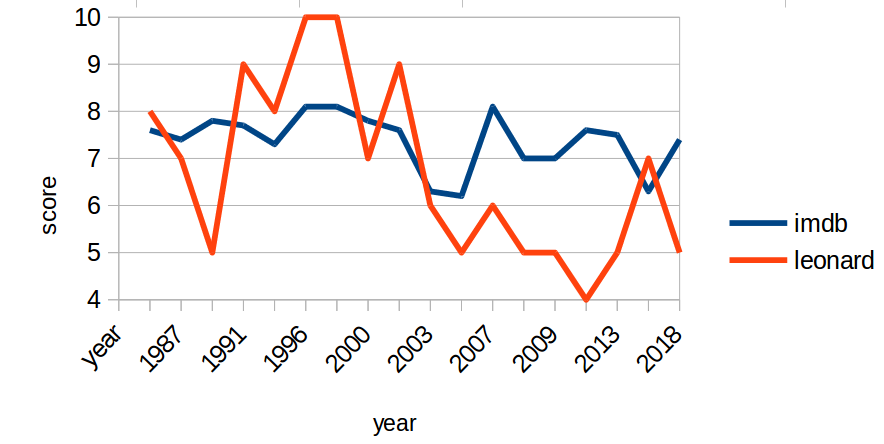
Survey says the Coens consistently produce above-average work but had a slight dip in the 2000s. What I learned from this project is how much value I put on the 1990s Coens in particular. The six movies from 1991 (Barton Fink) to 2001 (The Man Who Wasn't There) are my favorites by far, and include some of my favorite movies of all time. But apart from that ten-year stretch they're not really making movies for me. I don't think these movies are "bad" necessarily, but I like specific things and there was a magical period where the Coens were really into those same things.
For the record, here's my ranking, with my faves at the top:
- The Big Lebowski (1998)
- Fargo (1996)
- The Man Who Wasn’t There (2001)
- Barton Fink (1991)
- The Hudsucker Proxy (1994)
- Blood Simple (1984)
- O Brother, Where Art Thou? (2000)
- Hail, Caesar! (2016)
- Raising Arizona (1987)
- Intolerable Cruelty (2003)
- No Country For Old Men (2007)
- Burn After Reading (2008)
- The Ladykillers (2004)
- A Serious Man (2009)
- Miller’s Crossing (1990)
- The Ballad of Buster Scruggs (2018)
- Inside Llewyn Davis (2013)
- True Grit (2010)
Some miscellaneous notes on the films as a whole:
- There's a stock character who I really like whenever they show up: the highly eloquent, super-polite character. Buster Scruggs, Professor Dorr, Ulysses Everett McGill, Charlie Meadows and Maude Lebowski to some extent. Maybe there's a character like that in The Hudsucker Proxy, it's been a while. Most of the time this character is a villain, but Troy Nelson is my favorite thing about Inside Llewyn Davis—just a really nice square with his head screwed on straight. Which I guess makes him the villain in that topsy-turvy movie.
- In the moral calculus of Coen Brothers movies, the worst thing you can do is leave someone to die. It doesn't come up every single movie, but I believe there's a consistent pattern. This is how you find out Buster Scruggs is a bad guy. Llewelyn Moss leaves someone to die in No Country for Old Men and it's the only thing that makes him feel bad in the whole movie. The only non-self-centered thing Llewyn Davis does in his whole movie is check on Roland Turner when he ODs. Arguably "leaving someone to die" is what kicks off all the problems in A Serious Man, if you're determined to make the prologue have something to do with the movie.
In real life, actively killing someone is worse then leaving them to die, but in Coen movies homicide doesn't usually have a moral dimension—it's the "shit" in "shit happens". Most of the body count is accidental, or else caused by Bad People like Anton Chigurh, characters who we know won't have any moral growth. The morality play happens afterwards, in how the survivors deal with it. The leaving-for-dead scenario is a good way to give big dilemmas to characters who would never realistically kill someone.
film
Sun Jan 13 2019 19:33 The Crummy.com Review of Things 2018, Part One:
Hey, how are you doing? I've been putting off writing this post because there's books and plays and etc. from 2018 I'd been meaning to write about, and I never did. Now I've got to get it out by way of explaining why these things I've never mentioned before are on my best-of-the-year list. So I'm just going to put the little essays I was going to write in here. It'll be a good time. Let's start with the easy one, where I already have detailed records on my consumption:
Film - There's nineteen new films on Film Roundup Roundup, but only films I hadn't seen before are eligible for the best-of awards, so no The Apartment or Fargo. Here's my top seven for 2018:
- The Court Jester (1955)
- Big Business (1988)
- The Death of Stalin (2017)
- your name. (2017)
- Sorry to Bother You (2018)
- Spider-Man: Into the Spider-Verse (2018)
- Lots of Kids, a Monkey, and a Castle (2017)
Kind of a surprising result for me; I remember reading the screenplay for The Court Jester back in the BBS days and thinking it wasn't funny at all. Even now, if you look at the IMDB quotes page it doesn't seem like a terribly funny movie. But what they filmed is funny as hell. The "flagon with the dragon" bit is a good example. It's a famous movie line that I find tiring in and of itself, but that line isn't the main joke; the jokes focus on the folly of using an annoying tongue twister as a mnemonic.
Theater - Sumana and I saw a few shows in 2018, and the one I liked the best was "The Play that Goes Wrong", which we saw on Broadway. Like Big Business in the Film section, this play shows a mastery of different types of comedy—verbal, physical, character, meta... It's constantly switching things up, setting up and claiming callbacks, and exploring every variant of its simple premise. Hits all my comedy buttons, basically.
Books - Two books I read recently that really stand out for me are And There I Stood With my Piccolo and But He Doesn't Know the Territory by Meredith Willson. Willson's main claim to fame is that he composed "The Music Man", and NYCB readers know how much I love that musical. After we watched The Apartment, Sumana said: "You know, the saddest part is he didn't get to use those 'Music Man' tickets."
Territory is an inspirational book about the incredibly frustrating eight-year process of writing and producing "The Music Man". It's really nice to read as someone who's trying to work on large long-term projects. But nearly as inspirational is Piccolo, a book Willson wrote and published in 1948, almost a decade before releasing the project he's remembered for today. At this point Willson is close to nobody in show biz, just a guy who works in radio, mostly behind the scenes. But he puts out this book of hilarious stories and hot takes anyway, because who cares? The work speaks for itself. Both of these are outstanding books full of great anecdotes.
In similar "funny person makes random observations" territory I really enjoyed the second volume of Mark Twain's autobiography. I read the first volume as a huge hardcover book and it was a big chore, but reading it as an ebook is a much better experience, especially since there's lots of good stuff in the end notes. Volume 2 has lots of Twain's thoughts on copyright, and his not exactly Mr. Rogers-esque experience of giving Congressional testimony on the topic. I was saving volume 3 for the new year, but guess what—this is the new year!
In 2018 I started reading Vikram Seth's Indian epic A Suitable Boy. Sumana is a huge fan, and this gives us a fun topic to discuss while she waits for the serially-delayed sequel, A Suitable Girl. It's really funny! I'm a couple hundred pages in and finally getting comfortable with all the characters and their relationships. But they keep adding more characters! BTW A Suitable Boy is one of those late-twentieth-century works where there just isn't an ebook available. It's pretty common, but not usually a big deal unless the book is both well-known and really long. The Power Broker is another example—I haven't read that one because it isn't physically compatible with the way I read now.
Other great books I read in 2018 include Hemmingway's A Moveable Feast, Picking Up by Robin Nagle, Broad Band by Claire L. Evans, Wartime by Paul Fussell, and Lying For Money by Daniel Davies.
Broad Band starts off rehashing stuff I already knew about Ada Lovelace, but it really started surprising me after the end of WWII. There's a bit in Chapter 4 that gives me pause relating to the creation of COBOL. Like Javascript, COBOL was developed under an accelerated schedule. Unlike Javascript, the committee developing COBOL knew that everyone would be stuck for a really long time with whatever they came up with. But they decided to represent years as 2 digits anyway! I'd always assumed the Y2K problem was caused by a lack of foresight. But there was foresight, and they did it anyway! They weren't looking far enough ahead.
On that cheery note, I'll see you... in the future! Right now I'm going to go eat some food.
film
Mon Dec 31 2018 17:30 December Movie Roundup:
Happy New Year! I've updated
Film Roundup Roundup and it's now current up to the end of this particular installment of Film Roundup, with nineteen new highly-recommended films I saw in 2018.
I saw a lot of movies this month in particular, partly due to a project I embarked upon, which you'll see near the end. You, my loyal reader, are the beneficiary. As for you, my unloyal reader—have at you! You betrayed me to that scoundrel Richelieu!
- The Apartment (1960): I. Love. This. Movie. This is a rewatch after fifteen years, which is about as much time as I like to go between viewings of a great movie. I remember basically what happened, but every scene is a treat. Sumana and I saw it at Metrograph—a new restoration, I think—and it really benefits from the big screen treatment. This movie looks great, it's hilarious, it combines total cynicism with genuine emotion. It's the kind of movie where the 'comic relief' shows up not to provide relief but to change the type of comedy, like the alternating layers of chocolate and wafer in a Kit Kat. (I was eating a Kit Kat during the showing.) And it's a Christmas movie! What more could you want?
- Supermen of Malegaon (2008): A fun documentary about can-do low-budget filmmaking. At one point the handheld camera being used to shoot the film is broken and it's a huge setback, causing delays and jeopardizing the entire project. But there's a whole film crew right here, making the documentary, with equipment much more sophisticated than the equipment being used to make the feature. If it was me I would have helped them out. I guess I'm just not a tired general.
According to the presenter, this documentary was originally made for Singapore state television, but never aired there. I didn't know Singapore was so interested in what happened in India. Though I guess once they found out what was happening, they lost a lot of interest.
- Come Back to the 5 and Dime, Jimmy Dean, Jimmy Dean (1982): Who better to introduce me to the work of Robert Altman than Cher?
This had some great acting, but it's clearly a filmed play, which is most notable when some pretty horrible things are happening plot-wise but the characters just keep introspecting and monologuing. I guess I feel better about it if I think of this as the missing ending from The Last Picture Show—you come back to the lousy little town you left, and you've changed but all the ghosts are still there.
Sudie Bond in this movie is a dead ringer for my late grandma Rosalie, which was nice to see.
- Spider-Man: Into the Spider-Verse (2018): Fabulous. Looks amazing, feels fun, good use of New York as a story mechanic. The plot is cookie-cutter, but it's just more evidence for my theory that you can't change more than one variable at a time when you make a movie. They leaned on the 'visual style' lever and they changed that variable.
- Hercules (1997): This movie should have stayed in the vault. Disney always plays fast and loose with the source material, but this one's especially egregious. For some reason it really rankled me seeing Zeus and Hera as this lovey-dovey couple, and Hercules as... their legitimate son? The one Disney hero from an unbroken nuclear family and it's Hercules?
This sounds like I care a lot, but I don't! I barely care about this at all! I know very little about Greek mythology! But other Hercules movies make you feel smart for recognizing little bits of the stories they're mangling, and this one felt like some other story with the serial numbers filed off. I'm not a big fan of the songs, either. Best I can say is that there are some good sight gags.
Sumana and I will sometimes place bets while we're watching something. Here, I bet that the famous Labors of Hercules would show up as a plot point and be dealt with in the course of a single musical number. Sumana bet that the Labors wouldn't show up at all. What we got was individual Labors, and references to them, showing up haphazardly throughout the movie, in musical numbers and otherwise. That's not satisfying. Anyway, the final ruling was that neither of us won the bet.
- Gremlins 2: The New Batch (1990): I finally got Sumana to watch this, possibly out of guilt for her having suggested Hercules. This was my favorite film when I was a kid, and the favorite-filmness is still in there, but here's a film where they should have changed more than once variable.
IMO it doesn't get started until the famous "Gremlin nitpicking" scene halfway through. After that scene, it's like a Marx Brothers movie where Harpo and Chico are trying to kill everybody. All the stuff in that Key and Peele sketch happens in the second half of that movie. (We re-watched the sketch after the movie. Sumana: "They weren't kidding!") The interview with Brainy Gremlin is one of my all-time favorite movie scenes. In terms of worldbuilding, character development, and verbal comedy, it's top-notch.
But before the "nitpicking" scene, the film is way too slow and not terribly funny. Watching this film navigate the Gremlins rules, which gave a lot of tension to the first movie, is like watching someone try to parallel park a really big car. A mixed bag, is what I'm saying. Or perhaps... a mixed Gremlin? No, 'bag' makes more sense. A Gremlin was a kind of car, maybe I could do something with that... oh, I'm out of time? Last thought: the "nitpicking" scene is where it is because the Gremlins emerged in the previous scene, rendering the stupid rules irrelevant. No coincidence that's also where the movie kicks into gear.
- The Witches of Eastwick (1987): A combination of gal-pal wish fulfillment and fantasy violence that probably didn't go down well at the time, but I'd say the idea has aged pretty well. What hasn't aged well is this movie's 1980s John Updike feminism. It kinda works because Jack Nicholson provides such a sleazy contrast. But everything George Miller wanted to say in this movie, he did much better in Mad Max: Fury Road. Susan Sarandon is great.
- Practical Magic (1988): Sumana's review of The Witches of Eastwick was basically "Have you seen Practical Magic?", and we watched it right after coming back from the museum, as a cross-venue double feature. It's a disorganized jumble of different movies in different styles, but there's a lot of fun stuff in the buffet. In particular there's a few minutes where it's a supernatural version of 9 to 5; I wish they'd stuck with that. The casual sister relationship was very realistic and put me in mind of Celine and Julie go Boating.
If you want to see what an IMDB rating histogram looks like when it has a hard-core group of fans, Practical Magic is your movie. I can see what the fans see in it, but ultimately I side with the weighted average.
- The Muppet Christmas Carol (1992): A friend of a friend watches this movie every year as part of the holidays. I saw it a couple years ago at Susanna's house and forgot to review it, so... I watched it again and here's my review: it's really fun! Michael Caine is a great Scrooge. Would Dickens approve? Who cares? Public domain, baby!
- Miller's Crossing (1990): After seeing a bunch of Coen brothers movies last month, I realized that I was within striking distance of having seen their entire feature-film output, which would put them in such rarified Film Roundup company as Elaine May, and... that's probably it. Sumana was out of town for a while so I made a spreadsheet with the goal of not only seeing all the Coen movies I haven't seen, but rewatching the ones I had seen in the pre-Film Roundup era.
I'm not quite done yet, but I'll probably finish it up next month. In the meantime, Miller's Crossing (1990)! I thought this was basically popcorn noir. There's one cool little twist that gets un-cooled. Steve Buscemi only has one scene. I liked Blood Simple a lot, but this didn't have the same level of twistiness. I did like the soundtrack, something I don't usually notice.
- O Brother, Where Art Thou? (2000): Watched with Kirk who was in town for the day. Overall this was really fun, but there's one big caveat which is that this movie has blackface. Seriously, George Clooney, in blackface, in the year 2000. It's not like Holiday Inn bad, it's well into ironic "we were doing something else and it served the same purpose as blackface" territory, but that's a stupid excuse for doing something that could have... just not been done.
Anyway, apart from that GLARING PROBLEM, which sours the milk near the end of the movie, this is really fun. I saw this in the early 2000s and having watched Sullivan's Travels in the interim really improved my experience, so watch that one too—also, it's a better movie overall.
- The Ladykillers (2004): This was pretty fun but it turns out it doesn't need to exist. I also wish I'd made the 1955 version of The Ladykillers, but I wasn't alive then, so I work on other projects. You might say "it's time to update the riotous humor for a new generation", and that's a reasonable argument, but then you gotta look at the outcomes. This is the lowest-rated Coens movie on IMDB (6.2, which if Tom Moertel's measurement is still accurate, is perfectly average), and it doesn't exactly have a Practical Magic histogram.
So, if you like what my cousin Camilla said about the 1955 version—"I had never before seen quiet, pious, proper good triumph over violent evil."—you'll get the same thing out of this one. That's pretty rare in a movie, but it's about to happen again, because next up we got...
- Fargo (1996): I was apprehensive about this rewatch because I've been using this movie on Film Roundup Roundup as an example of a movie I've seen but never reviewed. But also, what if the movie isn't as good as I remember?
Well, no need to worry because this movie is amazing. A big reason for its amazingness is it's structured like a Columbo episode. You see the crime; then you see the cop; then you see the nice, polite, competent person take down the horrible fast-talking liar. But unlike in most Columbo episodes, while this is happening the crime is escalating and metastasizing, continually raising the stakes. (Also, in a Columbo episode, the villain would be the rich father-in-law, not the car salesman.)
The Coens' movies are full of characters who are flawed and weak, and problems that can't be solved, were self-caused, or aren't even real problems. Some of the characters have good intentions, and a lot of the time that's all you're going to get. Fargo is the one where a) there is a real problem, b) one of the characters has good intentions, c) that person is able to stop the problem from getting worse. As a bonus, the Steve Buscemi level is very high (certified NISBS).
- The Man Who Wasn't There (2001): Sumana and I saw this movie at a special UC Berkeley showing on one of our early dates. I thought it was all right (and we still have a souvenir barber's comb from the showing, which we still use—durable plastic) but I remembered the plot in pretty good detail and wasn't really looking forward to rewatching what I assumed would be a Miller's Crossing type popcorn noir.
Well, turns out this movie is way above popcorn. It captures what IMO is the essence of noir: not just a general hopelessness but the specific hopelessness of being an ordinary, weak human being whose life is ruined because they tried one freaking time to do something extraordinary. Basically, the feeling of being Jerry Lundegaard.
This is also the film where the Coens' interest in extinct genre stories really pays off. The implicit biases of those old stories shaped Hail, Caesar! and Buster Scruggs in a way that got them a lot of deserved grief, and maybe it also motivated the bad blackface decision in O Brother, but here the investment pays off big. Of all the films I've seen in this mini-project so far, this is the only one that really surprised me.
film
Fri Dec 07 2018 17:34 November Film Roundup:
- Attack the Block (2011): Good action, cool alien effects, lots of fun in a "simple sci-fi action film" way. The plot is something you'd see in the 80s, right? Or even the 50s. But nobody did it this way before.
- No Country For Old Men (2007): This was good but was it Best Picture good? I'd have given the 2007 Oscar nod to Hot Fuzz, so I'm clearly not Academy material. I did like the way this film ignored the sunk cost fallacy, killing characters off regardless of how much time had been spent exploring their psychologies. Very Psycho.
The obvious symbolism is that Javier Bardem's character represents Death, but I like to think of him as representing Entropy instead. Try it out!
- True Grit (2010): One of the things I love in stories, which the Coens do really well (but sometimes choose not to do, see below), is showing someone who isn't "supposed to" be in this kind of story. Either because Hollywood stereotypes say this isn't their story (Marge Gunderson) or because they're actually unqualified (the Dude). This film starts out real strong in that area, and then not so much. The first half-hour would have been a great addition to The Ballad of Buster Scruggs (again, see below). Then do a Greed-style title card and cut most of the rest.
- Infinite Football (2018): We thought this would be "17776: The Movie", but it ain't. It's not even a meditation on what "rules" are, because the bureaucracy scenes don't show the rules of bureaucracy, such as they are, in action. Sumana compared this film to The Peacemaker because it's about a guy who's really devoted to one project and lets a filmmaker get very intimate showing its effect on his life. Overall, a cut above the average meandering Eastern-European documentary.
Also, apparently in Romania the sport called "football" is slightly different? More like soccer. Who knew?
- The Ballad of Buster Scruggs (2018): Loved the titular segment. So corny. Also really liked "The Gal Who Got Rattled" but felt ripped off by the ending in a way that this non-hand-wringing roundtable gets at pretty well. All these stories are taking place during an enormous heist/misunderstanding/murder spree/clusterfuck that's like every Coen Brothers movie happening simultaneously, and although the Coens are aware of this and certainly not celebrating it, they're also not giving it the treatment they'd give a convenience store robbery.
- Mama Mia: Here We Go Again (2018): Seen on a plane. A great movie to see on a plane. The 'Waterloo' segment is fab, everything else a welcome distraction from the tedium of plane travel. To answer the implicit question I had while this movie was in theaters, the dozens of people on the poster aren't new characters, they're flashback versions of the people from the first movie, like in Dongal. They're all my friends now... my plane friends... whenever I'm on a plane, I can count on them. Sorry, I fell asleep. I have a hard time falling asleep on a plane, but an easy time when thinking about being on a plane. It's my curse.
Everyone who dies should be able to return for one last musical number.
- F For Fake (1973): Like Italianamerican and Daguerreotypes, this is one of those films that would be a Youtube video today. Actually it reminds me of Tony Zhou's Every Frame a Painting, which might would explain why Every Frame a Painting mentions it so often. Like with The Third Man, there's a piece of metadata about this film that will be a major spoiler if you notice it. But I was still along for the ride. I enjoy Orson Welles as a safely dead blowhard, his talent and his ego forever locked in a giant squid/sperm whale deathmatch.
- Inquiring Nuns (1968): The nuns are back! The film was remastered and this time I took Sumana, who loved it. To add a bit of thought to my previous review, all interview subjects are putting on an act to some extent. The highly artificial setup of these particular interviews forces people into their acts, but the nuns are serious in trying to get behind the acts. One guy in the art museum starts off sarcastic and one of the nuns asks "Is that a sincere answer?" and gets him to open up.
Director Gordon Quinn was present at the screening and mentioned that the nuns are still alive, although neither remains a nun. One married a former priest who first saw her in Inquiring Nuns! Both women found making the film a positive experience and one of them has done Q&A at screenings. Sumana asked: when Quinn was performing meta-interviews to find the nuns to use in the film, what was he looking for? "Good listeners."
film
Sat Nov 03 2018 17:44 October Film Roundup:
- The Brain (1988): I saw this as part of a MST3K Live event, which was really fun. Joel and Jonah brought an audience member on stage to riff with them! The film itself is great material for MST3K: long chase scenes, a goofy practical effect, a plot that's 100% cliche but could have been cool with the right execution, and not the right execution. Recommended if they're coming to your town.
- Lilo and Stitch (2002): A fun movie from Disney's "weird" period following the megahits of the early 90s. Sumana can't stand when fictional characters are jerks (also real people), so she did not have as good a time as I did, but I liked the technique of putting two jerks in the movie and making them care about each other.
Random question: do you think Bubbles is really a social worker, or is he a Man In Black who was rushed over to the likely crash site? His presence seems like a huge coincidence, but it could be something left over from an earlier draft of the screenplay. I could go either way. Probably overthinking it.
- White Christmas (1954): A little-known fact is that Irving Berlin wrote a sequel to "White Christmas", called "I'm Dreaming of a Bunch of Very Similar Musicals About Rural New England Inns That All Feature My Song 'White Christmas', Ensuring A Constant Stream of Royalties". It's not well known because whenever he tried to use it in a musical, it always made more sense to slot in "White Christmas" instead.
Anyway, Danny Kaye's in this one, and he's great. Good banter, fun dance numbers, mediocre songs. Unlike Holiday Inn there's no romantic blackface scene, but there is a whole song about how one misses the old-timey minstrel show. Just... keep it to yourself how much you miss that shit. Isn't there a song about yams we could be hearing instead?
- In Jackson Heights (2017): Saw the first half at the museum; I'll finish it up later. It was nice to see an in-depth look at a local neighborhood, but it was also nice to not see a three-hour movie all at once. It was really weird to see the camera pan over the exterior wall of the Trade Fair like it's the bazaar in Marrakesh or something. It's just pictures of produce!
film
Mon Sep 03 2018 00:07 August Film Roundup:
- Filmworker (2017): A chilling film about suppressing your own personality to merge with a collective intelligence. I'm not universally opposed to merging with a collective intelligence, in a sense we all do this, but I do think there needs to be a little give and take. It really seems like Stanley Kubrick used Leon Vitali as an offboard brain, in a way that goes beyond how most personal assistants are treated, and although Vitali doesn't seem to mind, some artful omissions (there's an obvious person who doesn't show up in Filmworker) make me think it hurt the people close to him.
- Won't You Be My Neighbor? (2018): I've mentioned before that I didn't grow up with Mr. Rogers, but I
guess Sumana caught me up to speed pretty quickly because there wasn't
much new to me in this documentary. It covers most of the
greatest hits, apart from Rogers's testimony in favor of VCR time-shifting, which
I guess normal people don't consider a "greatest hit".
The main food for thought I found was someone's claim that we're
afraid of how common Fred Rogers-style courage and decency is. It's
the flip side of the banality of evil. If we build up
Mr. Rogers as a huge outlier, we don't have to think about where we
come up short.
- The Way Things Go (1987): A.k.a. "Der Lauf der Dinge".
A Rube Goldberg art film, another high-concept genre that's been replaced by a type of YouTube video. It's super creative, with a
lot of the physical humor you get from a Road Runner cartoon or an OK
Go music video... yeah, I'm just comparing it to other kinds of videos. There's a lot of bits here based on fire and chemical reactions, which those other videos tend not to try.
Perhaps the ultimate West German film, in that it's precisely engineered but it's filmed in this dingy warehouse and everything's filthy. Very enjoyable.
- your name. (2016): A.k.a. "Kimi no na wa." This had a dorky twist previously seen in a bad Deep Space Nine episode, but when the twist arrived I was so into the
story that I didn't care. A compelling plot, lots of good
character moments, beautiful animation. I especially loved the bit
near the beginning where the two characters are figuring out the rules
of the game, as it were.
I'm sure this happens in anime all the time, but this was the first
time I'd seen mojibake as a plot element.
- Cielo (2017): After seeing the original Godzilla at the museum in 2014 I was annoyed to overhear someone talking about how the Godzilla suit effect wasn't as good as King Kong (presumably the 1933 stop-motion one). There, I thought, goes one person who did not leave the theater totally mystified and overwhelmed by Godzilla's invincibility. I mean, maybe the rubber suit is better, maybe not, but if that's how you're evaluating Godzilla I'm not sure you were fully exposed to the emotional sandblasting that film provides.
This went into my secret file of "stories too petty to tell in Film Roundup", but recently I saw Cielo at Film Forum and after the
movie I sat to collect my thoughts, which were dominated by people in
the back complaining about the recently renovated seats. It made me
think of the Godzilla thing. You paid to watch a
documentary about the wonders of the cosmos, a movie with some pretty
incredible time-lapse night sky photography. Do you not have the
emotional space to talk about that with your friends, and you're
complaining about the seats as a defense mechanism?
I realize that complaining about your fellow theater-goers is about as bad as complaining about the seating, so no more of that. Cielo was not the best space movie I've ever seen, but the photography was beautiful and the interviews with the folks who live under that sky were interesting.
The new seats are fine.
- Matewan (1987): A thrilling true-story Western about union organizing. I never heard of writer/director John Sayles before; turns out he's an unusually socially-conscious graduate of the Roger Corman School of Cheap-Ass Filmmaking. I'm interested in seeing more of his stuff.
- Intolerable Cruelty (2003): The Coens made a rom-com just for men, which was... a losing proposition, box-office wise. It's a fun movie but it's got a lot of problems. Sumana: "There's some good banter but it's not, like, Lady Eve level."
Another example: the pacing is weird. It would be normal thriller pacing if Catherine Zeta-Jones was the main character, but from the perspective of the George Clooney character the movie grinds occasionally as it switches gears.
Like I said, it is fun but it's on the lower end of the Coen output for sure. It's funnier than Burn After Reading, but BAR is a better movie.
film
Sat Aug 04 2018 12:28 July Film Roundup:
- Big Business (1988): Julia Rios asked us to watch this movie in honor of her birthday, and even sent us a fun care package of props used in jokes (Doublemint gum, swan-shaped soap). The movie itself is really fun, a screwball comedy with a totally predictable plot and great jokes. Physical comedy, double roles, sight gags, sharp banter... a buffet of different types of 80s comedy, like a femme This is Spinal Tap.
- The Spook Who Sat by the Door (1973): Another in the 1970s "racial slur in the title" action series. This reminded me of Ralph Bakshi's 1978 Lord of the Rings, in that the premise is brilliant but it ends abruptly, like they ran out of money, and I should probably just read the novel. However there are some great bits here, notably the code-switching bank robbery.
- Mamma Mia! (2008): This is not my kind of movie but Meryl Streep and the classic ABBA songs made it fun. I don't think we're going to see the sequel, but the sequel is what reminded Sumana of this movie and caused us to watch it, so an indirect marketing success?
- Sorry to Bother You (2018): This movie was in "okay" territory for me for most of the running time, but then there was a Cornetto-esque twist which was good on its own but also made me reevaluate the entire movie as a movie full of hidden Cornetto-type callbacks. Really good overall.
film
Fri Jul 06 2018 13:04 June Film Roundup:
Every movie I saw this month was great, blockbusters and block-ignorers alike.
- Deadpool 2 (2018): Saw it with Sarah, had a good time. Lots of silliness, some inventive action. However this franchise is getting a Muppets/Simpsons problem where there are too damn many characters. I guess it always had that problem, since the franchise is "X-Men", but before I didn't have to care because the first Deadpool was this freak long-shot thing they made with leftovers. Now it's characters galore! and the only new one I care about is Domino, whose superpower is hilarious. Fun despite my griping. In fact, maybe the griping makes it fun?! Is this the day I truly become a comics nerd?
- Daguerréotypes (1976): Sumana and I loved this quiet film made under a serious constraint: director Agnès Varda was at home with an infant, so she made a film about her neighborhood. But her camera had a fifty-yard cord and her neighbors apparently wouldn't let her use their oil-crisis French electricity, so she couldn't travel more than fifty yards away from an electrical socket I imagine was in her living room.
I don't know which of these constraints were self-chosen and which were of necessity, but it adds up to something really fun. Like Scorsese's Italianamerican (1974), amateurs now make this sort of film casually and they're treated as ephemera, but this was made at a time when it took professionals with fancy equipment. It's an interesting piece of time travel, it sometimes seems massively overengineered by modern standards, but there are also lots of fun juxtapositions that you get from having a professional in the editing booth. (Or, in fact, having an editing booth at all.)
- Oceans Eight (2018): This movie achieved the impossible: it made me care about the Met Gala for ninety minutes (more like seventy, allowing for time for the heist to be introduced). Sumana took umbrage at this and pointed me to Genevieve Valentine's blog post about the 2018 Gala, which only made it clear to me what a success Oceans Eight is on these terms. Like Ethereum or EVE Online, it's one of those things where I'm only interested if you've come up with some clever way of robbing it. I'd surely be upset if you stole the ink cakes from the Met, but here it's just jewels.
Anyway, a fun movie. The aftermath of the heist, with the Barton Keyes-esque insurance investigator and the clever disposal of the loot, was especially nice. I was confused by the ending, which seemed a real tonal shift, but on IMDB afterwards I learned they'd brought in a character from the other "Oceans" movies, which I haven't seen. Status: EXPLAINED.
- The Peacemaker (2016): Not the 1997 George Clooney movie but a documentary about Padraig O'Malley, who came up with an effective way of kickstarting the Irish peace process and has been trying to scale it up ever since. I'll link to the museum's page for the screening because IMDB's page doesn't have any real info on the film. This was a really amazing piece of work, very intimate, and it really spoke to the sense of futility/dedication I feel about my lifelong slow boring of hard boards. "Justice will take us millions of intricate moves."
- Who Framed Roger Rabbit (1988): I've now seen this movie three times and I've read the book, so clearly I like it a lot, but I always come away disappointed because I feel much better stories are tantalizingly close to the one they filmed. The last action scene, in particular, is dull because the film's most interesting characters are tied up and unable to participate. There's a line like "Use the escape-proof toon rope!" What a cop-out. Spend another five million dollars on one scene, would ya? Because of this I always leave the metaphorical theater with a bad taste in my mouth.
My other problem is the fictional world is crammed full of worldbuilding that would make for great noir but it's neglected in favor of things I found less interesting. Particularly the fucked-up relationship between humans and toons, and Judge Doom's... what's his motivation? Is he a quisling? Is he summoning some Dip-powered toon elder god? Yeah, I'm overthinking it, he's just a generic 80s movie villain, which is my actual point: they attached all this amazing technical wizardry and worldbuilding to a popcorn-noir movie with a generic 80s villain.
That's life. You can't change too many variables at once. I'm sure they had to fight like hell to get even what we see on screen. I'm glad this movie exists, but it could have been more. I haven't seen Alien Nation (also 1988) in a long time and I'm worried I'll discover it was just a cop movie.
An old version of IMDB trivia says: "According to director Robert Zemeckis, there's an old superstition that films with a question mark in the title do badly at the box office." However Zemeckis is the only named source of this information I can find -- current IMDB trivia just repeats this superstition without crediting it to anyone. Maybe someone asked Zemeckis about this at a con and he said "No! It's an old superstition! Ask anyone!"
If this is an old, widespread superstition, it would explain why I haven't been able to get the green light for my awesome screenplay, Macbeth?. However, since superstitions are fears with no rational basis, I should be able to change peoples' minds about this by showing them some data.
Using an IMDB data dump I found twenty-eight pairs of feature films whose titles were identical except for a question mark. (This includes two films called Who Cares?, which I matched against the same Who Cares.) For each pair of films, I checked which film had the higher IMDB rating and which had more rating votes. Here are the totals:
| Higher rating | More votes |
|---|
| Question mark in title | 16 | 14 |
|---|
| No question mark in title | 12 | 14 |
|---|
As you can see, there is basically no difference. This is a result I would expect from comparing pairs of movies selected at random. Omitting a question mark from the title of your movie does nothing. Nothing!
The superstition does appear to be real, otherwise it's hard to explain titles like Who's Knocking At My Door (1967). But it's not a blanket thing -- What's Up, Doc? came out in 1972 and was a big hit. And the madness only affected the United States: Shall we dansu? came out in 1996 and was remade in 2004 as Shall We Dance.
film
Fri Jun 01 2018 09:17 May Film Roundup:
- Lots of Kids, a Monkey, and a Castle (2017) a.k.a. "Muchos hijos, un mono y un castillo". And now, the story of a wealthy family who lost everything. This movie presents in a fun way a family situation that is in many ways awful, and it's mainly possible because Julita (the mom, the focus of the movie) is hilarious. She has a dry, cynical matter-of-factness that I associate with my own mother, and thus with the general concept of 'mom'.
In a recent episode of the Retronauts podcast, someone described the line between "collecting" and "hoarding" as the point where your stuff starts interfering with your living space. This film shows that there's a pretty big loophole in that idea—if you're rich enough you can just keep buying more space.
Anyway, it's rare to see a movie about a family going through problems where the family sticks together and everyone basically gets along, so this one's recommended from me.
- Freebie and the Bean (1974): From the innocent days when you could put a racial slur in the title of your fun-time cop movie. There are a couple good jokes and some great car chases (including one that's right out of Batman '66) but not recommended overall. Perhaps it could be remade, pairing a veteran Chicago cop with Anish Kapoor's sculpture "Cloud Gate".
Old game watch: there's a Commando Machine Gun game in the bowling alley.
- Harry and Walter Go to New York (1976): This film was a critical flop when it was released, and it's not a great movie, but I had a really good time with it. I like a heist movie but I like it even more when it's got a snobs-vs.-slobs element, and Michael Caine is the ultimate heist snob.
This is also a vaudeville film, another big plus for me, but as a 70s vaudeville film there is some brief, halfhearted Elliot Gould blackface. On the bad-meter it's not as bad as Holiday Inn, but it's not exactly a reckoning with the past either. The museum handout quoted Burt Young's memoirs as saying that when they were making this movie everyone was backslapping and really self-congratulatory about how funny they were, and it really does show.
My aunt Anne once told me a story where the punchline was her saying in a fake Southern belle voice "We are at your disposal!" Well, in this movie Diane Keaton says basically the same line in the same voice, and it's making me question the veracity of Anne's story. But maybe it's a stereotypical Southern belle thing to say. Anne wouldn't tell a story that wasn't 100% true, right?
- A Wrinkle in Time (2018): There are three series my mother read to me when I was really small: the Narnia books, the Hobbit/LotR cycle, and the first three books in what I now know is called the Time Quintet. (The other two weren't out yet during the reading-to-Leonard years, and in fact I just found out they existed.) My adult opinion of these series are: meh, awesome, and hadn't really thought about it. But when this movie was announced I did think about it and I realized how important l'Engle's work has been to me. These days there are entire sections of bookstores devoted to weird genre fiction for kids, but back in the day A Wrinkle in Time was a real oasis. Middle-Earth was real weird to my mom's generation, but by the 1980s, Tolkien wasn't just for hard-core hippies anymore. And Narnia has always had a stick up its ass.
In comes l'Engle, mixing fantasy tropes like witches and unicorns with Christian concepts (not allegory, just the concepts) and topics in contemporary science. Just, every chapter there's another wild, original situation. Every book has a totally different concept based on the same themes. It really worked like a karate chop on the weary little world of Dick, Jane, and Spot.
Sadly, my epic poem about peeing, A Tinkle in Rhyme, is still unapproved by the l'Engle estate, so my appreciation for these books can only be shown through Film Roundup reviews. I really looked forward to seeing this adaptation, even though an adult nostalgic for an experience they had as a kid rarely ends well. And I was disappointed in approximately the way I expected to be, but it's a good kids' movie, they did a good job making it relevant to kids' concerns today, and kids who are going to grow up to write science fiction will read the books anyway.
The whole movie I was wondering how they were going to handle the revelation of IT, which of all the weird things in these books is the one that stands out in my mind. I still remember being five or whatever and my mom taking a deep breath and saying "It was a BRAIN!" What a terrifying reveal. But a disembodied brain is probably too gross for a PG movie while not being that scary on the screen. Even in the book, Meg realizes pretty quickly that although an oversized human brain is disgusting, if she had a scalpel she could just slice it up. So I think they did a good job setting the movie's climax inside a brain, a more abstract but also more terrifying space.
- The Prestige (2006): Cheryl recommended this to me when my writing group met to discuss Mine, for reasons that will be obvious when you read Mine. It's pretty fun. I didn't know Christopher Nolan directed, and back then Christopher Nolan wasn't DIRECTED BY CHRISTOPHER NOLAN BWAAAAAAAHM, so if I hadn't had an inkling of what to look for I would have been pretty surprised by the switch from one type of genre fiction to another.
This film has a lot of fridge logic that's mostly explainable by the fact that the two protagonists will go to almost any length to sabotage each other. A convenient way to avoid nitpicking questions, but one that means you can only tell stories about certain types of people.
I remember around the time The Dark Knight came out Sumana mentioned Michael Caine and I had no idea who he was. We went through his entire IMDB page; I'd never seen a movie with Michael Caine in it. By this time I've seen several (two this month, even!) and it was nice to see him in a role where he's not always cool and in command of the situation.
This month the Television Spotlight focuses on... a frosty mug of beer? Oh, it's "Sunshine Sento-Sake", which I found about through this 2017 review and then kept in my queue until the perfect moment. That moment is now: I'm dieting and there's a vicarious satisfaction in watching someone enjoying food I myself wouldn't want to eat. I don't like beer and am not big on Japanese food, but watching Takayuki Utsumi ditch his meaningless job, slack off in a bathhouse and then rehydrate with a cold one at a nearby dive is really enjoyable. It's also really repetitive. I don't know if I'll finish the series. Fun stuff, though.
film
Wed May 02 2018 21:56 March/April Film Roundup:
I skipped a month of roundups because I was head-down finishing
Mine, but now the novel is done! Yay. Even so, I had to pad this roundup with a couple of movies I saw earlier, even last year, but forgot to review. Roll film!
- Marlina the Murderer in Four Acts (2017): This was a nice slow-paced thriller. For decades other countries have been adapting the themes of the American western, and this movie does it really well; you get the loneliness, the lawlessness, plus the human connection you get in the better westerns.
- Shaun the Sheep Movie (2015): Cute and fun. Not complaining about this per se, but one of the things I love about the Wallace and Gromit animations is the buddy relationship, and the relationship between Shaun and the farmer amped up the part of that relationship I dislike (Wallace being really helpless and Gromit having to do all the work).
- Legally Blonde (2001): A fun movie with a satisfying wish-fulfillment twist you rarely see: the main character's incredibly smart but didn't know it because it's just kinda never come up. Less enjoyable: a crucial plot point relies on bisexual erasure. A mixed bag, I guess I'm saying. Clueless remains the champion of this mega-femme subgenre IMO.
- The Death of Stalin (2017): For so long I've been waiting for this to come to the US, because Steve Buscemi as Khrushchev is my dream role. And it delivers—he's the Buscemiest! The Mr. Pink of the postwar Soviet era. I'm not a big fan of The Thick of It, but that's partly because the stakes are so low. Ramping it way up makes the cynicism more sit-throughable, I think. Recommended overall. In my review of Muppets Most Wanted when I said "I don't think massive human rights violations are totally off-limits for humor," this is more what I was thinking of.
- The Court Jester (1955): Recommended by Cheryl, who said this and The Princess Bride were the movies she watched over and over again as a kid. We saw it with Sumana's mom during a visit and... a huge hit! Great songs, great physical comedy, good verbal sparring, decent actual sparring. Danny Kaye's split-personality bit puts The Nutty Professor to shame. My favorite film of 2018 so far, not that that's saying much.
- The Inspector General (1949): We doubled down on Danny, but this film wasn't nearly as good as The Court Jester. "Good bones", as they say in real estate, but a lot of the humor probably originates from the sparkling pen of Nikolai Gogol. I'll just check Wikipedia... "The great originality of [The Government Inspector's] plan consisted in the absence of all love interest and of sympathetic characters." Huh, okay, I guess the movie did come up with its own jokes, and it has some good ones. But the musical numbers are not fun, and way too long. That really drags.
film
Thu Mar 22 2018 21:09 Direct Observation of the MST3K-IMDB Effect:
The
MST3K-IMDB effect, first hypothesized in 2011, is the effect on a movie's IMDB rating caused solely by its having appeared on
Mystery Science Theater 3000. A bad movie isn't made any worse by being on MST3K, but MST3K shows movies in the context of a fiction where they're an instrument of torture. You can model an episode of MST3K as a negative advertisement, designed to make the viewer feel negatively about a movie they'd never heard of before. The MST3K-IMDB effect measures the 'success' of the negative ad.
Previously, the MST3K-IMDB effect could only be observed through its gravitational tug on one movie out of a director's oeuvre. But in 2017, Mystery Science Theater: The Return took movies that for years had sat in the dustbin of history and turned them into well-known "MST3K movies". Thanks to my trusty 2015 IMDB data dump, I'm in a position to compare the ratings of all these movies before and after they were on MST3K, providing the first direct images of the MST3K-IMDB effect.
First, here's my control group: a comparison of the 2015 and 2018 ratings for some random movies that weren't on MST3K:TR. As you can see, IMDB ratings for old movies are normally very stable, not changing by more than a couple percent over three years.
| Title |
2015 rating |
2015 votes |
2018 rating |
2018 votes |
Percentage change in rating |
|---|
| Night of the Lepus | 3.9 | 2782 | 4 | 3484 | 2% |
| Embryo | 4.9 | 824 | 5 | 1052 | 2% |
| The Ninth Configuration | 7.3 | 3486 | 7.2 | 4893 | -2% |
| Gorgo | 5.5 | 1846 | 5.6 | 2479 | 1% |
| O Fantasma (2000) | 5.9 | 1859 | 5.7 | 2449 | -4% |
| They’re A Weird Mob | 6.6 | 550 | 6.6 | 686 | 0% |
My methodology: the first two movies in that list are the sort of thing you see on MST3K. The Ninth Configuration is a more highbrow obscure film. Gorgo was on MST3K a long time ago, so presumably the MST3K-IMDB effect is already priced in. The last two are movies of MST3K-level obscurity chosen at random. I would love to do this for every single movie in the 2015 data dump and just take an average, but I can't because IMDB doesn't offer full data dumps anymore.
Update: I took another look and this analysis is in fact possible once I write some code to compare the old and new IMDB dump formats. For non-porno feature films, the mean rating change between 2015/01/31 and 2017/12/24 is 0.13 stars. The median is 0.10 stars. Percentage-wise, it's 3% and 1%. So on average, IMDB ratings go very slightly up over time—a phenomenon I also noticed with Board Game Geek ratings.
Now, the moment I've all been waiting for, the experimental group. This table compares the 2015 and 2018 ratings of the movies that appeared in the first season of MST3K:TR. I've also included the rating of the MST3K:TR episode itself, as well as the number of votes IMDB used to calculate each rating.
Here, the percentage change in rating is largely due to the MST3K-IMDB effect. This is the percentage of a movie's previous rating that it lost just by being mocked on MST3K.
| Title |
2015 rating |
2015 votes |
2018 rating |
2018 votes |
Percentage change in rating |
MST3K:TR episode rating |
MST3K:TR episode votes |
|---|
| Reptilicus | 4 | 1599 | 3.6 | 2962 | -10% | 7.8 | 498 |
| Cry Wilderness | 5.2 | 37 | 2 | 877 | -62% | 8.3 | 819 |
| The Time Travelers | 6 | 753 | 5.1 | 1682 | -15% | 7.4 | 256 |
| Avalanche | 4.2 | 594 | 3.7 | 1352 | -12% | 8 | 261 |
| The Beast of Hollow Mountain | 5 | 509 | 4.2 | 1182 | -16% | 7.4 | 230 |
| Starcrash | 4 | 2946 | 3.9 | 4699 | -3% | 7.7 | 235 |
| The Land Time Forgot | 5.7 | 3085 | 5.7 | 4558 | 0% | 7.4 | 197 |
| The Loves of Hercules | 3.2 | 349 | 3 | 787 | -7% | 7.2 | 181 |
| Yongary | 4.3 | 592 | 3.9 | 1102 | -10% | 7.8 | 201 |
| Wizards of the Lost Kingdom | 2.6 | 502 | 2.6 | 1037 | 0% | 7.8 | 187 |
| Wizards of the Lost Kingdom II | 1.8 | 297 | 1.8 | 716 | 0% | 7.4 | 168 |
| Carnival Magic | 3.8 | 120 | 2.4 | 463 | -37% | 7.2 | 167 |
| The Christmas that Almost Wasn't | 5.5 | 204 | 3.8 | 541 | -31% | 7.1 | 148 |
| At the Earth's Core | 5.2 | 2276 | 5.2 | 3410 | 0% | 7.2 | 134 |
|
The MST3K-IMDB effect is real, but it's not a constant. In the control group we saw movie ratings vary up and down, seemingly at random. With MST3K:TR movies the trend is clearly down. But for five of the fourteen movies we see no effect, or an effect so small that it could have been due to chance.
I wasn't expecting this result! I don't see a pattern in the five movies that lack an MST3K-IMDB effect; they aren't the best-rated movies or the worst, they weren't in better- or worse-rated episodes of MST3K, they aren't from a different time period than the others. Sometimes MST3K just doesn't change peoples' opinion about a movie.
But sometimes it does. Take a look at Cry Wilderness, which lost over half of its IMDB rating due to being on by far the highest-rated episode of MST3K:TR. It went from a regular bad movie to being Manos-level. Part of this is just that its pre-MST3K rating of 5.2 was taken from a very small sample of just 37 votes—the kind of super-obscure film I usually omit in IMDB analyses. But two other movies—Carnival Magic and The Christmas that Almost Wasn't—also have very large rating shifts.
Here's the closest I can come to a unified theory of what happened to those three movies. I took the number of post-2015 votes for each MST3K:TR movie and divided the post-2015 change in IMDB rating by that number of votes. This gives a guess at an incremental per-person MST3K-IMDB effect. So, every time someone saw a movie on MST3K and then rated the movie, we can say its rating went down by an average number of stars.
For most of the movies this number is zero (people gave the movie the same rating as if it hadn't been on MST3K at all) or infinitesimal (a lot of people voted and the IMDB rating went down a little bit), on the order of -1.0*10-3 stars. But three stand out. For Cry Wilderness the per-person MST3K-IMDB effect is -3.8*10-3 stars. For Carnival Magic it's -4.1*10-3. And for The Christmas that Almost Wasn't it's an amazing (relatively speaking) -5.0*10-3 stars.
So in a sense the negative ad campaign against The Christmas that Almost Wasn't was the most successful one here. That was the episode that got people the most riled up against the movie they'd just watched. But that movie's IMDB rating didn't go down as much as Cry Wilderness's, because the Cry Wilderness episode got more people to actually go vote the movie down.
But beyond those three movies, the per-person MST3K-IMDB effect is a lot smaller. What's the difference? Are those three movies unusually MST3K-compatible? Are those episodes meaner? It probably has something to do with the content of the movie, since the two Wizards of the Lost Kingdom movies have identical MST3K-IMDB effects of zero. Beyond that, I don't know.
Obviously there is no real propaganda campaign; no one set out to lower these obscure movies' ratings by making fun of them on Netflix. But I think this is a natural experiment showing what can happen to ratings and metrics even when the stakes are very low and no one has malicious intent.
film
Fri Mar 02 2018 00:48 February Film Roundup:
- Newton (2017): This the closest I've seen to an Indian version of a Billy Wilder movie, which (see Fig. 1) means it's my favorite Indian movie. It's made with a mix of cynicism about and sincere belief in democracy. It sets up two characters on a course to romance, but doesn't actually show the romance and there's no guarantee it happens. Shorter than two hours, falls into the same "low violence, high suspense" quadrant as Dog Day Afternoon... just great stuff all around.
- The Heartbreak Kid (1972): I've now completed the quadfecta of Elaine May films. Sumana and I saw this one on a date; our relationship is at the point where we can have a date where we watch a movie about catastrophically bad relationships. You might not want to see this movie on a third date, or if you got married less than a year ago.
The film is good, but not a classic like Ishtar or A New Leaf. However, one thing those movies didn't have was Eddie Albert stealing the show as Mr. Corcoran. A funny character and great delivery in every scene. For the final time, I'll use this review as a soapbox to say that Elaine May is a really good director who should not be in movie jail. On a positive note, Ishtar's IMDB rating has gone up from 3.9 to 4.2 in the past five years.
- The Greatest Showman (2017): Saw with Susanna on a trip to California. I don't know about this one, I just don't know. The opening number is fabulous but then... yeah, I can't recommend it.
I get that P. T. Barnum inhabits the shadow world of the American tall tale, alongside Paul Bunyan and Hunter S. Thompson, so you can do whatever you want with his story without caring about things like 'accuracy'. But why spend the first act of a movie humanizing a con man, when you could not do that and have an awesome con man musical like The Music Man?
This movie just made me think about how great The Music Man is. How Harold Hill starts off with no redeeming qualities but is civilized by the decency of the people he interacts with. That's how you humanize a con man in a family-friendly musical. At any rate, I think you could write a screenplay that stuck closer to this classic biography of Barnum but left most of the musical numbers intact.
film
Sun Feb 18 2018 19:33 January Film Roundup:
Sorry for the delay! Also sorry that I only saw two movies last month. Here we go!
- Detective Byomkesh Bakshy! (2015): The poster for this movie looks really cool, in fact the whole thing looks really cool, with its recreation of 1940s Calcutta. However, I thought this film was paced way too slowly. It's got the amount of complexity of an American noir movie, but drawn out to Indian-movie length. So in the end, not a recommendation. I did like the appearance of Chinese and Japanese actors, something I've rarely seen in Indian films.
- Moments choisis des histoire(s) du cinéma (1994): I pitched this to Sumana as "Godard makes a vid", we saw it together and it turned out to be one of those movies that "I don't regret watching per se", which is kind of weak sauce for a date movie. Really glad we caught the ninety-minute cut instead of the four-hour miniseries.
A big reason I don't regret watching this movie is it performed a valuable service for me in dispelling some of the mystique around Godard and his peers. I don't make films myself, so sometimes I watch these New Wave movies and it feels like I don't "get it", like these dudes have some unique French insight into the human condition. But when Godard has his chance to soapbox, it turns out he's concerned with the same stuff other twentieth-century creative types are worried about: war, corruption, ephemerality. So even if I don't get it, I feel at least the "it" I don't get is something that I've come to understand through other means.
This (last) month the Television Spotlight turns to "Forged in Fire", the improbable History Channel reality show that is even more relentlessly positive than "The Great British Bake-Off". (Especially as Paul Hollywood has become meaner and meaner, taking on the aspect of an out-of-control death computer from a ST:TOS episode.) "Forged in Fire" is all about creating knives and other instruments of slicy death, but the contestants and judges are all super nice and supportive of each other.
Someone's sword will shatter on a pig carcass and the judge will say "Well, we had a little problem here." We recently saw an episode where a guy sounded like he wanted to start some typical reality-show drama, and either no one took the bait, or they edited it out, or he wasn't able to try anything because the whole time you're on camera you have a physically demanding task to focus on. I don't know how high our tolerance will be for a really formulaic show, but we're not tired of it yet.
film
Wed Jan 03 2018 09:01 Film Roundup Special: Miracle Mile:
Way back in June I saw
Miracle Mile (1988), and loved it, but didn't really review it because my recommendation is that you go in knowing nothing except that it's a very dark
horror movie. Now it's been six months and I'm going to talk about it, so skip this post if you want to try going in cold.
Miracle Mile evokes the fear its protagonist is feeling by making the experience of watching the movie congruent with Harry's plot arc. As he flails around looking for a loophole in
the end of the world, you're flailing around trying to figure out what kind of movie this is and how to watch it. The normal plot components from a zombie
movie—the vehicles, the weapons, the hyper-competent Denise
Crosby—are shown and then taken away. Landa (Crosby) leaves our
protagonist in the dust and Harry spends the rest of the movie trying to
catch up with her. Of course, it doesn't work, and even if it did,
it's far from clear that Landa will live much longer than Harry. This
is the nightmare where you try things and none of them work.
It is also my personal nightmare. I grew up in the Los Angeles of
this movie and my
father's postcards: Wilshire Boulevard, Fairfax, the La Brea Tar Pits. It's a
place of bright lights and high contrast: malls
frosted in neon, sunsets
and fountains. Film
noir shows the corruption beneath this bright facade; Miracle
Mile allows us to believe the facade, shows the blossoming of
love, and then just blows it all up.
This is what to be afraid of
in 1988, and now. This thing we've built could just go away, forever,
in moments, for no reason at all. The bad things in
other movies are just metaphors for this.
The worst part in Miracle Mile isn't even the nuclear
explosions; those are the gravestone on a civilization that has already
collapsed. It collapses in minutes, like, when Harry's in the bathroom
or something. There's a pretty good comic miniseries called "Memetic"
which covers the same ground but also introduces a lot of body horror,
so YMMV.
In a normal emergency people will band together and help each
other, but Miracle Mile says that in the apocalypse all bets
are off. This Prisoner's Dilemma will not have any further iterations,
so you might as well go out with one last Defect. Despite it all, a
few people choose Cooperate. It does no good, but at least they die
well. That's what passes for hope in this movie.
film
Sun Dec 31 2017 22:52 December Film Roundup:
Happy new year! I feel like my reviews for this month are kind of cranky. Anyway, back to wrestling with this giant whale. From hell's heart I stab at thee!
- Psych: The Movie (2017): Absolutely no reason you should watch this unless you're a big Psych fan, but it's pretty fun if you are. It was always going to be a big love letter to the TV show, but it could have also been a sharp parody of Hallmark Christmas movies. I feel like that's what they were going for. But after Timothy Omundson had a minor stroke, James Roday had to rewrite the entire screenplay at the last minute, which, good job doing that on such short notice, but it really shows and it threw a wrench into any larger ambitions this movie may have had. Kurt Fuller is funny as always.
- Timecode (2000): This is a formally impressive work that has some fun Easter eggs and improvised bits but doesn't offer much in the way of plot, or interesting characters. Instead it relies on there being so much information on the screen that you can't process it all. As we as a society get better at dividing our attention (albeit at the expense of other skills), the trick becomes less impressive. It's tough to make something under such an intense constraint and also have it tell a cool story, but that's the difference between an interesting movie and a great one.
I liked the 'cool' security guard who was also everyone's drug dealer, and Kyle MacLachlan is delightful. Also, I wonder whether this movie came out at a specific time: when the quality you could get from a digital camera was about 25% that of film, such that four tiled digital images would look like a regular film.
- Star Wars: Episode VIII - The Last Jedi (2017): Look, nothing will give you back the experience of being a kid and watching Star Wars for the first time. Chasing that feeling is a fool's errand. If you want a new Star Wars movie, one that engages with the material in an interesting way, then this is your film. Giving it to Rian Johnson was the right move.
If you just don't like Star Wars, this movie won't convince you. The franchise is still really slight, and they're giving it right back to Abrams for Episode IX. But The Last Jedi is the most fun I've had with a Star Wars movie since I was a kid.
- Coco (2017): Fun enough, but a reversion to the Pixar mean after the really innovative Inside Out. No complaints, though, I liked it the whole way through. Enjoyed all the antique tech.
This will have to suffice for a Television Spotlight: today I went to the museum and watched the solstice episode of "Fraggle Rock". I'd never seen "Fraggle Rock" before and I understand it's kinda didactic but I was not prepared for the sheer heaviness of the humanist message here. They're 'ringing' the Great Bell by using their own little bells to make a resonance chamber out of a bell-shaped empty space. Right? That seems like the correct read here. Unbelievable that they got away with that, but I'm all for it.
film
Sun Dec 24 2017 16:55 Christmas Movie Counterprogramming:
There are Christmas movies, movies that aspire to fill viewers with
the Christmas spirit. And then there are movies that are
set
during Christmas but would rather do something else with your
time. The canonical example of the first type of movie is
It's A
Wonderful Life (1946); the canonical example of the second is
Die Hard (1988).
If you're sick of watching It's A Wonderful Life every year,
then mixing it up with Die Hard might be nice, but once you
open that door you've got a lot of additional possibilities, and
watching Die Hard every year just to stick it to Capra fans is
silly. As a public service, I've used IMDB data to find the top-rated
'Christmas' movies for use in your holiday counterprogramming.
I used an IMDB data dump (see postscript) to find every movie
tagged with the christmas keyword, excluding documentaries,
movies with 'Christmas' or 'Holiday' in the title, and movies in
Wikipedia's "American
Christmas Films" category. I went through what remained and picked
out films that were set as a whole over the Christmas holidays or otherwise had a pervasive Christmas element—a
lot of top movies like Goodfellas and Full Metal Jacket and Citizen Kane seem to only have one memorable Christmas scene. Here are all the
matching films with an IMDB rating of 8.0 or higher.
- The Godfather (1972)
- The Apartment (1960)
- Pelísky (1999)
- Plácido (1961)
- Jagten (2012)
- The Thin Man (1934)
- The Lion in Winter (1968)
- Twelve Monkeys (1995)
- The King's Speech (2010)
- Ma nuit chez Maud (1969)
- In Bruges (2008)
- C.R.A.Z.Y. (2005)
- Brazil (1985)
I've seen seven of these movies and I'm pretty happy with these results. If I wanted to watch a movie that fits this niche it would
definitely be The Apartment, and The Godfather is kind
of a marginal case.
Postscript: unfortunately, IMDB changed their data format
recently to a format that is a lot easier to parse than what they had
before, but which is missing important pieces of information like
movie ratings and keywords, which makes a project like this impossible and renders the dataset as a whole nearly devoid of interest. It's been a fun ride, IMDB data
dumps. From Ghostbusters Past to Worst Best Picture to The MST3K-IMDB Effect to You Can't Be Serious to I Should Be In That Spoof to Where's that Golden Age? to Worst Episode Ever, the old, hacky, IMDB
dumps from an FTP site have provided me with quality data and my
readers with much entertainment.
But we all knew it was only a matter of time until someone at
Amazon said "Wait a minute..." and had a meeting with someone at
IMDB. So from this point on, all of my IMDB projects will use the last
full IMDB dump I got, for Ghostbusters Past in early 2015.
film
Fri Dec 08 2017 07:06 November Film Roundup:
Howdy, pardner. Time to round up some cinematic cows! Them's good eating.
- This is Spinal Tap (1984): My third viewing, and possibly the most fun I'll have watching this movie because my second viewing was like ten years ago before I had a lot of practice at watching movies. I remember all the big-ticket set pieces, but I forgot that this thing is full of comedy at all levels, from subtle character conflict to stupid puns to dick jokes, and it's all funny. Like a Monty Python movie, Spinal Tap just tosses out one classic bit after another, not realizing that entire cults are going to grow up around individual gags.
- Hellzapoppin' (1941): I've been wanting to see this film ever since learning about it in The Amazing Colossal Episode Guide in the nineties, and short story research finally provided the excuse I need. This is... uneven. The first, let's say, nine minutes is some of the funniest footage I've ever seen. Then it turns into a dull slog of a young-lovers weekend-party movie, livened up only by the occasional hilarious joke. It's worse than a Marx Brothers movie in this regard.
Olsen and Johnson seem to know they're heading in to trouble here. They throw up framing devices and lampshades to make light of the fact that they're squeezing their round Broadway show into a Hollywood square, and that this movie is no good when they're not on screen. But lampshading a fact doesn't make it go away. It's so bad that I questioned whether the Broadway show was also a big bait-and-switch, but no, according to this 2007 attempt to reverse-engineer the show, Hellzapoppin' was basically all like those first nine minutes, and it was the longest-running Broadway show until Oklahoma!. So, I guess I recommend going back in time (if only to 2007) and seeing it live.
Not a lot of films last month, and there wasn't even going to be a Television Spotlight, but it turns out the show we were watching, "The Good Place", doesn't have as many episodes as I'd assumed. We generally only start watching a show once the hype builds to a certain point, which usually gives us two or three seasons to catch up on, but "The Good Place" is so great (and the episodes are only 22 minutes) that the hype started early, we blew through it and we're stuck in the season two mid-season break with everyone else. So now I'm going to use my soapbox to add to the hype. It's really good—the characters change over time, individual episodes burn huge chunks of plot, and every episode ends with a cliffhanger. It's like a Greg Egan novel turned into a sitcom.
For comparison I'm going to bring in a show we watched and loved in the pre-Film Roundup days, "The Fall and Rise of Reginald Perrin". In a sitcom every episode presents the same basic scenario, but "Perrin", along with "The Good Place" and "Arrested Development", create plot arcs by breaking the sitcom reset button and forcing the characters to deal with the consequences of previous revisions of the same basic joke. This also allows the writers to approach the premise of a given sitcom from all different angles. Sumana sums up these three shows as: "What if your karass were also your crab bucket?", which is the subtext of most sitcoms made explicit.
film
Sat Nov 11 2017 09:29 October Film Roundup:
Sorry for the delay -- I've got a lot of other stuff to work on and was in fact working on it. Only now finding the time to procrastinate and talk about a couple movies I saw last month.
- Good Time (2017): Y'know, when I see a movie like Dog Day Afternoon, part of the fun is reveling in the problems of a bygone era and not thinking about the problems of my own. In 40 years, if mankind is still alive, Good Time may be that type of movie but now I feel the despair of someone who watched Dog Day Afternoon in 1975. Everything's falling apart and there's no hope. So... a good modern noir, I guess?
- Underworld U.S.A. (1961): By contrast, this noir is nothing special. The bold move of putting a chart on the movie poster made me think this film would have the hard-core attitude that there's no moral difference between organized crime and "legitimate" business, but the attitude was more of a scandal that organized crime was ramping up by taking on the management structure of big business.
You could really sense the boundaries of the Hays code in this film. Having a hoodlum as a "hero" was pushing the envelope, so they spent a lot of time rehabilitating him and farming off unpleasant hoodlum duties to other characters, to the point where I don't think we actually see him take any morally questionable action. Which, y'know, fish or cut bait, noir movie. Also, I don't think I can trust a chart in which "vice" is one of the things being measured. The chart format implies a level of precision which is not present.
- Portrait of Jennie (1948): Gets credit for being a very early paranormal romance, but the romance starts with an atmosphere of ickiness, and even without the ickiness the IMDB summary of this movie is "A mysterious girl inspires a struggling artist" and who needs another one of those? I would rather just watch the scenes with the supporting cast; they're fun.
- Love and Taxes (2015): Sumana is a Josh Kornbluth fan so we watched this film adaptation of his monologue, which took an Adaptation-like twist and started becoming about the film adaptation of one of his earlier monologues. It was a pretty fun time. I'd like to call out the character of Bob for being a rare example in narrative drama (not sure if this is "fiction" or what) of a really supportive boss.
- I saw a series of horror movie trailers at Metrograph, and am excited to some day see The Manitou (1977), Wicked Wicked (1973), and Lady in a Cage (1964). Most of the rest of the trailers were kinda meh, but it was fun to see a big-screen trailer for The Giant Gila Monster (1959). If you think about it, the gila monster really does become giant when footage from the movie is projected onto a screen.
I never knew that Joan Crawford was in so many genre films. (She's not in any of the ones I just mentioned, that's just a general observation.)
This month's Television Spotlight focuses on Terry Jones' Great Map Mystery (2008), a documentary miniseries that seems to have been funded to provide local content for BBC Wales. It was eager to present Welshness and Welsh things in a way that's familiar to me from Canada. There's a lot of interesting stuff in there, most of it more or less irrelevant to the Big Question of the documentary, which is fine because the Big Question turns out not to be all that big. It's definitely a cut above what we find on most of our lazy "see what's free on Amazon" trawls.
film
Mon Oct 02 2017 16:57 September Film Roundup:
Here we go. I'm sick right now so who knows what kind of weird opinions I'm going to have. Blaaah! Roll camera!
- Baby Driver (2017): This film serves as the counterpoint to Paul (2012): it shows the downsides of letting Edgar Wright direct a film without having Simon Pegg and Nick Frost to weigh it down with likeable characters. It's formally impressive but I didn't care about any of the characters. If you don't like Scott Pilgrim you could say the same thing about that movie, but... I do like Scott Pilgrim.
I caught a lot of hype for this movie and I always expect a lot of Wright, so I was psyched up, but it falls into the familiar territory of popcorn noir. It was fun to watch, but its "innocent pulled in life of crime" plot is right out of the black-and-white era and hasn't been spruced up much.
- The Teacher (2016): A.k.a. Ucitelka. An effective horror movie where nobody dies. By horror movie standards, the things that happen aren't even that bad. But it's creepy as hell. I would compare this to Get Out in the way it exploits an underused fuel source for its horror.
IMDB classifies this as "Comedy, Drama" but based on the poster and the final scene I'm comfortable with my opinion that it's intended to read as a horror movie.
- Run Lola Run (1998): A lot of fun, lots of eyeball kicks. I thought there were going to be four runthroughs, but three works better. I'm always pleasantly surprised when a movie is shorter than I predicted. Has some of the same problems as Baby Driver but I'll cut it more slack because it was made twenty years earlier and it's a half-hour shorter. Come to think of it, my favorite part of Baby Driver was the scene where he had to get out of the car and run.
- Jaws (1975): I absolutely loved the first two acts of this movie about a society so focused on short-term economic gain that it jumps through hoops to rationalize away an ecological threat. Then act three was a couple guys on a boat and I fell asleep. If I were this film's hotshot young director, I would have spent about ten minutes on that boat and then come back to shore to focus on the mayor's ass-covering, trying to hang the fiasco around the necks of the people who noticed the problem and did something about it.
Overall this is a fine film and I recommend it, but with one big asterisk: I believe Jaws is the movie that caused Hollywood execs to say "we found it!" and pull the lever that eventually stopped all that lovely 1970s experimentation. (c.f. my Die Hard review) So watch it with a pretentious tear in your eye.
Old-computer watch: includes an outdoor arcade that features the Sega mechanical arcade game "Killer Shark" and, more relevantly, a Computer Space cabinet. You can see the arcade in the trailer. Tragically no Shark JAWS.
D'you suppose that Computer Space cabinet was there at the beach where they filmed, or did they bring it in as a prop? They were so expensive, it's hard to imagine sticking one outside to get salt-crusted.
- Logan Lucky (2017): This film is the king of fridge logic but it's really, really fun. I try to tell stories about people who are more or less ordinary, no special societal status, so I'll always be there for a movie about NASCAR fans over a movie about NASCAR drivers. There are little bits of this movie where you see Talladega Nights sort of happening in the background, and although both movies are really funny, Logan Lucky's focus on its characters' real concerns puts Talladega Nights to shame, the way the second half of Sullivan's Travels shames the first half.
Basically, this movie over Baby Driver any time. For me, a super-complicated heist with a normal drive home will always beat a smash-and-grab that ends in a car chase.
- I Am Big Bird: The Carroll Spinney Story (2014): A surprise tear-jerker, and I say that as someone who isn't moved by Spinney in costume singing "It's Not Easy Being Green" at Jim Henson's memorial service. (I'm sure it's what he wanted.) There's a couple stories in here that hit me right in the gut. Definitely the most depressing documentary I've ever seen about a happy, successful person. The Norman Lear doc wasn't like this. Recommended??
This month the Television Spotlight completes its examination of Angels in America (2003). Overall this was a fine production but the Mormon stuff was really a mess. I think I can trace the problem back to the event described in this IMDB trivia item:
In a 2008 interview, Tony Kushner said that the idea to entwine Mormonism into the plot of "Angels in America" started when he saw some young, ignored Mormon missionaries near his home in Brooklyn: "There were these Mormon missionaries that I used to see at my subway stop, in Carroll Gardens, around 1983. One of them was, I thought, kind of hot. They were always there in the morning, in front of a bunch of people who could have cared less about the Book of Mormon. And I was kind of touched by that."
Not touched enough to talk to any Mormons, apparently, because the Mormon characters' dialogue doesn't ring true and all the imagery looks like it was taken from a book that didn't have diagrams. The angels aren't Mormon angels, they've got a Gnostic thing going on, which is cool, but Gnostic angels shouldn't be giving out golden plates. It feels like someone tried to put Mormonism into their preexisting D&D campaign to make the new player feel welcome.
The casting of Patrick Wilson as Joe Pitt is spot-on, and he does have the Mormon body language down pat. But when you show a Mormon character in 1985 drinking a Coke and I have to wonder "Is this a shocking, subtle piece of foreshadowing, or did someone not do their homework?", I'm going to err on the side of undone homework.
On the plus side, Emma Thompson's barely-keeping-it-together angel is great, and captures the "this is no way to run a railroad!" attitude I associate with Gnosticism. I'm aware that my knowledge of Gnosticism is approximately on the level of Tony Kushner's knowledge of Mormonism, but ever since I saw those hot Gnostic angels at the subway stop I've wanted to watch a play about them.
As a bonus, let's also Spotlight The Bronson Pinchot Project (2012-2013): I don't know if I'd recommend this, but it is the most interesting home improvement show I've ever seen. Actor Bronson Pinchot has bought a bunch of properties in a small Pennsylvania town and he spends his time restoring them according to his vision. Said vision is charming when it comes to designing relaxing spaces to chill out and hang with friends or read, but vague and handwavy when it comes to taking a shower, or storing dry pasta or more than twenty books.
When Pinchot revealed that he uses the properties he's not currently renovating to store antiques and reclaimed materials for the renovations, Sumana uttered the line that summed it up: "He's running a Ponzi scheme on himself!" This turned out truer than I knew; in 2015 Pinchot filed bankruptcy and all the properties seen in the show were reposessed by creditors. Seems like he's still making good money as an audiobook narrator, though.
film
Fri Sep 01 2017 18:49 August Television Roundup:
Yes, here is is, the monthly accounting of all the television I watch. I sure do watch a lot of television.
- Comrade Detective (2017): The smart parts of this faux-80s Romanian cop show are not smart enough and the stupid parts are... well, they're fine. A valiant effort, but this would have been a lot better if they'd had the Romanians write the first treatment.
- Mystery Science Theater 3000: The Return (2017): Does a great job of recapturing the original show, by which I mean the Joel show. It's laid-back, more often enjoying the cheesiness of the movie than ripping into it. That is, it's clearly on the Cinematic Titanic branch of the phylogenetic tree as opposed to the RiffTrax branch. I'd actually rate these riffs higher than the Joel-era riffs. There was a lot of Baby Boomer nostalgia in the old shows, and most of the new show's riffs take the present day as their jumping-off point.
No real problems, but I frequently got confused who was talking in the theater because the voices are kind of similar. Thank goodness for closed captions!
I'd like to see some fan discussion about the little weird things they show you and don't really remark upon. Who is the alternate host you see on screen for like a second? What's the significance of the spacewalk, given the other thing that happens in that episode? I guess the disadvantage of releasing the whole season at once is the Internet doesn't have time to obsess over the little details you've carefully snuck in. Steven Universe is taking this to the unhealthy other extreme, I think.
Full disclosure: I backed the Kickstarter so my name is in the credits with thousands of others. I'm the only "Leonard"!
- The Great British Baking Show (2013????-2015????): I don't even know which seasons of this show we watched. PBS renamed the show and renumbered the seasons, and the IMDB episode guide just says "Pie", "Cake", "Biscuits" over and over for each year. Anyway, I've never watched a reality show before, and I wouldn't have watched this one except I was promised there's no yelling and the contestants are all nice to each other. And it's great! Really soothes my nerves after a long day of whatever I do all day.
My fave: contestants who use idiosyncratic slang like "get a wiggle on".
- Angels In America (2003): We're in the middle of this one so no review yet, but a) it's really heavy, b) the Mormon stuff is extremely inaccurate, c) it looks like Meryl Streep is going to play a different character in every episode and I'm not sure what that does, dramatically speaking.
Tune in next month, when we'll have the new Twin Peaks, maybe?
Oh yeah, I almost forgot. Every month, Television Roundup presents the Film Spotlight, a listing of the films I saw that month. Of course, films, with their 98-minute running times, cannot compete with the many hours of entertainment that television provides. After all, one of your puny Earth "films" is but a single episode of MST3K. Nevertheless, we honor these bite-sized morsels of entertainment below.
- Trafic (1971): I'm glad that at the 2000 Academy Awards this film finally got the recognition it deserved. It's a goofy ride, doesn't drag like Playtime sometimes does, but also never feels like it's saying something Important.
- The Enchanted Desna (1964): a.k.a. "Zacharovannaya Desna". Lots of really beautiful photography and the kind of episodic, slow-moving plot that lulls me to sleep. Some nice Tom Sawyer bits in the flashback. There was some audience tittering at the Commie propaganda at the end, but I'm stunned by the scale of it and still trying to figure out what it was saying. That's a lot of concrete, comrade. We're damming up the river you grew up on? And that's a good thing? I'm overwhelmed by man's totally non-hubristic ambition! Maybe I should ask my doctor if communism is right for me. It's a weird mix of "I had to put this in" and "I'm being ironic" and "I really believe this" and "I'm a filmmaker from a different culture from Leonard and I use emotional cues differently".
- Cherry 2000 (1987): I went into this movie knowing nothing except it was by the director of Miracle Mile, and it seemed kinda sleazy. And... both of these are true. It's got the beautiful 80s L.A. aesthetic of Miracle Mile, science fictionified into little oases of yuppie or suburbanite heaven, surrounded by very drivable desert. Tons of cool eyeball kicks, especially in the first thirty minutes.
It's also sleazy, and meta-sleazy in how comfortable it is in its sleaziness. The relationship between human and sexbot could have been done a lot better. In fact, I think I did it better, in Constellation Games. Making Cherry into a real character could have made Cherry 2000 really good. When she's a toaster, the movie is real predictable.
In Miracle Mile you think you know what kind of movie you're watching, and then you are WRONG. That jolt disorients you, and you never recover because the movie keeps throwing you smaller twists. In Cherry 2000 I knew the major plot points as soon as the secondary lead was introduced, and throughout the movie I generally knew what scene was going to happen next. Events and characters happen because they're what happens in this kind of movie. You could cut this movie into a Macgyver episode and hit the same points.
Overall, a missed opportunity. Also, you stick a memory chip into an abandoned robot and it powers up? Shouldn't it also need... power? Lots of hardware/software problems in this movie, is what I'm saying. It's nitpicky, sure, but those details are where the better screenplay could have come from.
film
Thu Aug 03 2017 21:16 July Film Roundup:
July's always a good month for movies, in quality if not quantity. This July, News You Can Bruise Presents Film Roundup is proud to present... wait, what was I saying?
- The Big Sick (2017): Sumana's a big Kumail Nanjiani fan so we couldn't miss this pretty fun rom-com...? My romcometer isn't finely calibrated but this seems more towards the "rom-dram" region than most. On the plus side, that means not as much "awkward" humor (of which I'm not a fan) as I feared. I think cutting has a lot to do with it. As I recall, in this movie Nanjiani would have an awkward moment with (e.g.) a family member but they'd mercifully cut to something else, even if just another shot of the same scene. Proving, once and for all, that you don't have to let it linger.
- In Transit (2015): A soothing documentary about being on a train. Filmed up north where (according to the movie) Amtrak is the primary form of public transit. Lots of guys in their early twenties working in the fracking boom, trying to figure their lives out.
- Lincoln (2012): This movie has its cheesy Spielberg moments but it makes the minutiae of politics super compelling, as they should be presented. I dislike the ending. Totally unnecessary. But I understand that if Daniel Day-Lewis plays Lincoln and doesn't do the Second Inaugural, a lot of people are going to want their money back. So I take it in stride.
- A Man For All Seasons (1966): Sumana and I enjoyed this tale of a civil servant who carries "If you can't say anything nice..." to the extreme. Is there a lesson in here for our time? Unfortunately, as a 501(3)(c) registered nonprofit, Film Roundup cannot take a stand on the relevance of a work of art to any partisan issue. But if you put together the first letter of every review this month, you'll find my answer. Psst, while they're piecing together the first letters, check this out: RELEVANT.
- Becket (1964): The last gasp of old-timey boring Hollywood spectacle. So many long, ponderous dialogue-free scenes with trumpets tooting away while someone walks up some stairs in the distance. Four years later, the same actor's playing the same character, and it's squalid and grimy and close-up with a deliberate lack of grandeur. Skip this one and move right to...
- The Lion in Winter (1968): Here we go, late-sixties Hollywood. They're still adapting plays
rather than having Robert de Niro improvise for ninety minutes, but they're tackling "adult" topics and it's super Freudian. I saw this film in high school (like, in class) for some reason and I don't think it's boasting to say that I now understand it on a much deeper level. Lots of creepy scenes where O'Toole is interacting with people not as a human being but as the State personified. Katharine Hepburn is brassy as always. "They don't call her Hep-BURN for nothing!"—The Sumana Daily Herald
- The Taking of Pelham One Two Three (1974): Apparently all movies whose titles end in "One Two Three" are awesome. I'll have to test this hypothesis using this Armenian film. Anyway, this is great stuff. Constant tension without constant violence, 70s New York stereotypes, cranky Walter Matthau, subway system behind-the-scenes... it's crime-and-grime cinema gold! It didn't hurt that I saw this at Film Forum on a sweaty July afternoon with a bunch of New Yorkers who'd gotten there on the subway. Lots of camaraderie in the theater, lots of laughs at hyper-specific New York in-jokes.
- Across 110th Street (1972): My high hopes for this film were not met. The first scene had me primed for a power struggle between the black mob and the Italian mob, but instead the two mobs teamed up to take out some small-timers, in an act of serious overkill. There are also some cops I didn't really care about. The small-timers were believably down-on-their-luck. I rate the "grime" in this one highly, and the "crime"... lowly.
- The Spy Who Came In From The Cold (1965): I'd read the book a long time ago, but in the interim I got The Spy Who Came In From The Cold mixed up with another le Carré novel, so I was confused and accidentally found it suspenseful. Good intrigue, not as much out-and-out spycraft as I like to see in these movies. I'd been expecting more, but it turns out I'd gotten this movie mixed up with the Alec Guinness version of Tinker, Tailor, Soldier, Spy. Is there no end to this hall of mirrors???
Today the Television Spotlight announces the entrance of anime favorite Yuri!!! On Ice (2016). After Steven Universe took its turn in the Spotlight last month, I was 100% down for more queer animation, but I'd forgotten about a little thing called "reversion to the mean". Yuri!!! On Ice is more on the level of the restaurant that doesn't punch you in the face. I did not have a good time watching slight variants on figure skating routines I'd seen two or three times previously in earlier episodes. Gimme a brittle caste-based alien monoculture any day.
film
Sat Jul 01 2017 20:14 June Film Roundup:
Welcome to July! Here's June:
- Wonder Woman (2017): You know me, I'm not big into superhero movies. But I do like women, and wondering, so Sumana and I saw this together. It was all right! Cool stunts, funny comic relief, mostly good action scenes. But we talked about it afterwards and agreed that this movie doesn't really make its argument.
Wonder Woman is the story of Diana learning that horrible things like wars have complex historical causes and it's not just anthropomorphized concepts running around causing trouble. But what are superheroes and supervillains but anthropomorphized concepts? And what is a superhero movie without a big fight at the end between two of 'em and the world at stake? So that's what happens. The form of the movie is at odds with its content, and given Zack Snyder's "story by" credit I don't believe it even knows it.
In a Film Roundup first, I'm proud to link to a review of this film by my sister, WWI scholar Rachel Richardson: “I’m the men who can”: Wonder Woman as a First World War heroine.
- Jurassic Park (1993): Sumana and I both love this movie. I remembered nearly every scene even though I don't think I've seen it since 1993. It's not super deep, but it's got layers I didn't see when I was a kid. Notably Muldoon's respect for the dinosaurs and Hammond's attitude as the thing he's built crumbles during the test that was supposed to demonstrate it was safe. Such a joy to watch. It seems trite to say that the most successful, highest paid people in show biz were able to provide crowd-pleasing entertainment, but... they nailed it.
PS: This is more a fact about the book than the movie, but Jurassic Park has one of the cleverest science fiction premises I've ever seen. Love it.
- Kelly's Heroes (1970): The second museum movie I've walked out of. Not because it was horrible or offensive, but because serious technical problems threatened to interfere with my bedtime. I ended up watching about an hour of the movie proper, plus fifteen minutes of the movie with out-of-sync audio, a repeated viewing of the same footage, and about a reel of Where Eagles Dare (1968), a completely different movie. How did that happen? Did they torrent the whole Clint Eastwood war pack and click on the wrong file?
According to film scientists, Kelly's Heroes uses an earlier war as a way to talk about the then-current Vietnam War! This movie has a good look, and since there are no women characters, it avoids the sexism of similarly situated M.A.S.H. (1972). But I can't give it a strong recommendation. Don Rickles is believable as the hustling supply sergeant, but The Americanization of Emily did that better back in 1964. Anachronistic hippies in my WWII movie? That's pretty cool, I must admit.
- Kamikaze '89 (1982)
Rainer Werner Fassbinder, director of well-regarded-by-Film-Roundup film
The Marriage of Maria Braun and eternal MST3K reference Berlin Alexanderplatz, does what I can only describe as "an Alphaville thing". It doesn't work out great. Alphaville has the cold smoothness of the 1960s Paris business district, a period look also exploited effectively by Playtime. Kamikaze '89 has the cheesy look of a 1980s West Berlin dance club. I'm sure everyone had a great time making this movie, and I don't want to begrudge serious European directors having their sci-fi Alphaville flings, but... not great.
Uh, I should make it clear that Fassbinder isn't the director of this film, he's the star. Wolf Gremm is the director. So maybe it's Wolf Gremm's Alphaville fantasy, but Fassbinder is the one in the tacky outfit running around firing guns, so I suspect he's the one who wanted this to happen.
- Miracle Mile (1988): I'm about do something I've never done before on Film Roundup. I think you should see this movie, but I'm not going to tell you anything about it. I went in knowing basically what happens in this movie, and I absolutely loved it, but I think I would have loved it even more if I'd followed the directions I'm going to lay out below.
It's pretty simple. You can rent this movie on Amazon. Don't read the description, don't even look at the poster. Just start watching and see what happens.
I don't want you to have a bad time so I will tell you that this is a very dark horror movie. It's not wall-to-wall graphic violence, but don't watch it on a day when you need something light.
I do have a lot to say about Miracle Mile, but I'm going to wait a while in case anyone wants to see it as recommended above. For now I will say that Kurt Fuller's presence in this movie provides an additional data point for what I call The Fuller Conundrum. See, Kurt Fuller is in Ghostbusters II, where he's not funny at all, but he's hilarious in Psych, and in Miracle Mile he's right down the middle. Apparently he was in Wayne's World but I don't even remember him in that movie. In a character actor, is this variability a weakness, or a sign of versatility?
Finally, this month, the Television Spotlight shines its television spotlight on Steven Universe. This is really good! It gives us the same worldbuilding experience we got from The Legend of Korra, but it's all new stuff, it's not that there was a prequel show we didn't see. We started watching around the time of the last Film Roundup and now we're just about caught up. Fun characters who get more complex over time. That's all I need from a show, I think.
film
Thu Jun 01 2017 20:25 May Film Roundup:
Yes, may Film Roundup bring you blessings throughout the year! No
Twin Peaks spoilers, please.
- Antitrust (2001): Semi-hate-watch with Sumana. (Here's her review.) She saw this on a plane in 2001 and had ever since wanted to revisit it to make fun of the bad tech. But... turns out the tech isn't all that bad. Pretty accurate for the most part. The software development processes we see aren't great, but they're in line with what I saw in the 90s. The biggest technical flub (an impractical plan to spy on people as they write code) is, IMO, just a way of dramatizing GPL violations.
Which is not to say that this is a good movie. It's bad. "Killer App" (1995), a television pilot, does a better job of just about everything that's not directly related to free software, e.g. the Bill Gates character's house-of-the-future. Not recommended unless you gotta see an old version of GNOME on the big screen.
- Bahubali 2: The Conclusion (2017): First, read my review of part 1. Now, read it again, because the sequel is another 3-hour battering of the senses with spectacle. There were some moments where the plot got more complicated than your average blockbuster, but also moments where they passed up what I considered obvious opportunities for coolness. I was never bored, not at all, but where the first movie frequently went in directions I wasn't anticipating, this movie... didn't do that.
It's hard to stay unpredictable when half your movie is a direct prequel to a movie your audience has already seen. Sumana and I agree that the Bahubali series needs a mode where you can just watch the sub-films in chronological order. Currently it's as if you had to watch the Hobbit movies halfway through the Lord of the Rings movies, with Elijah Wood playing both Bilbo and Frodo.
- Cops and Robbers (1973): Really good crime-and-grime heist movie with just the right mix of NYC and Long Island. Nothing serious, but classic popcorn. Not a science-fiction film, but does a great job incorporating Apollo stock footage into the plot.
There's a feeling in twentieth-century crime movies that's made explicit in Cops and Robbers. Society expects people to stay in their lane, crime-wise. You expect a cop to take bribes, a store manager to embezzle, a stockbroker to commit securities fraud. What causes a problem/creates a movie plot is when you pull off a crime that someone like you isn't supposed to do. There's this great scene in Cops and Robbers where the two cops realize that someone else has casually piggybacked a much more successful caper on top of theirs, and they react with the same New York "whadayagonna do" attitude they exhibit when stuck in a traffic jam. Exploited by the ruling class again! Wah wah.
- I saw a series of films by Charles and Ray Eames which ranged from the somnolent (House: After 5 Years of Living) to the hypnotic (Tops) to the suspiciously sexy (S-73 Sofa Compact). Powers of Ten is always a treat.
- Guardians of the Galaxy Vol. 2 (2017): This movie succeeds where Interstellar fails: it turns Solaris into a summer blockbuster. I had a good time! Better than the first one (which I also liked), though significantly more violent. Still not sure why these movies bother to have villains. Isn't it enough that the heroes hate each other?
- D.O.A. (1950): An unbeatable first scene is, in fact, not beaten by anything else in this kinda dull noir. Nice dramatic structure though. The most interesting bit is how it dramatizes the white-collar nightmare that something you did at your boring desk job, something you don't even remember, has made an enemy of someone you don't know.
- Thief (1981): Another criminal-goes-out-of-his-lane heist film. Not as punchy or as... subtle?... as Cops and Robbers, but fun enough. Dave Thomas of Wendy's has a masterful turn as the evil spirit of capitalism. Wait, I'm being informed that that role is actually played by Robert Prosky of Gremlins 2 fame.
Big bombastic Tangerine Dream soundtrack in this movie. I didn't even know that was a thing. I thought Tangerine Dream just made music to put you to sleep.
Don't think I didn't notice the Rififi reference. I see all!
- Bottle Rocket (1996): Right from his first feature, the ups and downs of a Wes Anderson film are visible. Funny first sequence, emotionally effective final sequence, and in the middle lots of well-framed shots I don't care much about. Watch Fantastic Mr Fox instead.
IMDB trivia: "Originally, Owen Wilson had no plans to act in the film at all." In fact, this is true of every actor and every film.
film
Tue May 02 2017 22:29 April Film Roundup:
As they say, April showers bring Film Roundup. Many, many people say this, I'm told. Hundreds, possibly millions, chanting in unison. Can they all be bots? I say no.
- The Cinema Travelers (2016): Really neat documentary about travelling movie theaters that go around rural India showing films at fairs. I was surprised to see that fairs in rural India look just like fairs in the United States. In retrospect it makes sense. Why would they have different rides?
Although there was a lot of cool hardware in this movie, I felt this film fetishized the hardware, even when it was so obsolete as to be a burden. I felt bad for the guys towing a nonfunctional bus around India because their film projector was mounted inside the bus. I doubt audiences care whether the projection booth contains a old-timey reel projector or a LCD projector and a laptop. Are ticket sales in decline because everyone has satellite TV now and doesn't have to settle for 1970s Bollywood reruns? Good! You think I'm going to side with the people running the theater over the people who want to see movies? Who's your audience? By definition, it's moviegoers. You don't have a theater full of projectionists and one ticket-holder up in the booth.
The most striking shots in this film aren't really shots, they're stills, just photos of people who are watching a movie, unaware of the camera, and having a great time. Often when you're sitting in a theater watching a film of people sitting in a theater, it's supposed to be an unnerving experience, but these photos are so full of life and joy. It's like the end of Sullivan's Travels. There's one in particular of a man with a monkey on his shoulder, both of them super excited about whatever they're looking at.
PS: I think is the first film I've ever seen that shows someone negotiating a DRM license.
- Cabin Boy (1994): “Isn't that a Pauly Shore movie?” —Sumana. No, this is a lot more highbrow than anything Pauly Shore ever did. It's a stupid, corny movie, but it's got a lot of originality and... heart? Maybe I'm grading on a curve, but so many comedies from the 90s are so awful, that letting Chris Elliot goof off in a Ray Harryhausen fantasy seems like a gift from the comedy gods. Thalia, I guess.
- Italianamerican (1974): Really cute early Scorsese film where he gets his parents to tell all the family stories. Back in the day you couldn't just do a podcast, no, it had to be a big production. Strong recommend, good "Immigrant Experience" stories.
That's it for now, but we're almost caught up on Jane the Virgin, so maybe next month the Television Spotlight will have a new focus.
film
Sat Apr 01 2017 18:58 March Film Roundup:
- The LEGO Batman Movie (2017): Man, you head to the movies to take your mind off the increasingly troubling political situation, and then something like this happens. Anyway, the first hour of this movie
is really fun and goofy, and then it develops a plot and bogs down in
action scenes that are impossible to follow. I forsee an edit that
cuts 22:30 of the last 45 minutes, then slows down what's left by 50% so
you can see what's happening.
It seems really weird that IMDB lists Siri, a nonsentient computer program, as an
actor in this movie. I mean, I get that that's what it says in the
credits, but it seems like fodder for "Crazy Credits" and not
something we should take seriously. Are there other fictional actors
in IMDB? Kermit the
Frog doesn't have a .... wait... why is "Kermit the Frog"
showing up as a hyperlink? Dammit, he does have an IMDB actor
page. The very first example I looked up.
This makes no sense. Why is Kermit the Frog listed as having an
"uncredited" role as The Minstrel in Once Upon A Mattress
(1972)? If you're copying down whatever it says in the credits, that's
one thing. But a fictional character can't have an uncredited role!
As Kermit would
say, aaaaaaah! Come out from under that Muppet and face our scrutiny!
- Boxcar Bertha (1972): Just what I needed on that day: a Roger
Corman B-movie directed by Martin Scorsese. Raw talent doing its best
to fulfill a crappy work order. Trains, labor organizing, and 1970s
poster paint blood. Recommended but only if you're in that kind of
mood.
Film Roundup regulars will not be surprised to hear that like most
movies Boxcar Bertha features John Carradine, but unlike many
movies it's also got his son David. In fact there's one Oedipal scene
where David mugs his dad. Overall, I wasn't super impressed with
David's acting chops. It was like watching Joel Hodgson rob trains:
entertaining, but not quite believable.
- Beat the Devil (1953): Humphrey Bogart and Peter Lorre,
together at... still? With Robert Morley filling in for Sydney
Greenstreet, I suspect. The whole movie, I was looking for a twist
that turned out not to be there. But Jennifer Jones steals the show as
the bored wife who blithely surfs the edge of a hazardous Bogart-and-Lorre
caper, just because it's something to do.
This month the Television Spotlight shines on Jane the
Virgin (2014-), a fun, silly melodrama we picked up based on a
recommendation from Julia. Way to go, Julia! A while back in Film Roundup I said that
Jacques Tati's Playtime is like Brazil but with all the
nastiness taken out. Well, Jane the Virgin is like Arrested
Development with... most of the nastiness taken out. In
fact one could do a comedic Tumblr on the topic, a la Breaking
Development, but I don't know how big the overlap fandom
is. Should be bigger, is what I'm saying.
I was initially disappointed that Jane the Virgin doesn't have the fantastic element I assumed it would have, but it's addressed within the show with other people incorrectly making the same assumption, so that's fine.
Whew! Let's do the books while we're at it:
- I finished The Fortress of Solitude, the incredibly long
novel I mentioned last month. The first half was really good, and I
started out hating the second half, but it eventually won me over...
just in time for the book to end. The writing was really good on a
sentence-by-sentence level; a decent experience overall.
- Four Futures by Peter Frase is basically a four-part series
of blog posts. I don't think I found a lot of new information in it,
but I like the framing device.
film
literature
Wed Mar 01 2017 09:32 February Film Roundup:
- Kansas City (1996): I went to Kansas City on a Friday. Then I had to come back to the museum on Saturday, because that's when it was showing. Anyway, I figured a gangster film would be the perfect introduction to the ouvre of Robert Altman. And... there's not nearly enough Steve Buscemi but everything else about this movie is pretty great. There are different levels of corruption in the world, from the government to the mob to the grifter. Kansas City gets a lot of mileage out of a character on one level of corruption interacting or interfering with a character on another level.
- Charlie Varrick (1973): An enjoyable crime caper set in Albuquerque, kind of the opposite of Dog Day Afternoon where there's too much money in the bank. My only complaint is it goes on a little too long. I feel Walter Mattheau's character could have cut a couple steps from his plan, eliminated a lot of the risk, and come out just as well. The dentist office burglary is great, and Joe Don Baker excels as Evil Mitchell.
- Cradle Will Rock (1999): Another self-indulgent Tim Robbins herbal cigarette, but a lot more fun and more interesting than Bob Roberts. Super-random celebrity guests, both as actors and as characters. "Who's that supposed to be, Bertolt Brecht?" Yes, that's who it's supposed to be! I remember this movie came up a while back when we went looking through IMDB for all the times someone has portrayed Nelson Rockefeller on film. Not sure why we did that, I think because I was reading Before the Storm.
Anyway, the movie itself was enjoyable but the musical they're putting on seems, at best, comparable to other musicals of the 1930s.
- Toni Erdmann (2016): Fun, but not the laugh riot I was expecting. There are a lot of movies where a prankster character torments an uptight character, and I generally don't enjoy these, but in Toni Erdmann Ines starts tormenting her father right back in her own uptight way, so that provided some balance. I also liked that the film was almost entirely shot in Romania.
IMDB trivia: "Jack Nicholson and Kristen Wiig star in a remake of this film." No thanks.
- Get Out (2017): Effective creepy horror. I don't see a ton of horror movies, so I don't know how innovative this is, but I thought the way this movie doled out its gore quotient was great. I really got into this film, in my own nerdy way: near the end I was thinking "I don't want a The Shining ending or a Being John Malkovich ending, just a regular horror-movie ending."
Recommend seeing in the theater for the audience participation factor. There's an audience stand-in in the movie who has clearly seen it before and is trying ineffectually to stop it from happening! Just like real life.
I'm gonna shoehorn Book Roundup into this post because although I started three books on my commute, I lost interest in two of them a fair way in, and the only book I finished in February was Colson Whitehead's The Underground Railroad. A great horrifying read with a sinister George Saunders-type feel in places.
I thought I'd also finish The Fortress of Solitude, but that book's a lot longer than I thought! I'm not even halfway through. Stay tuned!
film
literature
Wed Feb 01 2017 21:44 January Film Roundup:
- Hidden Figures (2017): Loved it! Not much to say. I thought it lost a little focus right near the end, where John Glenn is making his descent and nobody can do anything but hang around and look tense, but overall really solid. I enjoyed the FORTRAN fan service.
- Dangal (2016): A whole movie about copy-protection hardware? I was skeptical. But then I learned that it was spelled "Dangal", and that it was... a sports movie. At this point I was even more skeptical, but I was inside the theater so I figured I'd go with it.
And it's... a sports movie. But it has three things going for it. First, it's also a breaking-down-the-barriers movie. Sumana liked how much screen time was devoted to Indian girls with short hair. Second, this film contains three awesome songs. Third, the hugeness of Dangal magnifies the working parts of a sports movie so that they're impossible to miss, much like the way Plato's republic is designed to make obvious the virtues that go into an individual human being.
Characters are ludicrously fictionalized to make them fit the sports-movie villain roles. Victories that in real life were incredibly lopsided are dramatized as knuckle-biting buzzer-beaters. There's also one place where I detect a shear effect between fiction and reality, but am not sure what the reality is. These girls spend up to the age of about ten training to be wrestlers and wrestling boys on a kind of freak-show circuit. Everyone's attitude is: A girl? Wrestling? Whaaaaa? It really seems like Dad is the first person in India to have the idea that girls can wrestle.
But at the beginning of act two they go into a gymnasium and it's full of girls doing wrestling. Turns out India has a whole wrestling thing going. Girls leagues and everything. So what's with all the incredulity in act one? Even if Dad's neighbors are ignorant hicks, it seems like a former national wrestling champion should know that he didn't invent girls' wrestling.
A similar thing happens at the end where people are saying "If an Indian wins the women's wrestling championship, girls all over the world will know they can do anything!" Was American sports movie exceptionalism ever this bad?
PS: The posters show Aamir Khan with the four actors who play the daughters at different ages, as though they're four different characters in the same timeframe. I love this.
- Taking Off (1971): A fun squares-go-hip comedy from the same Universal Studios indie-director push that gave us Silent Running (1972). The surest way to get me to see a film is to compare it to an Elaine May film, which Metrograph did, and I took the bait. Taking Off delivers with awkwardness, culture clash and bad original songs—it's like a much cheaper Ishtar. When a woman with a lute drops the F-bomb thirty times in the sort of singing voice you associate with "Greensleeves", you know you're in for a good time. Also features New York grime and the glorious tacky interior of a 1970s Catskills lodge.
- New York, New York (1977): With Liza Minnelli and Mickey Rourke. No, that's not right, it was Robert de Niro. Everyone's favorite video... hero. Mickey Rourke isn't in this at all. Don't know what I was thinking.
The all-too-relevant story of a man who can't deal with the fact that his girlfriend is more talented than he is. The museum's handout claims the problem with the relationship is the "two lovers' equal musical talent", but let's go to the tape. Liza Minnelli actually is a world-class singer, whereas Robert de Niro is a Method actor who learned to play the sax for this movie. It's quite clear she is the superior musician.
As such, the balance of power shifts over the course of the movie, and by act three de Niro is nearly out of the picture and Minnelli's character is just lapping up the fame. Basically, everything that's in La La Land that didn't come from The Umbrellas of Cherbourg, came from this movie.
Overall I was not crazy about this film. La La Land is more fun and my favorite Scorsese de Niro is still Rupert Pupkin, by a long shot. But those two musical numbers at the end really are amazing. And character actor Lionel Stander is great comic relief as the agent who speaks in inscrutable aphorisms. It was a classic "that guy" moment, where I knew I'd seen him before, but turns out the only place I've seen him before is the introduction to the TV show Hart to Hart. Not the show, just the introduction, which I've only seen once. That's how memorable his face and voice are.
- Pride (2014): As a sidelong way of talking about this movie I'm going to bring back sports movies for a bit and talk about Cool Runnings (1993). It's a film I haven't seen since it first came out, and I'm not sure why I saw it at all—I think a friend's dad took us? But it sticks in my mind as the only sports movie where I think "Maybe I should rewatch that and see if it holds up."
Why? Because Cool Runnings is the only sports movie I've ever seen that dares to violate the ironclad rule. In this shocking film, the underdogs don't win at the sport. It's not a movie about winning; it's about sportsmanship. Other sports movies allege that it's not whether you win or lose, but if you win, who cares whether or not it's whether you win or lose? Cool Runnings strips all of that away and teaches the only lesson a sports movie has to teach, the hard way.
(The basketball sequence in Meatballs (1979) has a more cynical take on this, and IMO is the best part of that lousy movie. One reason I'm iffy on whether Talladega Nights (2006) is a sports movie, is that it mocks the very concept of 'winning'. I admit I haven't seen every damn sports movie, although it sure feels like it, so please tell me about other sports movies that don't end with a win.)
Anyway, I bring this up because Pride is a non-sports example of a movie where it's a matter of historical record that the underdogs lose. Like Cool Runnings, it does much better than a "win" movie would of showing the virtues that can survive a loss: community, solidarity, tolerance and old-fashioned stubbornness. It really goes for the heartstrings, but sometimes that's what you need.
I was sure Bill Nighy was going to bow out after his first scene, having done his bit for low-budget film, but he was gracious enough to stick around for the whole movie—a nice surprise. Also, most of the women in this movie look like one or another of my relatives. The whole time I was thinking e.g. "Wow, Aunt Pat and Aunt Anne are really hating on each other."
film
Tue Jan 03 2017 20:30 The Crummy.com Review of Things 2016: Film:
Film: Maintaining Film Roundup Roundup (now updated with 150 high-quality films!) makes it pretty easy to come up with a top ten for 2016:
- Man With A Movie Camera (1929)
- Dekalog 10 (1989)
- Tampopo (1985)
- Inquiring Nuns (1968)
- Approaching the Elephant (2014)
- Chisholm '72: Unbought and Unbossed (2004)
- A Short Film about Killing (1988)
- Dekalog 1 (1989)
- Hail, Ceasar! (2016)
- The Defiant Ones (1958)
Look at that list, we got four documentaries on there.
My lower-tier "recommended" list gets longer every year; here's a quick stab at the top ten of my twenty-one recommended movies from 2016:
- Moana (2016)
- Ghostbusters (2016)
- Deadpool (2016)
- Caucus (2013)
- La La Land (2016)
- Avanti! (1972)
- McCabe & Mrs. Miller (1971)
- Three Colors: Blue (1993)
- Synecdoche, New York (2006)
- It (1927)
I'm not really happy with calling that second tier "recommended" because it implies I'll scoff at your decision to see a solid film like Arrival or Kung Fu Hustle that I didn't put on my list. Hopefully no one does the data gathering necessary to deduce (incorrectly) that I'm scoffing at you.
After several years of Film Roundup I think I can now make what to me looks like a normal person's top ten film list, containing only movies from 2016. All of these were worth watching:
- Hail, Ceasar!
- Moana
- Ghostbusters
- La La Land
- Deadpool
- Arrival
- Star Trek: Beyond
- A Beautiful Planet
- Shin Godzilla
- Zootopia
- The Last Arcade
Kind of a boring list though! Where are the nuns, the fourth-wall-breaking gangsters, or the convicts handcuffed to each other? Answer: in movies from previous years.
film
Sat Dec 31 2016 19:08 December Film Roundup:
Looks like December 2016 has escaped its holding pen! As you flee, please consult this Film Roundup for next steps and valuable offers from our partners.
- Blue Collar (1977): Solid work/heist movie with Richard Pryor doing a Peter Falk-like job of putting comedy and drama into a single role. In fact, the movie poster shows Pryor twice, once doing a "drama" face and once doing a "comedy" face. Like those old Greek masks, I guess. Not pictured: Pryor's co-stars. A good thriller with authentic 70s grime. Cool factory footage means this was probably Krzysztof Kieslowski's favorite Richard Pryor movie.
- Plunder Road (1957): Some films noirs claim to be LA-centric, but only Plunder Road has the guts to focus entirely on the logistics of highway transportation. High quality popcorn noir. The smog inspection scene made me laugh.
- La La Land (2016): The movie that picks up where Plunder Road left off. It's a pretty musical, a genre you don't often see in modern American films, and I was enjoying the settings and the low-tech accomplishments of craft and the fact that it's more emotionally realistic than most pretty musicals, and then the ending happened. Such a great ending! It recontextualizes the entire movie in a way that only works because you spent 90 minutes in a pretty musical with above average emotional realism. I'd go into more detail but for once I think I don't want to spoil you.
The whole movie I was thinking "I know Ryan Gosling is a different Ryan than the guy from Deadpool, but they look exactly the same and I can't remember the other guy's name so I'm going to pretend this is a Deadpool prequel." This did not enhance the movie as much as I thought it would.
- Ghatashraddha (1977): "Such a good movie!" - Sumana's mom. A Kannada New Wave weepie in the style of the Apu trilogy. It was pretty good, but I didn't like it as much as Sumana's mom does.
The print I saw included a hilarious subtitle. Two teenagers from the village school are arguing, the younger one runs off in a huff. The older one: "Tut! Poor fellow!" I kind of felt it didn't mesh with the tone of the rest of the film.
- Rogue One: A Star Wars Story (2016): This year's Christmas movie with Susanna. Finally, the superb junkyard art direction of the Star Wars universe is matched by an appropriate storyline: "we got the job done but everybody died." I know they only did it to avoid answering the question of why these people weren't in Episode IV (possible alternate answer: "they were somewhere else"), but it was so good to watch some characters in this universe unconstrained by the burdens of myth. A surprisingly high recommendation.
- The Umbrellas of Cherbourg (1964): Clearly an inspiration for La La Land, but the new film is more to my taste in a couple ways. First, Cherbourg isn't really a "musical" in the [HB]ollywood sense, it's more like an opera or a very long cantata. Second, this film has the same ending as La La Land, but because it's an understated French film and not a noisy American musical the really cool thing doesn't happen on screen.
Unlike my Deadpool fantasy, this film really is kind of a sequel to Lola, a film I saw in 2014. I didn't notice this until IMDB trivia time afterwards. I would definitely pick this movie over Lola.
As the year draws to a close (actually, afterwards; I'm writing this addendum on Monday) let's turn the Television Spotlight on the beloved classic, Mister Rogers' Neighborhood (1968-2001). I don't think I've said this explicitly on NYCB, but when I was growing up my family did not own a television. You might think this was snobbish behavior, but I don't think Mom and Dad went around bragging about this at parties, and looking back on 1980s TV I have to say it was a solid choice.
This means that I didn't see any Mister Rogers' Neighborhood until I was thirty-seven, but no harm done. MRN is really good for kids who have serious problems in their lives, who need an oasis of ritual and calm, and the problems in my life started right around the time I grew out of the MRN age group. Now that I'm an adult I see MRN as a good model for talking to children without condescending to them or ignoring their concerns. The thing that stood out to me is that when he shows you a potentially unfamiliar place like an art gallery or an airplane, he always takes the time to verify that there are bathrooms there. He goes into the airplane bathroom and shows you how everything works. So you don't pee your pants on the plane flight because you're afraid to use the toilet.
Of course, some of these techniques only work on television. Mister Rogers will frequently ask you a question that sounds rhetorical, and then proceed as though you had answered it. I believe is the source of the common "can you say X?" parody construct. The semi-rhetorical question is incredibly condescending when someone does it to you in person. But Mister Rogers never acts like he heard your answer. You both know it's television and he can't hear you. Instead, he'll answer the question himself. "Is this the right shape? No, certainly not." He waits for you to give your opinion and then he weighs in with his own. If you don't say anything, that also works.
In general, this show is not my thing and never would have been, but I really admire the dedication to the target audience, and the field trip segments are always cool.
film
Thu Dec 01 2016 22:37 November Film Roundup:
A few movies seen in a miserable month. Really high success rate
though! Plus, this is the first month since the beginning of Film Roundup where every feature I saw is a
new release. Maybe that counts for something in this messed-up world. Naw, who am I kidding?
Update: turns out that's not even true, I forgot about
Avanti! when I was writing this. When I was writing this I knew there was probably a movie I'd forgotten and I'd have to write an update like this one, and now it's happened.
- I saw a long series of Kieslowski shorts and the standout was Hospital
(1977), a slice-of-life documentary shot in a Warsaw trauma center where everything is super Communist and falling apart. Even the hammers don't work properly!
Unglamorous gore and unsexy nudity abound. For half these people it's
the worst day of their lives; for the other half it's just a normal
day of improvising.
- The Target Shoots First (2000): Watch it on Vimeo! A thought-provoking documentary about managing creative people in an anticreative environment/being creative with the disappointing materials on hand/being uncertain about the moral valence of your creative work. This film has a fun Office Space vibe, I think because of the editing. It was filmed at the last moment your boss might think "it's just home video, not like this could end up in a movie or anything."
I loved the Aerosmith cameo. Steven Tyler saying "such a deal!" has become a catchphrase in our household. I'm pretty sure it's Steven Tyler who says that, but I admit I would fail any "Aerosmith member or random old dude of equivalent age?" test.
- The Age of Shadows (2016): Man, Korean movies, huh? This was
much more violent than the corresponding American R movie would have
been. You think you're out for a classy espionage movie and it's just
people getting murdered from the first scene to the last. In between
the murders there were some cool fights, some good espionage, lots of
nice looking period sets and costumes. I do not recommend overall
because the amount of gore takes it past Robocop territory, but
Sumana liked it.
There's a suspenseful scene where you don't know whodunit, but the
real question is, whocares? There are maybe six characters here, we're
near the end of their movie, and I'm not so attached to any one of
them that I'm going to be shocked by a revelation that this one
is the Cylon. And... I was right not to get attached to any of these
characters. Whew.
- Avanti! (1972): Pulling out a new Billy Wilder DVD is like uncorking a vintage bottle of wine--an unrepeatable experience. At least I assume that's what it's like, from the way wine snobs talk about wine. We opened Avanti! uncertain as to the precise mixture of dark and funny in its bouquet, and... it's about 70-30. Laughs and callbacks all the way through, but it's a rom-com about a guy having an affair, handled with the attitude you'd expect from the director of The Apartment and Double Indemity.
Caution: includes fat jokes. They don't even land anymore because Juliet Mills is not fat by 2016 standards, and probably not even by 1972 non-movie-star standards.
- Arrival (2016):
 Sometimes I'll tear up during a movie and I
resent it. It feels cheap, like I'm just having a physiological
reaction to the soundtrack. This happens a lot during
trailers. Sometimes it's a good movie and the content legitimately
makes me tear up. This happens pretty reliably when someone's spouse
or kid dies and you have to see the effect of that death on the
surviving spouse or parent. (Parent death, not so much, maybe because
that's actually happened to me.) Three Colors: Blue and
Waiting both did this to me.
Because of its narrative structure, Arrival made me not just
'tear up' but full-on cry in the theater. There are things about this
adaptation that I am iffy on, but the one thing at the core of
"Story of Your Life" is done incredibly well, it
perfectly hits my pain points, and kablooie.
I think this is not most peoples' reaction to Arrival, so here's a review for normal people. I'd
have cut some stuff at the beginning but it's a good movie overall. It
does a good job showing big-idea space opera on a small budget.
Pictured to right: the Heptapod B sentence I wrote by accident
while baking Thanksgiving cheesecake.
- Moana (2016): In Albany for Thanksgiving, the family
divided into two
warring camps: the camp that was
seeing Doctor Strange and the camp that was seeing
Moana. I was in the Moana camp and even though the
theater was filled with noisy children,
I don't regret it. Great movie. Good songs, silly and heartwarming in
the right ways. Tons of sea life, no central villain... could this be
the Star Trek IV of Disney animation? There was a moment during
one of the songs where I thought "Cool, they're combining animation
with live action like in Mary Poppins WAIT A MINUTE THIS IS ALL
ANIMATION."
Sumana braved the 2.5-hour running time of Doctor Strange
and came back with a tale of... distracted driving? Doesn't sound very
'strange' to me. I thought these Marvel movies were supposed to have Iron Man punching things. Anyway, later that week Sumana saw Moana and also loved
it. I'm not wild in general about Disney animated features but I must admit
they've been on a roll lately.
film
Wed Nov 02 2016 22:41 October "Film" Roundup:
October was a Krzysztof Kieslowski month at the museum, so we saw a lot of his
stuff with a few other things mixed in. Kieslowski is Sumana's favorite director, whereas I had seen
one of his films. Tons of new stuff, many new favorites, some
duds... it's all in a Film Roundup's work!
- Film (1965): Or as Wikipedia calls it, "Film (film)". I make the decision on a case-by-case basis whether to review shorts, so don't look for consistency. Instead, look for post-Sunset Boulevard Buster Keaton doing Samuel Beckett's version of a Buster Keaton movie. Like Dali/the Marx Brothers, it's a conceptually satisfying matchup (the great surrealists! the great existentialists!) but one that's spoiled by a lack of mutual admiration. Groucho didn't like Dali's screenplay for Giraffes on Horseback Salad, and he was correct--it sounds like a disaster. Beckett had tried to get Keaton as Lucky for the American production of Waiting for Godot (and it's even possible Waiting for Godot was inspired by a Keaton short) but Keaton turned down the part because he didn't 'get it'.
Film isn't a disaster and it even has some really good gags, but if you don't 'get' Waiting for Godot you certainly won't 'get' this movie, even if you're the star.
- The Double Life of Veronique (1991): I saw Blind Chance
(1987) a couple years ago, and it was pretty decent, so although this
movie disappointed me I didn't write off Kieslowski's entire oeuvre
because of it. It starts off pretty good, and then the romance subplot
kicks in and both Sumana and I lost interest. On the plus side, I
believe this is the first film I've seen that shows a Minitel
terminal. (It doesn't get used.)
- Safety Not Guaranteed (2012): A fun date movie. Good laughs, good
chemistry between the weirdo characters, is okay with leaving a couple
things unexplained. Recommended.
- The Scar (1976) and Short Working Day (1981):
Although I'm not impressed by Kieslowski's storytelling when it comes
to romantic love, when it comes to talking about work, I think he's
right up there with Billy Wilder. These are awesome socialist-noir
films about the impossible job of being a middle manager in a planned
economy. Their protagonists are forever squeezed between the Workers
and the Party, unable to make anyone happy. Maybe it's all a
metaphor for filmmaking or something slight like that, but the sheer
number of films Kieslowski made about work makes me think he finds it
really interesting. I'm gonna give Short Working Day the nod,
because it's shorter and has more action. But they're both good.
- Shin Godzilla (2016): First, I gotta say I did not like this
Godzilla design. Did not like how dinosaur-like it was. I say: classic
Godzilla all the way, 90s Godzilla an acceptable substitute. Also
mystified by this movie's attempt to retcon "Godzilla" as an English
word. But whatever. Like all the Godzilla films that aren't completely
silly, this one's about the humans, not the monster, and it's solid.
A long time ago I suggested that the The West Wing should do
an annual Halloween episode: a noncanonical story about an alien
invasion or zombie attack. Well, here it is! This is a
Godzilla movie done as an episode of Veep. Lots of
walk-and-talk, lots of government incompetence on display. It was kind
of corny but definitely closer to the original Godzilla than to
the silly stuff in its emotional resonance.
I saw this subtitled, and although I prefer subtitles in general, I
gotta say a dub might be better here. There are a gazillion charaters
in this movie and each is introduced with a caption giving their name,
organization, and position within the organization. Some of these
people are only in the movie for one shot! The same thing happens for
every military unit we see, each distinct piece of hardware
fruitlessly deployed against Godzilla, etc. So you have to read all
that, and keep it separate from the dialogue subtitles that are
on screen at the same time.
- Dekalog (1989): This is a famous series of ten made-for-TV
movies, roughly modelled after the (Catholic version of the) Ten
Commandments. Its IMDB rating is a near-unbeatable 9.1, meaning if it were classified in the movie list it would be the third highest-rated movie ever. But it's classified as a TV show, so it's tied for 19th place with True Detective. I'm gonna say
we saw half of the Dekalog: we saw 1, 2, 9, 10, and A Short Film About
Killing (a.k.a. "5: The Extended Cut"). A lot of them show how a
miracle can ruin your life—a pretty solid concept.
None of the Dekalog films we saw were "bad", but IMO the Dekalog films dealing with romantic love (2 and 9) are
merely "pretty good", whereas the ones that deal with other emotions (1, 5, 10)
are some of the best filmmaking I've ever seen. There's a lot
of talk about A Short Film About Killing, and it is quite the
punch in the gut, but I want to put in a good word for Dekalog 10
("Thou Shalt Not Covet Thy Neighbor's Stuff").
Going in to the 9-10 double feature, I was thinking "Do we really
need two films about coveting different things?" But I
was wrong: we do! A flim about coveting your neighbor's wife is a
romantic-love movie, which we've established I don't think Kieslowski
does very well. Whereas coveting your neighbor's stuff... it's not a
work movie, but it's close, and Kieslowski nails it.
We had some fun coming up with the previews they must have run on
Polish TV when Dekalog was airing. "A ten night television
event!" "You'll cry, you'll cry some more!" But Dekalog 10 has a different emotional arc than the other films in the series. It's about two brothers whose
lives are almost ruined by a miracle, but because they
fundamentally love and trust each other, they make it through the
Kieslowski gauntlet with only minor damage. I guess you
gotta end the series on a happy note.
- Tampopo (1985): Saw this movie with Ashley Blewer (it's one
of her faves) and absolutely loved it. So fun and good-hearted. Starts
with a cool fourth-wall-breaking intro of the sort you used to see in
American movies in the 1950s. One of the best of the year for me.
Caution: this movie is not for faithful readers of
doestheturtledie.com and doestheoysterdie.com. The turtle scene was
pretty rough for me (real turtle, fer sure) and doesn't do anything for the film as a whole. I created my own "Phantom Edit" by closing my eyes when it became clear the turtle was gonna get it.
- Three Colors: Blue, White, Red (1993-1994): Gonna cover the
trilogy as one item because I want to publish this entry and move on. All three
films are really solid. The ending of Red was cheesy in the
same way as the ending of Blind Chance, so points off for
that. I'm going to give the prize to Blue, even though
White is a comedy with the actors from Dekalog 10
playing brothers again! As always, it comes down to Kieslowski's treatment of romance. It seems superficial and kind of petty in White. Whereas his treatment of the aftermath of spousal death (Blue) brings nightmares to vivid life and his exploration of telecommunication and surveillance (Red) seems downright hip for 1994.
film
Sat Oct 01 2016 22:19 September Film Roundup:
Ah, September, the month of cinematic disappointment. Wake me up when September ends. What's that you say? Well, just gimme like five more minutes.
- The Seven Samurai (1954): Okay, I've learned my lesson. No more Kurosawa films that take place prior to the Meiji Restoration. I think I've now seen all the big ones and although this one is clearly the best of the lot, it couldn't hold my attention for three hours. Some good scenes, but way too slow for me, and minus points for the blah romance subplot.
- Mikey and Nicky (1976): If you're like me, nothing I can say will talk you out of seeing an Elaine May crime drama starring Peter Falk, but a used DVD of this movie goes for a hundred fifty bucks, and what do you get? A pretty normal 1970s dramedy. I saw Mikey and Nicky at Metrograph for $15, a significant savings, and I don't regret spending the money, but it's the least good Elaine May movie I've seen.
Is it funny? Kind of. Is it awkward? Definitely. Does everything go wrong? Absolutely. It's interesting to see a woman's take on the 1970s small-time crooks immortalized by male directors like Sidney Lumet. But this isn't even May's best "Person A is person B's friend but also trying to kill them" movie. (That's A New Leaf.) It's the kind of movie that other people like more than I do.
There's only one Elaine May movie that I haven't seen (The Heartbreak Kid, DVD also $150 used) so I'll only have one more chance to say this in Film Roundup: The fact that May is still in movie jail over Ishtar is one of the great injustices of the film industry, especially because Ishtar is a really good, really funny movie.
- I saw a number of old Vitaphone shorts at Film Forum, but they were nothing to write blog about. However, there was also a really interesting talk from Alejandra Espasande, an archivist at the Academy of Motion Picture Arts & Sciences, with a (kind of too long) clip show afterwards.
One of our New York traditions is a variety/clip show called "Kevin Geeks Out". We don't go very often because it starts at 9PM on Thursday in Brooklyn, but host Kevin Maher makes it a fun time with guests, games, etc.
As you might imagine, "Kevin Geeks Out" has a certain attitude towards the unlicensed projection of short motion picture clips in an intimate but definitely commercial setting, and the attitude of the Academy of Motion Picture Arts & Sciences is... at the other end of the spectrum. However, the two clip shows were very similar in tone. Where Kevin Maher might have told the story of the infiltration of vaudeville performers into Hollywood via appropriate clips taken from... various sources, Alejandra Espasande told the story through ephemera from the collection she manages: PSAs, newsreels, and especially movie trailers.
The Academy has a collection of about 65,000 film trailers, most of which came from a single dealer's collection. The most interesting bit of the evening was Espasande's remark that this dealer did a lot of business with people who were making documentaries, because it was easy to get movie footage via the movie's trailer, and almost impossible to get it from the movie itself!
She didn't go into detail on this, and there was no Q&A, so I have only speculation to go on. But I could see this making sense in the pre-1972 era, when copyright had to be registered and film collectors were underground. The studio wouldn't bother to copyright trailers, so they (and the footage within) would be public domain. However, this authoratative-seeming web page says:
A scene from a movie that also appears in a coming-attraction trailer can be regarded as enjoying the copyright protection of the movie, in cases where (as is common) the movie was copyrighted but the coming-attraction trailer was not.
And yet, this equally authoratative-seeming page says:
Many of these trailers also contained material that appeared to be from the movie but was actually shot directly for the trailer. That material, since it did not contain a copyright notice, would also fall into the public domain.
Your honor, IANAL. The defense rests.
- Speaking of unauthorized screenings, this month the Television Spotlight focuses on something that never aired on television: the 1995 pilot for the Robert Altman/Gary Trudeau collaboration "Killer App". I have no idea why we thought this would make a good introduction for me to the world of Robert Altman. It feels a lot like a Aaron Sorkin joint (or mushroom, I guess). There's the ensemble cast, the snappy dialogue, the interest in work and the workplace. But it's not a ripoff--this was made the same year as The American President, and Altman does this stuff all the time (or so I hear).
By 1990s television standards, this is an incredibly accurate look at the tech industry. The triumph, the entitlement, the douchiness, the desperation... it's all there. All the technobabble makes sense. It's really impressive. The only unrealistic element is the far-too-intelligent personal assistant AI. There's your product, folks! Put that thing on a 3 1/2" floppy and sell it! The spam filter alone is a decade ahead of its time!
I could point out other flaws but it's a pretty fun 50 minutes and the point is moot because those flaws ensured it didn't make it to series. Check it out--it's freeonline!
film
Thu Sep 01 2016 23:45 August Film Roundup:
August was a month with a lot of writing and relatively little film-watching, but I've got a number of good selections for you.
- Three Days of the Condor (1975): Really solid Watergate-era thriller that holds up very well except for a certain Watergate-era naivete at the end; and the horrible, squicky, unrealistic romance subplot, which nearly ruins it. It's awful! A lot of 1970s films have squicky romance subplots, and you know I don't do this for everything, but I'm going to blame it on the proverbial male gaze. Like, compare this movie to A New Leaf (1971), a hilarious romcom about a man's attempt to romance/murder an innocent bystander. It's squicky and it works fine, it's funny and it serves the purposes of the movie, because the creepy dude isn't the hero. My point is a) there are movies that age well in this respect, even in the 1970s and b) I don't think it's a coincidence that A New Leaf is directed by a woman.
Anyway, this film has that one big problem but if that's not a deal-breaker for you, it's pretty exciting.
- The Last Arcade (2016): Documentary about a video arcade in Manhattan started out interesting like a normal documentary about something with a lot of history. Then the arcade shut down, the documentary started skipping forward in time to show what happens to the space and the people, and it got really interesting. There's a moment where the film sets up an easy villain, but the truth is more complicated than that framing will allow. Good stuff.
- The Wild Bunch (1969): This movie was a long watch for me since I think it makes its point in the first (awesome, disturbing, non-ASPCA-compliant) scene. There are some good bits afterwards but it never made it back to that level for me. Is it possible to get a full theatrical release for a fifteen-minute film? Asking for a friend.
- In & Out (1997): Sumana watched this movie in her youth and wanted me to see it. It's... all right? There were some good jokes. The fourth-wall-breaking motivational tape was a classic. We had an interesting discussion afterwards about how stereotypes have changed since 1997, and whether Tom Selleck's character really could have travelled from LA to the middle of Indiana in eight hours. It's an open question! Does he bring a camera crew, or does he hire local stringers? Does he have to finish the Oscars telecast before he can leave, or is he just there for the red carpet preshow?
Sorry to spoil the ending, but this film ends with the same trick used in Gentlemen Prefer Blondes (1953). Misleading cinematography implies that you are watching two dudes about to get married, but no, that could never happen, it's just a pleasant/disturbing dream.
- Waiting (2015): What a sad movie. Pressed all my buttons. Variety would call it a "weepie". Then I couldn't call Sumana afterwards because she was asleep in a different time zone. Don't be like me! Watch Waiting responsibly, with someone you love.
I think this was the first Indian movie I've seen with serious curse words. Lots of swearing in this one. And waiting.
- Big Trouble in Little China (1986): If I was a movie director... I'd make lousy movies because I never went to film school. But my life had gone differently and I was now known as a good director, I'd like to be compared to John Carpenter. His films are full of love of genre, over-the-top action, and goofy practical effects. He's not as sophisticated as, say, Edgar Wright, but I'm not known for my sophistication either.
In my hypothetical life I'd like to be remembered for a They Live or The Thing but I'd settle for a Big Trouble in Little China. Mashing up American-style and Chinese-style action movies is a great idea, and although this movie doesn't rise to the comedy-horror level of a Ghostbusters or a Gremlins, it's a really fun experience. I didn't even have to use my 1980s racism cringe. I gotta say it was a good movie.
IMDB trivia confirms my suspicion that the first scene of this movie was added due to studio interference. It ruins the pacing of the movie, frames Kurt Russell as the hero when he's actually the sidekick, generally doesn't make sense, and you should just skip to the second scene. Also according to IMDB trivia, "At one point, the film was going to be a sequel to The Adventures of Buckaroo Banzai Across the 8th Dimension." Believable!
- Inquiring Nuns (1968): Inquiring nuns want to know! An adorable film about the nature of happiness and the nature of interviews. The two nuns are super engaging, trustworthy and effective in drawing out their interview subjects, but their presence heightens the artificiality of the experience to the point that I often wondered if the subjects were putting on a performance rather than seriously engaging with the question. Like the guy who ends up reciting a sappy poem he wrote. Gimme a break. Those nuns are too polite to give you the tough love you need!
Strong recommend overall. Includes vintage footage of the Mathematica exhibit. Don't miss the riveting scene where the two nuns interview another nun!
- This month let's shine the Television Spotlight on the 80s classic Macgyver. I'm talking about the original, not the reboot (which we haven't seen but the trailer doesn't look good). We've been watching a bit, focusing on the earlier seasons. It's a cheesy, cheesy show, but the character is fun and I have a hypothesis that Macgyver is the climax of 80s TV action.
See, Macgyver the character lives a thrill-a-minute life of danger, but he hates guns and never engages in gunplay. This is a formula designed for maximum broadcast-friendly excitement. You can't show someone getting shot in the face, but you can show someone being shot at and missed. And you can show as many explosions as you want: TV explosions throw everyone clear, so no one gets hurt and it doesn't count as violence. Now you got your formula: people shoot at Macgyver, he makes a bomb out of a car battery and toothpaste; there's a huge explosion, everyone goes home happy.
The AV Club's guide to Macgyver has been very helpful, though I think the author of that guide likes Murdoc way too much. It's not that Murdoc isn't a good villain, it's that he's someone else's villain. He's the Joker. The Joker puts a lot of effort into his capers. He needs to fight a super-square like Batman, someone with a lot of equipment and a plan for every contigency. Macgyver doesn't have a plan! He's the anti-Batman. It's like the Joker taking on Bugs Bunny. Bugs would just stretch out of the handcuffs and walk away. Anyway, there's a lot of good stuff in Macgyver as well as many cornily enjoyable takes on standard TV action plots.
film
Tue Aug 02 2016 19:07 July Film Roundup:
Rising global temperatures, political documentary series, and
blockbusters in franchises I care about ensure that I spend a lot of
time in air-conditioned theaters this summer. The result is a Film
Roundup for the ages! Specifically, ages 13 and up. (Sorry—COPPA
demands it!)
- Armageddon (1998): The film so bad it got its own Film Roundup Special.
- Blood Simple (1984): Looking back this movie feels like a
dry run for Fargo, but on its own terms it's really good, sort
of a twisted version of "Gift of the Magi". Saw it with Sarah and we
both enjoyed it a lot. Keeps the tension going to the penultimate
shot! Then you get one shot of resolution and leave the theater a
broken mess.
- Kung Fu Hustle (2004): Fun action film that keeps the
violence cartoonish to the point of showing people with Road
Runner-type rotating legs. It sure beats The Mermaid, although
no one thing was as funny as the police station scene in The
Mermaid.
That said, I'm not really clear on who hustled whom or what the
hustle was. Perhaps I, the audience member, have been hustled?
- The Sound of a Flower (2015): Inspiring Korean drama of a
woman pansori performer who just wants to portray a Ghostbuster on
stage, but the rules of nineteenth-century Korean opera require that
Ghostbuster roles (plus all other roles) go to men. Will her
high-pitched singing break the glass [ceiling]? It's basically a
sports movie, so yes.
This was the consensus Asian Film Festival choice between me,
Sumana, and one of her friends; and as often happens with consensus
picks we were all kind of let down. Pansori is a genre that's not that
interesting to me, and although I'm not qualified to judge, according
to the programmer of the film festival, star Suzy Bae's pansori
singing isn't great.
- Antigone (2016): We made an unprecedented third excursion to a live theater event. This was a local theater production and it wasn't great. I'm interested in seeing other things in the same space, because it's relatively convenient and incredibly cheap compared to other theater options in New York.
- Norman Lear: Just Another Version of You (2016): I liked
this documentary a lot because I came into the movie knowing
absolutely nothing about Norman Lear, and
learning about him from a short documentary was a lot more
entertaining than learning the same facts from Wikipedia.
Like, just as an example, Norman Lear wasn't just a successful TV
guy. At one point he was the producer of five of the top ten network
shows. He plowed his millions right back into television, producing a
special called "I Love Freedom" to push back against the religious
right, a special which featured Robin Williams playing the American
flag. He bought a copy of the Declaration of Independence and sent it
on a road trip in an attempt to inoculate people against
anti-American authoritarianism. And in the interviews he really opens
up and talks candidly about the darkest parts of himself. Compare
someone like Mel Brooks, who shows up in this movie and spends most of
his scene telling one really long joke. Really interesting show.
- Bob Roberts (1992): Tim Robbins film suffers from all the
problems you'd imagine from a political mockumentary made by a
stereotypical Hollywood liberal who writes, directs, stars and performs the folk song parodies. Seriously, watch Tanner '88 (below)
instead. Giancarlo Esposito does a good job with what he's
given. Sumana and I agree there there are several minutes of footage
after what really should be the last, creepy shot of the movie.
- Ghostbusters (2016): Really solid. I prefer the
worldbuilding in the original, but I find 2016's escalating gags
funnier than 1984's more situational humor. No reason you can't have
both. In fact, have them
all!
Unlike a lot of modern action movies (see Star Trek: Beyond:
below), I could follow the action scenes even when they got
complicated. And looking forward, the end of this film gives me confidence the
sequel will avoid the
worst problem with Ghostbusters II (1989).
- Caucus (2013): This documentary about the 2012 Iowa
caucuses does what Bob Roberts was too self-righteous to do:
present a complex portrait of a man whose politics are awful (here,
Rick Santorum). This film is full of people you will hopefully never
have to care about, humiliating themselves to no purpose, but Santorum
is the standout.
He's got a couple great scenes, but the one that sticks out in my
mind has a frustrated Iowan throwing a big blob of generalized
resentment at Santorum, and he listens and sympathizes and probes
around the conspiracy theory for some normal conservative
sentiments he can agree with. It's a sign of how low the bar has been
moved since 2012, but I found that really touching. Rick Santorum
does the basic job of a politician.
- Chicago (2016): A fourth live theater production! We saw the all-female Takurazuka production. Sumana likes
Chicago and she also likes it when women play roles that are
the eternal birthright of men, so we dressed up (slightly) and headed
to Lincoln Center, where we we ran into our friends Mirabai and Kate,
also there to see Chicago! A pleasant surprise.
I'd never seen Chicago before, so seeing it in Japanese was
a nice stretch. Overall I would rate the musical as "okay". After the
show Takurazuka did a medley of their greatest hits, with elaborate
costumes and cross-dressing galore. As usual when we go out to a
live theater event, I'm unhappy with the cost, but Takurazuka did give
me the feeling of seeing something that I'd never be able to
experience any other way, so I'm glad we went.
Mirabai, a big Chicago fan, was not impressed by my trivia
tidbit: that according to IMDB ratings Chicago was the
155th-best movie of 2002, the worst performance of any Best
Picture winner. Maybe you'll be impressed! Who knows? Actually I'm a
little suspicious of this number; I did some spot checks on some well-known 2002 movies and the only
one I saw with a higher rating than Chicago was The
Hours.
- Chisholm ’72: Unbought and Unbossed (2004): Super enjoyable
documentary of the Shirley Chisholm campaign. Unlike most long-shot
presidential candidates, Chisholm had a good plan: to get some
delegates and use them as leverage to affect the party
platform. It's the plan Bernie Sanders started out and ended up
with.
This is a fascinating film, partly due to the inclusion of tons of
candid footage from two contemporaneous films where people heard about
the Chisholm campaign and thought "I must follow them around!" but
never actually released a film. Caucus gives you the 'real'
candidates by showing the abrasive effect on their emotional defenses
of a grueling sequence of public events. These unfinished films
achieve 'reality' by going right into Chisholm's Congressional office
and convention hotel room. It helps that she's the same person in
private as in public. The scene where Chisholm is watching the
convention on TV, she picks up the phone and tells her delegates to
vote how they want—it's the kind of moment that's often
dramatized but that documentaries rarely have the camera running to
show you for real.
Director Shola Lynch showed up for a Q&A afterwards and mentioned
some fun trivia about Shirley Chisholm's initial congressional run, plus what
happened in 2004 when she took the film to Chisholm's Florida home to
screen it for her. Chisholm originally hadn't wanted to watch the
movie, didn't even have a VCR, but now she was sitting, watching, not
saying anything, and Lynch was getting really nervous, until a friend
called Chisholm's phone and she went off to answer it. Lynch overheard
(paraphrase of a paraphrase): "No, I'm busy! We're going to be late!
We're going to be late to the Early Bird Special! I'm watching the
most incredible film!"
- Star Trek: Beyond (2016): I'm not going to say "Trek is
back!" but... people who understand Trek are in charge again. There's
a decent story here, and I respect the fake-out where the villain from
a bad Trek movie (Ru'afo) turned out to be the villain from a good
Trek movie (Colonel West).
The Simon Pegg script does a lot to save this movie, at the cost of
making Scotty's relationship with Keenser ever weirder. Lots of cool
spaceship grunge—Star Trek finally stealing the best
thing about Star Wars. Nice character moments between Spock and
McCoy, some cleverness during the impossible-to-follow action
scenes. We old-school fans have to take our enjoyment where we can,
you know?
Oh yeah, I saw this movie in 3D (not my choice) and I totally
forgot about it the whole time I was writing this review, until just
now. It felt like a normal 2D movie. Don't know what that says about me
or the movie.
- And finally, it's time to shine the Television Spotlight on the
most authentic political mockumentary, Tanner '88 (1988). What
better way to introduce me to Robert Altman's work than to watch this
Garry Trudeau collaboration? It occupies the place where you'll find a
lot of middle-highbrow cinema, a space that used to baffle me, where
the attitude is humorous but there's not a lot of jokes per
se. Overall recommended, partly for entertainment value, partly for
its influence, partly for sheer cleverness.
Behind-the-scenes interview says that Altman had such a great time
doing Tanner '88 that he wanted to keep it going after Tanner's
inevitable loss. This is an attitude shared by many real presidential
candidates, but the amazing DNC episode is the highlight of the series
and it's good that HBO pulled the plug afterwards because you can
already feel it start to go downhill.
film
Sun Jul 10 2016 08:50 Film roundup Special #2:
- Armageddon (1998): The first hate-watch in Film Roundup history! I saw this movie when it came out, in a "friend has an extra ticket" scenario, and like the other movies I saw for free while in college (Very Bad Things, Mars Attacks!, The Phantom Menace), it's awful. But unlike those other movies, people didn't seem to notice that Armageddon was bad! It was the top-grossing film of 1998! It's in the Criterion Collection! (Albeit more as a "representative sample" pick than a "good movie" pick.) Where I saw a uniquely awful film, others saw only a cheesy summer blockbuster.
At the time, my hatred for Armageddon focused mainly on the many, many plot holes and scientific errors in the film. But that's a pretty superficial way to look at a movie. Silent Running has huge plot holes and it's a great sci-fi movie. When I saw Armageddon was showing at the museum, I knew I had to watch it again, eighteen years later, with more mature eyes, to try and see deep into the horror.
Well, it's still bad, and the plot holes and scientific errors are still at the core of its badness. The fundamental problem—pointed out by Ben Affleck during the filming of the movie—is that it would be easier to train astronauts to operate a drill than to train oil rig workers to operate in microgravity. This movie is two and a half hours long, and a lot of that time is devoted to making excuses for why, no, it makes more sense to bring in the oil rig workers.
A big part of this work is establishing that there will be normal Earth gravity throughout this movie. This is because it's 1998 and they can't shoot the whole film on a wire like Gravity, and the sets are too large to pull an Apollo 13. But this technological limitation also makes the plot semi-possible, because Earth gravity negates most of the skill differential between a trained astronaut and a trained oil rig operator.
The one good twist in this movie makes all this unsavory exposition pay off. It's about two hours in and, after seeing one space scene after another clearly shot in Earth gravity, you've forgotten that these people are supposed to be on an asteroid and not on a cheap sound stage. Then a character remembers that, despite appearances, the story has them in a low-gravity environment, and they can exploit this fact to get out of a tight spot. Eureka!
Another big part of the necessary work is introducing four more characters to a cast that's already got way too many characters, because not even Michael Bay can convince an audience that experience on an oil rig translates to skill in piloting space shuttles. So they have to bring in some astronauts after all. It's okay, though, these are the pilots, so they're Air Force jocks, not loathsome NASA nerds.
'Cause this movie hates nerds. Our heroes are nice people, by blockbuster standards, but they're all jocks, except for Rockhound, the creepy Steve Buscemi nerd, and Truman, who was a jock before a tragic accident left him settling for nerddom. I'm sure there's a good movie somewhere that hates nerds, but a) filmmaking is a technically sophisticated activity that demands precision, so on some level all directors are nerds, and b) it's a circle-squaring operation to celebrate a twentieth-century space program while hating on the nerds who build the hardware and keep everything running. In the far future when spacecraft are toys, like muscle cars, you can do it, but not in 1998. I mean, we tried it! NASA was on board and everything. A ton of money was poured into the concept. And we ended up with Armageddon. I see Interstellar (2015) as an attempt to fix this problem, but it swings too far in the other direction and veers into uncritical nerd worship.
The action scenes in Armageddon are illegible. There's a lot of hardware on screen but the effects haven't aged well. The cuts are too fast and there are too many characters. (For much of the movie the characters are split into two groups that don't interact but are filmed on the same sets!) That's why most of the action scenes are accompanied by frequent cuts to a map or readout, or accompanied by shouted measurements, just so we can understand what the hell is going on. It's like hearing "rising tension... rising tension!... moment of maximum tension!... whew, everything's fine!".
So, it's a bad movie, but the world is full of bad movies. What's special about this one? Something dark and horrifying about Armageddon's badness made me willing to watch it again—something I rarely do even to good movies—to figure out why exactly I hate it. Then I read the little flier they hand out at museum showings, and it clicked into place.
Here's the essay the museum chose for Armageddon. It's by Jeanine Basinger, who taught film to Michael Bay at Wesleyan. Just as Armageddon spends a lot of time trying to convince you that its plan is a good idea, this essay spends a lot of time trying to convince you that Michael Bay is a smart guy. His prize-winning student film "told its story clearly, but in a highly nonverbal manner. Bay was ahead of his age group, but he was also ahead of his time. He still is."
[Armageddon] is never confusing, never boring, and never less than a brilliant mixture of what movies are supposed to do: tell a good story, depict characters through active events, invoke an emotional response, and entertain simply and directly, without pretense.
That was written in 1999. Now it's 2016 and according to IMDB trivia many of the participants in Armageddon have backed off or disowned it. Ben Affleck mocks the movie in his DVD commentary. Michael Bay has called Armageddon his worst film, although I don't know if he did this before or after Transformers: Revenge of the Fallen. Billy Bob Thornton, Armageddon's most stalwart defender, is quoted as saying "It's not THAT bad..."
When reading that essay I was transported back, not to 1998, but to 2004. Because that essay reads like a National Review article from a Yale history professor who taught George W. Bush. That's the missing key. Armageddon is uniquely horrible because it serves as a prophetic microcosm of the forthcoming Bush administration.
It begins with the Twin Towers being destroyed. An incoherent response is carried out in a laughably incompetent way. The poindexters who think they know better than the tough-talking action hero get their comeuppance. After a brief period of triumphant flag-waving, the whole thing turns out to have been a huge disaster, and everyone involved backs away from it or pretends it didn't happen. The result is used as an object lesson in how not to do things. The best available defenses are "It's not THAT bad..." and "simply and directly, without pretense."
Michael Bay is absolutely a smart guy, but you don't have to be stupid to make a bad movie. I do think Armageddon belongs in the Criterion collection, but it should be experienced the way I've experienced it: initial, superficial hatred; followed by the realization that something can be an obvious disaster in the making, and happen anyway, to cheers and applause; then the sad hollow satisfaction of being proven right.
Because I'm all about celebrating the cinema, I'll close with the good things about Armageddon. The initial narration and the first scene are pretty exciting—Gravity ripped them off, so you know they're good. One joke made me laugh (Rockhound's parting shot to the loan shark). And finally, Steve Buscemi couldn't save the movie Armageddon, but when the actual 9/11 happened the former firefighter went back to his Little Italy firehouse and put in several days of volunteer work. The guy's a mensch.
film
Mon Jul 04 2016 09:34 June Film Roundup:
This month's movies are all over the place. I also wrote a huge essay about a movie I saw on July 1, so there might be a supplemental post as well.
- Rise of the Legend (2014): Fun, generic popcorn martial arts movie with a generic name. Best thing about this one was a small heist subplot—it's a full-fledged heist but it's just one part of a larger plan—and a character named "North Evil".
- Putney Swope (1969): Anarchic Groucho Marx-style comedy meets the 1960s counterculture in a film that's got a good number of laugh-out-loud moments and a pretty impressive Molotov cocktail effect (possibly achieved with a real cocktail, I dunno) but is ultimately a huge mess. It was an extremely offensive movie in 1969, and it's still pretty offensive, but mostly for different reasons, which is its own kind of accomplishment.
The worst part for me was the pretty common low-budget movie conceit where someone is a terrible boss and bad at running a business, but is rewarded with huge success because... it's a satire? The director is extrapolating their experience in the film industry to the business world as a whole? I've never figured it out.
I'm glad I saw this, but it's not great. If you want a bitingly satirical Mad Men-era film about advertising that's based on an understanding of the business, check out the 1960 short Your Name Here. If you just want more commercial parodies, watch the first few minutes of Will Success Spoil Rock Hunter? (1957).
- Time Table (1956): The first scene of this movie is best-of noir material, and there's a twist at the start of act two that's handled really well, but really the first ten minutes is all you need. It's public domain, so see for yourself. The great theme of a plan that's perfect but brittle, undone by the slightest error, isn't done justice.
- Monkey Business (1952): Definitely inferior to the Marx Brothers Monkey Business, this lesser Howard Hawks feature focuses on Cary Grant and Ginger Rogers acting like teenagers. Cary Grant gets a haircut which, in retrospect, yes, is the haircut that teenage boys had in 1952 but adult men did not. It took me a while to catch on because of all those movies from the same period in which 25-year-old actors with that haircut are playing high school students.
Not a great watch, but it was really refreshing to see a romantic comedy where the couple starts off married and in love, and stays that way for the entire movie.
- Synechdoche, New York (2008): Distressing and effective. reminds me of a Buster Keaton film in the creative ways it keeps twisting and escalating its premise rather than letting the one joke ride. Recommended.
- Heaven Can Wait (1943): This film puts on the big screen the unspoken American worldview that mixes Christianity and Epicureanism, and shows how it creates an arbitrage opportunity between heaven and hell. The story's okay, but all the characters are cartoony stereotypes. Specifically it reminded me of a Tex Avery cartoon, the way the film was scored, the orchestra constantly quoting from old-timey songs.
Sometimes the techniques used by Code-era directors to sneak filth past the censors come off as humorous and sophisticated (Will Success Spoil Rock Hudson? again), but in this movie it just seems sleazy. Despite valiant efforts, only a couple of scenes really connected with me on an emotional level.
- Approaching the Elephant (2014): A pretty amazing documentary about a free school, with a lot to say about fundamental questions of political science. I found it really interesting because I think a free school would have been a much better environment for me when I was a kid than public school. Not really an option for me, though. Also, Lucy, the girl who's one of the focal points of the documentary, is the same age as and acts a lot like my niece Maggie. This film is really effective at showing that unstructured spaces attract a wide variety of people who don't "fit in", including bullies.
film
Wed Jun 01 2016 07:02 Mad May Beyond Film Roundup:
It is with great pride that I announce
Film Roundup Roundup, a page that collects my recommended films in one convenient table, without any of the bad movies or nuance-adding reviews that clutter these monthly blog posts. Of all the films I've written about on NYCB over the years, there are about 125 that I'm willing to go on record and say that you, random person on the Internet, should check out. I'll update the list... at least once a year, how about that?
And now, the latest candidates for addition to that big list, though I set up the toolchain before I wrote these reviews, so none of 'em are on there:
- A Beautiful Planet (2016): A 3D IMAX film shot on the International Space Station. It was edutainment aimed at the casual viewer (someone sitting in the theater hadn't known there was an International Space Station, and I hope they came out of the theater feeling better about humanity), but I didn't come to be edutained, I came to recapture the thrill I got from Gravity (2013)! And... it's fine as long as you don't compare it to a fictional experience like Gravity. It's a cinema verite documentary about life on a space station. There's a cool Blair Witch-esque scene filmed during a spacewalk, and lots of microgravity shots. The astronauts are competent and nothing goes wrong. This was in and out of theaters like a flash, and I do think it benefits greatly from the IMAX treatment, but to simulate the experience at home, check out Sunita Williams's 2014 tour of the ISS. Oh, according to the website if you're in Columbus, Ohio it's still showing until June 10.
- Rien a Declarer (2010): Seen with Sumana at her recommendation. A mismatched-cop comedy about the collapse of nationalism in the face of the European Union. It was pretty fun, had some Hot Fuzz moments, but it's no Hot Fuzz. There seemed to be jokes surrounding the fact that Benoît Poelvoorde's character is extremely racist, but I couldn't make them out; maybe the joke is that no Belgian could be that racist? But it seems quite possible! His extreme nationalism is comical, but why shouldn't it be paired with racism?
- Mad Max (1979) This isn't Mad Max, it's.... no, hold on. This is Mad Max, but it's not what I want from the series. It's a kinda generic exploitation flick with cool car stunts. According to IMDB trivia, the canonical explanation for why this movie isn't like the others, is that there was a nuclear war two weeks after the events of Mad Max. The real reason is "no money", a problem I'm sympathetic to. But if you're allowed to say "two weeks later there was a nuclear war", a whole lotta movies could be the prequel to The Road Warrior. For instance, what if The Jerk (1979) was secretly the first Mad Max movie? All you'd need to do is change the footage at the beginning of The Road Warrior to show Navin Johnson being shot at in a gas station. Much more satisfying.
Speaking of which, Memorial Day weekend was Mad Max weekend at the museum, so I also saw...
- Mad Max 2: The Road Warrior (1981): This is more like it. Cool worldbuilding, clever eyeball kicks, exciting chase scenes. I was not a big fan of the feckless community of refinery operators, but I did like how even though Max is central to the movie he's only a supporting character in their overall story. It creates a western-style loneliness that is used to excellent effect in Fury Road, and of course in...
- Mad Max Beyond Thunderdome (1985): This one I'd seen before, a long time ago, and I thought it was really stupid. And... it is stupid, but it's also very fun. This is the one where the series comes into its own as an anthology that shows different approaches to post-apocalyptic worldbuilding. Probably the most realistic entry in the series, not that we're going for realism.
Thunderdome also gets points from me for not having a "villain" per se. Auntie Entity is coded as the villain, but by Mad Max standards she's pretty chill. Max blows up her city, and she stands on the rubble and shouts "We will rebuild!" and everyone's still with her. That's the kind of popular support Immortan Joe can only dream of.
So... I guess from most perspectives I like this one better than The Road Warrior. The action scenes are a lot better in The Road Warrior, though, and that's really the heart of the series. Fury Road remains the best entry, because it combines the super-dense worldbuilding of Thunderdome with the nonstop action of Road Warrior.
- McCabe & Mrs. Miller (1971): One of the truths of genre fiction is that if you set out to deconstruct or destroy a genre, it is likely you will simply produce an example of it. Thus it is in McCabe & Mrs. Miller, Robert Altman's "anti-western" and the first Altman film I've seen. It's a very good western, full of loneliness and corruption and sad little schemes brought low.
It was quite entertaining to watch Rene Auberjonois effectively play Quark. On the other hand, this has one of the cruellest scenes I've ever seen in a movie. Not that it's more violent or sadistic than other movie scenes, in fact it's a really good scene. Just... what a mean thing to do to a minor character I didn't realize I cared about until this scene started.
film
Sun May 01 2016 18:10 April Film Roundup:
Man, this took forever to put together. I can't believe how many movies I saw in April, given that we spent a week in France, where everyone knows they don't have movies. Enjoy:
- Dracula (1931): Introduced by Guy Maddin! The projectionist accidentally (?) started showing us the original, and then had to start over with the version with the Phillip Glass soundtrack, and you really can tell the difference. It made a slow-paced movie seem action-packed. I haven't read the book and didn't really know anything about the plot apart from "vampire bites a buncha people", and I thought Renfield was great. I liked his abrupt turn from snob to craven Torgo-esque servant. If anything, it was a little disappointing how the best plot element in the movie happened right at the beginning.
I also liked how Van Helsing doesn't pussyfoot around like a lot of movie scientists. He's like "these bite marks indicate it's a vampire, therefore vampires are real, deal with it." Also enjoyable whenever Mina would glare really hard at her Zeppo-esque fiance trying to work vampire magic on him.
The ending was super disappointing! Dracula gets staked offscreen and you don't get to see what could be a great Bela Lugosi death scene.
Since Jeanne Thornton is a big Guy Maddin fan I decided it would be cool if I could get him to autograph my Dracula ticket to her, so after the show I looked around for him, but he had disappeared... like a vampire! Or like a guy with
something to do other than watch the movie he introduced.
(If the tone of this review seems different from usual it's because I basically copy-and-pasted it from an email thread with Jeanne.)
- Buck and the Preacher (1972): Seen as part of a Sidney Poitier retrospective at the museum. Overall these films gave me an appreciation for Poitier's skill in psychologically intense action roles. The only movie I'd seen him in previously was Sneakers (1992), where he scowls a lot but doesn't do much action. In The Heat of the Night (1967) is on my list but we haven't seen it yet.
Anyway, around 1989 I remember a movie about black cowboys came out (I don't remember the name and can't find it) and it was... not controversial, but it was remarked upon as unusual. But having discovered old movies after starting Film Roundup, I've learned that that movie would have been right at home in Hollywood fifteen years earlier. The 1970s saw tons of action movies and thrillers that have been stuffed into the "blaxploitation" box, plus a good number of westerns and comedies by and for African-Americans.
Something happened in the 1980s, maybe due to the rise of the Hollywood blockbuster, and now we mainly remember Blazing Saddles (1974), a movie directed by a white guy that plays the "black cowboy" idea for laughs. Blazing Saddles is a really funny movie, but it came out in the context of movies like this which took the same topic seriously. So it's like we're yukking it up at Spaceballs, but all we remember is Buck Rogers and we've all forgotten about Star Wars.
You don't need a "reason" to put black characters in a period genre piece, but this movie has a very good reason and it gives the plot, which is basically cribbed from Wagon Master, some real heft. It helps that the ending isn't a big disappointment like Wagon Master's was. A really solid movie overall.
I could have used a little more of Harry Belafonte's con-man preacher. There's a great scene where he's sweet-talking himself into Sunday dinner and you can see the pioneer ladies thinking "He's obviously a con man, but it's not like we have a real preacher..." But probably the best scene is one where Buck and the Preacher rob a telegraph office, but they can't get at the money, and rather than let it become a Dog Day Afternoon situation they just cross the street and rob the bank as well!
- Francofonia (2015): Kinda disappointing film from the director of the gorgeous Russian Ark (2002) (one of the first films reviewed on NYCB). There's a plotline that's really good, and it's the one that you see in the promotional material for the film, making you think it's the whole film, but there are two or three other plotlines sprinkled in and none of them are very good. I did like seeing Napoleon mugging in front of the Louvre's collection of paintings of him. And that one plotline is really good. Maybe a "Phantom Edit"-type vigilante operation is called for.
On the plus side, when we went to Paris this made me feel better about skipping the Louvre. There were specific works of art I wanted to see in Paris, but they were all in the Pompidou Centre.
- The Defiant Ones (1958): An intense, personal thriller.
Poitier and Tony Curtis are great, and the supporting cast includes
Theodore Bikel as the Southern sheriff, plus
Lon Chaney Jr. doing the same twitchy-eyed thing he does in The Indestructible Man (1957). One of those films you can recommend just by saying who's in it and asserting that they didn't screw it up.
- Paris Blues (1961): Conveniently, we saw this movie the day we left for our Paris vacation. There's a scene with Sidney Poitier and Diahann Carroll on the bridge by Notre Dame, and twenty-four hours later we were walking that same bridge. Really great.
The movie itself is pretty light fare, but it's an enjoyable rom-dram that doesn't settle for easy answers, and it's got hot jazz and great shots of nighttime Paris. I got a strong Commander Riker vibe watching Paul Newman pretend (?) to play the trombone.
- Tomorrowland (2015): I'd been wanting to see this movie for its retro-tech cheese factor, but then it was shown on the flight back from Paris at an inconvenient but not quite ignorable angle, and I got enough of it to see that it all plays out as you'd expect, but not enough to say that I've really 'seen' the movie. So let it sit eternally on this dread threshold, neither seen nor unseen, neither Rounded Up nor un-, until the end of days!
- Blow Out (1981): This started out great but rapidly went downhill, where The Parallax View (1974) starts out okay but ramps up the tension throughout. I feel like Brian de Palma is wagging a Hitchcockian finger at me for my supposed voyeuristic love of exploitation movies, whether they're trash like the fictional movie-within-a-movie in Blow Out, or Hollywood fare like Blow Out itself, or something highbrow like Blue Velvet. But I don't seek these movies out, buddy, I just watch what they show at the museum, so the joke's on you.
Anyway, I would have liked this movie a lot more if there had been less crazy John Lithgow and more John Travolta out in the woods with a shotgun mic. My recommendation is to watch The Parallax View and The Conversation (1974) instead of seeing this. Sure, it takes more time to watch two really good movies instead of one mediocre movie, but you can't rush quality.
- Shuffle Along (2016): Our second Broadway excursion. Post-Hamilton we've decided to pay more attention when our theater-loving friends say something's great and we should get in on the ground floor. And... problems with this technique are now becoming apparent.
Shuffle Along is a good time. It's an all-black musical about the creation and staging of another all-black musical. It deals with serious topics in a funny way, it's got great old-timey costumes and tap dancing. If I saw a musical every week I too might be thinking "yes, this is a cut above, a true classic", and recommending it to all. But since I don't, it was well within the range of "normal musical" to me. The love story was meh. The history bits suffered from major show-don't-tell issues (occasionally also a problem with Hamilton).
We saw a preview, so maybe everything has been improved 100%, but what hasn't changed is that tickets start at eighty bucks a pop. I'm not prepared to pay that much for entertainment on a regular basis. And this strategy has worked really well for me. In all my years in New York the only live performance I've regretted missing was Bryan Cranston in All The Way, and they're turning that into a movie, so no harm done.
- Zootopia (2016): Seen on a double-date. There was a lot of fun stuff in this. The worldbuilding was great, and the design of Zootopia the city makes me feel like the movie is taking place on a space station or a ringworld or something. As with Inside Out (2015), there was also the hint of something deeper but I don't think the "deeper" thing was put together coherently enough to deserve credit. And even at the superficial level Inside Out was a lot deeper than this movie, if that makes sense.
For me, the best cop stories are stories about systemic problems that the cops can't fix or are making worse. Zootopia is that kind of story, but this could easily have been an accident that happened in the course of building a more superficial story about the same topics. According to IMDB trivia a lot of the movie was reworked after the first test screenings in 2014, so that could have caused it, or maybe the creators of the movie didn't want to "overthink" things. (Bah!)
The Discworld Watch novels also deal with the topic of the responsibilities of a police force in a multispecies society. In fact I think it gets a little tiresome seeing the Watch novels deal with this issue over and over again, but Terry Pratchett clearly gets it. And I don't think Zootopia does because it creates problems of systemic racism and addresses them as though they are problems of personal prejudice (which it nails with cringey gags).
Is a shrew crime boss terrorizing your city? Maybe his grip would be less secure if he didn't know 100% that there are no shrews on the police force! That sort of thing. It's hard to fault Zootopia for being "unrealistic" in this regard, since very similar things happen in real life. And I'm spending a lot of time on this because Zootopia does seem aware that something deeper is going on, and interested in addressing it, but it feels like the edges got sanded off.
Having written all this I can't square it with the fact that my favorite cop movie is Hot Fuzz (2007), a cinematic tribute to all the cop movies I hate. Could it be that I contain... multitudes?
Speaking of the shrew crime boss... The Godfather came out in 1972, long before I was born. When I was a kid you'd sometimes get a Saturday morning cartoon doing the Godfather bit, and it felt a little old-fashioned, like seeing Clark Gable in a Bugs Bunny cartoon. Now it's 2016. This movie came out forty years ago and we're still doing extended riffs on it. Not a 'parody' per se, but a long reenactment with no twists or jokes. I love some Maurice LaMarche but it feels like this bit came out of a "Man, have you heard LaMarche do Brando? It's incredible, we gotta put him in the movie!" type discussion. They shoulda had him do the frozen peas commercial instead.
IMDB trivia: "This is the tenth film from Walt Disney Animation Studios to feature a character who is revealed to be the villain of the movie as a surprise[.]" Not much of a surprise anymore, is it?
- That's it for movies. But there's one more thing to take care of. This month, let's focus the Television Spotlight on Columbo (1971-2003), a mystery show where there's no mystery. You know who the killer is—it's the celebrity guest star, the first act is them committing the murder—and you know what's going to happen—Peter Falk's Columbo is going to come in, get the killer to underestimate him, and then bust them.
It's tempting to say something like "you'd think this wouldn't work," but why wouldn't it work? It works fine. You know exactly what's going to happen in a Bertie Wooster story, but it's still hilarious. What doesn't "work" is lazy mystery shows that assume they can fool us because we don't know how to watch television. As with many TV shows, Columbo's plots are a metaphor for the process of the show's production: the triumph of patient competence over flashy genius.
I came into Columbo a few years ago because Sumana's parents were big fans. I'd heard of it, sure, but thought it was just another 70s cop show like Kojak. But you put them side by side and there's no contest. Columbo might be the earliest fully modern television show. It's the Tristam Shandy of TV.
That said, individual episodes can flop. Each episode is basically a long face-off, so it succeeds or fails on the chemistry between Falk and the guest star. And the 70s episodes are a lot better than the 90s episodes. But overall, a hell of an achievement. As your guide to sorting out the good from the bad, I recommend the Columbo podcast Just One More Thing.
Well, see you next—ow! I banged my shin on Tomorrowland (2015), which for some reason is sitting right in the middle of this high-traffic dread threshold! Oh, right, the curse. Well, only one way to undo my hasty decision—express an opinion about the movie! It was a nice surprise to see Hugh Laurie as the scenery-chewing villain. Bye!
film
Sat Apr 02 2016 22:10 March Film Roundup:
Roundin' up the films, roundin' up the films... oh, hi. I didn't see you there. Because I'm looking at my computer monitor, typing this paragraph. Hey, you want to hear about some movies?
- Deadpool (2016): Saw this with Sarah (now my official "Sumana doesn't want to see this movie" buddy) and liked it a lot more than I thought I would. There was a ton of violence but only one scene made me squirm in my seat. Not in a good way like The King of Comedy. Just awful, that scene. Anyway, everything else was good! The R rating really gave Deadpool room to stretch out and depict a healthy attitude towards perverted sex. A big part of my distaste for superhero movies is their PG-13 treatment of material that really needs either a G or a hard R. Good job dodging that bullet (but not any other bullet), Deadpool.
However, I'm still holding out for Zack Snyder's big-budget treatment of Ambush Bug, and the Unbeatable Squirrel Girl Netflix original. Why get my hopes up only to have them pre-dashed? Take a look at this handy chart and you'll see why Ambush Bug is the best:
| Metafictionally aware | Not metafictionally aware |
|---|
| Has metafictional superpowers | Ambush Bug | Squirrel Girl |
|---|
| No metafictional superpowers | Deadpool, She-Hulk | Superman or whatever |
|---|
- Dragon Blade (2015): It happened again! A Chinese movie started out really fun and lighthearted, then took a horrifying turn, and then had a sappy tacked-on ending, without ever acknowledging the abrupt shifts in tone. The first part of this movie is really great, friendly and big-hearted, with Jackie Chan and John Cusak together-at-lasting to their (and your) hearts' content. But then... it's not great, let's leave it at that. I would put this movie alongside The Invention of Lying (2009) where the first half of the movie is incredibly fun and creative, and then, eh, turn it off and do something else. Or watch the first halves of both! Make it a double half-feature!
As is only appropriate for a movie about Roman soldiers, the inaccuracies in this movie are... legion. It makes me question the history I've learned from other Asian martial-arts films. Did a CGI whale really swallow the Korean royal seal in 14xx, as The Pirates claimed? Did that guy in The White Haired Witch of Lunar Kingdom really have to deliver those snacks? Whom can I trust?
- The Barker (1928): From Film Forum's "It Girls" series. I would not describe this film as good, but it has some fun carnival bits. You know that I don't automatically think a newer film automatically supercedes an older film on the same topic, but Nightmare Alley (1947) is just better in every way, a much better "seedy side of the carnival" film, despite having to deal with the Hays Code. I'm not even sure this film is supposed to be seedy at all. It does have the traditional flapper floozy, but there's a twist—you'll never guess which group 11 transition metal is the primary constituent of her heart! Oh, you guessed. I suppose I could have clued you in more gradually.
The thing I found most interesting was how they did this film as a hybrid talkie. The lively carnival scenes have sound and the scenes in the carnival wagon have title cards. Did sound break upon the scene when this movie was halfway done? Were they experimenting to see how much talkie audiences could take? I don't know, and don't care enough to try to find out.
- It (1927): Now this is more like it. In fact, this is exactly like It. At first glance this movie may seem like an outdated slog. A movie based on an essay in Cosmopolitan written by a woman named Elinor Glyn? What vision does the name "Elinor Glyn" conjure up for you? Personally, I thought "Margaret Dumont as a Cardassian". When the movie started with a character picking up Cosmo and reading the essay that is the basis for the movie, and then Elinor Glyn herself showed up in the movie to talk about the essay she wrote, I was merely confirmed in this opinion. And yet, why shouldn't middle-aged 1920s society women be able to write scandalous, sexy comedies with ridiculous didactic self-inserts? Middle-aged men have been doing that for decades with much less impressive results.
It is fun, the jokes still land, and it shows exactly what it's like to be one of those girls who's always getting entangled with Bertie Wooster. Even the essay is interesting, although I maintain that adapting an essay to a feature film is a bridge too far. The concept of "It", which is generally glossed as being identical to "sex appeal", is actually closer to the very modern notion of "cool". Overall, a pleasant surprise.
Movies in the "It Girls" series I wish I'd seen, solely based on their titles: Safe In Hell (1931), Why Be Good? (1929), Loose Ankles (1930) and a supremely honest movie that's just called Dames (1934).
- The Straight Story (1999): David Lynch's proof of concept that he can make an effective film without employing any of his usual cheap tricks. Except! Apparently he can't make a film without making an actress cry and filming it. (Funny scene though.) Overall it was fine, and I'm probably not gonna like any Lynch movie more than I like this one, but not a very high recommendation from me.
- I saw a block of children's shorts at the museum during the Children's Film Festival, and most of them were forgettable but it was all worth it because at the end of the shorts was... a new A Town Called Panic animation! Yes! A Town Called Panic: Return To School (2016?), 22 minutes of non-stop stop-motion silliness! It's not on IMDB and I could find no English-language information about this film, but it exists, I saw it, and I laughed and laughed.
BTW, when researching this entry I learned that the 2009 A Town Called Panic feature film is on Amazon Prime. Here's my review; basically, I give A Town Called Panic the highest recommendation I can give a movie without implying that it has anything to say about anything.
This month the Television Spotlight shines on Drunk History, a Youtube series that made the leap to basic cable and has been going strong for long enough that I'm comfortable spotlighting it here even though there's (hopefully) many more seasons to come. Sumana has written about the uses of history in Drunk History, Hamilton, and the comics of Kate Beaton, so I'll just say that all three use anachronism to deconstruct the accepted narratives of Serious History. Drunk History treats Serious History as an inhibition to be broken down with booze, and then tries to build the wall back up with 100% literal reenactments that treat the drunken ramblings of the narrator like they're Shelby Foote talking about Gettysburg. Great stuff.
I'm pretty sure Drunk History was also the inspiration for the hilarious, Mormon-friendly Kid Snippets Youtube series, which means that even as it's still on the air it's paying back in inspiration to the indie-web-film community that spawned it.
film
Sat Mar 05 2016 18:22 February Film Roundup:
This month quite a few non-feature-films make it into Film Roundup. Could this be becoming... a blog?
- Twin Peaks: Fire Walk With Me (1992): Really unpleasant, reminds me why I put off Twin Peaks for so long: I was afraid it was all gonna be like this. David Lynch gets a lot of credit for putting women actors through harrowing emotional experiences and filming it, and that's sort of the core of what I don't like about highbrow film. I don't know whether this opinion will prove popular or un- but I think the constraints of working with a 1990s television network and Mark Frost, Hill Street Blues writer, made Twin Peaks a LOT better than the corresponding David Lynch Movie (i.e. this movie) would have been.
- Hail, Caesar! (2016): Fun in a way that seems light and fluffy until you look beyond the boundaries of the silver screen and give a moment's thought to what's going to happen after the movie, at which point you know true terror. "Terror" may be a little strong. My point is this, like the movies it depicts, is a fun movie that carefully keeps all the ugliness out of the frame. There's a metafictional cleverness here that is unique even among Coen movies and subtle enough to miss. Recommended.
- Hamilton: An American Musical (2015): Live theater makes its first appearance here at Film Roundup. After months of living with all my friends and loved ones being obsessed with the Hamilton cast recording, our tickets, purchased in the mists of time, finally came due, and Sumana and I saw Broadway's hottest musical with Brendan, his friend, Rachel Chalmers, and her kids. It was good! The subject matter and the high information density of hip-hop brought me in, and the solid performances kept me interested. I've lived in New York City ten years and I think this is my first Broadway musical, so you can tell this isn't really my thing, but Hamilton is a genuine crossover hit.
- Man With a Movie Camera (1929): Another "believe the hype" selection, though after 85 years the hype on this drop has settled down to a dull roar. This docudrama about filmmaking has aged incredibly well. You get the thrill of the avant-garde with the comfort that comes from the avant-garde having been proven right and adopted by the mainstream. The cinema verite style may have seemed weird to moviegoers at the time, but it's not verite anymore--it's a glimpse of life in a long-away place. The rhetoric of editing has become standard, and for good reason--this is great stuff.
You can watch this film online. As with most works from 1929, the copyright status is unclear, but it tends to stay up longer on Youtube than most feature films.
- Talladega Nights: The Ballad of Ricky Bobby (2006): A goofy comedy with no villain, just stupid people sabotaging their own lives. I think Sumana is a bigger Will Farrell fan than I am, but he's fun. Gary Cole is great as always. Some might say this is the dreaded 'sports movie', and it certainly has the sports movie plotline, but to my way of thinking, in a 'sports movie' about NASCAR racing, the characters would be the cars themselves. Ever give any thought to why Cars (also 2006) is terrible? Here's your answer!
- Executive Suite (1954): A fun, realistic story of corporate intrigue. Barbara Stanwyck doesn't get much to do, but it has a nice bit of nerd wish-fulfillment as the industrial designer fights his way to the top.
- Mermaid (2016): a.k.a. "Mei ren yu". The non-filler parts of this movie are hilarious verbal comedy, pretty decent slapstick, and horrifying violence against marine life. Why do I keep walking into this trap? I'm just gonna lay it out here, spoilers be damned: this movie has a scene where trapped mermaids are massacred with automatic weapons. Also a scene right out of the Iron Chef octopus episode that made me stop watching Iron Chef. Does the whale die? Some do, some don't! Spin the wheel! Not recommended. Just find the police station scene online and watch it, 'cause that scene's a riot.
- I went to IFC and saw the Oscar nominations for Best Animated Short. The best one was World of Tomorrow, already reviewed in Film Roundup past, but the eventual winner (Bear Story) was also good. I also enjoyed Sanjay's Super Team, and was a little disappointed in We Can't Live Without Cosmos. The non-nominees inserted into the program were not great, and mainly served to illustrate an odd trend in which French animators specialize in animating realistic fur and link to their Linkedin accounts in the credits.
- Ran (1985): Some movies I watch because I think they'll be great, or at least interesting. Some movies I watch even though I'm not super excited about them, because other people think they're great and I want to understand why. It's not as clear as you'd think that the "I'll like this" movies have a better success rate than the "other people like this" movies, but Ran is in the latter category and did little for me. It looks nice, I liked a couple scenes, but eh.
Here's a hypothesis I'll be testing: I like Kurosawa's modern movies a lot better than his old-timey movies. Ikiru stays with me, probably will stay with me for the rest of my life, and historicals like The Hidden Fortress and Ran just feel like dudes hitting each other. Not as much depth, you know?
In lieu of Television Roundup this month I'd like to put in a good word for a company I don't like very much: Amazon. Specifically, Amazon Instant Video. If you spend $8 a month on Netflix you can stream the output of their recommendation engine all day long, but if you want to watch something in particular, you're likely to be disappointed, because Netflix's selection is terrible. That's why they put so much work into the recommendation engine! From one who knows.
By contrast, Amazon Instant Video has an excellent selection of classic, arthouse, and just plain old films. I generally want to watch specific titles, and about 90% of the things I put on my wish list are available on Amazon for the price of a video rental. Remember that? Back when there were video rental stores, you could borrow some Criterion DVDs and the works of big-name arthouse directors, but could you get an obscure noir, a 1950s office comedy, or an undistinguished war movie that you only want to watch because there's a character with your name in the movie? The answer was no. Same with the public library (still a good place to borrow seasons of television though).
So we frequently purchase the time-limited right to stream a movie from Amazon. It ends up a bit more expensive than Netflix, and if we watched a movie every single night it would get pricey real fast, but it's a lot more satisfying for casual use.
We do sometimes have Netflix-style nights where we just want to watch something that's free on Amazon Prime, and unfortunately we recently encountered the worst documentary I've ever seen, a thirty-minute piece on Queen that's part of a series of terrible music documentaries. They're all rush jobs cobbled together from still photos cadged from Geocities fan pages, old television footage, and interviews from other peoples' unfinished documentaries.
There's no Queen music in the Queen documentary. The interview subjects tell rambling stories laced with vague, inaccurate recollections. It's like Drunk History, except nobody's drunk, just frequently wrong. I know people get things wrong in interviews, but it's the filmmaker's job to fact-check and find some way of conveying the correct information, and that didn't happen here. We peeked at a couple other docs in the series and although they're all awful, only the Queen documentary was hilariously awful.
film
Sun Feb 07 2016 16:38 January Film Roundup:
How you doin'? I'm bringing the beginning of February into this post just so there's more than two things in this list. I was pretty busy all month and we spent a lot of evenings watching this month's Television Spotlight. Missed the whole Coen brothers retrospective at Film Forum, oh well.
- Office (2015): a.k.a. "Hua li shang ban zu". A gorgeous musical with a lot of great songs and a really dull, standard issue plot. So, effectively an American musical from the 1950s. I was hoping it would turn into the Chinese version of The Apartment, but it didn't get much past The Pajama Game. However, unlike other movies with dull plots, this movie is always fun to look at, and most of the songs are really fun. So, semi-recommended.
- McFarland, USA (2015): You know my feelings about sports movies, and this was sports movie all the way, but I was really interested in this one. I'd been wanting to watch it for a while, and finally saw it with my sister Rachel when she was in town. Why? Because this movie actually happened to us.
In 1989, our dad abruptly moved us to the San Joaquin Valley where he became a cross-country coach at the local high school. (For all I know he got the idea watching the 1988 Griffith Park race that's recreated at the climax of McFarland USA.) Dad saw talent in kids that didn't have a lot of options, and helped them develop that talent. I remember him talking about the McFarland team and I probably got dragged to McFarland for meets. So this wasn't just a movie for us. As soon as the immortal line "We can't afford to live in Bakersfield!" dropped, Rachel and I knew that what we were seeing was raw and real.
How can a by-the-numbers sports movie also be raw and real? It's simple: selection bias. My dad's story was very similar to Jim White's, but there's no movie about Dad, because his abrupt move to Arvin wasn't an exile in which he would forge a sporting dynasty. It was the rash decision of a dying man. For me, hanging over every scene of McFarland USA is the awareness that a feel-good sports movie can abruptly turn into a depressing indie film about a shattered family.
Some nitpicks: In the early meets, the McFarland team is running against schools like Palo Alto (240 miles away from McFarland), not schools like Wasco (12 miles away). I guess kids from Bakersfield and Fresno don't make good sports-movie snobs. We were also certain there would be a plot point about running in tennis shoes without breaking them in, and got kind of annoyed when it didn't happen.
- Sabrina (1954): Billy Wilder is nearly able to make a romance between 55-year-old Humphrey Bogart and 25-year-old Audrey Hepburn not seem creepy. It's a really fun movie, with great performances, assured female sexuality, Wilder's trademark respect for office work, and humor that ranges from sophisticated observation to jokes about butts. Good stuff.
And now, the Television Spotlight, focusing on a show that we started in January and finished in February:
- Twin Peaks (1990-1991): Seen many years after Beth gave us the Season 1 DVDs, but not quite late enough that we can immediately switch over to the new season premièring in 2017. This was really solid, really fresh compared to other shows of the time. Over the years I'd picked up the impression that the characters in Twin Peaks were completely illegible, like aliens, and I wanted to see how they pulled that off, but the truth is they didn't try. The inhabitants of Twin Peaks are... quirky. Slightly weirder than most sitcom characters. Disappointing in theory, but I didn't mind because for the most part the characters are very well-realized and likeable. And there are a couple characters who are more on the "alien" side, though I don't think it advances past the level of a Star Trek episode.
The second season was still fun but not as strong. I got the sense that the showrunners were winging it and maybe fighting a bit. Characters came close to explicitly saying "Terrible David Lynch things keep happening to me, so I'm going to go find another TV show to be in." or "Remember me? I'm the interesting villain! This other villain is a dime-store piker compared to me!"
We also rewatched the Psych parody/homage episode "Dual Spires", which was baffling when we first watched it in 2010 but is now revealed as a solid mass of references. Well, I guess that was pretty clear the first time we watched it, but now we get all the references. Not a great Psych episode, but worth it just as a game of "spot the in-jokes".
film
Thu Jan 07 2016 08:07 The Crummy.com Review of Things 2015:
Another year has gone, but what's the big deal? Let's remember the magical moments, like 12:12:12 on 12/12, or June 30th's leap second. Good timestamps, good timestamps. Here are the most worthwhile investments of my hard-earned 2015:
Books
I've been giving books short shrift by only mentioning a single Crummy.com Book of the Year, and in 2015 I started reading books on my commute (partly because I'm developing a tool that helps people read books on their commute), so I can afford to mention more than one. I have records of reading 25 books this year, and probably a couple more slipped through the cracks, but I've got a solid best-of slate.
The 2015 Crummy.com Book of the Year is Dragonfly: NASA And The Crisis Aboard Mir by Bryan Burrough. So much good stuff in that book. If you want to write fictional dingy spacecraft, you can't do better than looking at the dingy spacecraft we've actually built.
Runners-up:
- Nightwood by Djuna Barnes (who needs her own NYCB post)
- Jim Henson: The Biography by Brian Jay Jones
- You Can't Win by Jack Black (not that Jack Black)
- The Space Opera Renaissance, ed. David G. Hartwell and Kathryn Cramer (book needs its own NYCB post)
- Mastering the Art of Soviet Cooking, by Anya von Bremzen
- The Long Way to a Small, Angry Planet, by Becky Chambers
Honorable mention to Mallworld by Somtow Sucharitkul, a book that I didn't love, but I was blown away by its inventiveness. In 1982, Sucharitkul crammed Mallworld with all the jokes that would later be used in Futurama.
Film
Saw ninety-one features this year. As always, only films I saw for the first time are eligible for consideration, though that only eliminates three. Here are my must-see movies:
- The Americanization Of Emily (1964)
- Mad Max: Fury Road (2015)
- The Brink's Job (1978)
- Inside Out (2015)
- Sullivan's Travels (1941)
- Sunset Boulevard (1950)
- The Breaking Point (1950)
- The Man Who Shot Liberty Valance (1962)
- Sweet Smell of Success (1957)
- Fantastic Mr. Fox (2009)
- The Parallax View (1974)
- Nightmare Alley (1947)
And this year's bumper crop of "recommended" films:
- The Best of Everything (1959)
- Clueless (1995)
- Wagon Master (1950)
- The Crimson Kimono (1959)
- The Godfather, Part II (1974)
- Desperately Seeking Susan (1985)
- Star Wars: The Force Awakens (2015)
- Inside Man (2006)
- The Grapes of Wrath (1939)
- Kundo: Age of the Rampant (2014)
- Ed Wood (1994)
- How To Marry A Millionaire (1953)
- Brainstorm (1983)
- Invention For Destruction (1958)
Honorable mentions to the burglary in Rififi (1955) and the hotel tour in The Shining (1980). I don't want to sit through the whole movie again but those scenes were awesome.
Bots
Looking at the list of my follows I feel like I need to broaden my bot horizons because I love all of Allison's bots (except that damn Unicode Ebooks, which still has three more followers than Smooth Unicode) and I love bots that post images from image collections, and that doesn't seem like a very diverse set. Anyway, here are my faves of 2015:
Games
Didn't play a lot of new video games this year because of the persistent problem with my computer shutting off if I dare to start up a game. I did replace the computer near the end of the year, so there will probably be more games in 2016. In the meantime, the Crummy.com Game of the Year is the super-atmospheric This War of Mine; its only flaw, which it shares with nearly all games, is that it's not roguelike enough.
A couple runners-up and honorable mentions:
- 80 Days
- Mini Metro
- Alphabear
I played board games pretty regularly but the only new game I remember is the much-loved "Code Names", which I also think is great.
I'd wanted to do an escape room this year, but put the idea on hold when Sumana wasn't interested. Near the end of the year, though, Pat Rafferty (who now works at an escape room in Portland) invited me to join his room-escaping team, and I leapt stood up at the opportunity. As part of a crew of six, I helped to repair a drifting spacecraft. It was really immersive, finally allowing me to live the experience of crawling through a Jeffries tube.
My only complaint is the puzzles were free-to-play iOS game-level stuff. I understand why you have to do it that way, since none of us would be able to repair a spacecraft in real life, but it meant that a very immersive exploration experience was constantly interrupted by having to decode some Morse Code or solve cheesy riddles. Same reason I didn't like Myst. I did like the puzzles that made you combine objects.
Going Out
 Stereotypically this section would be called "Going Outside", but all the things I want to talk about happened indoors. In fact, two of them happened in the same building: the Town Hall Theater near Times Square. In fact, all of them, since I moved the escape room to the previous section,
Sumana and I both grew up listening to NPR, and we're both fans of the schticky comedy and down-home existentialism of A Prairie Home Companion (though less ardent fans than we were as teenagers). 2015 was the year I told Sumana (paraphrase) "You know, PHC does shows in New York, and as a project focused around a single individual who has been doing it since before we were born, it might not be around for much longer. We should see it live while we have the opportunity." Sumana was convinced by my airtight logic, and we caught the April 25th show. We had lousy seats but it was fun!
 Then, near the end of the year, the PDQ Bach Golden Anniversary Concert Kickstarter was announced. As per previous paragraph, Sumana and I are also fans of Peter Schickele's ur-podcast Schickele Mix, so we went through a similar process, although I ended up going to the concert alone. This time I had a great seat! Beautiful music, lots of laughs, I'm really glad I went.
Food
As you can see from the associated pictures, I lost a lot of weight in 2015. I still have a little more planned, but I'm very close to the impossible-seeming target weight I set in July. I found the Atkins diet to be very effective. I don't think I have a lot of self-control, but I am very, very stubborn, and Atkins lets you substitute stubbornness for self-control.
Because of this I didn't exactly spend a lot of time in 2015 exploring New York's burgeoned restaurant scene, and the Food section will be correspondingly short. However, I want to give a special shout-out to the King of Falafel halal food truck in Astoria. See, most places, if you order a meal without the carby thing, they'll simply omit the carby thing, yielding about 60% of a meal. However, if you order a plate at King of Falafel and ask for no rice, they will fill up the empty space with more meat and salad, and you still get a full meal. Thanks, King of Falafel. Saved my sanity.
Also this sugar-free flourless chocolate cake recipe is good for managing your chocolate cravings. Honorable mention: xylitol.
My Accomplishments
People say that being on Atkins normalizes your energy level, getting rid of the highs and crashes, and I've found this to be true but very inconvenient, since the highs are where I do all my creative work, and the crashes happen at night, a.k.a. "getting sleepy", or they happen at 2 PM, when I drink some tea, problem solved. Right now I feel like it's 1:30 PM all day. Anyway, if you don't count the amazing work I did going from Before to After, 2015 wasn't my most productive year, since I spent half the year in power-saving mode.
But I did finish Situation Normal, and handed it off to an agent, so the book is officially Not My Problem. I've started work on a new novel, Mine, my take on the classic Big Dumb Object In Space story.
I wrote four short stories: "We, the Unwilling" (a bonus story for Situation Normal); "The Katie Event" (the third in the Awesome Dinosaurs trilogy, which you haven't seen because the second in the trilogy needs a revision); "Worm Hunt" (exploratory work for a novel I probably won't write); and "Only G51 Kids Will Remember These Five Moments", which I think I can sell if I ever get around to sending it out.
I gave three talks of note:
I crafted a fabulous NaNoGenMo entry with a one-line shell script: Alphabetical Order.
Four bots came from my fingers in 2015:
I also breathed new life into Smooth Unicode by implementing beautiful emoji mosaics.
Well-wishing
Finally I want to wish all of you readers the best in 2016, and to ask you to tell me what you liked in 2015. or what you're proud of accomplishing. I like other peoples' posts like this (Here's Allison's, here's Darius's), and I think taking a moment at the beginning of the new year to look back is satisfying in a way that can't be matched by the corporate "best of the year" lists that dominate the end of the old year.
film
literature
Tue Dec 29 2015 17:13 December Film Roundup:
The final Film Roundup of the year! Step onto the red carpet, and... no, wipe your feet first! Geez.
- The Last Blitzkrieg (1959): A weird little war movie that I watched for only one reason: it's the only movie I've ever heard of that features a character named Leonard Richardson. Except that's not really his name! "Leonard Richardson" is an alias the main character steals from a red-blooded American POW to carry out a nefarious scheme.
This movie was nearly interesting--there were some moments when it could have taken a really cool turn, got some dramatic irony or moral ambiguity going, a la The Americanization of Emily. But nope! It's a normal WWII movie that was made fourteen years after the war ended. Bizarre.
- Sunset Boulevard (1950): This is a great movie. Exactly as you'd expect me to say. Classic dark-roast Wilder. 'Nuff said.
- The Breaking Point (1950): The sort of surprise that keeps me coming back to the museum. Sometimes I know a film will be great ahead of time, sometimes for educational purposes I watch a "classic" I don't think I'll like, and once in a while I'm blown away by a film I had no particular expectations for. Such was The Breaking Point. This film rises above popcorn noir by focusing not on the gritty glamor of the underworld but on the corruption of a decent family man. Great, great stuff.
- Bring Me the Head of Tim Horton (2015): Guy Maddin somehow gets a job doing the behind-the-scenes documentary on a Canadian war movie. He does his best to bite the hand that feeds. Some good lines ("A war movie is a funeral with no body.") and great gags. The weird video effects are inspired by 80s VHS movies and video games, and thus I find them less annoying than the usual silent-movie schtick. I think Maddin should stick this film on Vimeo.
- Hitchcock/Truffaut (2015): Pretty educational. It was fun to hear Truffaut be a huge fanboy. If I'd known about the book this film is about, my "French New Wave films are secretly genre films" theory would have gotten off the ground a lot sooner. The things you miss out on by not going to film school.
- The Golden Cane Warrior (2014): Starts out really cool, but the best character (the martial-arts mom) dies in the first act, her kids take over, and the middle of the film is kind of a slog. It comes back together for the big fight at the end. Sumana liked it more than I did.
A character in this movie does the most heroic thing you can do in this sort of movie: she stops a village from being burned down, preventing the traditional "burnt village" scene. The villagers get slaughtered anyway, but a valiant effort.
- Star Wars: The Force Awakens (2015): This was going to be my Christmas movie to see with Susanna, but she had to take care of her new baby, so I saw it with John and the niblings who were old enough for it. This movie provides a good illustration of the difference between Star Trek and Star Wars: J. J. Abrams ruined Star Trek, but he did an excellent job with Star Wars.
It's totally Abrams-friendly! Star Wars is based on action set-pieces and eyeball kicks, not thought experiments. The Star Trek characters are all military officers who serve together, but the Star Wars characters are distinctive archetypes, so it doesn't bog the film down to give everyone their scene. We expect a Star Wars movie to have a megalomanical villain, so it's not a disappointment when it happens every single time. The morality is cut and dried: light side, dark side. You can make the hero fight a giant spider in the second act and it makes perfect sense.
I think Star Trek is an important contribution to human culture, whereas I think Star Wars is a fun couple of movies that got out of hand, but I gotta face facts: the Star Wars movies that actually get made are now better than the Star Trek movies that actually get made. I don't like it, but that's what how Hollywood works.
Anyway, a really fun movie. I'm especially tickled that they made the hypothetical "plumbing contractor who works on the Death Star" from Clerks into a compelling, canonical Star Wars character.
- The Last Picture Show (1971): I guess this is the month where I watched movies that claimed to feature "The Last" of something. Appropriate, as this is The Last time I will watch this film. I'm not going to say this is a 'bad' film, there's a lot of good in it, but it hits too close for comfort (I basically grew up in that town) and I also encountered two of my common bugbears:
One, as I've mentioned before, ninety minutes is kind of my cutoff point. I'll watch almost any kind of film if you can keep it to ninety minutes. If you go beyond that point, I need something compelling, like a plot, or fight sequences, or I get antsy. This film is over two hours long, and...
I'm averse to films that could end at any time. The Last Picture Show is such a film. It has a through-line, sure, but since the point of the film is that life is a stochastic process that just creeps at its petty pace to the last syllable of recorded time, I'm sitting here at minute 90+k unsure if this movie's ever going to be over or what. Whereas Celine and Julie Go Boating has a rough first hour, but by ninety minutes a plot is apparent, and by the two-hour mark you can see what has to happen for the film to come to a conclusion.
Just to end on a positive note, it was nice to see young Jeff Bridges. And if you want a cynical 1970s black-and-white Bogdanavich film about the horrible past that's funny and full of life, check out Paper Moon (1973). That movie's more my speed.
- The Cheap Detective (1978): Rewatch with Beth over New Year's Eve. A classic pre-Airplane! spoof with incredible casting (Peter Falk! Louise Fletcher! Stockard Channing!) that gets a lot of laughs out of its absurd dialogue but isn't the perfect classic I remember, because I mentally edited out the bad/boring/offensive parts.
Hilarious and worth a watch, but not tight enough to be a work of genius. Trying to do The Maltese Falcon and The Big Sleep and Casablanca all at once makes it less a tightly focused experience like Airplane! and more like the omnibus spoof movies that dominated stupid comedy in the 2000s. I do think this movie is funnier overall than Airplane!, but I prefer verbal comedy to sight gags, and there's no wasted space in Airplane!. Unless I mentally edited that movie as well.
And now, the Television Spotlight focuses on a show that we watched in its entirety
in December:
- John Adams (2008): Hamilton-mania continues to run rampant in our household, and I had the idea to apply HBO's recent miniseries to Sumana's forehead as a sort of poultice. We had a good time and enjoyed the subtle shout-outs to last month's poultice, 1776. The John/Abigail relationship is always a winner.
If you look at the reviews for this movie, you'll see that a lot of the low-rated reviews are based on complaints about historical inaccuracies, but they're generally pretty minor inaccuracies, well within the range of... Creative License. In fact, in the final episode, Adams, talking to John Trumbull, makes the 'historical inaccuracy' critique more effectively than most John Adams reviewers, who admittedly may not have made it to the final episode. Just a little bit of fourth-wall breaking to send you on your way.
I haven't read the book but I think this series does a good job of portraying Adams the way he might have seen himself: as an unappreciated figure, always working away in someone else's shadow, a man whose greatest accomplishment as president was having the guts to do nothing when the public was demanding he make a horrible mistake.
film
Tue Dec 01 2015 22:17 November Film Roundup:
I remember this month's movies being meh-ful, but when I went back to the list there were three really good movies, and I'd just allowed my memories to be overwhelmed by the underwhelming movies, because I saw the three really good movies all in a row. No more! Let joy be unconfined!
- Aparajito (1956): I believe this movie was bankrolled by Indian moms looking for effective ways to guilt-trip their children. I saw this while Sumana was out of town. Sumana really wants to watch the Apu trilogy, and I'm happy to watch these movies with her, but it's the kind of episodic character study stereotypically associated with foreign film and it's not a great way for me to spend my alone time. PS: Call your mother!
- My Name Is Nobody (1973): An attempt to deconstruct the spaghetti western a la Sergio Leone, the way John Ford deconstructed his own work The Man Who Shot Liberty Valance. I don't think it works very well. Ford's films are full of humor and in Liberty Valance he uses that humor to fuel the dramatic irony. I find spaghetti westerns effective insofar as they're bleak and kinda humorless, and this film pours on the humor to create a satire of the genre. Admittedly this was (barely) pre-Blazing Saddles, so I understand why this movie was made, but between Blazing Saddles on the lowbrow end and Liberty Valance on the highbrow, the western is pretty well deconstructed by 1974.
This movie contains an awesome sight gag involving more pool balls on a pool table than I've ever seen before. I'll always remember that sight gag and I've already forgotten most of the rest of this movie. On IMDB for this film Sergio Leone is credited with "idea", and I hope his idea was "you should do a gag with a bunch of pool balls on a pool table" and not "what if you made a film that exposed the shallow conception of heroism in the western?" Because John Ford already had that idea.
- 1776 (1972): Among movies whose titles are years, the one with the largest delta from the year the movie was made is probably One Million Years B.C. (1966), and the smallest is Nineteen Eighty-Four (1984). In between we have... this fine movie. You may know that Sumana is obsessed with Hamilton, but I don't want to listen to the soundtrack until I've seen the play, so we saw 1776 together as a compromise move because our Hamilton tickets aren't until next year.
Sumana found it a learning experience since 1776 was a big influence on Hamilton. We agree that it's incredibly ahistorical and that the songs are overall not great (Sumana: "Do we really need a song about how Jefferson plays the violin?"). The villains (i.e. the Southern reactionaries) have the best songs, like the one that exposes New England's complicity in the slave trade. Howard da Silva does a great job playing Benjamin Franklin as I've always pictured him: as America's wacky Falstaffian uncle. According to IMDB da Silva also portrayed Franklin "in a National Park Service film presented in the 70s and 80s at Ben Franklin's home at Franklin Court, Philadelphia, Pennsylvania," making this also the federal government's official portrayal of Franklin.
- Johnny Guitar (1954): Didn't find it that enjoyable, and in retrospect I mainly wanted to see this because everyone in the screenshots looks like Jeff Goldblum in Buckaroo Banzai. Not a good reason to see a movie. I did like Joan Crawford being real brassy. Just a hunch, but I think this movie is a lot better if you're a forty-year-old gay man. I feel that's the approximate shape of the thing I don't understand here.
- Out of the Past (1947): Stereotypical film noir with a character named Leonard! Boosts my hypothesis that Leonard is a perfect film noir name. For heroes, villains, thugs, cops, society gents or skid row bums... "Leonard" always works. Consider naming your next noir character Leonard!
Oh yeah, everything else about the movie. The first few scenes defied convention with their setting and mood, but it settled in to the familiar pathways pretty quickly. Overall... popcorn noir, recommended, but not highly.
- Nightmare Alley (1947): Now this is some noir. It starts at a carnival, the place where all happiness is false and misery is paraded as entertainment. And it all goes downhill from there, and you're along for the ride. Great stuff. In particular the portrayal of a ruthless woman psychiatrist who sleeps in a Ruth Bader Ginsberg outfit seems unusually progressive for 1947.
- Clueless (1995): One of Sumana's all-time favorites, and an entry on our "women directors" watchlist. I saw it for the first time this month and I gotta say this is a great movie. The characters change over the course of the film, they avoid being John Hughes teen stereotypes, and the only real villain is dispatched pretty early on, allowing for plenty of conflict that's not predicated on someone being the antagonist. Lots of laugh-out-loud moments for me.
One weird thing: the cell phone jokes don't land anymore. You can see them happening, you know they are jokes, but everyone has cell phones now so the jokes don't do anything. They're like the ghosts of jokes.
- The Crimson Kimono (1959): Wow, what an unusual movie. It's resembles noir, but it's too procedural, too earnest, and it has a happy ending. None of the cops are crooked; they just have personal problems that get in the way of their work. It goes overboard showing that Japanese-Americans are good, patriotic Americans. In general, it has too much faith in humanity to be film noir. But it was more daring in its time than more cynical movies, and it's the rare movie that makes me want to seek out more of this director's vision. Really glad I saw this one.
- It's the Old Army Game (1926): At this point I gotta say that W.C. Fields, like Jerry Lewis, is one of those comic legends I just don't find funny. A misanthropic loser can be a hilarious character, but I only laughed at some of the physical comedy (like the Stooges but more highbrow). The best thing about this movie was that the Zeppoish love interest resembles Derek Waters from Drunk History, allowing me to pretend that the whole thing was a Drunk History vignette gone wrong.
This silent film includes a title card containing must be the ultimate W.C. Fields line: "I'll hit him in the face with this kid!"
- In honor of Clueless, this month the Television Spotlight focuses on Square Pegs (1982), a really smart television show about high school girls, created by SNL writer Anne Beatts. It's clever and funny in the same way as Clueless, but it's even better because it focuses on the misfits rather than the popular kids. Watch it today! Includes Devo.
film
Sun Nov 01 2015 16:17 October Film Roundup:
This month starts very mainstream, with lots of gunplay and explosions, but—plot twist!—takes a right turn into the avant-garde. And then ends with some random stuff. Just the way I, and, hopefully, you, like it.
- Inside Man (2006): A Sumana recommendation. I never would have seen this movie based on the poster. It looks like "Denzel Washington Has A Gun: Part XI". If I were in charge of the poster it would just say "SPIKE LEE MADE A HEIST MOVIE". However, the point is moot, the poster was designed, let's just live with it.
This movie's really fun. It's got good twists, all the characters are genre-savvy ("This isn't Dog Day Afternoon"), and the tension to violence ratio is very very high. It's also full of classic New York set pieces like the cops suddenly falling into a big argument about MTA trains versus Metro North. Good stuff.
Fictional video game watch: the kid in this movie is playing a PSP game that's a parody of 50 Cent: Bulletproof.
- Sneakers (1992): Another Sumana recommendation. I know that this is Brendan's favorite movie, but it's... not my favorite movie. It is okay. I like its portrayal of pre-Internet tech companies and the common varieties of nerd. The action is corny, and even though they've both done thrillers before I feel like Robert Redford and Sidney Poitier are kind of acting below their pay grades. I... don't regret seeing it? But not a revelation or anything.
- The Martian (2015): Matt Damon, regretting his performance in Interstellar (2015) as the least competent astronaut imaginable, called a Hollywood do-over and portrayed the most competent astronaut imaginable. Seen with Sarah, who disliked it, not as much as Interstellar, but she felt it was like watching a documentary. I like documentaries, so although I wasn't crazy about this movie I had a good time. I loved the 'aha!' moments of puzzle-solving that did duty for plot twists.
My least favorite thing about The Martian: Jeff Daniels's incompetent NASA administrator. I don't object to portraying NASA brass as incompetent, but when something like this happens, and your reaction is sustained incompetence, you can't keep your job. Yet there he is in the epilogue, still running NASA, happy as a clam. I hate clams. Always so damn happy. Who do they think they are?
This film takes an Alphaville strategy where, logically, the film must be set in the future, but the Earth scenes are effectively set in 2015. All the gee-whiz technology is in the space or Mars scenes. It's a good choice, and something you don't notice watching the movie in 2015, but I don't think it will hold up well. But maybe it's better than having some token future changes. Also they did a lot of smaller-scale time skipping, where events on Mars are interspersed with what happens on Earth twelve minutes later, when Earthlings become aware of what happened in the previous shot. I think that decision will probably age well.
Fictional video game watch: this movie mentions real video games. No credit.
- In Bruges (2008): They say the neon lights are bright... in Bruges. This was a fun movie that had some laughs, some really good plot twists, and then disappeared up its own ass trying to set up an ending with maximum dramatic irony. Great dialogue though. I was inspired to see this movie by this random NYCB comment from 2012, so beware! You never know when you might inspire me?
- Bombay Velvet (2015): I witnessed an interesting phenomenon during this movie. It's full of things Sumana hates in movies—mainly graphic violence against women—but unlike other movies the presence of these elements didn't make her hate the movie as a whole. She really liked this movie, because pretty much everyone in the movie is Indian. Getting to see a nearly all-Indian cast in a gritty retro-noir movie is a rare occurrence.
This is an Indian movie for people who love American movies, which may explain why its IMDB rating is a measly 5.8 compared to Baahubali's bestounding 8.8. The Scorsese influence (via Scorsese's editor Thelma Schoonmaker) is really strong. In addition to the violence and the lavish spectacle you get riffs on other Scorsese films: Raging Bull, Taxi Driver, The King of Comedy; maybe Shutter Island, I dunno, didn't see that one. The political corruption was top-notch.
Overall it's kind of a borderline recommendation for me, but I thought it was a better take on the "rags to blood-soaked riches" story than Scarface, so if you love that kind of movie, I think you'd really like Bombay Velvet.
Also, Bombay Velvet probably has the best soundtrack of any movie I've seen since the invention of Film Roundup. Hot nightclub jazz + all-out Bollywood singing. It's great.
- The Forbidden Room (2015): I feel like Guy Maddin is the Thomas Pynchon of avant-garde film. He surveys the landscape and says "Damn, this is a landscape of pretentious crap. I'm going to show you how it should be done, but at the same time I'm going to be really goofy so you know I don't take it seriously." And that's The Forbidden Room. It's a pretty fun movie but it's really painful to look at. Everything looks like it's been sitting in a film canister in someone's garage for sixty years, and the fact that it's intentional doesn't help.
The only visuals I enjoyed were the animated appearance of the nightclub singer Blob-U-Lo(?), a sort of incomprehensible phenomenon that can only be perceived as a hole in space. Super creative. He/it sings a song about being obsessed with butts, in case you were doubting the Pynchon comparison. Here's the music video.
- World of Tomorrow (2015): A fun sci-fi short, full of cool ideas and abstract eyeball kicks. Recommended.
- Cosmodrama (2015): I pitched this to Sarah as "the antidote to The Martian", and that much is correct. In The Martian an astronaut is abandoned by his companions and must rely on Science™. In Cosmodrama a group of astronauts are abandoned by Science™ itself, and must recreate their knowledge of the universe from scratch. It's a French film, so you know it's all a metaphor for the human condition.
For the first time ever, I was annoyed that a science fiction film included too much science. You could take the title literally: it's a dramatization of Cosmos (1980). Unfortunately this makes it unclear which of the movie's ideas you're supposed to take seriously once you leave the theater.
If you're already up on dark energy you don't need to see people explaining it; if you're not, this film makes it feel like a plot device instead of a real-world scientific mystery. I really liked the use of Lee Smolin's hypothesis about universes being created inside black holes (this is the official multiverse cosmology in Constellation Games, BTW), but it's just a hypothesis at this point. In the movie it's presented as a discovery and it's likely to read as technobabble. Especially since it's accompanied by real technobabble that has no factual basis.
In a Lem-esque twist, the astronauts are never named and are identified in the credits only by their specialties. One of them is "the semiotician" (Lem would have written "the cyberneticist"). In another Lem-esque twist, this movie wants to be Solaris but isn't nearly as deep. It looks great though. A classic 1970s spaceship in glorious digital high definition.
- The White Haired Witch of Lunar Kingdom (2014). A.k.a. "The White Haired Beauty", a.k.a. too many other titles to count. A mediocre Chinese historical action movie. Little bits of it were cool, but overall not worth the running time. Probably the best thing about this movie is that its historical hook is an incident called "The Case of the Red Pills". The pills sound really gross. Oh, also there's a plot point where someone gives the order: "You must deliver these snacks." The snacks look delicious.
- How To Marry A Millionaire (1953): Pretty fun, so long as you don't expect a step-by-step guide. Apparently marrying a millionaire is a matter best left entirely to chance. Some surprising plot twists as William Powell, initially set up as a creepy old guy, turns out to be a mensch. Also a baffling sequence before the titles, where the orchestra plays the overture for, like, four minutes, and you're just watching the orchestra do its thing. I didn't come here for no Leopold Stokowski, I wanna see some dames pass the Bechdel test! We speculated this was to make the experience feel like watching a Broadway musical, but How To Marry A Millionaire isn't a musical. My current hypothesis is, that bit was just supposed to play as people were walking into the theater.
There's a fashion show in this movie, and although the outfits everyone wears for the rest of the movie still look cool and glamorous, nearly everything in the fashion show is tacky and ugly. And I gotta ask: did that stuff ever look good or is it a joke?
And now, the continuation of Television Roundup. We actually finished a show this month!
- The Legend of Korra (2012-2014): Really really fun. Creative action scenes, good humor, realistic family dynamics, cute animals, enough twists on the "Chosen One" narrative that it wasn't annoying, a big ensemble of characters who wax and wane in importance over the seasons. We had to pay attention at close to an adult level since it's assumed we watched a previous show we didn't actually watch. We had a lot of fun speculating about the worldbuilding. Highly recommended.
Random character notes that I enjoyed: Every season Korra figures out she's being manipulated a little earlier, until in the final season she's too smart for that plot twist to work at all and they have to give that job to Bolin. Bolin, whose job throughout the series is to be Phillip J. Fry. Seriously, he never makes a decision or says a line that Fry wouldn't make or say in the same situation. It could get tiresome, but Bolin gets less time after season two. And Varrick has a cool arc that reminds me of Londo from Babylon 5. Londo starts off as a buffoon, then becomes a monster and ends up a tragic figure. Varrick starts out as a buffoon, then becomes a villain and ends up a hero—but he never stops being a buffoon! Also, he's Dr. NakaMats. Great stuff.
film
Thu Oct 01 2015 09:05 September Film Roundup:
Didn't see a lot of movies this month, so I'm going to add a new mini-feature that will run for the next few months. I'll be briefly reviewing some TV shows that, although I haven't seen (and may never see) absolutely every episode, I feel like I can evaluate the show as a whole. But first, our feature presentations:
- Rififi (1955) a.k.a. "Du rififi chez les hommes", a.k.a. "Rough Stuff" (my translation). Where's the dividing line between French New Wave films inspired by American noir, and just plain French noir? I don't know. This is definitely on the 'just plain French noir' side, but everything in this movie—the misogyny, the stylishness, the despair—is just a more extreme version of what you get from Truffaut. Not recommended overall but the half-hour silent heist scene is black-and-white gold, everything that was promised.
- Fantastic Mr. Fox (2009): The first Wes Anderson film I've enjoyed rather than admired. Everything is so cute and twee but with a little edge, so the style is a perfect match. If I've read the book it was in grade school, so I don't know who gets the credit for this idea, but I love how, despite being totally anthropomorphized, the stop-motion animals are animals. Really cool seeing Mr. Fox get into a hissing match with his lawyer, casually killing chickens, etc. Also love how 'cuss' is used as an all-purpose swear word.
- Kumaré (2001): Saw with Sumana and mother-in-law. Not really happy with the way this ended. It's common for the creator of a documentary about pulling a con job to start to feel remorse for their marks about halfway through the documentary. And this does happen to Vikram Gandhi in Kumaré, but when it's time to come clean he doesn't show the remorse. He retcons his con job as "Yes, I misled you and lied to you, but it was all in the service of a larger spiritual goal!"
Gandhi has a degree in religious studies so he should know this is Religious Huckster Trick #2. And of course it works. He pulls it off! But he's still operating the con.
- Desperately Seeking Susan (1985): This was on the list of great films by female directors (see previous post), and it was showing at the museum, so we caught the next train posthaste! (Actually we walked.) It's a fun movie that's very much a time capsule, not just because of the New York and the fashions and the yuppie coffee tables and the Madonna but because not one single element of this plot can coexist with cell phones or the Internet.
Well, one element can—hyperspecific amnesia caused by otherwise harmless head trauma—but that's just ridiculous, so I'm not counting it. No, you know what, even that can't survive cell phones. "I forgot who I am... good thing I'm still logged into Facebook."
You just know I'll like this movie because there's a very strong Celine and Julie go Boating vibe, not just in the magic show but in the way Roberta just picks up Susan's identity and tries it on for a while. Really fun.
And now the TV section. Obviously my technique of waiting until I can evaluate the show as a whole, creates a selection bias towards good television shows. I'll sit through a bad movie and then pan it in Film Roundup, but a bad TV show is outa here, especially since I watch movies on my own but I only watch TV with Sumana. But what's the problem with talking about good TV? Try this on for size:
- The Dick Van Dyke Show (1951-1966) - Or as I just typed into IMDB, "The Dick Van." I remember reading an essay that explained that Leave it to Beaver was a groundbreaking show because it showed post-WWII parents trying to figure out how to raise children without the corporal-punishment-centric style their parents used on them. But phooey on that, because Leave it to Beaver is not funny. The Dick Van Dyke Show shows a postwar couple trying to figure out how to be good parents and partners, and it's really really funny. It's got workplace comedy, metahumor, tastefully wacky neighbors, everything good you'd want from a sitcom. Rob and Laura will have a disagreement that turns into an argument and then a reconciliation, it will be realistic and funny, and they'll shoot it all in one long take. It's so good. Sometimes they tire of the normal fare and do a sitcom version of The Twilight Zone instead.
Best moment: Buddy, one of Rob's co-workers, is always making these awful jokes about his shrewish wife Pickles. And then in one episode all the co-workers have a night out on the town. Buddy brings Pickles along, and she's great! She's a Broadway chorus girl, she's the life of the party, she and Buddy are perfect for each other, totally in love, and you realize, of course! Why would Buddy marry someone who'd make him miserable? He's just an asshole who adopts this Borscht Belt persona at work. The show doesn't go out of its way to point out any of this; it just quietly develops the characters in ways that reward paying attention.
(Before you ask, Religious Huckster Trick #1 is "God told me to tell you to give me money.")
film
Wed Sep 30 2015 21:50 Top 100 Films From Women Directors:
Sumana is tired of dude movies, so I went through this
list of 100 great movies by female directors and noted the ones that a) I think Sumana would like (no
Pet Sematary) and b) I am willing to watch (no
Jeanne Dielman, 23 Quai du Commerce, 1080 Bruxelles, a film Sumana really likes but just thinking about it makes me fall asleep. I'm asleep right now!) There were about twenty-five such movies.
The above-linked list is very quirky, and although the idiosyncracies generally work in the reader's favor (gotta figure out a way to see Jodie Mack's Dusty Stacks of Mom (2013)), it left rhetorical space for men to come into the comments section and say HOW could you OVERLOOK this GROUNDBREAKING film, [potentially useful recommendation], for you see, I know a LOT about FILM. Which I must admit would have happened anyway.
I don't know a lot about film, but I do know how to run SQL queries against IMDB data, so I thought I would make an intersubjective list of the top 100 films directed by women, judged by their IMDB ratings. In general I copied the implicit rules of the hand-picked list. Only feature-length films are here. No documentaries, no concert footage. (There is one comedy special in here, but whatever.)
As usual, films with fewer than 150 votes on IMDB were not considered. Also as usual, there are no links because the IMDB dataset is far too ancient for such things. I did some spot checks and kicked a couple movies off the list for obvious astroturfing. I don't believe one of the movies on this list is real, but I left it on the list because it's so weird.
Here's the list:
| Title | Director | IMDB | Genres |
|---|
| 1. The Matrix (1999) | Wachowski, Lana | 8.7 | Action, Sci-Fi |
| 2. Cidade de Deus (2002) | Lund, Kátia | 8.7 | Drama, Crime |
| 3. Voskhozhdenie (1977) | Shepitko, Larisa | 8.3 | Drama, War |
| 4. Drushyam (2014) | Sripriya | 8.3 | Drama, Thriller, Family |
| 5. Moe no suzaku (1997) | Kawase, Naomi | 8.2 | Drama |
| 6. Zindagi Na Milegi Dobara (2011) | Akhtar, Zoya | 8.1 | Drama, Romance, Comedy, Adventure, Family |
| 7. Salaam Bombay! (1988) | Nair, Mira | 8.1 | Drama, Crime |
| 8. Mr. and Mrs. Iyer (2002) | Sen, Aparna | 8.0 | Drama |
| 9. Le roman de Renard (1930) | Starewicz, Irene | 8.0 | Comedy, Fantasy, Animation, Family |
| 10. Slumdog Millionaire (2008) | Tandan, Loveleen | 8.0 | Drama, Romance |
| 11. Persepolis (2007) | Satrapi, Marjane | 8.0 | Drama, Animation, War, Biography |
| 12. Chelovek s bulvara Kaputsinov (1987) | Surikova, Alla | 8.0 | Romance, Comedy, Musical, Western |
| 13. Zero Motivation (2014) | Lavie, Talya | 7.9 | Drama, Comedy |
| 14. Chou tin dik tong wah (1987) | Cheung, Mabel | 7.9 | Drama, Romance |
| 15. Out 1, noli me tangere (1971) | Schiffman, Suzanne | 7.9 | Drama |
| 16. Tau ban no hoi (1982) | Hui, Ann | 7.9 | Drama |
| 17. Gett (2014) | Elkabetz, Ronit | 7.9 | Drama |
| 18. Sharasôju (2003) | Kawase, Naomi | 7.9 | Drama |
| 19. Gangoobai (2013) | Krishnaswamy, Priya | 7.9 | Drama, Family |
| 20. Patrice O'Neal: Elephant in the Room (2011) | McCarthy-Miller, Beth | 7.9 | Comedy |
| 21. Jeanne Dielman, 23 Quai du Commerce, 1080 Bruxelles (1975) | Akerman, Chantal | 7.9 | Drama |
| 22. Little Miss Sunshine (2006) | Faris, Valerie | 7.9 | Drama, Comedy, Adventure |
| 23. English Vinglish (2012) | Shinde, Gauri | 7.9 | Drama, Comedy, Family |
| 24. Shrek (2001) | Jenson, Vicky | 7.9 | Comedy, Fantasy, Animation, Adventure, Family |
| 25. La distancia más larga (2013) | Pinto, Claudia | 7.9 | Drama |
| 26. Pasqualino Settebellezze (1975) | Wertmüller, Lina | 7.9 | Drama, Comedy, War |
| 27. Dönüs (1972) | Soray, Türkan | 7.8 | Drama, Romance |
| 28. Strangers in Good Company (1990) | Scott, Cynthia | 7.8 | Drama |
| 29. Awakenings (1990) | Marshall, Penny | 7.8 | Drama, Biography |
| 30. Dolgie provody (1971) | Muratova, Kira | 7.8 | Drama |
| 31. Ne dao Bog veceg zla (2002) | Tribuson, Snjezana | 7.8 | Romance |
| 32. Tong nien wang shi (1985) | Yang, Li-Yin | 7.8 | Drama, Biography |
| 33. Dedictví aneb Kurvahosigutntag (1993) | Chytilová, Vera | 7.8 | Comedy |
| 34. Cheshmane John Malkovich 1: Viggo Mortensen (2004) | Solati, Sara | 7.8 | Drama, Fantasy, Horror, Mystery |
| 35. Earth (1998) | Mehta, Deepa | 7.8 | Drama, Romance, War |
| 36. Nu ren si shi (1995) | Hui, Ann | 7.8 | Drama, Comedy |
| 37. Lost in Translation (2003) | Coppola, Sofia | 7.8 | Drama |
| 38. Efter brylluppet (2006) | Bier, Susanne | 7.8 | Drama |
| 39. Water (2005) | Mehta, Deepa | 7.8 | Drama, Romance |
| 40. Die Abenteuer des Prinzen Achmed (1926) | Reiniger, Lotte | 7.8 | Romance, Fantasy, Animation, Adventure |
| 41. Rocks in My Pockets (2014) | Baumane, Signe | 7.7 | Comedy, Drama, Animation |
| 42. Kirschblüten - Hanami (2008) | Dörrie, Doris | 7.7 | Drama, Romance |
| 43. Selma (2014) | DuVernay, Ava | 7.7 | Drama, Biography, History |
| 44. Nirgendwo in Afrika (2001) | Link, Caroline | 7.7 | Drama, Biography |
| 45. Hævnen (2010) | Bier, Susanne | 7.7 | Drama |
| 46. S tebou me baví svet (1983) | Polednáková, Marie | 7.7 | Comedy, Family |
| 47. Nastroyshchik (2004) | Muratova, Kira | 7.7 | Drama, Comedy, Crime |
| 48. Die Höhle des gelben Hundes (2005) | Davaa, Byambasuren | 7.7 | Drama |
| 49. Sita Sings the Blues (2008) | Paley, Nina | 7.7 | Comedy, Fantasy, Romance, Animation, Musical |
| 50. Sans toit ni loi (1985) | Varda, Agnès | 7.7 | Drama |
| 51. Olivier, Olivier (1992) | Holland, Agnieszka | 7.7 | Drama |
| 52. Little Fugitive (1953) | Orkin, Ruth | 7.7 | Drama, Family |
| 53. Film d'amore e d'anarchia, ovvero 'stamattina alle 10 in via dei Fiori nella nota casa di tolleranza...' (1973) | Wertmüller, Lina | 7.7 | Drama, Romance, Comedy |
| 54. Le bonheur (1965) | Varda, Agnès | 7.7 | Drama |
| 55. Krylya (1966) | Shepitko, Larisa | 7.7 | Drama |
| 56. Jibeuro Ganeun Gil (2013) | Pang, Eun-jin | 7.7 | Drama |
| 57. Whale Rider (2002) | Caro, Niki | 7.7 | Drama, Family |
| 58. Frozen (2013) | Lee, Jennifer | 7.7 | Family, Fantasy, Animation, Adventure, Comedy, Musical |
| 59. Europa Europa (1990) | Holland, Agnieszka | 7.7 | Drama, War, History |
| 60. Elsker dig for evigt (2002) | Bier, Susanne | 7.7 | Drama, Romance |
| 61. Die Fremde (2010) | Aladag, Feo | 7.6 | Drama |
| 62. Away from Her (2006) | Polley, Sarah | 7.6 | Drama |
| 63. Saving Face (2004) | Wu, Alice | 7.6 | Drama, Romance, Comedy |
| 64. Tou ze (2011) | Hui, Ann | 7.6 | Drama |
| 65. En chance til (2014) | Bier, Susanne | 7.6 | Drama, Thriller |
| 66. Wadjda (2012) | Al-Mansour, Haifaa | 7.6 | Drama, Comedy |
| 67. My Life Without Me (2003) | Coixet, Isabel | 7.6 | Drama, Romance |
| 68. Neposlusni (2014) | Djukic, Mina | 7.6 | Drama |
| 69. 36 Chowringhee Lane (1981) | Sen, Aparna | 7.6 | Drama, Romance |
| 70. Depuis qu'Otar est parti... (2003) | Bertuccelli, Julie | 7.6 | Drama |
| 71. The Hurt Locker (2008) | Bigelow, Kathryn | 7.6 | Drama, War, Thriller |
| 72. American Psycho (2000) | Harron, Mary | 7.6 | Drama, Crime |
| 73. The Secret Life of Words (2005) | Coixet, Isabel | 7.6 | Drama, Romance |
| 74. Brødre (2004) | Bier, Susanne | 7.6 | Drama, War |
| 75. Yeo-haeng-ja (2009) | Lecomte, Ounie | 7.6 | Drama |
| 76. Ting shuo (2009) | Cheng, Fen-fen | 7.6 | Drama, Romance |
| 77. I Am Sam (2001) | Nelson, Jessie | 7.6 | Drama |
| 78. The Namesake (2006) | Nair, Mira | 7.6 | Drama |
| 79. Boys Don't Cry (1999) | Peirce, Kimberly | 7.6 | Drama, Biography |
| 80. Büyük adam küçük ask (2001) | Ipekçi, Handan | 7.6 | Drama |
| 81. Hanezu no tsuki (2011) | Kawase, Naomi | 7.6 | Drama |
| 82. Pora umierac (2007) | Kedzierzawska, Dorota | 7.6 | Drama |
| 83. La faute à Fidel! (2006) | Gavras, Julie | 7.6 | Drama, History |
| 84. Kazoku no kuni (2012) | Yang, Yong-hi | 7.5 | Drama |
| 85. Zir-e poost-e shahr (2001) | Bani-Etemad, Rakhshan | 7.5 | Drama |
| 86. Proof (1991) | Moorhouse, Jocelyn | 7.5 | Drama |
| 87. Ramchand Pakistani (2008) | Jabbar, Mehreen | 7.5 | Drama |
| 88. Te doy mis ojos (2003) | Bollaín, Icíar | 7.5 | Drama, Romance |
| 89. Nanayomachi (2008) | Kawase, Naomi | 7.5 | Drama |
| 90. La misma luna (2007) | Riggen, Patricia | 7.5 | Drama |
| 91. Travolti da un insolito destino nell'azzurro mare d'agosto (1974) | Wertmüller, Lina | 7.5 | Drama, Comedy, Adventure |
| 92. Samt el qusur (1994) | Tlatli, Moufida | 7.5 | Drama |
| 93. Et maintenant on va où? (2011) | Labaki, Nadine | 7.5 | Drama, Comedy |
| 94. The Japanese Wife (2010) | Sen, Aparna | 7.5 | Drama, Romance |
| 95. An Angel at My Table (1990) | Campion, Jane | 7.5 | Drama, Biography |
| 96. Antonia (1995) | Gorris, Marleen | 7.5 | Drama, Comedy |
| 97. Hooligans (2005) | Alexander, Lexi | 7.5 | Drama, Sport, Crime |
| 98. Trolösa (2000) | Ullmann, Liv | 7.5 | Drama, Romance |
| 99. A New Leaf (1971) | May, Elaine | 7.5 | Romance, Comedy |
| 100. We Need to Talk About Kevin (2011) | Ramsay, Lynne | 7.5 | Drama, Thriller |
| 101. Ke tu qiu hen (1990) | Hui, Ann | 7.5 | Drama |
| 102. Mita Tova (2014) | Granit, Tal | 7.5 | Drama |
| 103. Ratcatcher (1999) | Ramsay, Lynne | 7.5 | Drama |
| 104. ...ing (2003) | Lee, Eon-hie | 7.5 | Romance |
| 105. Tin shui wai dik yat yu ye (2008) | Hui, Ann | 7.5 | Drama |
| 106. American Splendor (2003) | Berman, Shari Springer | 7.5 | Drama, Comedy, Biography |
| 107. Tian yu (1998) | Chen, Joan | 7.5 | Drama |
| 108. Cloud Atlas (2012) | Wachowski, Lana | 7.5 | Drama, Sci-Fi |
| 109. Jestem (2005) | Kedzierzawska, Dorota | 7.5 | Drama |
| 110. Korotkie vstrechi (1968) | Muratova, Kira | 7.5 | Drama, Romance |
| 111. Dogfight (1991) | Savoca, Nancy | 7.5 | Drama, Romance, War |
| 112. Across the Universe (2007) | Taymor, Julie | 7.5 | Drama, Fantasy, Romance, Musical |
| 113. Sedmikrásky (1966) | Chytilová, Vera | 7.5 | Drama, Comedy |
There are 113 movies in this list because IMDB ratings only have 0.1 star precision. If you're a woman and you direct a movie that gets a 7.5, congrats, you're tied for 84th place.
Susanne Bier and Ann Hui each have five films on the list. Naomi Kawase has four. Some of the directors share the credit with a man, notably Lana Wachowski and Suzanne Schiffman. Barring any titles I don't recognize because they're not in English, the only films on this list I've seen are Sita Sings the Blues, Whale Rider, Frozen and A New Leaf. My personal favorites, among movies I know were directed by women, are A New Leaf and Wayne's World.
Finally, here's the base query I used to get the info I needed out of the database. I used the same database I built for Ghostbusters Past.
select distinct(title.id), title.title, title.production_year, rating.info, votes.info, movie_info.info, kind_id, name.name, name.gender from title join cast_info on title.id=cast_info.movie_id join name on cast_info.person_id=name.id join movie_info_idx as rating on rating.movie_id=title.id join movie_info_idx as votes on votes.movie_id=title.id join movie_info on movie_info.movie_id=title.id where cast_info.role_id=8 and kind_id=1 and movie_info.info_type_id=3 and rating.info_type_id=101 and votes.info_type_id=100 and name.gender='f';
Update: The pedantry continues with Darius Kazemi telling me that Loveleen Tandan was the casting director on Slumdog Millionare, not the director who yelled "cut!" and "action!" and "it's a wrap!". If IMDB says role_id=8, that's good enough for me, but YMMV.
Update #2: danima asked about English-language films. I don't think IMDB tracks the primary language of a film, just whether a language is used in the film. So I can filter on "English", but I'll still pick up films that are primarily in French or Hindi, so long as there is some English dialogue.
Our story begins right after Across the Universe, where the previous list leaves off. Basically if your film is in English you only need to get a 7.4 or 7.3 (still several standard deviations above the median) to get in the top 100. I have not vetted this list for astroturf:
| 57. Pismo do Amerika (2001) | Triffonova, Iglika | 7.4 | Drama |
| 58. Bastard Out of Carolina (1996) | Huston, Anjelica | 7.4 | Drama |
| 59. Frida (2002) | Taymor, Julie | 7.4 | Drama, Romance, Biography |
| 60. Chance (2002) | Benson, Amber | 7.4 | Drama, Comedy |
| 61. Kaméleon (2008) | Goda, Krisztina | 7.4 | Drama, Comedy, Thriller |
| 62. Paris, je t'aime (2006) | Chadha, Gurinder | 7.4 | Drama, Romance, Comedy |
| 63. Le fils de l'autre (2012) | Lévy, Lorraine | 7.4 | Drama |
| 64. Lifted (2010) | Alexander, Lexi | 7.4 | Drama |
| 65. Belle (2013) | Asante, Amma | 7.4 | Drama |
| 66. Desert Flower (2009) | Hormann, Sherry | 7.4 | Drama, Biography |
| 67. Me and You and Everyone We Know (2005) | July, Miranda | 7.4 | Drama, Comedy |
| 68. On Dangerous Ground (1951) | Lupino, Ida | 7.4 | Drama, Romance, Thriller, Film-Noir, Crime |
| 69. Paris, je t'aime (2006) | Coixet, Isabel | 7.4 | Drama, Romance, Comedy |
| 70. Bound (1996) | Wachowski, Lana | 7.4 | Drama, Thriller, Crime |
| 71. Zero Dark Thirty (2012) | Bigelow, Kathryn | 7.4 | Drama, Thriller, History |
| 72. También la lluvia (2010) | Bollaín, Icíar | 7.4 | Drama, History |
| 73. Monsoon Wedding (2001) | Nair, Mira | 7.4 | Drama, Romance, Comedy |
| 74. Mimì metallurgico ferito nell'onore (1972) | Wertmüller, Lina | 7.4 | Comedy |
| 75. Hollow Reed (1996) | Pope, Angela | 7.4 | Drama |
| 76. The Trouble with Angels (1966) | Lupino, Ida | 7.4 | Comedy |
| 77. The Selfish Giant (2013) | Barnard, Clio | 7.4 | Drama |
| 78. Mikey and Nicky (1976) | May, Elaine | 7.4 | Drama |
| 79. José Rizal (1998) | Diaz-Abaya, Marilou | 7.3 | Drama, War, Biography, History |
| 80. Titus (1999) | Taymor, Julie | 7.3 | Drama, Thriller, History |
| 81. Sepet (2004) | Ahmad, Yasmin | 7.3 | Drama, Romance, Comedy |
| 82. Kung Fu Panda 2 (2011) | Yuh, Jennifer | 7.3 | Family, Drama, Animation, Adventure, Action, Comedy |
| 83. Put oko sveta (1964) | Jovanovic, Soja | 7.3 | Comedy, Adventure, Western |
| 84. Fish Tank (2009) | Arnold, Andrea | 7.3 | Drama |
| 85. Infinitely Polar Bear (2014) | Forbes, Maya | 7.3 | Drama, Comedy |
| 86. An Education (2009) | Scherfig, Lone | 7.3 | Drama |
| 87. The Black Balloon (2008) | Down, Elissa | 7.3 | Drama, Romance |
| 88. North Country (2005) | Caro, Niki | 7.3 | Drama |
| 89. Thousand Pieces of Gold (1991) | Kelly, Nancy | 7.3 | Romance, Western |
| 90. Funny Valentines (1999) | Dash, Julie | 7.3 | Drama |
| 91. The Secret Life of Bees (2008) | Prince-Bythewood, Gina | 7.3 | Drama |
| 92. Stander (2003) | Hughes, Bronwen | 7.3 | Action, Drama, Biography, Crime |
| 93. Shao nu xiao yu (1995) | Chang, Sylvia | 7.3 | Drama |
| 94. The Prize Winner of Defiance, Ohio (2005) | Anderson, Jane | 7.3 | Drama, Biography |
| 95. Craig's Wife (1936) | Arzner, Dorothy | 7.3 | Drama |
| 96. Firaaq (2008) | Das, Nandita | 7.3 | Drama, History |
| 97. Blood and Sand (1922) | Arzner, Dorothy | 7.3 | Drama, Romance, Sport |
| 98. My Brilliant Career (1979) | Armstrong, Gillian | 7.3 | Drama, Romance, Biography |
| 99. Eve's Bayou (1997) | Lemmons, Kasi | 7.3 | Drama |
| 100. The Name Is Rogells (Rugg-ells) (2011) | Warner, Rachel | 7.3 | Romance, Adventure |
| 101. The Voices (2014) | Satrapi, Marjane | 7.3 | Comedy, Thriller, Crime |
| 102. The Woodsman (2004) | Kassell, Nicole | 7.3 | Drama |
| 103. Talaash (2012) | Kagti, Reema | 7.3 | Drama, Mystery, Thriller, Crime |
| 104. My First Mister (2001) | Lahti, Christine | 7.3 | Drama, Romance, Comedy |
| 105. Big (1988) | Marshall, Penny | 7.3 | Drama, Fantasy, Romance, Comedy |
| 106. Monster (2003) | Jenkins, Patty | 7.3 | Drama, Biography, Crime |
| 107. The Secret Garden (1993) | Holland, Agnieszka | 7.3 | Drama, Fantasy, Family |
| 108. Little Women (1994) | Armstrong, Gillian | 7.3 | Drama, Romance |
| 109. Fire (1996) | Mehta, Deepa | 7.3 | Drama, Romance |
| 110. The Connection (1962) | Clarke, Shirley | 7.3 | Drama |
film
Sat Sep 05 2015 16:52 August Film Roundup:
I think this month is about as close as Film Roundup has gotten to a random sample of movies. The museum did a series based on the 70mm film format, so we got three movies that have nothing in common except a decision to put really big film in the camera. Overall pretty happy with this month's crop though.
- Stagecoach (1939): I always come into these hyper-classics expecting to be disappointed, but Stagecoach totally delivered. It's a movie full of memorable character actors and easy-to-get jokes. Its plot structure is very unusual for a western. I found it a cut above much "deeper" westerns like Red River. Recommended.
- The Sun Shines Bright (1953): John Ford's second attempt at Judge Priest, the film I walked out of in July. I saw this one with Camille, so I was committed. Still has Stepin Fetchit doing his bit but generally achieves 1950s-liberal levels of anti-racism. I upgrade this version to "watchable." There's a scene where a lynch mob pours into town, and you see reaction shots from all the black characters, and it's filmed like the scene in a western where the bad guy walks down main street and the shopkeepers hurriedly close up shop. Also a very effective moment of cringe comedy at the beginning, like the striptease in Cotton Comes to Harlem. Plenty of good stuff interspersed between the never-explained scandals and the tepid romance between [Female Lead] and [We Can't Give An Old Guy Top Billing! Get Me a Zeppo Marx type!]
Between this and Stagecoach I wasn't expecting how pro-sex-worker John Ford is. ("So was Jesus."—Camille) This is the one that really hammers the point home, though. So cheesy and heartfelt and effective. Not believable, but effective. People marching with a banner saying "He Saved Us From Ourselves"—the ultimate liberal fantasy!
- Brainstorm (1983): I was really impressed by Brainstorm's portrayal of a Research Triangle tech company and the weirdos who work there. It doesn't hurt that Christopher Walken and Louise Fletcher play the weirdos. Some really clever twists, by which I mean ideas you might see in print SF in 1983, instead of film being twenty years behind like usual. It becomes kind of goofy at the end, but it's a Douglas Trumbull movie, you're gonna get some goofiness. A pleasant surprise.
- Victor/Victoria (1982): I cut this movie a lot of slack while I was watching it because I seriously thought it was made in, like, 1965. It's a mashup of a bunch of mid-1960s movie plots, and I'm still at a loss to explain how young Julie Andrews looks in this movie. Maybe a mosquito bit her just as The Sound of Music wrapped, the mosquito was preserved in amber, and a clone of the beloved actress was created from the blood in the mosquito's stomach. I assure you, it's quite possible. German scientists brought to the United States by Operation Paperclip had been researching... but you're not here for the science lesson.
I don't know about the politics of this movie, I guess it's pretty good for 1982. Overall it's kind of a mess in my mind. It's worth watching just to see Robert Preston (who has aged a normal amount) be a huge ham. There were a lot of funny moments but also a lot of duds, like the... bumbling private detective? What, did Blake Edwards direct this? Oh, he did? Well, he should know better.
PS: In an act of sheer cowardice, a "nobody's perfect"-style line was cut from the romantic lead's part, leaving him nearly as Zeppo-ish as the dude in The Sun Shines Bright.
- It’s a Mad Mad Mad Mad World (1963): I'd never seen the prequels (It's a World (1956), It's a Mad World (1958), It's a Mad Mad World (1959), etc.) but it's pretty easy to follow. Also easy to see why this is where the franchise ran out of steam. Not recommended, especially since The Great Race (1965) fixes every problem with this movie:
- Shorter
- Less sexist
- Better characters
- Better jokes
- Better slapstick
- More Peter Falk
So watch The Great Race instead. It's one of my favorite movies and maybe the best thing about It's a (Mad )* World is that it ensured The Great Race would be greenlit.
- Baahubali: The Beginning (2015): Saw it again with the in-laws. My verdict is the same as before. One funny thing I forgot: there's a guy who's got all his lackeys together to carry out a coup, and as he explains why pulling a coup is the right thing to do, ethically speaking, all his lackeys intone in unison: "The right decision." It's funny the same way "The greater good." is funny in Hot Fuzz. I asked my brother-in-law if that was a translation error and he said no, that's pretty much what they say in the Telugu original.
In our collection of Amar Chitra Katha we found a comic called "Bahubali", and although it shares some similarities to the movie it's not the same story. The comic is notable for having a conflict between two brothers which could lead to war, but is instead resolved by contests of brotherly roughhousing: backyard wrestling, splashing water at each other, and so on.
- The Master (2012): I guess it was inevitable that some big-shot Hollywood auteur would take it into his head to make a prequel to Manos: The Hands of Fate (1966), answering all the questions no one cared to ask, like: why is Torgo's posture so poor? How did he and the Master meet? And why does the Master keep all his wives under hypnosis? Creating such an elaborate backstory to something so silly is, well, silly, but it's also something I would do, so I'll give it a pass.
The performances in this are great, but it's ultimately another in Paul Thomas Anderson's explorations of horrible men being horrible, so... I'd stick with There Will Be Blood. At least there's blood in that one.
film
Sat Aug 01 2015 09:57 July Film Roundup:
Sumana was gone for most of the month, and I discovered how easy it is to get to Film Forum from the library to see a movie after work. And when Sumana was around we saw a bunch of movies together, and the upshot is that I've now seen every movie ever made and there are no more movies. Here's just a sampling of the films I saw in July.
- Young Mr. Lincoln (1939): Very hagiographic about Lincoln personally but unsparing about everything surrounding Lincoln, especially antebellum American society and politics. One of the lesser John Ford films I
saw finished this month, if only because the competition's so stiff. In particular, The Man Who Shot Liberty Valance does all the political stuff much better. Not bad though.
- The Grapes of Wrath (1940): Really good and super liberal. None of the "this is all in the past, you can relax now" we saw with Border Incident. Even the unbelievable ending, tacked on by the producer to forestall a socialist revolution, is downright pinko by today's degraded standards. I'd like to give special attention to John Carradine, who turns in a really good performance as a man of God who's lost his connection.
- Judge Priest (1934): I walked out of this movie after ten minutes because of the super-racist comedy. If this was a Serious Film I would deal with the racism, but this was supposed to be my lighthearted Grapes of Wrath chaser, so screw this movie. Also, is this guy a judge or a priest? Make up your mind! Negative one-and-a-half stars.
- Inside Out (2015): I love movies that posit weird theories of consciousness, and this one kinda mashes up Multiple Drafts with traditional theater-of-the-mind. Great stuff. It's a kids movie that's more mature than most movies for adults: not only is there no villain, the protagonists are also the antagonists. You could sit around and analyze the world of this movie for hours (I've done it; it's fun), but then there's this bit of IMDB trivia, which undermines most of the speculation you might do:
When asked about the genders of the emotions, Pete Docter said, "It was intuitive. It felt to me like Anger's very masculine, I don't know why... with Mom and Dad, we skewed them all male and all female for a quick read, because you have to understand where we are, which is a little phony but hopefully people don't mind!"
I try hard not to mind, I know this stuff is difficult, but if you're making decisions you consider phony for the sake of a quick read, I don't think you're creating something that can accommodate a nerd's analysis.
- Magic Mike XXL (2015): The bros started out a little bro-y for my tastes but over time their characters got more defined and it turned into a decent road trip/small business movie. I wouldn't watch it on the big screen unless you've got a taste for beefcake.
I don't really have more to say about the movie but I would like to critique some of the striptease routines. Near the beginning of the movie they're planning all these cheesy soldier/fireman routines, and thankfully they move in a different direction but that makes me think the first Magic Mike must be unbearable, with Matthew McConaughey MCing these guys in Village People outfits. I liked the routines that had an improv element, like Donald Glover's rap or the Kevin Nash painting routine.
Oh, also, Kevin Nash looks so much like Mickey Rourke in The Wrestler (2008) that for the whole movie I thought it was Mickey Rourke, that he'd beefed up for The Wrestler and really liked being that buff and that's his look now. But I guess it's just a common look. I'm not great at this movie-watching stuff.
- Invention For Destruction (1958): a.k.a. "The Fabulous World of Jules Verne", a.k.a. "Vynález zkázy". An utterly Gilliam-tastic film, both in the animation style (a direct inspiration for Gilliam's Monty Python stuff) and in the single overarching aesthetic which requires that every piece of every elaborate set be custom built. Here's Pauline Kael from 1991:
Zeman employs almost every conceivable trick, combining live action, animation, puppets, and painted sets that are a triumph of sophisticated primitivism. The variety of tricks and superimpositions seems infinite; as soon as you have one effect figured out another image comes on to baffle you.
It's so fun to watch. The plot is terrible, but I don't care. It was a decent plot when Jules Verne came up with it in 1898. Recommended. I feel like this incredible movie is gonna get lost in this huge list because I don't have much to say about this except "it looks really cool", but it looks really cool.
- Wagon Master (1950): It's rare to see cinematic depictions of Mormons, and although the Mormons in Wagon Master are mostly played like generic movie puritans, there are two big exceptions. First, Ward Bond, who is extraordinarily likable as the tough, self-deprecating Elder Wiggs. Second, the dances. Generic movie puritans would frown at dancing (and everything else), but these Saints have serious happy feet. Still not a lot of Mormon-specific content, but a fun comedic western.
I have one major complaint: as the tension ratchets up in the third act, our two Gentile protagonists plot together to form a genius plan, but the "plan" is the same as in every other western: get the drop on the bad guys and shoot 'em. Doing a full planning scene for that just got my hopes up.
- The Third Man (1949): I believe viewer enjoyment of this movie is highly dominated by not knowing its twist. Unfortunately, even if you don't know the twist going in it's pretty easy to figure it out, and even telling you why this is the case is enough to trigger figuring-it-out, so it's a tricky situation but rather than bemoan "the culture of spoilers" I posit that The Third Man is a fragile movie. Any other movie on this month's list you could have told me how it ends and I'd have enjoyed it just as much (or as little). But you live by the twist, you die by the twist.
It's not ruined if you know the twist. This is a classic that people watch over and over, and I had a good time even though I went in knowing the twist. The movie looks great. But despite my general pro-spoiler stance I'm not comfortable talking about my major problem with this movie, or even minor stuff like the pacing, because I'm held hostage by this damn twist. I guess that it's own kind of accomplishment.
- The Man Who Shot Liberty Valance (1962): Not really fair to call this a 'deconstruction' of the western, but it's definitely John Ford being tired of making these movies and reevaluating exactly what message he's been sending for the past twenty years. In doing so he creates a much more complex story than usual and goes to some uncomfortable places. Great stuff.
Just when you think you can finally get through an old movie without seeing John Carradine, guess who shows up? No, guess again. John Carradine, you fool! He was the Christopher Lee of his day, or maybe the Nicolas Cage.
Amazing trivia! Woody Strode, the Dr. Phlox-esque coroner on Psych, is named after the actor who played Pompey in this movie. He was in some other Ford films as well as Spartacus. It's just about the weirdest character naming tribute possible, but there it is.
- The Fifth Element (1997): I was really down on this movie after seeing it because the sci-fi aspects, although beautiful, are entirely superficial. It's cool to see everyday life in the equivalent of the Federation, something that Star Trek never shows you, but it turns out it's very similar to everyday life in 1997 New York. A couple search-and-replace operations on the screenplay, and this whole movie takes place in 1997.
But then Sumana (who saw The Fifth Element a long time ago), pointed out that Luc Bresson directs action movies, not science fiction. If you're going to direct a by-the-numbers action movie, why not throw in an ancient prophecy and some really cool eyeball kicks and make it sci-fi? Otherwise no one will remember your generic action movie fifteen years later. Your only other hope is to write Laim Neeson's "special set of skills" monologue from Taken (2008)—Bresson also did that movie, so he's playing all the angles.
- Court (2014): The most realistic Indian movie I've ever seen. There are musical numbers, but they're all where you would expect to find musical numbers in real life. I didn't mind the slow pace, but it's not as funny as I'd been led to believe. I don't think it's funny at all unless you're unfamiliar with Indian culture and you turn the culture shock into nervous laughter.
Sumana did not see the movie, and I don't think she'd like it, but I narrated it to her afterwards and she made two really good points. First, this is a movie like To Kill A Mockingbird (1962) or Gentleman's Agreement (1935) whose goal is to get the audience to sympathize with an oppressed group, but the protagonist is not from that group. He's an outsider, a lawyer or journalist, played by Gregory Peck.
Second, Sumana explained the ending, which I found totally mysterious. The judge goes on his summer vacation and you see that even outside the courtroom he's passing judgement on people based on ridiculous, outdated precedents. That's who he is. Makes sense.
- Upstream (1927): Upstream Color? More like Upstream Black And White, amirite? This recently rediscovered John Ford film is full of light silliness. It's also got Sammy Cohen, a vaudeville-style actor who would have a lot of stereotypical "Jewish buddy" roles, including Ike Ginsberg, one of the cougar-hunting frat boys in The Cradle Snatchers (1928, previously on Film Roundup). In this film he's in his element as half of vaudeville duo Callahan and Callahan. That's the kind of movie we're talking about.
But the title's off. Upstream sounds kind of ominous. Like, well, Upstream Color. Our talented accompanists did what they could, composing a theme song for the movie that tries to make it make sense:
Broadway life is feast or famine
But if you're like the little salmon
You'll keep on swimmin' up-streeeeeam!
But here's the scoop, from the National Film Preservation Society:
The reason for the film being titled Upstream is no clearer after viewing it... According to Charles G. Clarke the film was known during production as The Public Idol: "The change in title was the result of a curious system that then prevailed. In those days, a film company sold a program of features to the theater owners for a year ahead…. In this case, a film called Upstream was scheduled to be made starring Dolores Del Rio, but for some reason it was not put into production. To make up for the deficiency, the Fox Film Company simply changed the name of The Public Idol to Upstream."
May curious systems always prevail.
- Ant-Man (2015): There was a lot of Edgar Wright in this, but not nearly enough. The thorax of this movie was a generic superhero movie, and it ain't no accident that this is the first superhero movie to show up in Film Roundup. I don't like 'em and I don't watch 'em. I do like the stories of ordinary losers on the periphery of a superpowered universe (the head of this movie), and I like ridiculous parodies of superhero movies (the abdomen). That's why I saw Ant-Man, and it delivered, just not all the way through.
I should make it clear that there are a ton of CGI ants in this movie, it's not just a metaphor for a guy being really small, so if ants squick you out, give it a pass. I didn't mind. It did make me wonder if doing mo-cap on ants counts as "animal action" for purposes of ASCPA monitoring.
No idea what was going on in the after-credits scene. Also not really clear on the difference between SHIELD and HYDRA. I was totally on board with Hank Pym's refusal to give shrinking technology to the military-industrial complex. Right on, fight the power, Tony Stark is a fascist. No need to explain anything more. But all the MCU movies have to share a common ideology, so Ant-Man then took pains to explain that the villain was working with HYDRA (bad), not SHIELD (good). It's well established that I won't do the homework to sort this stuff out, so it doesn't matter.
Bonus: Here are the three superhero movies I would love to see:
- Ambush Bug
- She-Hulk (probably better as a Netflix series)
- Squirrel Girl
You'd think I'd be excited for the forthcoming Deadpool movie, but Deadpool is too gory for me. I might see it anyway though.
- Baahubali: The Beginning (2015): The best thing about Times Square is that the big movie theaters on 42nd are always showing an Indian movie and a Chinese movie. It's a good way to see foreign blockbusters. Baahubali is very much in the spirit of the East Asian martial arts movies we've been seeing, but it's Indian, so a) everything has to be bigger and b) the martial art in question is "enormous set-piece infantry battles".
It's got everything I've come to expect from a martial arts movie, good and bad: non-stop action, semi-historical setting, political corruption, bandits, badass women, men creeping on those women, the CGI deaths of adorable megafauna. All that's missing is the burnt village (there was one implicitly, but at least we don't have to see it), and the priest who kicks ass for Lord Shiva. The priests in this movie are kind of craven. It's also got all the good and bad you'd expect from a Lord of the Rings type movie: magic, monarchy, quests, sword duels, horse stunts, a conlang, and a climactic battle against the dark-skinned Other. Plus the costume-change-heavy musical numbers you'd expect (blah) from an Indian movie other than Court.
It's a huge movie, three hours long. You watch a ninety-minute action movie, then you watch its prequel in a flashback (with some actors playing different roles and some playing 25-years-younger versions of the same roles--very confusing), and then it turns out it's the first part of a two-parter. Stuff that would be CGI in an American movie, they did it for real and filmed it. (A good decision--the CGI isn't great.)
I don't know if this movie is "good" in any highbrow sense—the plot is a pastiche of myth that gave me the overall impression of watching a big-budget Book of Mormon adaptation—but it's really fun to watch. American studios make this kind of movie all the time and they've got it down to a science. It's safe. I stayed interested in Baahubali because it didn't feel safe. There were a lot of plot twists, all from the same general mythic space, but they kept sticking 'em in and I didn't know which one they would choose next, not like with Ant-Man. Everything was so much bigger than other Indian movies I've seen, I felt at any time the director might lose control, but they pulled it off.
PS: Instead of the boring MPAA "This trailer has been approved for all audiences" green-screen, sometimes a trailer for an Indian movie will show you a picture of the trailer's censorship certificate. Classy!
- The Brink's Job (1978): Just after finishing the first run of Columbo, Peter Falk answers the question that was on everyone's mind: what if instead of a cop who entraps rich murderers, Columbo was a con who robs rich private security companies? I had to rearrange my whole day to catch this movie at Film Forum, but it was worth it. (It's on DVD, but the DVD costs $20. What is this, 2003?) It's a tense heist film full of slapstick that showcases Falk's ability to do comedy and drama at the same time. And his character is totally Columbo, whether he's baiting his adversaries into underestimating him, wearing shabby clothes he doesn't need to wear, or just doting on his wife. Features a solid supporting cast consisting entirely of "that guy", including Dick Van Dyke Show producer Sheldon Leonard as J. Edgar Hoover. Also features a brief Kevin Smith-esque comic book conversation.
In honor of seeing The Third Man and The Fifth Element in the same month I'd like to announce the Criterion Collection Film Festival. I call it that because I've collected movies that meet a certain criterion. I don't anticipate any trouble. Anyway, here's the lineup!
- The First Time (2012)
- The Second Face (1950)
- The Third Man (1949)
- The Forth Kind (2009)
- The Fifth Element (1997)
- The Sixth Sense (1999) <- Bruce Willis double feature!
- The Seventh Seal (1957)
- The Eighth Day (1996)
- The Ninth Configuration (1980)
Hope to see you there!
film
Wed Jul 01 2015 07:14 June Film Roundup:
- Cowboys (2013): a.k.a. "Kauboji". Combines the highbrow downer of Eastern European film (the theater director) with the lowbrow energy of screwball comedy (every other character). Genre fiction—in this case the western—brings them together. I had a good time. There were a lot of really clever jokes, including one I think was added just for the foreign audience. During her audition the female lead starts doing her piece, and there are no subtitles. It sounds like Croatian but the subtitle says:
[talking gibberish]
The camera cuts to the other auditioners, all looking confused.
[It's okay, they don't understand either.]
Good stuff, recommended.
- Flying Deuces (1939): I thought this film would save me a lot of time by simultaneously satisfying my idle curiosity about Laurel and Hardy, and the French Foreign Legion. For the French Foreign Legion I should have gone to Beau Geste, or Wikipedia. As for Laurel and Hardy, meh. I don't like when the straight man is the funny man's punching bag, and I only found them funny when they were doing really dark material like Hardy's protracted suicide attempt.
This film either assumes its audience is quite ignorant or demands more suspension of disbelief than a normal 1930s comedy. For instance, there's a stuffed marlin trying to pass for a man-eating shark. If I was bursting with laughter the whole time, I wouldn't care—I don't care when The Muppet Show does something cheesy like that—but despite the name of the movie L&H don't even touch an airplane until the final sequence, and that final sequence isn't too great.
- The Shining (1980): Starring Jack Nicholson as The Patriarchy! He really hams it up. Like Alien, a movie where I came in having read the book and well aware of the "spoofed in" scenes. As with Alien I loved the slow burn at the beginning, the long tour of the hotel with its glorious 1970s design. Probably not so fun on television, but that's why I wait to SEE [these films] BIG. It was intense, creepy and fun. It kind of dragged in the middle, possibly because of Hamlet cliches, but I think because none of the characters are that interesting. In the book the hotel slowly drives Jack insane, but in the movie it just gives him an excuse to let his preexisting problems run wild, meaning there's no character progression. And Shelly Duvall is still stuck in her Method acting as Olive Oyl.
The first thing I did after seeing this movie was create a bot. I call it A Dull Bot. It's not the first movie that inspired me to create a bot, but it is the first one where I got the idea while watching the movie. My dadaist heart was touched by how much Jack's manuscript resembles a real typewritten manuscript. It's not preternaturally neat, the way a possessed person would type. It's full of typos, like when your fingers can't keep up with your ideas. Jack really thinks this is great stuff. The manuscript thing is not in the novel, but if you've read On Writing I think you'll agree it's a very Steven King sort of scare.
My original plan was to create a full statistical model of typewriter typos, but once I abandoned this quixotic project I got the bot done in Darius time. I did copy the layout of the Adler typewriter used in the movie, so sometimes you'll see ½ in a typo.
- House Party (1990): Turns out Warrington Hudlin, film curator at the museum, also produced House Party. This was a 25th anniversary screening with a Q&A afterwards (including Play, via video chat), and the theater was packed with House Party superfans. There were a lot of good laughs, but after hearing people come up to the mic and saying they'd seen House Party over one hundred times, I wonder if it was the sort of laughter you'll hear from me watching The Big Lebowski.
Anyway, good teen party movie, and because it takes place over a single night the action is a lot tighter and the pacing more intense than other teen movies. Minor characters show up again in different contexts, major characters move around the game board and meet each other in different combinations, creating opportunities for different types of comedy.
Standout performances from Martin Lawrence as the un-smooth DJ, and Robin Harris as the working-class values dad, who's idealized in approximately the same way as the socialist mom in Good Bye Lenin! (2003).
- The Hudsucker Proxy (1994): Continuing my new resolution to watch only 90s movies with the initials "H.P.". I really dug this as a parody of classic 50s office movies like The Best of Everything. The main character was more complex than I expected, and it's pretty rare for the Coen brothers to do flat-out parody. And then the ending...? How, why? I don't understand it. It went from a funny parody of good 50s movies to stealing ideas from not-so-good 50s movies. What's going on? Maybe I don't get it, but I think I'm pretty good at figuring out the Coens' film-nerd tricks, and making me think something really clever is awful... not a useful trick. Still a "buy" on balance.
Tragically, this marks the end of Film Roundup, as the resolution I foolishly made late in the month means that the only movies I can see from this point on are the likes of Hocus Pocus (1993), Heaven's Prisoners (1996), Hurt Penguins (1992), and the Tagalog comedy classic Haba-baba-doo! Puti-puti-poo! (1997). We'll miss the magic, the mystery, but most of all... the movies.
Wait, I can just disregard resolutions? They're not legally binding? Amazing! See you next month! I gotta go cancel my Columbia Record Club membership.
film
Sun May 31 2015 17:55 May Film Roundup:
This month features some interesting foreign films, an old-favorite blockbuster, and an awesome new blockbuster with a surprising connection to one of my all-time favorite films. What are these nuggets of cinema gold? I don't know, I'm just the intro paragraph, you'll have to ask the bulleted list:
- The Lord of the Rings: The Fellowship of the Ring (2001): I know this movie pretty well by now, so I watched up to "Fly, you fools!" (my favorite part) and then left the theater and got some dinner. It was interesting to see the expanded editions on the big screen (and in a real digital print, not the DVD projected onto the theater screen like the museum sometimes does). I don't know how often I'll get to see that.
Dunno what else to say, if you've been reading this blog you know my feelings on Tolkien, both book and film. In fact this is one of the few films I reviewed when I first saw it, thirteen years ago, and I stand by everything in there. MinecraftMoria looks good, the elves are limpid, the large creature CGI now looks terrible. Hell, Peter Jackson, go ahead and pull a George Lucas, clean up that motion capture. It was all done on an SGI machine to begin with, you're not disrespecting anyone's craft. Although... to be honest I think the Hobbit movies had the same problems. All the mo-cap characters are constantly milking the giant cow. I don't think it's a solved problem yet.
It was really weird being in a theater seeing a movie that a) has been the basis for major Internet memes but b) the whole movie isn't a meme a la Rocky Horror/The Room. There was a lot of snickering at Boromir saying "One does not simply walk into Mordor" and it felt awkward, like people snickering at Ginger Rogers saying "Aren't we gay?" or Groucho Marx saying "Making love to Mrs. Claypool is my racket." They didn't know how we'd read that line!
- The 39 Steps (1935): Sort of a dry run for the much better North by Northwest. To be honest I forgot I even saw this movie until I saw it in my notes. It wasn't bad, the handcuffs conceit was solid, but there were just too many betrayals. It got old after a while. I also think this scenario (ordinary person on the run, in over their heads) demands spectacle, and the budget wasn't there.
- Black River (1956): aka "Kuroi kawa". Good drama about the corrupting effects of being under military occupation. It's pretty amazing how visually striking it is for all the signage in a Japanese movie to be in English.
There's a laugh line where the protagonist is confronting a gangster:
Protagonist: "Who are you?"
Gangster [flicking away cigarette]: "Godzilla."
It's funny and topical but also accurate, because the gangster is planning on tearing the protagonist's house down. Within this movie he is, effectively, Godzilla. This is notable as the only cinematic Godzilla joke I can think of that's not a Japanese character in an American disaster movie running away from the disaster screaming "This is worse than my encounter with Godzilla!" Which always struck me as a weird joke to make, because it puts your movie in the Godzilla universe, where the UNGCC exists and governments should be prepared for, or at least accustomed to, large-scale disasters.
Other Japan-specific plot points: obsession with knowing everyone's blood type, the near-uselessness of personal seals as a form of document security.
- Max Max: Fury Road (2015): I'm just glad that we as a nation have finally moved beyond Thunderdome. (Actual review starts now.) This was a good movie that became great at the beginning of act three, when it used my favorite action-movie plot twist—"let's turn around and go directly into the danger"— and revealed itself as an update of my third favorite film of all time, The General (1926). Pure infernokrusher fun.
As always, the worldbuilding is incredible (and understated), but expression of character is limited to everyone's individual post-apocalyptic fashion statements. Other downsides: every time there's voiceover or text on the screen it's embarrassing. The whole premise of the series remains silly. But c'mon, it's a canonical Mad Max movie featuring Megaweapon. Best of the year list for sure.
Doubting the The General connection? Here's director George Miller (h/t Sarah): "[T]he best version of this movie is black and white, but people reserve that for art movies now." And:
A while after this talk, during a post-film reception, I spoke with Miller about his affinity for that black and white version of Fury Road. He said that he has demanded a black and white version of Fury Road for the blu-ray, and that version of the film will feature an option to hear just the isolated score as the only soundtrack — the purest and most stripped-down version of Fury Road you can imagine.
Maybe you'll believe when you finally see Fury Road as a silent movie. Or just watch The General now. No other movie puts so much work into creating a nonstop thrill ride. Gravity (2013) does a good job keeping the adrenaline pumping, but it's got a totally linear narrative. (I'm guessing you could say the same for Speed (1994), the other big Sandra Bullock vehicle, but I haven't seen it.) Fury Road uses the double-back twist to turn all the ideas used in the first part of the movie on their head. And The General does all that while also being funny as hell.
- Rashōmon (1950): My verdict on this movie is that it's done its job and is now mainly of historical importance. I understand what it was doing but it had a really awful message of "gee, the rapist and the rape victim have conflicting testimonies, I guess we'll never know the truth!" ¯\_(ツ)_/¯ I also don't think the movie wanted me to feel the moment of maximum tension right at the end. What's going to happen to that kid? After all that I'm supposed to believe that kid is going to be okay? Don't you know how foreign films work?
I feel like this is a rare example where the Mel Brooks spoof would convey the appropriate points just as well, and age better than the actual movie.
- I Can Quit Whenever I Want (2014): aka "Smetto Quando
Voglio". A decent Italian comedy that's... a huge ripoff of Breaking Bad on every level, from plot to cinematography. I guess the character arcs are different. I'm not really unhappy about this, because there is one major twist in the formula: the drug the disgruntled chemists make in this movie isn't actually illegal. Changing that one variable and leaving everything else the same makes the movie feel more like a scientific experiment than a ripoff. It is in fact still a huge ripoff, but I had fun.
The main source of my fun was watching the non-chemists in the gang of academics bring the mindset of their fields to drug dealing. The one laugh-out-loud moment for me was seeing how they acquired guns for their heist. There was a lot of laughter in the theater, though, even for jokes previously found only on the Buzzfeed list "Only Real Italian Academics Will Get These 25 Jokes About Hyperfragmented Leftist Politics." There's some ethnic stereotyping of Roma which I didn't really pick up on because they used a specific Italian sub-group of Roma I'd never heard of, but I looked it up afterwards and yup. Pretty uneven overall, but if you wanted Breaking Bad to stay a comedy the whole way through, I think this is the current frontrunner.
film
Sun May 03 2015 08:43 April Film Roundup:
Sumana spent a lot of time out of town this month, so I took the opportunity to clear out a bunch of items on my "movies I want to see but Sumana doesn't" list. But there's also plenty of movies we saw together. How can you tell the difference?... I think you'll be able to tell.
- Chappie (2015): Dev Patel lives up to his name in this story of a really poorly run technology company. Tetravaal produces two competing products, each run solely by the lead developer, and the lead developers don't even have offices. Each has a cube right next to the other lead developer, for maximum bad blood. The security policy is terrible, and employee safety is not a priority. I guess this is how the film industry works. I mean, you write what you know, right?
The robot is cute. I was expecting some violence but not Robocop level violence, which maybe made it inappropriate for a date night. I was expecting to see more than two South African actors in this movie from a South African director set in Johannesburg. Seems a little weird?
Speaking of Robocop, there are a couple obvious movies you could compare this to, but I'd like to bring your attention to Robot and Frank (2012), a really wonderful movie we saw shortly before I started Film Roundup. I'm not bringing up Robot and Frank because I think it's better than Chappie (although I do think this), but because it takes a much different approach to the same basic premise. They'd make a great double feature.
- Kundo: Age of the Rampant (2014) A.k.a. "Kundo: min-ran-eui si-dae". Not to be confused with Transformers 6: Age of the Rampant. This was a fun movie with many of our favorite martial-arts elements: heists, Robin Hood type gangs, women and Buddhist priests kicking ass, etc. I especially liked the Faceman of this particular A-Team, who turned to a life of crime after acing the civil service exam but getting civil service-blocked due to a lack of family connections.
- War of the Arrows (2011): The museum's martial arts curator was really psyched about this one, but although archery is technically a "martial art" I don't think it's one of the more cinematically exciting ones. In terms of dramatic structure, I liked how the brutish loot-and-pillage villains of the first act all got killed and were replaced by a squad of cooler-headed villains.
This film is especially un-recommended for fans of doesthewhaledie.com sister sites doesthedogdie.com and doesthehorsedie.com. In a Korean movie, you can kill four dogs in the first scene and not even be the bad guy!
Oh yeah, also, all of these Korean historical action films have a village getting burned. Even The Pirates, which despite some notable missteps is supposed to be a lighthearted romp. Village gets burned in the middle of the film. It's awful! I have a pretty high tolerance for watching film violence, but it has to be coded kind of cartoonish for me to enjoy it, and burning villages I just can't watch. Why is that scene even in the movie? Most of the time it's just to make us hate the villains. C'mon, it's a silly action movie. I'll stipulate hating the villains.
- Ed Wood (1994):
As an afficionado of cheesy movies, the worst we can find (la la la), I didn't expect to learn much from this heavily fictionalized biopic. But it surprised me! This movie makes the really interesting argument that Ed Wood wasn't an abnormally bad director; he was an abnormally good producer. Obstacles that would have stopped other people from putting out a bad movie, didn't stop him. Ed Wood looks like the worst director in the world due to survivor bias. He's actually the worst director whose movies were finished and released. (And let's be honest, Coleman Francis is worse.)
If Ed Wood were as good a director as he was a producer he'd be Roger Corman, the SyFy Original of directors, a guy who consistently delivers mediocre B-movies on time and on budget. But the movie Ed Wood, like last month's Bowfinger, is a celebration of the drive to actually get a movie made, damn the quality. And that's the producer's job. The conversation between Wood and Orson Welles really drives this home. They're talking about producing, not directing.
I don't know what to think about Bill Murray's portrayal of Bunny Breckenridge. It's so over the top campy in a way that should have been on its way out in 1994, but after researching Breckenridge's life a bit I'm willing to believe it's an accurate portrayal.
- The House of Hate (1918): Another lesson I learned from MST3K is that it's okay not to watch all of a serial. That's why I felt perfectly fine leaving during intermission when the museum showed The House of Hate, long thought totally lost and newly restored from a Soviet print that cut it down to three hours from its original seven—a story more interesting than anything in The House of Hate itself. It has some decent silent-era action, but I didn't get the feeling I got during Reds, that I was leaving just as things were getting good. It's like watching characters bounce around a Markov chain. There's a lot of silent film I love, but the immaturity of the medium + the narrative constraints of a serial = bleh.
- The Godfather, Part 3 (1990) The triple threat of movies Sumana doesn't want to see: a really long movie about man-pain that she's already seen. I came in expecting it to be a disaster, and I don't think it needed to be so long, but I liked it. It's a disaster compared to the original Godfather, but I don't like Part 2 as much as everyone else, and this was just one step below that—still pretty good! It was great to finally see some bits of continuity with the New York I know, like the zeppoli stands at the Italian festival. I also loved the machinations in the Vatican.
I suspect part of people's dissatisfaction with this movie vis-a-vis part two is they want to see Michael Corleone acting like a badass, calling in hits, going out like Tony Montana at the end of Scarface. Instead the whole movie's about Michael being tired of this shit, which is probably a metaphor for the franchise but is a good topic for a film.
- The Wrestler (2008): Another movie Sumana wouldn't want to see, and not one I'd normally choose to see, but I remembered there was a fictional NES game in this movie, and I was in the mood to have something on in the background while I did computer stuff. Probably not what Aronofsky wants to hear, but this movie was great at being on in the background. If I had to give it my full attention I would have been annoyed at the by-the-numbers plot structure, but Mickey Rourke gives a great performance and the NES game is all it's cracked up to be.
According to IMDB trivia, "The film reportedly moved wrestler Roddy Piper so much, he broke down and cried after a screening." Big respect for that.
- Gentlemen Broncos (2009): The forgotten response to the surprising success of Napoleon Dynamite, it's as if Jared and Jerusha Hess decided to turn all the quirky nerdy rural Mormon humor sliders as high as they would go until everyone got sick of it. And... this is the point where everyone got sick of it. I didn't even know this film existed until I read about it on Boing Boing. And those sliders are a little high even for me, but overall I liked this movie and I'm really close to saying I really liked it. It presses one of my less-often-activated cinematic buttons of showing multiple adaptations of the same basic idea, a la The Five Obstructions.
This movie went on my no-Sumana list as soon as I saw "The vomit-soaked story..." in the Boing Boing review. It's too bad there's so much gross-out because I think Sumana would like it otherwise. It's got a very strong Garth Marenghi's Darkplace vibe. You've never heard of Garth Marenghi's Darkplace? Great, now I'm the blog telling people about visual experiences they've never heard of. Wait, that's good, because now you know that Garth Marenghi's Darkplace is hilarious and you should check it out.
- Night Shift (1982): A not-that-funny romantic comedy about the unionization of sex workers. Some classic Visicalc action doesn't redeem the lack of laughs; it's like they put the primal elements of comedy—sex, death, money—in a beaker and expected comedy to form spontaneously. I guess it's better than Pretty Woman, but I haven't seen Pretty Woman so I'm just going on my mental stereotype of the politics of that movie. Michael Keaton acts like he's in a totally different movie, a movie that also wouldn't be good if you were watching it, but glimpses of it come as a relief.
- The Best of Everything (1959): Absolutely amazing office dramedy with snappy banter, glorious NYC location shots, genteel sleaze, struggles of modern women, etc. I didn't like how the movie picked the least sleazy of all the sleazeballs for the heroine to hook up with, when her friend was able to find an actually decent guy, but I guess a girl's got to play the hand she's dealt. Definitely going on my best-of-the-year list.
There seems to be a strong connection to 9 to 5 (1980) in that the newly-minted secretary comes in to her first day of work drastically overdressed wearing a big ridiculous hat, but according to IMDB trivia, Jane Fonda talked to women who'd been in that situation and learned it was a common mistake, so both movies are based on a now-vanished reality.
- The Americanization of Emily (1964): Also going on my best-of-the-year list thanks to its almost-perfect script by Paddy Chayefsky. If Billy Wilder had directed this he would have sanded down the rough edges and this would be one of the greatest films of all time. But why look a gift horse in the mouth, it's really really really good. Snappy dialogue, a farce/fiasco/farce double-twist, and a brilliant core concept. And, hell, if Chayefsky had brought this script to Billy Wilder he probably would have said "Yeah, I fled the Nazis, I'm gonna take a pass on mocking D-Day," and that would be totally fair.
One little quibble: despite the title, the movie doesn't really focus on Emily.
- Reservoir Dogs (1992): The ultimate showdown, years in the making. I don't like Quentin Tarantino, but I love love love Steve Buscemi. Who will win? And hey, this movie's good! It's more restrained than Pulp Fiction, probably due to the tiny budget, but see above re: gift horses. The nonlinear narrative makes a lot of sense dramatically. The way Mr. Orange's "commode story" is dramatized is damn impressive. I could do without the graphic violence, but I knew what I was in for. The performances are good, but especially noteworthy is America's sweetheart, Steve Buscemi. He's so good he got the part Tarantino wrote for himself, meaning that although Tarantino still acts in the movie he's only got about three lines. Let's lift a glass to Steve Buscemi, savior of Reservoir Dogs.
film
Thu Apr 02 2015 10:55 March Film Roundup:
We saw lots of stuff this month but not a lot of feature films. The upside is that a lot of what I did see is online for free.
- A Matter of Life and Death (1946): a.k.a. "Stairway to Heaven" but tragically with no Zeppelin on the soundtrack. I'm really impressed by Roger Livesy. He keeps showing up in propaganda films (previously The Life and Death of Colonel Blimp) and bringing so much humanity to the role that he subverts the propaganda aspect. This film is no Colonel Blimp (another film that really could have used some Zeppelin on the soundtrack), but it's really weird and worth seeing. Half the film takes place in heaven, specifically a heaven for Allied service members during WWII. A sort of heaven as USO club. There's some great morbid humor where e.g. a squad of American flyboys whose plane has just been blown up come into heaven and head straight for the Coke machine. Ribbing their lieutenant when he asks for officer's quarters, etc.
As with many genre works created by people unaccustomed to genre fiction, the fantasy setting falls apart on the slightest examination. Like, where are the Russians? There are no Russian soldiers in this movie. I don't expect a British propaganda movie to show dead Nazis in heaven, but there's no mention of hell, and one of the main characters is an eighteenth-century French nobleman—certainly an enemy of the British in his day. There are Americans who died in the Revolution. Those guys hate the British. In fact, the postmortem hatred of colonized peoples towards the British underpins the best plot point in the movie. We see Indians, so the issue isn't religion. Where are the Russians?
Sumana proposed that the Axis powers have a separate heaven, to keep fights from breaking out, and they'll be integrated after the war in a divine Marshall Plan. But this means that the paperwork hasn't gone through to transfer all the Soviet soldiers from the Axis heaven to the Allied heaven, so there must be all sorts of post-Molotov-Ribbentrop fights going on in the other heaven, and that's a much more interesting story than the one we have here.
- Brotherhood of Blades (2014): OK but not great Chinese period piece. I don't have much to say about this one. I'm gonna keep going to see the museum's martial arts series but they only stand out for me when there's a stylistic twist (Tai Chi Zero) or an unusual plot (The Pirates).
- Film festival special! Sumana and I saw two runs of shorts from the International Children's Film Festival. It was really good, thanks to the general conflation of "animation" with "children's film" (only one film we saw had no animated component). You get a ton of animated films that, although kid-friendly, weren't necessarily intended for children, and which can explore some really dark territory. Here are the ones I liked, with links to full video or at least trailers or IMDB pages where possible.
- 5.80 Meters - Surreal and French, incredibly realistic CGI, my fave.
- Eyes - Chuck Jones-ish, literal "sight gags", Sumana's fave.
- JohnnyExpress - Incredibly dark comedy with super-colorful Pixar-style animation.
- Mythopolis - Clever and sweet.
- Me and my Moulton and A Single Life are Oscar nominees, so you know they're too good for full-length online videos. All you get is a trailer! A Single Life is effectively a music video, so that "trailer" includes a good portion of the film.
- Submarine Sandwich - "Like a Sesame Street short." - Sumana
- Imagination - Gumbyesque and Cyrillic.
- Leaving Home - Funny until it takes an abrupt turn into sad.
- By the Stream - Sad the whole way through.
- Eyes on the Stars - From StoryCorps, illustrates the stubborn badassness necessary to become an astronaut.
- Giovanni and the Water Ballet (trailer only) - Initially I was upset that the museum tricked me into watching a "sports movie", but I was won over by the hilarity of the relationship between Giovanni and his girlfriend Kim. This film is full of Dutch people being incredibly Dutch in different ways.
- Tigers Tied Up In One Rope. It's like The Human Centipede, for kids!
- Electric Soul - Visually great but nothing really happens.
- We also saw the three Wallace and Gromit shorts on the big screen, which are still totally fun and charming.
- And, not related to the film festival, but featuring a similar lack of feature-length movies I can review for you, we saw this retrospective on Jim Henson's commercials, which was absolutely hilarious. It started with the Wilkins Coffee ads (plus the many variants used to sell regional brands of bread or bottled water or luncheon meat). It also showed some fake promotional "behind-the-scenes" videos where Henson, Oz, and company get hired to do some Wilkins-style commercials, but spend the whole day goofing off on set instead of filming. Lots of other good stuff. The whole thing was really funny and Karen Falk of the Jim Henson Company did a great job curating.
- The Girl Can't Help It (1956): Frank Tashlin's test run for Will Success Spoil Rock Hunter?, released the following year. I imagine Tashlin telling Jayne Mansfield: "Everyone else looks at you and sees boobs, but I see socially incisive, character-driven comedy! With jokes about your boobs." In any comedy involving the intersection of gangsters with the non-gangster world, the question is whether it's the gangsters or the squares who will steal the show, and here, as usual, the gangsters run away with it. Edmond O'Brien's mob boss quickly reveals hidden depths, and Mansfield's gangster's moll gets a ton of good lines with the stick-up-his-ass male lead acting as straight man. Fun, but not as good as Rock Hunter?, which itself isn't as good as I'm making it sound here.
- Europa Report (2013): Every dramatic element in this movie comes from somewhere else, as does much of the footage. But it's effective, and pretty incredible that you can now take those pieces that required blockbuster money to realize back in the 1980s, and do them justice with a budget like that of a SyFy original movie. In fact SyFy should start doing originals like Europa Report.
This film has a bit of the tentacle monster prejudice problem, in that it's very easy to read as a horror movie but I really don't think it is. It generally avoids or subverts viewer expectations regarding the obnoxious found-footage genre. So maybe that's part of the general mood of subversion. Not original on the level of plot or characterization, but a very well-made film, and fun to watch.
- Bowfinger (1999): Frank Oz returns, hopefully with a little more professionalism than when he was drinking beer and dancing with girls when he should have been filming those lunch meat commercials with Jim Henson. Sumana really liked this movie when it came out, and I like it too, but not as much as she does, I think. The concept is great but I feel like it's got an indie-movie plot full of Hollywood-movie comedy. At this point I've watched a lot of movies about an absurd situation becoming more and more absurd, and I like it better when the escalation is driven by the characters trying to change strategies and dig themselves out of the absurdity. In Bowfinger the characters never change and the escalation is shown by involving more hardware in each successive scenario.
The only characters in this film who change are Bowfinger's crew, who start off knowing nothing about film but who show the hard-working entrepreneurial spirit traditional to American immigrants and become good enough to get steady work in Hollywood, unlike the rest of the losers in this movie. That's your subtle indie-movie humor there, and I wish the other characters had had real arcs.
film
Mon Mar 02 2015 22:51 January Film roundup:
- The Music Man (1962, 2003): We marathoned both versions of The Music Man, making me the Music Man Marathon Man. I'm attached to the 1962 original, Sumana to the 2003 remake (which you can see on Youtube). We laughed, we learned, we sang along. It's such a good musical, with the greatest resolution to a con job I've ever seen.
The 2003 version does a couple things better—notably the mayor—
but most of the actors in the 2003 version are too young for the part and look even younger than they are. Matthew Broderick doesn't have the gravitas to play Professor Hill. More like Graduate Student Hill, amirite? There's a line where he tells Marian she's "twenty-six years late" to her Lovers' Lane assignation. Kristin Chenoweth is 35 in this movie and she looks about 28. Some shots had to be redone with a stunt double because Broderick's umbilical cord was visible.
Overall, the 1962 version is still the best. I mean, Cary Grant refused to play Harold Hill because he wanted to see Robert Preston do it like he did on Broadway. That's a hell of an endorsement. And one thing we hadn't noticed before was that Preston isn't afraid to massively camp it up when he's putting the con on River City. I guess what I'm saying is it takes judgement, brains and maturity to play—I say that any fool can fast-talk his way through the Harold Hill part, and I call that sloth.
- The Parallax View (1974): This movie was super tense and really freaked Sumana out. I liked the way it would seem like a character was becoming important to the story and then, jump cut, they're dead now. The central concept of the movie is brilliant. The set pieces are pretty good and the final one is incredible. Recommended overall.
Video game watch: there's a scene where a scientist is playing Pong with a chimpanzee.
- The Pirates (2014): I was initially very excited about this story of medieval Korean pirates chasing after a renegade whale. And there's a lot of goofy action but all the fun was spoiled for me because the whale dies! Yes, the tragic destiny of this movie's majestic whale is to be graphically killed and become a CGI whalefall. Boooo. Not recommended.
Unaccountably other people don't consider this a deal-breaker. The movie was made, Sumana recommends it, and Sarah scoffed when I mentioned the possibility that a whale's gory death was a reason to dislike the movie. I am alone! I was afraid this would happen so I went online ahead of time looking for a Whale Death Warning, but even with hindsight the best I can find it this vague statement in an Amazon review: "Also, having the movie scenes with the Mother whale and the baby were to raw and disgusting for under aged people to watch.." I'm not even sure whether this is talking about the death scene or the (completely unobjectionable) nursing scene. That's why I'm starting a new website, doesthewhaledie.com, as a public service to whales and whale allies who want to be spared these graphic portrayals. Here's the initial site mockup I used to secure VC funding:
| Movie | Does the whale die? |
|---|
| Star Trek IV | No! 🐳 |
| The Pirates | Yes |
| The Little Mermaid (initial establishing shot) | Probably not |
| That National Geographic special from the 80s | OH GOD |
- Kid-Thing (2012): A modern illustration of my aphorism that the French New Wave directors made films that would be much better as genre films. You can read this film as an unpleasant indie dysfunctional-family dramedy that's mean and only kinda funny, the sort of film that considers Napoleon Dynamite a phony big-budget sell-out. Or you can read it as a really effective horror movie that relies solely on the fact that kids are assholes. Either way, it was refreshing in a Celine and Julie way to see a ten-year-old girl get the sort of screwed-up Huckleberry Finn part that usually goes to boys.
Annie squishes a grub in this movie, and there's a dead cow, so if you feel about grubs or cows the way I feel about whales, don't see this movie. Not recommended in general, except maybe for certain real-life ten-year-olds. I couldn't find an MPAA rating, but if your kid is ready, you'll know.
Video game watch: at one point we see Annie playing Devil World on the family TV using a N64 controller. This may appear to be a ridiculous inaccuracy, since Devil World was a Famicom game and it never even came out in America, but it's actually one of the subtlest, truest portrayals of video games I've ever seen in a movie. The "N64 controller" has AV cables coming out of it, indicating that it's an all-in-one system loaded with pirate ROMs. Specifically, it's the Power Player Super Joy III, which comes with Devil World and displays the flashing "FUN TIME" we see earlier in the scene. So the filmmakers got it absolutely right. Annie's playing Devil World on a crappy pirate Famiclone because that's the only game system her family can afford.
- Pennies from Heaven (1981): One of the most cynical movies I've ever seen, not just that its attitude is cynical but that it thinks the audience will swallow gritty 70s cinema if we also get fabulous show-stopping musical numbers where Christopher Walken does a tap-dancing pool table striptease. (Highlight of the film.) Fred Astaire, who's unwillingly in this movie via archive footage, said (courtesy IMDB trivia):
I have never spent two more miserable hours in my life. Every scene was cheap and vulgar. They don't realize that the thirties were a very innocent age, and that [the film] should have been set in the eighties - it was just froth; it makes you cry it's so distasteful.
I wasn't there in the 30s, but I think someone who says "it was a very innocent age" is really making a statement about their own mental state. Anyway, this sort of gets at the problem, but it doesn't explain how Paper Moon can be a 70s-cinema movie set in the Depression that's very cynical but also funny and a great movie. Doesn't explain Sullivan's Travels.
The secret ingredient is, again, that vague concept called "heart". Paper Moon and Sullivan's Travels have heart; Pennies from Heaven just hates musicals. But it also has to prove its technical chops to demonstrate that its hate does not spring from jealousy. And the film's technical chops are amazing, absolute first class. So the film is really good at being the thing it hates. It's like a talented lit-fic author writing a novel deconstructing the science fiction genre and then denying the book they've written is, in fact, an exemplar of a school of science fiction that flourished in the 1970s. So how about some heart with your cynicism? That's Dr. Billy Wilder's 100% reliable nostrum.
film
Wed Feb 04 2015 20:45 The Ghost of Ghostbusters Past:
Just a quick semi-technical post on how I made
@WeBustedGhosts, my new bot that casts movies from an alternate history where "ghostbusters" is a stock comedy genre, sort of a twentieth-century commedia dell'arte. In particular, I did a lot of work with IMDB data that I want to record for your benefit (and by you, I mean future me).
The bot was inspired by two things: first, this video by Ivan Guerrero which "premakes" Ghostbusters as a 1954 comedy starring Bob Hope, Fred MacMurray, and Martin/Lewis. Second, the reaction of fools to the fact that women comedians will bust ghosts in the upcoming Ghostbusters remake. More specifically, Kris's endless mockery of the idea that "ghostbuster" is a job with a legitimate gender qualification.
These things got me thinking about the minimal set of things you need to make Ghostbusters. You need the idea of combining a horror movie with a comedy about starting a business. Someone could have come up with that idea in the silent film era. You need a director and four actors who can do comedy. And all those people need to be alive and working at the same time, because ghosts aren't real... OR ARE THEY? Either way, you can describe a point in Ghostbusters space with six pieces of information: four actors, a director, and a year. That's small enough to fit into a tweet, so I made a Twitter bot.
Our journey to botdom starts, as you might expect, with an IMDB data dump. I've dealt with IMDB data before and this time I was excited to learn about IMDbPY, which promised to get a handle on the ancient and not-terribly-consistent flat-file IMDB data format. Unfortunately IMDbPY is designed for looking up facts about specific movies, not for reasoning over the set of all movies. However, it does have a great script called imdbpy2sql.py, which will take the flat-file format and turn it into a SQL database.
There will be SQL in this discussion (because I want to show you/future me how to do semi-complex stuff with the database created by IMDbPY), but unless you're future me, you can skip it. Basically, for each actor in IMDB, I need to calculate that actor's tendency to get high billing in popular comedies for a given year. They don't have to be good comedies, or Ghostbusters-like comedies, they just have to have a lot of IMDB ratings.
I also want to figure out each actor's effective comedy lifespan. If an actor stops doing popular comedy or dies or retires, they should stop showing up in the dataset. If a dramatic actor branches out into comedy they should show up in the dataset as of their first comedic performance. Basically, if you learned that this actor starred in a comedy that came out in a certain year, it shouldn't be a big surprise.
Orson Wells would be great in a Ghostbusters movie, but he never did comedy, so he's not in the dataset. How about... Cameron Diaz? She rarely gets top billing, but she has second or third billing in a lot of very popular comedies. For a year like 1997 she tops the list of potential women Ghostbusters.
How about... Peter Falk? His first comedy role was in 1961's Pocket Full of Miracles, his last in 2005's Checking Out. His acting career stretches from 1957 to 2009, but he's only a potential Ghostbuster between 1961 and 2005. He won't get chosen very often, because he's not primarily known for comedy (i.e. his comedies aren't as popular as other peoples'), but it will happen occasionally.
That's the data I extracted. Not "how famous is this actor" but "how much would you expect this actor to be in a comedy in a given year".
The IMDbPY database is more complicated than I like to deal with, so my strategy was to use SQL get a big table of roles and then process it with Python. Here's SQL to get every major role in a comedy that has more than 1000 votes on IMDB:
select title.title, title.production_year, movie_info_idx.info, name.name, name.gender, cast_info.nr_order, kind_id from title join cast_info on title.id=cast_info.movie_id join name on cast_info.person_id=name.id join movie_info_idx on movie_info_idx.movie_id=title.id join movie_info on movie_info.movie_id=title.id where cast_info.role_id in (1,2) and kind_id in (1,3,4) and movie_info.info_type_id=3 and movie_info.info='Comedy' and cast(movie_info_idx.info as integer) > 1000 and movie_info_idx.info_type_id=100 and cast_info.nr_order <= 7;
Some explanation of numbers and IDs:
movie_info_idx.info_type_id=100 means the join against the movie_info_idx table is looking up the number of votes (id #100 in my info_type table).
cast(movie_info_idx.info as integer) > 1000 means that the number of votes has to be more than 1000.
cast_info.role_id in (1,2) means I'm only considering "actor" and "actress" roles (IDs 1 and 2 in my role_type table). I'm not considering directors, writers, etc.
movie_info.info_type_id=3 means that I'm looking up the genre of the movie ("genre" is ID 3 in my info_type table). Then I use movie_info.info='Comedy' to restrict to 'Comedy'.
kind_id in (1,3,4) means I'm only considering "movie", "tv movie" and "video movie" (items 1, 3, and 4 in my kind_type table) I'm not considering television, video games, etc.
cast_info.nr_order <= 7 means I'm only considering the top seven billed actors for each movie.
I run this on a SQLite database and the output looks like:
#1 Cheerleader Camp|2010|2297|Cassell, Seth|m|2|4
...
So the title of the movie is "#1 Cheerleader Camp", it came out in 2010, it has 2297 votes, and Seth Cassell (a man) was an actor in that movie and got fourth billing.
Why didn't I include television in this query? Because television on IMDB is really complicated. See, actors aren't credited to television shows; they're credited to individual episodes. But nobody rates individual episodes; they rate the show as a whole. So I had to do a separate query to determine who the top actors were on each comedy television show, and then divide up that show's votes between the four top actors. Otherwise actors whose primary comedy career is in television won't get their due.
Here's SQL to get all the roles in TV episodes:
select tv_show.title, episode.title, episode.production_year, votes.info, name.name, name.gender, cast_info.nr_order from title as tv_show join title as episode on tv_show.id=episode.episode_of_id join cast_info on episode.id=cast_info.movie_id join name on cast_info.person_id=name.id join movie_info_idx as votes on votes.movie_id=tv_show.id join movie_info on movie_info.movie_id=tv_show.id where cast_info.role_id in (1,2) and tv_show.kind_id in (2,5) and episode.kind_id=7 and movie_info.info_type_id=3 and movie_info.info='Comedy' and cast(votes.info as integer) > 10000 and votes.info_type_id=100 and cast_info.nr_order < 5;
This is pretty similar to the last query but some of the IDs are different.
tv_show.kind_id in (2,5) means the show "tv series" and "tv mini series", IDs 2 and 5 from my kind_type table.
episode.kind_id=7 is "episode". I'm joining the title table against itself, the first time as "tv_show" and the second time as "episode". The votes come from "tv_show" and the roles come from "episode".
I run this and the output looks like:
'Allo 'Allo!|A Bun in the Oven|1991|14022|Kaye, Gorden|m|1
...
This means there's an 'Allo 'Allo! episode called "A Bun in the Oven", the episode came out in 1991, 'Allo 'Allo (NOT this specific episode) has 14,022 votes, and Gorden Kaye got top billing for this episode.
I got this data out of a database as quickly as possible and bashed at it to make a TV show look like a movie with four actors--the four actors who appeared in the most episodes of the TV show.
Directors were pretty similar to film actors. for each director who's ever worked in comedy, I measured their tendency towards putting out a popular comedy in any given year. There's a very strong power law here, with a few modern directors overshadowing their contemporaries, and Charlie Chaplin completely obliterating all his contemporaries.
Here's SQL to get all comedies with their directors:
select title.title, title.production_year, movie_info_idx.info, name.name, name.gender from title join cast_info on title.id=cast_info.movie_id join name on cast_info.person_id=name.id join movie_info_idx on movie_info_idx.movie_id=title.id join movie_info on movie_info.movie_id=title.id where cast_info.role_id in (8) and kind_id in (1,3,4) and movie_info.info_type_id=3 and movie_info.info='Comedy' and cast(movie_info_idx.info as integer) > 5000 and movie_info_idx.info_type_id=100;
The only new number here is cast_info.role_id in (8), which means I'm now picking up directors instead of actors.
At this point I was done with the SQL database. I wrote the "Ghostbusters casting office". It chooses a year, picks a cast and a director for that year, and then (15% of the time) it picks a custom title. My stupidly hilarious technique for custom titles is to choose the name of an actual comedy from the given year and replace one of the nouns with "Ghost" or "Ghostbuster". So far this has led to films like "Don't Drink the Ghost" and (I swear this happened during testing) "Ghostbuster Dad".
Here's how I pick a cast for a given year: I line up all the actors for that year by my calculated variable "tendency towards being a Ghostbuster", and then I use random.expovariate to choose from different places near the front of the list (to bias the output towards actors you won't have to look up). This is the same trick I use for Serial Entrepreneur to choose common (but not too common) adjectives and nouns for its inventions. My means are 0.85, 0.8, 0.75, and 0.7, which will, on average, give me someone who's at the 85th percentile, someone at the 80th percentile, 75th percentile and 70th percentile.
This is the best I could do to recreate the dynamic of 1984 Ghostbusters where Bill Murray and Dan Aykroyd were very well-known actors even before Ghostbusters, where Ernie Hudson and Harold Ramis were not. At this point you might object that Ernie Hudson and Harold Ramis weren't even 75th or 70th percentile. Ghostbusters was Ramis's second movie ever as an actor; I think there was an oral history that said he gave himself the part of Egon Spengler because no one else was a big enough dork. So for pure accuracy I should be doing, like, 0.90/0.85/0.35/0.30. But that gives you way too many obscure actors and the output isn't as fun. It also doesn't feel accurate, because 1984 Ghostbusters was a real movie, and all by itself it made Hudson and Ramis pretty famous actors. So now we expect "Ghostbuster" to be sort of a prestige comedy role.
A more valid point is that 0.8/0.8/0.75/0.7 also doesn't really capture the dynamic of the 2016 Ghostbusters, where all four actors are well-known but Kristen Wiig has twice the credits of the other three. So I also created an 0.85/0.8/0.8/0.75 mode, which will tend to give you more big-name ensembles.
As always, there's a lot of behind-the-scenes data munging. Going from a bunch of "xth billing in movie with y votes" entries to a single "tendency towards being a Ghostbuster" number required a lot of semi-arbitrary decisions, and I think my algorithm still undercounts television actors. Whenever there was a power law, I smoothed it out a little to increase the variety of the output. I smoothed out the overrepresentation of post-IMDB comedies compared to pre-IMDB comedies; of superstar directors like Chaplin who overshadow everyone else in their time; and of men directors vastly outnumbering women.
Representation of women comedic actors vs. men was not an issue because I followed the lead of the Ghostbusters remake. 45% of the ghostbusting teams are all women, and 45% are all men. (10% of teamups are coed, just to add variety.) There's no code that makes sure all the actors speak the same language or anything like that—I could extract that data from IMDB but it would be a lot of work to make the output of the bot less interesting.
And there you go. It's not source code, but you should be able to see more or less how I took this bot from concept to execution, and how I negotiated the tricky space between "this is an accurate representation of what would happen in an alternate universe where the primary cinematic comedy genre is films about busting ghosts" and "this is a fun output for this bot to have."
film
dada
Mon Feb 02 2015 09:07 January Film Roundup:
January started with three highly anticipated films that all turned out to be duds! What to do for the rest of the month, but stack the deck?
- The Strange Little Cat (2013) - a.k.a. "Das merkwürdige Kätzchen". The museum handout said that the sound design really shines in this movie, and maybe if we'd read the handout ahead of time we'd have focused on that and marvelled. But how groundbreaking can sound design be in a slice-of-life film that takes place in a normal house? I admit I don't understand the technical details, but I hear sounds every day, and the sounds in the movie were what I'd expect from a dull movie where someone fixes a washing machine. Is this the curse of the filmmaker? To have recreated the normal soundscape of life so precisely that philistines don't even realize anything special is going on? Anyway, not recommended unless you're a sound engineer and want to explain to me what the deal is here.
- Hard to be a God (2013) - a.k.a. "Trudno byt bogom". Okay, look. I love the Strugatsky brothers. I know they're not the cheeriest science fiction writers. Judging from the plot summary Hard to be a God is not their cheeriest book. (As far as my reading goes, their cheeriest book is in fact Monday Begins on Saturday.) I don't mind seeing the occasional Russian sci-fi movie that's nearly three hours long. But I don't know what I did to deserve this film. My only clue, once again, comes from the museum handout. Director Aleksei German said that "[f]ilm has turned into something for people who are bored to read the book," so I guess this film is my punishment for not reading the book.
When I try to describe Hard to be a God I come up with words like "shitshow" and "grueling" which also describe the movie literally--there's a lot of shit in this movie and a fair amount of gruel. And there's pretty much no science fiction element. When there is science fiction on the screen, the film is grim but inventive and bearable. The image of a Will Riker-type medieval baron training his serf to accompany his jazz clarinet riff on a crappy medieval tuba. The woman who wants to have a baby by a demigod, but before they have sex she has to hang up the big religious statue of the demigod she inherited from her mother, and then the statue breaks in half while they're having sex and conks them on the head. It's creative stuff. But most of the film is like the first scene of Monty Python and the Holy Grail, except it never ends and King Arthur has to also be Denis the Peasant.
As a viewer guide, to help you decide if you want to see this movie I'm gonna rank the top four bodily excreta featured:
- shit
- blood
- phlegm
- piss
Honorable mention to the technically ineligible but omnipresent "mud". If you like Game of Thrones but think it's not yucky enough to be real medieval, you might like this movie. I will admit there is one hilarious buckets-of-blood sight gag, but you could probably say the same for Cannibal Holocaust. There's someone who will read this review and think this movie sounds great and what's my problem, and if you're that person, I think I can guarantee you will like this movie. I'm laying it all out there! Everyone else, read the book, I guess? I'm interested in reading it just to see what exactly happened in this adaptation.
In a weird twist, many of the characters seem aware of the camera, or the audience, but nothing really comes of this. A Russian on IMDB says that "the main character has a camera on his forehead, that is transmitting back to Earth", but that detail is not in the English subtitles and I don't think it makes sense--who is this supposed "character" and why do they fill exactly the same filmic role usually filled by a non-digetic camera? And would people will never see anything displayed on a screen know how to engage with a camera? I don't know.
- Inherent Vice (2014) - I'm glad they gave it a shot, I think they did as good a job as possible, Josh Brolin and Benicio del Toro are really good in this... but as the great Russian director Aleksei Germain has noted, "[f]ilm has turned into something for people who are bored to read the book." And in particular you can't act out what happens in a Pynchon book and call it a movie.
It's an especially bad deal when the film ends up very similar to The Big Lebowski, which not only superficially resembles Inherent Vice but which I've argued translates Pynchon's primary sylistic innovation to film. "[E]ach of his characters is surrounded by a protective bubble of literary genre, which colors the way the narrative is reported and even shapes the plot." It's not too difficult to pull this off when you have multiple-POV, but it's really really tricky when you have an omniscient narrator. That's why The Big Lebowski starts with a narrator who quickly discovers that he's a lousy narrator, and gives up and becomes a normal character.
The narrator of Inherent Vice the movie is also a character in the movie, but she also never stops also being the godlike omniscient narrator, even showing up hallucination-like in scenes she's not really in. The presence of this strong narrator stops the protective bubbles from forming. Doc Sportello is supposed to focus the classic Pynchon conspiracy through the lens of noir (private eye) and Illuminatus! (hippie pothead), revealing the Golden Fang and the 1970s in general as a grand conspiracy of the square against the hip. It shows up in the film if you know to look for it, but it's super confusing because the dominant voice of the film--the narrator, who again is a specific person in the film--isn't involved in this plotline at all.
The Pynchonness is more visible in Josh Brolin's Bigfoot Bjornson, the cop who thinks he's on a cop show, who actually picks up extra roles in cop shows to preserve this fantasy even as his real-life career stalls. That's what I want to see. My point is that The Big Lebowski is not just a better film, it's a better Pynchon adaptation, because it lets the bubbles form.
What to do? You could film different parts of the movie in different styles, but because of that dang narrator it would never be clear why one bit was filmed in one style versus another. Sumana suggested animation, which could work--the different characters could be drawn in slightly different styles.
- Sullivan's Travels (1941) - After those three I had to throw in a ringer. Sumana saw Sullivan's Travels in college and liked it, and it's a movie the Coen brothers ripped off rather than the other way around, so I borrowed it from the library that's conveniently across the street from the library where I work. Oh man, it's great! It's got a really unusual plot structure. I was having a good time for the whole movie, but the third act kicked it up to such a higher level—comedically and politically and emotionally—that I started feeling bad for even liking the goofy butlers and movie producers in the first act. I think Down By Law may have also been ripping this movie off. And why not rip it off? It's funny, it's inventive, and it makes a dark-comedic argument for the value of light comedy.
I thought it was weird that the poster for this movie says "Veronica Lake's On The Take". How is that any way to advertise a movie, accusing your actors of corruption? That statement also has no justification within the movie. Maybe "on the take" meant something different back then.
- Sweet Smell of Success (1957) - A really unusual, or maybe just uncommon, sort of noir in that it deals with the relationship between the upper crust and the pseudo-riche strivers. Instead of heists and gunplay it's all cutting words and breaking up engagements. Very All About Eve.
Burt Lancaster and Tony Curtis are great. The characters who only show up in one scene are great. The secondary cast is kinda meh. Great movie though, a cut above average popcorn noir.
- The Italian Job (1969): More shallow fun in the form of light comedy. Breaks the rule of heist movies that if you explain how the heist is going to go down, you need to introduce complications during the heist. The ending is obviously fishing for a sequel, but since there was no sequel I'm quite happy with the ending. Not a fan of the way the movie blatantly shuffles characters offstage once they've played their part in the heist.
I was not expecting Benny Hill as the super hacker. Michael Caine was well-cast—you gotta play Bruce Wayne before you can play Alfred—but his character's a pretty bad heist manager and I'm glad the no-sequel ending gave him his comeuppance in a lighthearted way.
- The Godfather, Part II (1974): Bigger, badder, but not better than the original. It's a good movie, it kept my interest despite being long as hell, but at the end the obsession with mirroring the first movie kinda unleashed the Arrested Development farce that underlies the somber seriousness of the Godfather universe. The bit where Connie convinces Michael to forgive Fredo and give him a big hug really needed a Ron Howard "And that's when Michael realized..."
IMDB trivia:
Danny Aiello said that his line "Michael Corleone says hello" was completely ad-libbed. Francis Ford Coppola loved it and asked him to do it again in the retakes.
... ... ...doesn't that ad-lib completely change the main plotline of the movie? Oh well!
film
Sat Jan 03 2015 08:03 December Film Roundup:
And in this corner... Film Roundup!
- The Big Kahuna (1994): Saw this in November with Sumana but forgot to review it. Now it's December and I don't have much to say about it. I liked it fine, good performances, just not much to say.
- Pom Poko (1994): You know I like a movie like Godzilla that takes a really silly idea and treats it with the seriousness it would deserve if that stuff was really happening. This movie is the opposite: it treats a deadly serious topic (anti-colonial resistance) in the silliest way imaginable. I can't think of another movie like this. It's not a "dark comedy" because in a "dark comedy" a lot of the humor is awkward, derived from situational irony and the audience's distance from the suffering characters. In Pom Poko you totally empathize with the tanuki, all their arguments and compromises and weaknesses; but the whole movie they're goofing off, all their plans are slapstick, etc. There's even a little chibi-meter on each character that tells you how silly that character is being right now. (A Pynchon-esque touch, if I may say so.) I love it. Crummy.com Film of the Year.
IMDB says: "The English dubbed version censors all references to testicles." That explains why the English dubbed version is only twelve minutes long.
- A Town Called Panic (2009): a.k.a. "Panique au Village". It was like living in a town of panic... I just wanted out of that town. This movie goes into the other quadrant that I like: it treats a really silly idea (Gumby, basically) in a really silly way. It's old-timey injected-plastic childrens' toys in a ridiculous stop-motion comedy that has enough Belgian surrealism cred to be a hit with the festival crowd. It's the feature-film extension of a bunch of Belgian TV shorts, and you can watch the shorts online. High-school French is enough to understand them. Or even no French, it's almost all sight gags.
Anyway, love this movie. Total rave. Except I'm a little uncomfortable with the cowboy-and-Indian thing. (The main character-toys are Horse, Cowboy, and Indian.) I wouldn't say there's any offensive content or even any subtext here. The relationship between Cowboy and Indian is basically the relationship between Crow and Tom Servo, and the connotations of these particular roles are completely ignored except that Cowboy has a rifle and Indian has a bow-and-arrow and Horse is a horse. And they're childrens' toys and this isn't even an American film so it's doubly removed from real-world history. But I gotta judge this movie by 2009 standards, and I think there's a reason why Toy Story has Cowboy and Horse but not Indian. They didn't want to go there. And that's not really honest either, so I guess I'm saying it's... problematic.
- The Love of a Woman (1953): a.k.a. "L'amour d'une femme," speaking of high-school French. Sort of like Lady Oyu in that everyone would be a lot happier if they could just let go of their culturally-constructed hangups. But Lady Oyu felt like nothing changed the whole way through whereas the stasis in this movie is achieved by a shifting equilibrium.
I feel like this movie was filmed in the same seaside town as Lola, but I wouldn't place a big bet on that assertion.
- Hot Fuzz (2007): Feel-good rewatch with Sumana. It's still great, but upon rewatching it I want to take back what I said in 2013 and say that I think The World's End is the best of the Cornetto Trilogy. There are a lot of confounding variables: maybe these movies play much better on the big screen or maybe they're always a little worse the second time through. But the reason I say this now is that The World's End does a better job introducing the fantastic element. You expect people to die in a cop action movie, so the fact that there's something really weird about the deaths in Hot Fuzz doesn't become clear until pretty late in the movie. Whereas the first time The World's End gets violent you know something's going on.
- The Hobbit: The Battle of the Five Armies (2014) I hoped against hope that my ticket stub would say "HOBBIT 3", but it just said "Hobbit". I did however take this picture of a motto suitable for putting on mugs and selling throughout Middle-Earth:

This movie was 100% adequate and satisfied my desire for a Hobbit movie to watch with Susanna. My main complaint (and I think this can apply to the second movie as well) is there's way too much of a focus on hand-to-hand combat. The hand-to-hand set pieces in LoTR worked and were true to the book, but The Hobbit is all about the triumph of cunning over brute force, and although there was a lot of cunning on display, it wasn't 150 minutes worth or however long this movie was. Cut the hand-to-hand combat from all three movies and you've got two super fun movies, which (my final verdict) was what they should have made in the first place.
One advantage of the Hobbit series over LoTR is, the ending was properly dramatized. The only time I was really happy to be watching Five Armies (as opposed to satisfied) was when Lobelia Sackville-Baggins showed up. And that made me realize that what I want from Tolkien dramatizations isn't big battles, it's, like, Real Housewives of the Shire. I love Bilbo's goodbye party in LoTR, how it's his one passive-aggressive opportunity to strike back against a community that still resents him for having gone off on an adventure and come back.
- I saw a ton of animated movies over Christmas with my niblings, but I don't want to give them full reviews since I saw little snippets of the movies as I dashed around helping my sister make dinner and dealing with household emergencies, rather than my admittedly snooty technique of sitting down and watching the whole movie. So I'll just rank them from "really good" to "awful":
- Frozen (2013)
- The Little Mermaid (1989)
- The Nightmare Before Christmas (1993)
- Tangled (2010)
- The Sword in the Stone (1963)
- Despicable Me 2 (2013)
- It's Christmastime Again, Charlie Brown (1992)
- Santa Claus is Comin' to Town (1970)
- These aren't movies at all, but as long as I'm ranking Disney things, over Christmas we also went to Disney California Adventure ("It's everything Walt Disney hated, turned into a Disney theme park."—Susanna), so I thought I'd rank the rides we went on, on the same "really good" to "awful" scale:
- California Screamin' (also my niece's favorite)
- Toy Story Midway Mania!
- Animation Academy (would be higher, but I wasn't a big fan of the way Disney sued us all for copyright infringement as we left)
- Soarin' Over California
- Radiator Springs Racers
- Mickey's Fun Wheel
- Goofy's Sky School
- Ariel's Undersea Adventure
The last time I went to Disney-anything was in high school, and I could do a whole post about how weird it is to be in one of these things with a general knowledge of design and semiotics and the ability to see how it works, but I believe this ground has been well-covered elsewhere. So I'll just mention that during Ariel's Undersea Adventure I found myself thinking "Man, this must be the worst job in the park, sitting there in a Prince Eric outfit all day waving... wait, they're not sentient."
And I'll close this section with words of wisdom from a random kid my nephew instantly made friends with while in line for a rope swing, and then immediately forgot about post-rope swing: "Do you know why they call it Disneyland? Because it's Disney, and you're in a LAND!"
- The Ref (1994): Fun Christmas-noir movie seen with Sumana on her recommendation. Sumana is a big Kevin Spacey fan from way back and I'm pretty sure the first time I ever saw him was on Broadway in 2007, but I've come around. (See The Big Kahuna passim.) More personal than The Ice Harvest and really getting into the mechanics of dysfunctional relationships. I really liked the main plotline, was indifferent to the bumbling-cops B-plot and the Santa C-plot, didn't like the third act's abrupt twist into "heartwarming" territory. Overall, a good movie with a great title.
- Paprika (2006): Probably would have blown me away, except I was already away from Pom Poko, a much better movie with over-the-top visuals that are nearly as wild. It's still good, it's got a decent critique going, at its best its spectable is superb and totally original where Pom Poko takes everything from folklore. But it's literally got a Manic Pixie Dream Girl (part of the critique?) and if it has any guerilla tanuki they're way in the back. So, just "good".
film
Thu Jan 01 2015 01:55 Conceptual Crossovers:
Over my Christmas break I read Glen David Gold's
Sunnyside, a great novel, a little literary for my taste, but really solid. It's one of those novels with interweaving plots, and Charlie Chaplin is the main character of one of the strands. Around the middle of the book, Chaplin is at a rally in San Francisco, giving a speech trying to sell government bonds for WWI. His rhetoric starts to falter, and we go from a transcript of the speech into a pretty believable interior monologue:
He felt abandoned. He hated the war. He hated that the country was in
it, that there was no place to go but forward, that more atrocities
were to come. He felt people were never intentionally beastly or
malicious, but they were pompous and foolish; awful decisions were
made by men divorced from their own humanity. He thought that
universal peace was within reach if only people ceased to be stupid.
When he had pretended to be Trotsky, he had spoken well. But now that
he was trying to be both himself and a servant of the world, he was
failing. He persevered, believing that the simple act of faith, the
spirit of talking with the audience, would lead to a kind of
communion.
I thought this was really amazing because Gold's monologue, juxtaposed with his Chaplin character is doing at this point, explained the ending of The Great Dictator for me. Why real-life Chaplin is willing to turn the intense climax of his scathing film into a soppy train wreck: that's how he thinks he can actually make a difference. This is the only time you will listen. I still don't like the ending, but I have some sympathy in my Grinch-scale heart for the decision.
Over the break I also experienced a literature/film epiphany in the opposite direction. In my Constellation Games author commentary I say that I "reuse some of the character of Ariel from The Tempest, the guy with magic powers who gets bossed around all the time." But after rewatching The Little Mermaid I gotta admit that Ariel is also named after the girl who's so obsessed with an alien culture that she fills a cave with their incomprehensible stuff.
film
Tue Dec 02 2014 22:53 November Film Roundup:
2014's penultimate roundup! Here it is.
- Nine to Five (198
20): Perhaps the final thrust of American social democracy against the Reagan eighties. I saw this movie when I was young, it came up in conversation with Sumana (probably because of Lily Tomlin's great Snow White parody), so we watched it. It definitely holds up. I couldn't remember what happened after the initial setup, and maybe that's because it goes all over the place, with car chases and dead bodies and whatnot. Or maybe it's because when I was young I only watched the first act of this movie.
Anyway, it's a fun comedy with a good amount of action. Lily Tomlin is hilarious, Dolly Parton is pretty funny, Jane Fonda is... the Zeppo of the group, I guess. She's fine for the part but it's not very comedic, although her "I'm into everything!" speech is great. Dabney Coleman is as slimy as when he was pursuing Miss Piggy in The Great Muppet Caper. (Correction: that wasn't him, he was the villain in The Muppets Take Manhattan.)
Bonus (IMDB-confirmed) connection to Unfaithfully Yours in that Lily Tomlin's character freaks out when her fantasy happens in real life.
- Queen Christina (1933): Saw this with Sumana and Elisa and we really enjoyed it! Wikipedia claims the movie "depict[s] a heroine whose life diverged considerably from that of the real Christina", and that's true, but the aspects I thought were most likely to be Hollywood interpolations (Christina being super butch all the time, dressing in men's clothing, more interested in literature than warfare) are based in reality.
The best scene IMO was one where Christina lays down the feudalism to disperse an angry mob of peasants, saying basically, "I don't tell you how to carry out your inherited trade, don't tell me how to rule Sweden." From a character whose other attitudes are so modern as to seem anachronistic, that was really satisfying. Also the scene where Christina's in disguise and is given a tip: a coin with her face on it. A classic royalty gag!
- Blind Chance (1987): Actually made in 1981 but not released until 1987 what with the censorship and all. I like to imagine this as a cross-Iron-Curtain double feature along with Nine to Five. It's sort of the opposite of J.S.A. in that I was pretty happy with Blind Chance until the very last shot, when my opinion soured. I'd compare it to the polarizing ending of Lem's The Chain of Chance.
Sumana is a big fan of Kieslowski, and we bought the Three Colors trilogy during one of those Criterion flash sales, so more is in my future. I will say I like his general style where characters who are very important in one storyline will show up tangentially in another.
- Escape from the Liberty Cinema (1990): a.k.a Ucieczka z kina 'Wolnosc': Andrzej Krakowski, a colleague of director Wojciech Marczewski, introduced the film. He told a story of when they were in film school together: their instructor told them that in every film they should have a long shot of a street with a round trash can in the foreground. You should paint "DOWN WITH" on the trash can and position it so that it looks like there's more painted on the other side. The censorship board will tell you to cut this scene, and then you raise a big stink about your artistic integrity, and they'll be so busy fighting you on this dumb trash can that they'll miss the point of your movie.
There's no missing the point of this movie: censorship is a farce and creative freedom rulez. It's not up there with University of Laughs or Goodbye, Lenin! because its message is way too simplistic, but those movies were made long after the fact, where this movie wrapped the same day Poland's censorship regime shut down.
Nota bene: this film includes a clip and a crossover from Woody Allen's Purple Rose of Cairo, which might conflict with whatever Woody Allen boycott you've got going on. I'm just letting you know, the way I'd let you know that a salad contains peanuts.
- Interstellar (2014): See Public Service Film Roundup passim. ("I wish I'd listened to you."—Josh Hadro)
- Birdman (2014): I was in a bad mood when I saw this and I'm sure that colored my view of the film. I understand what it's doing—the endless take gives the feel of live theater, a claustrophobic feel that becomes more oppressive over time as the film jumps forward and forward in time, never relieving the tension by showing a cut. My problem is that the film posits only two stories you can tell with the Birdman character: the cheesy CGI-fest mocked by Birdman and the meta-fictional midlife crisis that is Birdman itself. But there's a way out of this dilemma: a midlife crisis movie about a superhero whose powers are useless for what he really wants to do. I didn't come up with this third story! This is the actual story at the beginning of the movie Birdman! This is what I thought I was getting! And IMO it's a better story. But no, just kidding, it's the second one.
- The Awful Truth (1938): I think I saw this movie in 2005 but I forgot all the jokes, so it was fresh and hilarious. The prototype for many lesser sparring-couple movies, but you can't blame quality for its imitators. Ends with some "DOWN WITH"-type trolling of the Hays Office which I didn't think was funny, not that the Hays Office didn't deserve to be trolled.
- Playtime (1967): This is the rare film on which I'm not comfortable passing judgement. It's a comedy that's really long and not all that funny, a satire with the searing force of a soap bubble. But it's so damn beautiful, and it's not not funny. It's like Brazil with all the nastiness taken out. (I think an orchestra plays "Brazil" at one point.) It's a world where nothing works right and everything is falling apart but we all muddle through and have a good time. Wouldn't that be a wonderful thing?
Over Thanksgiving I also saw a bunch of Phineas and Ferb with kids, and it's a fun kids' show, but not gonna review it. Okay, fine: it's a fun kids' show. The characterization is pretty bad and based on stereotypes but the multi-layered plots are very clever. There's your review.
film
Mon Nov 17 2014 11:13 Public Service Film Roundup:
- Interstellar (2014): I'm doing a special edition of Film Roundup before the end of the month to stop innocent people from seeing Interstellar under the impression that it's a film like Gravity where the cheesy plot is redeemed by great space visuals. That's what I thought going in, but it turns out that the plot isn't just cheesy, it's really awful, and the space visuals don't in fact redeem it.
Those who have been reading Crummy since 1998 (so, basically, Kris) will be shocked at me saying this, but... this movie is worse than Armageddon. Armageddon is a dumb movie that thinks it's fun. Interstellar is a dumb movie that thinks it's smart. In Armageddon the horrible science was plastered over with an attitude of "You eggheads don't know anything about the real world of asteroid mining, let some working stiffs show you how it's done!" I found this offensive, but I admit it works cinematically. Interstellar has a worshipful attitude towards scientists who constantly make rookie mistakes and have no way of solving problems beyond squinting at blackboards real hard. It's ridiculous.
I saw this movie with Sarah and afterwards we considered the possibility that we were seeing an Idiocracy-style scenario, in which society has so denigrated science that anyone with an undergraduate-level understanding of physics is considered a genius. (There's an astronaut who's always referred to as "Dr. Mann", even his nameplate says "Dr. Mann" instead of giving his first name, because it's unheard of for an astronaut to also have a Ph.D.) And that reading would work, except for one minor detail: these bumbling fools are somehow able to develop advanced space flight and cryosleep without any support from the outside society.
I bring up the Armageddon comparison because there are just so many problems with this movie, not problems with sci-fi cliches like someone going through a black hole's event horizon without getting smushed, but huge plot-wreckers that the movie tries to address and fails.
The space visuals definitely deliver, but they're used sparingly, and to my surprise I lost a lot of interest when the action moved to space. I thought the first act's portrayal of a dying Earth was really good. I also think that's because its emotional tone is copied from Children of Men. Which brings me to Interstellar's second meta-problem: it's an anthology of movies that are better than it, most notably Children of Men, 2001, and Tarkovsky's Solaris. (Sarah also mentioned Sunshine, which I haven't seen.) I admit that 2001 and Solaris are long, slow movies, and there's something to be said for adapting those ideas and visuals to a blockbuster, but Interstellar is about the same length as either of those movies (it has a longer running time but a 21st-century credit roll) and not exactly action-packed.
The one bright spot in this movie: the robots. Their design initially appears clunky, but they prove very versatile, and it's never made clear whether they're intelligent (which would be kind of disturbing given how they're treated) or just highly anthropomorphized.
film
Mon Nov 03 2014 08:44 October Film Roundup:
Pretty slim pickings this month. (Damn, shoulda used that line back in April after I saw
1941. Oh well, no one will even know—wait, am I typing this? Computer, end program.)
It may appear that I wouldn't have seen any movies in October were it not for my trip to San Francisco. What you don't know is that by taking the trip to San Francisco I missed out on a weekend of cool old horror movies at the museum. So it was probably two movies either way.
film
Mon Oct 06 2014 10:09 September Film Roundup:
A whopping
two films this month, at best. October's also not looking great. For movies, I mean. Everything else looks pretty good.
- Rebecca (1940): I don't even remember when I saw this, it probably wasn't September, but I'm 'reviewing' it here so that there's more than one film in this month's roundup. I was reminded of it when Sumana showed me the Mitchell and Webb parody. The parody will also serve as my review. It's a dull, super-melodramatic movie, and the best part is the scene where the maid is really creepily going through Rebecca's old clothes, a scene that's also in the parody, so why watch the movie?
After this and Vertigo and Rear Window I'm downgrading Hitchcock from "brilliant with occasional lapses" to "above average with extremely high variance". But let's remember the good times. The Strangers on a Train, the Shadow of a Doubt, the Psycho, the North by Northwest, even the The Birds.
- The Jerk (1979): I recommend this thoroughly funny movie. Now for the real point of this review. I saw this with Sumana on cable many years ago and I'd always wanted to rewatch it because there were a couple scenes which cut off really abruptly. The only explanation we could come up with was that the movie had been edited for cable. But what had been cut? The question gnawed at me for years without inconveniencing me in any way.
Here's the answer, near as I can tell: they cut every mention of the tattoo on Patty's ass. This movie has sex, racial slurs, every curse word in a slightly abridged edition of "the book", and comic mischief, but whoever edited it for cable thought we couldn't handle discussion of an ass tattoo. Not the tattoo itself, which we never see, but people talking about it. It squiggles the mind.
film
Mon Sep 01 2014 09:49 August Film Roundup:
Another month full of major progress on major projects, but I managed to squeeze in four features:
- The Women (1939): This was pretty fun! It brings together every single 1930s stock character of women in film and lets them duke it out. Just when you think the film is too classy to feature a Margaret Dumont-esque gold-digger, too middle-aged to feature a showgirl ingenue, and too urban to feature a profane cowgirl, BAM! Gold-digger, ingenue, cowgirl! I did not appreciate how the film started by comparing every major character to a different domesticated animal, but that was over quickly enough. Recommended overall. Oh yeah, the ending is super creepy and so over-the-top that I can only hope we're supposed to read it as the filmic equivalent of sarcasm. "Come back to me, male gaze!" Geez. Gimme a Gentlemen Prefer Blondes ending any day. Still recommended.
- Guardians of the Galaxy (2014): The nerd favorite. I had a really good time. The fact that it's based on an established comic book world meant that they crammed in a bunch of cool stuff without really explaining it, which is exactly the right speed for me. It still strains under the weight of its canon--there were a lot of proper nouns I didn't care about, and I thought the main plotline with its supervillains and its revenges was dull. But in the interstitials there is so much great stuff. Cute semi-humanoid aliens! Improvisational violence! Using a mech to control another mech!
As usual, I would have done things differently. This time I did do things differently, and you will eventually be able to read the result as Situation Normal. But just as an example, consider "Four Kinds of Cargo", the acorn that became SN. If the POV character of that story were the Captain, it would be a by-the-numbers space opera, like Guardians of the Galaxy, because that's how the Captain experiences life. So instead the POV character is Kol, the guy who is just trying to survive, who is trying to make the Captain's space-opera fantasy work, simultaneously intrigued and frustrated by her ability to change everyone's minds with an inspirational speech.
In GotG terms, the correct POV character is Rocket. You can have the doofy white guy who brings everyone together, but he shouldn't be the POV character. The American people understand this. I've seen people talking about this movie as if Rocket is the lead, because that's the right way to do it. But that's not the way it happened.
The one place my ignorance of the comic book let me down was when the unaccountable police force/military/governing body led by Glenn Close with her big swoopy hairdo and Peter Serafinowicz with his creepy British accent turned out... not to be evil? Not guilty of anything worse than imposing the bourgeois values of its Federation-type civilization on a band of criminals? That was unexpected, and I'm not sure whether my cognitive dissonance was the intention or if they're just saving the evil for the sequel.
PS: there's a lot of tasing in this movie. I guess that's how horrifying violence becomes comedy violence.
- The Phantom Tollbooth (1969): I was pretty sure I'd seen this before. I remember telling my great-aunt Lejeune about the book when I was six or seven, and the next time we went to her place she'd found a VHS copy for me to watch. But now I've actually seen The Phantom Tollbooth and I don't remember one frame of this movie. So I think I've conflated it with the time Lejeune showed me Ralph Bakshi's Lord of the Rings.
I'm not going to accuse this movie of 'ruining my childhood', because it's just a dumb movie, but... it's a dumb movie. I am a fan of Chuck Jones's fluid gag-packed animation, but it's a bad fit with the cerebral subject matter of The Phantom Tollbooth, except in a couple cases like the integration of typography into everything in Dictionopolis, and the ever-shifting bodies of the Demons of Ignorance. The demands of the animated-feature-film medium require changes to the plot that frequently undercut the message of the book. An example will suffice: as Milo sinks into the Doldrums, the Lethargians stop being lethargic and become very enthusiastic indeed about sneaking up on Milo and violently killing him. Why? Because a book may vividly describe procrastination and laziness as perils in themselves, but when you're watching a cartoon all the evil things have to have pointy teeth and nasty Grinch faces.
Other examples: Milo permanently screwing up the sky when he takes over for Chroma (don't experiment, kids, you might destroy the world!), Tock dying and being resurrected for no reason other than that's what happens in the third act. It's obnoxious. One addition I really liked is that the Mathemagician's castle includes a wall of digital computers—something that probably wasn't on Norton Juster's mind when the book came out in 1961.
In the "don't really care" file, movie Milo lives in San Francisco instead of what is almost certainly New York in the book. The only reason I could think of for doing this was ease of obtaining filming permits, but this was after John Lindsay made it really easy to obtain filming permits in New York, so who knows. I guess San Francisco was a more magical, kid-friendly place in 1969 than New York.
Oh yeah, there's songs in this movie, they're all very 1969, and I'm not a big fan of 1969 music.
- Popeye (1980): This was one of the movies for which I forever saw promos on Comedy Central in the '90s. Like all the rest of those movies (Meatballs, M.A.S.H.) it looked like a classic 'unfunny 1970s comedy' so I gave it a wide berth. Heh heh, 'berth', get it? Little nautical humor there. You don't think that was funny? Now you see how I feel about these movies!
I decided to watch Popeye after hearing the Laser Time tribute to Robin Williams, where it was mentioned that Popeye was directed by Robert Altman. I thought "I've never seen an Altman film before, I'll give it a shot." I brought it up to Sumana, who was even more skeptical than with Celine and Julie go Boating:
S: Altman does ensemble films. Aren't there like four characters in Popeye? Popeye, Olive Oyl, Bluto, and I'm leaving space for one I don't know about.
L: Swe'pea.
S: Who is Swe'pea?
L: A baby.
S: Can a baby really be a 'character'?
L: How about J. Wellington Wimpy?
S: What?
L: Poopdeck Pappy?
S: Are you just making up names?
I pressed on without Sumana. Imagine my surprise when a screenwriting credit for Jules Feiffer showed up! I knew I was in for a treat. A treat that was not forthcoming.
OK, yeah, honestly, I knew this wasn't going to be a good movie, no matter how many big names were attached. I watched it out of morbid curiosity. I would compare this movie to 1941: an unsuccessful experiment made while Hollywood was figuring out the parameters of the summer blockbuster. It looks great! There are some hilarious sight gags. But the action scenes were overwrought--maybe they should have brought in Steven Spielberg to direct the action scenes in Popeye and had Altman direct the comedy in 1941. There are a lot of characters in Popeye—more than I could have ever made up names for—but they're all pretty shallow and there's not a lot of good character comedy. I'm also disappointed that they never dramatized the time Popeye spent living in a garbage can.
The songs are a big problem. I mentioned to Rob I was going to see Popeye and he went on and on about how great songwriter Harry Nilsson was, so I'm not gonna say they're bad, but they're... really avant-garde for a musical adaptation of a Popeye cartoon? They play fast and loose with meter and rhyme and are generally not catchy. The problem is deepened by the inclusion of the insanely catchy theme from the cartoons, which tosses all the other songs under the bus. I do like that Shelly Duvall sang her songs slightly off-key.
film
Fri Aug 01 2014 17:49 July Film Roundup:
I saw most of these movies on airplanes, and I have no regrets. Not about that, anyway.
- The Grand Budapest Hotel (2014): A fun and surprisingly violent Wes Anderson quirk-fest, seen on the plane to England. I initially thought the fake Nazis were a weird touch. Like, Wes Anderson's love of typography must accommodate even the most evil Fraktur, but he doesn't actually want to do Nazi graphic design, so he holds off a little bit. Is this unfair? Then I got to thinking: this is supposed to be a 2014 version of a comedy from the 1930s. And The Great Dictator had fake Nazis. There were those Three Stooges shorts with the "Nazties" or whatever, and "Der Fuhrer's Face" featured the "Nutzis". So I guess it makes sense retrohistorically? Not necessarily the choice I would have made.
- American Hustle (2013): Seen on the way back from England. I've never been so glad that a film was really long. I'm going to give this film the faintest possible praise: I'm glad I spent 138 minutes of a transatlantic flight watching it. However, it's not as good as a real 70s con-man movie, so I think they should have re-released The Sting instead of making this. That movie was made in the 70s and set in the 30s, so the relative timeline matches.
I dunno, while I was watching I just kept thinking about the logistics of putting together a period piece. "Ah, this dry cleaner scene lets the wardrobe department show off an entire collection of 70s clothes in an unobtrusive way." Not a sign of deep engagement.
- The Lego Movie (2014): I only saw about ten minutes of this, because American Hustle tired me out, but it was enough to make me realize that my drawer story about Lego people (in which a family starts reconfiguring their house into a spaceship, to the increasingly violent dismay of their homeowner association) is probably gonna stay in that drawer forever.
- Celine and Julie Go Boating (1974): Oh yeah. Here's my earlier, briefer review. I imported the DVD some time ago to watch it with Sumana, and it finally happened this month. Forty-five minutes in, Sumana was very reluctant to continue, but she stuck it out and ended up appreciating what remains IMO a hell of a film. Not a top ten film, because of that incredibly slow first hour, but really great.
Sumana asked me specifically what I love about this film, and it's this: Celine and Julie discover a world of endless repetition and emotional repression, where women are relegated to subordinate parts in petty melodramas. So they break into that world and destroy it with the power of goofing off. It combines the fun of the Marx Brothers with the simple, satisfying closure of an action movie. Very eristic.
- The King of Comedy (1982): The first good Jerry Lewis movie I've seen. Has the Dog Day Afternoon thing going on where there's a lot of peril but almost no violence. Has one of my all-time favorite bits of IMDB trivia: 'Martin Scorsese has stated that he "probably should not have made" the film.' But he did make it, and it's awkward and squirmy from beginning to end, one of those films that I'm really glad I saw but I'm going to try never to see ever again.
Amazingly, I believe this film was the originator of the "Basement Dweller" trope. This is now a supercliche (it showed up again, along with Robert de Niro, in American Hustle), and I can't think of an earlier example than this, complete with nagging offscreen mother. Shatner's "Get a Life" SNL sketch is from 1986 (and written by Bob Odenkirk, apparently). I dared to find the "Basement Dweller" TV Tropes article, even though as I'm writing this I have to leave to go to work, but King of Comedy is not mentioned in the "Film" section, and everything mentioned in that section is post-1982. So... chalk one up for method acting, I guess.
film
Sun Jun 29 2014 11:03 June Film Roundup:
It doesn't get better than this. I liked every single movie I saw this month. Two, maybe three of them are in my top ten. I guess that's what happens when you only see time-honored classics and movies you've already seen and loved. I'm posting this a little early because I'm going on vacation next week. Have fun!
- Ghostbusters (1984): When Sumana said she wanted to see Ghostbusters my first thought was "She's going to love the fake Atlantic cover." And she did like that, and she liked the rest of the movie, because Ghostbusters is fabulous. 'Nuff said.
- Godzilla (1954): A top-ten movie for me. I'd seen the American version once and the Japanese version once, but never on the big screen. This movie speaks to me because it takes something silly and cheesy and gives it a real emotional core. That's what I always try to do with my work, and when you see a work of fiction that deconstructs the Godzilla mythos, that's what they're trying to do to Godzilla. (I admit I have dabbled in this myself.) But there's no need to deconstruct anything--just strip away the goofy stuff that has accumulated over the past sixty years, and you have the raw power and horror of the original. You leave the theater totally mystified and overwhelmed by Godzilla's invincibility.
The one false step: the first appearance of Godzilla, when it puts its head over the hill, doesn't look good. A hill can be any size, so there's no sense of scale.
- The Terminator (1984): Hard for me to believe this came out the same year as Ghostbusters, because I never heard of this movie until 1991 when Terminator II came out. Wasn't it Sylvester Stallone who starred in Terminator? Weird.
Anyway, this movie's... all right. (Sorry, Sukiko.) Definitely my least favorite of the June films, despite being the only one that passes the Bechdel test. I liked the basic concept, and seeing Sarah Connor's transition from harried waitress to seasoned freedom fighter. I liked seeing the sleazy side of the L.A. of my youth. Not a fan of the heavy-handed satire; Robocop (see below) would do it much better. I haven't seen Terminator II but I feel like it's got the material to be a much better movie, and IMDB agrees (8.5 vs. 8.1).
There's a lot of skulls in the future scenes. Like, disproportionately many skulls. I guess the robots invented a weapon that turns a human into a pile of skulls?
- Solaris (1972): I was apprehensive about the length of this movie, especially in the context of a brief clip I'd seen a few years back, which was the dialogue-free scene with the car driving on a Japanese highway for several minutes. But I can't say no to a Lem adaptation, and after two years of stretching myself with art films I was up to the challenge. And it was fun! Having read the book definitely helped. This is the earliest filmic use I've seen of my beloved "dingy spaceship" aesthetic. Probably not going to see it again because of the length, but an excellent movie. Next up: Stalker, I guess.
- Robocop (1987): What a weird, weird movie. Like Godzilla, it wants to have its B-movie cake and eat it too. And it does! Twenty-five years, later, it's still got that cake in the feezer. But unlike Godzilla, it doesn't do anything to elevate the material. I think enough has been written about the way Robocop managed to simultaneously satirize and embody the blood-lust of the Hollywood blockbuster, so I won't add more, but how about this example: Robocop shows you a fun stop-motion animated effect and then it's embarrassed about it. Stop-motion isn't cool in 1987. So then it shows you a fake commercial with some really cheesy Ray Harryhausen type stop-motion, just so you know Robocop is in on the joke.
I dunno, man. It's like there's two movies here in one package: a totally off-the-wall movie full of wild ideas and a dull Terminator-like cop movie. The satire is a couple levels above Grand Theft Auto, but that's a really low bar to clear. And it's so violent. If they were getting some emotional mileage out of the violence, like Godzilla does, I could see it. But that never happens!
I'm also pissed off at how the movie's critique of capitalism suddenly starts pulling punches in the final scene. But Robocop contains what for me will always be one of the great moments of cinema: the comedic slow-burn of ED-209 encountering stairs for the first time. It's so good. I'm so happy I saw that.
PS: I'm no master criminal, but if I were being hunted by Robocop I'd aim for the mouth.
- Silent Running (1972): Unlike most of my reviews this is spoiler-free because I want to watch Silent Running with Sumana. This was my third or fourth time seeing this movie, and the first time on the big screen. I picked up a few details I'd never seen before, and it was fun to see it with Tully Hansen, a known #botALLY, but also in the theater were Hal and Babs, who hated it ("It's so earnest." -Hal), so I feel like I have to defend it.
Silent Running is my second-favorite movie. It's my second favorite in a different sense than The Big Lebowski is my favorite. Lebowski has a good concept that's executed perfectly. It's the movie I wish I could make. But I'm not a filmmaker. Silent Running has a perfect concept that's executed near-perfectly, except the plot makes absolutely no sense. It's the movie I could fix.
All right, so it's earnest. It's okay for a movie to be earnest! Earnestness is the difference between Godzilla and Robocop, and I stand with Godzilla. If I were writing the screenplay I'd give it more nuance, but the core is perfect. The movie starts with an act of redemptive violence—the way movies like Robocop end—and then it turns out that the violence wasn't redemptive at all.
Visually, this film is so beautiful it hurts. The cramped but relatively tidy interiors are the missing link between the roomy jet-set aesthetic of 2001 and the "dingy spaceship" aesthetic of Star Wars and Alien. (Solaris, of course, was ahead of its time). Yeah, great movie all around, but the plot doesn't make sense. You might also try Moon (2009), a more modern take on the idea whose plot also doesn't make sense.
film
Mon Jun 02 2014 09:37 May Film Roundup:
Ready for "Wacky Wednesdays" here at News You Can Bruise? Here's the deal. We got five movies in the May roundup, but only three of them I actually saw in May! One is from April and one I saw yesterday. Also, it's not Wednesday.
- THX-1138 (
1971 2004!!!) I saw this in April and forgot to write about it, and then I remembered it and I was angry! Because guess what? George Lucas went in to this movie in 2004 and George Lucased it, and that's the version the museum showed us, under the pretense that we'd be seeing a 35mm print of the 1971 original. Fortunately, I don't think there were any substantial changes, because—and this is the official Crummy.com Opinion Of George Lucas—Lucas wouldn't know a substantial change if he made one by accident. He goes in and re-edits his first movie, not because the studio meddled with it, but because he now has the technology to make the car chase look cooler? Gimme a break. I'm sure it was fine.
The thing is, this movie's really edgy and disturbing for a 1971 sci-fi flick! I really liked it while I was watching it, and I would still like it if I weren't so angry about the editing. The plot is awful but, to damn with faint but sincere praise, I consider George Lucas to be one of the world's great art directors. There's a lot of eyeball kicks (I loved the opening scene), deliciously overwrought dialogue, and bizarre details and conundra.
For instance, why are all the holograms played by black actors, and why are they the only black characters in the movie? Is it mere artifice, an allegory that we see but the characters don't? Or is it a horrible reality within the world of the movie? With another director you could debate this point, but with Lucas, why bother? We've seen what he considers an artistic decision, and it's nowhere near this level. We've also seen that he frequently puts super racist stuff in his movies, so maybe it's best to back away slowly.
- The Famous Sword Bijomaru (1945): The museum is on a serious Mizoguchi kick (I believe they call it a "retrospective"). I never heard of the guy, but I figured I'd see a sampling. This is a bit of rally-round-the-emperor wartime propaganda that's full of low production values and sword-slashes that clearly don't connect and battles that are choreographed like kids roughhousing in the backyard, and overall it's not very good. But given that the Americans were firebombing the country while it was being made, I'm not in any position to complain.
In an interview Mizoguchi said making this film saved him from being drafted, so yay this film.
- Altered States (1980): This movie brings a lot of intellectual firepower (screenplay by Paddy Chayefsky!) to a subject that can't support it. It's like if Aaron Sorkin wrote a Godzilla movie. And not one of the tentpole Godzilla movies, but, like, Godzilla vs. Space Godzilla. The dialogue is snappy, the scientists talk more like real scientists than movie scientists, and there are quiet moments of yelling between the action scenes where it turns into something really special; the sort of good movie you made up in your mind when I said "Aaron Sorkin wrote a Godzilla movie," just to prove me wrong. But overall it's a mess, too ridiculous to even be pretentious.
Also not a good picture from an animal cruelty perspective. It's my non-expert opinion they actually killed the cute lizard (or a cute lizard, anway) used in the first hallucination sequence. Maybe you think I'm a fool and it's all Hollywood magic, but Cannibal Holocaust also came out in 1980, and William Hurt hits an elephant at one point, so who's gonna stop them killing a lizard?
- Lady Oyu (1951) Original title "Oyû-sama". More Mizoguchi. Three people spend their whole lives being miserable because the alternative is... doing something impolite. Just bite the bullet and do the impolite thing! A sad, sad movie.
- My Love Has Been Burning (1949) Original title "Waga koi wa moenu". Here's a confession, folks: I didn't originally intend to see Altered States or Lady Oyu. I saw them because twice in a row I showed up at the museum at 6:55 hoping to see My Love Has Been Burning, and twice in a row I'd misread the schedule and the 7:00 movie was something else. It doesn't help that the museum's website illustrates almost every Mizoguchi film with a screenshot of a woman looking unhappy. You think I'm joking? 1
2
3
4
5
6
7
8
9
and the one happy woman.
Anyway, I kept coming back for this movie because it sounded awesome, and let me tell you, it delivers! Kinuyo Tanaka gives an incredible performance for a character whose emotional options never open up past a) put up with shit, or b) quietly refuse to put up with shit. Much worse things happen in this movie than in Lady Oyu, but because the stakes are so high it feels like a political thriller, not angsty or exploitative (even when at one point it literally becomes a women-in-prison movie). It's preachy and didactic, but when virtue and right are repeatedly trampled, preachiness serves as a rallying cry.
I didn't think much of the first two Mizoguchi films I saw, but My Love Has Been Burning takes him all the way into James Tiptree "are we sure this is by a man?" territory. Like The Famous Sword Bijomaru, this film is propaganda: it was produced during, and to some extent for, the American occupation of Japan. But as Lori Spring wrote in 1983 (courtesy of the museum's handout flyer): "there has not been, to my knowledge, any film produced in the American popular cinema from the 40's to date with nearly as direct and radical a feminist intent as that of this film produced under American supervision."
film
Mon May 05 2014 22:57 April Film Roundup:
Running late this month because of work on
Situation Normal. But I'm sick of writing that tonight, so let's crank out some great reviews of (mostly) great movies.
- The Bucharest Experiment (2013): Has kind of a silly creepypasta feel I think Kris might enjoy. There's a funny meta twist at the end, and then this twist is immediately followed by another twist that takes it into real-life horrifying territory and makes this a difficult movie to write about. I don't have the critical skill to critique this movie. I don't know if it "works". I don't know if its final message is diluted or enhanced by basically goofing off for sixty minutes beforehand.
The preceding short, Before the Fall (2011) was creepy in a less complicated way, and I can unabashedly recommend it to the likes of Kris.
- Alien (1979): What a wonderful movie. It was engaging even though I knew everything that was going to happen. I read the Alan Dean Foster novelization when I was a kid, and you can't get very far in today's society without learning what happens in Alien.
Things I wasn't prepared for that blew me away: the slow burn at the beginning, the stunning dinginess of the spacecraft. ("Dingy spaceship" is my overall favorite aesthetic.) Unfortunately the second half is not as good as the first. The android and the ship's computer are goofy and unnecessary to the plot. Wouldn't this be a better movie if Ash was an amoral human, and Ripley found out about the secret order by snooping through the crappy 1979 computer? It sure would.
I was also surprised by how humanoid the xenomorph is in this movie. I mean, yeah, it's a man in a rubber suit, but I'm so used to seeing xenomorphs depicted on all fours, like big cats, that seeing the man in the suit sort of took me out of it. It's not like Godzilla where the scale of the shot tricks you into not seeing the man in the suit.
This movie is also responsible for one of the odder bits of IMDB trivia I've encountered:
According to Ridley Scott in the DVD commentary, he had envisioned a moment in the ending scenes of Ripley and the alien in the space shuttle in which the alien would be sexually aroused by Ripley. Scott says that in the scene, after Ripley hides in the closet, the alien would find her and would be staring at her through the glass door. The alien would then start touching itself as if comparing its body to Ripley's. The idea was eventually scrapped.
I like to think the idea was "scrapped" as soon as Ridley Scott woke up and said "Wow, haha, what a weird moment I just envisioned in that dream, I guess there is a lot of sexual subtext in this film I'm making."
- Border Incident (1949): Disappointing. I was hoping Ricardo Montalban's Mexican cop would preemptively avenge Charlton Heston's Mexican cop in Touch of Evil, and he's fine, but there's only so much you can do in an earnest-liberal 1940s film. Especially egregious: the framing device narration which effectively says "We feel it is important to inform the public of this terrible problem which has been completely resolved and there's nothing to worry about."
I feel like you could remake this movie without changing much.
- Alphaville (1965): I've been wanting to see this movie for years, and yet dreading it. For I knew Alphaville was the movie that would make or break my hypothesis that the unrealized destiny of the French New Wave was to make awesome genre films. And... yep, I was right. Great movie. Everything that's boring and pretentious about French art films is everything that's funny and fresh with this movie.
I posited last year that Fahrenheit 451 is Truffault wanting to make a sci-fi film, despite a history of looking down on the genre, because Bradbury's story is so good. Goddard also thinks American genre films are goofy, but he wants in. He wants to do the fistfights and the secret agents and the evil supercomputers. But he doesn't have any money. So he just appropriates the tropes without changing the visuals. Combine it with high-quality gags and you've got a winner. The one thing I couldn't stand: the computer's voice. So grating, and it went on for what seemed like minutes. (And may have actually been minutes.)
PS: Just gonna start a rumor that Alphaman is set in the same universe as Alphaville.
- The Man Who Fell to Earth (1976): Tragically ending my streak of movies whose titles start with "A" or "B", this is the first and lesser-known of the two movies about David Bowie's crotch. It's 139 minutes long, it doesn't drag, and unlike a lot of arty SF movies (Alphaville) its plot has a strong through-line and original (non-borrowed) science-fiction elements.
And David Bowie is really, really good in this. Like, anything I can think of makes it sound like I'm snarking on him being a huge weirdo, but he plays a really good space alien. He's like a less friendly Tetsuo Milk. The human/alien sex scene in particular is really touching. Makes me wonder where Ridley Scott got his idea for a scene where "the alien would find her and would be staring at her through the glass door."
Actually, let me zoom in on the human/alien sex scene, because there was a shot there that creeped me out more than anything in Alien, and more to the point I have no idea why it was so creepy.
A little light-spoiler background: David Bowie is an alien, as I mentioned before. We frequently see him in flashback on his home planet, where he's a typical Star Trek style alien: he's bald, he's got lizard eyes, his nose is maybe a little weird. Just before the sex scene there's a scene where David Bowie's in the bathroom. taking off his human disguise, revealing his alien form. His girlfriend (Candy Clark), who has just found out she's sleeping with an alien, kind of sneaks to the bathroom door and slowly reaches for the handle and opens the door. And there's David Bowie and he's an alien and the girlfriend screams.
Here's the thing I don't understand: I already know what the alien looks like. I've seen alien David Bowie, not in glimpses like the xenomorph in Alien but in big detailed close-ups. So why is it so creepy, that moment when Candy Clark is inching her hand towards the bathroom door? Is it because she doesn't know? Is it because I've seen alien David Bowie on his goofy-looking home planet, but now I'm about to see him in a 1970s bathroom with cheesy wood paneling? Is it because I know it's not just alien David Bowie in there, but naked alien David Bowie, and I'm afraid of what his alien junk looks like? (Good job on the alien junk, BTW, Ellis Burman, Jr.) Am I conditioned to think any inching-towards-the-door scene is creepy? I don't know, but it's probably the first two.
- He Walked By Night (1948) Sadly, even though Richard Basehart is in this movie, Gypsy did not show up for the showing. I didn't enjoy the main thrust of this movie but there were so many great set pieces. The killer moving around LA through the storm drains, the oscilliscope con job, the pre-Identikit Identikit scene where the robbery victims collectively converge on a portrait of the suspect. But the best part was early in the movie, when the police dragnet rounded up a number of other noir movies in progress, and we got a little noir sampler.
PS: There's a character in this movie named Chuck Jones.
film
Tue Apr 01 2014 13:21 March Film Roundup:
April Fools! As part of an elaborate prank spanning over a year I have slowly turned NYCB into mostly a film review blog! Hahahahaha... ah...
Anyway, I'm trying out a new strategy for spending less time writing these film roundups. Instead of trying to analyze each movie in detail I'm going to write only as much about a movie as I feel like writing in the moment. Sometimes this will still be a lot, but most of the time I think a paragraph's worth of text will suffice.
- Life Without Zoe (1989): A big budget father-and-daughter Coppola short that's charming despite being about a super-spoiled Richie-Rich type teenager. I think the key is that Zoe is a teenager who acts like an adult, whose parents act like teenagers. This works even though an adult who acted like Zoe acts would also be insufferable, and without Zoe her parents would be insufferable. It's a strange alchemy.
I was momentarily excited because the opening credits introduced everyone by given name ("Written by Francis and Sophie") and when the credits introduced "Giancarlo" I thought maybe Giancarlo Esposito was in this film. But no, it was just well-known Italian actor Giancarlo Giannini. Dammit!
- Lost in Translation (2003): O VER RA TED. In fact I'd go so far as to claim that this movie is the same as Meatballs (1979), with the Bill Murray part played by Scarlett Johansson and the Chris Makepeace part played by Bill Murray. Some good physical comedy from Murray.
- Last Action Hero (1993): Seen with Jake and Sukiko because Netflix didn't have Sukiko's favorite movie, The Terminator. To paraphraze jwz, this movie is good if your time has no value. There's forty minutes of really good, clever metahumor, an hour of obnoxious action movie parody, and half an hour that's just boring generic movie setup. So if you have nothing better to do, sure, go through this movie for that forty minutes. I don't regret seeing Last Action Hero. But being UN DER RA TED for years as people slowly gain an appreciation for its finer qualities is exactly what this movie deserves.
- Muppets Most Wanted (2014): Preview screening with Sumana! The Muppets, was a movie about the Muppets, and this is a movie with the Muppets. So it's got that going for it. Sumana likes it better than the first one, because it focuses on Kermit instead of Walter, who, let's face it, is kind of a nonentity. I... don't know. The movie flirts with how egregious an Idiot Plot can possibly get, but since most of the Muppets are well-established as idiots I guess it works.
In general the moments I loved in this movie—and there were a lot of them—were in the interstices. It's always lampshading its ridiculous plot and escalating sight gags into absurdity. It's funny, and certainly in the keeping of the classic Muppet movies, but it betrays the sweaty hand of the punch-up gag screenwriter. I think the Muppets have a lot of the same problems The Simpsons has at this point.
Misc notes: I loved the repurposing of Kermit's catchphrases into action-movie taglines. The songs are good, but nothing as catchy as "Life's A Happy Song" or "Man or Muppet". Sam the Eagle finally gets an entire movie subplot, and it's great. One misstep: the gulag? Maybe not the best idea? I don't think massive human rights violations are totally off-limits for humor, but maybe not in a PG Muppet movie?
A while back we were talking Muppet with someone and I mentioned that I can't tell the difference between the Jim Henson Kermit voice and the Steve Whitmire Kermit voice. Well, now I can, and it's kind of sad.
Prefaced with a fun Pixar short about Portal.
- The Playhouse (1921): Buster Keaton short. Watch it here, but only up to 4:30. The technical comedy achievement is marred by its conjunction with horrible blackface (blackface lasts from 2:10 to 3:00 and 4:30 to 4:45), and after the five-minute mark, there's no reason whatsoever to keep going. The technical wizardry ceases and for instead you get Keaton in apeface. That's right, he uses blackface makeup to impersonate a chimpanzee. the split-screen gimmick at the start is incredible, everything else is cringey, but give the man credit: he invented a new type of comedy capable of demeaning a whole different species.
- Seven Chances (1925): Also Buster Keaton, also watchable online. In stark contrast to The Playhouse, the whole thing is funny, and it gets better and better as it goes on. Not gonna say much more because the fun of this movie is seeing Keaton work out every possible permutation of its one basic joke.
I don't like doing Silent Movie Racism Watch, but I feel like it's a service I must provide. There's one kinda-iffy joke in Seven Chances, but this movie also features the only non-racist race-based joke I've seen in a silent movie. The main problem here is sexism. The premise of the second half of the movie is pretty sexist, but you also have huge crowds of assertive women in the final chase sequence, sending policemen to flight, commandeering vehicles, a sight that surely had reactionaries of the time grumping "I told you this would happen if they got the vote!" So maybe it's a wash?
- Will Success Spoil Rock Hunter? (1957): It's a Mad Men kinda satire of gender roles and corporate status play, except it's actually from 1957. People in the past weren't dumb. They knew what was up, and films like this show it. I can only hope we get the same consideration fifty years from now.
Starts with some fourth-wall breaking and then some zany fake MAD-style commercials. The movie is full of amazingly dirty innuendo-filled dialogue, and if you're not the intellectual sort, there's always Jayne Mansfield as "Mayne Jansfield." I think that was the character's name. Worth a watch, but not a must-see.
- 1941 (1979): Spielberg's Ishtar. A funny movie that went way over budget and, if things had gone a little differently, could have sunk the director's career. It's not as good as Ishtar, and it's been completely forgotten instead of becoming a punchline, but it has the same problems. Blockbuster comedies have trouble earning back their money, most people don't like to see super-convoluted movies about incompetent people, and Americans really don't like their government (at least, the parts of the government that carry guns) being satirized as incompetent.
That said, I love seeing super-convoluted movies about incompetent people, and the variety of incompetences depicted in this movie is really inspiring. The obvious next step would be to see Stripes, a highly acclaimed film on a similar topic to 1941 that has a lot of cast overlap. Which I'm guessing has a very straightforward plot, and that's the secret to box-office success.
I know Nathan Rabin's "Year of Flops" series did an entry on Ishtar, so I went to see if he did an entry on 1941 and, yes, he sure did. He did not like 1941 very much ("Fiasco"), but upon re-reading his Ishtar entry ("Secret Success") I now like Ishtar a little less, so he actually brought my opinions of 1941 and Ishtar closer together.
I also gotta take issue with Spielberg being described as "straight-arrow". Sure, he is now, but up to 1941 his films (Duel, Jaws, Close Encounters) were all pretty far out there. It's not unreasonable for him to think he could pull this off. Maybe 1941 was the movie that taught him to start playing it safe.
Two bonus appreciations: Dan Akroyd's inspirational troop-rallying speech, which is the same kind of jargony gibberish as the field manuals his character quotes the rest of the time. The Japanese sailor who's sad at the end of the movie for the same reason the other sailors are cheerful.
- Psych (2006-2014): I guess I'll do TV shows here when they end. I posted a brief appreciation of Psych when we started watching many years ago, back when it was just a silly mystery show. It never stopped being a silly mystery show, but over the years it suffered a bit of House syndrome as main character Shawn became more and more obnoxious while rarely suffering any consequences due to being the main character of a silly mystery show.
I'm glad it stopped when it did; the last two seasons were pretty uneven. But they were uneven partly because Psych started ramping up the crazy film-nerd stuff, doing experimental things like remaking one of their previous episodes. The sort of thing Manny Coto did in the last season of Enterprise. A lot of experiments don't work out, but even when it was bad Psych never took itself seriously.
Final note: I thought I said this on NYCB before, but it looks like not: Kurt Fuller is amazing as Woody the coroner. The story of the later seasons of Psych is the story of Woody becoming a major character. I feel so strongly about this I made a little chart charting his appearances since his debut in the 2009 Jaleel White vehicle "High Top Fade Out":

This is good and bad. Woody is a great character, and the most Santa Barbara thing about Psych, but all too often I think when the writers needed to make a guest star seem creepy or quirky they would give the guest star a line they wrote for Woody. Anyway, Woody 4evah.
- The Ladies Man (1961): This was Jerry Lewis's follow-up audition for being someone whose movies I'll keep watching, and he almost passed. This is funnier than The Nutty Professor, but still not all that funny. So I'm done. If you have a suggestion as to some Jerry Lewis movie you think I'd like, let me know and I'll give it a shot.
I was going to suggest that Jerry Lewis is like Mel Brooks in that as a comedian he's very creative, but not reliably funny. I was going to go further and say that his fatal flaw as a comedian is a Mel Brooks-like sentimentality: in this movie, the way he literally puts women on pedestals instead of letting them be funny. And then I go to IMDB trivia and see "During a 2008 interview, Mel Brooks noted that he wrote the original script for this movie, but since most of his work was excised from the final version asked that his name be removed from the credits." So I don't know what to think anymore.
Charlie Chaplin has this problem too, so it's probably not a "fatal flaw" so much as a "school of comedy I don't like."
- M*A*S*H* (1970): No thanks. Uses really, really awful sexism as the lens to view the clash between draftees and regular Army. I gotta say, if all of Robert Altman's films are like this, I want nothing to do with him. The football bit is funny.
- Groundhog Day (1993): Sumana saw this movie (at a Harold Ramis tribute), not me, but I just want it on record that I love this movie.
- The Ice Harvest (2005): Maybe not a movie you want to pay to see in a first-run theater, but that ship has long since sailed, and we're left with an enjoyable neo-noir thriller that does a good job of exploring the dark side of the holidays without making it the focal point of the movie. Oliver Platt auditions well for his upcoming role in the Fargo TV show.
film
Mon Mar 03 2014 09:23 February Film Roundup:
Three films this month, none of them great, but all of them worth your time.
- Pulp Fiction (1994): I think I came too late to this one. Like Superfly, it puts style way, way above substance. And twenty years later the style a) is kinda dorky and b) has been copied by tons of other movies. Samuel L. Jackson is always cool, but John Travolta was never cool. (Admittedly, I passed up the chance to see Saturday Night Fever; maybe he was cool in that.)
What substance there is, is gory fun. I loved Travolta's character in the bathroom convincing himself not to make a move on the boss's woman. He spends a lot of this movie in bathrooms, actually. I liked seeing the plot threads winding in and out of each other.
Before the screening, several people read essays about how much this movie (specifically, its soundtrack) meant to them. I'm glad it was important to them but I'm not really feeling it.
- The Pajama Game (1957): A beautifully shot musical about labor-management relations. It's really good. Lots of background relationships (including one horribly creepy one), not just the male and female leads. Too bad the songs are terrible! I have never hated the songs so much in a musical that I liked.
- Wu xia (2011): Fun violent emotional martial arts movie that keeps jumping from one subgenre to another. Unlike Tai Chi Zero, this movie consistently uses chi manipulation as a driver of fight scenes, to the point of using acupuncture needles as weapons. Good stuff.
film
Tue Feb 04 2014 13:34 January Film Roundup:
The cycle begins anew... OR DOES IT? Check out all the films I saw in January!
- The Hobbit: The Desolation of Smaug (2013): Or as my ticket stub calls it, HOBBIT 2. I love my now-tradition of watching the Hobbit movies with my sister Susanna, but I'm a little disappointed in this one. The thing I loved most about the first movie (dramatization of the totally canonical gaiden in which Gandalf hunts down the Necromancer) was combined with the thing I disliked most (the elevation of a throwaway character to Big Bad status, in a story that already features a frickin' dragon plus the Middle-Earth equivalent of the Crimean War). This made me suspect that the details of the Gandalf B-plot were left vague in the book for a reason.
Plus, terrible confusing action sequences all the time. The one at the end made me think that not only has Peter Jackson been playing too much Minecraft, he's the guy who wants minecarts to work like boats in lava. It was also unnecessary, since the plot of the book at that point would work just fine as the end of the second movie in a trilogy. I can only blame Hollywood meddling and hope for the best.
The good news is that we have now stretched out the story enough that the third film contains all of The Hobbit's canonical action set-pieces. But that's really an argument for making two movies, not three. Or four, as I over-enthusiastically suggested last time.
Smaug was great. I don't see a lot of movies with dragons, and I suspect such movies' dragon effects are generally lacking, because lots of people are really going ape about Smaug whereas I was thinking "yes, good, solid talking dragon implementation." The same thing happened with Gollum in the LotR movies. I guess I don't care enough about dragons in general. They're like dinosaurs... that don't exist!
Insta-update: After writing that, I listened to the episode of "The Dork Forest" with Tolkien expert Corey Olsen. It didn't change my mind on anything, but it did remind me of all the changes the filmmakers made that improved on the book, or at least made a better movie than a straight adaptation of the book would have. Especially the love triangle, the splitting up of the party to establish a POV in Laketown, the early introduction of the arrow on the mantelpiece, and all the work done to differentiate between twelve characters who are nearly identical in the book.
Yeah, only one film! Because I was travelling all month. I couldn't even count Future Love Drug, a short film made by my fellow Foolscap GoH Brooks Peck, because I came in late and only saw the last minute of the film.
I don't know if the film roundups will continue in 2014. On the one hand, I'm going to try to see, or at least review, fewer films in 2014 so I can do more reading. On the other hand, I love taking fiction apart to see how it works, and reviewing books the way I've been reviewing movies is a good way to make professional enemies. Whereas nobody cares what I say about film. So who knows?
film
Mon Jan 27 2014 12:13 The Crummy.com Review of Things 2013:
I've been travelling for most of the month, but I managed to scrape together a year-in-review post.
Here's 2012. I'm a little disappointed right now, because I just woke up from a dream in which I'd savvily combined several middle-tier Kickstarter rewards into being able to go to the International Space Station whenever I wanted, so let's start with a self-aggrandizing montage of my waking accomplishments in 2013:
- The big one was RESTful Web APIs, a radical reimplementation of RESTful Web Services that takes the lessons of the last seven years into account. My accompanying talk is the time-travel extravaganza, "LCODC$SSU and the coming automated web" (see commentary from outside the framing device). And after the book came out we released the predecessor book under CC-BY-NC-ND.
- I didn't finish writing Situation Normal but I got pretty close; I'll finish it this year and hopefully sell it.
- Autonomous agent mania! I achieved a measure of fame (for Rob) with Real Human Praise, the bot whose 20,000 remaining followers proves that most people don't use Twitter the way I do. (Here's a behind-the-scenes.)
But I'm most proud of Ebooks Brilhantes, the bot that proves there's a better way to make *_ebooks bots: by reverse-engineering the actual @horse_ebooks algorithm instead of being lazy and using Markov chains.
Honorable mentions to the lovely Smooth Unicode and the ribald Dada Limericks. In non-bots, there's Apo11o ll and In Dialogue. And my explanation of comedy ethics for computer programmers, "Bots Should Punch Up".
- The big NYCB posts of 2013 were my film roundups, which I really like as writing (I mean, check out the review of Norman Mailer v Fun City, USA), but which are ultimately not standalone pieces of prose. They're my impressions of the films, impressions I will be condensing into the "Film" section below.
Here's the best of the remainder:
Now let's take a brief look at contributions from the not-me community:
Literature: The category that suffered the most from 2013's focus on film. I didn't read that much, and my writing is slowing down because of it. This is a strange alchemy that I can't explain but I'm pretty sure other writers recognize it. Anyway, I've got some new books I'm excited about so I'll get back on this in 2014.
For 2013 I'll give the nod to Marty Goldberg and Curt Vendel's Atari Inc.: Business is Fun, a book that... well... this review is pretty accurate, but the book has a lot of good technical and business information, plus many unverifiable anecdotes. It seems I read nothing in 2013 that I can wholeheartedly recommend without reservation... except Tina Fey's Bossypants, I guess... yes! In a late-paragraph update, Bossypants has taken the award! Wait, what's this? In a shocking upset, the ant has taken it from Bossypants! Yes, the ant is back, and out for blood!
Games: 2013 was the year I finally learned the mechanical skill of shuffling cards. Maybe this doesn't seem like a big deal to you, but I've been trying to figure this out for most of my life.
The crummy.com Board Game of the Year is "Snake Oil", a game about fulfilling user stories with lies and shoddy products. The Video Game of the Year? Man, I dunno. I'm playing computer games a little more than in 2013, but still not that many. "Starbound" is really cool, and is probably the closest I'll get to being able to play "Terraria" on Linux.
Audio: As I mentioned, I'm travelling, and away from the big XML file that contains my podcast subscriptions, so I'll fill this in later, but there's not a lot new here. But I can tell you the Crummy.com Podcast of the Year: Mike "History of Rome" Duncan's new podcast, Revolutions. The first season, covering the English Revolution, just wrapped up, so it's a good time to get into the podcast.
Hat tip to Jackie Kashian's The Dork Forest. Probably not going to have to update this one, actually.
Film: Ah, here's the big one. As I mentioned earlier, I saw 85 feature films in 2013. By amount of money I spent, the best film of the year was Gravity, which I dropped about $40 on. But by any other criteria, it wasn't even close! Well, it was close enough to get Gravity onto my top twelve, which I present now. I consider all of these absolute must-watches.
- The General (1926)
- Nashville (1975)
- Ishtar (1987)
- Ball of Fire (1941)
- Calculated Movements (1985)
- The World's End (2013)
- No No Nooky TV (1987)
- Gravity (2013)
- The Godfather (1972)
- Cotton Comes to Harlem (1970)
- Gentlemen Prefer Blondes (1953)
- No (2012)
As you can tell, only films I saw for the first time in 2013 are
eligible; we call this the "The Big Lebowski rule".
There was no movie that really changed my aesthetic sense this year, the way Celine and Julie go Boating did last year, but Nashville gave me insight into managing a large ensemble cast. Hat tip to Fahrenheit 451 for getting me to understand why I keep lining up for French New Wave films even though they keep pulling the football away from me.
I still don't feel like I know that much about film. I treat films like they're books. I'm not that interested in what people do with the cameras. I have no idea what the names of actors are. I find the prospect of making a film quite tedious. They're fun to watch though.
For the record, here's my must-see list from 2012, which I didn't spell out last time:
- Celine and Julie Go Boating (1974)
- Brazil (1985)
- A New Leaf (1971)
- All About Eve (1950)
- The Whole Town's Talking (1953)
- Shadow of a Doubt (1943)
- Paper Moon (1973)
- Marathon Man (1976)
Okay, I think that's enough. Nobody reads these things until the centennial anyway.
film
Thu Jan 02 2014 09:14 December Film Roundup:
Counting it all up, it looks like I saw 85 feature films in 2013, plus some beefy television and a ton of shorts. Unfortunately the retrospective of 1913 silent film (semi-promised at 2012's 1912 retrospective) did not materialize. Oh darn!
I'll tackle the "best of" topic in a general 2013 wrap-up later on. For now, here's a look at December's cinematic adventures:
- The Kids Are All Right (2010): This was a fun family dramedy that never went for the cop-out solution. I liked that it presented sexual orientation as a spectrum rather than a binary. Also, Mark Ruffalo looks just like Rob Dubbin. Someone should look into this.
- The Marriage of Maria Braun (1979): Pretty exciting tale of a dame who sets out to be the brassiest of any dame in postwar Germany. There was a murder that I found pretty distressing, and the ending was a huge cop-out, but in the category of "random foreign film seen at the museum" I'd say it was above average.
The American soldiers in this film are clearly played by German actors. One of them speaks British English with a fake American accent. It was really, really weird.
- The Big Combo (1955): How can I not love a noir in which the detective is named "Leonard Diamond"? I don't know how, but I don't love this. Richard Conte is excellent as the crime boss Mr. Brown, and there are a couple great bits involving the chief henchman's hearing aid. Also Lee van Cleef as half of a gay henchman couple. But overall this was just a noir popcorn movie for me--good, but nothing special.
- Down By Law (1986): I went into this not knowing what to expect. I'd never seen a Jim Jarmusch film before [checks IMDB to avoid repeat of "Robert Altman" fiasco], and at first I was unimpressed by the way this movie dripped with sleaze and stereotypes and shiftless losers. I mean, I like Tom Waits songs, but you won't see me standing in line to see "Tom Waits Song: The Movie."
But then the shiftless losers get thrown in jail, and the movie a) radically changes direction and b) really takes off. The tight confines of the jail cell are the crucible that forges Down By Law into
a tight ball of character humor and callback-based jokes. It becomes a Marx Brothers movie written by Samuel Beckett, in which Groucho and Zeppo vie endlessly, pointlessly for supremacy, spurred onward by a combination Harpo/Chico. I can't recommend the second act of this movie enough. The third act is not quite as good, but what the hell, I'm feeling generous.
- Manos: The Hands of Felt (2013): I saw this at a party. I guess it counts as a movie? It was a filmed play, but a lot of early films were effectively filmed plays.
This is a puppet adaptation of Manos using Avenue Q-style Muppets (i.e. the puppeteers are not hidden and the puppets are not the official licensed Muppets). It was all right. They added a meta-narrative that recontextualized Manos as a found-footage movie depicting the process of its own filming. Which I don't like conceptually but it kept it from getting boring, as a completely faithful adaptation would have been.
The film was edited the same way as the original Manos, with the same abrupt transitions. (Okay, yeah, it's definitely a movie, not just a filmed play.) It was hard to resist the temptation to riff Felt using the original Manos MST3K riffs.
The puppet design was very good! I want to mention two things I thought were really clever. The teenage couple who make out in their car during the entirety of Manos are depicted by a joined Bert-and-Ernie puppet with two operators. (You can see a photo here.) And in the middle of the film, the "dancing wives of Manos" scene was performed as a The Muppet Show-style "At The Dance" sketch.
- Beyond Expectations (2013): Sorry, I've got to backfill this one because watching Manos reminded me of this other Kickstarter-funded film Sumana and I watched back in October. This is a documentary on The Phantom Tollbooth, a book that Sumana and I both adore. I want to say this film was "for hard-core fans only", but we're hard-core fans and we were a bit disappointed. We wanted more details about the creation of the book, and we felt this (very short) film focused too much on trying to sell the book's cultural importance to the unconverted. Interviewees rambled on about irrelevant topics and the editor didn't cut away to something more interesting.
Admittedly, the two main interviewees were Norton Juster and Jules Pfeiffer, and hearing them ramble on irrelevant topics appealed greatly to us. It's a delicate balance, and I'm not saying I could have edited the film any better, but I don't think it did justice to the source material. Great animated sequences, though.
- Children of Men (2006): Super good. It has all the same problems as Gravity (highly driven by coincidence, very predictable action-movie pacing) but also a ton of spectacle. And this movie has a plot. Yeah, I don't really have much to say about this one. It's great. The exposition could be done better.
- Lola (1961): At this point I know how it goes with 1960s French films, and I wasn't expecting anything from Lola except some nice visuals, which it delivered. But it also delivered some fun farce and a brief moment of excitement when it seemed like it was going to turn into a crime movie. (It doesn't.)
Unlike the American soldiers in The Marriage of Maria Braun, the American sailor in Lola is actually played by an American, Alan Scott. It's weird, though: his French sounds just like like an American speaking French, but his English sounds more like a French person faking an American accent.
Funniest line: "Learn your geography! There are no sailors in Chicago! Only gangsters!"
- The Bletchley Circle (2013): British TV series. A genius premise (bored, oppressed women in postwar London use their wartime codebreaking training to hunt down a serial killer) is ill-served by the plot, in which the killer is continually revealed to be more and more clever. He has to be; otherwise he'd be no match for the sleuths, and the series, already short even by British TV standards, would be over. To the point where in the final episode he's got out-and-out superpowers, like the once-mythical Mallory. Well, maybe they got it out of their system; I'll watch the second series when it comes out.
- The Godfather (1972): According to IMDB this is the second-greatest film of all time. Do I dare to be so conventional as to agree? I don't know, but I will say this is a hell of a movie. It flawlessly pulls off nearly everything it tries to do. (Notably, it does not try to have any female characters.) It's almost 3 hours long and I was only bored for a couple minutes total.
I know less about film criticism than I do about film, so I don't know how deeply this aspect of The Godfather has been explored, but the character progression was really the thing that caught my attention. The movie starts with a milquetoast undertaker asking Vito Corleone for a favor. He's terrified, because Vito Corleone is terrifying and ruthless. Everyone's afraid of him. The fact that he's polite and soft-spoken just adds to the terror. By contrast, Michael is the good guy, the "civilian", the son whose hands are clean.
Then Vito gets shot, and Sonny takes over. Sonny is a psychopath, and he's dumb, and the combination makes for a terrible crime boss. Sonny makes a lot of bad decisions and ends up getting himself killed. And then comes the turn. Vito Corleone calls in the favor he granted the milquetoast undertaker in the very first scene.
Because I was born after The Godfather came out, I came in to this movie aware of the general character of the titular Godfather. As such, this is the scene I've been dreading. How is this poor guy going to be compromised? But I'd read Vito Corleone all wrong. He doesn't compromise people for fun. He's a professional. And right now he really needs an undertaker. He needs his machine-gunned son to look presentable at the funeral. That's the favor.
And then Michael takes over the family, and it turns out that Michael isn't the good guy at all. Michael actually is the man I'd been assuming his father was. It's the "eaten by a bigger fish" trick I mentioned in my Constellation Games commentary, and I love it.
Interesting fact I'm not sure what to do with: The Godfather, The Marriage of Maria Braun, and The Bletchley Circle all cover the same time period.
- Emmet Otter's Jug-Band Christmas (1979): If you believe IMDB ratings, this film is almost in the same league as Fanny and Alexander, the made-for TV Christmas movie the museum showed last year. I disagree! This is dull. I only liked a couple of the songs. The plot is the plot of an above-average children's book. Most Muppet stuff aimed at kids has something for the adults as well, but this did not. It can't help that this is the thing I saw after The Godfather.
The heavy use of water and Muppet-sized "outdoor" sets was very impressive technically. I liked the fish Muppet who had to be dragged around everywhere in a tank of water. I also enjoyed the outtakes they showed after the feature, including an interminable series of takes in which an attempt to film the behavior of a chaotically moving object goes endlessly awry. I laughed harder at that than I did at anything in the film.
I'm planning on seeing a lot of movies in 2014, but I don't know if I'm going to write these detailed reviews of each one. It takes a long time to get my thoughts in order and write it down, and, as you'll see when I write the year-end roundup, it really eats into the time I spend enjoying other media. So until next time, I'll see you at the movies! (If you are Sumana, Hal, or Babs.)
film
Mon Dec 02 2013 09:36 November Film Roundup:
What a month! Mainly due to a huge film festival, but I also got another chance to see my favorite film of all time on the big screen. What might that film be? Clearly you haven't been reading my weblog for the past fifteen years.
- Wives (1975): This movie has a 4.9 IMDB rating, and although it's not as good as Ishtar, it deserves a lot better than a 4.9. I mean, John Cassavetes's Husbands has a 7.3, and who needs that guy?
Uh, anyway, Wives is a fun cinema verité piece where three ladies blow off married life for a while and goof off. Columbia professor Jane Gaines introduced the movie by describing the main characters' activities as a "rampage", and I think that's a little strong, but maybe by 1975 Norway standards it was a real barn-burner. The film is sort of a more commercial Celine and Julie go Boating. The humor is less reliant on in-jokes, the men are offscreen instead of totally absent, and it's ninety minutes long instead of three hours. It was pretty fun, but Celine and Julie is still the gold standard.
- Next of Kin (1979): a.k.a. "Heritage". A ha-ha-only-serious farce that prefigures Arrested Development in its depiction of the magnetic power of money to keep a dysfunctional family together. Also has a 4.9 IMDB rating, and since all the movie info is in Norwegian I gotta figure it's Norwegians hating on their own filmmakers. Why the hate, Norwegians? Did you know that Kon-Tiki is the only Norwegian film people outside of Norway have ever heard of? Show some pride and get your name out there.
I guess I'm just stirring up trouble now, so I'll go back to Next of Kin. The centerpiece of the film for me was a long sequence in the house of the late paterfamilias, in which the family argues over who inherits what, then takes everything down off the walls, puts stickers on everything, and carries all the furniture out to their cars. That must have been incredibly difficult to film, and as someone who has lived through that event (minus the arguing) I gotta say Anja Breien nailed it.
Breien attended the screening and after the movie I asked her to talk about that bit. She said she likes "people carrying things" and the "surrealistic piles" you see in Heironymus Bosch paintings. It symbolizes the alienating effect of materialism, you see. She mentioned that it was really difficult to find all those props; it had to be real expensive silver, paintings by big-name artists, etc. Sounds like they didn't insure it, either. The perfect time-travel heist!
- Gentlemen Prefer Blondes (1953): Man, that was saucy. Jane Russell and Marilyn Monroe really tear it up. Russell's "Anyone Here For Love?" number ("The gayest thing I've ever seen." -Hal) annihilates the male gaze, which spends the rest of the movie trying to recover.
I must admit I'm warming to Marilyn Monroe. I also admit that's a weird thing for a heterosexual man to say, but keep in mind that for most of my life I experienced Marilyn Monroe entirely through the medium of cardboard cutouts used as decor for fake 50s diners. Then I saw her in Love Happy, where she's terrible, and Some Like it Hot, where she's not that great. But as I mentioned a year ago, she's awesome in All About Eve, and she's great in this movie as someone determined to get hers out of a sexist society.
Uh, the worst thing I can say about this movie is the plot bogs it down. I don't really care about the machinations or the milquetoast dudes or the tiara; I just want to see Russell and Monroe hit on some more dumb jocks and maybe commit a little light insurance fraud. Plus, we have a French courtroom conducting an inquiry in English, which may be the most unrealistic thing I've ever seen in a movie.
Finally, I'd just like to point out that this movie ends with the two female characters getting married to their milquetoast dudes, but then it zooms in and cuts the dudes out of frame, so it's just Russell and Monroe standing next to each other in their wedding dresses. I can only imagine what this film would have looked like with the Subtext Glasses they handed out during its original theatrical run.
- The Wind Rises (2013) This was so close to being a good movie that I'm having a hard time pinning down the problem. I think it stems from the fact that this is one of the only Miyazaki films about an adult man. Does that make sense? Because the main character himself is fine but because he's a grown man I guess he's got to have this love interest who is sickly and angelic and apparently highly fictionalized. This would be okay if she was the mostly-offscreen mom from Totoro, but here she's supposed to carry the entire feminine side of the film and it's not good.
The other problem is that the movie doesn't tell its actual, interesting story--it obliquely tells the space around the story. Which, okay, it's a Japanese film and I'm not opposed to this technique in general, and I liked the way the actual story was told through foreshadowing and implication, but it also means we never see the main character directly struggle with the central problem of the film: the fact that he's designing beautiful things that will kill people. It skips past that part to focus on a cheesy fictionalized love story. I did not consider that a good trade.
- Kiki's Delivery Service (1989): Rewatched on DVD as a palate cleanser from The Wind Rises. I think it drags in the middle but the beginning is SO GOOD, the way it assumes you already know the rules of its fantasy world. And it's a world that's better than the real world, which I feel is usually more a science fiction thing.
- Good news, highbrow artists! I figured out how to get me to watch your
avant-garde abstract film. Just use a computer to make it before 1988!
The museum had a
festival of early computer films, and I didn't see any of the
features, but I watched almost all the shorts. It was a mix of really
great films and incredibly boring films. (Making your film with a
computer before 1988 does not guarantee I will give a good review. Offer still not valid for Andy Warhol.)
The worst offender was Woody
Vasulka's Explanation (1974), a twelve-minute film in which a mesh
is deformed and rotated before your eyes, over and over again. The
mesh is the visual representation of a waveform which is also played
aurally, and which always manifests as an obnoxious droning
noise. Twelve minutes, folks. Explanation beats out Trent's
Last Case to become the worst movie I've ever seen at the museum.
In the Q&A afterwards someone spoke up for the audience and
demanded an explanation for Explanation. The answer actually
made sense! Films like Explanation weren't meant to be screened
in a theater. They were meant to be looped on a television in an art
gallery. The essential affordance of an art gallery being that you can
leave when you get tired of it, rather than sitting it out because
there's an hour of hopefully better stuff afterwards.
It also would have helped if we'd seen the copyright date at the
beginning of Explanation instead of the end, because most of
the time I was thinking "This mesh deformation stuff would be
groundbreaking for the early 70s, but if this turns out to be from
1986 I'm going to hack Woody Vasulka's Twitter account and make him
follow Unicode
Ebooks."
The other big sonic annoyance was that most of the films up to
about 1972 had soundtracks featuring gratuitous sitar/gamelan/Japanese flute music that often didn't even match the animation. With no other point of reference, the new genre of
computer graphics was comparable only to the wonders of LSD, so... toss
in some hippy Eastern music! This interview about the film series puts it more diplomatically:
Science and Film: Can you discuss the early films’ fascination with Asian music and imagery?
Gregory Zinman: The influence of Asian music and imagery in early computer films can be traced to a couple of intertwining concerns. Following the horrors of the second world war, many people, including artists, were searching for different belief systems and ways of thinking about humanity’s place in the universe. This resulted, in part, in a flowering of interest in Eastern religions and philosophies, which in turn resulted in a number of cinematic works that simultaneously referenced other worlds and altered consciousnesses.
In a bit of cross-cultural revenge, we
also saw a Japanese film (1969's Computer Movie No. 2), in
which the soundtrack was Wendy Carlos's version of the third Brandenburg from Switched-On Bach, constantly interrupted by modem handshaking sounds. Make it stop!
Enough negativity. Let's cover the highlights, with links to full
video or clips or at least semi-official pages about the films where possible.
First, the abstract stuff. I loved Mary Ellen Bute's very early, good-natured Abstronic
(1952) and Mood Contrasts (1953). Especially the narrator at
the beginning of Abstronic who explains the concept of computer
art and then says "Enjoy yourself!" Here's a page with a couple clips of Mood Contrasts and I also discovered another great Bute film called Dada. Probably the cheeriest thing ever to be called Dada.
The Whitney family--John Sr., John Jr., and James, but sadly not my uncle Jon Whitney--were well represented and seem to have set the standard with films like Side Phase Drift (1965)
and
Lapis (1966) and Permutations (1968) and Arabesque (1975). The standard being "pointilism because otherwise the computer can't handle the math" and "slap some Asian music on the soundtrack."
But the champion of the abstract section IMO was Larry Cuba's work. 1978's 3/78 (Objects and Transformations) has a clear Whitney influence (moving dots + Japanese flute soundtrack), but by 1985 computer power had advanced to the point where he was able to create what ranks alongside Composition in Blue (1935) as one of my favorite abstract films of all time, the gloriously isometric Calculated Movements (here's a 30-second excerpt).
Cuba made Calculated Movements with a
system called GRASS, which I believe he also used to create the
animated Death Star infographic in Star Wars (1977). He was
present for the screening, and in the Q&A I asked him if he still had
the Calculated Movements source code and if there was a
framework for running GRASS on modern computers. He dodged the first
question and said no to the second--someone was working on something
for Windows but the project died. He did mention that he considered Processing to be the successor to GRASS.
Between abstract and representative film sits the surreal, neon candy-colored
demo reel for the computer graphics studio of Robert Abel and Associates. Their work was apparently described as "a psychedelic trip gone straight," and if I'm misremembering that quote, I'll use those exact words to describe it right now. We saw the 1974 reel and I can't find that exact one online, but here are a few later ones: 1981 and 1982
I especially enjoyed RAA's bonkers 1974 ad for 7-Up, which really lightened the mood after a half-hour of the Whitneys, I tell you what. Here's a YouTube playlist of their stuff. Here's a sequel to the 7-Up commercial with a McDonalds tie-in. Outstanding. This studio seems to have driven a big chunk of the late-70s early-80s aesthetic.
And now, my perrenial favorite, representative film. Yay!
 La Faim (1974) used computer animation and morphing to
create a traditional-style (albeit avant-garde) animated short. I'm
surprised the disturbing, grotesque faces on display in this film
aren't used in more memes. (See sample meme to the right.)
- Vol Libre (1980): This one really wowed 'em at SIGGRAPH with its fractal geometry. Bonus sci-fi connection: director Loren Carpenter says, "I used an antialiased version of this software to create the fractal planet in the Genesis Sequence of Star Trek 2, the Wrath of Khan."
- Voyager 2 Flyby (1981): We saw the second Saturn flyby, but YouTube also has the first Saturn flyby, as well as the 1986 sequel about Uranus and 1989's chiling "Neptune and Triton".
Jim Blin, creator of the Saturn flyby film, said, "Our storyboard was the NASA flight plan." (He wasn't there; the guy introducing the films told us that he said this.) The Voyager flyby film was apparently the first time computer graphics were shown on the nightly news as part of the news, rather than just in interstitals and 7-up commercials from Robert Abel and Associates.
- Human Vectors (1982): This isn't a great work of art, but it was filmed off of a Vectrex, so it looks like nothing else in the show. It was apparently rescued
by the New Museum's recent XFR STN project. I laughed at the C debugging joke.
- Big Electric Cat (1982): An 80s rock video. Not
that great but I'm including it here because it's so weird. One of the
directors was present and he introduced the video by saying: "It was
the 80s." It sure was.
- Adventures in Success (1983): Now this is more like it! A
funny music video for a good rock song. It's catchy and
toe-tapping and satirical and also very 80s. Highly recommended.
- No No Nooky TV (1987): The journal of a love affair between
a woman and her Amiga 1000. Funny and dirty and filled with the 16-color
joy that flows from late-1980s computer paint programs. A triumph! Vimeo says the video is only 2:40, but the entire film is there.
I would be really interested to hear about the relationship between the demoscene and the computer film scene. I'm pretty sure there was no connection whatsoever, for a variety of reasons, but I would like to hear some people who came in to computer art through the "art" side talk about the stuff that came out from the "computer" side. I'm talking about the tension between Human Vectors (which is technically very skilled but nothing special artistically) and No No Nooky TV (which is clearly the work of a professional filmmaker but was made using only the programs that come loaded on the Amiga).
I didn't bring this up in Q&A because I figured no one would know what I was talking about, and if they did it would derail the whole Q&A. Perhaps I should have had more faith in computer animators. I guess I'll have to wait for the Jason Scott documentary.
I also think the museum did a good job of showcasing excellent
work by women in a medium dominated (?) by male artists. The earliest films shown were Mary Ellen
Bute's, and my two favorite films of the show were made by women:
Lynn Goldsmith (who co-directed and sang Adventures in Success)
and Barbara Hammer (No No Nooky TV). There was also a whole
discussion with Lillian Schwartz which I didn't attend.
If this has whetted your appetite for old-fashioned computer animation, there's plenty more where that came from (the past).
- The Big Lebowski (1998): I'm not someone who rewatches movies, and I've now seen The Big Lebowski six times. What can I say now that I haven't already said?
Well, how about this. My favorite thing about Thomas Pynchon is that each of his characters is surrounded by a protective bubble of literary genre, which colors the way the narrative is reported and even shapes the plot. This is most obvious with the Chums of Chance in Against the Day, who start off having a carefree Tom Swift adventure that, as they grow up, gradually becomes a WWI military novel. The Big Lebowski does the same thing for film.
I admit it took the publication of Inherent Vice, Thomas Pynchon's own version of The Big Lebowski, for me to realize this, but there it is. Walter is in an action movie. Maude Lebowski is in an arty Eurofilm where people trade wisecracks and laugh about nothing. The Stranger is in a Western. Bunny Lebowski is in an acausal porno. Jeffrey Lebowski is in a biopic of himself, with classical music and a narrator sonoriously recounting his accomplishments. The Dude doesn't want to be in a movie at all, but his decision to get revenge for the death of his partner rug puts him into a bubble of film noir. And Donny is like a child who wanders into the middle of a movie and wants to know what's going on.
And I don't know what else to say. The Big Lebowski is my favorite movie. It's very nearly the perfect fiasco comedy, and since that's the best kind of movie, it's very nearly the perfect movie. But how many times can you watch the perfect movie? How can I laugh at a really funny joke knowing that my laughter rings hollow because I knew the joke's exact timing?
Here it stands, like Shakespeare's Hamlet or Larry Cuba's Star Wars, the source of cliches that will last a thousand years. Can I set down The Big Lebowski and walk away without betraying my love for it? Nay, and yet I must! For this is not 'Nam. This is Film Roundup. There are rules.
film
Fri Nov 01 2013 08:58 October Film Roundup:
This month features Hollywood hits past and present, plus an indie movie that made it big, plus whatever
8½ is. Coming this fall!
- Gravity (2013): I like to try and reverse-engineer the elevator pitch for this movie. I think it's one of these two:
- "What if we made the first minute of Armageddon into a full-length feature?"
- "What if we made one those educational films they show at the planetarium, except as an action movie?"
With these pitches in mind I'm able to reconcile myself to the big problem with Gravity: the characterization and plot are on the level of a video game cut scene. But look at the alternatives! Educational planetarium films have no plot or characterization at all. Whereas if Armageddon had no plot or characterization it would be a big step up. Put that aside and the moviegoer can treat Gravity as a technological proof-of-concept, like the rotating teapot. And as a technological proof-of-concept this movie is absolutely wonderful.
If you've read Constellation Games you might remember Ariel's crippling fear of being in space. I played it up quite a bit for the book, but that comes from me. This is the most terrifying film I've ever seen. I was scared for pretty much the entire running time. But unlike other scary movies, the scary thing in Gravity is also the beautiful, exciting, attractive thing. It's exhilarating.
Sumana and I saw Gravity in IMAX 3D. I thought the 3D was pretty effective, and the IMAX really gave me the feeling of "planetarium film gone wrong." (IMAX sound is really obnoxious, though.) I would say either see it on the big screen or skip it altogether. I mean, you don't watch planetarium shows on your television.
Finally despite my complaints I would like to put in a good word for Gravity's plot. There's an obvious and well-worn path that Gravity could have taken with the interaction between its two characters. At first it looks like the movie's going that way, but it's a fake-out. Then later on, as I was kind of expecting, the possibility rears its cliche head again. But it's another fake-out! Thanks for doing that.
- Red River (1948): Howard Hawks finally discovers John Wayne, the man who can convincingly play the Cary Grant role in Only Angels Have Wings. Wayne would be typecast as his Red River character for the rest of his life and beyond, which is unfortunate because this guy is a frigging sociopath. I mean, I like me some John Wayne. He's great. I just think he's pretty obviously not the hero of these movies.
I saw this film in 1997 and liked it a lot. I still like it, though I think it could be tightened up quite a bit.
Some miscellaneous notes:
- This movie has the same character arc as Only Angels Have Wings, in that the final shot strongly implies that the main character may have just experienced an emotion.
- Joanne Dru demonstrates Hawks's Third Law of Movie Plotting: "Any sufficiently brassy dame is indistinguishable from magic." Seriously, she bops into this movie and solves all the problems like she's Doctor Who.
- The movie's main narrative problem is the captioned summaries that pop up after nearly every scene and telegraph what's about to happen. Just get rid of them. It's 1948. We know how to watch a Western.
- The only Native American character with a speaking part is actually played by a Native American, Daniel Simmons.
- My puerile 1997 parody of Wayne's "ten-year squat", during which he delivers a stirring monologue about beef, holds up pretty well. (Not linking this, because it's juvenalia and kind of embarrassing, but you can find it on this site.)
- Ball of Fire (1941): Sumana was interested in seeing Sergeant York, but then she saw that Barbara Stanwyck was in this movie and wanted to see it instead. (We don't usually see two museum movies in one day.) Fine with me! Things got even better when the opening credits revealed a screenplay credit for the sainted Billy Wilder. That's when I knew this would be a great movie.
I was especially excited to see Gary Cooper's portrayal of a linguistic descriptivist. I brought this up with Allison Parrish, who was skeptical:
it's hard to imagine a movie from that era approaching language differences between social groups perceived to exist in an unequal power relationship
...
it would be good to know about a movie from that era with those tropes that isn't just... immediately terrible and offensive
(like my fair lady)
(which is like my least favorite movie ever)
Ball of Fire deals with all these important issues to my satisfaction. It's also a hilarious movie with a Billy Wilder madcap feel. Sumana loved it even more than I did. However, given Allison's shameless, shameful hypocrisy on other issues (only hypocrisy could be both shameless and shameful), I predict she won't be satisfied.
PS: although Gary Cooper is very much a descriptivist when it comes to vocabulary, he's a prescriptivist when it comes to grammar. I thought that was really strange, but Allison says: "I think it's fairly common to accept slang/neologism as okay, even among hardcore prescriptivists."
- Gravity (2013): Yes, I saw this movie twice. After writing the review above I took what it said seriously. I wanted to ride the roller coaster again, so I decided to strike while the iron was hot and the movie was still being shown at roller-coaster size. I went with Beth and Nandini and Girish to a non-IMAX 3D showing.
The second time around I thought I could sit back and pay attention to details. But I didn't notice any new details! I also decided to try and watch the movie as some kind of spiritual/existential analogy, because I think that's what the moviemakers intended. And... yeah, that's there, and there's a lot more of it than in other action movies, but I don't think it elevates the movie above being a roller coaster.
As long as I'm revisiting things I would like to call out my favorite shot in Gravity. Near the end when Sandra Bullock is swimming through Tiangong, she passes through a brightly lit room full of rows of grass. They're doing some kind of grass-in-space experiment. It's the first bit of color in the whole movie and a little preview of what's to come.
- Halloween (1978) It's generally agreed that Halloween spawned the slasher genre, but I'd argue that it also signals the dawn of the Lifetime Original Movie. This is a movie in which the female characters are very well realized, with realistic dialogue, and the male characters are either pompous incompetents or stalker serial killers.
I don't like horror films but I like John Carpenter a lot. I've now seen three of his films (the other two being the more sci-fi They Live and Dark Star) and I really admire his ability to mix minimalism and over-the-top insanity. Most of Halloween is like they filmed a particularly racy Babysitters Club book, relying entirely on dramatic irony for the tension. And then it just goes crazy. People in the theater were laughing at the obvious fake-out endings. And then the real ending--even more insane!
Miscellaneous notes:
- It was weird to see the museum theater completely full of people about my age. That never happens.
- I'm not the first one to make the Howard Hawks/Howard the Duck connection; the boy in this movie is reading Howard the Duck comics while watching Howard Hawks's The Thing From Another World.
- I didn't care for the film's anti-sex message, but I did like that Jamie Lee Curtis's character defends herself with a knitting needle and then a coat hanger. It's the little things.
- Curtis is great BTW.
- I'm never sure whether a Donald Pleasance role is supposed to be funny, or whether he even thinks he's playing it funny. He is always funny, though.
- I recommend Dark Star if you're an MST3K fan, and not (just) in a "would be funny on MST3K" way. It's a super cheap movie but it shows what Alien would look like as a comedy. And it looks like MST3K.
- El Dorado (1966): I think ninety minutes is the ideal length for a movie seen at the museum. El Dorado is over two hours and that's way too long for a movie that kinda wants to be a comedy but can't go all the way. It can't go all the way because by 1966 the "John Wayne" brand has become immutable. The good side of that is that the rough edges present in Red River have been filed off. "John Wayne"'s sociopathy makes a lot more sense in a movie where he's a hired killer, not a rancher. He can even be a sympathetic character here. But that's not such good news after all, because Red River was a much better movie than El Dorado.
Even boiled down to the comedic elements El Dorado is a mixed bag. Wayne has a lot of good one-liners, and good comedic chemistry with James Caan; not so much Robert Mitchum. Caan has a hilarious "I've got the worst fucking attorneys" moment, which is cancelled out later by the most offensive vaudeville yellowface I've ever seen. Don't believe me? Here's someone calling AMC's cutting of that scene "P.C. at it,s worst." [sic]. (I agree you shouldn't cut offensive stuff from movies, but you also shouldn't have put that in the movie to begin with.)
In fact, this is one of those situations where I'm gonna give you the best part of the movie and relieve you of the need to see it. Here's the "worst fucking attorneys" moment (also taken from IMDB):
Cole: What was the idea of diving under those horses?
Sheriff J. P. Harrah: Diving under those horses?
Mississippi: Yeah. A man can't shoot good when his horse is jumping, and a horse will not step on a man.
Sheriff J. P. Harrah: He won't?
Mississippi: He will?
Other thing of note: Nelson Riddle soundtrack is pretty not-there except during an exciting nighttime chase sequence, when it takes a welcome, incongruous turn into hard-driving jazz.
- 8½: My patience with Fellini has reached its end. He casts a jaded eye on dysfunctional relationships, which is fine on its own, but not when combined with his Hollywood belief in tacked-on happy endings. I can see how filmmakers love him—I'd sure love to get away with a character who runs through my stories commenting on how improbable everything is—but I don't make 'em, I just watch 'em. I still want to see Satyricon, but that's because I love the book, not because I'm looking forward to seeing Fellini handle the material.
Lots of good visuals in this one, though. I didn't expect a spaceship!
Bonus discussion: After seeing The World's End and then Gravity twice I'm now quite familiar with the trailers for a number of movies I won't be seeing. In particular, it looks like Hollywood ruined Ender's Game the way we all knew they would. An Ender's Game movie should not look like an action flick. It should look like a Youtube video of a boy playing DotA, and then he gets called to the principal's office.
Totally gonna see the second Hobbit movie, though. (q.v.)
Next month: I really have no idea because the museum has been putting its schedule up later and later. Looks like still more Howard Hawks, and some interesting-sounding Norwegian stuff from Anja Breien. Then, who knows?
film
Wed Oct 02 2013 14:16 September Film Roundup:
I missed a whole lot of museum movies in September because I was out of town for two weekends. And yet I still managed to see nine movies, plus wrap up a TV show, and write a huge blog post about it. Wonders, or at least me writing about them, will never cease.
- Rear Window (1954): Forget Vertigo. I was totally on board with the conventional wisdom of this as one of Hitchcock's greatest films. It was awesome. The work under constraints, the funny and sad minor dramas of the minor characters, the moralism aimed at you, the person sitting in your seat watching a movie, the inevitable twist in which it's revealed that Jimmy Stewart's paranoid obsession with Raymond Burr has caused him to miss an actual murder that went on right under his nose while he was watching.
Wait, that's not going to happen, is it? The movie's almost over. Well, at least I can look forward to the ironic tragedy of an innocent man killing someone who broke into his house trying to find evidence that he'd killed someone. No, that didn't happen either. Raymond Burr was the murderer. Jimmy Stewart was right the whole time. That's all, folks!
I'm not the only one who expected a twist here, right? I love Hitchcock's twists. (Except for the one in Vertigo.) But this movie didn't have a twist, and I also found it lacked Hitchcock's other big asset: the ability to create panic in the viewer. I would expect Jimmy Stewart flailing around, helpless, unable to convince anyone that his paranoia was justified. He got Grace Kelly and Thelma Ritter on board really quickly. In terms of suspense and paranoia, I think Shadow of a Doubt did it better.
- Fig Leaves (1926): As I implied earlier, the first reel of this movie is great. There's dinosaur puppets, there's all the corny Flintstones jokes (dinosaur pulling a vehicle, stone newspaper). There's a very sophisticated stone-age-technology sight gag which... you know what, just watch it yourself. There's also a cool creepy snake puppet, previously used by Alexander of Abonutichus.
Tragically, before long the caveman fantasy fades to the modern day. Adam and Eve become Adam and Eve Smith, living in an apartment in the city. Adam and Eve both have their tempters. Eve is thrust into a world of high fashion and extreme emotional shallowness by Alice, her flapper neighbor across the hall. Meanwhile, Adam heads in to work at his plumbing business, where he is urged towards misogyny and outright wife-beating by his crass partner Eddie, the Mario to Adam's Luigi.
We spend most of the rest of the movie watching Eve in the clutches (and gowns) of histrionic fashion designer André. André's fake artiste act is funny enough, but unless you really like ogling flappers and/or fancy gowns, it's slow going. Like many in 1926, this movie isn't even sure how much time has elapsed since the time of Adam and Eve. It's either eight million years or 896 million years, or possibly 897 million. That's a pretty big differential! Get it together, movie.
I think it's interesting how silent films like Fig Leaves and Sunrise portray the changing gender roles of the 1920s. Both movies have an evil flapper-seductress character, but both movies also show a more "traditional" woman claiming some independence without becoming evil. Fig Leaves also shows a bit of the masculine side of the change, in the scene where Adam rejects Eddie's antediluvian advice in re: wife-beating.
- The Cradle Snatchers (1927): The person who wrote one of the two IMDB user reviews saw a completely different movie than I did. I'm not saying they experienced the same movie differently. I'm saying they mention a lot of things that were not in the movie I saw, including the term "cake-eaters." But the biggest mismatch was the claim that "the movie seems to be flaunting its naughtiness but it isn't really all that naughty, even by 1920s standards." Whereas the print I saw is probably the raunchiest silent film I've ever seen. And silent films are, almost by definition, pre-Code films. Is it possible that they made two different versions of this movie, one of them super-tame in case there was censorship? And then in the intervening years the two versions got mixed up? I don't know.
For the record, I'll summarize the movie. This is a pretty funny movie about three Margaret Dumont-like society ladies whose husbands are cheating on them with Sunrise-style evil flappers. (The best title card of the movie: one of the husbands is on the phone being told to get to the flapper-infested "Club of 400", with his wife looking on. What to do? The only solution is to invent a fake business deal as an excuse to get out of the house. Title card: '"Mr. Rockebilt? Two million dollars? You interest me strangely."')
Kitty Ladd, the aptly named and most Dumont-esque of the society ladies, discovers her husband's deception. Her title card introduces her as "A wife of ten years' standing... standing for almost anything."
But she's stood all she can stands, and she can't stands no more. When Kitty's niece sees the incriminating evidence, she offers to pimp her boyfriend out to her aunt to get back at her cheating uncle.
You might think (as some reviewers of this film do) that there's no pimping, that it's all innocent fun designed to "teach the men a lesson". But after an annoying SCENE MISSING which covers an entire reel, we rejoin the film already in progress to reveal that two of this guy's fraternity brothers have been drafted as "dates" for the other two society ladies. The triple-date is not taking place at, say, the Club of 400, the only place where showing up with frat-boy arm candy might profitably teach anyone a lesson. It's taking place in Kitty Ladd's abandoned mansion. And each of the would-be gigolos has been paid one thousand dollars, in 1927 money, for his services. You don't shell out that kind of cash and not expect some action. And... how to put this... there's action. It's not explicit, but there's one scene that leaves about as much doubt as to what happened as the conveniently timed fade-out in a James Bond movie.
This is based on a stage play, and a lot of comedy comes through in the title cards, especially those used to introduce the characters. E.g. "Ethel Drake, whose conscience is spotless... and who has consequently led a very dull life." Or for her husband: "Howard Drake, a husband at such the cutest age. Leave him alone and he'll play for hours!" There's a racist joke in a title card near the beginning, but at least the movie depicts a 1920s fraternity that admits Jewish members. Yes, I will apply modern standards to this silent film, thank you very much. Especially since The Cradle Snatchers has a number of character names that appear to be in-jokes inserted by a time traveller: "George Martin", "Ann Hall", and "Howard Drake."
Actually "Howard Drake" is probably a Howard Hawks self-insert.
- Dog Day Afternoon (1975): I missed this last month at the theater, but then I picked up a cheap DVD at a yard sale. And wow, what a great movie. Al Pacino shines as the guy who just wanted to rob a bank, is that so much to ask? Spot-on performances by everyone inside the bank. Everyone outside the bank is drawn kinda broadly, especially Angie and Leon, Sonny's two wives, who are pretty simplistic stereotypes. But the relationships between Sonny and his wives were believable.
These old movies (see also Fig Leaves above) keep surprising me with the way they deal with gender and sexuality. It's a mix of human decency and wince-inducing stereotypes. There's an exchange from Taxi Driver that kind of sums it up for me. Bunch of taxi drivers are swapping stories.
Driver 1: In California, when two fags split up, one's gotta pay the other alimony.
Driver 2: Not bad. They're way ahead out there.
Dog Day Afternoon also does an amazing job of maintaining tension. It uses the same trick I saw in There Will Be Blood. The characters spend the entire movie in a state of extreme danger, but there are no "action scenes" and almost no actual violence. Good stuff.
- La Jetée (1962): Well, this is embarrassing. This film was never properly explained to me, or else I wasn't paying attention. I somehow got the idea that the whole thing played out over the single static image of the airport terminal seen during the opening credits. I'd watched the first minute or so online and given up because I don't want to watch a picture of an airport for half an hour. (I'm looking at you, Andy Warhol.) But the double feature with Twelve Monkeys gave me a reason to force myself to see it, and it turns out the film is a series of static images, not just the airport terminal. And it's pretty good! My rule is not to expect hard SF from 1960s French movies, but as long as they're doing genre work, they're all right by me.
- Twelve Monkeys (1995): This movie is kind of a mess, and definitely suffers by comparison to La Jetée. Brad Pitt's performance as a crazy dude is embarrassing. The romantic subplot is both creepy and boring. Why don't you start La Jetéeing and stop La Jetéerorizing me?
That may be a little harsh. I did have a good time watching Twelve Monkeys. The plot is nice and convoluted, Bruce Willis does a great job, and there's lots of Terry Gilliam set-dressing insanity.
Given the combination of "a big Terry Gilliam mess" and "Leonard had a good time watching it," I find it kind of odd that Twelve Monkeys became a big hit. The museum's handout guide to the movie was an interview with Gilliam in which he mentioned that the big tent-pole movies of the season—Nixon and Casino—kind of flopped, which gave Twelve Monkeys an opportunity to move in for the kill.
There's a scene at the very end which I saw and immediately thought "Aha! The scene that completely changes the tone of the movie, which Universal forced Gilliam to include!" But IMDB trivia says Gilliam had final cut on Twelve Monkeys. So I guess he wanted that scene. It's a funny scene, and although it invalidates the whole premise of the film, it doesn't do so unambiguously.
- Only Angels Have Wings (1939): Can't believe Hal convinced me to watch this instead of I Was A Male War Bride. War Bride has Cary Grant with (presumably) a French accent in (presumably) a goofy comedy. That sounds awesome. This movie has Cary Grant as a macho stereotype. The kind of character generally associated with John Wayne, although every John Wayne performance I've seen has more nuance than I was expecting. But Cary Grant is so emotionless in this film that in the thrilling climax, a pilot uses his stiff upper lip as an emergency runway.
Most of the characters in this movie are based on pilots Howard Hawks encountered while doing location scouting in South America. I admire this movie's willingness to kill characters at random, and I can see how a real person in that situation would retreat into a shell of stoicism and refuse all human contact. But it's not very entertaining. Cary Grant is probably my favorite actor, but he's my favorite actor because I like the way he conveys various emotions. Don't take that away from me!
- Trent's Last Case (1929):Without a doubt the worst movie I've seen at the museum. (The benefits of having skipped Trash Humpers.) I nearly fell asleep, even though it's only 50 minutes long and silent movies don't generally make me sleepy.
This is Howard Hawks's final silent film, not the 1952 Orson Welles film that's based on the same book. We saw the only print in existence, so I will summarize the terribleness. The movie was originally going to be a talkie. One of the lead actors had damaged vocal cords, and I guess at the dawn of the talkie period it was conceptually funny to have an actor with damaged vocal cords be in a talkie. Once they started shooting it turned out not to be funny in execution, so they turned a talkie into a silent film at the last minute. Alternate explanation I've seen online: they had the rights to make a silent adaptation of the book, but not the sound rights.
Either way, that lack of attention to detail is typical of Trent's Last Case. As this Finnish review says, "The Howard Hawks approach is unrecognizable." It's just terrible. Here's Hawks's opinion, from IMDB trivia:
It was presented at a Howard Hawks retrospective in the mid-'70s and when Hawks found it was on the playlist he asked out loud, "You really aren't going to play this, are you?" Midway during the showing of the film Hawks walked up to the projection room and demanded the projectionist destroy the print of the film.
Little-known fact: this was the incident that led Crow T. Robot to form the Film Anti-Preservation Society.
There were some scattered, halfhearted laughs at the foppish PI, but only one gag in the movie was really funny, and I'll tell you it so as to kill any interest you might have in the movie. The villain is in the process of framing his secretary for a crime. The secretary's back is turned. The villain is a classic melodrama villain with a banker's suit and a little moustache. He's really hamming it up, chortling, wringing his hands in glee, about to foreclose on the proverbial orphanage. And then the secretary looks up, into a mirror, sees the villain prancing around behind his back, and gives him a look like, "what the hell are you doing?"
That's great. It's a joke you couldn't do in a talkie. But it doesn't justify the rest of this dumb movie.
- Scarface (1983): I missed the 1932 Scarface due to RESTFest, but returned in time to catch this monstrosity. I'm not really sure how this movie fits into the Hannah Montana continuity, but Al Pacino is always engaging, and it was really interesting to see all the stuff that Breaking Bad took from this movie (remember the famous BB elevator pitch, "From Mr. Chips to Scarface"). From obvious visuals like the pools of blue water and the scenes on the drug lord's patio, to thematic elements like "main character's attempt to provide for his family destroys his family."
I also found it really interesting that everyone remembers the full-on, screaming, coke-snorting, grenade-launching Tony Montana from the end of this movie, like he's some kind of badass. But that guy is a failure! He's a broken man. He's like that because he's lost everything. He's got cocaine smudged on his nose and he doesn't even notice. For most of the movie he's a lot calmer, more cunning, and a more effective badass/antihero.
The '80s abstract art and beachfront architecture in this movie is amazing! And no wonder—turns out much of the movie was filmed in the Los Angeles of my childhood. Take that, Miami, you cultural backwater!
And finally, I've kept this hidden so far but I didn't like this movie all that much. It's nearly three hours long and its plot is very predictable. Michelle Pfeiffer is bland as the serial trophy wife. And it's got a bad case of Hamlet cliches, because before seeing this movie I experienced the most famous cultural children of Scarface: violent gangster-themed video games like Grand Theft Auto and Hotline Miami. Those games are better. They have really dumb plots, but it's not like Scarface has a great plot. It has a very well-realized protagonist, and everything else has aged poorly. I would rather play through Hotline Miami again.
By the way, does anyone else think that Hotline Miami really needs a roguelike element? Randomly generated floor plans? That would be great.
- Breaking Bad (2008-2013): I thought I could justify putting this in the film roundup because we had a plan to SEE [the series finale] BIG at the museum, which fell through for a couple reasons, but this post remains the logical place to talk about the series as a whole.
This is the first time Sumana and I have been fans of a show that was also hugely popular with the mainstream. It was a really weird experience. Genre shows are becoming more popular, but non-genre shows are not becoming more popular with me or Sumana. At the same time, Breaking Bad pushed my genre buttons in a way that, say, Arrested Development never did.
This bit of Tor.com revisionism got me thinking that Breaking Bad might secretly be genre fiction, and after the finale wrapped everything up with a nice bow (too nice, one might argue), I've decided that Breaking Bad is in fact a Mundane SF twist on the classic mad scientist story.
Every few months on Twitter I saw someone reinvent a joke about how in the Canadian adaptation of Breaking Bad, Canadian Walter White finds out he has cancer, the government pays for his chemo, and that's the end of the show. But something very similar happens during the first season of the American Breaking Bad. See, American Walter White has some rich private-sector friends. They find out about his cancer and they offer to pay for his treatments. But he refuses, because he envies and hates his rich friends. A long time ago they cheated him, denied him his scientific triumph, condemned him to a life of obscurity and humiliation. Now they mock him and they want him to beg them for charity? Pah! Never! The fools! He'll show them all!
That's your mad scientist origin story right there, and it's also the point where Sumana and I lost all sympathy for Walt. The rest of Breaking Bad did a great job of a) creating a story we loved watching despite having no sympathy for the main character, and b) showing what it means, day-by-day, to be a mad scientist.
Sometimes you're up, sometimes you're down. Sometimes your technical know-how saves the day, like in a Tom Swift book. Sometimes your henchmen fail you, sometimes you get cornered and forced into a bad situation. And every time you achieve what you thought you wanted, it turns out not to be what you actually wanted, because you're a freaking mad scientist and your insane desires do not reliably correspond to your real needs.
The part of Breaking Bad that isn't about a mad scientist and his family is about the relationships between supervillains and their henchmen. So many great henchmen in this show. Sometimes a henchman makes a bid for power, more often they're comic relief or raised-eyebrow loyalty, sometimes they get in a villain's way and they just gotta die.
The two Breaking Bad scenes that really stick in my mind are both about the weird genre-fictional state of being a henchman. The first is Ted Beneke's IRS audit, in which Skyler White, the classic henchman who's smarter than the boss, saves her clueless boss by pretending to be the clueless henchman who screwed everything up. The second is the train heist, because that's the first real Todd sequence. The whole episode I'm thinking "Oh, man, now they're dragging Todd into their web of lies." I've got Todd pegged as the easygoing, dumb-jock henchman, like Jimmy Bond from The Lone Gunmen. And then at the end of the train heist, Todd reveals himself as the most evil person in a show staffed almost entirely by bad guys. It's no surprise Todd is one of the few henchmen who makes a bid for power, and oh, man, I love these dramatic switches. Good job, Vince Gilligan.
What's up for October? More Howard Hawks, it looks like. See ya then.
film
Tue Sep 10 2013 15:35 Awesome Dinosaurs Update:
- On Sunday I saw the 1926 Howard Hawks film Fig Leaves. I'll publish a full review in the roundup at the end of the month, but I couldn't wait to mention the dinosaurs! This movie (briefly) features two very cool-looking puppet dinosaurs. There's Adam's pet Apatosaurus, named Dobbin:

Exactly as depicted in Genesis 2.
More amazingly, there's also a budget-busting life-sized Triceratops that pulls a bus!

Awesome! Not gonna spoil the review, but the first reel of this movie used all the good Flintstones jokes, thirty-four years before The Flintstones even premiered. Except for the unfortunate bus dinosaur saying "It's a living." in a morose voice. And I'm sure that's just because the joke would be really awkward if you had to do it with title cards.

(Screen image simulated.)
- If you share my belief that dinosaurs are the most interesting part of any movie that includes dinosaurs, you'll love Kevin Maher's deleted scene from King Kong.
- A recent Ureddit course on narrative structure in short fiction used "Let Us Now Praise Awesome Dinosaurs" as one of its example stories. I thought this was a) a good choice, and b) pretty funny, because I deliberately wrote "Dinosaurs" to be opaque to traditional analyses of narrative structure.
If you'll forgive me being serious about a very silly story, here's what I mean. Nearly every plot event in "Dinosaurs" is a red herring. It's actually a New Yorker type story, in which a series of insane infernokrusher interventions leads to Entippa's epiphany that humans are exploiting dinosaurs' tendency to get involved in insane infernokrusher interventions for their own entertainment. (Those humans including, in a bit of Hitchcock-type moralizing, you for reading the story and me for writing it.)
I wrote the first scene to have something very close to a literal Chekhov's gun. It's Tark's gun, or at least his desire for a gun. Later on, Chekhov's gun goes off: Tark gets his gun! But as soon as the literal gun goes off, Tark discovers that literal guns are loud and painful, and he throws it away. The Chekhov's gun was fake. Sort of like the keys in my old text adventure Degeneracy, which don't unlock anything—you're supposed to melt them down for the metal.
But! In the Reddit thread dissecting "Dinosaurs" and the other example stories, the person running the class proves my intellectual superior. It turns out there was also a real Chekhov's Gun in that first scene: Tark's "killing claws", which are in fact used to kill someone later in the story, just like they would in a regular story about dinosaurs killing humans.
I didn't even notice that. I'd assumed the human-killing scene worked because everyone knows meat-eating dinosaurs have claws. I didn't even realize I'd made a big deal about the claws in the first scene. You win this round, literary analysis!
PS: Never forget.
film
biology/organisms/dinosaur
writing
Tue Sep 03 2013 14:13 August Film Roundup:
Not the blockbuster month as I was anticipating—I missed all of the museum's big-name Pacino/de Niro movies due to other committments—but a lot of interesting movies, and movies that were uninteresting in interesting ways, among the nine I did see.
- Baikonur (2011): Taking the logic of Star Wars to an extreme, Baikonur shows space travel in a dingy, lived-in future: the one we have now. And that part of the movie is awesome! But the plotline is creepy hurt/comfort nerd fantasy with a litle reactionary agrarianism thrown in. So I can't really recommend it. But there's no other movie that can match these spectacular visuals of Baikonur Cosmodrome, the city outside it, the Kazakhstan steppe, and actual Soyuz launches. It's your call.
As a bonus, I would like to quote this bit of trivia from Kim Newman's review from Screen Daily:
Wary of international cinema after Borat, the Kazakh authorities were evidently persuaded to support this effort by a strategic decision to cast the favourite grand-daughter of the President in a small, key role (which the little girl aces) in the climax.
- You're A Big Boy Now (1966): Saw this as an experimental control. How much would I enjoy a movie if the old-school New York shabbiness was the only interesting thing about the movie? And I was foiled, because of course that's not the only interesting thing about Francis Ford Coppola's first movie. It's a raunchy sex comedy that looks exactly like a Disney film of the same period; say, The Computer Wore Tennis Shoes. There's a hilarious triangle of relationships between the main character and his parents. But... not a great movie, overall. Thumbs up for the Freudian automat comedy though.
- Cotton Comes to Harlem (1970): This was more like it. "Con man posing as religious figure" is one of those tropes that gets me every time. It's got action, comedy, quotable lines, and of course classic location shoots.
Now, here's the thing. Like G.O.B. Bluth, I'm white. So when I watch a comedy made by black Americans for black audiences in the 1970s, I frequently find myself deciding "all right, I assume the filmmakers know what they're doing, I'm going to laugh at this." And yet feeling kind of nervous about laughing. This happened sporadically during Emma Mae back in February, and it happened pretty much throughout Cotton Comes to Harlem.
E.g. this movie has a white character idiotically try to disguise himself with blackface. The tactic is even less effective than when the Marx Brothers tried it in A Day at the Races. It's kinda funny even in 2013 because it's such an obviously dumb idea, not like A Day at the Races where you think Harpo's magic might allow it to actually work, but seriously movie, you're doing a blackface joke? Similarly for a lot of the humor about the cultural divide between
urban and rural blacks. (Emma Mae sided with the hicks; Cotton Comes to Harlem is very pro-city, although most of its humor is at the expense of the city slickers.)
None of this is supposed to be particularly transgressive! It's a zany '70s studio-indie film. The contemporaneous Times review mentions the most jaw-dropping moment of the movie in a casual aside. But times have changed. If you made this film today it would be disjointed: half Hollywood-friendly buddy-cop stuff and half edgy in-your-face comedy.
The guest curator who introduced the movie said he thought director Ossie Davis shot his wad too early with the excellent car chase at the beginning of the movie. (Classic sight gag: guy in top hat and tails watches the car chase with glee, then pulls on white gloves and runs back into his storefront; turns out he runs the local funeral parlor.) And maybe so, but the movie ends with a fight scene in the Apollo Theater's prop room, and I think that's a pretty good bookend.
- Bye Bye Braverman (1968): A ton of classic New York location shots in this movie, but they're not particularly grimy. Mostly in Brooklyn. And this is a hard movie to get into. I guess I'd compare it to Seinfeld: very Jewish, unapologetically New York, and not really caring whether you get the joke or not. Like, you're supposed to understand quite a lot about the four main characters based on which Manhattan neighborhood they live in. There's a brief bit of conversation that you might or might not notice as a throwaway joke about the class differences between the Times and the Daily News. And so on.
The stand-out bits are a young Jessica Walter in a minor role, and three show-stopping set-piece rants. The first two are by stand-up comics: Godfrey Cambridge (the funny man to Raymond St. Jacques's straight man in Cotton Goes to Harlem) as a cab driver, and Alan King as a rabbi delivering a eulogy. The third is a rambling, moving monologue by star George Segal, bringing the inhabitants of a cemetery up to date as a way of facing his own mortality. ("TV is really good... pollution is bad... we're going to the moon!... We discovered cures for some diseases that might have kept you alive a little longer; you're not really missing much.")
If you're the sort of 1960s Jewish intellectual depicted in this movie (as director Sidney Lumet clearly was) I'm pretty sure you'll enjoy it. But it doesn't have a lot of crossover appeal, the way a Woody Allen film does. I think I got most of the jokes, and it was still a tough slog for me.
- Norman Mailer v Fun City, USA (1970) according to the Internet, this is a.k.a. "51st State" and "The Other Guys Are The Joke", and according to the program notes it's "Norman Mailer vs. Fun City", but I'm writing down exactly what I remember seeing on the title card, because there is almost no information about this film on the Internet. It has no IMDB page. It's like the VHS tape you discover at the beginning of a creepypasta. I could tell you anything about this film and you'd have to believe it. For instance:
Remember Norman Mailer's huge futurist Lego apartment building? Well, that model is the aesthetic linchpin of this movie which doesn't seem to exist! Director Dick Fontaine uses window reflections to superimpose the huge Lego structure onto the real-life New York skyline, blocking out the real buildings as Mailer explains his frankly insane vision for an 200-story apartment block that will house fifty thousand people, some of whom ought to be "adventurous" types interested in renting an apartment on the tip of one of the structures, which might sway five feet back and forth in a high wind.
It's a clear metaphor for Mailer's mayoral campaign and his Napoleon of Notting Hill-esque platform for making New York City the nation's 51st state, turning the neighborhoods into townships, and devolving the power of the mayor's office onto the townships. After the primary, in which Mailer gets a surprisingly high five percent of the vote, you see the Lego structure again, but this time there are no reflection tricks; perspective integrates the Lego building with the skyline behind it.
I tend to think of writers as introverts, but Norman Mailer is definitely an extrovert. And I think of smart extroverts as being natural politicians, but Mailer is a terrible politician. And the personality feature that makes him a terrible politician is the feature I recognize in him as a fellow writer. It's what led him to build that Lego model and to imagine a guy who's excited to rent an apartment where you have to bolt the furniture to the floor to keep it from sliding back and forth.
He hates being boring. He hates for things to be like they always have been. He thinks that he can win an election by making the election really interesting, so that the obvious next plot point is that he wins.
And he knows this about himself. From a museum-provided contextual interview that barely mentions the nonexistent movie it's contextualizing:
[B]eing in these kinds of things is never easy. At a certain point you go into overdrive and you feel something ugly in your ego functioning. You are selling something you don’t quite believe in. Why? To keep the movie moving and to keep it interesting so you aren’t a bore like other people you see in documentaries.
The other reason Norman Mailer is a terrible politician is that he constantly overrides the much better political operatives he somehow got to work his campaign. In particular, he has very bad judgement about radio ads. Just thought I'd mention that; a little freelance political criticism to go with the film review.
BTW, that interview also has this gem:
Did you feel afterwards that Don had any kind of obligation to put the camera down and intervene?
[Mishearing the question] I always assume God to be much too occupied. I see God as a tired general.
No, not God. Don. D.A. Pennebaker.
Oh! Boy, I thought we really getting into top gear fast.
- Superfly (1972): Curator Warrington Hudlin started announcing this film in a dry sort of way, but in a Shakespearean move Paul Anthony (I'm pretty sure it was him, but not 100%) of House Party fame rose up out of the audience, interrupted Hudlin's speech, and demanded that he put on a '70s trenchcoat and a funkier hat, which loosened him right up. And that kind of set the stage for Superfly, a movie that strongly prioritizes style over substance.
It definitely has the style, capturing both the sleaze of the '70s streets and the tackiness of the middle-class '70s interior shots. But the substance... there's some good excitement at the end, and a great musical montage in which people of all races come together to buy cocaine from Priest; the sort of sardonic commentary that Breaking Bad also does really well. But most of what I remember is people driving around really slowly like they're looking for parking—a classic low-budget tell, as anyone who's watched a lot of MST3K knows.
I know not everyone shares my preference for comedy over drama, so I understand why Superfly is considered a proto-blaxploitation classic while I'd never even heard of Cotton Comes to Harlem. But I think it's a failing of Superfly that its grittiness never made as uncomfortable as did the lighthearted comedy of Cotton Comes to Harlem.
- Little Murders (1971): I actually saw this movie when I was about fifteen! At least, I saw the first ten minutes. My mom showed me Harold and Maude and this movie, and I didn't think Harold and Maude was that interesting, but ten minutes into Little Murders I was like "Okay, Mom, this is too dark, turn it off." And then I saw it again this month and I was like "Oh, shit, it's this movie. I can't leave the theater or they'll think I'm a wuss. Well, I'm not fifteen anymore, I can take it."
And I can indeed take it, but seriously, this is probably the darkest movie I've ever seen. It's a zombie movie where it turns out the main character was a zombie the whole time, just waiting for everyone else to become zombies. If that's your cup of tea (and you won't be disappointed when it turns out I don't mean "zombies" 100% literally and Elliot Gould doesn't go shuffling around biting people in the head), here's your comedic nihilism-fest.
You may be wondering why my mother was showing this movie to her fifteen-year-old son. It's a good question, and the true answer will never be known, but I think there were two reasons. First, both this movie and Harold and Maude came out in 1971, when my mother was in college. I think she thought I was finally at a point where I could appreciate these movies the way she had, the way we had bonded over Monty Python and the Holy Grail (1975) when I was about twelve. She was wrong, but these things happen.
Second, as I've alluded to before, as a kid I had serious emotional problems. Not something we need to talk about now, but definitely something to worry about if you're the parent of such a kid. And now that I've finally made it all the way through Little Murders, I think I see why my mom rented these particular movies. She was trying to show me that there are people with darkness within them, horrors that fifteen-year-old Leonard can't even imagine, but who are able to channel the darkness to creative ends and generally be productive members of society (screenwriter Jules Feiffer illustrated my beloved Phantom Tollbooth, for heaven's sake!), without "selling out" or closing their eyes to society's problems. So thanks for that, mom.
- The Angel Levine (1970): I admit I wasn't expecting much from a movie that's literally about a Magical Negro sent to help a white guy. But an interesting thing happens: Harry Belafonte's character turns out to have agency! He doesn't want to be a guardian angel; he wants his old life back. He doesn't want to be dead. And he fails to get what he wants, like everyone else in this depressing-ass movie, but at least he tried. Throw in some more trope psych-outs, like making you think this is the kind of movie where no one else can see the angel, but no, everyone can see him, he was just using the bathroom during one scene; and you've won me over. It's definitely below this month's median, but if you need a cinematic antidote to It's A Wonderful Life, here it is.
On the scale of "use of classic New York grime in location shots", I would rate this movie: very poor. To quote Paul Zimmerman's Newsweek review, "[Director Ján] Kádar's unfamiliarity with New York shows. His camera views the city as if it were a tourist unwilling to wander too far from his hotel." Zero Mostel is great as always.
- The World's End (2013): Loved it. I won't go into a lot of detail because there's a reasonable chance you're planning on seeing it in the theater, but it was really fun. My biggest complaint is it maybe needed one fewer main character.
After thinking about the Cornetto Trilogy as a whole, I went to IMDB and saw that the collective shares my opinion: all three movies are great, but Hot Fuzz is better than The World's End (7.9 vs. 7.8), and Shaun of the Dead (8.0) is better than Hot Fuzz. Honestly, at this point you know what to expect. You hear a bit of banter at the beginning of the movie, know that it precisely foreshadows the events of the movie, and it doesn't even matter. It's like knowing that Ulysses is based on the Odyssey. That's not a "spoiler"; it's the structure of the piece. We have here three great movies around two eternal themes: society as a threat to individuality, and the indestructable love between Simon Pegg and Nick Frost, regardless of who is playing the responsible one and who is playing the screwup.
In case you haven't had enough of my idiosyncratic approach to movie quality (and you probably haven't, or why are you reading this), consider the following: if I had to pick only one movie from the Cornetto Trilogy, it would be Hot Fuzz. Not Shaun of the Dead, which is definitely a better and more influential movie. Because Hot Fuzz is the movie that caters to my specific kink: stories about people obsessed with stories, to the point where they let the stories run their lives, who get to save the day when they're suddenly thrust into a situation where the rules from the stories are the only ones that apply.
This month and next the museum is showing every film Howard Hawks ever made, so search for his name on IMDB and prepare for the Cary Grant-fest. SEE IT BIG is also returning, and I'm looking forward to seeing the Howard Hawks Scarface on the 21st and then the Brian De Palma Scarface on the 22nd.
film
Thu Aug 01 2013 11:59 July Film Roundup:
Oh man. As promised last month, July was an epic month of moviewatching, and I decided to try a little epic experiment with this roundup, inspired by the "The Balcony is Closed" game on
No More Whoppers. For every movie I saw in July, I came up with a nonobvious connection between that movie and every other movie I saw in July. For instance, if I saw both
Die Hard and
Live Free or Die Hard, the connection between them would of course be "fresh-faced hacker".
I saw nine movies over the course of the month (well, eight and a half), and by the end this exercise became kind of ridiculous, as I strained to remember obscure aspects of earlier movies. But I knew it would become ridiculous, so when it did, I had no standing to complain. Here we go:
- Citizen Kane (1941) For years I have searched for an answer to that unanswerable question, "What is the Citizen Kane of games of movies?" What movie is held up as an unattainable example for what movies could be if only moviemakers would get their acts together and make some proper art? Then, one day, it struck me: perhaps Citizen Kane was the Citizen Kane of games of movies.
But I hadn't seen Citizen Kane in over ten years. I'd only seen it twice. The only solution was to go to the museum and SEE IT BIG. Only then would I know whether or not cinema was a worthy art form.
And... it's not. Because how could it be, with those kind of expectations heaped upon it? But Citizen Kane is a great movie. Just one example of its greatness: I'm pretty sure the reel changes don't sync with scene changes. You'll see a reel change coming up and it will just cut from one camera angle to another angle on the same shot.
I became acutely aware of reel changes ever since seeing a very metatextual episode of Columbo and I can't emphasize how bizarre this is. Movies made fifty years after Citizen Kane have abrupt scene changes at reel changes, but near as I can tell Citizen Kane just says "screw that, we're telling the story at its own pace and we trust people to not misplace an entire film canister." Or whatever the normal reason is for syncing scene changes to reel changes.
But not all of Citizen Kane's experiments hold up. The newsreel at the beginning is a really clever way to do a huge infodump and set up a framing device, but back in the day watching two newsreels in quick succession would have been super annoying, and now that newsreels are extinct, it just feels like a huge infodump.
So, tragically, Citizen Kane cannot be said to be the Citizen Kane of games of movies. But keep trying to meet those impossible, irrelevant expectations, filmmakers!
This seems like a good time to reveal the secret I've been keeping for years: the Citizen Kane of video games is Legend of the Bystander from Constellation Games. That's the game you get when you translate Citizen Kane's dramatic structure—someone circling around the past in flashback, unable to change or understand anything—into game form. Is it a good game? No! It's a weird, confused, frustrating game. So stop searching for it.
- Bonus connection with last month's No: dirty-tricks election.
- Sunrise (1927): A chilling tale of the cycle of domestic violence. This film starts out with the most crushing melodrama imaginable. Then there's a goofy series of skits about barbershop misunderstandings and piglets getting drunk and flappers' shoulder straps falling off. Then, back to the crushing melodrama! It's insane, but it works. (At least, the second and third acts work.) The goofy stuff makes you think the tension has been resolved, even though the movie's only half over. But you're a fool for thinking so! The first bit of tension was a ruse, and the goofy skits are secretly building up the real tension, which when it breaks has real emotional impact.
- Connection with Citizen Kane: Man trying to buy back his wife's love.
- Greed (1924): The Breaking Bad of its time. If you wanted to see Samwise Gamgee as a dentist who sexually assaults his patients, this is your silent film. If you wanted to see vaudeville-era German stereotypes, or the Cliff House in its heyday, or Oakland back when it was just a train station... Greed has it all. Well, it doesn't have about 5 1/2 hours of footage which was cut by the studio, but you can find most of that stuff in the book.
- Connection with Citizen Kane: Girl meets boy because she has a toothache.
- Connection with Sunrise: Disastrous rainstorm.
- Do the Right Thing (1989): After we watched Ace in the Hole on Criterion DVD, we saw a special feature in which Spike Lee talked about his love for that film. I didn't make much of it at the time, because the only Spike Lee film I'd seen at the time was Malcolm X. But now it's clear. Spike Lee shares Billy Wilder's interest in comedy that turns to tragedy and farce that slips into fiasco. Do the Right Thing is the same kind of slow-burn catastrophe as Ace in the Hole.
I have a few complaints: some stretches are boring, there's some exploitative boobs. But Mookie's strong through-line lets this movie avoid the "sketch comedy" feel you sometimes get when a movie has a whole lot of characters.
- Connection with Citizen Kane: Something highly valued gets burned.
- Connection with Sunrise: Commotion in a restaurant.
- Connection with Greed: Heatstroke!
- Reds (1981): I really wasn't in the mood for a 3.5-hour movie so I left during intermission. What I should have done was come in at intermission, because right before intermission the film found its focus and got super interesting and spectacular. But it wasn't enough to get me to stay. The studio really should have gotten someone to butcher the first half to about 20 minutes, a la Greed, but I'm sure those contracts were ironclad. I'm thinking you could just show the scenes with Jack Nicholson as Eugene O'Neill, and when Diane Keaton storms out of the house, show a title card saying "Such were the Reeds."
So... I can't properly review this movie because I'm disappointed by the half I saw and I long for the half I didn't see. I will say that if for some reason you genuinely hate Ishtar, this can be your "Warren Beatty is a doofy American in over his head" movie instead.
I gotta say, though, I never got the feeling that I was watching the 1910s. Diane Keaton looked just like she did in Annie Hall, and Warren Beatty looked just like he would in Ishtar.
- Connection with Citizen Kane: Wandering around an abandoned palace.
- Connection with Sunrise: Domesticated animal running all over the place.
- Connection with Greed: A wayward dentist's wife.
- Connection with Do the Right Thing: Directly addressing the camera.
- Bonus Breaking Bad connection: epiphany upon seeing something inside a copy of Leaves of Grass.
- The Right Stuff (1983): The other half of my mashup, Do The Right Stuff. I've mentioned before how Tom Wolfe's book changed my perception of manned space travel. The movie isn't as good as the book, but it's very good, and it does a good job of exploring what I consider the book's primary topic: the adoption of the test pilot ethos as a model for nationalist heroism in an era where nuclear weapons have rendered traditional macho heroism irrelevant.
What I didn't expect from this movie was that it would also show the simple, uncomplicated heroism that occurs when people stand up for each other. When the Mercury astronauts stand together against fake-Wernher von Braun and demand better treatment than the space program chimps. When John Glenn jeopardizes his career by refusing to pressure his wife to talk to LBJ, and the other astronauts have his back. And if you don't like that stuff and you wanna read the film as a celebration of Chuck Yeager stealing a plane and crashing it for no real reason, that's in there too.
- Connection with Citizen Kane: Dive bar.
- Connection with Sunrise: Man tempted by floozy.
- Connection with Greed: The desert sucks.
- Connection with Do the Right Thing: Burning photos on the wall.
- Connection with Reds: The Russians got there first.
- Apollo 13 (1995): I loved this movie when I saw it in
the theater, and I think I love it even more now. It continues The
Right Stuff's exploration of heroism by showing a space mission
that produced nothing else. It shows what The Right
Stuff didn't: people sticking together in a genuine life-threatening situation. (In real life there was even more sticking together than in the movie, which invented Fred Haise's pissy hatred of Jack Swigert. Or at least invented it coming out over a live comm; Sumana and I read over the transcript and we think they kept it pretty professional, all things considered.)
Best of all, Apollo 13 brings the nerds into the loop. Max Grodénchik is a big hero as FIDO Gold (SYMBOLISM), and it's not played for laughs the way it always was on DS9. I think that's why they stunt-casted Ed Harris as chief nerd Gene Kranz; it sort of gives you a bridge from The Right Stuff.
Oh, no, wait, best of all, the sainted Billy Wilder liked this movie! From poorly-worded IMDB trivia:
Over the course of lunch with his idol Billy Wilder, Ron Howard has said that he was thrilled to learn that Wilder deemed this movie to be Howard's best work as a director because it was about a guy who did NOT realize his dream...
That's our Billy!
- Connection with Citizen Kane: Cost? No man can say.
- Connection with Sunrise: An unorthodox lifeboat.
- Connection with Greed: I think we can all agree that Greed is also a movie about a guy who does not realize his dream.
- Connection with Do the Right Thing: Exposition broadcast over radio.
- Connection with Reds: Old person doesn't remember famous person's name.
- Connection with The Right Stuff: Can't think of one, sorry.
- Howdy, y'all. Joe Hills here, recording as I always do from
Nashville (1975). I'd never seen an Altman film before, and
this one plays out like a whole season of Arrested Development in one
movie. There's a complicated network of relationships between self-absorbed characters that plays out in a funny, horrifying way. Perhaps the cleverest move is to give the knee-jerk Hollywood-liberal approach to 1970s Nashville ("these hicks are crazy") to the British reporter Opal, a clueless, snobbish foreigner around whom all red-blooded Americans can unite in mockery. The songs are always bad in just the right way.
- Connection with Citizen Kane: Pretending that someone who
can't sing, can.
- Connection with Sunrise: Big city musical hooplah!
- Connection with Greed: Awkward family dinner.
- Connection with Do the Right Thing: Exploitative use of boobs.
- Connection with Reds: Foreign journalist has a poor grasp
of what's going on.
- Connection with The Right Stuff: Unexpected Jeff Goldblum.
- Connection with Apollo 13: Flashy white clothing.
- There Will Be Blood (2007): I'd just like to state for the record that Kern County is exactly as depicted in this movie. Even though they filmed it in Texas.
Uh, yeah, this was pretty good. Just your basic movie about men digging themselves into moral cesspools and foreclosing on any possibility of redemption, but better than its competitors thanks to Daniel Day-Lewis's amazing acting. I liked the passive-aggressive rivalry between his character and Paul Dano's. I'm really excited that director Paul Thomas Anderson is doing an adaptation of Inherent Vice. (Although I think that adaptation might be better if Wes Anderson did it.)
I also want to point out what a great title this is. It's kind of cheesy. Other movie titles don't make explicit promises. And I can't imagine someone squirming on their theater seat at the two-hour mark thinking, "Well, I'd leave, but I was told there would be blood." But it works. The title sets up a tension that lasts the entire movie. There are all these moments of horrific violence and symbolic stand-ins for blood, but you never see literal blood until the very end.
- Connection with Citizen Kane: Hey, there's oil on your property!
- Connection with Sunrise: Wedding as act break.
- Connection with Greed: The sordid true story of Minecraft.
- Connection with Do the Right Thing: Brother set against brother, because one of them is an asshole.
- Connection with Reds: Poor labor conditions.
- Connection with The Right Stuff: Something explodes before it should.
- Connection with Apollo 13: Something explodes that shouldn't have exploded at all.
- Connection with Nashville: Deaf kid.
This month the museum panders to me with a festival of classic crime and grime. New York in the 1970s: a lousy place to live, a great place to make a movie about. Looking forward to seeing films like Cotton Comes to Harlem, Serpico, Superfly, The French Connection, and Across 110th Street. We'll probably also catch some Wong Kar-Wai. I will not be repeating July's movie connection experiment.
Correction: "I'd never seen an Altman film before" is one of the least accurate claims I've ever made. I've seen Gosford Park, The Company, and A Prairie Home Companion. And I've probably seen M*A*S*H, given how often they showed it on Comedy Central back when I was in high school. But I came out of all those films thinking "that was good/terrible/okay", whereas I came out of Nashville thinking "No wonder this guy's a legend!" It was like watching a whole nother director.
film
Mon Jul 01 2013 09:06 June Film Roundup:
I guess the theme of June was mixing fact and fiction? I dunno why I feel the need to come up with a theme for all the random movies I watched in a month. This thing is long enough as it is. Here you go:
- Computer Chess (2013): A painstakingly forged docudrama about a computer chess tournament in the early 1980s, shot on period cameras, featuring old computers and super realistic dialogue. It's really amazing... and then... writer/director Andrew Bujalski throws it all away! He piles on fantastic elements that start out pretty good and then swerve into creepypasta territory.
It didn't help that I sat with an audience of chess enthusiasts who'd come not to see a quirky, nearly-plotless indie movie, but rather to hear Joel Benjamin and Murray Campbell talk about their work on Deep Blue. See, the World Science Festival didn't mention the name of the movie they'd be showing, because it technically hadn't had its New York premiere yet. I knew the score: I'd heard of Computer Chess, this mystery movie was obviously Computer Chess, and I was really looking forward to seeing it. But most of the people coming in didn't know, and this movie left them... nonplussed.
And I'm on their side, honestly. This should be a great movie, verily, the kind of movie I would make. Not the kind of movie that would make the chess fans stand up and cheer necessarily, but there's a decent through-line in there about the ethics of computer programming, and a nice conceit about two mutually unintelligible groups of people circling each other curiously when they rent the same conference center over a weekend. But it's... it's too Sundance. In fact, it's so Sundance that it's winning prizes at Sundance, so it doesn't need any help from me.
I'm sure this has only niche appeal, but Computer Chess features an actor who looks kinda like Roy Fielding, playing a character similar to John Goodman's character in Barton Fink. That was a sweet spot for me.
Uh, I'll talk about the panel discussion as long as I'm here. There was some interesting stuff. Murray Campbell was a veteran of many computer chess tournaments like the one shown in the movie, and confirmed that everything except the fantastic elements was extremely accurate. He also mentioned that into the 1990s, people had preconceived ideas about "how computers play chess", and when computers like Deep Blue started having a grasp of strategy (and were preprogrammed with responses to various openings), human players started freaking out, accusing IBM of Mechanical Turk hijinks, etc.
- Star Trek V: The Final Frontier (1989): Watched on DVD as a palate-cleanser from Star Trek Into Darkness. Man, it's a terrible movie. No two parts of the plot fit together. It's got about forty-five minutes of filler that could be avoided if the Enterprise just had working transporters. But I remembered three things about the movie that I really liked, and all three of them still stand up:
- I've always thought Sybok was a pretty decent Trek villain, and after rewatching I think he's actually the second-best Trek movie villain. What's his devious plan? To find enlightenment! What's his evil power? He's freakishly good at empathizing with people! You gotta admit that's pure Trek.
- Not pure Trek, but very welcome, was the portrayal of Nimbus III. Not the Mos Eisley part, but the "dead-end diplomatic posting" part. You rarely see environments in Trek that are not horrible or hostile, per se, just run down and a lousy place to be.
- The famous "What does God want with a starship?" scene is one of my favorite Trek moments, and the only good thing to come out of letting Shatner write this movie. Shatner knows Kirk: the bluffer, the smiling con man. You can't kid a kidder, and when "God" tries, Kirk not only refuses to take the bait, he trolls "God" into letting the mask slip, turning McCoy and Sybok against him. It's awesome.
This is just another reason why I don't give ratings to the movies I see. The Final Frontier is an awful movie and Into Darkness is a mediocre movie, but there's nothing in Into Darkness to match those three things from Final Frontier.
- The Conversation (1974): A great Gene Hackman portrayal of a super-nerd, before nerds became irrevocably associated with computers. A pre-Star Wars Harrison Ford experiments with playing a heavy, and it doesn't go well. Definitely worthwhile, but the rest of the movie can't help being overwhelmed by the awesome 1970s surveillance trade show. More relevant than ever?
- The Odd Couple (1968): When I was a teenager, Jack Lemmon was the decrepit face of dull establishment Hollywood comedy. I felt the same way about Steve Martin, and was really astonished and somewhat angry when I saw a super-old SNL stand-up act and learned that the guy from Father of the Bride was secretly an alt-comedy genius! Who knew?
Over the years I a) mellowed out about this and b) saw the wonderful movies that had put Lemmon on the gravy train to begin with--The Great Race, The Apartment, Some Like it Hot, The Fortune Cookie. I grew up a little and learned to forgive. But for some reason, in my mind The Odd Couple was the turning point, the top of the slippery slope that had Grumpier Old Men at the bottom.
Well, now I've seen The Odd Couple, and... sort of? I'd say The Fortune Cookie is the top of this particular slippery slope: a great movie that moves Lemmon away from zany capers and exploits his abrasive chemistry with Walter Matthau for dark, cynical character-driven comedy. The Odd Couple is a little way down the slope: it's funny, it's character-driven, it's dark, but it's not cynical at all. Everybody just needs a hug. In other words, it's not a Billy Wilder film. But hey, nobody's perfect.
PS: If you're going to put any faith in my reviews (which I don't recommend) you should know that I get extra visual enjoyment out of any movie set in New York during the 1960s and 1970s: The Odd Couple, Marathon Man, etc. So even a film like Taxi Driver which I hated, I'll go away thinking "at least there was some classic New York griminess."
- True Stories (1986): David Byrne's version of UHF. If you think parody is the truest form of humor, as I did when I was a Jack Lemmon-hating teenager, you'll like UHF a lot and think that True Stories is meandering and pointless. But if you prefer satire, as I do today, then True Stories is where it's at. John Goodman shines as Roy Fielding. (Just kidding. But there is a fun early aw-shucks Goodman role.)
- The Great Magician (2011): I get a Jimmy Stewart vibe from Tony Leung. He projects the same blend of awkward handsomeness and potentially sinister decency. He's the best thing about this movie, which mixes real and made-up history in a way I personally found very confusing. Admittedly I don't know much about early twentieth century Chinese history, but Tai Chi Zero did this without confusing me, so I know it's possible.
More problematically, The Great Magician mixes real-looking stage magic, in-world stage magic that was clearly done with camera tricks and CGI, and real honest-to-goodness in-world magic (also done with CGI). That's even more confusing. The end result is I don't understand what happens in this movie; whether or not I should be rooting for the warlord character; or what political point, if any, the movie is making.
- Journey to Italy (1954): Museum website called it "one of the most influential movies ever made, a work that many critics now believe ushered in the modern era in filmmaking." So I guess this movie's to blame for all those other movies about women who put up with douchebag husbands. Good points: spectacular ruins porn and Italian landscapes; hilarious rambling tour guides.
- The Goonies (1985): I thought I'd seen this movie twice, but now I remember my first "viewing" was actually the James Kahn novelization, which I read in grade school. The novelization wasn't bad! I'd say it's better than the movie, but I haven't read it in twenty years, and the movie's not as good as I remember, so why not the book, too?
Perhaps I approached this viewing with the wrong attitude. The Goonies is not supposed to depict a believable sequence of events. It's a dramatization of kids' adventure fantasies and the lies they tell each other. You gotta go in with that attitude. Maybe I did! Let's say I did. But it didn't last, because the first thirty minutes of The Goonies does its best to dispel that attitude, showing a relatively realistic setup that gets the kids to the restaurant. Once they're at the restaurant, the coming-of-age movie collides with the crime movie, and all bets are off.
Maybe other people don't even notice this. Maybe I only notice it because I'm working on a novel that features drastic tonal shifts and misfit kids in terrible peril and people chasing other people, and am becoming very familiar with the attendant problems.
Things where I remember the book being better than the movie: it has a much tighter POV on Mikey (I think it might even be first-person), and it's a lot more explicit about the class warfare going on between the Goonies and the country-club folk. Underappreciated thing about the movie: Ma Fratelli's string of pearls. The only bit of white on her black outfit, and the only bit of femme in a very butch role. Things where the Konami NES game Goonies II is better than book or movie: music and weaponry. (Speaking of which, the PC in that game is clearly Data, not Mikey.)
I feel like I should add an Update that after thinking about this review for a few days I decided I was too hard on The Goonies, it's just a goofy fun kids movie, but then I thought, why should thinking more about a movie get me to lower my standards? So I dunno. It's okay. People should definitely watch it. Unlike...
- Meatballs (1979): Geez, this is the kind of movie Comedy Central used to show all the time in the 90s. You know what, all those terrible "comedies" actually had me convinced that it's nearly impossible to make a comedy movie that's funny. You know what else, I still believe that! What the hell is this? Bill Murray doing his Bugs Bunny act not to spread chaos, but to boost a depressed kid's self-esteem? Give me a break! Thank goodness there's a fat guy and a nerd in this movie, because otherwise the entire cast would look exactly the same! Are Murray's corny PA announcements supposed to make me laugh? Because... well, they did, actually. Those were good.
Maybe this movie looks a lot better through a thick layer of nostalgia, but I never went to summer camp and it looks like an awful place to be, so screw it. I did like Murray's character's refreshing approach to the inter-camp athletic rivalry: viz., screw it.
Two Meatballs/Goonies connections I thought were odd. 1. Both movies seem to be named after a term claimed by the slobs in a slobs-vs.-snobs movie rivalry. (I'm not sure about this for Meatballs, but otherwise I have no idea why the movie is called that.) 2. In both movies, the fat guy is also the Jewish guy. Why? Was that a big stereotype back then? Neither movie makes a big deal about this, and Fink from Meatballs is clearly not observant, but it's definitely there.
- Upstream Color (2013): Finally! We saw it on Netflix, which was probably better because we got to pause the movie occasionally and talk it over. Where Primer tests your ability to piece together a plotline from a sequence of nearly indistinguishable events, Upstream Color tests your more basic ability to turn a sequence of film shots into a sequence of events.
Only the artiest shots make it into this film, the plot is advanced as tangentially as possible, and every shot ends five frames before you think it will.
Fortunately, with the movie-watching work we've put in over the past year, we were up to the challenge. If you can read the text you'll find a nice X-Files-esque horror movie that uses arthouse techniques to mask its low budget (the other two possibilities: make the movie an in-world document so that low production values are excusable, a la Blair Witch, or just roll with it and do really cheap gore effects).
- No (2012): An incredible movie that combines heart and cynicism in a way worthy of Billy Wilder. (I keep bringing him up; I guess he's officially my favorite director.) This movie takes its place among two of my favorites—Good Bye Lenin! and University of Laughs—which also deal with the intersection of creativity and totalitarianism.
No mixes fact and fiction to an almost unheard-of (but not confusing) extent. In Forrest Gump it's clear when footage has been modified, but in No I don't think any footage has been modified. It's just that the footage and the movie are indistinguishable. It's all filmed on period cameras, a la Computer Chess.
During the movie you see this real TV commercial, and you also see a fictionalized recreation of the filming of that commercial. The movie builds a whole behind-the-scenes world around that commercial, creating the kind of person who would have thought it was a good way to fight against a dictatorship, and fought for their creative vision, and won.
Naturally this leaves a bad taste in the mouths of the real people displaced by this fictional viewpoint character. While doing post-movie research I found this no-table article:
“The film is a gross oversimplification that has nothing to do with reality,” Genaro Arriagada, director of the No campaign, said in a telephone interview from Chile. “The idea that, after 15 years of dictatorship in a politically sophisticated country with strong union and student movements, solid political parties and an active human rights movement, all of a sudden this Mexican advertising guy arrives on his skateboard and says, ‘Gentlemen, this is what you have to do,’ that is a caricature.”
English-language reports of this inter-Chilean argument made it sound like the disputed issue is the effectiveness of the television campaign versus other things like voter registration drives. But if machine translation of this interview with Arriagada can be believed, his problem is less with the idea that the television campaign was important, and more with the idea that an "advertising guy" came up with it.
This is a political process that has a very important dimension. For starters, the slogan is defined much earlier, in a technical committee. The pitch is determined by political and peaceful reconciliation tone, not to fear, not violence. From that meeting, also there are two elements, such as the rainbow and the slogan of "Joy is coming". That is a political decision. It was a pretty aggressive bet, but there was no major problem with the world I had to approve it. And then designate two political representatives, who were in charge of directing the band: Juan Gabriel Valdes and Patricio Silva. From them the computer is configured. Here the orientation were entitled to politicians and execution to those who know it, that is to advertisers.
I also found what appears to be a transcript of a roundtable, "¿Por Que Gano El No?". The roundtable presented some poll results which give a lot of influence to the television campaign (again, machine translation):
In rural areas over 90% of people said that band saw almost every day. Interviewers who were to land that rural people have, where in many homes no TV, walked from one house to another to get together at night and see this strip television, and more, serving the following question: Where did you learn the meaning of "No"? Answer: 80% for television.
"Band" and "strip television" are "franja" and "franja televisiva" in the original: i.e. TV and radio time set aside for political campaigns, e.g. the 15-minute blocks dramatized (and shown) in No. Here's an entire block for the "No" campaign, and here's one of the sinister, even dorkier "Si" blocks.
July is gonna be a huge month at the museum, as their theme for the month is "The American Epic". Movies that might show up in next month's review include Citizen Kane, The Grapes of Wrath, Do The Right Thing, Reds, The Right Stuff, Nashville, There Will Be Blood, and The Night of the Hunter. I'm tired already!
film
Sat Jun 01 2013 10:06 May Film Roundup:
Lots of travel in May, so not many movies this month either. But I do have heterodox opinions for you. Read on!
- Fahrenheit 451 (1966): Or, "From Truffaut to True Friend." Because I figured out why the French New Wave keeps not doing it for me. Truffaut et al. keep making films that would be much better as genre films! The lingering, visually striking shots; the stylized dialogue, the existential despair; all hallmarks of science fiction and noir. That's why I thought I would like this stuff. That's why I thought I'd like Shoot the Piano Player. But none of it worked for me, until Fahrenheit 451. From IMDB:
François Truffaut reportedly said that he found science fiction films uninteresting and arbitrary. Because of this, a friend of his told him the story of Ray Bradbury's novel 'Fahrenheit 451'. Immediately afterward, Truffaut wanted to make a film from the novel and subsequently spent years raising the financing.
It was a simple communication problem. "Ze science fiction films, zey are not so good." "Well, have you read this one science fiction book?" "Ze holy shit, it will be my life's work!"
The movie's got issues. Oskar Werner hated Truffaut, and takes it out on us by Nicholas Caging his way through the lead role. Truffaut was so excited about making this movie that he finished the screenplay before becoming fluent in English. But hey, it's a dystopia whose defining feature is a lack of high culture. People are gonna act like robots and talk like poorly-translated subtitles. Fahrenheit 451 captures the school of SF in which sheer desire to tell a story compensates for the lack of literary chops. That means it's nothing like Bradbury, but it ain't bad.
- Promised Land (1975): The best thing about seeing movies at the museum, apart from the eclectic selection and the fact that it's usually free for members, is that you don't have to sit through a bunch of ads and trailers. At most, the curator will give a little speech. But the Promised Land showing brought back some of that traditional cinema non-magic, by not being free to members and by having a whole bunch of speeches beforehand, simulating the trailer experience nicely. I will admit it's not every day you get to hear from the consul-general of the Polish consulate in New York.
OK, the movie itself. By the director of Ashes and Diamonds, and having many of the same visual trademarks as that movie, notably "light streaming through windows" and "blood-stained white cloth". There's a lot of blood in this one, actually: industrial accidents, third-degree burns, plutocrat cane-beatings, and old-fashioned fistfights and riots. The movie's engaging the whole way through, and there are a couple scenes that are amazingly clever--I loved the scene in the theater and the scene where the Bartleby-like clerk tells off his boss.
But I was never surprised. It's an adaptation of a nineteenth-century novel, it's a movie about industrialists made in a communist country, and it goes pretty much as I thought it would. No, I was surprised, once. There's one glorious moment when entrepreneur Moryc Welt is so relieved and exhausted from having carried off a con that he breaks the fourth wall. He becomes his actor, Wojciech Pszoniak. Pszoniak looks at the camera and waves excitedly at the audience. A little flash, and then he's back to being Moryc Welt, and the movie is back to being what you thought it was.
Good movie? Sure. Three hours worth of entertainment. Much better than Ashes and Diamonds. But not the transcendent experience I go into these movies hoping for.
- A Hard Day's Night (1964): Goofy fun. I was going to say "not much of substance", but the essay that accompanied this screening said that its cinematography was very influential. So, there's your substance.
This movie solidified my opinion that Ringo is the most interesting Beatle. He's the only one in A Hard Day's Night who's willing to create comedy at his own expense. As long as I'm throwing Molotov cocktails: I'm kind of tired of the Beatles' music. I used to like it a lot, I still respect it, but I've been hearing this stuff for twenty years and it's time to take it off heavy rotation. Not A Hard Day's Night's fault, but the scenes where the Beatles are just playing their instruments and people are screaming didn't move me at all. They were just kinda creepy.
- Upstream Color (2013): Went to see this at IFC as a date with Sumana but the showing was CANCELLED, so we just had dinner.
- Star Trek Into Darkness (2013): I wasn't even going to see this. The buzz was so negative, with J.J. Abrams doing that thing he does, where he reveals something really dumb in a way so vague that you mentally fill in the clever thing he could be doing instead. I'd gone so far as to write off the entire franchise, the way we write off the Roman Republic once Julius Caesar comes along, even though there's still a good five hundred years of consuls and quaestors serving something called "the republic of Rome".
But Sumana saw it, and wanted to talk about it, so I saw it with Beth. And... it exceeded my low expectations! Since you can't make a Star Trek movie these days unless it's a ripoff of The Wrath of Khan, it makes sense to literally remake The Wrath of Khan. In fact, at this point my review of the 2009 movie and my notes on Khan envy suffice to say most of what I want to say about Star Trek Into Darkness. It's pretty much the same movie as Star Trek, the difference being that I'm not going to put up with it any more. Rip off The Wrath of Khan once, shame on you. Rip off The Wrath of Khan twice, shame on me.
And 2009-era Leonard, we gotta talk about plots not making sense. I've written a novel since then and I now see that there are different levels of making sense. On a technical level, the Genesis device is nonsense, but thematically it's perfect. Genesis has enormous creative potential, but when Khan learns about it, all he sees is a weapon. Khan thinks he should rule humanity, but he doesn't know what humanity is for.
On the other hand, red matter, or the "red matter" deus ex machina in this movie... who the hell cares? It's a special effect. It has whatever properties are necessary to drive the plot forward. Nobody's gonna say "I sure wish they'd do something that revisits that issue."
And that's the difference between good Star Trek and crap Star Trek. The closest this movie came to good Trek was Scotty's rejection of the militarization of Starfleet. Yes, Scotty is the film's moral center, and that's the only thing about this movie that is truly great.
You know what? I'm changing the holy film rankings. Don't try to stop me! I'm doing this for all our sakes. The best Star Trek movie is now The Voyage Home, the one about using social engineering to clear up a big misunderstanding. The second-best Star Trek movie is now The Undiscovered Country, the one about confronting your prejudice and making peace with your enemies. The Wrath of Khan is now only the third-best Star Trek movie. Do you hear me? The third-best! AH HA HA HA H
PS: Amitabh Bachchan for Khan.
- Arrested Development (2013): Not gonna make a habit of mentioning TV show-like things in these roundups, but c'mon, it's Arrested Development. Season 4 had the feeling of a "darker, grittier" reboot. I enjoyed watching the puzzle unfold, but was it really a comedy? It wasn't that much funnier than, say, Breaking Bad. Well, who's to say what's a "comedy"? It was really well done. Needs some editing though.
film
Wed May 01 2013 10:59 April Film Roundup:
Another month, another few movies.
RESTful Web APIs is almost done, but not quite, so once again there's not a whole lot here. The theme of this month is "really loving a movie, seeing a different movie on that basis, and being very disappointed."
- The Face You Deserve (2004): This movie caused a rare Siskel and Ebert-type rift between me and Sumana. I thought the first part of the movie was boring, but that it picked up once it turned into a surreal fairy tale. Sumana thought the first part showed promise and hated the Michel Gondry-esque manchildren in the fairy tale part. I don't recommend this movie, either, but I was engaged for the fairy tale.
- The General (1926): This is one of the best movies I've ever seen. It's so well put together. The movie is basically two chase scenes, and each chase scene is made entirely of inventive Jackie Chan-style action gags. People in the theater were cheering, which I've never experienced before, and laughing to an extent not heard since The Whole Town's Talking. The General has all the good things Chaplin put into his films, but none of the treacly sentimentality. The one bit of sentimentality is deflated by its co-occurance with the one bit of corny dated-looking special effects.
No surprise, then, that this was Keaton's Ishtar: a way-too-expensive flop that cost him his creative control. You can Watch The General on the Internet Archive, but as always with silent film the problem is finding an appropriate soundtrack. We heard an amazing live soundtrack performed by Viola Dana, and they have a CD available, but the CD only has "selections". [Update: The liner notes make it look like the CD only has selections, but upon ripping the CD I discovered what appears to be the entire soundtrack.] So maybe try Stravinsky's "Chamber Works", as suggested by a comment on this page? I bet some peppy chiptunes would also work.
- Die Hard (1988): Not one of the best movies I've ever seen. It deserves a lot of credit as the pinnacle of the 80s action movie, but at this point I've seen some action movies from the 70s, and it feels like movie execs saw Die Hard and said "well, we found it!" and the genre never advanced again. Not really Die Hard's fault, but it's hard not to be bitter.
For improvisational comedy-violence, The General is better. Not just my idiosyncratic opinion! The General's IMDB rating is 8.4, versus Die Hard's 8.3, and at the high end of the distribution, 0.1 IMDB star is worth a lot.
- Steamboat Bill, Jr. (1928): A big disappointment after The General. Buster Keaton has lost his creative control, and it shows. The film lacks a through-line (unlike The General, which was literally on rails), and promises a "snobs vs. slobs" rivalry that never gets going. Partially redeemed by great stunts. This, too, can be seen on the Internet Archive.
- Tai Chi Zero (2012): Zany anti-colonialist steampunk kung fu movie that annotates events with video game-style infographics and otherwise breaks the fourth wall all the time. It's kind of China's Scott Pilgrim Versus the World, and judging from online reviews it's just as divisive. We liked it a lot. (I also liked Scott Pilgrim.) It's got big problems, notably the acting, which is very stiff. But most of the actors were chosen for their martial arts ability, and martial arts are happening about seventy percent of the time. The only time the fourth-wall-breaking got out of control was a scene at the beginning of the third act, which blends together "we're planning this heist" shots and hypothetical "this is what it will look like when you carry out the heist" shots, and then starts mixing in "this is how the heist actually went down" shots! It took about thirty seconds before I realized that I was now watching the actual heist.
Sometimes the problems made me enjoy the movie more! The awkward English scenes gave me an experience similar to what I imagine a Mandarin speaker feels watching a Mandarin scene in an American movie. There's a steampunk tank with an English instruction manual, which was supposedly written by Brits but which reads exactly like the instruction manuals that come with Chinese-manufactured kitchen appliances. I thought the villain was a more complex character than he actually was, because I assumed that if everyone derides a character as a wimp, that makes him the underdog and you're supposed to have some sympathy for him. But no, apparently not in this movie.
Oh, and you know how they say "there ought to be a law?" Well, the special effects supervisor for Tai Chi Zero is credited as "A Law". So now there is A Law!
But I gotta tell you that this is not a standalone movie. It could have been, but about three minutes from the end it turns into The Good, the Bad, and the Ugly, introduces a whole bunch of new characters, sets up a sequel and leaves you hanging.
- Tai Chi Hero (2012): Fortunately, the sequel is playing in Times Square right now, so we went and saw it the next day. Aaaand... we were very disappointed. If you liked all the steampunk and fourth-wall-breaking from the first movie, then too bad, because there's no steampunk until the second act and no fourth-wall-breaking until the third. (The steampunk, when it finally happens, is still great.) On the other hand, if you hated all that nerd shit from the first movie, you'll love the by-the-numbers soap opera they replaced it with.
On top of everything else, the title of this movie retroactively makes the title of the previous movie dumb. I can't believe they got Peter Stormare to... wait, he was in Armageddon, never mind.
film
Mon Apr 01 2013 09:25 March Film Roundup:
Okay, look. I don't see movies just for their entertainment value. I dig film as an art form. But my permit to dig is premised on an amateur understanding of film as a
narrative art form. If you want to present an endless stream of disconnected images, let's do an installation piece, because I want to decide for myself when I've had enough. I'm not going to be your captive for fifty minutes. (I'm looking at you, Andy Warhol.) And all that aside, I'm not gonna see a movie called
Trash Humpers (2009), when the nicest thing
the folks doing the screening can say is that it "rewards the open-minded viewer with moments of astonishing and unexpected poignancy."
Which is to say that I skipped most of the museum's highly avant-garde March offerings. I also got this book I have to work on. So not many movies in this roundup. Let's-a go:
- Fallen Angel (1945): Decent noir with a fake mystery and an interesting twist at the end (in terms of which characters got what they wanted and how, not in terms of plot). John Carradine appeared as a classic comedic noir conman, but he had to appear in twenty other movies, so he left after the first reel, much to Fallen Angel's detriment.
Turns out
a noir film is my popcorn movie. I'll go see any number of them but I'm not expecting great things from them. PS: there is no popcorn allowed in the museum theater.
- Horse Feathers (1932): Still really funny, but this is the first viewing where I noticed that the Marx Brothers' general disrespect for society encompasses a lot of misogny. It's not just Harpo chasing the choir girls. In fact, Groucho's the worst. It doesn't help that there's no Margaret Dumont here to take up the flag of society and fight back. But Chico filling bottles in the speakeasy will never get old.
- Ikiru (1952): Watched on Hulu during the free Kurosawa weekend. Highly recommended. A little heavy-handed at the beginning, but it really started paying off when the main character died. (Not a spoiler.) At that point I saw a masterful display of one of the most difficult and most important things that fiction can bring to our attention: the mechanics by which we all construct narratives for our lives in which we're the good guy making good things happen.
Bonus: everyone referred to Takashi Shimura's character as "Kacho", deepening my belief that Game Center CX is a workplace satire in the vein of Ikiru.
- Wreck-it Ralph (2012): I'm not sure who gave Disney the idea that it's okay to use other people's intellectual property in their movies, but it gives good results. Wreck-it Ralph is a by-the-numbers Disney narrative, but the fact that it's a movie about arcade games and their by-the-numbers narratives leaves quite a bit of room for subversion and criticism, in service of the larger goal of feel-good entertainment. As with Who Framed Roger Rabbit?, I thought the original characters were a lot more interesting than the famous cameos, to the extent that I continually wished the famous cameos would butt out and let the original characters get on with it.
(The worst cameo was Sonic the Hedgehog's infodumpy PSA near the beginning. Awful! But! What if it was a sly reference to those dumb PSAs at the end of the old Sonic cartoons? Does an obscure reference deserve respect even when deployed as a cheesy infodump? OH THE DILEMMA)
The museum showed this in 3D, and I was apprehensive about the extra D. I can report that it neither caused me headaches nor made me want to see all movies in 3D from this point on.
- 2 or 3 Things I Know About Her (1967): The French New Wave eludes me again. There's one great scene in this, in which the conspiratorially-whispering narrator (Godard himself) deconstructs the subject-object distinction to the extent that he loses the ability to make directorial decisions, and lets the camera linger on some trees for a while. There's a few other good bits, and lots of Ballardian imagery. Makes me want to watch Alphaville even more. But... eh. Eh, I say!
film
Mon Mar 04 2013 14:38 February Film Roundup:
The second in the 2013 series, as promised. Note: I draw no distinction between information about a movie that's a "spoiler" and information that's not.
- Roots (1977): I'd never seen Roots. We watched it so we could reasonably go to a reunion interview at the museum featuring Levar Burton, Louis Gossett Jr., Leslie Uggams, and Ben Vereen. Here's Sumana's take. Non-surprise: Roots is really good! I have only one complaint: it was disconcerting to see Levar Burton abruptly replaced by John Amos in a "nine years later" flash-forward, since we now know that age cannot change the essential Levar Burton-ness of Levar Burton.
My other complaint was going to be that some (not all) of the villains were one-dimensional villains defined entirely by their hatred for the main characters. I'm actually okay with this in certain kinds of pieces, and Roots definitely qualifies, so my criticism was going to be somewhat muted. But then something magical happened that cancelled my criticism altogether.
You see, in a decision that probably made sense to whichever ABC exec was trying to backpedal from having greenlit Roots in the first place, it was decided to cast "television's most likeable white actors" in the roles of the villains, to sort of tone it down a little. At least that's what it said in the little mini-documentary on Roots that they showed before the reunion interview. If an actor's natural "likeability" tones down the evil of their character, that means they're not a very good actor, so it's a good thing that the whole "likeability" thing was a bust.
But then! The most despicable villain of the entire show, the final boss of Roots, the very face of evil, was played by genial, honey-voiced Burl Ives. Amazing! It was like watching Burl Ives play Saruman. I don't think that's what they were going for, but it was great. And I can confirm that Roots as a whole deserves all the praise given to it over the years. Ben Vereen, in particular, is amazing.
- Killer of Sheep (1979): A sad movie about a man so beat-down by the grim meathook future that he can't appreciate the odd moments of grace when they pop up. It's always been tough for me to stay engaged in a movie that has no through-line, but after the first half of Celine and Julie Go Boating I've learned to treat it as the dramatic equivalent of sketch comedy. And although this movie is not a comedy, its brand of existential despair gives it something in common with sketch comedy, so it wasn't as much of a mismatch as you might think.
- Metropolis (1927): The first of several movies we saw on Hulu when they made their Criterion movies free to watch over the course of a weekend. I'd seen it before; Sumana had not. My current opinion is an amplified version of my old, uninformed opinion. As a story, Metropolis is terrible, but if you treat it as an opera it's a pretty good opera, with lots of awesome stuff to look at. And the robot's wink is one of my favorite film shots ever.
- Modern Times (1936): Sumana has zero tolerance for protagonists whose incompetence is supposed to be endearing. Since endearing incompetence is the Little Tramp character's stock in trade, I probably should have anticipated her reaction to Modern Times. I wouldn't say I have zero tolerance for such protagonists, but I don't have a lot, and it really dampened the mood of the movie. Bright moments include the feeding-machine scene, the Tramp getting high on coke, and the one line of silent-film dialogue that redeems his incompetence (paraphrased): "I'll do whatever it takes to get you a home, even if I have to work for it!"
- Diabolique (1955): The cream of Criterion Weekend, an exciting thriller that Hitchcock wanted to direct but Henri-Georges Clouzot got there first. So the authors of the novel on which Diabolique was based wrote another novel with a similar twist but which was probably a lot worse, because that novel became Vertigo. I guess back then you couldn't just write a screenplay, you had to try it out as a novel first.
While watching this movie we noticed that it's effectively a Columbo episode. A little while later we watched the movie that serves as the pilot episode of Columbo, and there were quite a few similarities to Diabolique! Coincidence? I really don't know. The play that introduced the Columbo character premiered in 1960.
Bonus: Hulu kept interrupting the movies with commercials, creating the bizarre experience of watching subtitled French films on a local TV station in 1993. They've clearly got an algorithm for determining how many commercials they can cram in before people stop watching, because near the end of Diabolique the commercial breaks started coming once every six minutes. It's so suspenseful, they know no one's going to tune out.
It was the same three or four commercials the whole weekend, and one of the commercials included the perfect iambic-tetrameter line "In every segment we compete," which we mashed up with Sydney Smith's Answer to an Invitation to Dine at Fishmongers Hall.
In every segment we compete
The monsters of the deep to eat
- Shoot the Piano Player (1960): Hulu called this "Truffault's most playful film", and I misinterpreted this statement as implying that the movie would be a comedy. It is not a comedy, but it's not bad. I dunno about this whole French New Wave thing, though. I just don't know.
- I Married A Witch (1942): This was a comedy, and it was terrible. You know how sometimes a movie gets into Criterion more because it's representative of a genre than because it's good? I suspect that happened here. This is the perfect "stupid black-and-white non-musical comedy." After a decent opening it went downhill fast, and by mutual agreement Sumana and I skipped the middle 45 minutes of this 77-minute movie. Fortunately, this movie ends with a witch stealing a gubernatorial election through brainwashing and magical vote fraud! Stupendous! But please don't take that as an endorsement of the movie as a whole. I Married A Witch has an IMDB rating of 7.1, a rating that rightfully belongs to Ishtar.
- Foreign Correspondent (1940): Hitchcock's propaganda thriller. I was definitely caught up in it but I don't have a lot to say about it in the cold light of day. Some of the twists were not that surprising, others were good examples of Hitchcock thinking outside the cinematic box. E.g. most of the main characters get on a passenger plane to America and you're in the middle of some piddling drama that pits Group A against Group B, but then the real twist happens which is the plane is shot down by a German submarine!
- The Great Dictator (1940): I rewatched this after Sumana went to sleep, in an effort to get one more free Criterion movie out of Hulu. I remember really liking The Great Dictator and I wanted to bring my recently honed film-watching skills to bear on it. And it's... uneven. Chaplin's tramp-like character is as genially incompetent as ever, and his author-mouthpiece speech at the end, which expresses a lot of nice sentiments, makes no sense in terms of plot and does nothing to fulfil the incredibly tense dramatic situation that the rest of the movie has been building up. (Compare the speech at the end of Foreign Correspondent, in which Hitchcock puts away all his cinematic tricks and gimmicks and simply begs the American audience for help.) So I guess I have zero tolerance for sappy melodrama in comedies, especially comedies about horrible wars.
But when Chaplin plays Hitler it's amazing. This is the portrayal I can imagine getting under the dictator's skin. "Adenoid Hynkel" is a petty, insecure, puffed-up, blustering asshole, the opposite of Chaplin's tramp, a man whose legendary incompetence threatens to ruin the world. You can tell that Chaplin wasn't aware of how evil Hitler really was (or else you can understand why he claimed he hadn't been aware). Even though this is the most scathing satirical portrayal of Hitler I've ever seen--and well-timed to boot--you'd always feel bad for even deploying satire as a weapon instead of buying more government bonds.
- Emma Mae (1976): Kind of an unintentional pun on "MMA" there. Director Jamaa Fanaka tried to make a funny action film for a black audience, only to see it dubbed "blaxploitation" and released on DVD as "Black Sister's Revenge". Well, it's a very fun movie, but if you're expecting "Black Sister's Revenge" you're gonna be disappointed.
IMDB trivia says Fanaka was a fan of Billy Wilder, and it shows in this story of a country girl who comes to L.A. to live with her aunt and uncle. The plot, the action and the comedy are all driven by Emma Mae's tendency to take the most direct approach to any problem. A guy calls Emma Mae a hick, so she hits him. Her boyfriend gets arrested, so she starts a car wash to raise money to pay his bail. Someone else thinks a car wash is a dumb idea, so Emma Mae hits her. The Man shuts down her car wash, so Emma Mae robs a bank. And so on.
Jerri Hayes, who played Emma Mae, came to the showing and said that before Fanaka died last year, they'd been talking about doing a sequel to Emma Mae. That would have been really fun to see.
- J.S.A.: Joint Security Area (2000): March bonus! I don't have the stomach for Oldboy, so I'm skipping most of the Chan-wook Park festival, but I figured I could handle a thriller about the Korean DMZ. I mean, the worst that can happen is nuclear war. And it was pretty good! I was analyzing the movie while watching it (occupational hazard) and thinking how its use of symbolism and callbacks was corny and heavy-handed, but then the very last shot of the movie tied together two earlier scenes, which initially seemed to be nothing but comic relief, into the movie as a whole. Tied it all together in a way that made those scenes transcend comic relief to create something moving. The very last shot changed my opinion of the movie from "pretty good" to "very good". I didn't think that stuff happened in real life.
My attempt to explain this experience to Sumana revealed that this is very much a "you had to be there" thing, but if you have the chance to be there, I think you should take it. I'm not gonna say there's no disturbing violence in this movie, but it's no Oldboy.
film
Fri Feb 01 2013 10:13 Video Roundup: January 2013:
Gonna put one of these up every month, so as to avoid the big bolus of reviews
that happened last time. There are only three films here, all from a Paul Williams retrospective at the Museum of the Moving Image.
- Phantom of the Paradise: A flop on its initial release, Phantom has seen a resurgence as a cult classic. A very uneven movie that does over-the-top comedy very well but everything else is kind of a mishmash taken from other films. Well, a lot of the comedy is also taken from other films: there's a great scene that uses the car-bomb scene from Touch of Evil by way of killing off the Beach Boys. But that scene is great because it doesn't just blindly reference another movie, It adds a layer of complexity onto the original (using a split screen to show an "onstage" view and a "backstage" view which are united by the explosion) that creates suspense even if you've seen the referent.
But for me, the character of Beef stole the show. Beef, the flaming metalhead, progenitor of both Rocky from Rocky Horror and Vyvyan from The Young Ones. Good times. Rocky Horror has better songs, though.
- The Muppet Movie: It's The Muppet Movie. We all know how it goes. People in the theater were pre-laughing when we saw Miss Piggy and Kermit in the restaurant, because we knew Steve Martin was gonna show up, and then he showed up and life was good.
- Ishtar: This film has a really bad reputation and a horribly low IMDB rating, but I was looking forward to it because I loved Elaine May's A New Leaf. And I was right to look forward to it! This is a great movie. It's really funny and the plot comes together nicely. It's not perfect, but it doesn't deserve a 3.9 rating.
To illustrate my point, I've brought back The MST3K-IMDB Effect for a return engagement. Here, the part of "a movie being (or not being) on MST3K" will be played by "a movie being (or not being) Ishtar."
| Director |
Normalm |
Normalstd |
Normaln |
MSTm |
MSTstd |
MSTn |
Effect1 |
Effect2 |
MSTed Films |
| May, Elaine |
7.1 |
0.14 |
3 |
3.9 |
- |
1 |
3.2 |
22.9 |
Ishtar |
That's right, Elaine May's MST3K-IMDB effect is 22.9 standard deviations, sixty percent higher than the previous highest MSTm of 14.1, which was itself highly suspect. It's not impossible that a director would hammer out three movies that cluster very tightly around an IMDB rating of 7.1, and then deliver a movie that's 23 standard deviations worse, but I'm not seeing it. Instead, I would rate Ishtar a little lower than A New Leaf. The Onion agrees.
So what explains the low rating? The obvious reason is sabotage. The movie cost too much to make, May took way too long to edit her films, and the studio head had some kind of feud with Warren Beatty which he took out on Ishtar in public. Once the movie had become a punchline (specifically, the punchline to the Far Side "Hell's video store" cartoon), it was too late to change anyone's mind.
But I have two other explanations. First, during the Reagan years, during Iran-Contra, the moviegoing public was probably not in the mood for Ishtar's ham-fisted satire of America's foreign policy. Let alone one that climaxes with two Americans firing rockets at a CIA gunship that's trying to take them out. But now it seems pretty light by comparison with real life.
Second, Ishtar is a film about idiots who are really bad at something creative. Any time you write an infrafictional work that's supposed to be bad (and the songs in Ishtar are hilariously bad), you're inviting people to skip a step and believe that you have written something simply bad. Spinal Tap are idiots, but they have good songs.
Anyway, Elaine May was actually at this showing, and she took a couple questions, but she seemed really shy so we didn't bombard her with our fandom. Especially because other people were bombarding her with their fandom, and we saw how awkward it was.
film
Thu Dec 06 2012 08:23 End-of-Year Film Roundup:
I was gonna wait til the end of the month for this but I have seen so many great movies recently that I want to tell you about them now.
This is a combination of movies I watched at the Museum of the Moving Image, usually with Sumana, and Criterion Collection movies, hurriedly purchased during the recent half-price sale, which we watched at home. I've put them roughly in reverse chronological order of when we watched them. Sumana also put up some short reviews recently. Don't want to read this huge post? Read Sumana's entry instead!
Incidentally, I love the name "Criterion Collection." "We only select movies that meet... a criterion!" It's like the "Un Certain Regard" award they give out at Cannes. I imagine a French person shrugging and going "eeeeeeeh..."
- Céline et Julie vont en bateau - Phantom Ladies Over Paris (1974) - aka "Celine and Julie Go Boating" Yes, the original title is in both French and English. The film that made me decide to do this post now. I saw it on Sunday. It's amazing. But it's hard to describe; if I tried you'd think I was telling you about my boring dream. (Okay, I can describe the plot in one non-dreamlike sentence: two best friends discover a haunted house.)
This is not an easy movie. It's three hours long and takes about an hour to get started. Once it gets started, there's a lot of repetition, due to the holodeck-esque nature of the haunted house. But the enormous chemistry between the lead actresses won me over. I've never seen a better depiction of the endless in-jokes and stupid pranks of friendship. It's as if two Manic Pixie Dream Girls decided to stop finding boring guys to make over and just hang out together. Includes a reenactment of the Duck Soup mirror scene that might surpass the original.
- Cat Scratch Fever (2011) - This film doesn't have a distributor, so I dunno how you can see it at this point, but you should know about it. It's a science-fiction comedy whose direct inspirations are "Primer" and "Celine and Julie Go Boating". (Two best friends discover they can watch alternate universe versions of themselves via Internet streaming video.) It lacks the rigorous confusion of "Primer" but it has the same no-fi aesthetic, and the lead actresses have some of the chemistry found in "Celine and Julie". The best part: it's fast. The movie's 72 minutes long and there's no repetition, even though "Primer" and "Celine and Julie" are based on repetition.
- "Invasion of the Body Snatchers" (1956). Great, creepy stuff. There's a stupid tacked-on framing device, but the framing device has Richard Deacon from The Dick van Dyke Show playing a doctor! Can't complain. Also can't look at Richard Deacon's IMDB page because I want to keep getting these surprises (see below).
- "Night Train to Munich" (1940) - Sumana got this from Criterion thinking director Carol Reed was a woman. A 1940 war thriller directed by a woman would be an intriguing prospect indeed, but Carol Reed was a dude. Good movie, though. The beginning kept pulling the dramatic rug out from under the viewer. Surely our story begins now, with our heroine making her escape with a transfer at Munich... oh, the Nazis got her. Damn, how is she going to escape the prison camp... oh, she escaped. Well, it's a long way to England, surely she must make the first leg of the journey on some kind of "night train"... oh, she made it.
- Shadow of a Doubt (1943) Excellent Hitchcock. (Hitchcock's favorite of his own movies.) Disturbing and meta, it knows you're watching it and mocks the whodunit conceptual framework you've brought to it.
- All About Eve (1950) - So great. Full of witty dialogue and petty snobbery and Machiavellian backstabbing. Marilyn Monroe is in one scene that's funnier than her whole performance in "Some Like it Hot". Everyone's funny.
- "Design for Living" (1933), the movie tangentially related to an apparent temporal paradox. I did not like this as much as Sumana did—it feels like all the really good jokes got censored—but it was certainly interesting!
- "Unfaithfully Yours" (1948) - This movie has a "Fantasia" gimmick I could do without, but it's very sharp and funny. It perfectly captures the mood when you're angrily playing forward your brilliant handling of some hypothetical confrontation, then it shows the chaos that would ensue if you actually tried to handle the confrontation that way.
- "Paper Moon" (1973) - A really funny movie about the Depression, a la "O Brother, Where Art Thou?" Classic setup--con artist gets stuck with custody of a little girl who turns out to also be a gifted con artist--and great performances.
- A whole load of silent films from 1912. The museum is doing an annual exhibition of films from 100 years ago. Back when movies were made by the same companies that made the cameras and the film projectors, so there'd be something to film and theaters would have something to show. We saw A Night at the Nickelodeon and Alice Guy Blaché, Queen of Solax together (that's a description of a person, not the name of a movie), and I went to Griffith in Fort Lee on my own. All of them had live old-timey piano accompaniment by Ben Model.
Since these films are all public domain, you can watch them yourself online. For yuks I recommend the comedy of manners "The New York Hat" and the comedy of "throw whatever we can think of into the story" "A Grocery Clerk's Romance". For soul-crushing melodrama, I recommend "The Painted Lady" and "The Land Beyond the Sunset", which starts off as turn-of-the-century social activism and then takes a very dark turn. "Sunset" was made by Thomas Edison's studio as a sort of PSA for the Fresh Air Fund, the charity depicted in the film (which still exists). I'm kind of surprised they approved it.
But the real revelation was Alice Guy Blaché, who brought to American film a fresh sensibility that I really think is mainly due to her being a French woman. For instance, she directed "A Fool and His Money" (I can't find the video online), the first film with an all-black cast. I don't watch a lot of silent film, but when I see black actors in a 1912 film I'm primed to cringe at horrifying racism. But the racism... never really happened. Sure, it was goofy, but it felt like vaudeville, with the actors in control of their performances. Here's some more analysis of the film and the different ways it was marketed, the marketing being a lot more representative of 1912 in my mind than the film itself.
There's also "Algie the Miner", a comedy western in which the titular Algie is the most flamboyantly effeminate man you can imagine. Yes, you're cringing already. I, too, cringed. But... it's not what I expected. Algie's pro-forma advances on the New York society daughter are deflected by her New York society father, so Algie goes west to make his fortune and "prove himself a man." He's entrusted into the care of rough-and-tough miner Jim, who mocks Algie's sissy mannerisms and his tiny pistol (SYMBOLISM)... and then shows him the ropes of mining. They become friends. Algie fends off claim jumpers and helps Jim kick his drinking habit. Over the course of the movie Algie learns to handle a bigger gun (SYMBOLISM), and tones the mincing down a bit, but he's still pretty flaming when he goes back to the big city to "claim his girl", with burly buddy Jim in tow.
I don't know about it. I just don't know. It's not a movie anyone would make today, I wouldn't say it's a "positive" depiction of a gay character, but it's a lot more sophisticated than I was expecting from 1912.
I told Andrew Willett about "Algie the Miner" and he said he'd heard of it. The Internet Archive description says it was mentioned in The Celluloid Closet, and Andrew happens to own Vito Russo's 1981 book The Celluloid Closet, so I went through it looking to see what the expert opinion was, but there was no Algie, and "Algie" didn't really fit the paradigm of the other silent films mentioned in the book (which, again, were a lot more representative of what I was expecting from the 1910s and 1920s). Well, it turns out The Celluloid Closet was made into a documentary in 1995, and that's the one with Algie in it. So I still don't know. I'd like to know what other people think.
Finally, there's "The Making of an American Citizen" (I could only find the first part of the movie online, but you get the idea), a heavy-handed film which informs new immigrants that just because your wife's not allowed to vote, that doesn't mean you can beat her with a stick the way you did in the old country. Over the course of the movie we see the entire spectrum of respectable Yankee manhood--the Wall Street toff, the lower-middle-class landlord, the bewhiskered yeoman farmer--stepping in to break up domestic violence with more violence. This is America, pal! [BIFF!] We treat women with respect! [SOCK!] This one's for Elizabeth Cady Stanton! [POW!] Again, it's not the way you'd depict the promise of American freedom today, but its heart is in the right place? Am I crazy here? Don't these sound like movies only an American immigrant woman would make in 1912?
- "The Birds" (1963) - I got a very strong vibe from this one of "I'm Alfred motherfuckin' Hitchcock, I can make you afraid of birds doing nothing." I was not afraid of the birds doing nothing. It does have some great scenes, like the traditional B-movie "convincing the skeptical townfolk" scene, which a) takes place in a great-looking 1960s diner, and in which b) the skeptical townsfolk derail the whole scene with random, pointless side arguments. It also has some really awful scenes, like... well, I can't find a real source for this bit of IMDB trivia, but it seems accurate:
Before filming the final [incredibly stupid] attack scene when Melanie goes upstairs, Tippi Hedren asked Alfred Hitchcock, "Hitch, why would I do this?" Hitchcock's response was, "Because I tell you to."
So, a mixed bag. DID I MENTION RICHARD DEACON IS IN THIS MOVIE? As "Stuffy Guy In Elevator"? Aww yeah.
- "Psycho" (1960) - Finally, a movie that has the guts to kill off its main character at the end of the first act! I knew the arc of this movie from its sheer prevalence in popular culture, but I wasn't expecting that. Good stuff. Tragically, this excellent movie contains a pointless afterword with a psychiatrist who talks nonsense under the guise of "explaining" everything. Even Richard Deacon can't save the pointless afterword, mainly because he's not in it.
I was really excited to see that the car-lot scene takes place in Bakersfield, but when I looked up the location it turns out that scene was shot in the vicinity of LA.
- Ken (1964) a.k.a "The Sword." I'd like to think I'm open-minded enough to appreciate a movie that presents a point of view I totally disagree with, but "Ken" presented its argument for Japanese feudalism in a really melodramatic way that assumes you're on its side to begin with. It didn't help that this movie was from the same studio as 1965's "Daikaijû Gamera", and featured many similar shots and locations. I kept hoping Gamera would show up and smash everything. Now that's how you speak out against modernization!
- Mushuku mono (1964) a.k.a. "Homeless Drifter", from the director of "Ken". A more approachable film for Americans than "Ken", the kind of thing that could become the basis for a western. More approachable, but not better. "Ken" is super annoying but engaging, whereas "Mushuku mono" is a really boring film, until the last thirty minutes, when it uses the plot twist from The Empire Strikes Back. This movie may be the original source of that plot twist. But this movie does the plot twist better than The Empire Strikes Back. Seriously!
Okay, dig this. Luke Skywalker spends the whole movie trying to avenge the death of his father, Anakin Skywalker, at the hands of the evil Darth Vader. He can't touch Darth Vader--Vader is too powerful. But he does find Darth Vader's estranged son, Han Solo. Luke Skywalker hates Han Solo. Luke wants to kill Han Solo because he can't get to the real villain.
But Han manages to convince Luke that Darth Vader, although admittedly a bad guy, might not be the real killer. If they can get to Darth Vader together, they might be able to uncover the truth about Anakin Skywalker's death, and Han Solo might be able to patch things up with his dad.
But when they meet up, Darth Vader is in no mood to talk. There's a big fight in which Darth Vader kills his son, Han Solo. And then we find out that Darth Vader is actually Anakin Skywalker. Luke's father. not Han's, is the villain. Luke's father killed Han's father, not the other way around. All of Luke Skywalker's misplaced hatred for Han Solo comes crashing down on him. And then Luke Skywalker has to kill Darth Vader, his father.
Yeah, the last thirty minutes of this movie is pretty awesome. I can't recommend the whole thing, though.
- Ashes and Diamonds (1958) - A nice quiet movie about the pointlessness of war, occasionally bogged down by SYMBOLISM that seems completely random unless you're Polish. The main character in his James Dean jeans and sunglasses and haircut looks like a time traveler among everyone else in WWII period dress.
Update: Gonna post the rest of the movies I see this year here, again in reverse chronological order.
- "The Whole Town's Talking" (1935) A nearly-pre-Code screwball comedy directed by John Ford and starring Edward G. Robinson. Stupid title makes this sound like a movie version of a boring Broadway musical, but it brought down the house more than any other movie I've seen at the museum. Robinson plays his typecast "Little Caesar"-type gangster, but also plays a wide-eyed nebbishy clerk who gets into many varieties of trouble due to his resemblance to the aforementioned gangster. These two characters would later be averaged out into Robinson's insurance adjuster character in "Double Indemnity". Sample joke: gangster about to rub someone out reaches for a tommy gun instead of his pistol, saying "It's more humane this way." Co-starring Jean Clark as a brassy dame who puts up with more creeper shit from the nebbishy clerk than you'd see in a movie today, but given that she lies to the cops just for fun, with no apparent consequences, I guess she's got everything under control.
- "The Nutty Professor" (1963) Jerry Lewis's cinematic revenge on Dean Martin; the tragic tale of a university that institutes a shortsighted ban on independent research. I was expecting big laughs, and I got medium-sized laughs that petered out after the first reel. Lewis is funny and everyone else is terrible. The Computer Wore Tennis Shoes level of terrible. I don't think it's snobbish to say that Jerry Lewis could have made a much funnier college movie if he'd gone to college himself. I do like that Julius Kelp isn't portrayed as being particularly smart; he's just... nutty.
- "All That Heaven Allows" (1955) - Rock Hudson as Manic Pixie Dream Boy. Crushing social satire featuring the sort of WASPy country club party that begs for the Marx Brothers to come in and start busting comedic heads. Jean Wyman takes a more restrained approach to her head-busting, and the film provides some genuine emotional moments, but they're drowned out by cornball melodrama. The happy ending is tacked on, but the depressing ending that precedes it is its own kind of cornball melodrama.
It doesn't help that in this "May-December romance" Rock Hudson appears to be about five years younger than Jane Wyman. (He's actually a whopping eight years younger.) A couple in-jokes about the fact that Hudson was gay got big laughs from the 2012 crowd.
- "Fanny and Alexander" (1982) - I wasn't in the mood to watch the entire miniseries in one sitting, so I left after the first episode. That was the one I really wanted to see, anyway--the Christmas party. I'd never seen a Bergman film before, and the prelude fulfilled all the stereotypes, but once the movie actually started I got into the raucousness and the family drama. I will see the other four hours eventually.
- "The Hobbit - An Unexpected Journey" (2012) - Yes, amazing, a new release that I bought a ticket to (along with my sister and brother-in-law). Apparently people are dissing this movie but I had no problem with any of it except the action sequences were too actiony and the one-liners were dumb (even the ones from the book--they were dumb in the book). The Hobbit was my introduction to fiction, I love it, and I love anything to do with it so long as it's consistent with Tolkien's original worldbuilding. Three 170-minute movies? Make it four! Long dramatizations of Gandalf's investigation of the Necromancer? I've been waiting years for that! Radagast being goofy? Tolerable! I'm the guy whose biggest problem with the "Lord of the Rings" series is the lack of Tom Bombadil. Keep it coming, is what I say.
Oh, the one good joke that wasn't from the book was Gandalf being unable to remember the names of the other two Istari.
- La Dolce Vita (1960) - My first Fellini film. I was going to watch "Satyricon" earlier this year, but I misread the starting time and got there an hour late. Sumana has negative tolerance for films in which the unlikeable POV character surrounds themselves with unlikeable secondary characters, and I must admit it rubs off. This film is great when it goes for the gut. The sequence with the kids who saw the Virgin Mary is probably the most horrifying thing I saw in a movie this year. But "La Dolce Vita" spends most of its time showing how trivial trivial things are, and I thought that was dull. Still want to see "Satyricon", though.
film
Sat Aug 25 2012 19:14 Movie Consensus:
Since Sumana bought us a membership to the Museum of the Moving Image we've been going to see a lot of old movies, movies we hadn't seen before, movies that although critically acclaimed are generally not ones I'd have made a special trip and paid money to see.
I haven't been posting detailed reviews of my experiences, but at this point I think I've seen enough films at the museum to try and map out my views on classic film in general, with a special focus on where my opinion differs from the critical consensus.
- A New Leaf: A hilarious comedy. I'd never heard of it before, now highly recommended.
- Marnie: Eh. Pretty decent Hitchcock.
- Marathon Man: A great, exciting thriller.
- 2001: It's 2001, what do you want? I love this movie and I wrote about watching it earlier.
- The Life and Death of Colonel Blimp: A propaganda movie that had too much humanity to succeed as propaganda.
- Bridge on the River Kwai: Another superb, even more complicated war movie.
- To Catch a Thief: Super frivolous but fun to watch.
- Vertigo: BLEH. Not the greatest movie ever made, British Film Institute. Not even as good as Marnie. What's going on here? Is everyone hypnotized by the dolly zoom?
- The Searchers: A beautifully-shot movie that I didn't care about.
- Taxi Driver: Another beautifully-shot movie that I didn't care about. I really liked the ending, though.
- Brazil: Amazing, even though over the course of my life I'd essentially absorbed the entire movie through osmosis before finally seeing it today. Not perfect, but really really good.
I'm really interested in figuring out why I hated Vertigo and thought The Searchers and Taxi Driver were boring, given how celebrated those movies are, and given that I like other films that are superficially similar. I don't have any hypotheses to go on, but maybe you and I can compare notes?
Also, Roger Ebert didn't get Brazil but loves, absolutely loves Dark City. How does that even hapen? I like Dark City too, but before seeing Dark City I was required to take a special test to prove I understood Brazil.
film
Thu Jul 12 2012 15:28 Small Talk:
Last weekend Sumana and I went to the Museum of the Moving Image and saw
2001, a movie I probably hadn't seen for ten years. Apart from the big-screen visual spectacle, I was struck by how phatic
2001's dialogue is. Some of the dialogue does exposition, but almost all of it is small talk that would be instantly cut from a work of prose.
From memory: Heywood Floyd makes small talk with an elevator operator.
He's met on the space station by a guy who makes small talk with him.
He places a phone call so he can make small talk with his daughter. He makes small talk with some Russian scientists (inc. one played by Leonard Rossiter!). They try to draw him out but he doesn't take the bait.
Floyd holds a meeting where nothing is decided: he just asserts his place atop the pecking order and says to maintain the status quo. He makes small talk with the pilot of the moon shuttle. (We don't even hear this, it's just shown under classical music. It is clearly small talk.) On the moon buggy he talks to some guys about sandwiches (there is also some non-phatic stuff here, about the excavation of the monolith).
Cut to Jupiter mission! Dave Bowman and Frank Poole and HAL watch themselves on TV, giving an interview full of small talk. Frank gets a birthday message from his parents full of small talk. Dave makes small talk with HAL, and then finally, just before intermission, we see what in terms of traditional plot is an important conversation. HAL shares his concerns about the mission and then reports the impending failure of the AE-35 unit. Beyond this point, although the dialogue still has a flat affect, it's not phatic. It's all about important stuff.
I'm not complaining. The preponderance of small talk was clearly a deliberate decision and it works. The banality of the dialogue contrasts with the wonders onscreen during the dialogue-less majority of the film. But I'd never noticed this about the dialogue, because the last time I saw 2001 I wasn't a fiction writer.
film
Thu Mar 08 2012 13:20 Worst Best Picture:
Last night I dreamed I was teaching a college-level class on the history of film. Despite my total lack of qualifications, the class went well, because I focused more on film metadata than on history or craft. One of the things I did in dream-class was compare different measures of film quality, as I've been doing recently on NYCB with TV shows. In particular, I compared the winner of each year's Best Picture Oscar to IMDB's highest-rated movie of that year.
Well, prepare for a dream come true, because when I woke up I created that comparison in real life, using my old standby, IMDB data. I also brought in Wikipedia data, because it looks like IMDB doesn't publish any machine-readable information about awards or nominations. Wikipedia doesn't either, but you may have heard of a little library called Beautiful Soup.
Without further ado, here's the table. Well, I need a little more ado to explain what the headings mean.
- BPIMDB is the IMDB rating for a given year's Best Picture winner.
- If you sort all of a year's movies by their IMDB rating, then BPrank is the Best Picture winner's rank in the resulting list. So according to IMDB, 1927's winner was actually the 9th best movie of my 1927 dataset. (This isn't all of 1927's movies—see below—but it should be all the big ones.)
- BIRIMDB is the IMDB rating of a given year's highest-rated movie
- BIRnom is ✓ if the highest-rated movie was also nominated for Best Picture, and ✓✓ if the highest-rated movie actually won Best Picture. If it's blank, the highest-rated movie didn't even get a nomination.
- "Alignment" is semi-complicated so I'll explain it after the table.
Ok, "Alignment". Take 1941 as an example. There were ten Best Picture nominees in 1941 (although it was called something different back then). So we take the top ten movies of 1941 by IMDB rating. Six of the Best Picture nominees are also in the top ten by IMDB rating, so the alignment for 1941 is 60%. At the other extreme, none of the five 1983 Best Picture nominees are in the IMDB top five for that year, so the alignment for 1983 is 0%.
For a few years I couldn't calculate BPrank, generally because the IMDB year of the Oscar winner differs from the year it won an Oscar. Early on this happens a lot because until 1933 the Academy Awards covered parts of two years. That's why "All Quiet on the Western Front" got the nod in the 1929 Oscars, and then showed up as the best-rated IMDB film of 1930. The "1929" Oscars weren't just held in 1930, they actually covered some movies released in 1930. But sometimes the dates just don't match up. Casablanca is the top-rated film of 1942 and the winner of the 1943 Oscar. This still happens: The Hurt Locker won Best Picture in 2009 but IMDB says it was released in 2008. In most cases I was able to find the year the film was released, according to IMDB, and put down down its ranking within that year for BPrank.
My dataset excludes TV shows, video games, direct-to-video releases, and shorts. (Excluding shorts required cross-referencing against IMDB's genre.list file.) I also excluded movies with fewer than 150 votes on IMDB. I did what I could to exclude movies that are mainly concert footage, although Freebird... The Movie still made it on there. I did not exclude documentaries or foreign films.
Finally, to fulfil the promise of this post's title. According to IMDB, the worst movie ever to win Best Picture is 1930/1931's winner, "Cimmaron" (IMDB:6.3). But if you look relative to what else came out the same year, the worst Best Picture is "Chicago" (IMDB:7.5), which IMDB data ranks at the 155th-best movie of 2002. However you look at it, the best movie ever to win Best Picture is 1974's The Godfather: Part II (IMDB:9.00).
PS: Why are the Oscar nominees linked and the IMDB champions not linked? Because IMDB DATASET DOESN'T INCLUDE ANY URLS ARGH.
PPS: I did something similar for board games as part of Loaded Dice. I called it the "People's Spiel des Jahres." I didn't put up the table because the results were uninterestingly full of wargames. But wargames generally don't get nominated for Spiel des Jahres, so maybe I should exclude them and try it again.
film
Tue Aug 30 2011 08:30 You Can't Be Serious: Addendum: I Should Be In That Spoof:
After messing around with the IMDB movie connections for the original "You Can't Be Serious", I've decided to measure a movie's spoofability with a
ratio instead of just counting the number of times it's been spoofed. Counting spoofs only measures the impact a movie has on our culture.
Star Wars is the most-spoofed movie by far, but also the most-referenced movie by far. Measuring the ratio of spoofs to earnest references will find movies whose impact on culture was primarily to give us something to spoof.
(I came into this hating the word "spoof", BTW, and the more I type it the more I hate it.)
I calculated the spoof/reference ratio for all IMDB entries with more than one spoof and more than 5 references. Surprisingly, the movies with spoof/reference ratios near or above unity aren't movies; they're almost all TV shows:
| Movie | Ratio | Spoofs | References |
|---|
| "Crocodile Hunter" | 1.62 | 13 | 8 |
| "TMZ on TV" | 1.56 | 14 | 9 |
| "The Undersea World of Jacques Cousteau" | 1.43 | 10 | 7 |
| "The Twilight Zone" | 1.43 | 10 | 7 |
| "Hardball with Chris Matthews" | 1.40 | 21 | 15 |
| The Perils of Pauline | 1.29 | 9 | 7 |
| "The McLaughlin Group" | 1.12 | 9 | 8 |
| "Inside the Actors Studio" | 1.07 | 15 | 14 |
| The Six Million Dollar Man | 1.00 | 8 | 8 |
| Kids | 1.00 | 7 | 7 |
| Der 90. Geburtstag oder Dinner for One | 1.00 | 7 | 7 |
| Bigfoot | 1.00 | 6 | 6 |
| "The Tomorrow Show" | 1.00 | 11 | 11 |
| "Aquaman" | 1.00 | 6 | 6 |
| Riverdance: The Show | 0.91 | 10 | 11 |
| "Behind the Music" | 0.91 | 10 | 11 |
| Uncle Tom's Cabin | 0.90 | 9 | 10 |
| "Through the Keyhole" | 0.88 | 7 | 8 |
| King's Quest: Quest for the Crown | 0.86 | 6 | 7 |
| "The French Chef" | 0.83 | 5 | 6 |
I'll let you look up the ones you don't recognize, though I will say that "Der 90. Geburtstag oder Dinner for One" looks pretty great, and "Bigfoot" is exactly what you think it is: the one-minute 1967 film. (IMDB rating: 8.2!)
Calculating the average spoof/reference ratio is an iffy proposition, but for movies with a lot of references, it's around 0.15.
What movies have a very low ratio? Are there movies that are referenced, say, 100 times more often than they're spoofed? Once again, the question of what distinguishes a "reference" from a "spoof" rears its mediocre-looking head, but maybe it cancels out when we're calculating a ratio between the two. Let's find out.
| Movie | Ratio | Spoofs | References |
|---|
| Sex, Lies, and Videotape | 0.01 | 2 | 138 |
| Deep Throat | 0.02 | 2 | 92 |
| "Little House on the Prairie" | 0.02 | 2 | 87 |
| "Hogan's Heroes" | 0.02 | 2 | 83 |
| Guess Who's Coming to Dinner | 0.03 | 2 | 77 |
| Brazil | 0.03 | 2 | 73 |
| The Searchers | 0.03 | 2 | 73 |
| THX 1138 | 0.03 | 2 | 71 |
| "Green Acres" | 0.03 | 2 | 69 |
| "Will & Grace" | 0.03 | 2 | 64 |
| Vertigo | 0.03 | 8 | 253 |
| Mr. Smith Goes to Washington | 0.03 | 2 | 63 |
| Sleeping Beauty | 0.03 | 2 | 62 |
| "Two and a Half Men" | 0.03 | 2 | 61 |
| A Wild Hare | 0.03 | 2 | 60 |
| The Way We Were | 0.03 | 2 | 60 |
| To Kill a Mockingbird | 0.03 | 2 | 60 |
| Tootsie | 0.03 | 2 | 59 |
| "Captain Kangaroo" | 0.03 | 2 | 58 |
| Sophie's Choice | 0.03 | 2 | 58 |
I was skeptical about this list, but upon investigation it's pretty good! Certainly better results than I got on Sunday. Sex, Lies, and Videotape the movie wasn't that influential, but it has one of the most influential titles in cinema history. Similarly for Mr. Smith Goes to Washington: lots of title references and lots of conspicuously visible movie posters. A Wild Hare was the origin of the phrase "What's up, Doc?". Guess Who's Coming to Dinner scores whenever a character wryly cracks that phrase at the end of a scene. And so on.
film
Sun Aug 28 2011 22:15 You Can't Be Serious:
It's time for another big HTML table! This time I'm interested in movie connections. IMDB's dataset relates movies to each other using many different predicates: "edited into", "remake of", "alternate language version of", and so on. I'm interested in two of the most common predicates, "referenced in" and "spoofed in". Specifically, I want to answer these questions:
- What movies have been most influential on other movies?
- Are there movies that are commonly parodied, but almost never referenced in earnest? (And vice versa.)
I think my table speaks for itself, but I'll give a legend above it and a little commentary below it. The table has two columns:
- The most spoofed movies and TV shows (by number of "spoofed in" references)
- The movies and TV shows most referenced in earnest (by number of "referenced in" references)
The little numbers are the counts of "spoofed in" or "referenced in" references for that movie or TV show.
A title in bold shows up on only one list. This doesn't mean that, for instance, "The X-Files" has never been spoofed, only that it's not spoofed enough to make it onto the "most spoofed" list. A title in italics shows up on both lists (or would, if I extended the lists a little bit), but it's in a much higher position on the "spoof" list (left column) or the "non-spoof" list (right column). If a title is neither bolded nor italicized, then it's in approximately the same position on the "spoof" and "non-spoof" lists.
At this point I should probably let the table do the talking, so here it is. If you hate data, you can skip the table.
| Most Spoofed | Most Referenced Seriously |
|---|
| 1 | Star Wars 279 | Star Wars 1793 |
| 2 | The Wizard of Oz 199 | The Wizard of Oz 1397 |
| 3 | "Star Trek" 180 | "Star Trek" 1270 |
| 4 | The Godfather 155 | The Godfather 737 |
| 5 | The Matrix 148 | Psycho 693 |
| 6 | 2001: A Space Odyssey 141 | Casablanca 622 |
| 7 | Psycho 139 | Star Wars: Episode V - The Empire Strikes Back 587 |
| 8 | Raiders of the Lost Ark 134 | Jaws 585 |
| 9 | Jaws 120 | "The Simpsons" 573 |
| 10 | Star Wars: Episode V - The Empire Strikes Back 119 | Gone with the Wind 534 |
| 11 | The Exorcist 96 | King Kong 527 |
| 12 | King Kong 96 | The Terminator 485 |
| 13 | "Batman" 95 | E.T.: The Extra-Terrestrial 449 |
| 14 | Pulp Fiction 93 | 2001: A Space Odyssey 448 |
| 15 | Titanic 93 | "Sesame Street" 448 |
| 16 | Superman 89 | Raiders of the Lost Ark 440 |
| 17 | E.T.: The Extra-Terrestrial 86 | Apocalypse Now 422 |
| 18 | Apocalypse Now 85 | Frankenstein 379 |
| 19 | The Shining 84 | The Exorcist 374 |
| 20 | "The Twilight Zone" 83 | "The Twilight Zone" 366 |
| 21 | The Terminator 81 | "Saturday Night Live" 363 |
| 22 | Casablanca 75 | Scarface 361 |
| 23 | Jurassic Park 74 | Citizen Kane 358 |
| 24 | Frankenstein 72 | Pulp Fiction 350 |
| 25 | Taxi Driver 71 | Titanic 350 |
| 26 | Rocky 68 | The Shining 348 |
| 27 | Alien 68 | "Doctor Who" 348 |
| 28 | The Silence of the Lambs 67 | Alien 346 |
| 29 | The Blair Witch Project 61 | "The Oprah Winfrey Show" 344 |
| 30 | Il buono, il brutto, il cattivo. 59 | Taxi Driver 343 |
| 31 | Terminator 2: Judgment Day 59 | Ghost Busters 343 |
| 32 | The Graduate 58 | "The Flintstones" 334 |
| 33 | Ghost Busters 57 | Rocky 333 |
| 34 | Gone with the Wind 56 | Star Wars: Episode VI - Return of the Jedi 328 |
| 35 | Star Wars: Episode VI - Return of the Jedi 56 | The Matrix 326 |
| 36 | It's a Wonderful Life 54 | Back to the Future 323 |
| 37 | Forrest Gump 52 | The Silence of the Lambs 323 |
| 38 | Goldfinger 52 | "Batman" 317 |
| 39 | Back to the Future 52 | A Clockwork Orange 306 |
| 40 | Dr. No 49 | Terminator 2: Judgment Day 302 |
| 41 | Star Wars: Episode I - The Phantom Menace 49 | "Happy Days" 301 |
| 42 | Gojira 48 | Snow White and the Seven Dwarfs 298 |
| 43 | Dr. Jekyll and Mr. Hyde 48 | The Sound of Music 293 |
| 44 | Scarface 47 | A Nightmare on Elm Street 289 |
| 45 | Planet of the Apes 47 | Superman 285 |
| 46 | "Cops" 47 | "Gilligan's Island" 284 |
| 47 | "Scooby Doo, Where Are You!" 47 | Dracula 282 |
| 48 | Snow White and the Seven Dwarfs 46 | "Star Trek: The Next Generation" 276 |
| 49 | Dracula 45 | "The X Files" 275 |
| 50 | The Sound of Music 44 | "The Brady Bunch" 271 |
| 51 | Reservoir Dogs 44 | Dr. No 270 |
| 52 | Batman 44 | "I Love Lucy" 269 |
| 53 | Citizen Kane 43 | First Blood 268 |
| 54 | Goodfellas 43 | Night of the Living Dead 262 |
| 55 | Night of the Living Dead 43 | "American Idol: The Search for a Superstar" 261 |
| 56 | Carrie 43 | Gojira 259 |
| 57 | "Jeopardy!" 43 | Jurassic Park 258 |
| 58 | Saturday Night Fever 42 | Dirty Harry 257 |
| 59 | The Texas Chain Saw Massacre 41 | The Texas Chain Saw Massacre 254 |
| 60 | "American Idol: The Search for a Superstar" 40 | Vertigo 253 |
| 61 | Mary Poppins 40 | It's a Wonderful Life 253 |
| 62 | Full Metal Jacket 40 | Aliens 243 |
| 63 | Dirty Harry 40 | Planet of the Apes 243 |
| 64 | The Lord of the Rings: The Fellowship of the Ring 39 | Batman 239 |
| 65 | The Karate Kid 38 | Il buono, il brutto, il cattivo. 236 |
| 66 | "The Brady Bunch" 38 | "Scooby Doo, Where Are You!" 231 |
| 67 | Friday the 13th 37 | The Graduate 229 |
| 68 | RoboCop 37 | Goldfinger 227 |
| 69 | Risky Business 37 | Deliverance 226 |
| 70 | "I Love Lucy" 36 | The Lord of the Rings: The Fellowship of the Ring 221 |
| 71 | Dr. Strangelove or: How I Learned to Stop Worrying and Love the Bomb 35 | Blade Runner 220 |
| 72 | "Star Trek: The Next Generation" 35 | Die Hard 218 |
| 73 | "The Tonight Show Starring Johnny Carson" 34 | "Jeopardy!" 215 |
| 74 | Close Encounters of the Third Kind 34 | "Seinfeld" 215 |
| 75 | "Baywatch" 33 | Rosemary's Baby 214 |
| 76 | Scream 33 | Star Wars: Episode I - The Phantom Menace 213 |
| 77 | Flashdance 33 | The Lion King 211 |
| 78 | Lady and the Tramp 33 | Saturday Night Fever 210 |
| 79 | First Blood 33 | Mary Poppins 206 |
| 80 | "The Oprah Winfrey Show" 32 | Bambi 205 |
| 81 | Willy Wonka & the Chocolate Factory 32 | The Karate Kid 202 |
| 82 | The Lion King 32 | "Friends" 201 |
| 83 | "The Flintstones" 32 | "The Tonight Show Starring Johnny Carson" 200 |
| 84 | Indiana Jones and the Temple of Doom 32 | Halloween 199 |
| 85 | "24" 32 | Reservoir Dogs 199 |
| 86 | "Mission: Impossible" 32 | Top Gun 198 |
| 87 | The Seven Year Itch 32 | Dr. Strangelove or: How I Learned to Stop Worrying and Love the Bomb 196 |
| 88 | Halloween 32 | "The Muppet Show" 194 |
| 89 | Spider-Man 31 | "Buffy the Vampire Slayer" 193 |
| 90 | Patton 31 | "The Andy Griffith Show" 192 |
| 91 | Rain Man 31 | Forrest Gump 188 |
| 92 | Thriller 31 | Dawn of the Dead 188 |
| 93 | Singin' in the Rain 30 | Friday the 13th 188 |
| 94 | Aliens 30 | Jerry Maguire 187 |
| 95 | A Clockwork Orange 30 | Close Encounters of the Third Kind 186 |
| 96 | Monty Python and the Holy Grail 30 | Singin' in the Rain 185 |
| 97 | Grease 30 | "Dancing with the Stars" 180 |
| 98 | Deliverance 30 | West Side Story 177 |
| 99 | Mission: Impossible 30 | "Baywatch" 176 |
| 100 | "The Sopranos" 30 | Grease 175 |
I'm not terribly happy with this data. I suspect many "referenced in" references are actually spoofs, or are throwaway jokes that don't even rise to the level of "spoof". Are there really 179 non-spoof references to "The Lion King"? You know everyone's just riffing on the baby-lifting shot.
However, the reverse problem ("incorrectly regarded as spoofs") is nonexistent, so it's easy to spot things like The Blair Witch Project and "Cops" which only exist in our culture as things to make fun of; as well as things that are occasionally referenced seriously but much more frequently spoofed (The Matrix).
film
Sun Aug 07 2011 11:57 The MST3K-IMDB Effect, Quantified:
Sometimes when I rewatch an MST3K episode I go to the movie's IMDB page to learn more about it. Inevitably I'm annoyed by the comments of people who give these movies one-star reviews solely on the basis of having watched an edited version on MST3K. But even greater than my annoyance is my desire to quantify the phenomenon. Today, I have quantified it.
What does being on MST3K do to a movie's IMDB rating? My best guess is that it knocks 2.9 stars off what what the rating would have been if the movie hadn't been on MST3K. But read on to see how I came up with that number, and why it depends on the director.
Disclaimer
I am not a statistician. I'm not even a data scientist. I know how to get data out of the Internet. I know the difference between mean, median, mode, and standard deviation. And that's about it.
Example
Here's an example in case you're not familiar with the MST3K-IMDB effect, which there's no reason you should since that's a name I just made up for it. Consider "Speech: The Function of Gestures", a short film directed by Arthur H. Wolf. It's got 5 votes and an IMDB rating of 5.2. Now here's another short film in the same series, "Speech: Platform Posture and Appearance". Same director, same writer, same lead actor, but this film had the misfortune to be double-billed with Red Zone Cuba on MST3K. As a result, it's got 98 votes and an IMDB rating of 1.6.
Call me skeptical, but I've watched both films and I'm not convinced there's really a three-and-a-half star difference between them. Another film in the series, "Speech: Using Your Voice", was also featured on MST3K, but in a less memorable episode ("Earth vs. the Spider"), and it struggles along with an IMDB rating of 2.4.)
Methodology
Since the "Speech" films are part of a series, it makes sense to suppose that the difference between them is mostly due to the MST3K-IMDB effect. Of course, most films aren't part of a series. So I went by
director instead. I picked up the filmography of every director who
directed a film that was on MST3K. I split their films into two
lists, "Normal" (not featured on MST3K) and "MST" (featured on
MST3K). The "Normal" set only includes films that had enough IMDB
votes to be given a rating. I included shorts and episodes of TV
shows. This isn't perfect, because IMDB's plain-text data dump
sometimes (but not always) gives a director's credit where their
website gives a writer's credit. But it's close enough.
I took the average rating of the "Normal" list and the "MST"
list. The difference between the two averages is how much it
hurt that director to have one of their films featured on
MST3K. As we'll see see, some directors were hurt a lot, and some of
them shrugged it off, both for interesting reasons.
For the sake of comparison, the mean rating for a movie on IMDB at large is 6.4 stars, the median is 6.6 stars, and the standard deviation is 1.6 stars. However, "one star" is not a consistent unit of measurement. I'm considering redoing this table with normalized percentiles, but I'm not convinced there's a big demand for that, so for now you get stars.
Data
Here's a big table with the data for every director who had at at least five films in the "Normal" set and at least one in the "MST" set. Normalm and Normalstd are the mean and standard deviation for the IMDB ratings of that director's non-MST films, and Normaln is the sample size. MSTm, MSTstd, and MSTn are the same thing for the director's MST film(s).
Effect1 is what we're looking for: for a given director, how many stars does a film lose just from being on MST3K? But wait! What if the director made some good stuff and some bad stuff, and only the bad stuff ended up on MST3K? The MST3K set would have lower ratings, but it wouldn't be because of MST3K. That's where Effect2 comes in, and that's why the table is sorted by Effect2. I'll explain Effect2 after you get a look at the data.
Click here to skip the table.
| Director |
Normalm |
Normalstd |
Normaln |
MSTm |
MSTstd |
MSTn |
Effect1 |
Effect2 |
MSTed Films |
| Bava, Mario |
6.2 |
0.9 |
22 |
6.3 |
- |
1 |
-0.1 |
-0.1 |
Diabolik (1968) |
| Francisci, Pietro |
5.0 |
0.9 |
9 |
4.8 |
0.7 |
2 |
0.2 |
0.3 |
Ercole e la regina di Lidia (1959), Le fatiche di Ercole (1958) |
| Tucker, Phil (I) |
3.1 |
0.9 |
6 |
2.8 |
- |
1 |
0.3 |
0.3 |
Robot Monster (1953) |
| Steckler, Ray Dennis |
3.1 |
1.3 |
22 |
2.1 |
- |
1 |
1.0 |
0.8 |
The Incredibly Strange Creatures Who Stopped Living and Became Mixed-Up Zombies!!? (1964) |
| Rebane, Bill |
2.7 |
0.7 |
8 |
2.1 |
0.6 |
2 |
0.6 |
0.8 |
Monster a-Go Go (1965), The Giant Spider Invasion (1975) |
| Burke, Martyn |
5.8 |
1.5 |
7 |
4.4 |
- |
1 |
1.4 |
0.9 |
The Last Chase (1981) |
| Sachs, William |
4.3 |
1.1 |
9 |
3.2 |
- |
1 |
1.1 |
0.9 |
The Incredible Melting Man (1977) |
| Warren, Jerry |
2.4 |
0.6 |
8 |
1.8 |
- |
1 |
0.6 |
0.9 |
The Wild World of Batwoman (1966) |
| Maetzig, Kurt |
5.4 |
1.3 |
13 |
4.0 |
- |
1 |
1.4 |
1.1 |
Der schweigende Stern (1960) |
| Buchanan, Larry |
3.3 |
1.2 |
25 |
2.0 |
- |
1 |
1.3 |
1.1 |
The Eye Creatures (1965) (TV) |
| Yuasa, Noriaki |
5.0 |
1.6 |
12 |
3.1 |
- |
1 |
1.9 |
1.1 |
Gamera tai daiakuju Giron (1969) |
| Gordon, Bert I. |
4.2 |
0.8 |
13 |
3.2 |
0.6 |
8 |
1.0 |
1.2 |
Beginning of the End (1957), Earth vs. the Spider (1958), King Dinosaur (1955), The Amazing Colossal Man (1957), The Magic Sword (1962), Tormented (1960), Village of the Giants (1965), War of the Colossal Beast (1958) |
| Brannon, Fred C. |
5.8 |
1.3 |
43 |
4.2 |
- |
1 |
1.6 |
1.2 |
Radar Men from the Moon (1952) |
| Mikels, Ted V. |
3.3 |
1.3 |
19 |
1.8 |
- |
1 |
1.5 |
1.2 |
Girl in Gold Boots (1968) |
| Wood Jr., Edward D. |
4.0 |
1.0 |
15 |
2.8 |
0.8 |
2 |
1.2 |
1.2 |
Bride of the Monster (1955), The Sinister Urge (1960) |
| Zarindast, Tony |
4.2 |
2.0 |
10 |
1.7 |
- |
1 |
2.5 |
1.2 |
Werewolf (1996) (V) |
| Bradley, David (I) |
4.9 |
1.9 |
6 |
2.4 |
- |
1 |
2.5 |
1.3 |
12 to the Moon (1960) |
| Ludwig, Edward |
6.1 |
1.0 |
33 |
4.7 |
- |
1 |
1.4 |
1.3 |
The Black Scorpion (1957) |
| Clark, Greydon (I) |
3.5 |
1.2 |
19 |
1.9 |
0.0 |
2 |
1.6 |
1.3 |
Angels' Brigade (1979), Final Justice (1985) |
| Franco, Jesus |
4.1 |
1.2 |
166 |
2.5 |
- |
1 |
1.6 |
1.3 |
The Castle of Fu Manchu (1969) |
| Eason, B. Reeves |
5.8 |
0.9 |
46 |
4.5 |
- |
1 |
1.3 |
1.4 |
Undersea Kingdom (1936) |
| Pyun, Albert |
4.5 |
1.5 |
43 |
2.5 |
- |
1 |
2.0 |
1.4 |
Alien from L.A. (1988) |
| Sturges, John |
6.5 |
0.7 |
42 |
5.5 |
- |
1 |
1.0 |
1.4 |
Marooned (1969) |
| Neumann, Kurt (I) |
6.2 |
0.9 |
51 |
4.8 |
- |
1 |
1.4 |
1.4 |
Rocketship X-M (1950) |
| Rou, Aleksandr |
6.8 |
1.5 |
14 |
4.5 |
- |
1 |
2.3 |
1.5 |
Morozko (1965) |
| Zens, Will |
4.4 |
1.8 |
7 |
1.6 |
- |
1 |
2.8 |
1.6 |
The Starfighters (1964) |
| Corman, Roger |
5.4 |
1.4 |
44 |
3.2 |
0.8 |
6 |
2.1 |
1.6 |
Gunslinger (1956), It Conquered the World (1956), Swamp Women (1956), Teenage Cave Man (1958), The Saga of the Viking Women and Their Voyage to the Waters of the Great Sea Serpent (1957), The Undead (1957) |
| Fukuda, Jun (I) |
5.8 |
1.3 |
10 |
3.6 |
- |
1 |
2.2 |
1.7 |
Gojira tai Megaro (1973) |
| Piquer Simón, Juan |
3.5 |
1.0 |
11 |
1.8 |
- |
1 |
1.7 |
1.7 |
Los nuevos extraterrestres (1983) |
| Crichton, Charles |
6.5 |
1.7 |
58 |
3.6 |
- |
1 |
2.9 |
1.7 |
Cosmic Princess (1982) (TV) |
| Portillo, Rafael (I) |
4.7 |
1.6 |
10 |
1.9 |
- |
1 |
2.8 |
1.7 |
La momia azteca contra el robot humano (1958) |
| Beaudine, William |
6.1 |
1.2 |
128 |
4.1 |
- |
1 |
2.0 |
1.7 |
Design for Dreaming (1956) |
| Peshak, Ted |
3.7 |
0.7 |
14 |
2.5 |
0.1 |
2 |
1.2 |
1.7 |
Appreciating Your Parents (1950), What to Do on a Date (1951) |
| Conway, James L. (I) |
7.2 |
1.2 |
74 |
5.0 |
- |
1 |
2.2 |
1.8 |
Hangar 18 (1980) |
| Worth, David (II) |
4.3 |
1.3 |
20 |
2.0 |
- |
1 |
2.3 |
1.8 |
Warrior of the Lost World (1983) |
| Grefe, William |
4.3 |
1.5 |
11 |
1.7 |
- |
1 |
2.6 |
1.8 |
Wild Rebels (1967) |
| Shonteff, Lindsay |
4.5 |
0.9 |
19 |
3.0 |
0.6 |
2 |
1.6 |
1.8 |
Devil Doll (1964), The Million Eyes of Sumuru (1967) |
| Kane, Joseph (I) |
6.2 |
0.9 |
127 |
4.5 |
- |
1 |
1.7 |
1.8 |
Undersea Kingdom (1936) |
| Yarbrough, Jean |
6.5 |
1.7 |
87 |
3.4 |
- |
1 |
3.1 |
1.8 |
The Brute Man (1946) |
| Hessler, Gordon |
5.7 |
1.2 |
48 |
3.4 |
- |
1 |
2.3 |
1.9 |
"The Master" (1984) |
| Kessler, Bruce |
6.5 |
1.6 |
67 |
3.4 |
- |
1 |
3.1 |
1.9 |
"The Master" (1984) |
| Lawrence, Quentin |
7.1 |
1.4 |
12 |
4.4 |
- |
1 |
2.7 |
1.9 |
The Trollenberg Terror (1958) |
| Fox, Wallace |
6.1 |
1.1 |
31 |
4.0 |
- |
1 |
2.1 |
2.0 |
The Corpse Vanishes (1942) |
| Kincaid, Tim (I) |
6.5 |
2.2 |
25 |
2.0 |
- |
1 |
4.5 |
2.0 |
Robot Holocaust (1986) (V) |
| Malatesta, Guido |
4.3 |
1.4 |
14 |
1.5 |
- |
1 |
2.8 |
2.1 |
Maciste contro i cacciatori di teste (1963) |
| Dein, Edward |
6.1 |
1.0 |
7 |
4.1 |
- |
1 |
2.0 |
2.1 |
The Leech Woman (1960) |
| Juran, Nathan |
6.4 |
1.0 |
53 |
4.2 |
- |
1 |
2.2 |
2.1 |
The Deadly Mantis (1957) |
| Baldanello, Gianfranco |
4.8 |
1.3 |
9 |
2.0 |
- |
1 |
2.8 |
2.1 |
Il raggio infernale (1967) |
| Beebe, Ford |
6.1 |
0.7 |
50 |
4.6 |
- |
1 |
1.5 |
2.1 |
The Phantom Creeps (1939) |
| Winters, David (I) |
5.5 |
1.7 |
17 |
1.8 |
- |
1 |
3.7 |
2.1 |
Space Mutiny (1988) |
| Harvey, Herk |
5.1 |
1.1 |
22 |
2.7 |
0.4 |
3 |
2.4 |
2.2 |
Cheating (1952), What About Juvenile Delinquency? (1955), Why Study Industrial Arts? (1956) |
| Medak, Peter |
6.7 |
1.4 |
63 |
3.6 |
- |
1 |
3.1 |
2.2 |
Cosmic Princess (1982) (TV) |
| Corona Blake, Alfonso |
5.6 |
1.3 |
13 |
2.7 |
- |
1 |
2.9 |
2.2 |
Santo vs. las mujeres vampiro (1962) |
| D'Amato, Joe |
4.7 |
1.3 |
141 |
1.9 |
- |
1 |
2.8 |
2.2 |
Ator l'invincibile 2 (1984) |
| Pierce, Charles B. |
4.9 |
1.3 |
10 |
1.9 |
- |
1 |
3.0 |
2.2 |
The Barbaric Beast of Boggy Creek, Part II (1985) |
| Rich, David Lowell |
6.6 |
1.2 |
99 |
3.8 |
- |
1 |
2.8 |
2.3 |
SST: Death Flight (1977) (TV) |
| Strock, Herbert L. |
6.1 |
1.5 |
23 |
2.6 |
- |
1 |
3.5 |
2.3 |
The Crawling Hand (1963) |
| Katzin, Lee H. |
6.6 |
1.3 |
71 |
3.6 |
- |
1 |
3.0 |
2.3 |
The Stranger (1973) (TV) |
| Ulmer, Edgar G. |
5.7 |
1.0 |
38 |
3.4 |
- |
1 |
2.3 |
2.3 |
The Amazing Transparent Man (1960) |
| Sloane, Rick |
3.4 |
0.7 |
14 |
1.7 |
- |
1 |
1.7 |
2.3 |
Hobgoblins (1988) |
| Cardos, John 'Bud' |
5.1 |
1.4 |
9 |
1.8 |
- |
1 |
3.3 |
2.4 |
Outlaw of Gor (1989) |
| Castellari, Enzo G. |
5.5 |
1.1 |
39 |
2.9 |
- |
1 |
2.6 |
2.4 |
Fuga dal Bronx (1983) |
| Mahon, Barry |
4.4 |
1.3 |
34 |
1.3 |
- |
1 |
3.1 |
2.4 |
Rocket Attack U.S.A. (1961) |
| Vogel, Virgil W. |
7.1 |
1.1 |
141 |
4.4 |
- |
1 |
2.7 |
2.5 |
The Mole People (1956) |
| Giancola, David |
3.9 |
0.7 |
7 |
2.0 |
- |
1 |
1.9 |
2.5 |
Tangents (1994) |
| Francis, Freddie |
5.7 |
1.1 |
30 |
3.0 |
- |
1 |
2.7 |
2.6 |
The Deadly Bees (1967) |
| Baker, Roy Ward |
7.0 |
1.2 |
89 |
3.7 |
- |
1 |
3.3 |
2.7 |
Moon Zero Two (1969) |
| Nicol, Alex (I) |
5.6 |
1.0 |
9 |
2.9 |
- |
1 |
2.7 |
2.7 |
The Screaming Skull (1958) |
| Sears, Fred F. |
6.1 |
1.0 |
45 |
3.3 |
- |
1 |
2.8 |
2.7 |
Teen-Age Crime Wave (1955) |
| Rakoff, Alvin |
6.5 |
1.2 |
25 |
3.3 |
- |
1 |
3.2 |
2.8 |
City on Fire (1979) |
| Lieberman, Jeff (I) |
5.7 |
0.7 |
9 |
3.9 |
- |
1 |
1.8 |
2.8 |
Squirm (1976) |
| Cahn, Edward L. |
5.5 |
1.0 |
106 |
2.8 |
- |
1 |
2.7 |
2.8 |
The She-Creature (1956) |
| Arnold, Jack (I) |
6.7 |
1.0 |
109 |
3.9 |
1.2 |
2 |
2.8 |
2.8 |
Revenge of the Creature (1955), The Space Children (1958) |
| Heyes, Douglas |
7.6 |
1.1 |
42 |
4.4 |
- |
1 |
3.2 |
2.8 |
Kitten with a Whip (1964) |
| Ferroni, Giorgio |
5.3 |
1.1 |
16 |
2.0 |
- |
1 |
3.3 |
3.0 |
New York chiama Superdrago (1966) |
| Fowler Jr., Gene |
6.8 |
1.1 |
9 |
3.4 |
1.1 |
2 |
3.4 |
3.0 |
I Was a Teenage Werewolf (1957), The Rebel Set (1959) |
| Bava, Lamberto |
5.4 |
1.1 |
30 |
2.1 |
- |
1 |
3.3 |
3.0 |
Shark: Rosso nell'oceano (1984) |
| Wolf, Arthur H. |
4.6 |
0.8 |
8 |
2.0 |
0.4 |
2 |
2.6 |
3.1 |
Speech: Platform Posture and Appearance (1949), Speech: Using Your Voice (1950) |
| Jameson, Jerry |
6.1 |
1.2 |
109 |
2.5 |
0.6 |
2 |
3.6 |
3.1 |
Superdome (1978) (TV), The Bat People (1974) |
| Koch, Howard W. |
6.3 |
1.3 |
20 |
2.4 |
- |
1 |
3.9 |
3.1 |
Untamed Youth (1957) |
| Morse, Hollingsworth |
6.6 |
1.3 |
105 |
2.5 |
0.6 |
2 |
4.0 |
3.1 |
Crash of Moons (1954) (TV), Manhunt in Space (1956) (TV) |
| Cottafavi, Vittorio |
6.2 |
0.8 |
17 |
3.6 |
- |
1 |
2.6 |
3.2 |
Ercole alla conquista di Atlantide (1961) |
| Moxey, John Llewellyn |
6.7 |
1.2 |
110 |
2.9 |
- |
1 |
3.8 |
3.2 |
"San Francisco International Airport" (1970) {San Francisco International (#1.0)} |
| McLaglen, Andrew V. |
6.5 |
1.3 |
215 |
2.3 |
- |
1 |
4.2 |
3.2 |
Mitchell (1975) |
| Trikonis, Gus |
5.8 |
1.3 |
72 |
1.7 |
- |
1 |
4.1 |
3.2 |
Five the Hard Way (1969) |
| De Martino, Alberto (I) |
5.2 |
0.9 |
25 |
2.2 |
0.2 |
2 |
3.0 |
3.3 |
L'uomo puma (1980), OK Connery (1967) |
| Cardona, René (I) |
5.6 |
1.0 |
45 |
2.0 |
- |
1 |
3.6 |
3.4 |
Santa Claus (1959) |
| Miner, Allen H. |
7.6 |
1.5 |
25 |
2.4 |
- |
1 |
5.2 |
3.4 |
The Days of Our Years (1955) |
| Newfield, Sam (I) |
5.5 |
0.9 |
145 |
2.4 |
0.5 |
4 |
3.2 |
3.5 |
I Accuse My Parents (1944), Lost Continent (1951), Radar Secret Service (1950), The Mad Monster (1942) |
| Sholem, Lee |
6.7 |
1.4 |
44 |
1.9 |
- |
1 |
4.8 |
3.5 |
Catalina Caper (1967) |
| Turner, Ken (I) |
7.3 |
1.5 |
7 |
2.2 |
- |
1 |
5.1 |
3.5 |
Revenge of the Mysterons from Mars (1981) (TV) |
| Haas, Charles F. |
6.8 |
1.2 |
31 |
2.6 |
- |
1 |
4.2 |
3.6 |
Girls Town (1959) |
| Kowalski, Bernard L. |
6.9 |
1.1 |
80 |
2.9 |
0.2 |
2 |
4.0 |
3.7 |
Attack of the Giant Leeches (1959), Night of the Blood Beast (1958) |
| Fukasaku, Kinji |
7.1 |
0.9 |
53 |
3.8 |
- |
1 |
3.3 |
3.8 |
The Green Slime (1968) |
| Gentilomo, Giacomo |
5.6 |
0.8 |
11 |
2.4 |
- |
1 |
3.2 |
3.8 |
Maciste e la regina di Samar (1964) |
| McDougall, Don |
7.2 |
1.4 |
158 |
1.7 |
- |
1 |
5.5 |
3.8 |
Riding with Death (1976) (TV) |
| Webster, Nicholas |
6.8 |
1.1 |
13 |
2.3 |
- |
1 |
4.5 |
3.9 |
Santa Claus Conquers the Martians (1964) |
| Austin, Ray (I) |
6.6 |
1.1 |
135 |
2.1 |
- |
1 |
4.5 |
3.9 |
"The Master" (1984) {Hostages (#1.4)} |
| Oswald, Gerd |
6.7 |
1.2 |
52 |
1.8 |
- |
1 |
4.9 |
4.1 |
Agent for H.A.R.M. (1966) |
| Lynn, Robert (II) |
5.5 |
0.8 |
12 |
2.2 |
- |
1 |
3.3 |
4.4 |
Revenge of the Mysterons from Mars (1981) (TV) |
| Szwarc, Jeannot |
7.3 |
1.0 |
167 |
2.5 |
- |
1 |
4.8 |
4.6 |
Code Name: Diamond Head (1977) (TV) |
| Myerson, Alan |
7.0 |
1.1 |
101 |
2.1 |
- |
1 |
4.9 |
4.6 |
"The Master" (1984) {State of the Union (#1.3)} |
| Lipstadt, Aaron |
7.2 |
1.1 |
73 |
2.1 |
- |
1 |
5.1 |
4.7 |
City Limits (1984) |
| Rondeau, Charles R. |
7.0 |
1.0 |
58 |
2.2 |
- |
1 |
4.8 |
4.7 |
The Girl in Lovers Lane (1960) |
| Collins, Lewis D. |
6.0 |
0.9 |
56 |
1.7 |
- |
1 |
4.3 |
4.9 |
Jungle Goddess (1948) |
| Green, Alfred E. |
6.4 |
0.7 |
73 |
2.4 |
- |
1 |
4.0 |
5.4 |
Invasion USA (1952) |
| Levi, Alan J. |
6.9 |
0.9 |
122 |
1.7 |
- |
1 |
5.2 |
5.7 |
Riding with Death (1976) (TV) |
| Lane, David (I) |
7.2 |
0.8 |
19 |
2.1 |
- |
1 |
5.1 |
6.3 |
Invaders from the Deep (1981) |
| Greidanus, Tjardus |
6.3 |
0.7 |
13 |
1.7 |
- |
1 |
4.6 |
6.3 |
The Final Sacrifice (1990) |
| Saunders, Desmond (I) |
6.7 |
0.7 |
14 |
2.1 |
- |
1 |
4.6 |
6.5 |
Invaders from the Deep (1981) |
| Ptushko, Aleksandr |
7.2 |
0.4 |
8 |
4.2 |
1.0 |
3 |
2.9 |
6.9 |
Ilya Muromets (1956), Sadko (1953), Sampo (1959) |
| Williams, Douglas (I) |
8.5 |
0.7 |
6 |
2.1 |
- |
1 |
6.4 |
9.6 |
Overdrawn at the Memory Bank (1983) (TV) |
| Morgan, William (I) |
6.2 |
0.4 |
10 |
2.6 |
- |
1 |
3.6 |
10.1 |
The Violent Years (1956) |
| Elliott, David (II) |
6.7 |
0.3 |
9 |
2.1 |
- |
1 |
4.6 |
14.1 |
Invaders from the Deep (1981) |
| Average | |
|
|
|
|
|
2.9 |
|
Analysis
Now, for the explanation of Effect2. From Normalstd we know how likely this director is to make a film that's substantially better or worse than their average. If they made one bad film that was on MST3K, and there was no MST3K-IMDB effect for that director, the rating for that film would most likely be within two standard deviations of the director's average. But if there were a strong MST3K-IMDB effect for that director, the rating for the MSTed film would be much lower than the director's other bad films. So, Effect2 is: how many standard deviations below Normalm is MSTm?
Let's look at the extremes of the list. First, the directors with very low Effect2:
- Mario Bava seems to have actually benefited from having his movie Diabolik appear on MST3K! Looking at the IMDB reviews, it seems that the nostalgic 60s-spy-movie fans have taken the upper hand over the MST3K-IMDB effect and given this film a rating in keeping with the director's other films.
- At the top but in non-anomaly territory, we have Pietro Francisci,
who directed a bunch of sword-and-sandal movies
(Normalm=5.0), including two of the Hercules
movies shown on MST3K (MSTm=4.8). These movies are
nothing special but they're pretty fun, such that being on MST3K
barely hurts them at all.
- On the other hand, we have Ray Dennis Steckler, who directed
movies so bad (Normalm=3.1) that having one of
them appear on MST3K (MSTm=2.1) barely hurts the rating
at all.
And this is the big thing I learned doing the project: you can
calculate the MST3K-IMDB effect, but you must also look at the
director's average movie rating to see what it means. A low
Effect2 just means that being on MST3K doesn't hurt a
director's ratings very much. It doesn't say anything about the movie's
quality.
OTOH, a director with a high Effect2 is probably worth a
second look in a non-MST3K context.
- Look at the director at the
bottom, David Elliot, with Effect2 of
14.1. He worked with Gerry Anderson,
creator of "Thunderbirds", and Invaders From The Deep is made up of recut episodes of "Stingray", a "Thunderbirds"-type show. Cutting episodes of a TV show into a movie is never a good
idea, but "Stingray" has an IMDB rating of 7.9, which is quite a way from the MSTm of 2.1.
I'd couldn't even remember Invaders From The Deep being on
MST3K. Investigation reveals
it was on the very first non-pilot episode of MST3K. This episode is lost and no one's seen it for over
twenty years, so why is Effect2 so large? Could it
be that a bunch of MST3K fans gave this movie a one-star rating
without even seeing it on MST3K?
- William
Morgan made the questionable decision to direct the Ed Wood-penned The
Violent Years (MSTm=2.6), but he also directed
six-star movies like Mr. District Attorney and Disney's
cartoon compilation Fun and Fancy-Free
(Normalm=6.2). This is a case where it's hard to
isolate the MST3K-IMDB effect. It's probably there, but we're
looking at a guy who made one really bad film in an otherwise
average career, and that bad film also ended up on MST3K.
- Douglas Williams
directed Overdrawn at the Memory Bank, a movie that was
pretty good for made-for-TV but whose rating (MSTm=2.1)
is almost ten standard deviations away from his stellar
Normalm of 8.5, which he got from directing episodes
of Fraggle Rock.
- Robert
Carlisle directed Last Clear Chance
(MSTm=2.3), a short film that was a hoot on MST3K, but
he also directed a series of shorts called "Unusual Occupations"
that looks interesting. ("A daisy grower invents tinted daisies; a
woman makes 3-D seaweed art[.]") (Normalm=7.3)
- Alan J. Levi
directed TV shows from "Battlestar Galactica" in the 1970s to "Airwolf" in
the 1980s to "Columbo" and "Quantum Leap" in the 1990s to "NCIS"
today. (Normalm=7.2). But when the mediocre "Gemini
Man" (IMDB rating: 6.4) had some of its episodes re-cut into Riding
With Death, suddenly the premise becamse ridiculous and the director
earned an MSTm of 1.7.
- I always
enjoyed Aleksandr
Ptushko's lush Soviet epics, and IMDB agrees
(Normalm=7.2). But put one of his movies on MST3K and it
instantly loses three stars. (MSTm=4.2)
And so on. The MST3K-IMDB effect is real--ninety percent of the
directors in this table have an Effect2 of more than one
standard deviation, and for sixty percent of them, it's more than two standard deviations. But it doesn't affect all directors equally.
Let's close out by taking a look at some of MST3K's favorite
directors.
- Bert I. Gordon has a Normalm=4.2, which is
pretty bad. But his record 8 MST3K movies have an MSTm of
3.2, which isn't much worse. Put one of his movies on MST3K and it
loses only one star.
- Roger Corman, the B-movie king, has a pretty respectable (if you're Roger Corman) Normalm=5.4, but the same
MSTm as Bert I. Gordon: 3.2.
- Ed Wood isn't especially well-known for being on MST3K but he does
provide a pretty clear example of the MST3K-IMDB effect. His fifteen
non-MST movies have a Normalm=4.0. His two MST movies
have a MSTm of 2.8. Is The Sinister Urge (IMDB rating: 2.11)
really the worst movie Ed Wood ever directed?
- Unfortunately, there is no way to calculate the MST3K-IMDB effect
for the notorious Coleman Francis: since every film he directed
was on MST3K, we can't calculate Normalm.
Conclusion
I'm still annoyed by those one-star reviews, but I understand them a little better now. When you watch, say, "The Function of Gestures", you enjoy it for its camp value, you have fun with it, and you give it a relatively good rating. But when you watch "Platform Posture and Appearance" or "Using Your Voice" on MST3K, you're watching someone else making fun of it, you have fun at its expense, and you give it a bad rating as a sign of solidarity with the MST3K characters.
Finally, I'd like to thank IMDB for, in a relic of its geeky past,
making plain-text dumps
of its data available. It's a strange feeling to have a file open
in an Emacs buffer that lists nearly every movie ever made. (There are
about 2 million, if you're curious.) Now that I have the data and
scripts to process it, I may run other cinematic experiments in the
future. One thing I would like to see added is IMDB links for the people and movies. It's a pain to look all these things up, which is why there aren't as many links in this post as you'd think.
film
television
Fri Sep 24 2010 22:43 Resolved:
The Great Race was the Austin Powers of its time.
film
Tue Aug 10 2010 20:39:
On the plane back to New York I watched The Good, The Bad, And The Ugly. It was listed in the in-flight entertainment system as "Good, The Bad, And The Ugly, The." They should have gone all the way and called it "Good, Bad, Ugly, The The And The."
film
Fri Mar 26 2010 18:47 End Of An Era:
It used to be that movies would advertise using taglines that made puns on the phrase "kick some ass". A quick IMDB
movie tagline search (possibly the coolest specialized search engine ever) reveals "It's time to kick some glass" (
Glass House), "Kick some ice" (
Blades of Glory), "Time to kick some asteroid" (
Armageddon), "Kick some grass" (
Shaolin Soccer), "Kick some Ash" (
My Name Is Bruce), and "Kick some past" (
Hot Tub Time Machine). The two taglines I specifically remembered ("Kick some shell" from a
TMNT movie and "Kick some asphalt" from who knows what) turn out not to have been official taglines, but I'm pretty sure I've heard them used in advertising.
See, it's funny because you can't say "ass" on a movie poster. (Dishonorable mention to Slap Shot 3: The Junior League, whose tagline "Get ready for a rough-and-tumble comedy that knows how to kick some serious puck!" is a) as long as the movie itself and b) can only bring itself to make a pun on "butt".) But that fig leaf has fluttered away, because there's a movie coming out called Kick-Ass and they've got a huge subway-visible ad in Queens that doesn't have a tagline at all, just the name of the movie with its three-story "ass".
Now that the taboo has fallen, the only thing standing in the way of an epidemic of the word "ass" on movie posters is the fact that, formally speaking, a tagline has to be a joke, and "kick some ass" isn't a joke. I'm sure they'll figure out a way, though, and when that day comes I'll be waiting and vengeful. It's time to kick some "ass"!
film
Sat Mar 13 2010 13:29:
Evan: "You really need to watch Summer School on the original rental VHS. It's like listening to the Beatles on LP."
film
Tue Mar 02 2010 18:27 Star Trek vs. Batman:
No need to dream,
it's a filmed mashup of the 1960s Star Trek and the 1960s Batman. The Batman writing is pretty decent, but the Star Trek writing is bland and doesn't capture the feel of the series.
film
Fri Feb 26 2010 10:17 Satan vs. Leonard:
In the late 90s I did some work on a rock opera called "Porcelain Puppy vs. Demon Dog". On the whole, it was terrible, and I never completed or recorded it, though some of the better songs have shown up in my subsequent albums (
"Royal Jelly" is one). But I did record one tiny test skit to satisfy my love of overdubbing my voice with itself, and for some reason put it online.
A few years ago, Katie Bolte, student at the Minneapolis College of Art and Design, found this test skit and liked it enough to animate it. She emailed me about it yesterday. So check it out and relish my humiliation as teenage-me tries to do the voice of Satan in a Saturday morning cartoon. The narrator's overblown description of Cerberus is funny, though.
film
Thu Dec 31 2009 16:44 Nostalgiathon 2009: Best of Multimedia:
Welcome to this gala end-of-end-of-year event. First off, it's a special presentation of
The year in Internet video:
- The single best media value of 2009 is Chrontendo. About 30 hours
of video reviews of Famicom and NES games. My consistent exercise
companion.
- Academic runners-up: David
Blight's incredible class on the Civil War and Reconstruction, and
J. Bradford Delong's economic history of the
20th century, which is really more like "J. Bradford Delong
talks about whatever he wants and then tests you on it," but which is full of interesting stuff.
- Surprise dark-horse entertainment: bobtwcatlanta's
Youtube channel, full of engrossing television ephemera from the
80s and 90s.
- James Rolfe continued to entertain with his AVGN videos
(best episode of 2009: Michael Jackson's
Moonwalker, posted before Michael Jackson's death made it cool/tasteless to
do Michael Jackson-themed web videos). But if you can't stand Rolfe's
scatology-obsessed Nerd character, you should at least watch his
amazing documentary of a life spent making films, Cinemassacre 200,
which only has one F-bomb right at the beginning.
- Infomania's Viral Video Film
School and Target:
Women also continued their runs of excellence.
- Another noteworthy workhorse: the mega-agglomeration of That Guy With The Glasses, which at this point has a couple dozen web "shows", transformative works all. They're hit or miss, but I've found maybe eight that I really like, and I let those accumulate in browser tabs until I've got enough to get me through a thirty-minute run.
- Now on to miscellaneous one-offs. The Match Game 1977 School Riot, in which the mannered high civilization of The Match Game collapses into anarchy and warlordism. (Don't know how TMG worked? Invest a couple minutes in some boring video of TMG working properly, and then you can enjoy both this video and the excellent Saturday Night Live parody "It's A Match".)
- Music videos: One from the 80s that uses "Sinistar" as a metaphor for a bad
relationship. One from TMBG. OK Go does it again. A rerun of "Wishmaster Misheard", revealed in 2009 to have been created by our friend Lucian.
- Music videos featuring unrelated pop culture characters: The world-famous Bohemian Rhapsody Muppets turns the unwieldy, huge Muppets cast into a strength. Four Super Mario World levels, one for each part in Queen's "Don't Stop Me Now".
Film: I don't watch a lot of movies. I think I only went to the theater four times in 2009: to see "Star Trek", "Moon", "My Winnipeg", and "Ponyo". Most of the time Sumana and I watch movies at home. That said, the Crummy.com Movie of the Year is "University of Laughs", a 2004
Japanese movie that I've been looking for since 2005. (We
eventually imported it from Yes Asia for an exorbitant sum.) It's an
awesome film. Like, imagine "The Five Obstructions", except instead of
Lars von Trier playing a funny prank on you, it's a police censor
and your livelihood is on the line. And the film is hilarious. We saw
it with Lucian and couldn't stop laughing. Between this movie and
"Game Center CX", I'm coming to appreciate how dependent is Japanese
humor on body language. Truly, this is the real secret of manzai.
Runner-up: the thematically similar "The Lives
of Others", which won a lot of awards and you probably don't need me
telling you how great it is. If for some reason you demand that I give the 2009 award to a film released in 2009, then I give it to "Moon", despite its huge plot holes.
Television: After Battlestar Galactica ended in disaster, I watched only one TV show: the ultimate Sumana/Leonard guilty pleasure, USA Network's Psych. The show's silliness continually breaks the fourth wall and the old dictum how "if it ain't on the page, it ain't on the stage". The "Tonight's Episode" episode titles are the clear spray-on preservative that gives the icing on the cake its gloss.
Food: Is food a "medium"? I say yes, and give appreciation for three New York restaurants that started in 2009 (or very late 2008): Vesta and Bare Burger here in Astoria, and Dos Toros (Mission-style taqueria!) near Union Square.
Books: I read 88 books in 2009 if you count the one I created, which I'm going to because that means I read exactly twice as many books as in 2008. I made a special effort to read more books this year, and it
definitely succeeded. The Crummy.com Book of the Year is "Mason &
Dixon" by Thomas Pynchon. Reread of the Year: my mother's copy of Stephen Jay Gould's
"Bully for Brontosaurus", the book that originally introduced me
to evolutionary theory (a ringer, it was practically my only
reread of the year). "The Complete Dying Earth" was amazingly
fun, as mentioned
earlier. I also had a really good time with two espionage books:
"Tinker, Tailor, Soldier, Spy" and "The Zimmerman Telegram".
I can recommend two books from 2009 that you've never heard
of. First, "Monday Begins on Saturday" by the Strugatsky brothers,
obtained from Susan McCarthy. Second, "A Time of Gifts" by Patrick
Leigh Fermor, which sat on my wishlist for 4 years after I heard about
it on Crooked Timber. It's a book where I start every tenth paragraph
thinking "This is it, the purplest prose ever, there's no way Fermor
can pull out of this nosedive!" and by the end of the paragraph I'm
like "Good show, old chap! Pip-pip, what?"
Worst book that I read all the way through in 2009: Reward for
Retief, one of Keith Laumer's last novels. (My LibraryThing
review: "Man, what a train wreck. Give us more Groaci!") I read it all
the way through because I'm a Retief completist and because I admired
Laumer for continuing to write after his stroke. Objectively speaking,
he should have stopped in the mid-80s, but I'm sure he needed the
money. Keeping a midlist author on your publication rolls as he passes
his prime is not the most efficient method of wealth transfer, but
it's a time-honored one.
I read about 150 individual short stories (ie. not part of collections), from magazines, writing group, and the TE slush pile. There is no Crummy.com Short Fiction of the Year this year because I recuse myself for conflict of interest. Also I can't really think of one, though you can't go wrong with Jack Cady's "The Night We Buried Road Dog".
Video games: I was talking about this with Kirk. Here's the thing. When I read a book, even a book I don't like, I learn something about writing. But when I play a video game, even a good game, I don't usually learn much about game design. There's probably fifty games I spent at least an hour playing in 2009, but I can only think of one that was both as stylistically interesting and as viscerally enjoyable as, say, "A Time of Gifts".
People who love movies might make a similar distinction. There are really interesting movies, there are really enjoyable movies, and every once in a while there's a movie with crossover appeal, the first movie to tell a really fun story using some previously introduced innovation. I think comparing video games and movies is a sucker's game so that's as far as I'm going to take this analogy.
When I think of 2009 games that are pure fun I think of a lot of entries in series: the "Metal Slug" anthology I picked up, "New Super Mario Bros. Wii" in multiplayer, Mega Man 9, the DS Grand Theft Auto game (I really love sandbox games, but most 3D first-person games make me nauseous, so I liked having a modern GTA I could physically play). All of these games combine a close allegiance to some longstanding series with solid implementation and attention to detail. I also think of "Retro Game Challenge" and my "Cave Story" replay, games that are just a collection of well-executed callbacks to older games.
When I think of games I that have a lot of innovation I think of "Scribblenauts", an amazingly creative game that has huge, huge conceptual and implementation problems. I think of "Barkley: Shut Up and Jam: Gaiden", a game that presents a deadpan sarcasm I can't remember seeing outside of interactive fiction, but objectively speaking not a game I want to play all the way through. I think of "Treasure World", a game that I was obsessed with for a couple weeks but which is not technically a game at all.
"Spelunky" is the only game I played in 2009 that I would consider fully successful in both enjoyment and innovation. It took the least popular aspects of roguelike games (permadeath and extreme dependence on randomness) and made them crowd-pleasers by incorporating them into a preexisting genre (super-difficult platformer), introducing roguelike replayability to people who hate ASCII graphics and turn-based keyboard controls.
The fact that I'm describing Spelunky in terms of other games and genres implies that it's not all that innovative. But creativity is almost always the combination of two preexisting things. The ideas in this year's innovative titles will be synthesized into 2011's crossover hits which will lead into 2015's soulless cash-cows.
OK, time to start work on the New Year's Eve party. Happy new year!
food
film
games
literature
television
Thu Nov 12 2009 11:22:
Speaking of Sherlock Holmes pastiches, a while back Sumana and I watched The Private Life of Sherlock Holmes, the least impressive of the Billy Wilder movies we've watched. After an excellent opening vignette and the promising appearance of Mycroft Holmes, there's a big boring movie about Scotland and then the credits roll. Kind of similar to the big boring movie about Scotland found in the beginning of the original Casino Royale. I dunno what it is about movies from that time period, but they always seem like lavish Bollywood productions of a fever dream.
film
Fri Oct 09 2009 08:05:
I woke up this morning wondering: lots of movies have been remade, but how many of those original movies were themselves sequels? That is, you make movie A, you make a sequel, A II, and then you remake A II, regardless of whether you'd remade A.
IMDB says there are four movies meeting this easy-to-state-but-difficult-to-state-precisely criteria: the "Dawn of the Dead" remake, "The Ring Two", "Shankardada Zindabad" (a Telugu film featuring a hallucinated Gandhi), and the forthcoming remake of "An American Werewolf in Paris". I know Rob Zombie made a sequel to his remake of "Halloween", but I don't know whether it can be considered a remake of the original "Halloween II".
film
Tue Sep 01 2009 21:49 Demix:
As noted elsewhere on this server, Sumana and I watched the 1960s
Casino Royale, a film that first entered my consciousness in 1997 when
Need to Know reviewed
Austin Powers as "good in parts, but ultimately suggests that Mike [Myers]'s never seen Casino Royale - or maybe seen it *far too many times*".
After seeing it I'm gonna go with "*far too many times*". Casino Royale is a tremendous mess, a Bond parody made by someone who'd rather be making a canonical Bond film. It needs to be remade by someone with the guts to make it a real parody, and it turns out Mike Myers was that person.
But what a crazy original. After being bombarded by this movie I was trying to make sense of it and I realized--all those directors, all those writers, all those different plotlines that never quite mesh, all those big-name actors who never interact with each other. It's as if someone took a bunch of beloved preexisting material and tried to remix it into a single movie. We need a demix to split the movie back into the originals that never were. My favorite would be the hour-long battle of the nerds--Peter Sellers versus Woody Allen!
The other great connection I'm glad I found is to the DS9 episode Our Man Bashir, which it turns out is not just riffing on the canon Bond movies--it's riffing on Casino Royale. Michael Dorn plays Duchamps just like Orson Welles' Le Chiffre, and of course there's the nefarious Dr. Noah in his Nehru jacket. (Note that the DS9 Noah's plot involves killing everyone under a certain height.)
Oh, one more thing Sumana pointed out to me. There's lots of stuff that mocks other James Bond movies, but at one point there's a scene that parodies a scene from the novel Casino Royale (the chair with no bottom). Sumana knew about it because the scene is played straight in the Daniel Craig adaptation. But at the time you'd have had to have read the novel. Do you know of other examples of this sort of thing? (A visual parody of something that had never been played straight in a visual medium.)
film
Sun Jun 28 2009 21:18 You Will Go To See Moon:
You should, anyway. It's a good movie. I'll see pretty much any movie set on the moon (offer not good for other celestial bodies) and this is one of the best. It's got beautiful visuals, the characterization is great, and the callbacks to precursors (
2001 and
Silent Running) are well-done and often extremely inventive. But I can't leave well enough alone, I have to pick at things.
There's artistic license stuff like sound in space and stars visible from the lunar surface during the daytime. That stuff doesn't really bother me, and Moon at least gave alternate POVs for most of the sound you heard while the camera was in vacuum. There's stuff that would just be too expensive to get right, like filming all the scenes in lunar gravity. Moon did get the exterior scenes right. And then there's... the whole premise of the movie. Which doesn't make any sense.
And the movie knows it. As in many movies, there's a scene where the characters nibble around the fact that the premise doesn't make any sense, and then defuse it with a joke and move on. I call this the "Gremlins 2" solution. I wasn't even happy about it in Gremlins 2, which played it for laughs. I'm sorry but I can't let it go.
It's a good enough movie that I keep thinking of ways to tell similar stories without doing anything nonsensical. While the movie was going on I coped with the situation by deciding I was watching a horror movie. Horror movies work on the logic of nightmares, where something like what happens in Moon can make sense. But it's not satisfying to me as science fiction.
The other thing I was worried about was that this movie would be so similar to a story I wrote that I'd never be able to sell the story, but despite some shared inspirations the stories are pretty different. Not that I'll ever sell that story!
film
Thu Jun 25 2009 17:44:
We bought copies of my three favorite Miyazaki movies and I noticed that the titles form a story: "Kiki's Delivery Service Spirited Away My Neighbor Totoro."
film
Fri Jun 12 2009 11:12 More Star Trek IV Stuff:
Sumana was falling asleep:
L: What was your favorite part of the movie?
S: When Star Trek was swimming with the whales.
L: Star Trek?
S: Spock. I meant Spock.
(That's also my favorite part of the movie.) Sumana also pointed out that the reconstituted Spock in ST:IV is pretty much the same as Data at the beginning of ST:TNG, before they rounded out his character.
One of the more understated bits of humor in that movie is that while most of the Enterprise crew can't function in the 20th century, Sulu does fine. He's from San Francisco and he knows about old machines, so he just does his job with no problems.
This movie also puts into perspective one of the more unrealistic parts of the new Star Trek movie; Kirk getting a command assignment straight out of the Academy. There's still no excuse for that, but the first four Trek movies show that Kirk is very good at being a starship captain and very bad at any other job. So it's really the best use of his talents, though you wouldn't know that ahead of time.
film
Thu Jun 11 2009 22:45:
So far, Star Trek IV is the only original cast Trek movie that Sumana has wanted to watch in one sitting and stayed awake for the whole thing. Now on to Star Trek V! Just kidding. (Though I'm thinking of rewatching it to see if my previous musings on Sybok hold up.)
film
Thu Jun 04 2009 22:22:
The
Center for Visual Music put together a $30 DVD of ten
Oskar Fischinger films, which I bought even though it didn't have any of the films I specifically wanted. It's the only legit way to get copies of any of Fischinger's films, and all his stuff is great. The CVM sent this notice along with the DVD:
PRIVATE HOME USE ONLY
Public Performance rights are not included; the DVD may not be exhibited publicly, commercially or theatrically. The DVD may not be exhibited in museum or gallery exhibitions without obtaining additional licenses. The DVD or any of its contents may not be broadcast, cablecast or webcast in any manner. The DVD may not be duplicated, distributed or reproduced in whole or in part. The DVD may not be licensed to any institution or individual. The DVD may not be altered or excerpted in any way.
Here's the Oskar Fischinger quote from the DVD cover:
These films have no limitations on when they can be shown. Like a great work of music or a great painting, they will become more valuable with age. Because of its complete originality, this type of film knows no boundaries of time or fashion.
film
Sat May 16 2009 21:40 The Remake Of Khan:
Sumana and I watched
The Wrath of Khan as part of my plan to get her to watch pre-TNG Star Trek movies. In the context of having just watched the 11th Trek movie, it was very enlightening. The new movie is pretty close to being a remake of
The Wrath of Khan. Which explains why it's good but also why it's not
that good. Almost all the callbacks to older Trek movies were callbacks to
Khan, including callbacks I didn't notice, like Kirk eating an apple during the Kobayashi Maru. And then I realized that a lot of the bad Star Trek movies are bad because
they're trying to remake
The Wrath of Khan.
Here's what I mean. By normal standards, Khan is a really bad Star Trek villain. Star Trek villains generally have some self-justifying line of BS that makes them the hero. The Borg want to unify all life forms and cultures, the Cardassians are imperialists spreading civilization, the Xindi think they're acting in self-defense. Admiral Leyton is trying to stop the Federation from becoming soft. Harry Mudd is a Willy Loman type who's just trying to shift product. Etc. Their actions make sense given their worldview. Even TOS-era Khan assumes what he does is right by virtue of his innate superiority.
But Khan in Khan is Captain Ahab, a character defined by his obsession and his need for revenge. He no longer cares whether he's doing the right thing. With Khan it made sense, because he's the superman who's been humiliated by Kirk, a normal person. But the people who make Star Trek movies keep making the villain into Captain Ahab as if that'll make the movie good.
Check out the lousy Trek movie villians. Soran: obsessed with the Nexus. Ru'afo: wants revenge on the Son'a. (Yeah, I had to look those names up.) Shinzon: wants revenge on Picard, which doesn't even make sense. Nero: wants revenge on Spock (also makes no sense). Obsession. Revenge. They're all trying to be Khan.
Some of the Trek films don't have villains at all, which I always enjoy, but look at the good villains. General Chang: afraid of change. Borg Queen: is a freaking Borg. Even Sybok (religious fanatic) is a decent villain. I don't think you can get a big-budget SF movie made these days with no villain, but maybe if Khan hadn't been such a good movie the other Trek movies would have been better.
PS: Anyone complaining about red matter, rewatch Khan and try to explain how Genesis works.
film
site-meta/Best Of NYCB
Sun May 10 2009 22:05 Star Trek:
Sumana and I went to see it this afternoon. I'm still letting it sit in my consciousness but this definitely sorts with the "good" Trek movies and I might end up thinking it was about as good as First Contact. I'm cautiously optimistic. It had serious problems but almost all of them were problems with Star Trek in general. Every time I try to formulate a complaint I come up with something from preexisting canon that's ten times worse. All in all, it was a fun time, and I'm anxious for the sequels to resolve the plot threads, and hopefully not hit the reset button you just know they're gonna hit.
I am gonna mention two problems that I think are summer movie problems not Star Trek problems, so if you don't like spoilers or complaining, turn back.
Problem #1 has to do with the relationship between Scotty and his alien co-worker on Hoth. Scotty's always yelling at him, shoving him around, generally treating him like Igor. I don't terribly mind that Scotty was made the comic relief (it's Simon Pegg, after all), but this seemed cruel and even kind of racist of Scotty. There's only room for one racist on the Enterprise, and that's McCoy!
After the film I had writing group, and I told Andrew about this. He mentioned an interview he'd read in which Simon Pegg said Scotty and his co-worker had gone stir crazy being assigned to Hoth for so long. Sure, but stir crazy is a double-edged phaser. The alien should have shoved back.
Problem #2 is reliance on ungodly coincidences. I'm sure I'm overlooking something but I can't think of another Trek movie where major plot points just happened by coincidence. This shows up at its worst on Hoth. Kirk gets marooned there, he wanders around for a while and finds Future-Spock. Then the two of them wander a bit more and run into Scotty! If Kirk had found a guy (Scotty) who went on to play an major role in his life, that would be contigency, not coincidence. But Kirk meeting Future-Spock and then Future-Spock meeting Scotty was too much to bear, somehow.
PS: John Cho is terribly miscast as Sulu, but if someone says "We want you to play Sulu in a Star Trek movie" how can you turn them down?
film
Sat Feb 28 2009 22:41:
I've been digitizing Sumana's collection of old videotapes, a somewhat tedious process that has required me to remaster obsolete technologies such as VCRs and Microsoft Windows. There's some really good stuff in here:
- Many episodes of "Square One TV", which is strangely not available on DVD at all.
- Obscure Kannada Bollywood movies. Later I'll tell you about the metahumor in "Ganesha's Wedding".
- A series of Dan Rather news reports from the first Gulf War.
- Non-obscure Hindi and Indian-American movies whose DVDs are out of print and expensive. Such as "American Desi", featuring both Kal Penn and "Uncle Morty's Dub Shack"'s Aladdin Ullah. Fun fact: Aladdin Ullah also voices Hanuman in "Sita Sings the Blues".
But mostly, it's the commercials. Yes, time has worked its mysterious alchemy on these tapes, and the commercials are now more difficult to find, and often more interesting, than the programs they sell. That's what I tell myself when I set a tape full of first-season Star Trek: The Next Generation to record, anyway. Some observations:
- It takes about ten years for commercials to undergo this transformation from annoyances to cultural time capsules. Commercials from 1998: starting to be interesting. Commercials from 1999: still boring.
- Back in the 90s, it was acceptable to have an ad for a kid's toy in which all the kids were white.
- No matter how old they are, car commercials have the same emotional effect as they did when originally aired. Boring ones are still boring, hilariously dumb ones were hilariously dumb at the time. I guess if you went back far enough the cars themselves would start to look funny.
Enough lists. I gotta go to Montreal tomorrow for work, a sprint in preparation for the open sourcing of Launchpad. I suffered severe poutine disappointment last time but maybe this time will be better. Or, it seems, I can just get poutine in Manhattan.
film
Thu Feb 26 2009 20:59 A Survey Of James Rolfe's Non-Nerd Films:
The past few days have brought little to report. We bought another story for
Thoughtcrime Experiments, bringing the total up to five. We're going to buy four more. We should have all the acceptance and rejection letters out by the end of Saturday.
I thought I'd do something different tonight so as not to bore you with talk of anthologies and secret projects and other stuff that takes up my time that you can't see yet. I've mentioned a couple times in the past that I'm a fan of James Rolfe's Angry Video Game Nerd show. To my mind it's a perfect example of post-television entertainment, and one that predates Dr. Horrible or anything else that came out of the Hollywood writers' strike.
Lately Rolfe has been putting up reedited versions of the films he made before the Nerd character took over his life. Some of his fans are unhappy about this, and demand more Nerd instead. But if I may generalize grossly, that's an attitude generally seen among people who don't create a lot of cultural artifacts themselves. (Here it is again.)
Instead of bitching, I've taken the opportunity to go through Rolfe's online filmography and check out his other films. In this entry, I point out the ones I enjoyed.
- Cinemassacre 200 is an amazing, inspiring documentary about Rolfe's lifelong obsession with filmmaking. Obsession is a harsh mistress. On the one hand, it kind of ruins your life, but on the other it gives you the motivation you need to put enormous amounts of time into projects of uncertain payoff. If you only watch one of these films, watch this one.
- The Deader the Better is probably Rolfe's best-known non-Nerd film. It's an excellent and very gory zombie movie done in the style of 50s B-movies. If they'd had the R rating back in the 50s.
- Spaghetti Western is a lot of fun, and the most family-friendly movie in this list. It was made as a constrained filmmaking exercise.
- The Death Suit is also a notable constrained film, though I think it's not as good as SW.
- Cinemaphobia is a meta-horror film. It's so well put-together that I think I can go up a level in my criticism and criticize the cheesy acting in any scene that includes more than one person.
- Legend of the Blue Hole, Rolfe's senior project from college, has great cinematography and decent acting to boot. I especially enjoyed the wilderness shots.
- Beer Man is a Wacky Comedy that crashes into a Serious Drama. There's an older edit that has one additional funny scene in it, but doesn't look nearly as good. I can see what the film is trying to do but I don't think it quite works. Still worth a look. If there's one of these films that should be remade, it's this one.
- The enormous History of Horror Films filled a lot of gaps in my knowledge.
- I found Rocky Jumped a Park Bench boring and stopped watching it after too long, but I have to admire it as a piece of nerdy completism.
- "The Herbivore" and "Death Puppy" have their moments. I'm not linking directly to them because I'd be linking straight to the movie file.
- Kung Fu Werewolf From Outer Space has a fun fight scene starting around 17:30.
- There's a really good movie inside The Mind That Makes The Matter, but I don't have the critical vocabulary necessary to describe the changes you'd need to make. Also, the really good movie might be Ghostbusters, which already exists. PS: I loved the stop-motion apple.
- The Spread of Malevolence is kind of a similar situation. It's got some great no-budget atmosphere, but it's mostly people wandering around or chasing each other. It's not a good movie in any sense except the sense that it's fun to watch.
film
Wed Jan 21 2009 08:53:
I kind of got hooked on
Little Miss Gamer and
The New Adventures of Captain S ever since realizing they're both filmed in my neighborhood. (The same reason I freebase Sesame Street, actually.) As in, I think I walked past the apartment building on Saturday while attempting to get brunch.
Kris and I were talking recently and sharing our admiration for Internet filmmakers of this sort. It would be cool to make our own shorts about whatever ordinary dramas strike our fancy, and it's a big inspiration to see random apartment-dwellers in Astoria doing it, but we don't have the passion for the medium that's necessary to make good films.
Here's what I mean. Cameras and lights are relatively cheap, and with today's software you can make good enough special effects to get your fantastical point across, but with any creative endeavor there's a certain amount of drudgery and skill involved in just completing a piece that's good. And the certain amount is "a lot". That's why the passion is important. Kris has the passion for drawing comics, I have it for writing prose. We don't have it for making films. It's just something it feels like we ought to be able to do because the equipment's cheap. It's always kind of sad to discover this kind of thing about yourself.
film
Sun Jan 04 2009 14:22 Manhattan Takes The Muppets:
At one point in November I had the idea to watch every stupid Christmas special ever created and write reviews. Yeah, you may have noticed a pattern to my terrible ideas. Fortunately this didn't happen, but I did go as far as recording a bunch of those specials on the PVR.
For me the only Christmas special is A Charlie Brown Christmas, with its existential crisis resolved by a Kierkegaardian leap to faith. Also because it was the only Christmas special I'd ever seen until a few months ago, when I saw some Rankin-Bass specials while playing with Maggie. I liked the animation but the stories were a mess. But my point is that all these specials were lying around on the PVR, and yesterday for some reason we watched a Muppets special called "Letters to Santa".
Man, it was terrible. I've never seen anything so bad that involved Muppets. Kermit has been toned down into blandness, even though his negative traits were never really that negative. I don't even recognize Gonzo. On the plus side, its relentless demonization of the TSA provides valuable counterprogramming for today's youth. (Yet the USPS was lionized! I've never seen a television program play such favorites with government agencies.) A pleasant sense of vertigo arose from Jane Krakowski never revealing that she was actually her 30 Rock character doing a terrible Muppets/NBC holiday special while coked to the gills on Teamocil. And Sam the American Eagle is always good, but at this point the Muppets have a problem similar to the Simpsons, where there are so many bit players who have to come out and do their schtick that whatever you're trying to illustrate bogs down.
In this case, though, the main plot was so inane that the show was actually at its best when bogged down in schtick. But afterwards we re-watched the great Steve Martin scene from The Muppet Movie, to cleanse the palate. Now that's a celebrity cameo!
film
biology/organisms/muppet
Mon Dec 08 2008 21:46:
At writing group it was proposed that someone remake Dogma as a Dogme 95 film.
film
Mon Sep 15 2008 21:47:
James Rolfe, not content with his character of the
Angry Video Game Nerd, has cultivated an obsession with film that culminates in
visiting the mall parking lot seen in Back to the Future and, the real point of this entry, a completist aesthetic that is leading him to do
little video reviews of every Godzilla movie. Hell yeah! He's like Adam Kaplan, except making films instead of getting a doctorate in computer science.
film
Tue Aug 26 2008 22:56:
Apropos
today's Dinosaur Comics cartoon about abrupt sex changes I emailed Ryan to tell him about a movie I'd seen in India. There were no subtitles but I got the gist of it:
[A] guy was a
jerk to women, and ended up getting hit on the head with a statue of
Shiva [on second thought, maybe it was just a random statue -LR]. He had a dream where Shiva and Parvati lectured him, and when
he woke up he'd been turned into a woman. It was wacky! But then he
slept with his best friend or something, and got pregnant! And then
the girl he was a jerk to framed him for the murder of his male self!
He went to jail! He was about to give birth when we got to the airport
and I stopped watching the movie.
Unfortunately it's difficult for me to search for this movie because
some subset of these things happens in almost every Bollywood movie.
This was just the one that had it all.
Ryan's friend Priya knew the movie! It's called Mr Ya Miss, and Priya comments: "It is the worst movie ever." Also, apparently the blow to the head actually killed the protagonist, and the scene with Shiva and Parvati was a reincarnation interview. I don't think reincarnation is supposed to give you a fully mature new body, but Parvati works in mysterious ways her wonders to perform. And how can you say a movie is the worst ever when the main character gets killed fifteen minutes into the movie? I've been waiting for that for years!
film
Fri Jul 04 2008 15:55 "He said to take any rug in the house.":
I. Saw.
Iron. Man. with Sumana. It was pretty fun. Sumana was hoping I would be blown away, and it
was probably the best superhero movie I could hope to see, but I don't really like superheroes or movies made about them. If you go to
Kris's old video where he figures out the exact dates he collected Iron Man back issues, that was the opposite of my childhood. It was like the childhood of someone whose religious parents forbad comic books as Satanic, except my parents weren't like that. I thought there was something wrong with comic books on my own.
I've grown up and I no longer think there's anything wrong with comic books per se, but I find superhero comics ridiculous. Super-inventor Tony Stark basically invents cold fusion and his first priority is to use it to power his robot exoskeleton so he can beat up terrorists. That logic may work in four colors in the 1960s, or even in a stylized format today, but it doesn't hold up well in a live-action movie. Now, they actually did a good job of depicting someone for whom that would be the first priority, but nobody else in the movie tried to present alternate possibilities.
Anyway, Jeff Bridges is always fun, and after the movie we went to the comic book shop and spent a total of $17.76 on comic books. Happy Fourth!
film
Sat May 24 2008 23:20 "Dear friend. Question mark.":

At last! A while back I discovered that the
NYCB A/V Club's favorite Prohibition-era comedy, "What Price Pants?", was available on DVD as part of a Paramount shorts (ha) collection. My copy came in the mail today. We watched it and it's got an interminable Zoidbergian framing device but the framed dream sequence is all I'd hoped for, nine minutes of lunacy in which the government outlaws pants, leaving men in their underwear and scrambling towards gangster-controlled pantseasies. Shown: the inevitable raid.
Bonus: like the classic "Duck and Cover" video, "What Price Pants" was filmed in Astoria.
Bonus bonus: My "Dogme 1895" idea was semi-realized in 1995's "Lumiere and Company".
film
Fri Jan 25 2008 22:44:
I had some fun today flipping through
My Year of Flops, reviews of commercially and critically unsuccessful movies written by
The Onion AV Club's Nathan Rabin, who I thought was but was actually not the person who wrote my favorite-ever phrase from
The Onion (referring to Jonah as
"the Nineveh-averse prophet").
film
Thu Jan 24 2008 21:20 Cinematic Titanic - Reviewed!:
Sumana was interested in watching the
Cinematic Titanic DVD with me. I was apprehensive as Sumana has heretofore reacted towards MST3K in a way that must be described as lukewarm. We watched the first half last night and then I finished it off by myself this evening. She was happy that there was a woman in the cast, but not interested enough to stick around.
In terms of riffs it was a solid early episode of MST3K. That's not as good as it sounds; I have a very-long-term project to watch all the episodes of MST3K, and one thing I've discovered is that the early episodes aren't nearly as good as I remember. There's a lack of polish and an over-dependence on observational riffs.
Observational riffs take some aspect of the film and tie it in to some aspect of pop culture or common knowledge. This derives from the KTMA and first season episodes where there wasn't much (or any) writing done beforehand, and it was just noting who looked like who or what sounded like what. Oozing Skull example: Joel doing the Mod Squad theme song because a particular shot looks like the Mod Squad opening sequence. Classic baby-boomer Joel riff that's only funny because it comes as one of a flood; however, he does then turn it into a meta-joke, one of the funniest in the movie.
Commentary riffs do what people say MST3K does: "make fun of bad movies". It's not making fun to say that something looks like the Mod Squad opening sequence; it is making fun to say (Oozing Skull example) "Yeah, it's nice to just slowly ease into a chase scene."
The best riffs combine an observational with a commentary riff. The first one that comes to mind is from MST3K "Pod People": "Even the movie The Fog didn't have this much fog." It combines two jokes that aren't that funny ("The Fog starring Adrienne Barbeau!" and "Boy, there sure is a lot of fog in this movie") to get a result that's funny.
Here's the thing: I associate this sort of riff very strongly with Mike Nelson. It grows in prominence as Mike goes from staff writer to head writer to star of MST3K to nearly the most senior MST3K staff member to post-MST3K solo projects. Mike Nelson has been refining this technique almost nonstop for eighteen years. It's not easy to do, and he's good at it. I find the last couple seasons of MST3K dominated by bland one-note characters and a need (possibly imposed by Sci-Fi Channel brass) to jump strange new sharks every week, but the movie riffs are consistently funny. They're also extremely nasty, because most of them are this combo that takes the movie down a peg while tickling some semirelated part of your brain.
The Cinematic Titanic team don't have Mike and haven't done this sort of work since the end of MST3K. Two of them have been over at America's Funniest Home Videos, which doesn't have much call for sophisticated comedic devices. So this movie doesn't have much of what I think was the best device to come out of MST3K.
Another thing that would help would be fleshing out the riffers as characters in a fictional situation. Having a framing device really helps with suspension of disbelief, even a minimalist device like Uncle Morty's Dub Shack/The Film Crew. This is especially important because there's five people in the theater, and only Frank and Mary Jo have really distinctive voices (even UMDS only has four, and they're always doing funny voices). This will also help the problem some other reviewers noted, where the riffers were hamming it up. I suggest they're hamming it up because they don't have characters to play.
This is more an analytical review and less a "should you watch this" review, but in general I think you should watch this if you like MST3K. I'll keep buying the DVDs and will let you know once CT hits its stride. I've also ordered some Film Crew DVDs so that I can try the Mike fork of MST3K out on Sumana.
film
Sun Dec 02 2007 00:42 I'll form an alliance with the crown. Not the king, just the crown!:
We just re-watched Love and Death. Even funnier than when I saw it in college and didn't get it.
film
Wed Sep 26 2007 23:44 Passport to Pimlico:
The original P2P troublemaker. This was a great movie that kind of copped out at the end. I don't remember how "The Napoleon of Notting Hill" ended, which is good because that means it's time to read it again, but it probably wasn't with an "everyone just needs to pitch in" message.
Oh, that reminds me that the TV Tropes wiki has grown a lot since I looked at it last, possibly because Wikipedia's banished trivia sections are moving there. It's now a pretty useful random-browsing dictionary of craft. Which in turn reminds me of a piece of implicit feedback from the writer's group. I'm not good enough at fiction writing yet to pull off cliche parodies; they read like the actual cliches. I actually learned this with "Mallory" but I keep thinking this story's the one where I can push the envelope.
film
Tue Sep 04 2007 21:27 Well, bye!:
As part of my "being sick" plan, Sumana and I watched
One, Two, Three. That's a hilarious movie with an awful title. The jokes just keep coming and are memorable and quotable. It gets a tiny bit slow and confused at the end but the Billy Wilder ride is worth it. Plus,
IMDB confirms it: the Coca-Cola building in this movie is the same one used as the Cola-Cola building in
Good-Bye Lenin! Now that's what I call "Referenced In"!
film
Tue Aug 21 2007 20:52 Dave:
After many years of hearing about
Dave from Sumana, we watched it tonight. I don't think it's aged very well. At the beginning I was thinking, "Well, this president sure is a jerk, and he cheats on his wife, but at least he didn't start a disastrous war or have people tortured." Then it just got unbelievable. I think
The West Wing has greatly raised the level of procedural accuracy I expect from fiction about the government. On the plus side, Frank Langella reprised (preprised?)
his role from Star Trek: Deep Space Nine. Ah, it was fun just to watch him be evil.
While looking up Frank Langella I discovered that there's now a Star Trek wiki for non-canon information from licensed books, video games, etc. Now you can create a Mirror Universe version of your Trek RPG character! I hear that sourcebook has a great facial hair roll chart.
film
Thu Dec 07 2006 12:33 We'll Distribute Anything:
Sumana was looking at her old Abbot and Costello tape (which, she now realizes, started her interest in sketch comedy) and was curious about what else the ultra-80s distributor GoodTimes Home Video was in the habit of distributing.
A little of everything, it turns out. My fave has got to be: "Form... Focus... Fitness, the Marky Mark Workout".
film
Tue Oct 24 2006 12:54 Three counts suspicion of cowabunga:
I don't know where I got this dumb idea that I would do reviews of the websites that are advertising on
Starslip Crisis, but was clicking around and I found a great 20-minute movie called
Laser Force. Laser Force is a movie made by Texans with props from American Science and Surplus. It's cheaper than but greatly superior to that other famous Texan movie,
Manos: The Hands of Fate. The mangling of language in the first half is excellent; then it goes a little off the rails. It's a fun watch though.
Also advertising on Starslip: This usually-funny raytraced comic, and a thing I'm not going to link to because it seems pretty sketchy, though it might just be arbitrage.
film
Thu Oct 05 2006 23:28:
I keep having weird ideas tonight and not being able to sleep until I investigate them. Example:
Erdös-Bacon numbers. Other example: I figured out how old I was the time I went to the hospital by looking up the release date for
Young Einstein, which was advertised heavily on television while I was there. I'd just turned nine, which is weird; I remember it happening a lot later. Also I'd been hoping all this time that
Young Einstein was a fever dream and not a real movie.
film
math
Thu Oct 05 2006 01:16 Back to the Drawing Board:
My low-budget teen monster movie, The Regular-Sized Gila Monster, has flopped. Blahlahlahlahlah.
film
Mon Sep 25 2006 16:27 The Science of Sleep:
Sumana and I saw this movie yesterday.
She didn't like it that much because the protagonist is messed up in ways that she doesn't sympathize with. I did sympathize, and liked the film a lot, though the ending glosses over the fact that long-term there's no way things can work out for this guy.
Unstrangely, the night after seeing this movie I had several very vivid dreams, including one that took the form of a MST3K skit. This is fitting because the movie's aesthetic was very MST3Kish. In my dream Joel went off somewhere to fight a space monster. The bots were worried about him, and when he came back unharmed they clamored to hear the story of the fight. Joel gathered them around in his parental way and started rambling on and on about strategy and fight psychology and everything but the fight itself. "And, you know, I'm not double-jointed or anything, us Hodgsons [sic] have always fought with the one set of joints." Etc. I'm not that big of a guy, but I'll crawl ya. The dream also involved Tom Servo's head being used as a disco ball.
film
Thu Sep 07 2006 17:55 Stop the Motion!:
The best thing about the crop of online video storage sites (YouTube,
Google Video, et al.) is that it's a perfect medium for sharing, on
someone else's dime, old short films that otherwise no one would ever
see. There's the
old proto-Muppet coffee
commercials, and yesterday
Andy
Baio pointed to
an Art Clokey
pre-Gumby film which has a great Lovecraftian
Roadside
Picnic feel.
Gumbasia reminded me of old films like the ones I saw at the
Exploratorium, so I went digging. I found
Norman McLaren's Synchromy, which is
still excellent though on my computer it was slightly... out of
sync. Oskar Fischinger's Composition in Blue I could not find,
but there is another
film of his, seemingly a commercial that anthropomorphizes
cigarettes. It's fun except it was made in 1934 and you're all the
time worried it's going to turn into a cigarette Nuremberg
rally. Which is totally unfair because Oskar Fischinger's art was
degenerate and unwelcome, and he left Germany for Hollywood in 1936, so why am I thinking that?
There's also Norman McLaren's Neighbors, which
some crackpot Wired article claimed was one of the inspirations for
Star Wars. Why, because there's a swordfight? (Note: I don't
feel like finding the reference because the Wired article might
actually have a point, and then where would I be?)
film
Mon Aug 07 2006 20:56:
For a while Mike Nelson has been doing MST3K-style audio commentaries for movies' DVD releases. Now he's refactored and is
selling freelance commentaries as MP3 files.
film
Sat Jun 24 2006 23:52 A Prairie Home Companion:
A fun movie, not mind-blowing, about what you'd expect. Garrison Keillor is self-deprecating and deadpan funny and writes the worst parts of his personal life into the script. The singers are good, the plot happens, there are dirty jokes. Oh, the penguin joke is in this movie, too. It's good to see in the theater, but with prices the way they are these days you might want to wait.
film
Sat Jun 10 2006 19:28:
Earlier I speculated that you could improve any game by replacing the human characters with cars. The movie
Cars demonstrates that this does not work for movies.
film
Sun Jun 04 2006 11:41 Brick:
Sumana and I went and saw
Brick last night. Actually we went to do some unspecified thing in the East Village, and while perusing the Voice (<--aaaaargh) we saw that close by was the only theater in Manhattan playing
Brick, so that's what we did.
This is a good movie but, pace Brendan, not the best ever made. The problem is that while it's stylistically excellent, it follows the noir mystery formula too faithfully. The best noir mysteries have a non-stylistic twist on the formula (The Big Lebowski, which for my money remains the king of stylistic twists as well). The best noir movies abandon the mystery element altogether and just go after the depravity of man (Double Indemnity). Or you can just be an extremely confusing mystery like The Big Sleep, which gives you some points in my book. In between you have movies like The Maltese Falcon and Brick, which are very stylish but formulaic.
I think the other major noir subgenre is the underworld film, but I haven't seen any of those yet, so I'm even less able than usual to pass ill-informed judgement. Those movies seem kind of sensationalistic and Manichean, but I could be wrong.
film
Sun Apr 09 2006 23:32 Zardoz:
Andy came over and we watched Zardoz. Sumana left after the first ten minutes. We watched the whole thing apart from some Tivo-skipping during two extremely long repetitive scenes. I think people get distracted by the visuals of that movie because the plot is not that complicated. Some of the visuals are great and some (ie. Sean Connery's costume) are terrible. I liked it better than Mad Max Beyond Thunderdome. Save your breath, Jake.
film
Thu Apr 06 2006 23:11 You Won't Believe The Cardinality Of The Set Of Twists:
I'm getting pretty good at figuring out the twist in Hitchcock movies (except I don't remember North by Northwest really having a twist). The only problem is that the movie is never as long as Tivo says it is, so I'm second-guessing myself right until I see "The End", whether the twist happened for real, or whether it will be reversed by another twist before the end of the movie. So even when I guess correctly, modern technology enforces Hitchcock's idea of suspense: that you know the Titanic will sink, but you don't know when. Hmm, maybe the twist gets reversed after the end of the movie. That would be... quite the twist!
film
Sat Feb 25 2006 22:37 That Touch Of Mink:
Not sure why we're Tivoing so many Cary Grant movies. This one painted the early 60s as a time where people were insane or sociopathic in very retro ways, in a rather creepier way than, say, The Apartment did. Pretty funny, but also disturbing. When did the Hayes Office shut down? Wikipedia says 1967. It's the kind of movie that makes you ask that question.
film
Fri Dec 30 2005 17:02:
I was going through
this big list of DVD nerds' favorite DVD releases of 2005 and I saw a really nice-looking Japanese film called
University of Laughs. It's kind of similar to
The Five Obstructions, except that the obstructions are imposed on a playwright by a WWII government censor. The playwright keeps rewriting his play to satisfy the censor, who ends up using his power as a collaborative tool.
That's a funnier premise than The Five Obstructions, so I have high hopes for this movie. Plus it's got a great "Japanese comedy troupe" name (which is, within the movie, actually the name of a Japanese comedy troupe). It looks like I'd have to go to one of those importer web sites to get it, though.
Also, Kevan may be interested in the French film Les revenants (English title "They Came Back", which doesn't seem to be any kind of translation), assuming he hasn't seen it already.
film
Thu Dec 29 2005 17:01 The Violence-Screen's All-Time Rocker-Shocker!:
That's the heavily-hyphenated tagline for
The Big Sleep, which we borrowed from Andrew and watched in our ongoing orgy of pre-move borrowed media consumption. I didn't even know there was such a thing as a "violence-screen", but they had all sorts of weird movie gimmicks back then.
We put the DVD in upside down and ended up watching the unreleased 1945 version of the movie, which included long dialogueless scenes which were presumably the ones not written by William Faulkner. Most memorable is the text adventure-like scene where Humphrey Bogart is snooping around a house, finds some keys, unlocks a desk with one of the keys, finds a box in one of the drawers of the desk, takes it out of the desk, unlocks the box with another one of the keys, and takes out a book of ciphers. Next scene: he's in his office trying to solve the ciphers! What's next, the Towers of Hanoi?
Afterwards we found out that we'd seen the 'wrong' version of the movie so we flipped the disc and saw some of the scenes that were added before the movie's 1946 release. They were better than the cut text adventure scene, but not by much since their only purpose was to save Lauren Bacall's career with crude sexual innuendo. (I am not making this up; that's more or less the reason given by the UCLA film professor who guided us through the 1946 scenes on one of the bonus features.)
There's a lot of stuff that happens in this movie, and Sumana kept getting tired so we had to take it in shifts. It was worth it, though. Strong characterization, great cinematography, nicely confusing plot. It also has good Marxesque comedy bits, like one where Lauren Bacall's need to call the police loses out to her insatiable desire to participate in telephone comedy routines.
No NYCB discussion of this movie would be complete without a comparison to The Big Lebowski. IMDB trivia claims that the latter movie actually has more in common with The Long Goodbye, which I haven't seen. But there's nearly a complete mapping from the characters in The Big Sleep to characters in The Big Lebowski, and some of the themes are similar, so I think the relationship is like that between O Brother, Where Art Thou? and the Odyssey.
I think The Big Lebowski is a better movie than The Big Sleep; it's not as complicated, per se, but it's more complex. It has more interesting things in it. Sumana became agitated when I made this statement, so I'll qualify it by saying that my judgement might be different if I'd seen the 1946 version first. Incidentally, I recently saw a tremendously patronizing Big Lebowski "Achiever's Edition" boxed set for sale and was very glad that no one got me that for Christmas.
Bonus: The Big Sleep includes a hot bookstore clerk who takes off her glasses and lets down her hair and -- bam! -- she's milquetoast and not that hot after all! How do they do that? Why do they do that?
film
Tue Dec 13 2005 22:58 I'll Clobber Your Heart With My Dancing:
We watched
Holiday Inn, another Tivoed classic. Pretty good; there are not enough movies where people start businesses. However, all the songs except "White Christmas" were forgettable. I'm not someone who goes around claiming that polygamous marriages will solve everyone's problems, but it really would have helped the characters in this movie.
There was an odd wartime newsreel type song for the Fourth of July, where the chorus sings "Freedom! Freedom! Here comes the Freedom Man!", and, yes, here he comes, the Freedom Man, to sing about freedom. "I'm singing a song about freedom," he sings. I think a lot of the problems in this country stem from the fact that freedom is no longer sold door-to-door.
Blackface. Argh. Every movie I've seen with Fred Astaire (a grand total, I believe, of two) also has hideous blackface. In this movie I suspect there was an actual blackface number which was cut for cable, but they couldn't cut it all because there's a touching scene where Bing Crosby proposes to his beau... while making her up in blackface! Gah!
Also we recently saw A Day at the Races, where the Marx Brothers put on blackface for no reason at all. Supposedly they did it to hide among genuine black people, but the authorities are fooled for precisely 0.0 seconds, so they could have just skipped it. The only interesting aspect of it is that Harpo only puts blackface on one side of his face, making him look like the racial allegory aliens from the original Star Trek.
film
Fri Dec 09 2005 23:00 The Jerk:
Saw this from TiVo and it was really funny. But pretty obviously it had undergone severe cuts for television, unless the director was way ahead of his time in developing an Adult Swim-like style of split-second cuts right when a joke was
about to happen. But man, what a funny movie, right down to the bits that weren't funny. They anticipated those SNL skits that go on way too long without being funny, even though "too long" here was only about a minute.
My "H" key stopped working, so I think it's time to sleep now.
film
Wed Dec 07 2005 22:16:
Bizarrely, both my NYCB entries today are IMDB links. Read the
Prairie Home Companion Movie and weep. Woody Harrelson? It's like the
Jay and Silent Bob Strike Back of
A Prairie Home Companion.
film
Sat Nov 26 2005 16:56 My Favorite Wife:
This was a weird, weird movie. At almost any point it could have become a noir thriller: the main character would be forced by his own spinelessness to kill someone, and the noir would start. But since it's not a Coen brothers movie that didn't happen. Instead, the characters constructed big tissues of lies which were destroyed and constructed again. It starts out awful Marx Brothers and soft focus sentimentality (which I guess is just the other aspect of awful Marx Brothers; hey, remember those Marx Brothers movies near the end, hideous in form, where Harpo's character was actually named "Wacky"?) but as you get used to it it becomes a sort of relentless psychological slapstick that dies out at the end.
For the first third of the movie I was driven mad by the voice of the male lead. Who was it he sounded like? Then Sumana told me: he sounds like Tony Curtis' imitation of Cary Grant in Some Like it Hot. Because he is Cary Grant. I had never seen Cary Grant in a movie before, except when I was very young.
film
Thu Oct 06 2005 17:41:
You know those old science fiction B-movies where "giant" lizards and dinosaurs wrestle with each other? They're always flipping each other over in their jaws. How did they film those scenes? The mandibular body slam is not a natural fighting technique of lizards, and it doesn't look very real (though realer than stop-motion), so it must be something that's easy to gimmick up with fake lizards. But I can't figure out what that gimmick might be. Do they have the lizards on sticks that they turn over? Gabe probably knows this one.
film
Tue Sep 06 2005 10:57 DSR:
virgin in the web people
I think there needs to be a B-movie with that title. Do they even make B-movies anymore? It doesn't seem like it. The movie business has gotten too complicated and unmaneuverable, just like everything else.
film
search requests
Fri Aug 26 2005 21:24 Primer:
You can tell that this is one of those weeks when we borrow a bunch of movies from the library. I watched
Primer by myself because Sumana doubted she would like it. I think she probably wouldn't have liked it. The plot is insanely complicated, which I found refreshing, but there's just one plot and on an emotional level it's pretty simple. There were enough technical twists to keep me interested, but I can see how someone else would just give up.
The DVD cover said the movie was rated PG-13 for "brief language", but then the DVD itself said the movie was rated R for the same reason, but if there was any "language" it was so "brief" that I didn't notice it. There's a lot of crosstalk in that movie.
Oh, at one point I paused the DVD and used the zoom feature to get a closer look at a detail. Then I forgot I'd done that and watched the rest of the movie in a zoomed state, never noticing that about 1/4 of the screen space was missing until the end when the credits were chopped off. It's got that kind of cinematography.
film
Sun Aug 21 2005 21:29 Desk Set:
Sumana borrowed this movie from the library. It's pretty funny and it has great corporate set design and booze-drenched office Christmas parties like
The Apartment. The acting is good; you don't get good snort-laughing from today's top actresses the way you got with Katherine Hepburn. The whole story is an object lesson in not making really stupid design decisions, which got kind of frustrating. The romance seems kind of tacked on. Sumana watched the DVD commentary and reported that in the original play, there was no romance and it was a
Man in the White Suit sort of comedy.
Incidentally, has anyone noticed that Kate Mulgrew really likes to play characters also named Kate? She's playing Katherine Hepburn live at some local theater, she played Kathryn Janeway of course, she played a Kate Columbo in an old mystery series, and I think there was another mystery series that only had a pilot where she played another Kate. It is odd.
film
Wed Aug 17 2005 22:08 March of the Penguins:
This is a great movie. Very beautiful. However I think the narration anthropomorphized the penguins too much.
film
biology/organisms
Mon Jul 04 2005 21:09:
Today we saw two similar movies,
Double Indemnity and
The Lavender Hill Mob.
Double Indemnity was an amazing movie: original, strong theme, good acting from everybody. One thing I noticed is that Fred MacMurray is basically a more versatile version of Will Ferrell. Try it out sometime and you'll see that every one of Fred MacMurray's roles is one that Will Ferrell would like to have, and you'd think it would be great, but he'd probably mess it up somehow. I'm not a big Will Ferrell fan but watching Fred MacMurray actually makes me feel better about watching
Will Ferrell.
The Lavender Hill Mob was okay but definitely the low point of the Alec Guinness comedies from Ealing. I believe we've seen them all now so I can say that. It started losing my interest after the caper was pulled off, and the ending was an interminable Laurel and Hardy-type chase sequence which made me not like the movie. But if I ignore that part it was definitely enjoyable. I was hoping there'd be more of a mob.
film
Thu Jun 23 2005 21:50 The Man in the White Suit:
We just finished watching this movie and I checked my mail and there was spam
Business Cooperation in Textile Products. So he's still at it.
Oh yeah, the movie. Not as funny as The Ladykillers, but a more interesting plot, with several good dramatic moments. The Lavender Hill Mob is now waiting at the library, so our Film Festival of the Long Now proceeds apace, in which we will eventually see all the Ealing comedies starring Alec Guinness.
film
Thu Jun 23 2005 10:37 My Neighbor Totoro:
Really cute but somehow not a whole lot of substance. The
She's Got a Thing for a Spring of movies. But I would watch it again (and I would probably play
She's Got a Thing for a Spring again). Some of the more bizarre qualities I exhibit (the stomping around and roaring) I used to think were Godzillan or T-rex-esque, but now I think they might be totoroid.
The DVD we borrowed from the library, which is apparently the only edition available in the US, was dubbed (who knows how well etc.) but supposedly Disney is going to release a subtitled version soon... Hold on, I've just been handed a late-breaking bulletin. It seems Disney won't have enough incentive to release the subtitled version unless copyright is extended another twenty years! Hey, why is this "bulletin" written with letters cut out from magazine headlines?
film
Tue Jun 07 2005 13:41 Gained In Translation:
I should have mentioned earlier that my seeing
Kiki's Delivery Service earlier
with Riana was actually the second time I saw it; I'd also seen it the day before with Sumana. Also we had watched
Elf, which Sumana really likes but which I wasn't crazy about.
Anyway, when I watched it with Sumana we watched it in Japanese with subtitles, just because that's how we saw Spirited Away in the theater and we liked the voice work for that movie. About halfway through the second viewing, the disc started acting up and we tried various things to fix it, including switching the audio track to English. And gaah! but the English track was a mess.
There was already a perfectly servicable and (as far as I could tell) pretty faithful English translation, which was used as the subtitles for the Japanese audio track. But in the dubbed version, this translation had been jettisoned in favor of what was clearly a much looser and greatly inferior translation, complete with entirely new lines of dialogue that didn't even work. It was like someone's bad fan fiction had been dubbed onto the movie. So I guess I am going to have to be a subtitle snob, if that's what they do when they dub movies. I never really compared the subtitled versions of a particular movie to the dubbed before, because I assumed they used the same translation for each. Does this always happen?
film
Sun Jun 05 2005 22:31 Missed Calls... Of Destruction!:
Riana and I went to see a preview of
Godzilla: Final Wars, but it was sold out, so no Godzilla for us. Instead we watched a DVD of
Kiki's Delivery Service, which was great.
Working on a little project which is fun and which you might like when I'm done. Also trying to get my sci-fi story done before someone actually implements the idea and it becomes pointless New Yorker fiction instead of sci-fi. My next article isn't due until the end of the month so I have a little time to do other things.
film
biology/organisms/kaiju/godzilla
Sun May 29 2005 22:23:
For lack of anything better to do Rachel and I went to see the new Star Wars movie. And it was pretty good as such things go, though... well, if I start complaining about things I'll stop liking the movie. Just one thing: all the scenes take place in furniture catalogs. In fact, furniture catalogs are more realistically furnished than the scenes in this movie. Nobody in the movie has any paperwork or magazines lying around or anything. It's creepy. But this, as with all of this movie's shortcomings, just leaves me wondering if the same shortcomings are also present in the original movies, hidden behind a veil of nostalgia. Come out from behind that veil of nostalgia and fight, you cowardly shortcomings!
film
Sat May 21 2005 21:31 Xiao Loong And Thanks For All The Fish:
Yesterday: date with Sumana. We went to Xiao Loong in West Portal, a tiny Chinese restaurant which I've always thought would be really classy just because the door is painted a really cool shade of red. Well, it is pretty classy. They use a great technique where they dip things into hot oil for
one millisecond and then stir-fry. The sauces are good but the tofu was in big chunks that didn't absorb the sauce very well. We had to mash it up to make it not bland yet covered with sauce.
Video rental time! We got The Great Dictator and the original Ladykillers. The Great Dictator was alternatively hilarious and bizarrely sentimental. You don't see movies with names like The Great Dictator anymore. I miss that.
Oh, one weird thing about this movie. At the very very beginning there's a scene during World War I and Charlie Chaplin is playing a German soldier. So you think he's playing fake-Hitler, because of course real-Hitler was a soldier in World War I and used this to his political advantage later. But apparently this was not common knowledge in 1940, because in the first scene Charlie Chaplin is playing the other guy in the movie, the everyman barber who just looks like fake-Hitler, and it's incredibly disorienting. You're expecting in the first scene the kind of vicious anti-Hitler humor you end up getting later on in the movie, because c'mon this guy is Baby Fake-Hitler, but he's played as a garden-variety buffoon, the Tramp, not fake-Hitler at all.
We just finished The Ladykillers and it too was great. Truly this is the weekend we struck comedy gold. About halfway through I realized that Alec Guinness' mannerisms in that movie are just the same as Danny O'Brien's mannerisms. I expect the movie would be even funnier if you watched the whole thing imagining it's Danny O'Brien planning the heist.
I inherited a corduroy jacket from my grandfather, which I wear sometimes when I go out. It's great because it makes me classy. Without the jacket I haven't shaved and I'm wearing ratty jeans and a T-shirt I got for 25 cents at a yard sale. With the jacket I get let into restaurants.
Back to working on article.
food
film
Sun May 01 2005 21:52 Hitchhiker's:
Wow, that was great. Good job, Yoz!
film
Sun Apr 17 2005 20:55:
Saw
Eternal Sunshine of the Spotless Mind with Sumana and Sarah. (Remember,
you heard about it here first; you also saw it long before I did). Everything I might have to say about the movie has probably already been said, so I thought I'd just recount a funny bit of dialogue from when we were perusing the DVD menu:
Sumana: Ooh, deleted scenes!
Leonard: They're all deleted scenes!
film
Sat Apr 09 2005 23:43 Shaun of the Dead:
Sumana rented it and we watched it tonight. It was really good, but in an amazing twist of fate the movie was ruined for me by false spoilers! Somehow while hearing about the movie (or, perhaps, seeing the name of the movie) I got the impression that halfway through, the main character got killed and came back as a zombie, but nonetheless they managed to pull it off as a romantic comedy. I thought this was so awesome that I kept wondering how they would manage it, and once it became clear that 1) it was not going to happen, and 2) the nature of zombiehood in this movie was such that it couldn't happen, it was a big disappointment. Still the best zombie movie I've ever seen.
film
Mon Apr 04 2005 09:09 More Movie Magic:
Though I've never understood the "magic" part. Anyway, yesterday Sumana and I made up for watching
Melinda and Melinda by re-watching the first halves of classic comedies
Austin Powers and
Some Like it Hot. I decided it would make
Some Like it Hot a little more interesting to pretend that the character Dolores is actually Dolores Haze from
Lolita, even though the timeline doesn't match at all. Also, William H. Macy was born to play Osgood Fielding III in the remake.
Sumana says I should write the screenplay for the heist picture in which Richard Feynman teams up with the Kool-Aid Man. "Okay, Kool-Aid Man. You get us through the wall, I'll get us into the safe."
film
Sun Apr 03 2005 16:14:
I got dragooned into seeing a movie today, but I got to pick the movie. I picked
Melinda and Melinda, and... well, it was okay, but not great. Pros: Will Ferrell was funny, and the concept is good and very Socratic ("Oh, hi, Socrates, we were just discussing which is the worthier form of drama: comedy, or tragedy?"). Cons: It dragged a lot.
Two miscellaneous fun things: the movie features Wallace Shawn in full Grand Nagus Zek mode, and there's a scene where a guy wears a plastic mullet like the one Brendan has.
It's a cliché to say that Woody Allen doesn't make funny movies anymore, but I'd rather perpetuate a cliché than a base falsehood. At least he's started having good ideas again.
film
Tue Mar 29 2005 21:43 Blockquote Thetans:
Beautiful Soup is on a roll lately, getting lots of
buzz at
PyCon, and at the
BangPyPers, the Bangalore Python users' group. Now that I've got a little free time I worked on version 2.0 this evening, which should make people happy. But then I watched
The Emperor's New Groove with Sumana, which made me happy.
I can't think of any other Disney films that are out-and-out comedies. Usually they've got a bunch of songs and morality crap and it's like a dang variety show up there. I really dislike that, but this movie was great. Even its failed jokes were funnier than the comic relief in a typical Disney animated feature. Of course, I stopped seeing these movies a long time ago; maybe they're all like this now.
development
film
Tue Feb 22 2005 07:40 Nontrivial Tests For Being Trapped In A Cultural Artifact #2:
Product placement. If you live in a modern consumer society, yet lead a Soviet-like existence in which there's effectively only one brand of soda, one type of car, etc, you're probably in a movie or TV show.
film
Thu Feb 17 2005 21:12 It's Time To Dim The Lights:
This has been linked all over, but I enjoyed it a lot:
Over Time, a student short featuring puppets that are not quite Kermit the Frog. It's funny and it's (off-brand) Muppets, but it's also got an interesting take on the relationship between puppet and puppeteer. Better than those dang pizza ads that's all the real Muppets are doing nowadays.
film
biology/organisms/muppet
Tue Feb 01 2005 08:20 This is pretty funny:
Someone submitted the precis of the movie
(At Least) Three Cheers for Cause and Effect from
Infinite Jest as an actual proposal for a movie. How far was the query letter submitter hoping it would get into production before someone realized this? Who would even watch that, or any of the movies from
Infinite Jest (except, I suppose,
Infinite Jest itself)?
film
literature
Fri Jan 21 2005 23:18 Blasts From The Past:
Some folks set up
a Java NES emulator on their site and will let you play
all the old-school NES games in an applet, as well as the games of lesser contemporaneous systems. It's like they're the coolest kid in school, though their coolness is of a peculiar completionist kind not generally found among middle school students.
Speaking of maxima of cool: I really hate comic books, but there's going to be a Buckaroo Banzai comic book series which I think I pretty much have to get. Yup, there's no way around plunking down my cash for the next item in that franchise. Nothing gonna swoop down from the sky and save me from this predicament. What's taking them so long?
film
games
Mon Nov 29 2004 11:29 Word Of The Day:
"Timepass". One of India's most recent contributions to the English language. It seems to mean "the ability to distract you enjoyably but without making you accomplish anything", as with Tetris.
It's all over the place but I saw it in an ad for an Indian movie that claimed to be "Full of family timepass" and also "A laugh-packed rib-tickler". You can tell it's a rib-tickler because it features the only comedic actor in all of Bollywood, making faces of surprise. You know who I mean. The chubby guy.
film
technology/languages
Fri Oct 08 2004 12:16 Dy-no-mite:
As
suggested and
previously reported, Sumana and I went to see
Napoleon Dynamite the other day. I can confirm that the main character is basically me in high school; not in general like "yeah, I was a misfit in high school", but in fair detail down to the mannerisms. Also,
Efren Ramirez, who plays Napoleon's buddy, looks a lot like my high school buddy Dario Espinoza (however, Dario is much cooler than the character in the movie).
The movie takes place in the present day or at least in the late '90s, but aesthetically everyone in the movie seems ten to fifteen years behind the times. They all dress like my junior high classmates. I don't know if this was a conceit of the movie to make the characters look dorky or if it was a way of making fun of rural Idaho or if rural Idaho is actually stuck in the early '90s (Do you guys need help? Wait, actually, can we join you?). What goes on here?
It was a good character study movie and I recommend it. It starts out looking like a lot of set pieces, but the set pieces cohere into a story, but the story doesn't really have a plot because if there were a plot the characters would find out what it was and then try to ruin it for various reasons.
Lebowski watch: there was a brief bowling alley scene which can only be explained as a Lebowski homage. Why else would characters in a movie enter a bowling alley?
Sumana, I think the reason the theater is spooky is that nobody goes there, and it's supposedly part of a mall but it's actually across the street from the mall on the edge of a residential area.
film
Fri Oct 08 2004 07:34:
Dog Bites Dog says: "Darth Vader Controls the Speed of Protein Folding". I guess I underestimated the power of the dark side.
There's a Darth Vader grotesque (via, with picture) in the National Cathedral. Which makes sense, since pop culture is what we have now instead of myth and folklore. I thought about browsing the NatCat (ooh, good newslang!) site to see if there were any other interesting grotesques, or even if they had a list of the ones there were, but "Darth Vader" was its own menu option so somehow I doubt it.
This reminds me of one of my co-workers telling me about a cathedral they're building in Barcelona (?) which has statues of businessmen and other average contemporary people. I was only half paying attention so I don't remember any details or even who told me this, but I thought it was a good idea. This happened at a disappointing lunch at Chili's restaurant. If you ordered something with bleu cheese and chipotle peppers you'd expect it to have some flavor or at least make your breath smell bad, but that's not how they do things at Chili's restaurant. Anyway, does anyone know anything about this cathedral?
food
film
Thu Jul 22 2004 11:11 Obituary:
Sumana told me that Jerry Goldsmith, who composed a lot of themes for Star Trek series and movies, has died. I went to look at
his IMDB page and found that that barely scratches the surface of what he accomplished. Even apart from his
Trek work, he wrote the scores for many of the best-known sci-fi movies of the past 30 years:
Alien (and its sequels),
Planet of the Apes (and its sequels),
Alien Nation,
Gremlins (and its greatly underrated sequel),
Total Recall,
Logan's Run... Before that he did TV themes. Like the
Twilight Zone theme and the
Perry Mason theme.
He won an Oscar for The Omen in 1997, and for six years he wrote the yearly Oscar theme song itself, which should qualify him for a meta-Oscar. He's gone now, but he'll be stuck in people's heads for as long as we watch movies.
film
Wed Jun 09 2004 22:13 Movie Night:
Oh yes it's movie night, and the feeling's right. Well, it's IMDB night anyway. The feeling? Still right. Tonight's feature presentation: the Prohibition-era satire
What Price Pants?
film
politics
Sat Apr 03 2004 15:23 The Uses of Enchantment:
Seth and I saw
Good Bye, Lenin! last night. Sumana was supposed to come as well, but I messed up the planning and scheduled the movie night while Sumana was at a concert with Zack. The movie was great-- a touching, beautiful film about propaganda and its effects on its makers and consumers. Who could have thought such a thing possible? It even cheated,
Kobayashi Maru-style, by stealing a gag from
The Big Lebowski, so what can I say? Go see it! is what I can say.
PS: Confidential to everyone. Who do you and I both know who looks exactly like Florian Lukas?
PS Update: Jarno, was it the guy from Denmark we met at EuroPython whose name I don't remember?
film
politics
people/Seth David Schoen
people/Sumana Harihareswara
Tue Mar 16 2004 00:17 What about the Eagles?:
If you thought
The Big Lebowski was a thing not subject to SCA-ish appropriation by dressing-up fanboys then
Big Lebowski night in North Little Rock should have shattered that notion. (Adam-Dude #2, where are those pictures?) But no! You chose to believe, despite all evidence, that the Coen masterwork could only be appreciated by those too cool or too stoned to make fools of themselves by dressing up like characters from the movie.
If your childish preconceptions were not so laughable, perhaps you could be an object of pity. For behold! Lebowski Fest is coming to YOUR TOWN (if you are Brendan), and its Star Trek convention-esque geekiness scatters to the wind like ashes from a Folger's can any aspirations you may have had for having your master's thesis The Dude Abides: Lebowski as a Mithras/Christ Figure in Modern Mythology taken seriously. You should have picked on Barton Fink instead. Nobody dresses up like Chet the bellboy. Well, if you do, I don't want to hear about it.
film
Sat Mar 13 2004 21:14:
Saw
Secret Window with my mother today. She said people are comparing it to Hitchcock movies, so I will join the club. There was a Hitchcock movie fitting the title schema "X Window".
Secret Window was a rehash of
The Dark Half, which had a lot of birds in it, reminiscent of
The Birds. The end.
Enough levity! The movie was okay but not great. I wish there were some way to edit these movies down to 45 minutes. The movie's saving grace was John Turturro in a role where he looks like Dennis Kucinich's evil twin.
Fun trailer fact: science has run amuck! We never should have put I, Robot and The Caves of Steel into the supercollider just to see what would happen. A Will Smith movie was produced that scientists estimate might have a half-life of up to 50,000 years. Is this the kind of world we want for our children?
film
Tue Mar 09 2004 22:40:
One of the advantages of having a digital camera that fits in your
pocket is that you can take a picture whenever your arms are not paralyzed. I kind of had this
when I had the Hiptop (That reminds me: I got rid of the Hiptop
because it never worked for me. I now use a cheap old reliable cell
phone with no features beyond Tele-Talk
TM), but my time
trials indicate that it takes about ten seconds for me to take my
camera out of my pocket, turn it on, take a picture, turn the camera
off, and put it back into my pocket. I don't think I could
have taken a picture with the Hiptop in 10 seconds. Plus you can
actually see details in the camera pictures.
All that was seemingly a big lead-up to the fact that I've had to
start putting up "misc" directories to contain pictures that don't
correspond to a "big event, better take the camera" thing. Here they
are for February and March. These sets include
hilarious moments like At
least they didn't park in the handicapped space.
Bonus for Joe: this Ad
campaign for New Zealand found near the Apple
store which opens up new fields in tautological
advertising. "Don't even come," it says. "We won't let you in."
Bonus bonus for everone: for some reason they're ripping up all the
greenery around the building where I work. I assume they know what
they're doing. Anyway, I call this picture set The Scouring of
the Shire, and it should satisfy those of you who were hoping
Return of the King would be even longer.
technology
film
people/Joe Mahoney
advertising
places/New Zealand
places
Mon Mar 08 2004 21:19 Best Dressed:
stack's roommate did
a documentary on the Weather Underground that was nominated for an Oscar but did not win. stack went to the Oscars and was
duly saluted by the papparazzi. Kevin sez, "Don't you hate it when Sandra Bullock gets in your shot?"
This is an ongoing problem for stack.
PS: stack's day job project is out.
film
technology/software
people
people/Kevin Maples
Sun Jan 25 2004 18:11 Night Of The Living Tired:
Day NH-2. Social norms have completely collapsed. It is in this crucible that men's souls are laid bare. J. expressed a desire to see a movie, if any movies existed. I asked him to design a movie that would meet his needs of the moment. He thought a little. "The Good, The Bad, and the Ugly," he said. "Set in outer space, with an all-female cast."
film
Sat Jan 24 2004 11:01 Speak Of The Dude And You See His Sunglasses:
Every month or so it seems we get a furlough of sorts and we get to go out and do something. Yesterday, no sooner had the electrons dried on my previous entry than I was invited to Adam Harrington's birthday party. But this was to be no ordinary birthday party. This was to be a Big Lebowski-themed birthday party, held in a bowling alley. Truly, the ultimate birthday experience! Dave Mason and I went to Target beforehand and bought Dude-ish clothes and, for the gift, a duffel bag full of socks and underwear briefs--the ringer.
Adam and I were the only ones who truly captured the essence of Dudeness in our bathrobes. (Dave went for the "picture on the movie poster" Dude look, and merely looked like a non-Dude slob; sorry, Dave.) I bowled three frames, doing horribly (top score: 107) and having a great time. Last evening, I lived the dream: I was the Dude.
I got so excited about this that I started considering a "Jeff Lebowski, Cable Repairman" Halloween costume, until I remembered that I don't do Halloween costumes.
Update: Wes Clark gets in on the action.
film
Sun Dec 28 2003 12:50 Sounds like one for the Department of Dream Studies:
My dreams have voiceovers and cuts, like a movie--at least that's how I interpret the sudden scene changes and voices out of nowhere I experience in dreams. Did the dreams of pre-movie man have these? From what I've read of old recounts of dreams, I would say so: "Then I saw... I heard a voice..." So what were the ancient metaphors for dreams? Just weird stuff happening for no reason?
film
dreams
Sun Dec 21 2003 10:58 Still Coasting On My Trip To The Theater:
Before ROTK I saw a preview for a time-travel movie, and I started thinking about the common time-travel trope that attempting to change the past will invariably make the present worse. Isn't this effectively the view that we inhabit the best of all possible worlds? And what does this say about our ability to make choices in the present? Why is it that the decision we make with no foreknowledge is always better than the alternatives? Answer: because we're trapped in a patronizing cultural artifact! This is probably the best nontrivial test I've thought of for being trapped in a cultural artifact.
technology
film
Fri Dec 19 2003 08:51:
The poster for the movie Elf has the tagline "This holiday, discover your inner elf." They put a generic tagline on a Christmas movie, so that everyone could go see it! It's so special! At long last, I think I now understand the true meaning of Holiday.
film
Wed Dec 17 2003 22:12 The Film Goes Ever On And On:
Saw
Return of the King today. Great stuff! (Despite the lack of all of my favorite scenes.) I felt sorry for the mumakil, though. They were only trying to have fun!
Stomping on people.
PS: Hey, Past Leonard, you saw The Two Towers with your family and Return of the King with the rest of the technical team from the presidential campaign where you work.
Past Leonard: Yeah, right. Stop calling me here!
Anyway, I see that Saruman has not been idle since the War of the Ring: his love of perverting all that is good and natural is surely the driving force behind Perlthon. Look at the author's name! "Manura"? An obvious anagram.
Future Leonard: Hey, Present Leonard, you will watch the extended DVD version of LOTR to pass the time on your colony ship's voyage to Sirius.
Stop wasting my time!
film
technology/software
technology/languages/python
Wed Dec 03 2003 06:33:
This is an
Exclusive You Can Bruise! I asked Joe for his take on
this Slate article, about the gala
Return of the King opening in Wellington, New Zealand. Since I'm always proud to put up stuff on this site written by other people, here's his response:
The article is actually a pretty good description. The local paper has
talked of nothing else since NZ lost the semi-final of the Rugby World
Cup three weeks ago. For the first movie it renamed itself the Middle
Earth Post but didn't go that far this time.
I do know more than a few people who worked on the films in some part,
but the closest I get to actually knowing an actor would be that I used
to work with someone who is in a band with the guy who played an elf in
the Rivendell scene in the first movie (fans dubbed him Figwit).
The only exaggeration in the Slate article is the decription of
Wellington as "a collection of high rises at the foot of green
mountains" - mountains my arse. They're hills and it's quite possible to
ride a bike up them.
I went down to the celebrations quite late. I missed the parade, but my
gf Joanne saw it and thought it quite magical, especially the people
dressed as elves and orcs. The makeup is apparently really good even in
broad daylight.
It's sort of a shame to see the Rings stuff finished, it was nice to
have a common sense of purpose with others in the city. Then again
apparently work on King Kong will start soon...
Joe
film
people/Joe Mahoney
places/New Zealand
Wed Sep 24 2003 19:20 Kaijuche:
You may or may not know that Kim Jong Il, nutcase dictator of North Korea, is quite the cinema buff. (You just know he also ego-surfs. Bite me, Kim Jong Il!) Supposedly he loves James Bond movies, though
not so much the latest one which actually had North Korea in it. That's irrelevant to the point that's not the main point but which is on the way to it, which is that at one point Kim Jong Il had South Korean director Shin Sang-Ok kidnapped to make films for him.
That leads right into the main point, which I didn't know until Sumana sent me a link to this Salon Premium exclusive. The main point is that the last film Shin Sang-Ok made before escaping with his wife to the US was a Godzilla rip-off called Pulgasari. Not only that, but it featured a Godzilla alum in the monster suit and other imported monster movie talent from Japan.
There's a capitalist distributor that will sell you a copy of the film, and Stomp Tokyo has the scoop on Pulgasari from a movie perspective. The film sounds okay: it's set in medieval Korea, but fortunately we still get the staple scene in which heavy weaponry is used ineffectively against the monster.
One interesting thing about Pulgasari the movie is that it reenacts in reverse the decline and fall of a giant monster movie series, as the monster destroys the enemies of the main characters and then goes on to destroy everything else. That plot itself is just a slight variant on the standard mad scientist plot; maybe there's some deep insight into giant monster movies here.
Meanwhile, south of the border, where people make films because they want to, South Korean monster Yongary continues to thrive in such films as Yonggary [sic], Yongary, Monster From the Deep, and Yongary Glen Ross.
film
biology/organisms/kaiju
Sun Sep 07 2003 12:48 Godzilla vs. Mechagodzilla:
I Tivoed this and ended up skipping through a lot of it because it thinks it's a spy movie (this was a common failing of Godzilla movies made in the 1970s). You could do a good spy movie involving Godzilla and Mechagodzilla, but it would be called "The Godzilla Operation" or "Code Name: Mechagodzilla", rather than having a title that implies that the movie is about Godzilla engaged in some sort of dispute or combat vis-a-vis Mechagodzilla. (That reminds me; I need to finish my serialized postmodern Godzilla fanfic so that I can implement my plan of running an installment each Saturday for three Saturdays.)
There is a Godzilla/Mechagodzilla fight in the last twenty minutes, which is pretty good, albeit burdened with fake spurting Godzilla blood. On balance, I think that every other Mechagodzilla movie I've ever seen was better than this one. Heck, I think Godzilla vs. Space Godzilla was better than this movie, if only because Space Godzilla looked neat and had a cool mutant roar, and that movie contained Akira Emoto. For me, if there is to be a monster movie the monsters must have a lot of screen time, and Godzilla vs. Mechagodzilla came up short on this count.
The other memorable thing about this movie is that the bad guys have a secret hideout and demand that you repeat a codephrase before entering so that they can keep girls and Interpol agents out of their fort. But the only times we see the challenge/response in use, it's being used by people who are infiltrating the hideout, so it's not a very good challenge/response. Maybe they should choose something harder to guess, like "Mecha/Godzilla".
film
biology/organisms/kaiju/godzilla
Sun Sep 07 2003 07:44 Camera Man killed in duel, all future shots to be from Mega Man's perspective:
Did you know that there was
a Mega Man cartoon? According to
one Amazon review, there is an episode in which "Dr. Wily uses [a shrinking ray] to shrink major cities and sell them to criminals." I guess there would be a big market for that among those criminals who turned to a life of crime because there weren't enough Franklin Mint collectible plates to hold their interest.
film
games
Fri Aug 01 2003 23:08 Subescribe To KMDB Today:
Kris' hypothetical plot summary for the prequel to Breakin' 2; Electric Boogaloo: "Neighborhood kids help a small business owner become a wealthy developer."
film
people/Kristofer Straub
Fri Jul 18 2003 15:36:
Many of my ideas come to me in little moments of delusion in which I envision the world as other than it is (this is the real-life analogue of
this). It is sort of like a game where you fish in a little pond and sometimes you get a fish and sometimes something comical like a boot. The big fish get turned into ideas like
Downhill. The boots get turned into tasty NYCB entries,
The Gold Rush-style.
Here is a boot. Consider the encoding UTF-8. Now instead of an encoding, visualize it as a Japanese TV show, "Ultra Terra Force-8", with spaceship battles and dumb-looking aliens.
That's it. It just sits there, like a sleeping alligator, planning to live off Google royalties (a hit for "japanese tv" here, a hit for "'gold rush' boot" there) for the rest of its life, not contributing a bit to the intellectual quality of this website. Well, out with it, I say! It has no place on my glamorous weblog! Now, if I could only work this electronic doohickey... there, "Publish". That should do it.
film
television/foreign
Fri Jun 13 2003 17:52 More Than Meets The IMDB:
The Transformers could be
coming to the big screen, partly courtesy of
X-Men( [0-9]+)? screenwriter and producer Tom DeSanto. NYCB has the scoop, mainly due to our penchant for brazenly manufacturing entire interviews from whole cloth.
News You Can Bruise: Is there any artifact of our youth for which you wouldn't write a treatment?
Tom DeSanto: Well, there was already a He-Man movie, so that's out.
NYCB: But the He-Man movie sucked.
TDS: That's because it was made too early. It was made in the 80s, when only ten-year-old dorks would see it, so it was a dorky movie. Now those dorks are 25 and have disposable income, but the market's tapped out. He-Man is a joke.
NYCB: So, would you write, say, a Gobots treatment?
TDS: No, because the Gobots were a pathetic ripoff of the Transformers. Let me give you an example. You know how the boss of the good Gobots was a fighter jet named "Leader 1"? Well, one of the merchandising tie-ins for the Gobots was this Gobots activity book for kids. One of the activities in the activity book was a word search where you had to find the names of the Gobots. In the first place you have an activity book which is destined to show up at the Pic 'N' Save in six months. Second, that activity book contained a word search, which is simply busy work to gets kids to be quiet for a while. Finally, you'd look at this word search and there'd be all these random letters and right in one of the corners there was a numeral 1. And that's where Leader 1's name was.
NYCB: Wow.
TDS: Totally amateurish!
NYCB: So, in a live-action context how do you plan to deal with the fact that there are effectively no humans in the Transformers universe?
TDS: Well, there are humans, but nobody cares about them. They just fix things and get into trouble. So I'm going to introduce a new human character, Humie the Human. He's someone the audience can relate to.
NYCB: Does he transform?
TDS: Yes, he transforms into a tugboat. No, he doesn't transform. Ha!
NYCB: Ha! What are the difficulties in doing a live-action treatment of something as essentially cartoonish as the Transformers?
TDS: I don't understand the question.
NYCB: Well, like so many cartoons of the 80s, the Transformers cartoon existed only to sell toys. The cartoons were basically renditions of what you might see in your imagination playing with the toys, and that's why you suspended disbelief. But if you see it as a live-action thing you're not going to see them as toys, and you're going to wonder why the Transformers were built in the first place.
TDS: Uh-huh.
NYCB: Like with X-Men you could suspend your disbelief because mutants don't have control over what abilities they have. There's not some Rawlsian preexistence where you decide what sort of mutations are good and then everyone is born and gets one of the ones you decided on. You take whatever your genes give you. But Transformers are constructed beings, and you gotta wonder why anyone would decide to build this combination bulldozer/battle robot, unless they were just making a toy. The X-Men had this super plane, but it was based on the SR-71 Blackbird. It didn't turn into a robot.
TDS: Uh-huh.
NYCB: So how do you plan to resolve this problem, of suspension of disbelief?
TDS: Well, there are tricks of screenwriting you can use to induce the suspension of disbelief. For instance, for the first twenty minutes you can have it be a perfectly normal movie about a normal modern person's life, and then the first plot point happens and kablooie! It all goes to pot.
NYCB: Wow! Has nobody ever told you how boring that is?
TDS: Well, keep in mind that during the first twenty minutes of the movie a lot of people are still coming into the theater, or they go out to get popcorn, and if something weird is happening when they arrive you get a lot of talking in the theater, which nobody likes. But sometimes test audiences react negatively to this extended normalcy sequence, so the standard procedure is to put a flash-forward scene at the beginning and then treat most of the movie as a flashback.
NYCB: But that's just a sop thrown to the audience to get them to sit through twenty minutes of boredom! You should start right in the middle of the action and not let up!
TDS: Okay, but the other problem with that, and I probably shouldn't say this, is the musicians' union. You know how every movie has this wishy-washy opening music that's all heavy on the woodwinds? That's because there is otherwise no place for the flute and the piccolo in modern moviemaking, and the flautists and piccoleers become angry. That wishy-washy music requires a mundane introductory sequence over which to lay the credits.
NYCB: There's a conflict I've felt goes to the very heart of the Transformers mythos, and that is Grimlock. Grimlock is a T-Rex, which is awesome, but he's also a Transformer that looks like a dinosaur, which is even stupider than one that looks like a bulldozer. So my question for you, is, do you want to improve on the rather simplistic notion of good and evil presented in the original Transformers series?
TDS: Wow, you got me.
NYCB: Yeah, you thought it was gonna be some lame fanboy question about Grimlock.
TDS: Usually interviewers don't get so involved in the creative process.
NYCB: I do because I care about the movies.
TDS: Well, I don't think the Transformers have a simplistic morality at all. You have good Transformers, and you have bad Transformers.
NYCB: Yeah, but take Magneto for example. He wasn't evil the way Megatron is evil. He did things that were evil, but they served towards a goal; he wasn't doing them just to be evil.
TDS: But every single movie has that sort of villain nowadays. So if you have someone like Megatron who just wants to wreak havoc for no real reason, it's a refreshing twist. Because you have no idea as to his motivation, you never know what's coming next.
NYCB: Bizarrely, you have a point.
TDS: When reviewers say that a character is "mysterious" it just means that they liked the movie but this character had no motivation. It's completely independent of whether or not the movie is good. People who say that characters should have motivations are just exposing their inability to tolerate the mysterious.
NYCB: What's the one thing you want moviegoers to take home from their live-action Transformers movie experience?
TDS: I want people to leave the theater totally mystified and overwhelmed by Godzilla's invincibility.
TDS: Wait a minute, I never said that. That was Shogo Tomiyama, producer of Godzilla 2000! Don't you do basic fact checking?
NYCB: You never said any of the other stuff in this interview either.
TDS: Fair enough.
NYCB: It's been a pleasure, Tom.
TDS: Well, I'm not sure what the ontological status of this conversation is, but if it had actually involved me the pleasure would have been all mine.
film
site-meta/Best Of NYCB
interviews
Thu Jun 12 2003 22:15 In Medias Res:
A very funny short film, for those steeped in the appropriate precursors:
Eighties Ending. Available in various proprietary formats. Purists can
wait until next Friday and then
view the photo gallery.
film
technology/software
Wed May 07 2003 23:11:
From Russia, that land of
enchantmentinfringement, comes
Screenplays For You, a site with... a bunch of movie screenplays. No longer need you do a Google search on a remembered phrase to find a copy of a screenplay. Includes "From Dusk Til Down" [imdb: typo], and a new Charlie Kaufman project called
Eternal Sunshine of the Spotless Mind, which sounds like the title of a North Korean propaganda flick.
Update: Josh sent me a screenplay site in the good old U.S. of A.
film
Fri Apr 04 2003 09:45 Divine Intervention:
The movie is basically a collection of little skits bound together by incredibly boring filler. The skits are either low-key psychological humor or over-the-top manic anger and violence. Two of the skits (the balloon skit and the tank skit) are hilarious. The rest span the spectrum of not-hilarious funniness, most of them being moderately funny.
The pacing is off on those skits near the beginning, in which the same scene is repeated numerous times. There's also a weird Palestinian-nationalist fantasy sequence near the end which turned me off. The filler, as previously mentioned, is boring.
The trailer is much snappier and has almost everything that's really funny in the movie, except for the license plate skit and the tank skit, and the fact that the balloon skit goes on and on with James Bond music playing the whole time. My recommendation: just watch the trailer. It's great.
film
Fri Mar 14 2003 21:00:
Here's
Sushicam, a cool photo-heavy journal from Japan. This segues nicely into the thing which has almost nothing to do with that, which is that I've convinced Ed to bring me back those copies of those Godzilla movies when he returns from Japan. I have no way of watching the DVDs, and they probably won't have English subtitles, but I remain confident that Providence will... provide.
weblogs
film
biology/organisms/kaiju/godzilla
Mon Mar 10 2003 22:23 Arty French Film--It's Good For You!:
Last night I watched the ambitiously obscene
La Grande Bouffe (IMDBwhack: "antique-car"), which translates as "The Big Blow-out" but which I shall hilariously mistranslate as "The Big Beef". The brilliant conceit of this movie is that four Frenchmen[0] decide to commit suicide by eating themselves to death. I feel churlish complaining about such a gifted premise, but we're never given any clue as to their motivation for doing do. There are hints that this appetite for deadly overindulgence is born of some
Fight Club-ish desire for the jaded modern soul to feel something real and true, no matter what the consequences. But what actually happened was the film made it look like any given Frenchman wants to commit suicide, and lacks only the resources to do so in truly spectacular fashion. This, I suppose, was the 70s.
If I, myself, were planning to commit suicide by eating myself to death, then I, like the characters in the film, would want the relevant food to be really good. Unfortunately, I would then feel guilty about putting the cooks (for such there would have to be) through all this trouble to make all this food that I was just going to use in a suicide attempt. The characters in the film cleverly sidestep this problem by enlisting among their number a gourmet chef, whom they all assist in preparing the food. I really like this idea, and to me it's the most touching part of the film. It's not a big, wasteful, impersonal catered bachanal like I was expecting: the characters are intimately involved in preparing the instruments of their suicide.
Oddly enough, the last half-hour, the climax of the film, is pretty boring. But there are some funny scenes near the beginning, and great French movie lines like "Le deluge universal... du merde."
There is lots of pointless French movie sex in this movie. Also, the characters die like Muppets (I don't think I'm giving away anything when I say that people die in this movie). They're living, living, living, then suddenly they sort of thrash around and stretch out, dead. This fits into my mental picture of Muppet death, in which the animating force, or "hand", leaves the Muppet body and lays out the Muppet prostrate on the nearest table.
To get into the spirit of the film, I gorged myself on the following food while watching it:
- 1 bowl pasta with cheese and avocado (aka "I Have No Vegetables And I Must Eat" Pasta, similar to Trader Joe's Super-Carbohydrate Monopoly Pasta)
- 1 slice toast
- 1 can Hansen's grapefruit soda with added grenadine
- 5 Girl Scout Cookie Thin Mints
I was pretty full after that, but I survived.
[0] Three of the Frenchmen are actually played by Italians. Sure, why not. I couldn't tell.
food
film
biology/organisms/muppet
Sun Mar 09 2003 19:51 Now I'm All Excited:
There's
a new Godzilla/Mechagodzilla movie! They keep making worse and worse design decisions in building Mechagodzillas; this time, he's got "the skeleton of the original Godzilla that attacked Japan in 1954". Do they think Godzilla isn't tougher than his own fifty-year-old skeleton?
Here's the official site, which includes
photos from a press conference at which Godzilla wields a baseball bat for some reason.
What's more, last year there was another Godzilla movie that hasn't made it over here yet. The list of release dates for both movies stop abruptly in South Korea. Stop hogging Godzilla, South Korea! (Never mind that I'm so lazy that I haven't yet seen Godzilla 2000.)
film
biology/organisms/kaiju/godzilla
Sun Mar 09 2003 19:31 "Read" "About" "It" "On" "Weblog":
Sumana and I have been renting movies recently. Here are some reviews.
- I meant for Sumana to rent A Slight Case of Murder, but instead she rented A Slight Case of Murder. The latter is a made-for-TV movie starring (and partially written by) William H. Macy. However, it's interesting in its own right. First, it's what Very Bad Things should have been. Second, it was made in 1999 and it's a lot like The Man Who Wasn't There, which leads me to think that the following happened:
William H. Macy: I enjoyed my slow burn performance in Fargo, but my character cracked under pressure and didn't get enough screen time. I know! I'll write a movie full of homages to the noir genre, in which my character does the Fargo schtick the whole time!
...
Joel and Ethan Coen: How dare that Macy fellow do such Fargo-esque schtick in a non-Coen-brothers-approved film! We've got it! We'll make our own movie, similarly full of homages to the noir genre, and release it in theatres! Everyone will watch our movie and forget about his!
...
William H. Macy: Damn! They're on to me! My only hope is to release my movie on video and give it the same name as the classic noir comedy A Slight Case Of Murder, in hopes that people will rent it accidentally!
...
Joel Coen: What's for dinner?
Ethan Coen: You were supposed to make dinner.
- The Apartment: Jack Lemmon is at his put-upon best, and occasionally gives voice to that aspect of his personality that is Professor Fate in The Great Race, which is how I will always remember Jack Lemmon. Good jokes and banter, incredible office sets. The villain of the piece is Fred MacMurray, and the movie came out the same year "My Three Sons" debuted, which adds a completely new subtext to "My Three Sons"; the movie could almost be a prequel.
- Shall We Dance?: Cute, inoffensive, and fun. A lot of memorable characters. As so often happens, I didn't think the lead actress was as good-looking as everyone in the movie did. Several characters try to steal the show, but the one who walks off with it is the friendly gumshoe who plays a bit part early on and then just hangs around for the rest of the movie to see how it turns out. I didn't think there was any way to top the cowboy in The Big Lebowski, but the gumshoe in Shall We Dance? does everything the cowboy does while actually being part of the movie world.
PS: The actor who played the gumshoe (Akira Emoto) was in Godzilla vs. Space Godzilla! I knew I recognized him from somewhere.
film
Tue Feb 25 2003 09:26 Idle Thought:
Remake classic 50s movies to be about punctuation marks, eg.
- I Was A Teenage Hyphen
- Semicolon Without A Cause
- Forbidden Comma
Update: Sumana says, "Semicolon Without A Clause!". Wah wah.
film
people/Sumana Harihareswara
Thu Feb 20 2003 09:06 Joyless B-Movie Title:
Creature From The Same Planet
film
Fri Feb 14 2003 22:51:
Russian Ark was like being in a text adventure with particularly unobservant NPCs. For sheer audacity, ambition, and alliteration, I recommend it. Big chunks of it were boring; I can only hope they were neccessary pauses in the action to shuttle all the actors around the Hermitage, and not something the director thought would be a soul-shattering confrontation with mortality.
The previews included one for a film that looks cool, despite being called "a darkly comic masterpiece" on the webpage: Divine Intervention. It features an actor who looks like Siddig El Fadil, and a pink Yasser Arafat balloon. I thought Big Shot's Funeral looked good, though[0], so what do I know.
[0] I haven't actually seen Big Shot's Funeral, but every review I've read was either really negative or (worse for my prospects of wanting to see a film) damning with faint praise.
film
Wed Feb 12 2003 10:18 Antisocial Butterfly:
Sumana and I have (well, Sumana has) been invited to three separate anti-Valentine's Day parties. We're not going to any of them; we're seeing
Russian Ark instead. However, I sort of want to host a Valentine's Day party out of contrariness, even though I hate parties in general and a Valentine's Day party in particular makes no sense.
film
Mon Feb 03 2003 22:21 A Few Of My Favorite Things:
Real Live Preacher, one of the best new blogs,
thanks the Creator for The Big Lebowski. Just below that entry is
a guide to tamales ("Do not eat the corn shuck wrapper, Yankee.").
weblogs
food
film
Sat Jan 25 2003 23:48 "To see the snowman is to dislike the snowman.":
Roger Ebert is at his cranky best in
his 1998 review of
"Jack Frost". This is, I must stress,
not the 1997 film called
"Jack Frost", which makes me think that there must have been some experiment to keep making movies called "Jack Frost" just to see what would get a rise out of Roger Ebert.
The 1997 "Jack Frost" has had a sequel made of it; I don't know how that fits into the experiment hypothesis. Stomp Tokyo review (I should check Stomp Tokyo more often.)
film
Mon Dec 30 2002 22:20 More Capsule Reviews:
- The new Nirvana compilation: a big rip-off. I know, what did I
expect? I expected to exchange the gift certificate I got for Christmas
for a CD, and that's pretty much what happened. The liner notes feature
unreadable, aggrandizing blab, which is probably par for the course. To my ear the remastered songs sound no
different from the originals, though I was listening to them with my lame
car stereo. "You Know You're Right" is not very good. Instead, they should have
had the guts to put on the album my favorite Nirvana bootleg, "Gallons
Of Rubbing Alcohol Flow Through The Strip".
- No!, by They Might Be Giants. Fun songs; "Fibber Island", "Four Of Two",
"The House At The Top Of A Tree", etc. Some duds, but let's not
dwell on those. This CD would probably make a good supplement to other
collections of children's songs, since it tells children about edge conditions
not properly addressed in other songs (measurements can be inaccurate,
authority can be abused, etc.). At least that's what it tells me it tells
children.
- The Producers. I just watched this with Sumana, and it's very
funny. The characters have amusing idiosyncracies which would kill the
movie if any one character's were dwelt on for too long (the comedy
graveyard is strewn with such movies), but it switched between characters
fast enough to avoid problems, and was also pretty short. Only a couple
of dull parts; almost every scene was full of amusing bits.
Among other things: the goofy fake 60s flower-power song aged well,
I think; it sounds pretty good now. Sumana made the point (paraphrased): "They mocked it, because they didn't know what was coming next."
music
film
Thu Dec 26 2002 16:06 Insecure Movie Trailer:
Or, you could watch that OTHER MOVIE!
film
Mon Dec 23 2002 21:29 Spoiler Theatre Presents:
Just got back from
The Two Towers. I liked the first movie a lot better, but I also liked the first book a lot better. My favorite part, the Ent trashing of Isengard, was well-executed in a way that seriously tickled my monster movie bone, but the movie botched the leadup, took out the cool war song (the only LOTR song I don't skip), and cut the Gandalf/Saruman smackdown denoument. That last bit could still go in the third movie, but the end of this one had a "Well, that's Saruman taken care of!" feel).
Gollum was brought to life very well, but nothing really happened in that plot: you'll recall that the end of Fellowship saw Frodo and Sam trudging apprehensively toward Mordor. The second movie ends with almost the same shot, only they're about ten miles closer and they have Gollum. I don't remember, but I think this is actually pretty faithful to the book (since Shelob got pushed off to the next movie).
There were some battles which involved no Ents and which I therefore found pretty boring. Saruman came up with some good seige engines, though. He woulda conquered Middle Earth, too, if it hadn'ta been for those meddling hobbits and their Ring of Power!
film
Tue Oct 29 2002 21:11:
If you think Tonight's Episode has been sliding downhill recently, just be glad the same person isn't doing it who came up with the movie name
Half Past Dead. Motto: "The Good, The Bad, and the Deadly" (actually, that one's not bad).
Hm, if Tonight's Episode were to jump the shark, how would we know?
film
Sat Oct 12 2002 23:58:
My aunt Ann and cousin Kristin are in town. Sumana and I went with Kristin and Aaron to see
Spirited Away, which I liked a lot. Since everything reminds me of something I did, it reminds me of
Guess The Verb!. But more it put me in mind of a Lovecraftian fairy tale, except without the the-universe-is-meaningless stuff. I recommend it, and will provide more details (w/spoilers) upon request.
Also, I know I've seen the radish spirit before, but where? The only references to it I can find on Google are reviews of Spirited Away. I had the impression it was a standard part of Japanese mythology.
film
Wed Sep 25 2002 23:49:
It looks like Jackie Chan doesn't do his own stunts in
his new movie. In a sense it's understandable; after all, the guy is getting old. But the stunts are things that no human could do, like leap a full story from a standing start[0]. It's a bit disappointing; I hope that Jackie Chan doesn't turn into a generic CGI-enhanced action hero.
The West Wing premiere was awful. Hey, you know who could save that show? Jackie Chan! He could balance the budget with his bare hands! Think about it.
[0] Not meant to imply that Jackie Chan could leap a full story even with a running start.
film
television
Sun Sep 22 2002 19:33:
How can a movie have a "guest star"? You're either in the movie or you're not.
film
Sat Aug 31 2002 18:31:
Movie Madness! Last night I went with Sumana and Adam to the Pacific Film Archive see
Some Like It Hot, which wowed me. I've heard it called the best comedy of all time, and I thought that was hyperbole, but I now think it has a shot at that distinction. Very funny, and racy without being very dirty. It also didn't suffer from the bane of modern comedies, the minutes of tiresome non-funny exposition. The exposition was funny! Long have I waited for such a movie! (Not that long.)
I say "Madness" because the movie-watching is not yet over. Tonight Sumana and I will be watching The Seven Samurai.
film
people/Sumana Harihareswara
people/Adam Parrish
people/Allison Parrish
Wed Aug 28 2002 09:15:
Last night Sumana rented The Truman Show and we watched it together. It's a good concept (I feel like railing against the concept, but it's actually a cool idea, and The Truman Show probably prevented other, worse movies on that idea from being made). It has some good sight gags, which are always welcome. But quite apart from that is the amazing transformation you see in Jim Carrey over the course of the movie, as before your eyes he actually becomes Robin Williams. At the end he bursts free of his chrysalis and, with a twinkle in his eye, steps off into a world of heartwarming family dramedies.
film
people/Sumana Harihareswara
Tue Jul 16 2002 12:41:
I would have more interest in the movie The Bourne Identity if it were about a mathematician named Bourne who discovered an interesting identity property.
film
math
Sat Jun 29 2002 10:18:
Kuch Kuch Hota Hai, since it's a love story, could be called
Smooch Smooch Hota Hai.
OK, I'm off.
film
Sat Sep 29 2001 07:51 Dialogue Cut From The Big Lebowski:
WALTER
Is this your toe, Larry?
DUDE
Walter, we know it's not his toe!
WALTER
Is this your toe, Larry?
DUDE
Walter, it's not his fucking toe! It has fucking nail polish on it!
film
Fri Feb 16 2001 09:19:
I bought
Godzilla vs. Mechagodzilla II last weekend and still haven't watched it. I'm tempted to watch it now, but I'm trying to set up Tigris on my laptop (because the lag to the dev machine at work is intolerable) and that requires my full attention.
Mechagodzilla is really the coolest Godzilla monster ever, apart from the G man himself. He's the poster boy for government waste. "Gentlemen, once again an immense kaiju threatens our shores. The only solution is to build a full-scale replica of Godzilla out of dully-gleaming, plastic-like metal."
OK, my huge download of the tarball of RPMS containing the Tigris runtime environment is done. Back at it.
technology
film
biology/organisms/kaiju/godzilla
Sat Mar 11 2000 16:05:
Me glasses are broken. This has got to be some kind of record.
I did not mistreat my glasses in any way. They just broke.
Adam says Mission to Mars was more ridiculous than
Armageddon.
people/Adam Kaplan
film
Fri Feb 04 2000 06:40:
Aaaaaah!
Godzilla
2000 is attacking the city!
I love that site because THEY PICK VITAL STATISTICS FOR
GODZILLA AND STICK WITH THEM!!! Something that the Americans
never figured out how to do.
Great blurbs from the producer and directors on that site as well, such as: "I want
people to leave the theater totally mystified and overwhelmed by
Godzilla's invincibility." But the very best thing is that it looks
like this Godzilla story brings back the Gamera thing where Godzilla destroys
everything but it's somehow okay and he's our friend. I can't get enough of that.
When can I see this movie, you ask? Not until summer, unless you
live in Japan. (I got that from IMDB, it's not on the Godzilla site that I could see)
I gotta see what else is on this site.
film
biology/organisms/kaiju/godzilla
Tue Apr 20 1999 21:15:
I saw a movie poster for a movie starring Jeff "Lebowski" Bridges
today. The tagline: "Your paranoia is real". At the risk of nitpicking, might I suggest
"Your paranoia is justified" instead?
film