Sat Jul 27 2024 13:10 When does The Phantom Tollbooth take place?:
I just read
The Annotated Phantom Tollbooth, with annotations by Leonard S. Marcus. The annotations were excellent regarding earlier drafts of the manuscript, and the correspondence between Norton Juster and Jules Feiffer. But some of the annotations brought in scholarly analysis of the book's concepts, and I thought a lot of those fell flat compared to the gold standard of annotated children's books, Martin Gardner's
The Annotated Alice.
However, a couple things I noticed as I reread the book with those annotations put me in the mood to answer a specific high-concept question: when does this story take place, exactly? I did come up with an exact answer: though published in 1961, The Phantom Tollbooth begins on Tuesday, April 11, 1967. But getting there requires several leaps of logic. I think these leaps make sense, but I also don't think the story was designed to support this kind of analysis. Certainly Norton Juster didn't plan this, since the answer relies on societal trends that played out after the book was published. But here we go:
How to interpret background assumptions?
Several of the inferences I'm going to make depend on an assumed geographic or cultural background. The Lands Beyond is, well, beyond, but it's an extremely American sort of fantasy world. Everyone speaks English, all the puns are in English, all the spellings are American, and Dictionopolis only recognizes the 26 characters of the Latin alphabet. Two characters in chapter 16 refer to American currency ("ten dollars apiece", "dollars or cents").
Specifically, I argue that the Lands Beyond are a New York tri-state area fantasy world, mainly because of the titular tollbooth. I grew up in Los Angeles, land of freeways, and when I first read this book as a child, a "tollbooth" seemed as weird and magical as a talking dodecohedron.
For this analysis I will assume that Milo lives in or near New York City, both for Doyleist reasons (that's where Norton Juster lived when he wrote the book) and Watsonian reasons (Milo lives in an apartment building with at least eight stories and knows what a turnpike tollbooth is). The background assumptions of the Lands Beyond are the midcentury East Coast American assumptions Milo will recognize; there's no Watsonian reason given for this but it seems indisputable. In the 1969 film, Milo lives in San Francisco, but that's only one of the problems with that movie.
What year?
Next, let's establish the year The Phantom Tollbooth takes place. In the absence of any internal cues, we tend to assume a book is set in the year the book came out: 1961 in this case. This assumption worked until I hit chapter 16, where I ran into a big problem: the average boy, of "ten dollars apiece" fame, who is the .58 in his 2.58-children household.
In 1961, worldwide fertility was 4.58 children per woman, and fertility in the United States was 3.52 children. The baby boom was winding down, and the Pill had been approved by the FDA the previous year, but no matter how you map "average fertility" to "size of family," I don't see how you get 2.58.
Norton Juster was 32 years old in 1961, and I think this bit, which reifies averages, is based on things he heard long before, at the start of the baby boom. Especially since the average child also says "A few years ago I was just .42". This is the detail that makes me very confident Juster wasn't meticulously piecing all of this stuff together so someone could figure it out 60 years later. Nonetheless, I press on, because I'm having fun.
As I see it we have two options. We can say The Phantom Tollbooth takes place in the future—say, 1967, when the US fertility rate was 2.52; or we can say it takes place much earlier than 1961: right after World War II, on the upswing of the baby boom. I really don't see how that second option can work, since the average child says "each family also has an average of 1.3 automobiles." I didn't look up the statistics for, say, 1947, but that sounds like 1950s-level prosperity at least. (On top of all the other things that would no doubt become anachronistic if this story took place in the 1940s.)
So I'm saying The Phantom Tollbooth takes place in 1967, six years in the future relative to when the book came out.
Where does this leave the statement "A few years ago I was just .42", if "a few years ago" refers to the 1940s? Well, this kid is an average, not an individual. He doesn't age; he waxes and wanes. In the 1940s he was .42, and by 1973 he, or one of his siblings, will disappear altogether.
What date?
The Phantom Tollbooth takes place in spring, based on this quote from the final chapter, when Milo returns to the real world from the Lands Beyond:
The tips of the trees held pale, young buds and the leaves were a rich deep green... there were... caterpillars to watch as they strolled through the garden.
Milo goes to school on the day he finds the Tollbooth. After school he spends several subjective weeks in the Lands Beyond, but he returns to the real world the evening of the day he left. He then goes to school the next day. So Milo leaves for the Lands Beyond during the school year, and not on a Friday, Saturday, or Sunday.
For the rest of this, I'm relying on what happens to Milo Inside the Lands Beyond. This is tricky because of the fairy-logic time dilation, not to mention that an entire week passes without notice in chapter 11. But I argue that we can nail it down using only clues before the missing week.
In the Doldrums, Milo learns that "smiling is permitted only on alternate Thursdays." This is right after he enters the Lands Beyond, so I think it's fair to assume this is happening on the same day he left. If it's a Thursday on the day you go past the Tollbooth, it seems like a reasonable assumption that it's still Thursday on the other side. But if Milo had left on a Thursday, this rule would have required clarification—"this isn't one of the Thursdays you can smile." So he probably didn't leave on a Thursday. (If you don't find this convincing: we don't need this clue to narrow it down, but my final answer is consistent with this analysis.)
Now it gets a little more complicated. I'm going to argue that the events of chapters 1-10, basically the first half of the book, happen in a single subjective day. This encompasses a ton of activity (another reason why I think Juster didn't meticulously plan out the timeline), but here's a summary of what happens in between all the clever conversations:
Milo arrives in the Lands Beyond while the sun is shining. He
drives to Dictionopolis, gets thrown in the dungeon, hears some
stories from the Which, then immediately escapes the dungeon to be
greeted by "a shaft of brilliant sunshine"—so it's still
daytime. There's a royal banquet and then Milo drives out of
Dictionopolis. At this point (chapter 9) it is "late afternoon." They
stop for the night, Milo watches Chroma conduct the sunset, and then
falls asleep.
So we have a lot of driving while the sun is out, a meal, more driving, and then watching the sunset. All, I would argue, over the course of a single day. You can argue that's too much to cram into a single day after school, and I agree, but the first half of the book has a pretty tight perspective on Milo's activities, and we only see him eat one meal and sleep once.
Now here's the important part: the sunrise the next day is scheduled for 5:23 AM. If it's the spring of 1967, this means the only day Milo can have entered the Lands Beyond is Tuesday, April 11. (Remember, the implicit assumptions of the Lands Beyond are calibrated for Milo's tri-state area self, which is why I'm using NYC as the location from which the time of sunrise is calculated.)
So, there's our answer: The Phantom Tollbooth begins on Tuesday, April 11, 1967. A spring day during the school year that's not a Thursday, Friday, Saturday, or Sunday.
Beyond that point things are less reliable, because of the week that's lost in chapter 11, but fortunately I only found one more clue that needs to be slotted in. In chapter 12 the Soundkeeper says her vault is open to the public "only on Mondays from two to four", with the strong implication that this is not Monday. But this looks like it happens on Milo's second day in the Lands Beyond (apart from the missing week), which would be Wednesday the... 19th, I guess. So that's consistent with an April 11 start date.
In Conclusions
I've said a couple times before but I'll repeat: I don't think The Phantom Tollbooth was meant to hold up to this kind of analysis. Here's another example: in chapter 18, Tock says they've been traveling for "days", and then we read this:
"Weeks," corrected the bug, flopping into a deep comfortable armchair, for it did seem that way to him.
The narrator clearly thinks "weeks" is an exaggeration, and I think that's correct, if you don't count the missing week from chapter 11 as an actual week. Looking at the map, and seeing how much happened on Milo's first day in the Lands Beyond, I think they could have made it to the Castle in the Air in 6-7 days, depending on how long they spent on time-sinks like swimming back from Conclusions and doing tasks for the Terrible Trivium. (They spent at least 21 hours in the grasp of the Trivium, by the way. I remember counting this up when I was a kid, so I've always been like this.)
After the return of Rhyme and Reason, there are three days of feasting, and then Milo heads back to the real world. At the beginning of chapter 20, "it suddenly occurred to Milo that he must have been gone for several weeks." But that's the same idea that was treated as a silly exaggeration just three days earlier, in chapter 18! In actual fact, Milo was gone for (lets say) 17 days by the calendar, and ten subjective days, since the missing week passed in a few seconds.
So... the timeline here is not exactly intended to snap together like a Lego set, is what I'm saying. But I am very happy that there seems to be a unique date where The Phantom Tollbooth began, even if Norton Juster didn't plan it that way and couldn't have anticipated that the question would ever have an answer.
literature
Sat Jan 20 2024 18:25 The 2023 Crummy Review of Things, Part 2: Books and Games:
OK, I've finished looking over my records and I'm ready to do book and game recommendations. As often happens, the Crummy.com Review of Things will proceed in fits and starts this year, but I'll eventually get it all done. I've discovered that this is now how I keep track of the passage of my life, rather than blogging the things I do right as I do them like a normal person.
The Crummy.com Book of the Year 2023 is Happy Snak, because it's the only book I wanted to do its own blog post about. Other good books I read in 2023 include Rescuing Prometheus: Four Monumental Projects That Changed the Modern World by Thomas P. Hughes, and the conceptually very similar The Backroom Boys: The Secret Return of the British Boffin, by Francis Spufford.
The Crummy.com Game of the Year is Mr. Sun's Hatbox by solo developer Kenny Sun, which sets roguelike combinatorics in a platforming environment with a slapstick style to create a comedic, customizable Spelunky-style experience. Other games I really enjoyed include: The Legend of Zelda: Breath of the Wild, Mosa Lina, Factorio and Void Scrappers.
Finally, Sumana and I added a few new games to our irregular daily rotation:
Next up: something else!
games
literature
 Sat Jan 20 2024 11:32 Happy Snak:
While making a list of books I read in 2023 I realized there was one book that I wanted to give its own post:
Happy Snak by Nicole Kimberling, published in 2018. I was recommended this book by, I believe, Liz Henry, who said that she recommends
Happy Snak and
Constellation Games as a package deal, since anyone who likes one will like the other. As the author of
Constellation Games, I had to test this hypothesis.
Well, I can tell you that Happy Snak is a lot of fun, and definitely has a similar feeling to Constellation Games. It's got weird aliens, cultural exchange focused on low culture, and a snarky main character whose reaction to first contact is to start a business—all things I love reading and writing. It gave me a fun "You're probably wondering how I got into this situation" feeling, so check it out!
literature
Thu Dec 15 2022 18:31 My RSS!:
Since listening to KUSC in college I've been a fan of the old BBC radio program(me)
My Word!, an ur-quiz show with a focus on chin-stroking erudition, shameless bluffing when erudition fails, and cornball shaggy dog stories. About ten years ago my fandom took a big hit when
the BBC stopped pouring decades-old My Word! reruns down whatever transcontinental pipe eventually got it broadcast on American radio stations' streaming websites. But recently I discovered
a large cache of episodes uploaded to the Internet Archive in 2020, including a bunch of episodes I'd never heard. Jackpot!
I really wanted to get this cache turned into an RSS feed so I can listen to episodes alongside my podcasts. Kevan's Fourble service can do this pretty easily, and in fact it already has, but what I'd really really like is an RSS feed that incorporates the information about broadcast dates and shaggy dog stories found in this particular item's carefully written description. That will dramatically improve the usability of the "podcast" and allow me to listen to the episodes in rough chronological order, rather than alphabetically according to the first vocabulary word lobbed at the panelists.
This is, in fact, a job for The Syndication Automat, a project I created in 2004, the semi-early days of RSS. Back then it was sometimes necessary to employ vigilante justice to make RSS feeds for websites that didn't have them. This was actually the original use case for Beautiful Soup!
Of course, hard times soon struck the Automat as every website got its own RSS feed, RSS feeds themselves were ditched in favor of Twitter and Facebook, and then Twitter and Facebook melted down, leaving us with nothing. (I'm extrapolating a little here.) 2009 was the last time any of the Automat's old feeds were updated. But podcasts still stand, the cockroaches of syndication, so it makes perfect sense to bring back the Automat one more time to host The Doubly-Unofficial, Partially Chronological "My Word!" Podcast Feed. Painstakingly hand-crafted by a script I painstakingly hand-crafted to deal with tons of edge cases like "two shows that use the same vocabulary word" and "shows where the filename doesn't precisely match the vocabulary word" and "shows where the general era of the show is known but not the exact broadcast date". I took care of all that stuff; all you have to do is listen.
If you just want to make a podcast out of the MP3 files in an Internet Archive item, and not do any other processing, you can use my very tidy, edge-case-free Python script, which depends on the modules internetarchive, feedgen, and pytz
from datetime import datetime
from feedgen.feed import FeedGenerator
from internetarchive import get_item
import pytz
import sys
import time

def utc(dt):
    return dt.replace(tzinfo=pytz.utc)

class IACollectionFeed(object):
    def __init__(self, ia_item, destination_url):
        self.item = self.fetch_item(ia_item)
        self.feed = FeedGenerator()
        self.feed.link(href=destination_url)
        self.feed.description(self.item.metadata['description'])
        self.feed.title(self.item.metadata['title'])
        for file in self.item.get_files():
            if file.format != 'VBR MP3':
                continue
            self.add_entry(file)

    def fetch_item(self, ia_item):
        return get_item(ia_item)

    def add_entry(self, file):
        entry = self.feed.add_entry(order='append')
        entry.id(file.url)
        entry.title(file.metadata['name'])
        mtime = utc(datetime.fromtimestamp(int(file.metadata['mtime'])))
        entry.updated(mtime)
        entry.enclosure(file.url, str(file.size), "audio/mpeg")
        return entry

    def __str__(self):
        return self.feed.rss_str(pretty=True).decode("utf8")


if __name__ == '__main__':
    print(IACollectionFeed(sys.argv[1], sys.argv[2]))
To generate a fast and cheap version of my DUPCMW!PF, I'd invoke the script with this command line:
$ python roughdraft.py bbcmyword https://www.crummy.com/automat/feeds/myword.xml
While producing this post I discovered that not only is there another, smaller, differently organized collection on the Internet Archive, but there's a significantly larger (but less well described) archive on RadioEchoes, which also has an even bigger archive of My Word!'s inevitable but lesser companion, My Music!.
development
literature
Fri Feb 26 2021 14:03 Pandemic Reading Roundup #2:
As I prepare the Crummy.com Review of Things 2020 I've been looking back at the stack of books I bought off my wishlist and read over the past few months. That's right, it's time for a second edition of
Pandemic Reading Roundup. I'm not in a mood for detailed reviews so I'll just recommend my favorites of this batch:
- Smallbone Deceased by Michael Gilbert
- Death Sentences by Kawamata Chiaki
- The Unconquerable World by Jonathan Schell
- The Honor Code by Kwame Anthony Appiah
- The Flu Swatter by Nicholas Dawidoff
I also have an anti-honorable mention: Len Deighton's 1964 spy novel Funeral in Berlin. It occupies a space halfway between Ian Fleming and John le Carré, a space that in retrospect doesn't really need occupation. I mention this not-great book in this post when I let many decent books pass without notice only because there's a reason why my wishlist included two Len Deighton novels. Deighton wrote a really good novel in 1978, SS-GB, an alt-history about the impossibility of selective collaboration with evil, which I read many years ago. Big recommendation for that one. It doesn't seem like his other work is similar, though.
literature
Mon Nov 02 2020 22:03 Pandemic Reading Roundup:
While stuck at home over the past few months I've tried all sorts of things to keep occupied: eating food, sleeping, even working on a novel. But I've also made a lot of progress going through my backlog of books. I thought I'd give mention a few of these highlights.
- The Centauri Device (M. John Harrison, 1974): Reading this book was like discovering an uncle I didn't know I had. This is the origin of modern space opera, clearly a huge influence on Banks and (this is more of a guess) even Hitchhiker's Guide, and it's done as a takedown by someone who clearly thinks the whole thing is ridiculous. Spaceships with goofy names, meaningless space battles... The fact that it's incredibly depressing didn't bother me, because the author isn't taking it seriously so why should I?
- Pinpoint: How GPS is Changing Technology, Culture, and Our Minds (Greg Milner, 2016): Interesting history on the same level of technical detail as Milner's phenomenal Perfecting Sound Forever. Plenty of good military-industrial-complex gossip.
- Things A Computer Scientist Rarely Talks About (Donald Knuth, 2001): A gift from a friend that got lost behind my bookshelf and stayed there for years. This was really nice to read, maybe because I'm not religious at all. I love Knuth's 3:16 project and it's great to hear him go into detail about his process and what he learned about the Bible while working on it.
- A Dream About Lightning Bugs: A Life of Music and Cheap Lessons (Ben Folds, 2019): My favorite kind of celebrity autobiography is where they just tell you a bunch of stories about their life. The best book in this genre will probably always be Peter Falk's Just One More Thing, but this one's pretty good. Feel free to suggest your favorites; always looking for more of these!
- Empire of Imagination: Gary Gygax and the Birth of Dungeons and Dragons (Michael Witwer, 2015): On the other hand, the lack of original research makes this biography read like a Wikipedia article, and there's also fictionalized dramatizations, like you'd get in a biopic. Two types of biography I find much less enjoyable than "celebrity tells stories", and furthermore two that pull the book in incompatible directions. However the subject matter is really interesting. I admit I was pulled in by the incredible cover art, something that basically never happens to me.
- Russian Spring (Norman Spinrad, 1991): An entertaining near-future sci-fi story that extends the Cold War into the 21st century, undone by one fatal error: it refers to UCLA as the home of the Trojans. The correct answer is, the Bruins. [taps note cards] The Bruins.
- Collision Course (Barrington Bayley, 1974): A brilliant concept (Earth as the focus of two timelines going in opposite directions) and a creepy setting can't make up for a cheesy plot. Mentioning this one solely for the, again, brilliant concept, and the alien with the mind-bending pronouns.
- Not quite done with A Suitable Boy (Vikram Seth, 1993), but I'm nearing the end and I don't think the last 150 pages are going to change my mind: this is a really, really fun book. Ever since I've known Sumana this has been one of her favorites, and it's good to be able to get her references. I've been moseying through it over the past... couple of years... but recently picked up the pace because once I finish it we can watch the BBC miniseries that just came out. Yes, they made a whole miniseries while I was reading the book. PS to Seth: you can finish A Suitable Girl! We believe in you!
literature
Sat Apr 01 2017 18:58 March Film Roundup:
- The LEGO Batman Movie (2017): Man, you head to the movies to take your mind off the increasingly troubling political situation, and then something like this happens. Anyway, the first hour of this movie
is really fun and goofy, and then it develops a plot and bogs down in
action scenes that are impossible to follow. I forsee an edit that
cuts 22:30 of the last 45 minutes, then slows down what's left by 50% so
you can see what's happening.
It seems really weird that IMDB lists Siri, a nonsentient computer program, as an
actor in this movie. I mean, I get that that's what it says in the
credits, but it seems like fodder for "Crazy Credits" and not
something we should take seriously. Are there other fictional actors
in IMDB? Kermit the
Frog doesn't have a .... wait... why is "Kermit the Frog"
showing up as a hyperlink? Dammit, he does have an IMDB actor
page. The very first example I looked up.
This makes no sense. Why is Kermit the Frog listed as having an
"uncredited" role as The Minstrel in Once Upon A Mattress
(1972)? If you're copying down whatever it says in the credits, that's
one thing. But a fictional character can't have an uncredited role!
As Kermit would
say, aaaaaaah! Come out from under that Muppet and face our scrutiny!
- Boxcar Bertha (1972): Just what I needed on that day: a Roger
Corman B-movie directed by Martin Scorsese. Raw talent doing its best
to fulfill a crappy work order. Trains, labor organizing, and 1970s
poster paint blood. Recommended but only if you're in that kind of
mood.
Film Roundup regulars will not be surprised to hear that like most
movies Boxcar Bertha features John Carradine, but unlike many
movies it's also got his son David. In fact there's one Oedipal scene
where David mugs his dad. Overall, I wasn't super impressed with
David's acting chops. It was like watching Joel Hodgson rob trains:
entertaining, but not quite believable.
- Beat the Devil (1953): Humphrey Bogart and Peter Lorre,
together at... still? With Robert Morley filling in for Sydney
Greenstreet, I suspect. The whole movie, I was looking for a twist
that turned out not to be there. But Jennifer Jones steals the show as
the bored wife who blithely surfs the edge of a hazardous Bogart-and-Lorre
caper, just because it's something to do.
This month the Television Spotlight shines on Jane the
Virgin (2014-), a fun, silly melodrama we picked up based on a
recommendation from Julia. Way to go, Julia! A while back in Film Roundup I said that
Jacques Tati's Playtime is like Brazil but with all the
nastiness taken out. Well, Jane the Virgin is like Arrested
Development with... most of the nastiness taken out. In
fact one could do a comedic Tumblr on the topic, a la Breaking
Development, but I don't know how big the overlap fandom
is. Should be bigger, is what I'm saying.
I was initially disappointed that Jane the Virgin doesn't have the fantastic element I assumed it would have, but it's addressed within the show with other people incorrectly making the same assumption, so that's fine.
Whew! Let's do the books while we're at it:
- I finished The Fortress of Solitude, the incredibly long
novel I mentioned last month. The first half was really good, and I
started out hating the second half, but it eventually won me over...
just in time for the book to end. The writing was really good on a
sentence-by-sentence level; a decent experience overall.
- Four Futures by Peter Frase is basically a four-part series
of blog posts. I don't think I found a lot of new information in it,
but I like the framing device.
film
literature
Fri Mar 24 2017 20:14 Reviews of Semi-Old Science Fiction Magazines: F&SF January/February 2012:

Hey there. After keeping this magazine in the house for five years, I
finally read it. You see, I only like things that are vintage. Sometimes you gotta age it yourself.
Standout stories for me were Naomi Kritzer's adorable "Scrap
Dragon" and Alexander Jablokov's gross-out "The Comfort of
Strangers". I guess I'm exposing the fact that I haven't read the Rich
Horton anthology that reprinted "Four Kinds of Cargo" (The Year's
Best Science Fiction & Fantasy: 2013 Edition), since that also
reprinted "Scrap Dragon". I repeat: adorable.
I also liked Ken Liu's "Maxwell's Demon" for the clever way it
combined several very different ideas. I love this issue's Mark Evans
cover art, for John G. McDaid's "Umbrella Men", but I prefer the story
I made up after looking at the cover art for five years. (However it
is the first time the story I made up based on the cover art bears any
resemblance to the real story.)
In the course of an essay on vampire fiction, Elizabeth Hand
mentions the ur-text, John Polidori's The Vampyre, as
well as the 1845-1847 serial "Varney the Vampire"
which ran to 670,000 words (Project Gutenberg has a measley 327,927 of those words). I don't care about vampire stories
but I'm always interested in the first or biggest example of
something. This column also made me aware of Theodore Rozak's
Flicker, in a would-actually-want-to-read-it way.
Man, "Varney the Vampire" makes me think of vampire Jim Varney. How
come they never did an Ernest movie about that? Seems like a natural
fit. Bye for now!
literature
Wed Mar 01 2017 09:32 February Film Roundup:
- Kansas City (1996): I went to Kansas City on a Friday. Then I had to come back to the museum on Saturday, because that's when it was showing. Anyway, I figured a gangster film would be the perfect introduction to the ouvre of Robert Altman. And... there's not nearly enough Steve Buscemi but everything else about this movie is pretty great. There are different levels of corruption in the world, from the government to the mob to the grifter. Kansas City gets a lot of mileage out of a character on one level of corruption interacting or interfering with a character on another level.
- Charlie Varrick (1973): An enjoyable crime caper set in Albuquerque, kind of the opposite of Dog Day Afternoon where there's too much money in the bank. My only complaint is it goes on a little too long. I feel Walter Mattheau's character could have cut a couple steps from his plan, eliminated a lot of the risk, and come out just as well. The dentist office burglary is great, and Joe Don Baker excels as Evil Mitchell.
- Cradle Will Rock (1999): Another self-indulgent Tim Robbins herbal cigarette, but a lot more fun and more interesting than Bob Roberts. Super-random celebrity guests, both as actors and as characters. "Who's that supposed to be, Bertolt Brecht?" Yes, that's who it's supposed to be! I remember this movie came up a while back when we went looking through IMDB for all the times someone has portrayed Nelson Rockefeller on film. Not sure why we did that, I think because I was reading Before the Storm.
Anyway, the movie itself was enjoyable but the musical they're putting on seems, at best, comparable to other musicals of the 1930s.
- Toni Erdmann (2016): Fun, but not the laugh riot I was expecting. There are a lot of movies where a prankster character torments an uptight character, and I generally don't enjoy these, but in Toni Erdmann Ines starts tormenting her father right back in her own uptight way, so that provided some balance. I also liked that the film was almost entirely shot in Romania.
IMDB trivia: "Jack Nicholson and Kristen Wiig star in a remake of this film." No thanks.
- Get Out (2017): Effective creepy horror. I don't see a ton of horror movies, so I don't know how innovative this is, but I thought the way this movie doled out its gore quotient was great. I really got into this film, in my own nerdy way: near the end I was thinking "I don't want a The Shining ending or a Being John Malkovich ending, just a regular horror-movie ending."
Recommend seeing in the theater for the audience participation factor. There's an audience stand-in in the movie who has clearly seen it before and is trying ineffectually to stop it from happening! Just like real life.
I'm gonna shoehorn Book Roundup into this post because although I started three books on my commute, I lost interest in two of them a fair way in, and the only book I finished in February was Colson Whitehead's The Underground Railroad. A great horrifying read with a sinister George Saunders-type feel in places.
I thought I'd also finish The Fortress of Solitude, but that book's a lot longer than I thought! I'm not even halfway through. Stay tuned!
film
literature
Fri Feb 03 2017 18:26 January Book Roundup:
- Europe in Winter by Dave Hutchinson. Not a super satisfying ending, but I stayed interested through the whole trilogy.
- SPQR by Mary Beard. At one point I swore off reading more books of Roman history, because they all kind of retread the same ground based on the same sources, but Beard brings in lots of archaeological detail that provides glimpses into everyday life. Big recommend from me.
- The History of Nintendo, Vol. 2 by Florent Gorges. My retrogaming interest has gone down somewhat since I finished Constellation Games, but I can't say no to the lovely illustrated books put out by French publisher Pix'n Love Publishing. Volume 2 (which covers Game & Watch) wasn't as colorful as Volume 1 (which covers everything pre-) but the presentation is so good it justifies my paying import prices. They're like coffee table art books, but the size of a regular book! A new volume gets translated into English every few years, so I guess I'll see the NES one in 2020?
literature
Wed Jan 18 2017 13:20 Jokes For Minecrafters:
The last time I went to California, my nephew told me lots of punny jokes about animals ("Why are cats so vain? Because they're purr-fect.") He'd gotten these jokes from a Pokémon joke book, in which the jokes were about Pokémon ("Why are Meowth so vain? Because they're purr-fect."), and kindly translated the Pokémon into real animals for my benefit. Which worked out well because the jokes had clearly been about real animals to begin with.
This reminded me that I'd been meaning to report back about two other joke books about a common childhood obsession: Jokes for Minecrafters and Hilarious Jokes for Minecrafters. I'm really interested in the shady but seemingly profitable world of unlicensed Minecraft books. I've seen Minecraft self-insert fanfic being sold as an 80-page chapter book at Target! I applaud Mojang's lax stance on fan works but that seems a little excessive.
I recall from my own childhood that this sort of obsession-feeding book is usually a big disappointment once obtained. Themed joke books are the worst because they're often a big cash-in on preexisting folk jokes. Plus you have to find someone who's as big a nerd as you, and wants to listen to you tell the jokes instead of reading the book themselves.
I was prepared for disappointment, but I had to find out what Minecraft kids' jokes were like, so I ventured one more time into a world I'd abandoned long ago. Fortunately, this time I didn't have to pay the Troll Book Club to send me two slim paperbacks. I just put the ebooks on hold at NYPL.
And... the best joke in the series is probably the very first one in Hilarious Jokes for Minecrafters:
Q: What happens when a creeper walks into a bar?
A: Everyone dies.
It's all downhill from there. Here are the two runners-up:
Q: Why do players shop at Endermen yard sales?
A: To get their stuff back.
Q: Do zombies eat popcorn with their fingers?
A: No, they eat their fingers separately.
I'm not here to make fun of bad jokes, because comedy is hard, but most of the book is more like this:
Q: What did the pig say to the creeper?
A: Nothing. The creeper blew up the pig.
Many entries have the form of jokes, but are actually Minecraft trivia. Here's one I didn't know:
Q: How do zombies and skeletons keep from burning during the day?
A: They stand on soul sand.
This one hasn't aged well:
Alex: "What do you call a polar bear in Minecraft?"
Steve: "I don't know. What?"
Alex: "Lost, because there are no polar bears in Minecraft!"
I need some help on this one:
Q: What happened when it became so cold in the icy biome?
A: The snow golems were holding up pictures of thumbs!
There are also many jokes that require knowledge of the Orespawn mod, which I'd never heard of. One book had a separate chapter dealing with "mods", but a lot of Orespawn jokes were not in that chapter. This seemed unfair to kids who are just trying to understand jokes and maybe laugh a couple times.
This one makes me irrationally angry:
First player: "I heard the End has its own soundtrack."
Second player: "What does it sound like?"
First player: "You can only hear it in the End."
This one has an artifact that makes me think most of the book was copy-and-pasted from an IM conversation:
You might be a Minecraft addict if you forget to give your mom a present for her birthday and instead get her a Minecraft account XD.
Anyway, I'm here to tell you that the terrible Amazon reviews of these books are more or less accurate. In the spirit of reconciliation, I thought I'd close by trying my hand at corny Minecraft jokes:
Q: How does Steve detect if someone is raiding his marijuana stash?
A: He uses a BUD switch.
That one's on the house!
games
literature
Sat Jan 14 2017 12:32 The Crummy.com Review of Things 2016: Books:
Nearly all the books I read in 2016 were in electronic format. I either read library books through SimplyE, or I dug through the piles of ZIP files I've accumulated through Simon Carless's video game StoryBundles. Greg Millner's
Perfecting Sound Forever was the only paper book I read in 2016 that I recommend; in fact, it's the Crummy.com Book of the Year.
I've got seven more super-recs and I'll give little capsule reviews for them, since they predate the first occurrence of Book Roundup. I read a decent amount of fiction, but you'll notice there's not much fiction on this list. What happens in my head when I read fiction seems highly idiosyncratic, so I'm more comfortable recommending super-detailed nonfiction.
- The four-volume Designers and Dragons by Shannon Appelcline, an incredibly broad survey of role-playing game publishing. This is absolutely not for everybody but I loved the uncovering of weird little experiments and the anecdotal gossip.
- J.R.R. Tolkien, Author of the Century, by Tom Shippey. This book is a deep dive into what I would argue is the invention of worldbuilding. It does a great job explaining how the unreadable parts of Tolkien make the readable parts so compelling. Here's the money quote IMO:
[P]eople can tell the genuine from the fake, even when it comes to making up names. Do not make them up, therefore.
There are a series of amazing close reads that show how Tolkien worked, e.g. by finding weird stuff in medieval texts (What is the name "Gandalfr" doing in the middle of "Tally of the Dwarves", when "alfr" means "elf"?) and making up a retcon.
- Digital Apollo by David A. Mindell. Narrative of the computer architecture of the Apollo, the process of designing it with each piece being made by a different contractor, how it performed during each mission and how it was changed after each mission.
- Before the Storm by Rick Perlstein. 'Nuff said. Everything I've read by Perlstein is great.
- Starboard Wine by Samuel R. Delany. Like the Tolkien book, a really useful book on the techniques necessary to write fantastic fiction, but written by a practitioner.
- ZZT by Anna Anthropy - Great coverage of an obscure but incredibly important game. Like the cover copy says, "[N]ot everyone has played ZZT, but everyone who played it became a game designer."
- Way Station by Clifford Simak - Introspective prose captures a type of melancholy that science fiction could be doing all the time but doesn't attempt very often.
literature
Mon Jan 02 2017 11:57 December Book Roundup:
Just a few notes on the books I read in December 2016. Books marked with a * are ones I read for free through NYPL's SimplyE mobile app. (Big news on that coming up! Also, I guess I should write a simple explanatory post for people who don't want to read my RESTFest talks.)
- *Europe in Autumn by Dave Hutchinson. This was fun sci-fi spycraft, and just as the concept started to get old there was a MEGA TWIST that kept me interested to the end. The sequel, *Europe at Midnight, went deep into the world of the TWIST. It reminded me of Giles Goat-Boy, except good. Presumably there's a third book... yes, there is. I've requested that it be added to the NYPL collection.
- Modern Romance by Aziz Ansari and Eric Klinenberg. Combining observational humor and pop science creates a book that reminds me of two of my favorite authors, Susan McCarthy and Mary Roach.
- *The Dead Mountaineer's Inn by the Strugatsky brothers, translated by Josh Billings. The big standout in this book was a wonderfully clueless, desperate alien who doesn't get a lot of page time.
- Perfecting Sound Forever by Greg Milner. Sumana read this book a while back and raved about it. I must agree: it's really, really good. It takes recorded music, something you're already familiar with, and makes it clear how weird it is and how many social constructs surround it. Then it retells what you thought was an artistic history in terms of technological changes and business decisions. A lot of nonfiction books give you the facts, but Perfecting Sound Forever gives you a hidden history of something you've been living with your whole life.
- *Double Entry by Jane Gleeson-White. Not as good as Perfecting Sound Forever but also does a good job of showing that something frequently thought of as an objective record of reality is actually a measurement taken through a mess of social constructs.
literature
Sat Dec 03 2016 16:54 November Book Roundup:
Please join me in writing a long-overdue Crummy feature, Book Roundup. Hmm, I'm being informed I have to write this myself. Please join
other NYCB readers in
reading a long over-due Crummy feature, Book Roundup. This is part of my up-ramping effort to post to NYCB more often and to control more of the information I put on the Internet.
It works like Film Roundup, but with less detail. At one point I pledged less detail on Film Roundup and it hasn't really worked, but here I'm serious. I'm just going to mention the books I read that I liked or that I need to remember I read. I'm reading most of these books on NYPL's SimplyE reader, and since libraries don't keep track of which books you read, this is a great way of remembering what I've read.
- Carnegie by Peter Krass. Read for work research. The true story of a poor radical who became a rich reactionary who convinced himself he was still a radical.
- The Idea Factory by Jon Gertner. A history of Bell Labs that does a good job explaining the relationship between the Labs and the AT&T monopoly. It's always awkward to see UNIX called a programming language. I don't think this impeaches the overall accuracy of the book, but there are probably similar technical errors I couldn't catch.
- Speer: Hitler's Architect by Martin Kitchen. A well-deserved hit job on a man who successfully cultivated an image as The Guy Who Didn't Know. It's petty of me but I really liked the architectural criticism aspect of the hit job, which always ended with Kitchen mentioning that the site of Speer's Eternal Palace of the Volk (or whatever) now holds a parking garage (or whatever).
- Exploding the Phone by Phil Lapsley. The Idea Factory reminded me that I'd checked out this book a long time ago and wasn't able to finish it before my DRM license expired. It's the same story as The Idea Factory, where the phone system is a big time-share computer, but from the perspective of the computer's unauthorized users.
- Comic trade paperbacks! Sumana and Leonard agree: Unbeatable Squirrel Girl Vol. 3 is the best! Leonard agrees: Gwenpool Vol. 1 is fourth wall fun. It got a little gory but not as bad as your average Deadpool. I'm assuming there's a connection between the two? But it didn't actually happen in the book. I don't think I'm ever going to like low fantasy but Rat Queens volumes 2 and 3 are pretty nice.
literature
Thu Oct 06 2016 21:51 Reviews Of Old Science Fiction Anthologies: 1972:

Just finished
Donald A. Wollheim Presents The 1972 Annual World's Best SF, an old SF anthology with one of those funky 1970s Yves Tanguy-esque cover paintings, obtained, I believe, through Jed Hartman. While it's fresh in my mind I wanted to take note of my favorite stories from the book. If nothing else, it's sometimes useful for me to go back and remember stories that I really liked.
As you'd expect from a year's-best anthology all the stories in this book are pretty good by 1972 standards. I'd say the champion is probably "Real-Time World" by Christopher Priest, which is weird in a way I found really interesting. Has a PKD-like plot but written in a different style. Honorable mention to Joanna Russ's "Gleepsite", which is weird in almost the same way, and a lot shorter. R. A. Lafferty's "All Pieces of A River Shore" was my favorite story in the book all the way up to the last paragraph, which enraged me to the point that I've bumped it down to third place.
Runners-up: Paul Anderson's "A Little Knowledge" was slight but really fun to read. Larry Niven's "The Fourth Profession" (Hugo nominee!) combined the superb inventiveness characteristic of the very best SF with a very 1972 conception of the range of acceptable human behavior. The introduction to "The Fourth Profession" mentioned it was originally published in a Samuel Delany anthology series called Quark, which looks like it's got a lot of good stuff.
Now that I've started writing all this down, I'll conclude by mentioning that I recently read the September/October 2011 F&SF and my favorite story was "Aisle 1047", Jon Armstrong's goofy story of brand warfare.
literature
Thu Jan 07 2016 08:07 The Crummy.com Review of Things 2015:
Another year has gone, but what's the big deal? Let's remember the magical moments, like 12:12:12 on 12/12, or June 30th's leap second. Good timestamps, good timestamps. Here are the most worthwhile investments of my hard-earned 2015:
Books
I've been giving books short shrift by only mentioning a single Crummy.com Book of the Year, and in 2015 I started reading books on my commute (partly because I'm developing a tool that helps people read books on their commute), so I can afford to mention more than one. I have records of reading 25 books this year, and probably a couple more slipped through the cracks, but I've got a solid best-of slate.
The 2015 Crummy.com Book of the Year is Dragonfly: NASA And The Crisis Aboard Mir by Bryan Burrough. So much good stuff in that book. If you want to write fictional dingy spacecraft, you can't do better than looking at the dingy spacecraft we've actually built.
Runners-up:
- Nightwood by Djuna Barnes (who needs her own NYCB post)
- Jim Henson: The Biography by Brian Jay Jones
- You Can't Win by Jack Black (not that Jack Black)
- The Space Opera Renaissance, ed. David G. Hartwell and Kathryn Cramer (book needs its own NYCB post)
- Mastering the Art of Soviet Cooking, by Anya von Bremzen
- The Long Way to a Small, Angry Planet, by Becky Chambers
Honorable mention to Mallworld by Somtow Sucharitkul, a book that I didn't love, but I was blown away by its inventiveness. In 1982, Sucharitkul crammed Mallworld with all the jokes that would later be used in Futurama.
Film
Saw ninety-one features this year. As always, only films I saw for the first time are eligible for consideration, though that only eliminates three. Here are my must-see movies:
- The Americanization Of Emily (1964)
- Mad Max: Fury Road (2015)
- The Brink's Job (1978)
- Inside Out (2015)
- Sullivan's Travels (1941)
- Sunset Boulevard (1950)
- The Breaking Point (1950)
- The Man Who Shot Liberty Valance (1962)
- Sweet Smell of Success (1957)
- Fantastic Mr. Fox (2009)
- The Parallax View (1974)
- Nightmare Alley (1947)
And this year's bumper crop of "recommended" films:
- The Best of Everything (1959)
- Clueless (1995)
- Wagon Master (1950)
- The Crimson Kimono (1959)
- The Godfather, Part II (1974)
- Desperately Seeking Susan (1985)
- Star Wars: The Force Awakens (2015)
- Inside Man (2006)
- The Grapes of Wrath (1939)
- Kundo: Age of the Rampant (2014)
- Ed Wood (1994)
- How To Marry A Millionaire (1953)
- Brainstorm (1983)
- Invention For Destruction (1958)
Honorable mentions to the burglary in Rififi (1955) and the hotel tour in The Shining (1980). I don't want to sit through the whole movie again but those scenes were awesome.
Bots
Looking at the list of my follows I feel like I need to broaden my bot horizons because I love all of Allison's bots (except that damn Unicode Ebooks, which still has three more followers than Smooth Unicode) and I love bots that post images from image collections, and that doesn't seem like a very diverse set. Anyway, here are my faves of 2015:
Games
Didn't play a lot of new video games this year because of the persistent problem with my computer shutting off if I dare to start up a game. I did replace the computer near the end of the year, so there will probably be more games in 2016. In the meantime, the Crummy.com Game of the Year is the super-atmospheric This War of Mine; its only flaw, which it shares with nearly all games, is that it's not roguelike enough.
A couple runners-up and honorable mentions:
- 80 Days
- Mini Metro
- Alphabear
I played board games pretty regularly but the only new game I remember is the much-loved "Code Names", which I also think is great.
I'd wanted to do an escape room this year, but put the idea on hold when Sumana wasn't interested. Near the end of the year, though, Pat Rafferty (who now works at an escape room in Portland) invited me to join his room-escaping team, and I leapt stood up at the opportunity. As part of a crew of six, I helped to repair a drifting spacecraft. It was really immersive, finally allowing me to live the experience of crawling through a Jeffries tube.
My only complaint is the puzzles were free-to-play iOS game-level stuff. I understand why you have to do it that way, since none of us would be able to repair a spacecraft in real life, but it meant that a very immersive exploration experience was constantly interrupted by having to decode some Morse Code or solve cheesy riddles. Same reason I didn't like Myst. I did like the puzzles that made you combine objects.
Going Out
 Stereotypically this section would be called "Going Outside", but all the things I want to talk about happened indoors. In fact, two of them happened in the same building: the Town Hall Theater near Times Square. In fact, all of them, since I moved the escape room to the previous section,
Sumana and I both grew up listening to NPR, and we're both fans of the schticky comedy and down-home existentialism of A Prairie Home Companion (though less ardent fans than we were as teenagers). 2015 was the year I told Sumana (paraphrase) "You know, PHC does shows in New York, and as a project focused around a single individual who has been doing it since before we were born, it might not be around for much longer. We should see it live while we have the opportunity." Sumana was convinced by my airtight logic, and we caught the April 25th show. We had lousy seats but it was fun!
 Then, near the end of the year, the PDQ Bach Golden Anniversary Concert Kickstarter was announced. As per previous paragraph, Sumana and I are also fans of Peter Schickele's ur-podcast Schickele Mix, so we went through a similar process, although I ended up going to the concert alone. This time I had a great seat! Beautiful music, lots of laughs, I'm really glad I went.
Food
As you can see from the associated pictures, I lost a lot of weight in 2015. I still have a little more planned, but I'm very close to the impossible-seeming target weight I set in July. I found the Atkins diet to be very effective. I don't think I have a lot of self-control, but I am very, very stubborn, and Atkins lets you substitute stubbornness for self-control.
Because of this I didn't exactly spend a lot of time in 2015 exploring New York's burgeoned restaurant scene, and the Food section will be correspondingly short. However, I want to give a special shout-out to the King of Falafel halal food truck in Astoria. See, most places, if you order a meal without the carby thing, they'll simply omit the carby thing, yielding about 60% of a meal. However, if you order a plate at King of Falafel and ask for no rice, they will fill up the empty space with more meat and salad, and you still get a full meal. Thanks, King of Falafel. Saved my sanity.
Also this sugar-free flourless chocolate cake recipe is good for managing your chocolate cravings. Honorable mention: xylitol.
My Accomplishments
People say that being on Atkins normalizes your energy level, getting rid of the highs and crashes, and I've found this to be true but very inconvenient, since the highs are where I do all my creative work, and the crashes happen at night, a.k.a. "getting sleepy", or they happen at 2 PM, when I drink some tea, problem solved. Right now I feel like it's 1:30 PM all day. Anyway, if you don't count the amazing work I did going from Before to After, 2015 wasn't my most productive year, since I spent half the year in power-saving mode.
But I did finish Situation Normal, and handed it off to an agent, so the book is officially Not My Problem. I've started work on a new novel, Mine, my take on the classic Big Dumb Object In Space story.
I wrote four short stories: "We, the Unwilling" (a bonus story for Situation Normal); "The Katie Event" (the third in the Awesome Dinosaurs trilogy, which you haven't seen because the second in the trilogy needs a revision); "Worm Hunt" (exploratory work for a novel I probably won't write); and "Only G51 Kids Will Remember These Five Moments", which I think I can sell if I ever get around to sending it out.
I gave three talks of note:
I crafted a fabulous NaNoGenMo entry with a one-line shell script: Alphabetical Order.
Four bots came from my fingers in 2015:
I also breathed new life into Smooth Unicode by implementing beautiful emoji mosaics.
Well-wishing
Finally I want to wish all of you readers the best in 2016, and to ask you to tell me what you liked in 2015. or what you're proud of accomplishing. I like other peoples' posts like this (Here's Allison's, here's Darius's), and I think taking a moment at the beginning of the new year to look back is satisfying in a way that can't be matched by the corporate "best of the year" lists that dominate the end of the old year.
film
literature
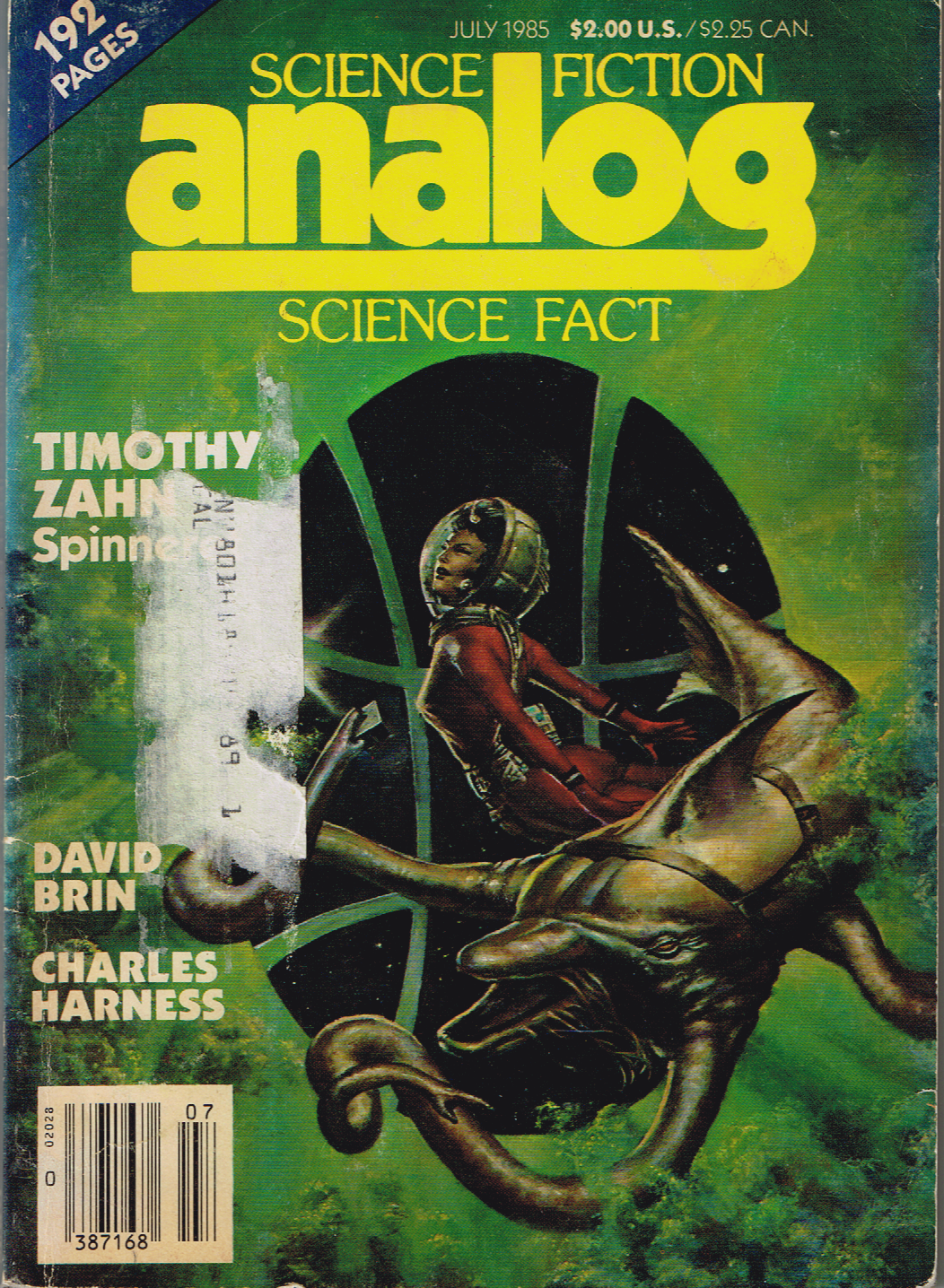
Sun Jun 21 2015 12:26 Reviews of Old Science Fiction Magazines: Analog 1985/07:

Here it is, the final entry in this series, started
seven years ago when I picked up a bunch of old SF magazines at a swap-fest. I've acquired a lot of magazines since then, and those are getting 'old', so it could continue, but this is the last of the original set. And good riddance, because this magazine smells like laundry detergent for some reason.
So what do we got? The cover story (one assumes) is the first part of Timothy Zahn's "Spinneret", which would later be published as a novel. It was good but I kinda see where it's going and don't feel a strong need to read the novel.
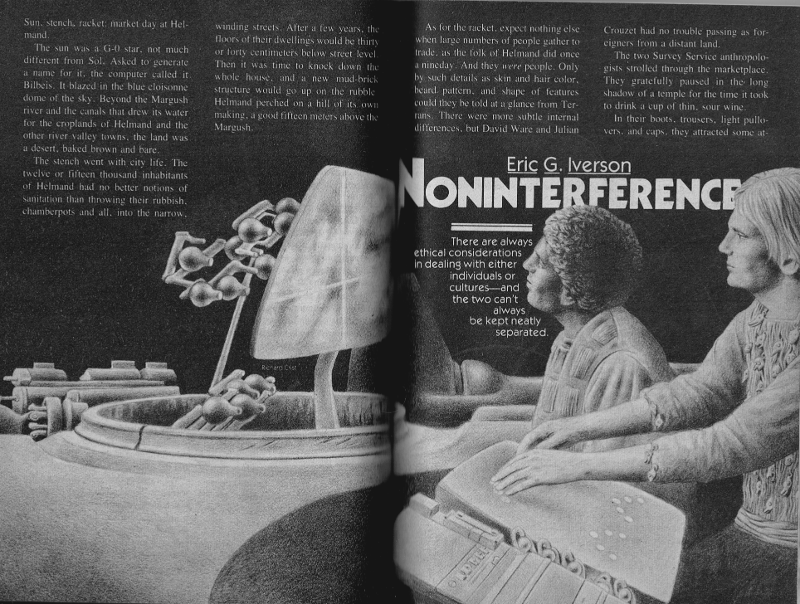
Eric G. Iverson's "Noninterference" is a pleasant story whose sole purpose is to dis the Prime Directive. The accompanying artwork seems more appropriate to a story about the mixing of the ultimate prog-rock album.
Charles L. Harness's "George Washington Slept Here" is the cream of this issue: a creative, funny and entertaining story that combines several Analog favorites (aliens, historical figures, and fussy middle-aged hobbies) that you rarely see together. Bonus: no time travel or major alt-history, just a character with a really long lifespan. I really liked the concept of the main character, a lawyer who loses every case he takes, but in a way that's more beneficial to his client than if he'd won. That concept's strong enough to support a series, but it looks like this is the only one.
This month's vague story blurbs:
- There are always ethical considerations in dealing with either indivuals or cultures—and the two can't always be kept neatly separated.
- Some fictional clichés eventually achieve a sort of reality—but seldom exactly as their creators imagined.
- Can a good thing be carried too far?
Now to nonfiction. David Brin's essay "Just How Dangerous Is The Galaxy?" classifies every known potential solution to the Fermi Paradox and puts them in a big table by which term of the Drake Equation they affect. He also introduces his own "Water World" solution, which he deigns to classify in a separate section called "Optimism". This solution posits that "Earth is unusually dry for a water world," and that intelligent life evolves all the time, and thrives for long periods, but very rarely builds spaceships. I'm just riffing on the idea here, and I don't buy the idea that "hands and fire" are prerequisites to advanced technology, but you could imagine a dolphin-type civilization treating a planet's surface and atmosphere the way we treat low-earth orbit.
Tom Easton's book review column includes a review of Ender's Game, which wanders into a long philosophical discussion that I won't reproduce here because it's pretty similar to stuff you can find on the Internet. I was disappointed to read that "Russel M. Griffin's The Timeservers is a pale incarnation of the diplomatic satire that made Laumer's Retief so popular." It was a Phillip K. Dick Award finalist, though, so maybe it's just on a different wavelength from Laumer.
In letters, paleontologist Jack Cohen returns fire at Tom Easton, who in an earlier book review column disputed the evolutionary biology in Harry Harrison's Cohen-collaboration West of Eden. And reader Michael Owens has it out with Ben Bova about the latter's support of the Star Wars program. Summary of Owens: "far from leading to a defense-oriented world, Star Wars leads to another offense-oriented arms race." Bova responds that he wrote a book (Assured Survival) that deals with all this stuff, and then mentions this comforting tidbit:
[T]he new defensive technologies do not apply only to satellites and ballistic missiles. They are already being developed into "smart weapons" that will make the tanks, artillery, planes, and ships of conventional land and sea warfare little more than expensive and very vulnerable targets. "Star Wars" technologies (plural!) can make all forms of aggressive warfare so difficult that an era of worldwide peace is in view—if the nations of the world want peace.
Which leads nicely into the thing I've saved for last because I've got a lot to say about it, in direct violation of my usual "if you can't say anything nice" rule. Previously on Analog, columnist G. Harry Stine asked readers to send in their answers to the following question, which I will quote in full:
What, in your opinion, is the most important problem that technologists should tackle in the next twenty years, and why do you believe this?

In this issue Stine reports the results, and I was looking forward to doing a kind of The Future: A Retrospective thing on them.
The first thing Stine does is disqualify 120 of the 127 replies he got. That may seem extreme, but that's approximately what I'd do if I was running a magazine and accepting fiction submissions. I was kind of laughing along as he disqualified entries for exceeding the word limit or otherwise ignoring the rules, but then I got to this:
49.61% of the replies [63 of 127]... discussed problems that were either (a) not technological problems, but social and political instead; (b) already solved or well along the road to solution; (c) trivial and parochial in their scope; (d) based on incorrect, incomplete, or outmoded data; and/or (e) the result of someone else's telling the respondent that the problem was a problem because the expert said so, whereupon the respondent stated it on faith without checking.
And at this point I gotta call bullshit. You didn't say "most important technological problem", you said "most important problem technologists should tackle." Social and political problems have technical aspects, and vice versa. The impact of a technological development is judged by its effect on society. This is the basis of the science fiction genre! You could replace every vague Analog story blurb with "Social and political problems tend to have technical aspects, and vice versa...", and it would always fit the story!
Half of Analog's readership can follow directions but their opinions are wrong. Let's take a look at the top five disqualified "problems" (all direct quotes, scare quotes in original):
- Control of nuclear weapons
- the "population explosion"
- the "energy shortage"
- the "raw materials shortage"
- "pollution" in various and sundry forms
I sure am glad technologists didn't waste any more time on these non-problems after 1985! According to Stine, America's ballistic missile defense system is well on its way to solving #1 (if the nations of the world want peace, of course). #2 isn't a problem anymore because the rate of population growth has slowed. #3 and #4 were never real problems. ("The only reason we had an 'energy shortage' was to provide an excuse for politicians and bureaucrats to gain control of natural resources, and thereby gain control over people.") As for #5, who's to say what counts as "pollution"? Like most words, it's a "semantically-loaded term". "Pollution in its many forms may be a localized problem in some areas, but it is not a worldwide problem."
So what are the seven entries that made the cut? I'm glad you asked, previous sentence:
- "Making products maintenance-free, i.e. designed for a 100-year life with a 0.0001 probability of maintenance." DISQUALIFIED. Maybe the move from 75 years to 100 would be a technical improvement, but the problem as it exists today is a problem with the way products are sold, and technical improvements won't change that.
- "[C]ontrol of the weather" to boost crop yields and prevent famine. SEMI-DISQUALIFIED. Modern famines are political problems, not technical problems. Control of the weather would indeed be great, not for this reason, but because it would let us mitigate the damage caused by our worldwide pollution problem.
- "The construction and maintenance of closed ecological systems". Sure, OK.
- Here's the shortest quote I could get that explains this one:
Education depends on communication. John points out that communication involves moving information from place to place... which really isn't much of a problem, but... managing the information is. It's possible to download lots of information into a student's mind. But if the student doesn't know how to determine what information is meaningful and relevant... everything stored in the student's memory is useless.
Now that's more like it! Not only is this a real problem, it's one that we made significant progress on between 1985 and 2005!
- "The development of the direct link between the human mind and the computer to produce a true intelligence amplifier." Another good one. We got both parts of this (mind-computer link and intelligence amplifier), but in practice they don't have anything to do with each other.
- "[T]he construction by machines of very small machines." This also happened but proved not to be a huge deal, and even Stine is kinda skeptical ("he doesn't specify exactly what technological problems can be solved by developing sub-microscopic technology"). I'm gonna go out on a limb and say the real problem is the reader doesn't specify exactly what social or political problems can be solved with this technology.
- And finally,
Del Cain of Augusta, ME presented a technological problem that is as much philosophical as technological... He wants technologists to develop structures and artifacts that tend to support healthy behavior in human beings—i.e. to help people live and rear children so they can develop to their full potential without trauma but not without struggle, difficulty, or drama. To do this, he believes that we should solve the technological problem of determining what are the optimum sizes and structures of healthy communities. In short, he feels that the big problem is developing technology with a life-affirming philosophy behind it.
I don't understand how Del Cain managed to smuggle the concept of Scandanavian social democracy past G. Harry Stine, but good job. No, wait, I figured it out: I'm projecting, and so was he.

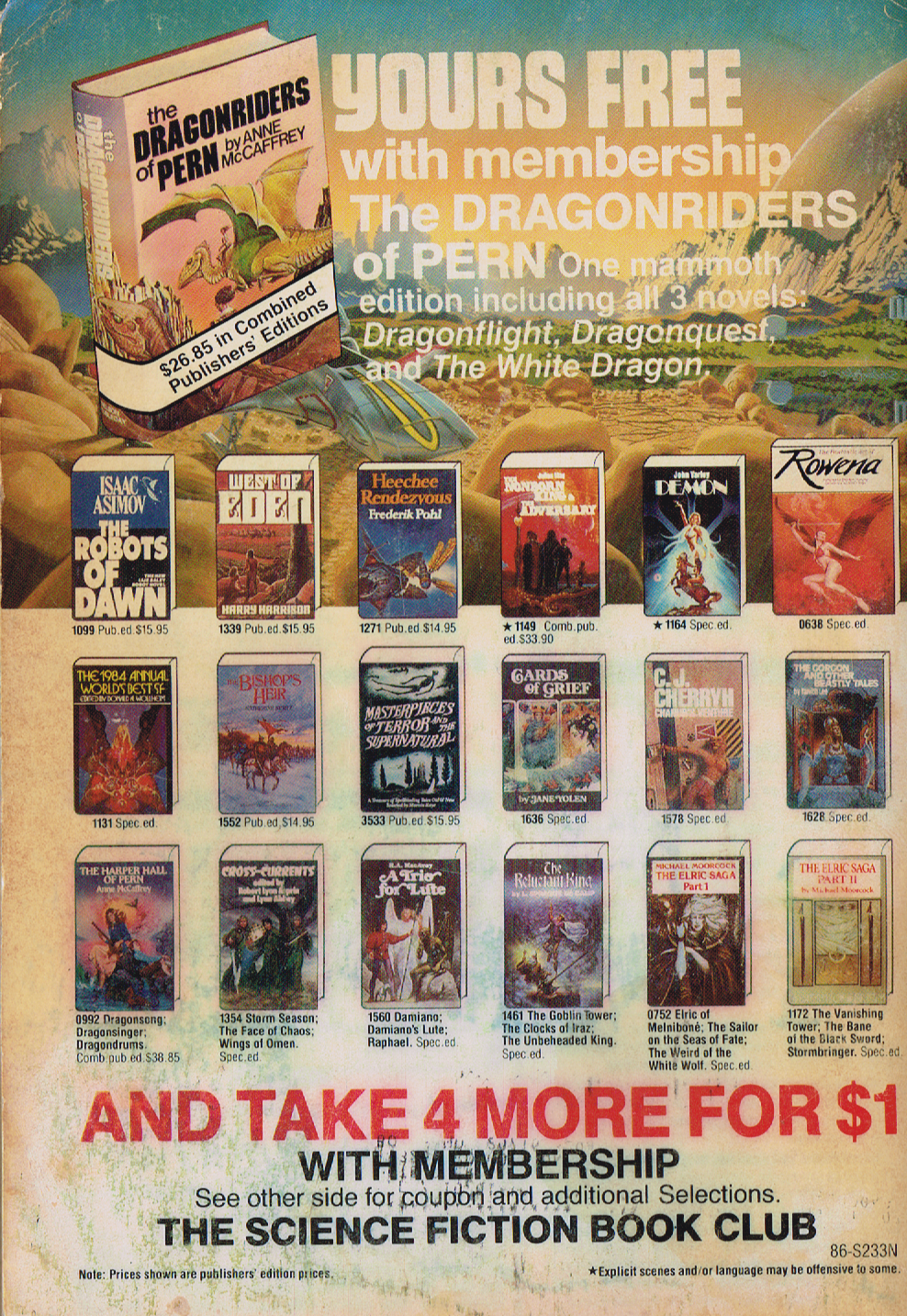
Well, there we go, that's our look at old SF magazines of the 80s. To commemorate the end of the series, I've scanned all the old ads in this magazine, not just the ones I thought were interesting or funny. But here are the ones I thought were interesting or funny:
I'll leave you with this question: what, in your opinion, is the most important problem that technologists should have tackled from 1985 to 2005, and why do you believe this?
literature
Thu Feb 26 2015 21:48 Reviews of Old Science Fiction Magazines: F&SF October 1985:

The first story in this magazine is James Tiptree's "The Only Neat Thing to Do", and the introductory copy introduces the main character as "a green-eyed young woman who happens to be one of the most appealing characters you are likely to encounter in these or any other pages," and my attitude was "Pffft, green eyes, sure, we'll see about that... DAMMIT." This story's so good. It starts out with this perfect wish-fulfillment space adventure but look at the title, folks, it's not gonna end well. Argh, so good.
Harlan Ellison still hates Gremlins, in fact he says he's been getting letters from people who scoffed at his Gremlins hate but now they've seen the movie they're swallowing their pride and sending him "toe-scuffling, red-faced, abnegating appeals for absolution." I'm harboring a doubt or two here, because he's also saying other people who took his advice (and presumably didn't see the movie) are thanking him.
Given that Gremlins has consistently been a well-regarded film since its release, why would someone say "Thanks for warning me off the movie I haven't seen that people still seem to like."?
But all that's in the past. In this issue Ellison doubles down, telling people not to see The Goonies due to "utter emptyheadedness", which, okay, at least it's a critique and not 'the lurkers support me in email.' Also on Ellison's shit list for this month: Rambo: First Blood Part II, A View to a Kill, and The Black Cauldron. He loves Cocoon, Ladyhawke, and Return to Oz, and who's to say he's wrong? Not me, 'cause I haven't seen any of those movies.
There's some really corny back-cover copy in one of the ads for books, but I know from experience that writing back-cover copy is the worst, so as a professional courtesy I'm not going to make fun of it. Kind of weird that most of the stories in this issue are SF or horror, but all the ads are for fantasy books.
Halley's Comet fever strikes the classifieds! There's an ad for Halley's Comet, 1910: Fire in the Sky, sort of a historical recreation by Jerred Metz. Also a "HALLEY'S COMET. TIE TAC or Stick Pin. Four color enamel and beautiful." I'm hyping up the Halley's Comet thing because I happen to own a mint in-box Halley's Comet Hot Wheels car the likes of which are currently going on eBay for a measly $5.32 used including shipping. C'mon! This is my nest egg here! I demand... demand!
literature
Sun Feb 15 2015 18:23 Poems of SCIENCE! I Mean, Science:
I picked up a cheap old poetry anthology called
Poems of Science, figuring there'd be some good stuff. And... there was, but I had wait for the modern conception of "science" to come about, and then spot poetry about a hundred years to come to grips with it, and decide that science is interesting and not going to go away. By that time I was more than halfway through the anthology. But around the late nineteenth century some excellent poetry starts happening, and I thought I'd share a couple links.
Miroslav Holub's Zito the Magician and Robert Browning's much longer An Epistle Containing the Strange Medical Experience of Karshish, the Arab Physician are really great and work as spec-fic stories. Swinburne's Hertha is this weird humanist we-are-made-of-star-stuff mythology that's what you'd expect from Swinburne. And then there's "Cosmic Gall", a goofy poem by John Updike which I'm gonna quote in full because it's the only thing of John Updike's I've read and liked.
Cosmic Gall
John Updike
Neutrinos, they are very small.
They have no charge and have no mass
And do not interact at all.
The earth is just a silly ball
To them, through which they simply pass,
Like dustmaids down a drafty hall
Or photons through a sheet of glass.
They snub the most exquisite gas,
Ignore the most substantial wall,
Cold shoulder steel and sounding brass,
Insult the stallion in his stall,
And, scorning barriers of class,
Infiltrate you and me. Like tall
And painless guillotines they fall
Down through our heads into the grass.
At night, they enter at Nepal
And pierce the lover and his lass
From underneath the bed—you call
It wonderful; I call it crass.
literature
Sat Nov 01 2014 23:23 Reviews of Old Science Fiction Magazines: F&SF October/November 1991:
I bet you thought this Crummy mini-feature was dead! That's because it was! When I started making pro sales I decided it wasn't a good idea to be constantly badmouthing my colleagues and the venues I was trying to sell to. So I stopped posting reviews. But a while ago Sumana and I were asked to pick a story to reprint in
Strange Horizons, and I really had no idea, because these reviews are the only records I have of which short stories I've read. (We ended up choosing Kim Stanley Robinson's
"The Lucky Strike".) And then I took this 1991 magazine on my most recent plane trip and pretty much everything in the magazine was fun. So I thought I'd mention some of the fun and keep a record for posterity.
There will still be some badmouthing, notably of the ad at the beginning of the magazine for a dorky "sexpunk" book. It's a two-page spread that includes some quotes from the stories, two of which are dramatizations of urban legends. Then it shows you the book's I-missed-the-80s cover, and then it brings on the hard sell: "Eleven Short Stories, Two Novelettes, One Novella—256 pages on acid-free paper." I gotta say, I was on the fence until I heard the book was printed on acid-free paper! I'll paste my scrapbook photos into it!
OK, on to the positivity! Carolyn Ives Gilman's "The Honeycrafters" is a Nebula award nominee-to-be that works its one basic idea from all angles and captures the thrill of Minecraft's Forestry mod. A super, super fun read. Bradley Denton has a great Breaking Bad-esque story in "Rerun Roy, Donna, and the Freak", complete with drugs cooked in an RV. Jane Yolen's "Dear Ms. Lonelylegs" is silly and only four pages long.
There's a weird subplot in the book review columns (one by Algis Budrys, one by Orson Scott Card) about how books that come out in paperback first are considered second-class citizens of the book world. Books that come out in hardcover first and then paperback are the upper-crust of 1990s science fiction society, living the high life while "paperback originals" are left to toil in the sweat mines. It's a fascinating glimpse of a distant culture.
Harlan Ellison, O.G. hipster, waxes about the thrill of introducing someone to something great and wanes about the anti-thrill of not being able to be a snob after everyone knows about the great thing. In this film review column he kind-of-but-not-really passes the torch to Kathi Maio. By which I mean Ellison's column will still be printed whenever he sends one in, but Maio is able to review three films in six pages, where Ellison writes twelve pages in this issue and encounters only one film, The Rocketeer (he luvs it). So we're not really looking at two film review columns, we're looking at one film review column plus Harlan Ellison's blog. A wise editorial decision on the part of F&SF.
In Isaac Asimov's science column, Isaac Asimov bemoans the downsides that come along with being as smart as Isaac Asimov. Fortunately, the mighty brain of Isaac Asimov is able to cope with such petty inconveniences. I like how Asimov's column (the topic is energy) gives respect to underappreciated scientists, not just once but repeatedly.
Back to stories. Mike Resnik's "Winter Solstice" is a sad story of Merlin that really highlights how the concept of someone living backwards in time is incoherent—one of Dan Simmons's Hyperion books covered some of the same ground and I had the same problem there. Lois Tilton's "A Just and Lasting Peace" is nice and creepy alt-history that does more character development than a lot of alt-history. (With a title like that, you know it's creepy alt-history!) Marc Laidlaw's "Gasoline Lake" had too many plot twists to keep my interest but I loved the setting and the setup.
There's a cartoon of a starfield where one star says "We're the star that inspired the verse 'Twinkle Twinkle Little Star'" and another star says "Yeah? Well we're the star that inspired the song: "When You Wish Upon A Star". I may be overthinking this, but... why does each star speak of itself in the plural? Is there an unspoken SFnal twist in which stars are collective intelligences? How did the stars discover these facts? Did Jane Taylor and Leigh Harline use long-range transmission to inform the stars that inspired them? Or is this the opposite of the "lunar real estate" scam, where stars pay for certificates that lay claim to certain human songs?
If you were a star, and you communicated with another star over a distance of hundreds of light-years, is this really what you would talk about? Would it be fair to say that these stars are so vain they think this song is about them?
Unaccountably, the cartoon does not answer these questions. I will say that this issue contains a "Dr. Quark, Low-Tech Physicist" cartoon that I liked.
You know, looking over this it's clear that mostly what I want to do is make note of the stories I liked and then snark on the columns, so maybe I'll rev this feature back up. Anyway, this issue was really fun. Pick up a copy 23 years ago!
literature
Mon Nov 18 2013 10:55 In Dialogue:
I wanted to participate in Darius Kazemi's
NaNoGenMo project but I already have a novel I have to write, so I didn't want to spend too much time on it. And I did spend a little more time on this than I wanted, but I'm really happy with the result.
"In Dialogue" can take all the dialogue out of a Project Gutenberg book and replace it with dialogue from a different book. My NaNoGenMo entry is in two parts: "Alice's Adventures in the Whale" and "Through the Prejudice Glass".
You can run the script yourself to generate your own mashups, but since there are people who read this blog who don't have the skill to run the script, I present a SPECIAL MASHUP OFFER. Send me email or leave a comment telling me which book you want to use as the template and which book you want the dialogue to come from. I'll run the script for you and send you a custom book.
Restrictions: the book has to be on Project Gutenberg and it has to use single or double quotes to denote dialogue. No continental chevrons or fancy James Joyce em-dashes. And the dialogue book has to be longer than the template book, or at least have more dialogue.
literature
dada
Thu Jul 11 2013 10:02 Billy Collins, Stand-Up Comic (Bonus: How To Write Poetry):
For reasons that need not concern us, I recently gave some advice on writing poetry. I don't know anything about poetry, but I was able to derive the most basic advice from first principles: "read a whole bunch of poetry before you try to write some." Adam Parrish knows more about poetry and offered some poetry-specific advice: "get over yourself".
I think a lot of incipient poets get caught in the idea that poetry is somehow about free self expression, and that the best poetry is that which most freely expresses the self—which, of course, isn't true. Poetry is a genre that you have to be literate in and a toolbox that you have to learn how to use.
If reading a bunch of poetry is too much work for you, you should at least take the time to reverse-engineer the findings of this paper by Michael Coleman (also via Adam), which uses machine learning to model the differences between poems written by members of the Academy of American Poets, and poems written by the general public. It gives some clues as to how the genre works and what's in the toolbox. e.g.:
The negative association with the PYMCP
variable ‘Rhy’—a proxy for the extent to which
words elicit other words that rhyme with the
stimulus word—indicates that professional poets
use words that are somewhat unusual but not necessarily complex. Professional poems have fewer
words denoting affect but more words denoting
number. Professional poems also refer less to the
present and to time in general than amateur
poems.
Run your stuff through Poetry Assessor until you start getting good scores. Now you're a poet! Well, sort of. The machine-learning algorithm can reliably tag crappy poems as crap, but it mainly looks at vocabulary and I don't think it knows about scansion at all. I ran the first paragraph of Bleak House—three ponderous Victorian sentences—through Poetry Assessor and it got a 1.8, making it a decent twentieth-century American poem. (And it's a very good paragraph, but you see the problem.)
I formulated my "read a lot of poetry" advice because that was also the techinque I used to figure out if I had any more specific advice to give. (I don't.) While reading a lot of poetry, I got really into the work of former US Poet Laureate Billy Collins. Collins has written a number of what I would call "NPR poems", poems that you could imagine him reading aloud on NPR, some of which he probably did read aloud on NPR. He's on NPR a lot. And at first glance the NPR poems have more in common with stand-up comedy than traditional or contemporary poetry.
I think it's best to think of the narrator of a Billy Collins poem as a fictional poet named "Billy Collins", a man whose bouts of incompetence and perpetual lack of inspiration are exploited by the real-world Billy Collins. Stand-up comics do the same thing. I became very interested in how Collins is able to use this persona to do serious poetic work through poems that aren't serious at all—again, something analogous to what a good stand-up comic does.
Some examples. I'm gonna start with Cheerios and
Litany, two poems I don't really like. These poems are about as confrontational as Billy Collins gets, but it's not because of their subject matter: it's because they're poetry hacks.
"Cheerios" has a Poetry Assessor score of 0.8--barely professional quality. In "Cheerios" the incompetent poet "Billy Collins" keeps trying to launch a flight of poetic fancy using the overwrought abstract language associated with amateur poetry: "stooped and threadbare back", "more noble and enduring are the hills". But he can never get it off the ground because the engine keeps stalling on concrete imagery--the objective correlatives associated with professional poetry. The problem with that is the concrete imagery consists of nothing but different breakfast foods ("waited for my eggs and toast", "that dude's older than Cheerios", "illuminated my orange juice"). So it's deliberately bad amateur poetry interrupted by deliberately bad professional poetry. Just saying it's a bad poem isn't enough. It's bad in a very interesting, bathetic way.
On the other hand, "Litany" has the incredibly high Poetry Assessor score of 4.4. (The maximum score given in the Coleman paper corresponds to a PA score of 5.2.) What's his secret? Collins spends the entire poem blasting out objective correlatives at high speed. Some of them are taken directly from other poems ("the crystal goblet and the wine"), some of them are allusions ("the plums on the counter", "the burning wheel of the sun"), some are original ("the boat asleep in its boathouse"). But as he shoots those images out, he classifies them, like he's working on an assembly line, or brainstorming the poem he will eventually write. "Litany" is the opposite of "Cheerios". Collins is hacking the part of your brain that evaluates poetry, pushing all your buttons with free-floating imagery. It's a bad poem because you don't know enough about the people in the poem to understand what the imagery means.
Some other NPR poems, arranged roughly in ascending order of seriousness:
Pay special attention to "Another Reason Why I Don't Keep A Gun In The House" and "Nostalgia", two hilarious poems that are literally highbrow stand-up comedy. "Gun" is Seinfeld-esque, employing the tricks of modern poetry to take an exasperating everyday situation and blow it up into series of escalating fantastic images. (In case you were wondering, its Poetry Assessor score is 2.2, squarely on the "professional" side.) "Nostalgia" (1.3) is more of a Steve Martin kind of comedy, presenting logically flawed arguments and the dumb things people say when they're arguing on autopilot.
"Nostalgia" escalates not to a punchline--a funny kind of absurdity--but to a reductio ad absurdum, a logical absurdity. That makes it a good transition to two Collins poems that, although they deal with ephemeral topics, are more serious and less jokey. They both deal with words, the relationship between words and reality, and the fact that we're always putting words into boxes that themselves have no relationship with reality:
"First Reader" (2.9) is my favorite Collins poem. I feel like "American Sonnet" is the most professionally composed of his poems, and Poetry Assessor agrees, giving it the highest score (3.2) of any of the poems I tested. (Apart from "Litany", which is a poetry hack.) I tried writing down some analysis but these two are easy poems to appreciate, so I'll spare you. I want to close with two poems that I'm not crazy about as a whole, but which do a really interesting thing in the last stanza: they anthropomorphize individual words.
"Paperwork" shows fictional poet "Billy Collins" not being able to write a poem, dreaming in the end of gaining inspiration from an "ancient noun who lives alone in a forest." "Thesaurus" is all about anthropomorphizing words, but it's not until the end that the words leave "the warehouse of Roget" and take on independent lives, "wandering the world where they sometimes fall/in love with a completely different word."
Anthropomorphizing words is how Collins deals with the fact that poetry is a lonely business: writing things down all day, making sure to use exactly the right word all the time. Who else needs to be that careful about individual words? Stand-up comics, that's who. A punchline and a poem both rely on an unexpected word at exactly the right time. That word, when it comes along, is your best friend.
PS: Minor error in the Coleman paper which confused me when I was trying to convert between the paper's scores and Poetry Assessor scores.
For example, Robert Hass has two poems in the
corpus, The Image and Our Lady of the Snows, which score in the high to very high range of .72 and .94, respectively.
Those numbers should be reversed. "The Image" has a score of .94 (PA: 5.2), and "Our Lady of the Snows" has .72 (PA: 1.1)
literature
writing
Thu Nov 29 2012 10:25 The Silver Eggheads:

I read this 1961 Fritz Leiber novel and... I dunno. There's a lot of interesting stuff in this book, but also a lot of crap, and some of the interesting stuff is only interesting by accident.
It starts out so well! Actually my copy starts out pretty poorly, with this self-congratulatory blurb which I'm mainly quoting so I don't have to summarize the plot:
It is a very lucky thing Fritz Leiber decided to be a writer and not a surgeon. Somewhere in his background, though, there must lurk a frustrated medico, for he writes, as it were, with a scalpel... His target this time is the whole world of the literari—writers, publishers, reviewers and the great reading public—a rich field of self-flatterers, phony intellectuals and soft-headed businessmen to which Mr. Leiber does full justice. But because he writes with infinite glee, he is not vicious: he doesn't hate the world or the people in it. He simply has fiendish fun in cutting through to expose the frenzied, tangled, Heath Robinson structure beneath the complacent surface.
Hey, baby, you must be a frustrated medico, for you write, as it were, with a scalpel. (Also, Heath Robinson ~= Rube Goldberg.)
"Reviewers" get off pretty light in The Silver Eggheads; I don't think any reviewers even show up. But we got writers! A militant union of writers who in the opening chapters go on strike and destroy the wordmills, 1960s room-sized computers that act as their coauthors and creative enablers. In the destruction of the wordmills Leiber gives us some honest-to-goodness infernokrusher:
...
Fritz Ashton Eddison loosed a cloud of radioactive bats inside a Fiction House Fantasizer (really a rebuilt Dutton Dreamer with Fingertip Credibility Control).
Edgar Allen Bloch, brandishing an electric cane fearfully powered by portable isotopic batteries, all by himself shorted out forever a whole floorful of assorted cutters, padders, polishers, tighteners, juicers, and hesids-shesids.
Conan Haggard de Camp rammed a Gold Medal Cloak-'n-Sworder with a spike-nosed five-ton truck.
...
Infernokrusher fans will also enjoy this monologue later on in the book:
But I did spot a federal investigator named Winston P. Mears just outside. I got to know Mears while he was investigating me on charges—nothing was ever proved—of designing atomic-powered giant robots (an inevitable technologic development that still seems to terrify most humans).
It's a really funny book. And man, the robots. There's a government robot programmed for censorship. It's only fair to let you know that I'm gonna flat-out steal that idea, and when you see it you'll know this is where I got it. There's a robot who writes science fiction for other robots. We get to see a bit of his work: this is from the steamy "cranking scene":
Clinch, clinch, clinch went the bost working pinchers, firming the cable to the streamlined silfish burden. Squinch, squinch, squinch went to [sic] the winch as Dr. Tungsten turned it. A feelingful flood rilled the grills of his brunch frame. 'Happy landings,' he gusted softly, 'happy landings, my golden darling.' Seven seconds and thirty-five revolutions later, a shock of delicious violence trilled his plastron. He almost let go the winch crank. He turned crinkily...
Apparently that stuff really does it for robots. (We also see some terrible human-written science fiction from the infrafictional slush pile.) And here's where things start falling apart/being interesting only by accident.
The robots in The Silver Eggheads are humanoid and have gender, but they're not human genders! Some robots are "brunch", aka "robost" (whence "bost working pinchers"), and other robots are "silf", aka "ixy" (whence "silfish burden"). I spent half the book wondering what was the deal with these genders and why they didn't use human genders. It's pretty clear that "brunch" is male and "silf" is female. It's clear by the use of pronouns, and from the silf censorship robot, who says "I have a lot more in common with beings of my own sex, whatever material they're made of, than I do with babbling robots or brunch men." But why not just use "male" and "female"? WHAT WAS GOING ON?
What was going on was, I was overthinking it. There's no difference. Halfway through the book, in an infodump that spans two chapters, we learn that the robots copied human genders. Robots don't use the terms "male" and "female" because robot gender is a social construct. Unlike human gender, you see.
[I]t's become traditional for a robot—a brunch robot, I mean now—to have conections that are all of the pattern you humans call male, or plug-ins, while a robix has only female connections, or sockets.
Yeah, whatever, Fritz Leiber. You had your chance to create entirely new genders for robots and you blew it. Not surprising, given your 1960s Playboy sexism that is quaint enough in the first part of the book but which takes over the storyline around the time of the two-chapter infodump and turns The Silver Eggheads into wacky "battle of the sexes" crap and jokes about breasts. Also, there's no evidence that you ever wanted to be a surgeon.
So, as I said earlier, I dunno. The Silver Eggheads: an infuriating mix of hilarity, insights into creativity and generative fiction, and crap.
literature
Fri May 18 2012 12:54 ASINs that Spell Words:
In the past year I've learned more about Amazon's ASIN product identifiers than... well, probably more than the median person wants to know, but not more than
I want to know. One thing I've learned is that the ASIN for a print book is the same as its ISBN, but the ASIN for the Kindle edition of
that same book is an Amazon-specific code. And where ISBNs are all numeric, non-ISBN ASINs tend to contain letters. Which means in theory you could have a Kindle book (or other Amazon product) whose product identifier was obscene.
Well, enough chitchat, let's look at some books whose ASINs end in five- or six-letter words! Courtesy of an Amazon site map and a word list:
literature
Mon May 14 2012 14:11 A Time Machine And Other Poems:
Among my recent childhood scans were a number of books, written in pencil and bound with staples and tape. One of the earliest is a six-page chapbook of poetry called
A Time Machine and Other Poems.

For the first time ever, I now present A Time Machine as it was originally intended to be seen: on the Internet. I wrote these poems sometime between the ages of 6 and 8, and I'm much happier showing them to you than the poems I wrote when I was a teenager. I think you will see that certain themes have been constants in my writing my entire life.
A note on the text: The poems were originally formatted as free verse, but they're clearly not free verse, so I reformatted them. I've corrected the spelling throughout except in one case where it was ambiguous. Strangely, there is no poem called "A Time Machine".
A Time Machine and Other Poems
Written and illustrated by Leonard Richardson
A time poem
There's no such thing as a time machine.
Even so you may sometimes wonder
If you could hear ancient thunder
If you could see an ancient beam.
If you could swim in an ancient stream.
So build a pretend time machine if you please.
And go and feel an ancient breeze.
The dinosaurs have died
The dinosaurs have died you see.
Even in the great big sea.
So when you're swimming in the sea,
Beware of dinosaurs, you and me.
Tyrannosauruses are red
Tyrannosauruses are red
Allosauruses are blue.
When you're near them,
Run away to. [sic]
How did the dinosaurs die out?
How did the dinosaurs die out?
Was it a whale with its spout?
No one knows for sure I know
But in a time machine I will go.

Other books in this series
- Better Homes and Gardens
- All About Dinosaurs
- What Can You Do?
- I Saw a Dragon (and I mean it!)
Oh man. That "whale with its spout" line gets me every time. And the first poem's ABBAACC rhyme scheme is pretty nice.
I'm sure I wrote the "Other books in this series", but the only one I still have is Better Homes and Gardens ("WITH QUESTIONERES AND CHECKLISTS!!!). It's nowhere near as good as A Time Machine—like most magazines, it's full of padding—but it does include the immortal line: "Now buy the stuff you don't have." Better Homes and Gardens has its own "Other books" list, which promises a fifth book, Computer Games—also lost to history.
site-meta/Best Of NYCB
literature
Mon Jan 16 2012 10:50 Findings:
My writing life has settled down a bit so I'm finally going to write about
Findings, the social reading startup where I worked last summer. This is more an essay about what I see in Findings than an introduction to the site--you can see lots of general introductions
linked to from this Findings blog post, including
co-founder Steven Johnson's introduction, and the
Business Insider article whose title is the perfect elevator pitch, "Findings is GitHub for Ideas".
If what I'm about to say sounds interesting to you, there are development jobs open at Findings right now. Just as a reminder, I myself don't work at Findings anymore, and even when I did, only the foggyheadedest knave would have taken my personal opinions as representative of company policy.
 Let me start out with this quote I took from Darwin's The Descent of Man, not because the quote itself proves anything, but because the quote is an important part of my reading of Darwin:
Brehm gives a curious account of the instinctive dread, which his monkeys exhibited, for snakes; but their curiosity was so great that they could not desist from occasionally satiating their horror in a most human fashion, by lifting up the lid of the box in which the snakes were kept. I was so much surprised at his account, that I took a stuffed and coiled-up snake into the monkey-house at the Zoological Gardens, and the excitement thus caused was one of the most curious spectacles which I ever beheld.
If you want to learn about evolutionary biology, read Steven Jay Gould's essays. Darwin's a good writer and he got it basically right, but he didn't know about genes or DNA. I read Darwin to experience the origins of the field. I didn't expect (though perhaps I should have) to encounter endless artifacts of the days of two-fisted Baconian science.
When Charles Darwin needs to figure something out, he carries out an experiment,
no matter how tedious or disturbing. He takes snakes to the zoo, he puts kittens' feet in his mouth, he floats 94 kinds of plants in seawater, he hacks aphids. If someone has the temerity to question his conclusions he's all "Citation needed? I'll give you citations, motherfucker!"
When you read a book, it has an effect on your mind. You're a slightly different person after reading it. You've created something new: a reading of the book: Here's an apropos quote from Alberto Manguel's A History Of Reading, which I read on paper and typed in. Manguel is talking about Petrarch's Secretum:
What Augustine (in Petrarch's imagining) suggests is a new manner of
reading: neither using the book as a prop for thought, nor trusting it
as one would trust the authority of a sage, but taking from it an
idea, a phrase, an image, linking it to another culled from a distant
text preserved in memory, tying the whole together with reflections of
one's own -- producing, in fact, a new text authored by the reader.
Readings are ephemeral. Life goes on, and the memory fades. Ken Macleod's The Star Fraction had a huge influence on me, probably leading to whatever career I now enjoy as an author of fiction, but I read it ten years and 600 books ago, and now I don't remember a damn thing about it.
 That's why we dog-ear pages and highlight passages. We're instantiating our reading of the book so we can go back later and approximate the mental state it gave us without re-reading the whole thing. Even if all we got out of a book was "this bit was funny", it's better to have the funny bit at hand than not. Even if you never go back to the highlighted passage, the act of highlighting replays that passage and deepens your initial memory of it.
Liberate your readings
I've been typing in quotes from the paper books I read, like I did with the Manguel. Of course, with an electronic book, you don't have to do this. The act of highlighting creates an electronic record of your reading of the book. When I was in college I read about the first e-ink research coming out of MIT, and I knew that this was the future. Indeed it was the future, because I had to wait ten years for the technology to make it to market. But, sour grapes, we've got ebook readers now.
Ebook readers have big problems, but at this point the problems are mostly political, not technical. For instance, you can highlight passages when reading a book on your Kindle, but because of a deal between Amazon and the publisher, your book's metadata may include restrictions, which the Kindle will obey, on how much you can highlight. And your highlights and notes—the "new text authored by the reader"—are stuck on a website that Amazon didn't put a lot of work into because they don't consider your reading of a book important to their business.
Findings takes advantage of the fact that Amazon is wrong about this. Findings liberates your highlights and makes them searchable and shareable. Your reading of a book is a big part of your relationship with that book, and Findings gives you access to it.
You can also use Findings to take a reading of a web page, creating a record of what would otherwise be an ephemeral activity. I'm not as interested in this feature, but people are using it quite a bit, and my interest does increase as the length of the web page I'm reading approaches the length of a book.
Browse readings
So that's what Findings can do for you personally. Now let me pitch you the network effects. Take a look at this screenshot which shows the Findings global stream:

You can't see the global stream without logging in, which I think is a shame because I think this is what really sells Findings. We have here a stream of little bits of text, like Twitter used to have on their front page. Except here, every bit of text is a quote that someone liked well enough to save. It's very high-quality stuff. At the top you can also see some recently added books, and by clicking on a book you can see someone's condensed reading of the book.
Basically, Findings gives you browsing access to a large library, not of books, but of readings. It's easy to discover new books, people who read books you like, and—this is new—people who read books in ways you like.
There are a ton more useful things I could mention, but they're mostly behind-the-scenes things where Findings makes things "just work" (like consolidating multiple editions of the same text), or they depend on features that haven't been implemented yet. So I'm going to close by mentioning the social signalling feature.
 Strut your stuff
One underappreciated feature of paper books is signaling to other people that you are cool. You read books! Fancy books, like Ulysses! You care enough about books to make space for them in your house. You take them on the subway even though they're heavy. Darwin would say it's like the peacock's tail. But if you have an ebook reader, nobody knows how cool you are. You're just a person with an ebook reader.
By letting you publicize your reading of an ebook, Findings reinstates your ability to send those social signals. The downside is that you have to actually read the book. You can't just put a big book on your coffee table: the thing you're sharing is what you got out of the book. (Well, you can fake it, but it's probably about as much work as reading the book legitimately.)
So that's Findings. I don't use it as much as I thought I would, because I'm still trying to draw down my stack of paper books, but when I read a book on my Kindle, it stays read, thanks to Findings.
I mentioned this before, but the last thing I did at Findings was design a web service for them, which they're hopefully working on now. Once the web service launches, you'll be able to write programs that import readings into Findings from non-Kindle sources.
Do it yourself
One final note: If you have a Kindle, connect it to your computer and look on its filesystem. All your highlights are kept in a structured-text file located at documents/My Clippings.txt. This file includes highlights taken from PDF files and other ebooks not recognized by Amazon, which don't get synced to kindle.amazon.com. Even if you don't use Findings, take control of your highlights by backing up this file.
Image credits: McKay Savage, Romana Klee, and André Fincato.
literature
Tue Apr 05 2011 21:17 Solaris:
We were talking to
Zed Lopez and he mentioned there was some author one book of whose he's never read, because he doesn't want to live in a world where he's read all of this person's work. I don't think he meant it
as dramatically as all that, but it brought to mind my own similar pledge about Stanislaw Lem. I've read all the available English translations of his work, except
Solaris. I have
Solaris, I just didn't want to live in a world in which I'd read all of Lem.
But that conversation with Zed made me realize that living in a world with no more Lem to read was much better than dying without having read all of Lem. And those are the only two options, barring a tricky race-condition maneuver. So over the past week I read Solaris on the subway. And now there's no more English Lem for me to read.
I don't think I'll ever write anything as good as Solaris but I'm pretty sure I can do better than the English translation of Solaris. Not really recommended; for pure mind-blowing Lem action it's gotta be His Master's Voice or Fiasco.
literature
Fri Feb 04 2011 08:59:
I've reached the end of the first volume of Mark Twain's autobiography, although I started at page 200 (this was recommended in the introduction). I had a pencil handy while I read the book, with which to mark up all the funniest and most interesting passages, and I thought I'd share a few with you.
Earlier I called this book "an advertisement for e-books", and although I was referring to its physical dimension I was more truthful than I knew, because more or less the second half of this book is scholarly notes. Even the notes are pretty interesting, but it would have been nice to have some kind of hyper-text mechanism to keep them at hand during the reading.
A few sample interesting notes:
The [Second Iowa] Regiment had been disgraced by general order for having failed to prevent vandals from stealing taxidermic specimens from McDowell College in St. Louis, which was being used as a prison.
In 1910 in "The Turning Point of My Life", Clemens recalled that Herndon told "an astonishing tale" about the "miraculous powers" of coca, instilling in him "a longing to ascend the Amazon" and "open up a trade in coca with all the world."
I'd like to buy the world some coke?
Ok, on with the fun. Quotes from the autobiography itself:
My parents removed to Missouri in the early thirties; I do not remember just when, for I was not born then, and cared nothing for such things. It was a long journey in those days, and must have been a rough and tiresome one. The home was made in the wee village of Florida, in Monroe County, and I was born there in 1835. The village contained a hundred people and I increased the population by 1 per cent. It is more than the best man in history ever did for any other town. It may not be modest in me to refer to this, but it is true. There is no record of a person doing as much—not even Shakspeare. But I did it for Florida, and it shows that I could have done it for any place—even London, I suppose.
On unconscious plagiarism: "all our phrasings are spiritualized shadows cast multitudinously from our readings."
"William Swinton was a brilliant creature, highly educated, accomplished. He was such a contrast to me that I did not know which of us most to admire, because both ends of a contrast are equally delightful to me."
"I conceived the idea of a magazine to be called The Back Number, and to contain nothing but ancient news; narratives culled from mouldy old newspapers and mouldy old books; narratives set down by eye-witnesses at the time that the episodes treated of happened."
The account of his duel in "About Dueling" is great. "I woke up Mr. Laird with some courtesies of the kind that were fashionable among newspaper editors in that region."
I also loved this section about James G. Blaine, the Continental liar from the state of Maine.
On election day we went to the polls and consummated our hellish design. At that time the voting was public. Any spectator could see how a man was voting—and straightaway this crime was known to the whole community.
I feel that this ties somehow into the "Horrid Tragedy In Private Life" saga:
Susy [Twain's daughter] and her nearest neighbor, Margaret Warner, often devised tragedies and played them in the schoolroom, with little Jean’s help—with closed doors—no admission to anybody. The chief characters were always a couple of queens, with a quarrel in stock—historical when possible, but a quarrel anyway, even if it had to be a work of the imagination. Jean always had one function—only one. She sat at a little table about a foot high and drafted death-warrants for these queens to sign. In the course of time, they completely wore out Elizabeth and Mary Queen of Scots—also all of Mrs. Clemens’s gowns that they could get hold of—for nothing charmed these monarchs like having four or five feet of gown dragging on the floor behind.
I think that's enough for now.
literature
Mon Jan 31 2011 11:10:
A story I helped critique in writing group has been published:
"Showoff" by L.K. Herndon. It's a story about an alien wereflamingo. If that doesn't sell you, you can't be sold.
literature
Thu Jan 27 2011 23:57:
Hello, weblog. I am writing in you. I just finished "Four Kinds of Cargo", my first post-novel short story, so now I feel like I can write some other stuff. The story still needs to pass the Sumana "does this plot make basic sense" test, but I'm optimistic.
Beautiful Soup work has mostly focused on trying to get easy_install to work, working around a Launchpad bug--I'm still not totally sure if it's working. Last Friday I was in Dallas for work, so tomorrow will be a BS development day.
I seem to really like writing fiction about small businesses--"Mallory", "Awesome Dinosaurs", Constellation Games, and this new story all revolve around business partnerships. I'm just doing my part to boost the economy--did you know that stories about small businesses are responsible for most of this country's stories about job growth?
I'm still reading that space-astronomy book and I'm saving up more interesting bits to tell you. I'm also reading the first volume of Mark Twain's autobiography and it's awesome—he's just dictating random stories as they occur to him, and, like Groucho Marx, he's always in comedy mode. I don't think the printing of this autobiography will create many new famous Mark Twain quotes, if only because Mark Twain never said the existing "famous Mark Twain quotes". But this cubical advertisement for e-books is to me as America: the Book was to Sumana: every few minutes I'm disturbing her with some new weird kind of laugh.
literature
writing
Sat May 15 2010 16:03 Reviews of Old Science Fiction Magazines: Analog 1989/01:

The best thing here is Marc Stiegler's essay "Hypermedia and the Singularity". I've put off reviewing this issue for a long time because I wanted to do this essay justice, but I give up. I'll discuss it later. It's a prediction-filled essay from a dude who would shortly go on to take over development of Xanadu, and it's got lots of
Mac Classic illustrations. It's like reading some contemporaneous
Analog science article about how space colonies will work, in a future where there are actual space colonies all over the place.
What else we got? Rick Shelley's "To Give Them The Moon" is really fun, action-packed, and fulfills every nerd's fantasy of advancing a primitive society without having to know everything on Ryan's time travel poster. Just general "uh, somehow light is both a particle and a wave" type knowledge is good enough. It's a sequel to January 1988's "The Worlds I Used To Know", so keep a look out for that. Bonus: story includes an ominous alternate-world "Department of Security", the "equivalent of the Defense and Justice departments combined."
What is it with the 1980s and dull medical SF? After reading Timothy Zahn's "I Pray The Lord My Soul To Keep", I'm convinced that Zahn should stick to space opera. A.J. Austin's "The Promise" is another "inequitable social access to advanced medical technology" story--that makes at least four just in this random sampling of magazines I picked up way back when. They're all the same story!
L.A. Taylor's "Testing, 1, 2, 3..." is so 1980s I have no idea what the point of the story is. I've read it three times and it's got something to do with typewriters, but I don't get the joke. I've used a typewriter, folks. (Though, admittedly, only the display typewriter at Office Max back when I was a kid.)
J. Brian Clarke's "The Last Defender" reads disturbingly like a boring story written by me. I won't mention the rest of the fiction, except to express my amazement that Analog published a story (Arlan Andrews's "Indian Summa") in which the final revelation is literally "oh, yes, we did that with magic."
Stan Schmidt has a good editorial casting a Mars mission as a proving ground for techniques of international cooperation. Book reviewer Tom Easton points out that strict scientific accuracy is not Rudy Rucker's strong suit (Wetware). Letters column has some fun nitpicking-rebuttal involving big-O notation.
This is the issue where the unhelpful Analog story blurbs descend into nonsense: "What do you do when you know achieved something you could have that you haven't?" ([sic] throughout) I dunno, maybe Miss Manners would know what to do? If you're curious, here's the blurb for "Testing, 1, 2, 3...": "An important part of research and development is testing--and when the systems being tested get sophisticated enough, the methods may become a bit strange!" No kidding!!
Here's the photo gallery, featuring many crazy ads and one awesome piece of spot art. I could commission an entire anthology themed around that drawing and every piece would be awesome.
I just had brunch with Evan and his dad; the elder Baer has somehow acquired a double subscription to Analog, and gave me some of his extras. I've now got the June 2010 and the July/August 2010 issues to review. Yes, that's how cutting-edge is the science fiction in Analog. They're publishing two months into the future, not just one month like other magazines.
BTW, here's a story blurb from the July/August issue: "The ways a tool was designed to be used are not the only ways it can be used...." This sort of thing has been going on for over twenty years! (I'm apparently determined to reduce the already infinitesimal probability that I'll ever be published in Analog.)
literature
Mon Apr 12 2010 19:31 Reviews of Old Science Fiction Magazines: F&SF 2000/06:

RoOSFM returns! Because I was near the end of a huge book (
The Structure of the Cosmos, which is great) and didn't want to take it on the subway. Here we go!
There is some quality stuff in this issue, though "The Birthday of the World" by Ursula K. Le Guin and "In Shock" by Joyce Carol Oates (!) both start out slow. I recommend reading the first section of N. Lee Wood's "Three Merry Pranksters at the Louvre" as a non-genre story, and skipping the rest. My favorite story in the magazine was Chris Willrich's "The Thief With Two Deaths"--like a Discworld story written by someone with a completely different sense of humor from Terry Pratchett. The shorter pieces are forgettable, but just in terms of word count, most of the fiction in the magazine is good.
I also think this is the first old SF magazine I've ever reviewed to have good cartoons. By which I generally mean "New Yorker-quality cartoons that were rejected because they were too fantastical for The New Yorker." There's also an amazing cartoon in this issue, one that I think I or Sumana mentioned a while back but couldn't find. Here it is. That's by New Yorker staff cartoonist Tom Cheney--not Dick Cheney, as you might think. Actually three of the four cartoons in this issue are his; I guess he's a cut above.
In his science column Gregory Benford talks un-scientifically about how great Southern California is (which it is), and demonstrates that even talented science fiction writers can't write good science fiction and explicit futurism at the same time. (Why are people going to the mall to buy e-books?) There are some funny Hollywood-lunacy stories a la An Evening With Kevin Smith.
Zeitgeist miscellany: Kathi Maio's movie review column praises every aspect of Galaxy Quest. Charles De Lint's book review column covers In The Beginning... Was The Command Line and mentions "Linux, that outlaw maverick of operating systems". Remember the "Linux doldrums" of June 2000?
From the classifieds:
FREE FANTASY GIFTS CATALOG. Your #1 source for Dragons, Fantasy Figures, Skulls, Lamps, Clocks, Jewelry and much more! Call or write...
I've come to terms with this genre of kitsch--crystal dragons with semiprecious stones for eyes, pewter wizards holding glass orbs. But clocks? Clocks are SCIENCE!
literature
Thu Mar 04 2010 16:47:
Last week Sumana and I went to the launch party for
N.K. Jemisin's epic "The Hundred Thousand Kingdoms". Nora founded the writing group I'm in, and I read and critiqued a draft of the novel just before she sold it. Then she left the writing group and went off to be a famous novelist.
I always have a difficult time at events held in bars, but Sumana is very good at introducing me to people. For instance, I met Saladin Ahmed, who along with Nora was nominated for a Nebula this year. And then comes this SF Signal interview with Saladin, Nora, and many other Nebula nominees. "If your work couldn't have been on the ballot this year, what work would you have liked in its place?" Saladin:
I'd also have been happy to see more two-fisted fun on the ballot. Two of the absolute best stories I read this year were "Zeppelin City" by Michael Swanwick and Eileen Gunn, and "Let Us Now Praise Awesome Dinosaurs" by Leonard Richardson. Both were ridiculously enjoyable and Nebula-worthy to my mind.
I'm encouraged!
literature
writing
Wed Feb 24 2010 19:33 Prime Suspect:
More from Walter Jon Williams's
The Praxis:
The 313-degree Shaa compass had no zero coordinate, but began instead with one, the odd number left over after factoring the prime number.
I guess that's true. Maybe the Shaa could help Bill Gates factor those large prime numbers.
Apart from prime number weirdness (and species essentialism), this is a really fun book. There was a lot of boring clan politics at the beginning, but it turns out that was setup for an examination of how totally dysfunctional is a society based on clan politics. I often suspect these authors of being secretly enamored of the petty intrigues of clan politics, but it's clearly not the case here.
Insta-update: Before posting this entry I asked Adi about the compass thing. His response:
I don't understand that statement at all. Do the Shaa simply relabel their compass? Instead of using labels of 0,1,...,360, their compass uses the labels 1,2,..,313? (i.e., their compass has a full range of motion, but simply a different scale)
If this is in fact true, then I wonder what additive identity the Shaa have chosen. From the statement you wrote, it seems as though the additive identity is 1... which can't of course be consistent with 1 working as a remainder after division by prime numbers. And the "odd number left over after factoring the prime number" does not make sense to me... Why one would use the multiplicative identity [ie. 1] as an additive identity is beyond me.
Unfortunately, by this point in the book the Shaa are all dead, so we can't ask them, and it's clear that a bad compass is the least element of their legacy of incompetence.
math
literature
Tue Feb 16 2010 20:35 Hey, Who Doesn't?:
And forty-one, a prime number, was a significant number for the Shaa, who loved primes and multiples of primes.
--Walter Jon Williams, The Praxis
math
literature
Sun Feb 07 2010 11:53 Reviews of Not That Old Science Fiction Magazines: Apex Volume 1 Issue 11 (2007):
Not to be confused with Abyss and Apex. I believe Sumana got this magazine from a friend in 2008 and gave it to me so I could study the market. I studied it enough to see "Science Fiction & Horror" at the top of the cover, and then put it in with the rest of my unread magazines. I do not like horror. I realize that this says more about me than about the genre, so I will spare you my half-baked opinions and nickel psychoanalyses of the horror writers profiled in this issue of Apex. Suffice to say that I am suspicious of any genre named after an emotion. Like if comedy was just called "laughing".
That said, there was one story in this issue I really liked. Sara King's "The Moldy Dead" is one of my favorite types of story: a first contact story with no humans in it, just alien-on-alien action. The horror element is surprisingly understated, and I appreciated it on an intellectual level when it came into play in the ending. It was kind of Star Trek-ish, though (if I may damn with faint praise) more interesting than any time Star Trek ever tried to do horror. (PS: Helpful hint to space explorers. If you go to a planet looking for intelligent life, and you find only one form of life on the planet, that might be it!)
I also enjoyed the title of one of the pieces: "Cain XP11 (Part 3): Sorry About All The Blood". That was the third part of a four-part novella about a government plan to clone history's great serial killers and train them as super-soldiers, a well-thought-out plan which surprisingly goes awry.
And that's the kind of thing found in the rest of the magazine. The ads are uniformly interesting: small-press stuff with the distinctive small-press art style, and because I don't believe in the reading conventions of horror the copy just makes me laugh. ("Resurrected against his will in an unholy deal with Hell, he must now use his surgical skills to harvest the living to feed an ever-growing army of the undead.")
However, I would like to give a special shout-out to David Wong, editor of Cracked.com and author of John Dies At The End, which in 2007 was advertised as available online for free, but which since then has been trapped in a paper book. Great title! I'm getting most of my entertainment here from the titles. ("Where Evil Lurks: Special Edition") Also Alethea Kontis had an editorial about curses that was pretty interesting.
Finally a note about the cover. I don't have my camera handy but it's a brownish painting of the face of some dude who looks like an octopus (or maybe it's the whole body, if dude really looks like an octopus). Tentacles, mottled skin, big round eye, etc. I looked at this cover and thought "Man, this is why I hate horror. I'm supposed to be prejudiced against this creature just because it looks like a tentacle monster. There's probably some Lovecraft ripoff story in this magazine, instead of a cool story about aliens." But no, the cover illustration was just a picture of one of the aliens from "The Moldy Dead", a cool story about aliens.
So that was a pleasant surprise. But then I started wondering how Apex readers distinguish between a horror tentacle monster and a science fiction tentacle monster. Then while looking at the ads I figured it out: teeth. The single most reliable indicator of horror art is exposed teeth (runner-up: an open mouth without exposed teeth).
Octopus-dude's teeth, if any, are not depicted on the cover. Its most prominent feature is the eye, which you'd think would be creepier (I'd rather see a tooth lying on the sidewalk than an eyeball), but in fact it creates empathy, letting you know that this other thing is a person. In the ads in this magazine, creepy things tend to have their eyes closed, or else their eyes lack pupils.
This teeth thing is also largely a matter of prejudice (there's a funny scene in Old Man's War that makes fun of this), but I think that's how the signalling works.
literature
Wed Jan 27 2010 10:00 HP Sauce:
Possibly the greatest Lovecraft sentence ever (from "The Strange Case of Charles Dexter Ward"):
To call it a dull wail, a doom-dragged whine or a hopeless howl of chorused anguish and stricken flesh without mind would be to miss its most quintessential loathsomeness and soul-sickening overtones.
Reminds me of a night when Kris and I were doing everything in Lovecraft style, like the "My most embarrassing moment" column in Seventeen magazine.
At once I felt a hideous upwelling of blood from within my bowels, a red stream of ichor that flowed without measure into the white trousers I had just purchased at this dying town's dusty Mercantile.
Kris also came up with the ultimate dinner-table line: "If you'll excuse me, I have to go give vent to certain measured sounds."
On a related note, does anyone else find it uncanny that the spokesman for Nintendo of America in the 1980s was named Howard Phillips?
literature
Fri Jan 15 2010 10:51 Reviews of Old Science Fiction Magazines: F&SF 1986/03:

A good issue, but the whole time I was reading, I was waiting for the story that fulfilled the promise of the cover. A spaceship landing (or, I suppose, taking off) near a stegosaur! Which story would it be? "Good Night, Sweethearts" by James Tiptree Jr.? "Still Life" by David S. Garnett? Probably not "The Dog of Truth" by Kit Reed. Well, I'm at the end of the magazine, by process of elimination it's gotta be "Sea Change" by Scott Baker. But no, it was just a misleading cover image that has nothing to do with any story in the magazine. Oh well.
I think the best story is "Sea Change", despite the stegosaurus disappointment. Although it has a little too much of a "I went on vacation and had a really evocative experience, so I wrote a story" feel. So maybe the Tiptree is the best. They're both very good.
Also recommended are Karen Joy Fowler's "Wild Boys", and Neil W. Hiller's "Peace Feelers", in which invading aliens have the same military structure as the US Army. (Points deducted for puns.) It's always strange to be on the New York subway reading about someone trying to blow up the New York subway.
Paul Di Filippo's "Skintwister" and David S. Garnett's "Still Life" are both the "eternal youth is possible but only for the rich--and at what cost?" story that was written a lot in the 80s, or maybe is written a lot by writers approaching middle age.
George Zebrowski is now officially my "writer whose work I find compelling when described but disappointing when I read it." He's got a story about semidecidability called "Gödel's Doom" (originally printed in Popular Computing!), but the story just can't happen. The Incompleteness Theorem says it can't happen. The author knows this. The characters in the story know this. They spend much of the story exchanging dialogue: "The Incompleteness Theorem says this can't happen!" "But what if it can?" And in the end it happens and makes no sense and is boring. Ted Chiang did it better ("Division by Zero").
On the plus side, because of "Gödel's Doom" I found MathFiction, which lists fiction about math and critiques the math. Here's its get-off-my-lawn page about "Gödel's Doom". Here's 29 more works of fiction that involve Gödel somehow. MathFiction also loves "Division By Zero".
In movie reviews, Harlan Ellison can't shut up about how great Brazil is (or, indeed, anything). It's an enjoyable column. Algys Burdis's book review column contains a review of Schismatrix and The Postman, which I just read. (3/4 kickass adventure, 1/4 David Brin's cranky blog!) Also the phrase "Now, Bruce Sterling is what they have begun calling a 'cyberpunk'", and these two footnotes:
*Someday if they don't stop giving Brin awards and money long enough to edit him properly, he, his publishers and we his readers will all lose. The initial burst of charming and/or socially praiseworthy ideas will have slackened a little, the need for a better grasp of storytelling per se will make itself felt, and Brin, like many another bright young star before him, will be left wondering where his career has gone. This will be a notable shame, in his case.
*At this point, I began picturing [Philip K.] Dick as a squid among the stars grappling Arthur C. Clarke's whale from Childhood's End. Fortunately, in most realities this footnote does not exist.
No interesting ads (apart from some classifieds pushing Halley's Comet kitsch), the cartoons still suck. The end.
literature
Thu Jan 07 2010 20:08 Captain Raptor!:
My now-undirected ongoing search for the phrase "awesome dinosaurs" has picked up another example of what if this was music would be called dinocore. From
The Aviary I found out about a series (two is a series!) of illustrated children's books called "Captain Raptor": "CR and the Moon Mystery" and "CR and the Space Pirates". I got copies today and they're awesome. 1) dinosaurs in space! 2) everything's drawn like those gorgeous old-fashioned movie posters. 3) since it's a children's book you probably learn a valuable lesson. Minus points for stereotyping dinosaurs based on their species (which I also did).
literature
biology/organisms/dinosaur
Thu Dec 31 2009 16:44 Nostalgiathon 2009: Best of Multimedia:
Welcome to this gala end-of-end-of-year event. First off, it's a special presentation of
The year in Internet video:
- The single best media value of 2009 is Chrontendo. About 30 hours
of video reviews of Famicom and NES games. My consistent exercise
companion.
- Academic runners-up: David
Blight's incredible class on the Civil War and Reconstruction, and
J. Bradford Delong's economic history of the
20th century, which is really more like "J. Bradford Delong
talks about whatever he wants and then tests you on it," but which is full of interesting stuff.
- Surprise dark-horse entertainment: bobtwcatlanta's
Youtube channel, full of engrossing television ephemera from the
80s and 90s.
- James Rolfe continued to entertain with his AVGN videos
(best episode of 2009: Michael Jackson's
Moonwalker, posted before Michael Jackson's death made it cool/tasteless to
do Michael Jackson-themed web videos). But if you can't stand Rolfe's
scatology-obsessed Nerd character, you should at least watch his
amazing documentary of a life spent making films, Cinemassacre 200,
which only has one F-bomb right at the beginning.
- Infomania's Viral Video Film
School and Target:
Women also continued their runs of excellence.
- Another noteworthy workhorse: the mega-agglomeration of That Guy With The Glasses, which at this point has a couple dozen web "shows", transformative works all. They're hit or miss, but I've found maybe eight that I really like, and I let those accumulate in browser tabs until I've got enough to get me through a thirty-minute run.
- Now on to miscellaneous one-offs. The Match Game 1977 School Riot, in which the mannered high civilization of The Match Game collapses into anarchy and warlordism. (Don't know how TMG worked? Invest a couple minutes in some boring video of TMG working properly, and then you can enjoy both this video and the excellent Saturday Night Live parody "It's A Match".)
- Music videos: One from the 80s that uses "Sinistar" as a metaphor for a bad
relationship. One from TMBG. OK Go does it again. A rerun of "Wishmaster Misheard", revealed in 2009 to have been created by our friend Lucian.
- Music videos featuring unrelated pop culture characters: The world-famous Bohemian Rhapsody Muppets turns the unwieldy, huge Muppets cast into a strength. Four Super Mario World levels, one for each part in Queen's "Don't Stop Me Now".
Film: I don't watch a lot of movies. I think I only went to the theater four times in 2009: to see "Star Trek", "Moon", "My Winnipeg", and "Ponyo". Most of the time Sumana and I watch movies at home. That said, the Crummy.com Movie of the Year is "University of Laughs", a 2004
Japanese movie that I've been looking for since 2005. (We
eventually imported it from Yes Asia for an exorbitant sum.) It's an
awesome film. Like, imagine "The Five Obstructions", except instead of
Lars von Trier playing a funny prank on you, it's a police censor
and your livelihood is on the line. And the film is hilarious. We saw
it with Lucian and couldn't stop laughing. Between this movie and
"Game Center CX", I'm coming to appreciate how dependent is Japanese
humor on body language. Truly, this is the real secret of manzai.
Runner-up: the thematically similar "The Lives
of Others", which won a lot of awards and you probably don't need me
telling you how great it is. If for some reason you demand that I give the 2009 award to a film released in 2009, then I give it to "Moon", despite its huge plot holes.
Television: After Battlestar Galactica ended in disaster, I watched only one TV show: the ultimate Sumana/Leonard guilty pleasure, USA Network's Psych. The show's silliness continually breaks the fourth wall and the old dictum how "if it ain't on the page, it ain't on the stage". The "Tonight's Episode" episode titles are the clear spray-on preservative that gives the icing on the cake its gloss.
Food: Is food a "medium"? I say yes, and give appreciation for three New York restaurants that started in 2009 (or very late 2008): Vesta and Bare Burger here in Astoria, and Dos Toros (Mission-style taqueria!) near Union Square.
Books: I read 88 books in 2009 if you count the one I created, which I'm going to because that means I read exactly twice as many books as in 2008. I made a special effort to read more books this year, and it
definitely succeeded. The Crummy.com Book of the Year is "Mason &
Dixon" by Thomas Pynchon. Reread of the Year: my mother's copy of Stephen Jay Gould's
"Bully for Brontosaurus", the book that originally introduced me
to evolutionary theory (a ringer, it was practically my only
reread of the year). "The Complete Dying Earth" was amazingly
fun, as mentioned
earlier. I also had a really good time with two espionage books:
"Tinker, Tailor, Soldier, Spy" and "The Zimmerman Telegram".
I can recommend two books from 2009 that you've never heard
of. First, "Monday Begins on Saturday" by the Strugatsky brothers,
obtained from Susan McCarthy. Second, "A Time of Gifts" by Patrick
Leigh Fermor, which sat on my wishlist for 4 years after I heard about
it on Crooked Timber. It's a book where I start every tenth paragraph
thinking "This is it, the purplest prose ever, there's no way Fermor
can pull out of this nosedive!" and by the end of the paragraph I'm
like "Good show, old chap! Pip-pip, what?"
Worst book that I read all the way through in 2009: Reward for
Retief, one of Keith Laumer's last novels. (My LibraryThing
review: "Man, what a train wreck. Give us more Groaci!") I read it all
the way through because I'm a Retief completist and because I admired
Laumer for continuing to write after his stroke. Objectively speaking,
he should have stopped in the mid-80s, but I'm sure he needed the
money. Keeping a midlist author on your publication rolls as he passes
his prime is not the most efficient method of wealth transfer, but
it's a time-honored one.
I read about 150 individual short stories (ie. not part of collections), from magazines, writing group, and the TE slush pile. There is no Crummy.com Short Fiction of the Year this year because I recuse myself for conflict of interest. Also I can't really think of one, though you can't go wrong with Jack Cady's "The Night We Buried Road Dog".
Video games: I was talking about this with Kirk. Here's the thing. When I read a book, even a book I don't like, I learn something about writing. But when I play a video game, even a good game, I don't usually learn much about game design. There's probably fifty games I spent at least an hour playing in 2009, but I can only think of one that was both as stylistically interesting and as viscerally enjoyable as, say, "A Time of Gifts".
People who love movies might make a similar distinction. There are really interesting movies, there are really enjoyable movies, and every once in a while there's a movie with crossover appeal, the first movie to tell a really fun story using some previously introduced innovation. I think comparing video games and movies is a sucker's game so that's as far as I'm going to take this analogy.
When I think of 2009 games that are pure fun I think of a lot of entries in series: the "Metal Slug" anthology I picked up, "New Super Mario Bros. Wii" in multiplayer, Mega Man 9, the DS Grand Theft Auto game (I really love sandbox games, but most 3D first-person games make me nauseous, so I liked having a modern GTA I could physically play). All of these games combine a close allegiance to some longstanding series with solid implementation and attention to detail. I also think of "Retro Game Challenge" and my "Cave Story" replay, games that are just a collection of well-executed callbacks to older games.
When I think of games I that have a lot of innovation I think of "Scribblenauts", an amazingly creative game that has huge, huge conceptual and implementation problems. I think of "Barkley: Shut Up and Jam: Gaiden", a game that presents a deadpan sarcasm I can't remember seeing outside of interactive fiction, but objectively speaking not a game I want to play all the way through. I think of "Treasure World", a game that I was obsessed with for a couple weeks but which is not technically a game at all.
"Spelunky" is the only game I played in 2009 that I would consider fully successful in both enjoyment and innovation. It took the least popular aspects of roguelike games (permadeath and extreme dependence on randomness) and made them crowd-pleasers by incorporating them into a preexisting genre (super-difficult platformer), introducing roguelike replayability to people who hate ASCII graphics and turn-based keyboard controls.
The fact that I'm describing Spelunky in terms of other games and genres implies that it's not all that innovative. But creativity is almost always the combination of two preexisting things. The ideas in this year's innovative titles will be synthesized into 2011's crossover hits which will lead into 2015's soulless cash-cows.
OK, time to start work on the New Year's Eve party. Happy new year!
food
film
games
literature
television
Sun Dec 27 2009 20:54 Reviews of Old Science Fction Magazines: Analog 1986/09:

Sick of these reviews? I've only got ten magazines left! Which means
about another year of this feature. Oh well! Enjoy
some low-quality ad photos.
This issue contains Stanley Schmidt's editorial response to the
Challenger disaster, as well as letters from readers dealing
with the same topic. Schmidt references a Harry Stine column from a
1983 Analog, "The Sky is Going to Fall", which discussed the
public's likely reaction to a Shuttle disaster. It's not pretty. I
thought I would write about this in some detail but it's too
depressing and bloodless to synthesize peoples' raw reactions twenty years
afterwards.
Schmidt mentions Barbara Morgan, Christa McAuliffe's
backup for the Teacher in Space program, and hopes she'll be headed
into space soon. Morgan did eventually fly a Shuttle mission, but not
until 2007 and not as part of the Teacher in Space program.
OK, on to the stories. The best one is Vernor Vinge's "The
Barbarian Princess", even though it's a story about people who run
a science fiction magazine. It doesn't get as metafictional as I'd
feared, and it gave the cover artist an excuse to do the kind of cover
you never thought you'd see on Analog. Shelley Frier's
"Plagiartech" was also very entertaining, but I felt like it
wanted me to sympathize with the incredibly unsympathetic protagonist.
Arthur C. Clarke invents steampunk with his fake essay "The
Steam-Powered Word Processor: A Forgotten Epic of Victorian
Engineering". No kidding. Fully-formed steampunk, complete with
Charles Babbage obsession, in 1986.
Halfway through Robert C. Murray's "The Immortal Smythe" I thought
to myself: "this story is going to end with a terrible pun." In fact,
the story ended with terrible fake science and then a terrible
pun. Insult to injury.
Eric Vinicoff's "Haiku for an Asteroid Scout" is a pretty good
story and has some original future-tech, but you'll have to fight your
way through portmanteau words like "neomarble", "robomech",
"holotank", and "pubtrans". (And "maglev", which only became a real
word because of repetition in stories like this--I'm glad holotanks
aren't practical, or we'd have them too.) The story takes place in
Space Feudal Japan, so be prepared to do battle with corporate feudal
lords, a restaurant called "Mount Fuji", seppuku, "synthetic
ricepaper" (I would have written "paper"), and "the most expensive
geisha house in P-Tokyo!" Geisha house?! What happened to love hotels
and hookers? Also, the haiku sucked. You know what, screw it! I'm
writing my own Space Japan story! With love hotels, and hookers!
Charles R. Pellegrino and James R. Powell write a check they'll
never be able to cash with the title of their nonfiction article,
"Making Star Trek Real". There a conversation in the letters section
about whether Analog nonfiction articles assume too high or too
low a level of technical knowledge. This issue's articles split the
difference, by explaining really complicated things like K-mesons at
the same level of detail used for fairly simple things like the
inverse square law.
Elizabeth Moon's "Sweet Dreams, Sweet Nothings" is memorable only
for its "notebook-sized computer with a flip-up screen" and some (biological) virus
talk that starts out interesting but rapidly descends into
implausibility. Harry Turtledove's "Though the Heavens Fall" is a
sequel to his earlier, bad "And So To Bed",
published eight months earlier, and it's worse than the
original. Like a lot of alt-history it tries to be a cute remix of
real history, as though history is a game of solitaire where you can play the cards in any order but the game always plays pretty much the same (maybe Turtledove pioneered this technique, I don't know
much about alt-history). But it's not cute! I hate it! It doesn't help
that "Heavens" is a very predictable story and in terrible taste.
Conflict of interest watch: the game column mentions but does not
review the post-apocalyptic RPG Twilight 2000 (not
affiliated with Twilight), which advertised heavily in
Analog: there's been an ad for T2K in almost every issue
I've read. Also, "Plagiartech" author Shelly Frier was Analog's
associate editor at the time.
When I write these reviews I get a lot of people asking me "What
kind of exposition have you found to be the clumsiest?" Actually, I am
lying. No one asks me that. But I do have an answer if anyone ever
does ask: the clumsiest exposition is that used to establish the
timeframe of the story. Here's some dialogue spoken by the
psychiatrist of the eponymous "Immortal Smythe":
Now Dr. Smythe. Surely you don't believe you have been resurrected on
three occasions? This may be 2301, but medical science, while
considered somewhat above the quackery state, cannot perform the
ultimate Lazarus technique and restore the dead to the living.
Man, if my shrink talked like that I'd find another shrink. And
here's a bit from "Though the Heavens Fall", which also gives you a
picture of the cute history-remixing:
"I don't know," Gillen said judiciously. "When the Conscript Fathers
wrote the Articles of Independence after we broke from England in '38,
they gave us two censors to keep the power of the executive from
growing too strong, as it had in the person of the king."
Oh, was it '38? THIS HAS NO RELEVANCE TO THE STORY
literature
Sun Dec 13 2009 16:10 Reviews of Old Science Fiction Magazines: F&SF 01/2002:

Yes, in case you needed to feel decrepit, the F&SF issue containing Gordon Van Gelder's 9/11 editorial now qualifies as "old". It's also got good stories by Gene Wolfe ("The Waif") and R. Garcia y Robertson ("Death In Love"). James Stoddard's "The Star Watch" is worth a read, and Harlan Ellison playfully gropes the reader with "Never Send To Know For Whom The Lettuce Wilts".
James Sallis' book review column gives the thumbs up to a William Tenn collection (never heard of him? he's awesome) and to Kelly Link's Stranger Things Happen. Kathi Maio's movie review column covers previously-unknown-to-me Happy Accidents, which sounds like if Primer was a romantic comedy. The Gregory Benford/Elizabeth Marlarte science column comes really close to discovering the uncanny valley, and contains this interesting bit:
We have no true idea of an upper limit on lifespan. If we eliminated all aging... eliminated diseases, and could avoid all causes of death except accident (including suicide), how long could we live? Most people, when asked, guess at ages like 120, or 150. The answer gathered from death rate tables is astonishing: close to 1500 years!
Cartoon insanity! Three of the four cartoons in this issue involve rats. There's one with rats in a maze, one with humans instead of rats in a maze, and... this one, which--what the hell? It's a dog whistle I just don't hear.
If you still don't feel old, check out the photo gallery, which has ads for defunct MMORPGs and novels you read a long time ago. Also the fourth-wall-breaking classified ad I mentioned in my review of the February 2009 issue.
literature
Thu Dec 10 2009 22:32 ...In Popular Culture:
Not sure where I found out about Tielhard-influenced SF writer George Zebrowski, and did not expect to find out (while researching this entry) that he sometimes collaborates with Pamela Sargent. Last year I picked up his novel
Macrolife and a short story collection,
The Monadic Universe. I read
Macrolife back in May: I was hoping to like it, and it certainly had epic scope, but I found it pretty dull, so I didn't have high hopes for
TMU.
But, I read through it today, because it's one of a dwindling number of books that I didn't pack into boxes, and it wasn't too bad. Most of the stories were 1970s New Wave fables of pollution and overpopulation, but the title story was very good, as was "Heathen God". But I read a lot of books, and apart from the yearly nostalgic look back (coming soon!), I don't mention them here unless I have some interesting tidbit to convey. Preferably something that's not already on the Web.
And so I do about "Assassins of Air", the most 1970s story in TMU. The protagonist steals old pollution-spewing cars and sells them for scrap, the illicit face of an economy that's going to great lengths to undo enormous environmental damage. And what does he do with his money?
"I need it now," Praeger mumbled. "I have to pay for my PLATO lessons. I gotta have it, honest."
What? That couldn't be the ahead-of-its-time PLATO time-sharing system, could it?
PLATO the sign read: PROGRAMMING LOGIC FOR AUTOMATIC TEACHING OPERATIONS. Once the facility had been free, just like chest X rays. Now students had to pay to milk the machine, twenty dollars a rap; but it was a good teach if you wanted to learn a skill.
Wow! PLATO became big in 1972 (insofar as it became big at all), and Assassins of Air was published in 1973. Zebrowski clearly had his ear to the ground. The technical details of PLATO don't exactly play a major part in the story, but it's still very impressive.
It made me wonder about the first pop culture references to the Internet or ARPANET. According to Wikipedia, the very first was either the 1969 Disney movie The Computer Wore Tennis Shoes, or a 1985 episode of Benson, the sitcom whose intro seemingly gives you permission to laugh at black people being chased by attack dogs. Google Book Search reveals an ARPANET reference in Theodore Roszak's 1983 thriller "Bugs". Not really sure where else I'd go for this information--TV Tropes has nothing--but it seems likely that there are multiple ARPANET references in early-1980s print science fiction, given how the damn thing was full of SF fans.
literature
Wed Dec 09 2009 23:24 Reviews of Not That Old Science Fiction Magazines: F&SF February 2009:

Every story in this issue is good! In fact, almost every story is better than the Charles Coleman Finlay story ("The Texas Bake Sale", which has the best title but pales in comparison to all but Mario Milosevic's "Winding Broomcorn".) Fred Chappell's "Shadow of the Valley": great. The reprint of Jack Cady's Nebula-winning novella "The Night We Buried Road Dog": awesome. Eugene Mirabelli's "Catalog": good, and pushed beyond good by a
metatextual classified ad in the classified ad section, which I don't think anyone has mentioned online before. I mention it now! It's great.
In my history of reviewing this damn stack of magazines I don't think I've ever found an issue as satisfying as I found this one. There's just not much to say. (Also I'm going to sleep soon.)
literature
Sun Nov 29 2009 20:17 Reviews of Old Science Fiction Magazines: F&SF 1991/08:
Three "eh"s for the stories in this issue. Almost all of them were decent, but nothing stood out. The best stories were the last two, "A Long Time Dying" by Geoffrey A. Landis and "The Woman, the Pilot, the Raven" by Dean Whitlock. Proving how subjective this stuff is, there's an editorial at the beginning (not seen all that often in F&SF) where Kristine Kathryn Rusch talks about what a tough room she is.
The big unspoken theme this issue is the collapse of the Soviet Union. Specifically, not seeing it coming. The cover date is August 1991, the month of the hardline anti-Gorbechev coup that IMO was the point at which the USSR started seriously falling apart. But the magazine was surely in stores the previous month and had been put to bed months earlier. With that in mind, here's the intro to a Bruce Sterling story:
National news commentators looked tired by the middle of 1990. The Cold War had eased, the Soviet Block had released restrictions on its satellites and the world seemed a little warmer. Sometimes it seemed as if we had stepped into an alternate universe . . . at least until Iraq invaded Kuwait. Bruce Sterling's story, "The Unthinkable," returns to that place where the Cold War appears to have lost a bit of its edge -- in a true alternate universe, filled with its own demons and nightmares.
"The Unthinkable" is kind of a Lovecraft take on the nuclear arms race. No, not quite like "A Colder War." Although it's a pretty accurate prediction of 1992, modulo the magic, the story's introduction apologizes that it's not more topical!
Similarly, August 1991 was not a good time for Norman Spinrad to publish a novel called Russian Spring that projects the space race into the future. From Amazon reviews it seems his biggest predictive blunder was saying "Soviet Union" instead of "Russian Federation", but it's a little sad to read Orson Scott Card saying that Russian Spring is "almost certain to be the book of the year" given that the book looked obsolete before the year was out. Here's the F&SF review from Orson Scott Card's website site if you want to read it. I'll just quote the most poignant part of the review:
Current events will catch up with him, but not as quickly as you might expect: For instance, there's no mention of the Gulf War in Russian Spring, and indeed, the novel might have been written entirely before that war took place -- and yet the Gulf War is exactly the kind of thing that Spinrad's future America could do, and if we let our euphoria at victory lead us to become global bullies, his vision of a morally and economically bankrupt America may be far more accurate than any of us would wish.
There are a couple more minor things I could mention but I'll close by highlighting an ad from the classifieds:
ALIENS PROGRAM IBM PC Games. Nifty demo disk [5.25 or 3.5] $2.00. Tommy's Toys, Box 11261, Denver, CO 80211.
I vaguely remember this from BBS days; this guy had a shareware company and his schtick was that he was so prolific because he was a space alien. In actuality, as he now admits on his website, he was just using QuickBasic to make cheap games. Now he's a novelist, with such titles under his belt as "Baby Boomer Morticians", "Space Reachers 2999", and "Salvation Day: The Immortality Device." Not an Unwinder's Tall Comics character, folks, a real person.
literature
Tue Nov 24 2009 15:43 Reviews of Old Science Fiction Magazines: Analog 1986/06:

A really interesting issue, despite the useless-in-isolation second part of Vernor Vinge's "Marooned in Realtime". First, there's Timothy "I'd Rather Be Writing
Star Wars Tie-In Novels" Zahn, with an enjoyable space opera piece, "The Evidence of Things Not Seen". Geoffrey A. Landis has the funny "Stroboscope", in which a guy cryogenically freezes himself as a cheap way of time travel, but people keep waking him up and making him sign forms.
Those are the two stories from this issue that I thought were really good. But there's also "Bugs" by Christopher Anvil, an incredibly weird story about the mid-80s personal computer industry.
"Bugs" is like Anvil took one of those "if computers were cars" email forwards and turned it into a science fantasy story.[0] In 1986. The ending is a disappointment and everything is a huge cliche, but I couldn't stop reading it. It's like the Hamlet of email forwards. Also, for whatever reason all the computer companies are named after animals: Sharke, Gnat, Barricuda, Cougar.
Misc.: Book review column praises Speaker for the Dead and Always Coming Home. G. Harry Stine's "Alternate View" column covers the history of the Kalashnikov, revealing an odd kind of faith in central planning:
One can hope the new Soviet avtomat Kalashnikova obr 1974 is a big hit and replaces the AKM. The AK74 is a scaled-down AKM firing a Soviet 5.45mm. round. The need to keep the smaller weapon well maintained may deter terrorists from using it...
(Sumana wants me to add that the 19th was the Kalashnikov's anniversary (?) and that The Colbert Report did a bit about it.)
Interesting ads are up in a gallery. Ad not pictured says that Arthur C. Clarke has "one of the world's most exciting and honored imaginations."
PS: Has anyone read "Twist Ending" by Barry Longyear? This issue has an ad that promises "a realm where the dinosaurs, after 70 million years, decide it is finally time to return to Earth."
[0] You can get away with a fair amount of magic when writing "hard" SF about computers. Much more than you could get away with when writing about spaceships or mining equipment.
literature
Mon Nov 16 2009 08:15 Pop Culture Invades History:
Yesterday I read Barbara Tuchman's amazing book on the Zimmerman telegram,
The Zimmerman Telegram. It was a little distracting that Woodrow Wilson had an advisor named Edward House, because I kept reading paragraphs like this:
Superficially it would seem that Wilson, who dealt in principles and disliked details, was perfectly seconded by such a man as House, who loved the minutiae of deals and personalities. But this was not so. If Wilson had too much contempt for men, House had too little respect for principles. He became so immersed in his wire-pulling, in playing one personality against another, in keeping everyone conciliated and all wheels turning that this became and end in itself. The goal of negotiation became lost in the procedure.
As a bonus, there's a minor character named Princess Daisy.
literature
politics
Sun Nov 15 2009 17:15 Reviews of Old Science Fiction Magazines: F&SF 12/1986:

Fun cover, huh? That's for John Morressy's enjoyable fantasy-versus-science-fiction story "Spirits from the Vasty Deep".
I'm reading more of these magazines because all the books are packed up for the move. This was a really good issue. The best story here was "A Stage of Memory" by David Brin and his brother Daniel. Kenneth W. Ledbetter's "Outpost on Europa" has no big literary merit but is a great adventure with talking dolphins. Ron Goulart's "Glory" was a Hollywood vampire story that was fun but didn't really feel fresh (it's fairly similar to "A Deskful of Girls", a F&SF story from 1959 I reviewed last month). I didn't really enjoy Pamela Sargent's "The Soul's Shadow" but I did admire how it read like a D.J. Hall painting come to life.
In the book review column, Algis Burdys disses Walter Jon Williams's first novel, which I found a little distressing because I've got a later novel by him packed in my boxes of still-unread books.
Harlan Ellison's film column provides me with even more endless amusement than usual. His schtick is that in this column he's going to get right to the point, which leads to even more grandiose digressions and outrageously-stated opinions than an average Harlan Ellison F&SF film review column.
Ellison apparently hates James Cameron and must grudgingly admit that Aliens is "a rather good action-adventure". He loves Big Trouble in Little China as a "cheerfully blathering live-action cartoon that will give you release from the real pressures of your basically dreary lives." (He goes on for a full column of print in this vein.) He loves the 1937 Frank Capra film Lost Horizon, which had recently been restored and was making a tour.
He really loves The Great Mouse Detective, "the first new Disney animated to recapture the incomparable wonders of Fantasia, Snow White and the Seven Dwarfs, Pinocchio and The Three Caballeros." I'm neither a huge Disney animation fan--the only one I really like is Pinocchio--nor an expert, but The Three Caballeros? The geography lesson? The movie whose plot summary is "It is Donald Duck's birthday. He recieves three presents."? Harlan Ellison, these random-ass opinions are why I love your twenty-year-old film review columns.
Anyway, I vaguely remember seeing The Great Mouse Detective when I was a kid, and it was definitely fun. But Three Caballeros fun? I dunno.
Ellison is really pissed off at the Geraldo Rivera TV special The Mystery of Al Capone's Vaults, referring to it as "that 2-hour con job" and calling Geraldo "increasingly lacertilian". Finally he gets to what is supposedly the point of the column,
heaping praise on Labyrinth and regretful complaints on a Ridley Scott film called Legend which I'd never heard of. It's a movie that pits Tom Cruise against Tim Curry (look at their names! They're almost the same!), with Robert Picardo in a supporting role. And according to IMDB comments, a much better director's cut was released in 2002, so it's definitely worth a look.
And with that I close the book, or magazine, on this issue of F&SF. Enjoy the photo gallery, which also includes pix from the recently reviewed Analog. Don't miss the Hitchhiker's Guide ad, featuring a non-digital watch that's nonetheless a pretty neat idea.
literature
Fri Nov 13 2009 09:33 Reviews of Old Science Fiction Magazines: F&SF 10-11/2002:
Another big anniversary issue. I tend not to like these anniversary issues, but this one was very good. First, "A Democracy of Trolls", in which RoOSFM favorite Charles Coleman Finlay dares to tell the true story of Reddit. Ursula K. Le Guin's "Social Dreaming of the Frin" is also excellent. Tanith Lee's "In the City of Dead Night" starts out really slowly and infodumply but picks itself up and becomes a fun
Dying Earth-esque piece of fantasy/SF.
In the tier of stories that are not great but still worth your time: Lucius Shepard's "The Drive-in Puerto Rico" and Robert Reed's "The Sleeping Woman", which will stand as a testament that stories sometimes get published with that kind of stylized "POV character is obsessed with something" plot, even though it never works when I do it. Also Damon Knight's last story, "Watching Matthew", which has almost no fantastic element to it but has really admirable dialog.
So three great stories, three good stories, no interesting ads, you could do a lot worse. Trivia: In nonfiction, Gregory Benford gives explaining string theory his best shot. The book review column covers the beginning of the now-big Fables comic series. The end-matter column, "Curiosities", mentions the apocalyptic 1901 book The Purple Cloud, which wouldn't normally be worth mentioning except I'm pretty sure there's a story earlier in the magazine that mentions the same novel.
literature
Wed Nov 11 2009 21:31 Reviews of Old Science Fiction Magazines: Analog 1985/12:
Some good stuff in this issue, such as an awesome color ad for the Infocom
Hitchhiker's Guide game (not pictured because Sumana has the camera) and a two-page spread for Telarium's
game adaptations of SF classics.
I got sidetracked talking about the ads, but there are a couple good stories here as well. The best one is "The White Box" by Rom Chilson and Lynette Meserole, which, like Qubit Slip, posits a society dependent on a fictional technology, and then breaks the technology to see what happens. My favorite kind of Analog-compatible story, and highly recommended if you like that kind of puzzle solving.
Spider Robinson's "The Blacksmith's Tale" runs the gamut of overwrought emotions, veering from erotica to shaggy dog story to Silver Surfer fanfic. It was well written but it didn't make me want to run out and grab a bunch of Callahan's story compilations.
Thomas R. Dulksi's "The Case of the Gring's Mill Goblin" would be unremarkable except it's a Sherlock Holmes pastiche. Like "House", it takes place in the modern day but the protagonists are obviously Holmes and Watson. I can't deny that that's fun, but it's the only fun part of the story. The story left me with the impression that there's more to what happened than what Holmes and Watson believe happened, but I don't like the story enough to go back and check. Bonus fun: most Holmes pastiches forget about Mycroft Holmes, but not this one.
OK, back to ads. There's a hilarious one for Martin Caidin's Killer Station (Amazon reviewer: "One of the worst science fiction books ever written.") which has the seemed-like-a-good-idea-at-the-time tagline "KILLER STATION. IT'S GOING TO GET TO YOU..." I think Caidin may have written the copy for his own ad. Then again, I also suspected him of editing his own Wikipedia article and writing astoturf Amazon reviews of his own books, but that's impossible--he died in 1997.
(Bonus: Caidin earlier wrote The Six Million Dollar Man and the novel Marooned, which became "Marooned", the only film to have won an Oscar and then shown up on MST3K.)
There's also an ad for Heinlein's Job in paperback, which shows off faint-praise blurbs from Isaac Asimov ("Funny, exciting, and thought-provoking.") and Stephen King ("The greatest writer of such fiction in the world.") If someone blurbed one of my books by saying I was "the greatest writer of such fiction" I'd take a step back and say "Wait a minute, have I gone crazy and no one will tell me, like happened to Heinlein?" Such as, for example, if I decided to retell the story of Heinlein's Job as G.O.B.
From the book review column:
A few columns ago, I ingenuously asked whether Tom Robbins might not be the S. Morgenstern who wrote The Silent Gondoliers. Well, now I know the truth... the real man behind Gondoliers is William Goldman.
That's a weird truth not to know because William Goldman wrote a much better-known book ten years earlier--The Princess Bride--which is supposedly an abridgement of a work by S. Morgenstern. The movie wouldn't come out for another couple years, but it seems like something a science fiction magazine's book reviewer should have heard of.
Book review column also includes a sentence I thought I'd never read: "But seriously, with The Secret of Life, [Rudy] Rucker makes a bid to be the J.D. Salinger of the 1980s."
Another interesting tidbit. An earlier issue of Analog ran a G. Harry Stine article called "Astronomical Ghost Towns". I haven't read it but Stine proposed that light pollution and the then-forthcoming Hubble Space Telescope would drive ground-based telescopes out of business. Well, obviously Carl A. Posey, public information officer at the National Optical Astronomy Observatories, can't have any of that, and writes a sternly-worded letter:
It should be made clear to your readers, for example, that astronomers welcome (and none we know of "fear") the advent of the Space Telescope, which we expect to extend human vision significantly further into time and space. However, there will still be things--high-resolution spectroscopy, for example--that can be done better from large groundbased telescopes.
Stine responds, basically, "bite me". Groundbased telescopes are still around, but I'm gonna call this one for Stine, mainly because Posey spends most of his letter plugging the National New Technology Telescope, which near as I can tell never got funded. (They did eventually build other telescopes on the same site in Hawaii, and it's possible one of those telescopes has a paper trail that originated with the NNTT, but who knows.)
But I can definitely say, from my vantage point in the future, that the reason the astronomical ghost towns didn't happen is that one space telescope, or even ten, isn't gonna satisfy all the world's astronomers. They want as many telescopes as possible. The idea that astronomers are telescope technicians who "fear" that one space telescope will leave them unemployed is ridiculous. (Again, I haven't read the original article, so I don't know what exactly Stine said.)
Generic Analog blurb mania! #1: "Sometimes the line between 'improvising with available resources' and 'asking for help' isn't as clear-cut as you might think!" #2: "The size and shape of a problem depend on the background against which you view it." You could switch those two and no one would notice, even though one is from a Harry Turtledove story about dinosaurs (not as awesome as you'd think) and the other is the Spider Robinson.
Non-generic blurb: "The Box was exactly what medicine has been striving toward from the beginning--or was it? There's one human malady that, by definition, no cure-all can cure...."
In conflict-of-interest news, the classifieds have an ad for "Triveax", a game that's reviewed in the game review column. There's also a classified section called "BARGAINS" that should surely be called "SCAMS", since this is the only item:
FLY FREE WORLDWIDE on Major Airlines. Drive Luxurious cars. Complete details only $5.00 (WORTH THOUSANDS). Joseph McWade, 3D Serpentine Plaza, Clinton, New Jersey 08009
Also this bit of mystery in "MISCELLANEOUS":
If the number 247.032 is of special significance to you, please write to: R. Schuman, RR 2, Winthrop, Iowa 50682.
Probably just wants someone to talk to.
literature
Sat Oct 17 2009 00:22:
My VP classmate Jeff Soesbe just got his near-future story
"The Very Difficult Diwali of Sub-Inspector Gurushankar Rajaram" published in DayBreak magazine. "Diwali" was a story we
almost bought for
Thoughtcrime Experiments, and it's great to see it in print.
literature
Fri Oct 02 2009 22:08 Grant, Grant, Grant:
Aha! I found the Grant story mentioned in the previous entry, by searching for "General Grant" on Project Gutenberg. It's from Donald Ogden Stewart's 1921
"A Parody Outline of History", featuring vignettes from American history "as they would be narrated
by America's most characteristic contemporary authors."
"How Love Came to General Grant" parodies the self-bowlderizing style of Harold Bell Wright. This HBW website says that "readers quickly recognize which characters are intended to be models for good behavior, and which are symbols of evil," as you can tell from scrupulously accurate passages like this:
"Madam," said he, turning to Mrs. van der Griff, "Am I to
understand that there is liquor in those glasses?"
"Why yes, General," said the hostess smiling uneasily. "It is
just a little champagne wine."
"Madam," said the general, "It may be 'just champagne wine' to
you, but 'just champagne wine' has ruined many a poor fellow and
to me all alcoholic beverages are an abomination. I cannot
consent, madam, to remain under your roof if they are to be
served. I have never taken a drop--I have tried to stamp it out
of the army, and I owe it to my soldiers to decline to be a guest
at a house where wine and liquor are served."
Wright and half of the other parodied authors are completely forgotten today, but the parodies are still funny, because they parody types of writing that are recognizable and/or immortal. Here's the beginning of the first chapter. Who cares who it's parodying, it's hilarious:
On a memorable evening in the year 1904 I witnessed the opening
performance of Maude Adams in "Peter Pan". Nothing in the world
can describe the tremendous enthusiasm of that night! I shall
never forget the moment when Peter came to the front of the stage
and asked the audience if we believed in fairies. I am happy to
say that I was actually the first to respond. Leaping at once out
of my seat, I shouted "Yes--Yes!" To my intense pleasure the
whole house almost instantly followed my example, with the
exception of one man. This man was sitting directly in front of
me. His lack of enthusiasm was to me incredible. I pounded him
on the back and shouted, "Great God, man, are you alive! Wake up!
Hurrah for the fairies! Hurrah!" Finally he uttered a rather
feeble "Hurrah!" Childe Roland to the dark tower came.
That was my first meeting with that admirable statesman Woodrow
Wilson, and I am happy to state that from that night we became
firm friends...
The non-forgotten authors include F. Scott Fitzgerald and Eugene O'Neill. I still have no idea how I came to read the Grant vignette from this book in the first place.
literature
politics
Fri Oct 02 2009 12:38 Reviews Of Old Science Fiction Magazines Special:
Looking at my bookshelf I see that I've read about half of the old science fiction magazines I got
back in May 2008, even though I didn't review all of them. So here is a bonus middle-of-the-project review of
a book my mother gave me for my birthday in 2001 but which I never read until today.
It's The Best from Fantasy and Science Fiction, Eighth Series, published in 1959 (not 1957, as I said earlier). It's a best-of anthology from F&SF, edited by founding editor Anthony Boucher, and it's full of big names. And sexism.
Both the big names and the sexism are front-loaded. Here are capsule reviews of all the big stories in the anthology. There are some tiny stories and poems as well, but they're generally only as short as they need to be to convey a horrible pun, so I'm not gonna review them.
- "Ministering Angels" by C.S. Lewis is unutterably awful. Apparently inspired by this quote from "Dr. Robert S. Richardson's controversial 1955 article, The Day after We Land on Mars":
[W]e may be forced into first tolerating and finally openly accepting an attitude toward sex that is taboo in our present social framework... To put it bluntly, may it not be necessary for the success of the project to send some nice girls to Mars at regular intervals to relieve tensions and promote morale?
Assuming you don't immediately spot the enormous hole in this logic, you might consider "Ministering Angels" to be a hilarious send-up of Dr. Richardson's [no relation] idle fantasy. And if you're a fan of awkward, moralizing parental facts-of-life lectures, you'll love a kick-up-your-heels sex romp written by C.S. Lewis. Me, I'd rather read slash written by George Bernard Shaw. In fact, I'll write my own story! With blackjack! And space hookers!
- Poul Anderson's "Backwardness" is one of those stories that should be called "Untitled" because any clever title spoils the story. But it's fun. There's a great scene between the Cardinal Archbishop of New York and an alien priest.
- "The Wait", Kit Reed's first story... has not aged well. Though not itself sexist, the twist ending only works if the reader is constantly thinking "It's the 1950s and I'm reading this in a magazine, this can't be going where I think it is!" There's also weird stuff in the story that I just don't understand. I thought it must be a metaphor for something, but after reading other peoples' online reactions I think it's just weird stuff in a story. So that's certainly a plus.
- Ah, Isaac Asimov, king of genteel sexism. "The Up-To-Date Sorceror" doesn't have any space hookers, but only because that would be too crude for Asimov's taste. The excruciating correctness and moral probity of the story is clearly a ruse and probably intended to be satirical.
I remember reading a 19th-century story called something boring like "Personal Recollections of General Grant", a parody of hagiography which portrays Ulysses S Grant as a squeaky-clean teetotaler. I thought Mark Twain wrote it, which would have caused severe lacerations to the hand that feeds, but apparently not. (If you know what story I'm talking about, let me know.) Anyway, the tone of "An Up-To-Date Sorceror" reminded me of that Grant story.
- Despite the title (and some of his other work), Fritz Leiber's "A Deskful of Girls" is not titillating at all. It's also not that interesting a concept, but it's extremely well-written, and the way it showcases the damaged psyches of the three main characters is good noir.
- Brian W. Aldiss's "Poor Little Warrior!" is "Shooting an Elephant" meets "A Sound of Thunder", recommended only if you can stand prose so purple it verges on the ultraviolet. Includes brontosaurus [sic] farts.
- Shirley Jackson's "The Omen" is excellent: a funnier, not-totally-unbearable The Chain of Chance. Not the source material for the movie The Omen.
- There's a Jules Verne story in here. No kidding. "Gil Braltar" was published in 1887 to fill out a novel, and translated for F&SF as part of a comprehensive barrel-scraping project. It's kind of funny, I guess. What do you want? It's 120 years old. I don't expect to be funny when I'm 120 years old.
- Avram Davidson's "The Grantha Sighting" is funny and good-hearted, the way science fiction from the 1950s ought to be.
- Cyril M. Kornbluth's "Theory of Rocketry" begins: "Mr. Edel taught six English classes that year at Richard M. Nixon High School, and the classes averaged 75 pupils each." And I wouldn't say it gets better from there, but it's really good.
- The intro to Ron Goulart's "A New Lo!" (do not read this as "A New Lol") compares Goulart to Thurber, and the story is indeed what you'd get if Thurber wrote a Charles Fort parody. Usually I hate three-page "funny" SF stories, but this one was great.
- John Shepley's "Gorilla Suit" has kind of a McSweeney's vibe to it. It's damn funny, and one of the only stories Shepley ever sold.
- Zenna Henderson's "Captivity" is a perfectly fine but not great story that I wouldn't be too surprised to see published today, as a perfectly fine but not great story.
- "The Men Who Murdered Mohammed" is the funniest Albert Bester story I've ever read. Sumana read it when she was a kid, and agrees with my assessment. Highly recommended.
In general, the best stories are by the non-big names.
literature
Sat Sep 26 2009 18:11 Reviews of Old Science Fiction Magazines: S&SF October 1988:
It's the boffo 39th anniversary issue, and despite a lot of big names, there's not much that holds up twenty years later. Clive Barker's gross-out "How Spoilers Bleed" is disqualified for the sentence "Now those tribes were all but decimated." Frederik Pohl's "The Star War" has a cool setup but doesn't deliver beyond some stale snark.
On the plus side, Ray Bradbury's "Lafayette Farewell" is amazing, easily the best thing in the issue, and infuriating given that he probably wrote it in forty-five minutes based on a conversation he had with a friend. Wayne Wightman's "Rat Run" is worth reading if only because it totally slams the town of Coalinga. I didn't like Lucius Shepard's "A Wooden Tiger" as a story, but it was really well written.
No cover photo this time because I'm lazy and the art is nothing special. No good ads in this issue, either, thought there is a video club selling Star Trek episodes on a subscription model: $25 for each two-episode tape.
literature
Tue Sep 08 2009 13:24 Think About It, Won't You?:
In 1960 Kingsley Amis wrote a book about science fiction called
New Maps of Hell. In 1982, his son Martin Amis wrote a book about arcade games with the much clunkier title
Invasion of the Space Invaders.
I couldn't find much real information about this book, but the cover promises "An addict's guide to battle tactics, big scores, and the best machines," so it's probably not a groundbreaking work of criticism the way New Maps of Hell is.
literature
Fri Sep 04 2009 13:48 Reviews of Old Science Fiction Magazines: Analog 1986/01:

I have a lot to say about this issue, very little of it about the stories, none of which I recommend (though nothing is truly bad, except for Ian Stewart's pun-trocious "Missing Link"). I got this issue because I wanted to read Frederik Pohl's novel
The Coming of the Quantum Cats and I thought this issue had an earlier novella version of the novel. Instead, it has the first 25% of the novel. Oh well. In the years after forming a desire to read
TCotQC I read a lot of Frederik Pohl and kind of got tired of his work, so 25% is plenty. I did like Pohl's alternate universe Ronald Reagan as a limousine-liberal dilettante.
This is not a recommendation, but Harry Turtledove's "And So To Bed" has Samuel Pepys coming up with the theory of evolution by natural selection. It also has Harry Turtledove coming out from behind his former pen name of Eric G. Iverson. This is the only magazine I've seen with a Harry Turtledove story where his name isn't on the cover.
One odd thing about Analog is that the story blurbs are often extremely generic. Like they came out of fortune cookies, or the writing exercise "describe the story as if pitching it to someone who hates science fiction." I wish I'd mentioned this last time because the last Analog I read (now sent to Camille in Slovenia) was full of amazingly generic blurbs. But here are some a-little-less-generic blurbs from this issue:
- "The most tragic dilemmas are those which have no truly 'right' answer."
- "One of the hardest facts for many people to grasp is that personal tastes and values are... personal. And highly relative."
- "When incontrovertible evidence leads to two conflicting conclusions, maybe some of it isn't as incontrovertible as you thought. Or maybe the rules of the game aren't what you thought."
- Even when the blurb applies directly to the story it seems generic: "Some of the great ironies of history come from the fact that sentient beings interact on so many different levels. Individuals and nations, for instance -- or worlds."
- In fairness, an absolutely non-generic blurb, for "Missing Link": "When Billy the Joat is in legal trouble, whom does he hire to defend him? You guessed it..." (nb. I did not guess it, having no preknowledge of the story's setting.)
Dana Lombardy's gaming column reviews some expansion modules for the Dune board game. Best quote in the whole magazine: "Play becomes more complicated when a Shai'Halud (giant sandworm) appears..."
Another interesting quote, from John G. Cramer's "The Alternate View" column: "There is even speculation that Iceland, which developed from sub-ocean volcanic activity starting about 65 million years ago, may have risen from the hole punched in the Earth's crust by the cretaceous meteor."
Best story title mentioned in the book review section: Dave Eggers George Alec Effinger's "The Aliens Who Knew, I Mean, Everything." Summarized here.
In the editorial, Stan Schmidt tries his hand at social engineering. In the letters section, Ben Bova unloads on an earlier letter-writer who wrote in defense of parapsychology:
I'm prepared to be generous, but after more than thirty years of watching and waiting (and ever participating in some of the experiments, as a referee) I have yet to see any successful demonstration of any parapsychological phenomenon. The experimenters always say, "Gee, it worked fine yesterday," or "The vibrations here are negative." How long would you accept such excuses from a physics student?
Bova goes on to defend the idea of strategic missile defense.
I think there's an inverse relationship between how much I like a magazine's stories and how much I like its ads. The ads in this issue are amazing. We've got space pterodactyls, post-apocalyptic role-playing games, L5 Society and National Space Institute ads, a Star Trek text adventure, The Man Who Melted Jack Dann, the fantasy novel so bad they put the supplemental map in the ad[0], and more!
The top of this ad doesn't make sense. I didn't even know Timothy Zahn was an alien, and what kind of name is "Spinneret By Hugo Winner"?
One ad not pictured claims that the "Mid-December 1984" issue of Analog was the "Special Spoof Issue". That would be an interesting read.
Oh, I forgot to mention the review of "Lovecraft's Book" by Richard A. Lupoff, a historical novel in which "German propagandist George Sylvester Viereck asked Howard P. Lovecraft to write an American Mein Kampf." The novel vaulted into obscurity but was recently published in full as "Marblehead" ("Lovecraft's Book" is apparently a bowlderized version). Here's the thing: I saw a copy of this book in England and, based on the fairly misleading book cover, thought it was nonfiction. I'm pretty sure I told Kris about it. So, sorry, H.P. Lovecraft. You were a pretty bad person, but you didn't go so far as to write a book of out-and-out fascist propaganda. And how appropriate that I would fall for a Lovecraft-related hoax about a nonexistent book.
[0] The Internet says it's not so bad, but who are you going to believe, some lousy Internet, or an ad for the book itself?
literature
Thu Sep 03 2009 22:01 Kafka For The Easily Bored:
I just read a bunch of Franz Kafka--everything of his except the novels. Let me tell you, there's a lot of boring stuff in that corpus. But there's not so much stuff, total, that you could put together a "just the good parts" anthology that could compete with the complete short works. Especially since the ideal length for a Kafka story is about one page. For me a good Kafka story is like a good Lovecraft story: it knocks you over and runs away.
So I thought I'd share my list of the Kafka stories that I thought were really good, so that you don't have to go through a bunch of stuff that just flails at you without knocking you over. I've added links to translations, when I could find them.
Short-shorts:
Longer stories:
literature
Thu Aug 27 2009 21:02 Reviews of Old Science Fiction Magazines: F&SF 1999/05:

Doesn't seem
that long ago, but this sucker's over ten years old. Man. Interesting side note: one of the authors in this issue submitted a story to
Thoughtcrime Experiments. (It's not Steven Baxter.) Also, this has the busiest magazine cover I've ever seen; the background painting is absolutely covered in text.
Almost every story in this issue was good! The kind of story that I'd mention after mentioning the really good story. But there was no really good story. I guess my favorites were K.D. Wentworth's "The Embians" and Baxter's "Huddle" (not the story pictured on the cover). Gregory Benford's nonfiction essay mentions Burning Man and the Long Now Foundation, but I don't think 1999 is terribly ahead of the curve for either of those phenomena, so maybe it's not worth mentioning the mentions.
Two of the three cartoons were jokes about science, which is a pretty good ratio. The "Curiosities" section on the last page mentions a prequel to H.G. Wells' Little Wars called Floor Games. I'd never heard of this book before, but it sounds interesting, and it begins with the scrupulously accurate statement: "The jolliest indoor games for boys and girls demand a floor[.]"
Summary: nothing to make the sprit soar, but the only boring stories were very very short. I even liked most of the supernatural stuff. You could do a lot worse.
literature
Sat Aug 22 2009 12:29 Reviews of Old Science Fiction Magazines: Analog 1993/09:

This was a really good issue. It starts off with a semi-famous Stan Schmidt essay, "Magic" (well,
I'd read it before). There are two really good time-travel stories: W.R. Thompson's "The Plot to Save Hitler" and Duncan Lunan's "With Time Comes Concord", which name-checks Carl Sagan. (
Update: Now that I think about it, it implies Carl Sagan would be alive in 1999, which would have been nice and was probably an act of optimism in 1993.)
There's also Bud Sparhawk's Jake's Gift, which is not the kind of story you imagine appearing in Analog, while simultaneously fulfilling your Analog-story stereotype to the highest degree: the story comes with a technical diagram, and once you see the diagram you say "oh, cool" and you don't need the story itself. Although Jerry Oltion's "Course Changes" isn't stupendous, I wouldn't kick it out of any metaphorical bed for eating metaphorical crackers. I was excited to see that Linda Nagata had a story in this issue ("Small Victories") but I didn't like the story very much.
No interesting ads, except for a color insert advertising a limited-edition Captain Picard collector's plate (by "Plate of the Year" artist Thomas Blackshear, who's still in business). The book review section has a positive review of Mostly Harmless, and mentions a probably-not-that-interesting story by Del Stone, Jr. with the very interesting title of "The Googleplex Comes and Goes." (Yes, "Google", not "Googol"; see contemporaneous complaint about the misspelling.)
literature
Tue Aug 18 2009 19:56 Reviews of Old Science Fiction Magazines: F&SF 1985/05:

And we're back. This issue starts off with Nancy Kress's "Out Of All Them Bright Stars", which won the short story Nebula for 1985. So logically speaking, it's gotta be all downhill from there. And so it is. Felix C. Gotschalk ("Vestibular Man") and Gene O'Neill ("The Shadow of the Mountain") both had good scenes set in military boot camps, but the rest of O'Neill's story is dull, and
the only reason to keep reading Gotschalk's is his New Wave style of writing the story as a set of physiological changes described in this clinical medical language that's alienated from the POV character's perspective.
I was despairing of any other good fiction in this issue, and then the last story was "Top Of The Charts" by Bradley Denton, who wouldn't publish Buddy Holly is Alive and Well on Ganymede for another six years but was already writing about pop music. "Top Of The Charts" is not the most inventive story but it's a lot of fun to read, and it has this great song lyric:
Your baby is a beauty.
She lives inside a shell.
She's one of several million
Interstellar Personnel.
In non-stories, Isaac Asimov talks about batteries, and Harlan Ellison complains about mindless summer movies. He kind of likes Indiana Jones and the Temple of Doom, though he never stops insulting it; he hates Cloak and Dagger and a film I've never heard of, Streets of Fire ("But as we say in the world of periodonture, Streets of Fire masticates the massive one.") He also hates Gremlins, though a lot of that seems to be hatred of the spin-off merchandising.
As usual I've photographed some interesting ads. There was a bizarre ad I forgot to photograph. It was an ad for the first Writers of the Future anthology that made the anthology look like the Bible with L. Ron Hubbard's name at the top. (Regrettably, correspondence on this topic is now closed.)
literature
Sun Aug 16 2009 18:03:
The latest read was
The World of null-A by A. E. Van Vogt. I did not enjoy this book but I must admit it was very inventive. I got this
Ace paperback edition from the 1940s that has a strange introduction by Forrest Ackerman:
About the author:
The magic name of van Vogt conjures up a world of stimulating mental images to those familiar with his works, of which THE WORLD OF NULL-A, reprinted here, has been acclaimed a classic. For A.E. "slan" Vogt is the undisputed Idea Man of the futuristic field.
Canadian born, of Dutch descent, the author is now a transplanted Hollywoodite (although there are those among his legion of fans who secretly suspect his birthplace of being Mars, beyond the stars, or up ahead somewhere, say in the 25th Century).
Van Vogt always is years ahead with his concepts. Semantics, "totipotency", Batesystem vision restoratino, hypnotism, "similarization", dianetics, and "Nexialism", have all been grist for his mill.
Author of a dozen best-selling science-fiction books and dozens of short s-f stories, van Vogt has been repeatedly reprinted here and abroad, translated in French, German, and Italian, even recorded on Talking Records for the blind.
Van Vogt speaks fluently the universal languages of excitement and tension, action and invention.
Not terribly surprising that similarization and Nexialism were "grist for his mill", since those are just terms he made up to use in his novels!
literature
Wed Aug 12 2009 20:25 Reviews of Old Science Fiction Magazines: Analog 1984/05:

This was a quick one because the bulk of the issue is the first 25% of Vernor Vinge's
The Peace War. It's a pretty good novel but I've already read it, and if you want to read it it's easier to just buy the novel.
What else is there of note? Two things: David Brin's speculative nonfiction "The Deadly Thing at 2.4 Kilo-Parsecs", which I remember reading online but can't find now, and Allison Tellure's story "Low Midnight", which has cool sea monsters. That's it, really. But! I love the ads in old Analog! They've got lots of ads for role-playing and computer games. I took pictures of my favorites and put them up for you. Highlights:
- An ad for the cult-classic boardgame Cosmic Encounter with a blurb by Harlan Ellison.
- An ad for the paperback of Battlefield Earth.
- Two computer games based on Fred Saberhagen's Berserker series, published by Baen Software, which promises upcoming games co-written by luminaries like Robert Heinlein and C.J. Cherryh. I'm pretty sure those games didn't happen.
- An ad for a board game not mentioned anywhere on the web: Space Colony Rescue® by (one assumes) David Mac, which promises exciting encounters with "Abandoned Fuel Depots". It's possible this game didn't really exist either.
games
literature
Sun Aug 09 2009 21:01 Reviews of Old Science Fiction Magazines: F&SF 1984/09:

It's been a long time since I did one of these, because I was trying to cut down on the unread books and I wasn't counting magazines as unread books. But now I'm back to reading these old science fiction magazines
I got last
May. Since
my last review of this kind I've had to go through a real slush pile, and I'm no longer in the mood to analyze why I found a forgettable story forgettable. So I'm just gonna tell you what in this magazine is worth reading. I know I said things like this before but this time I mean it.
You might like the cover if you're interested in old SF depictions of the World Trade Center. In fact you might also like Frederik Pohl's "The Blister", which dares to predict the changes to unionized labor in New York once they cover Manhattan with the big dome they're always threatening to cover Manhattan with in these stories.
Up-and-comer Bruce Sterling has a decent possibly-no-fantastic-element story with "Telliamed", and Nebula nominee Bob Leman has the creepy Portal-esque "Instructions" ("We will now tell you that we lied in Instruction 11. There was in fact danger in Area Two.") which I really liked until the disappointing fake-Lovecraft ending.
Harlan Ellison has a bunch of movie reviews. He loved Splash, and speaks about Ron Howard (director) and Tom Hanks as though they were newcomers with something to prove, so maybe that was the movie that made their names. His initial impression of Star Trek III is "seems less interesting than ST II", even though a year later he says he disliked Khan and seems to have developed a grudging respect for The Search For Spock. He really loves The Quest and Iceman, two movies I've never heard of and The Quest doesn't even show up in IMDB despite having been written by Ray Bradbury and co-directed by Saul Bass.
Oh, there's a cartoon by Joseph Farris that, amazingly, has a small SF/fantasy element and is pretty funny. Finally, there's a horror story "Redcap" by Lisa Tuttle that I intensely disliked the way I intensely dislike horror stories (Who could the killer be? Could it be the only other character in the story?!?!), but I mention it because at the end is a great pre-Web example of unfortunate content/ad juxtaposition.
literature
Fri Aug 07 2009 10:09 Roadside Picnic:
I read
Roadside Picnic, which unlike
Mason & Dixon is definitely not the best book I've ever read, but which does have the all-time best title for a science fiction novel. There's this interesting assertion in the author biography that I couldn't find in English anywhere on the Web, so I'm putting it up:
The Soviet cosmonaut Georgy Grechko, while in orbit during the Soyuz-17 flight, relaxed by reading the Strugatskys, making theirs the first science-fiction novels to be read in space.
(cf.)
literature
Mon Aug 03 2009 22:48:
I just finished Thomas Pynchon's
Mason & Dixon. Could it be the best book I've ever read?
Update: I forgot to mention that if you read the Baroque Cycle, you should definitely read this book. (You'll also be able to read this book.)
literature
Sat Aug 01 2009 22:56 99 Bottles Of Literature On The Wall:

I have a lot of books I haven't read. It got so bad I had to buy a bookcase just to hold them. For the past few years the number has hovered around 150. At the end of last year,
when I had 130, I got serious about getting that number down.
I put an embargo on buying new books. I gave up on about 15 books, Bookmooching them or giving them to charity. And so far this year I've read 42 books--once I finish the two I'm working on, I'll have read as many books as I read in all of 2008. People keep giving me and loaning me books, of course, but last night I reached a milestone: I have fewer than 100 unread books. They fit on a mere three shelves of the bookcase.
What's a good way to ease back into buying new books? I could just adopt a one-out one-in rule, but I don't want to stay at 100 forever: I'd like to keep trending downward. I could do two-out one-in, or adopt some more complicated rule, such as "If I have 10n books, I can buy 10-n books."
literature
Sat Jul 25 2009 11:28:
I'm reading
Lest Darkness Fall, a fun de Camp novel that kicked off the "Competent Man goes back in time and makes history AWESOME" genre. Near the end of the book, the protagonist introduces modern American electioneering methods to the Gothic electors. Since the novel was written in 1939, his methods take a lot from early-20th-century big city machine politics; ie. he hosts a big blow-out barbecue for the electors.
"That's interesting," I said. "I bet if someone was writing this book today they wouldn't think to go back that far. They'd probably try something more modern, like having the protagonist set up a debate between the two candidates for king and playing it for laughs."
Sumana had read the book before and was now rereading it over my shoulder. "Read on!" she said. And I read on, to see the protagonist imply that his rival had fathered an illegitimate black child--just like George W. Bush did to John McCain in 2000! Wow.
literature
politics
Mon Jun 22 2009 22:24 The Enormous Egg:
Going through postcards I was reminded of a book from my childhood,
The Enormous Egg, about a triceratops that hatches from a hen's egg and throws the nation into turmoil. I looked up the book online and saw people claiming it had a political subtext, so I decided to Bookmooch it and reread.
The book arrived today and I reread it. The political subtext is only sub-textual if you're a kid, but it did its job. Pretty much everything in the book is part of my adult philosophy, right down to the ham-handed satirical dialogue I write for government employees. Highly recommended assuming you want your kid to turn out like me.
The illustrations are also awesome. My main complaint (also mentioned in the postcard, which will show up sometime in the next 3 years) is that if a chicken gave birth
to an evolutionary throwback it would be a theropod, not a saurichian
like Triceratops.
When I mentioned this book to Sumana she immediately countered with Homer Price (the book with the story about the donut machine), which I remember being really good. I was also considering John Fitzgerald's Great Brain books for the "lesser-known but awesome childrens' books" list, but those books have a pretty good Amazon sales rank (they're outselling RESTful Web Services) so they're not as obscure as I thought.
literature
biology/organisms/dinosaur
Sun May 24 2009 17:23 Infernokrusher!:
Sumana reports that she was talking at WisCon to Jed Hartman about the story I sold to
Strange Horizons (to be published in just a couple months). At one point Jed said "Ah! It's
infernokrusher!" I thought this would be obvious from
the title alone, but when I went searching for other infernokrusher stories online, I couldn't find any. Only jokes about hypothetical works. So you might reasonably not recognize a submitted infernokrusher story as such.
Is mine the first infernokrusher story to be sold? That can't be right. Prove me wrong. Examples predating the invention of infernokrusher grudgingly accepted. By browsing LibraryThing tags I've determined that John Varley's "Steel Beach" may be genuine infernokrusher, but most other things given that tag look like regular slipstream. Hey, if I don't have the expertise to slice music into sub-subgenres, I'll settle for fiction.
PS: I know infernokrusher is just a joke. Jokes are meant to be told.
literature
Tue Apr 28 2009 18:06:
Sumana has complained that my NYCB entries often turn into cranky complaining. Ironical that she should
complain about this. No? Okay, false alarm.
Anyway, here's an entry with no complaining, just greatness. I do have complaints, but they're minor and for once I'll keep them to myself.
I first read about Jack Vance's "Dying Earth" stories as a teenager, in prefaces to AD&D manuals which listed the game's literary precursors. I took no interest in Vance at the time for a number of reasons, the least complaint-like of which is that when it came to old fantasy books that I couldn't find, "Fafhrd and the Gray Mouser" sounded a lot cooler.
But recently I become interested in those literary precursors as precursors, and sought them out. About a week ago I started reading "The Compleat Dying Earth" and it blew me away. It's inventive and rich, refreshingly cynical, and delivers sense-of-wonder in a way I've almost exclusively associated with SF. (Technically it is SF, but it's at its best when the SF element is in the background, which is nearly all the time.)
I was especially interested in the specific influences of Vance on the mechanics of D&D. Turns out Gary Gygax wrote an essay about this, but I'd like to mention a few other things I noticed.
I knew that D&D's magic system came from Vance, but it always seemed gamelike to me and I'm amazed at how well it works in the stories. And it has the same effect as in the game: to keep magic-users from being so powerful they ruin the plot.
Ioun stones first showed up in Vance as IOUN stones, the all-caps name making them sound like a piece of advanced technology. It turns out they're not technology, but it was a nice Richard Brautigan-esque touch. It's great to see how the effects of the stones in the books were turned into game mechanics.
"Vecna" is an anagram of "Vance". I'm pretty sure I noticed this once and then forgot.
One could argue that the notion of reversible spells comes from Vance. Spells in "Dying Earth" are like computer programs, and swapping two instructions can cause a reversed effect.
Update: Oh yeah, Vance invented grues (though Infocom really fleshed out what they are).
games
literature
Thu Mar 19 2009 22:47 The Devil You Say:
One of the strange things about getting older is that you'll have a friend who you think you know, and then in the course of conversation it'll turn out she wrote a series of well-regarded supernatural Wodehouse pastiches in the 1990s. In this case it was Sumana's friend Elisa DeCarlo, author of
The Devil You Say and its prequel
Strong Spirits. I went on a stepstool through Elisa's closet to find copies of the books, and was injured by a falling box of 5 1/4" floppy disks that contain the original manuscripts.
Anyway, I've now read both books and I can heartily recommend at least The Devil You Say. It's not Wodehouse, but what is? (The answer: Wodehouse.) It's funny and clever, and has an excellent tagline: "Satan has risen... and just in time for tea." Strong Spirits has a better conceit, but the production schedule was severely rushed so it was written in not much time, and it's got huge plot holes and not as many jokes.
Both books are really short, like the length of two round-trip subway trips. Elisa has the rights, and the books have a decent fan base, so we told her she should put the books up on Lulu. She was working on a third book in the series when it was canceled in an editorial shakeup, and the manuscript is with the others on one of those deteriorating floppies.
literature
Mon Mar 16 2009 21:09:
My recent burst of game-related reading has come to a close as I finished Matt Barton's Dungeons and Desktops, a history of computer role-playing games. This is a really straightforward book that mostly describes games in chronological order without doing a bunch of theory or rehashing a lot of things I already knew. Very recommended. I especially enjoyed the chapters describing the late 80s to the late 90s, roughly the times when I wasn't paying attention and that aren't covered by other books. Minor downsides: the prose doesn't glisten, and screenshots were not previewed in black-and-white before printing, so the fact that they're practically unreadable in the book was not caught.
games
literature
Mon Jan 05 2009 23:05 The Origin Of Consciousness In The Breakdown Of This Really Long Title:
I'm reading clusters of related books:
Consciousness Explained,
I Am A Strange Loop, now
Origin of Consciousness Yada Yada. I knew about this book since it was name-checked in
The Big U, and afterwards I think I gathered that the same concepts had been deployed in
Snow Crash, both of which books I want to re-read now.
But my interest was seriously piqued when I read Richard Dawkins referring to Origin as (non-exact quote) "one of those books that is either complete brilliance or utter rubbish". There are many such books, but most of them have been classified by now, and usually as "utter rubbish." I was intrigued by this thirty-year-old book whose ideas never became mainstream but which could still stand up to someone like Dawkins. If there are any other such books lying around I would like to hear about them.
It's a fascinating book because even if it's totally wrong, it's an excellent work of science fiction. And reading these books in rapid succession it feels to me like the bicameral mind theory is compatible with, or even a special case of, Dennett's Multiple Drafts theory of consciousness. And what do you know, Dennett has written an essay about bicameral mind theory which ties it together with his own writing in about the way I expected.
Anyway, the cluster-reading continues, as I now need to read a bunch of books about game design for the upcoming big project. I've experimented in the past with choosing a next book that has some relationship to the book I just read, but it didn't work because I was trying to make a chain chain chain, chain of books. Clusters make more sense. For instance I was just going to read Rules of Play next, but also on my bookshelf are Dungeons & Desktops and Magister Ludi, both of which I think will be important to this project, so I've put the three books in a stack. A STACK, I tell you!
literature
philosophy
Wed Dec 31 2008 20:22 Squeezing Out The Tube Of 2008:
I read 44 books in 2008, about half of what I read in 2007. Kind of depressing given I've got about 130 unread books, enough to keep me busy for the next three years at this rate. On the other hand, I wrote six short stories, compared to two in 2007.
I'm generally dissatisfied with the quality of the books I read in 2008, so I'm only going to mention a few that stood out: The Making of the Atomic Bomb (crummy.com Book of the Year), Anathem (the only fiction on this list), Consciousness Explained, Jimmy Carter's presidential memoir, and Sumana's friend John Morearty's self-published autobiography. Runner-up award to George Saunders, I guess.
A question, a conundrum if you will, about the quality issue. I've got a number of excellent books that I haven't read because I know I'm going to want to keep them. Instead I tend to read huge books that I know I'll discard after reading, to free up the maximum space on my bookshelf. A good strategy if I had infinite time, but I'll only live so long and I want to read books with a higher expected value. So I ask you, how do I force myself to read the books I think will be super good keepers in preference to the ones I just think might be good?
One idea I just thought of is to pick out the 30 books with the lowest expected values and hide them in a box. More room on the unread-book bookshelf = less pressure. And maybe one day I can just get rid of that box and not feel like I lost anything. Any other ideas?
literature
Thu Nov 06 2008 17:24:
Kevan gave me a book of Groucho Marx-related letters, called appropriately enough
The Groucho Letters. I'd flipped through the book at Jake Berendes's house but now I'm reading it through, and I was intrigued by his 1957 description of a
Mystery Science Theater-esque show he was writing and co-starring in:
The format is a simple one. Jane and I sit in front of a television set at home watching a television show. The show we watch is usually a sports reel, a travelogue, or a whatnot, and we make up funny jokes to say while looking at it...
It will be a new kind of writing for me. We have to write jokes to fit the footage of the film shots. Like I need a forty-foot joke to describe what the man is doing when he examines the sheep's wool in Australia, so I say to Jane: "See, they examine the wool to determine if it's ready for shearing." And she takes the rest of the 40 feet to tell the joke. Which in this case turns out to be: "Oh yeh--they want to make sure it's a hundred percent wool."
Hilarious, isn't it? And after writing 40-foot jokes, 75-foot jokes, and even 108-foot jokes, we have a nine and a half inch [Nielsen] rating, and all is well.
IMDB doesn't know about this television program and it's not clear who "Jane" is, though picking up context throughout the book indicates that it's Jane Ace, Goodman Ace's wife.
literature
television
Wed Oct 01 2008 22:03:
Hey, nobody writes depressing-ass stories like George Saunders. But I wanted to rave a bit about
Offloading For Mrs. Schwartz, which I just read yesterday. That's a damn good piece of science fiction. Not for the story's future tech gimmick, which is poorly designed, but for the plot, which is based on the gimmick working as a technology. Often Saunders writes fantasy-type stories where the weird element is a ghost or some other unexplainable or subjective phenomena. But here it's something that can be quantified, focus-grouped and sold, equipment built around it, etc., and all that peripheral activity drives the plot.
I originally wrote "poorly designed in a way that screams 'I'm writing genre fiction but have no grounding in the field!'" but took it out not wanting to be mean and having no evidence. But then I found this interview where he says, "I never read a lot of science fiction when I was a kid, and what I read I didn't really like." And presumably doesn't read a lot of it now, or he wouldn't have cast back to when he was a kid. Well, keep writing creepy stories, George Saunders.
literature
Sun Aug 17 2008 13:53 Reviews of Old Science Fiction Magazines: F&SF 1993/05:
Took me a long, long time to finish this magazine because I left it in a bag I seldom use. I think this may have been the first one of the big pile I started reading. Okay, so what do we have here. John Morressey's "Working Stiffs" puts fantastic humanoids into a modern-day scenario and milks the scenario for laughs, but unlike most such stories it doesn't focus on a single species. It's worth reading.
I absolutely loved Joyce K. Jensen's "Janell Johannson's First Exhibit", but after completing the story I discovered that a large part of my love was based on a misreading. I thought Jensen had plied some writer-fu at the beginning of the story that paid off spectacularly when she executed a fantasy twist on it later on, but it turns out the fantastic element was in the story from the beginning. Still a great story.
Barry Malzberg's "Something from the Seventies" is funny but today it would just be a rant on Malzberg's weblog. I remember Kristine Kathryn Rusch's "Sinner-Saints" being really well-done but not having any fantastic element; maybe it's alt-history. Yeah, that's right, it's alt-history about Lillian Helman. Michael Coney's "Die, Lorelei" had a lot of worldbuilding elements I liked, including ridiculous adaptations that let aquatic animals live on land, but as inevitably happens in my F&SF rejection letters, the story didn't grab me.
In books, John Kessel reviews Bruce Sterling's seminal The Hacker Crackdown. I'm going to break my usual talk-about-what-I-liked rule and totally slam the comics in this issue. They're terrible. I realize that your publication options are severely limited if The New Yorker rejects your one-panel cartoon with pithy caption, but just do another cartoon. I'd like to also advise making sure your cartoons have some connection with fantasy and/or science fiction, but that doesn't seem to help. I have seen one really good cartoon in these old magazines, and I was going to link to Sumana's discussion of it as a palate-cleanser, but I can't find that discussion. So, wear my crankiness on your palate all day!
Now, off to writing group, where I'll be told that Princess Toadstool slash fiction has no place in modern SF. Update, later: In a surprise twist, my slashfic was deemed "brilliant." Now I just have to find an editor who agrees.
literature
Fri Aug 15 2008 14:02 Anathem:
In a move sure to earn me the jealousy of nerds everywhere, yesterday I finished reading an advance copy of
Anathem. Without giving away any of the story I can say that it's an excellent book, my favorite Stephenson after
Cryptonomicon, and will probably be remembered as his best book assuming he doesn't do anything better in the future, which there's no real reason to think. It combines the crowd-pleasing conversational mind candy you've come to expect from Stephenson, with the even more crowd-pleasing technique of moving the plot in a straight line from one event to another (with one major exception) until it reaches a proper conclusion.
The first-person narration really helps here. You don't get the mind-boggling interwoven plots or rhetorical excesses you see in Stephenson's previous books (I love rhetorical excesses, but hey). It's still a very complex book, but all the complexity goes into the worldbuilding, the relationships between characters, and the ideas deployed in the service of the plot. And into the multi-page descriptions of buildings, which are apparently here to stay.
If you're not afraid of spoilers (and really, these "spoilers" will raise more questions than they answer, so I say go for it), then de-rot13 the phrase that made me say "Yes! Awesome book!": "cnexvat fgehpgher qvabfnhe".
literature
Mon Jul 14 2008 17:30 Reviews of Non-Old Science Fiction Magazines: F&SF 2008/08:
As seen previously. Man, this magazine should be publishing my stuff. Also, I should actually send them more stuff. I finished reading "The Political Prisoner" and it was great all the way through, worth the price of the magazine by itself.
"Childrun" is a decent fantasy story, except... Look, characters in horror movies nowadays have seen horror movies and have some knowledge of how to avoid stupid mistakes. But almost nobody in fantasy stories has read any fantasy stories, usually because these stories tend to take place in a pre-printing-press world. But there's still myths and folklore, so I dunno. "Childrun"'s backstory wouldn't have gotten very far if some of its characters had read some fantasy stories. Or seen some horror movies, actually. Imagine being a character in a joke, and living for years and years in between the last line of the setup and the punchline, and not noticing anything unusual. That's the thing that bugs me about these stories, as well as any story in which prophecy is fulfilled.
"But Wait! There's More!" is a fantasy story whose characters (living in the present day) probably have read fantasy stories, and the story is better for it. There's no "this is just like such-and-such a story" but there's also no making obvious mistakes because the characters didn't keep up on the literature. Incidentally, this is part of what makes "The Political Prisoner" so great: the main character knows basically what's happening and why it's happening, but that doesn't reduce the horror or give him much power over the situation.
(Prove me wrong, but it also seems like characters in science fiction stories generally haven't read much science fiction, even when they're astronauts or computer programmers. This bothers me and I try to do the opposite, but it doesn't bother me as much as the equivalent in fantasy stories, because the universe of a science fiction story is rarely teleological, and in fantasy it often is. It's admittedly difficult and/or cheesy for an author to employ the tropes of science fiction in a supposedly realistic story when their characters will notice those tropes, but we live in a science fictional society right now, and navigate it in part with our knowledge of science fiction stories. So it's clearly possible.)
PS: Great cover art for "The Political Prisoner", which cover art incorporates a 1950s aesthetic that I don't think is justified anywhere in the text, a la the new BSG. Also, two of the people on the cover have just been shot but they look like they're just having fun with their friends in the parking lot.
PPS: Now that I think about it, "But Wait! There's More!" might have no fantasy element whatsoever.
literature
Fri Jul 11 2008 19:52 Reviews of Old Science Fiction Magazines: F&SF 1987/05:
Not the best
issue of a magazine I've ever read. There's a whole lot of stories in here and none of them are great. The cover story is James Morrow's "Spelling God with the Wrong Blocks", which is a James Morrow story. Morrow's stories appeal to me on an intellectual level but it's kind of like the kind of conceptual art where once you've read a description of the art there's no need to see the actual art.
Towing Jehovah was excellent but it can stand in for all his stuff as far as I'm concerned. This story was the equivalent of a really snarky weblog entry.
None of the other stories left an impression on me, except for "The Extra", an SF horror story by Michael Shea. "The Extra" doesn't make sense in the way that horror stories don't make sense, and I started out really wanting to dislike it because of its heavy use of future-jive (no kidding!), but it had a lot of action and split-second decision making and you know what, the real reason I liked it was it was like Smash TV. Not a bad theme for a story. Also worth mentioning is Brad Strickland's "Oh Tin Man, Tin Man, There's No Place Like Home", which is a bit similar to Tim Pratt's Hugo-winning Impossible Dreams. Felix C. Gotschalk's "Menage a Super-Trois" started out nicely disturbing but then didn't have a plot.
In nonfiction, Isaac Asimov rambles on for a while--did you know he's self-deprecating about his own huge ego? The cover promises "Harlan Ellison on Star Trek", which portends a bloodbath, but Ellison keeps it down to a slow, controlled stream of blood that you couldn't even wash dishes with. Interesting fact: Ellison disliked The Wrath of Khan but considered The Search For Spock "a decent piece of work". (My own heretical Star Trek movie opinion is that The Motion Picture would be really good if you were to cut it down to about 105 minutes.)
Sighted in book reviews: A Hidden Place, Robert Charles Wilson's first novel, which I'd never heard of; and The Handmaid's Tale.
literature
Sat Jun 07 2008 12:44 The Eye of the Lens:
I've got books that have been on my wishlist for years and no hope of me remembering how I put them on. I just trust my earlier self. (Occasionally I mistrust my earlier self and remove a nonfiction book that now sounds really boring.) But I think this book got on my wishlist when I read
The Trillion Year Spree (not to be confused with the Trillionage Sprout) and came up with a crash course of works from the history of science fiction.
As you might guess I'm not a big fan of what an essay I'm reading calls "the left-bank affectations of the New Wave". My particular pet peeve is "science" elements that are just technobabble, verily technobabble that makes Star Trek's technobabble seem like well-thought out Clarkean exposition. And of course the technobabble is delivered in infodumps. This ruined "The Time Machine" for me despite the excellence of the central conceit. Near the end of TTM there was a diagram that reminded me of The Bride Stripped Bare by Her Bachelors, Even, but even that didn't appease my aggravation. Duchamp wasn't trying to write science fiction.
As bonus New Wave aggravation there's also peurile anti-Christianity (ruined the otherwise good third part of the title story, and "Symphony Number 6 in C Minor 'The Tragic' By Ludwig van Beethoven II") and boring mundane-freaking (was the entire point of "The Garden of Delights"). What's left? Well, "The Hall of Machines", the first part of the title story, is great, like Lovecraft writing Richard Brautigan fan fiction. And I was initially very happy with "...Ludwig van Beethoven II".
See, as I approached the end of that story I suddenly skipped from page 128 to a reprint of page 33. In an if on a winter's night a traveller type mishap, one of the octavo sheets had been duplicated and so instead of pages 129-144 I had pages 33-48. I missed the ending of LvB2 and the beginning of "The Garden of Delights". But the story still had a satisfying conclusion. Then I was able to find LvB2 online and the real ending was crap. It just goes to prove the adage about stories being improved by chopping off the last ten percent.
Oh, another good thing about this book is the late-70s ads in the back for British SF books with their mod cover art. One ad announces "The 1970's toughest collection of fiction and graphics," summoning up the image of a chain-smoking, fiction-writing robot named The 1970.
literature
Tue Jun 03 2008 23:05 The Soul of a New Machine:
The second of the books I was compelled to read by an anonymous commenter who I don't know--the IP address is from Wisconsin, and the only person I know from Wisconsin is Courtenay Teska, and it's probably not her, and that's not even her name anymore because she got married. Anyway.
I would have liked this book a lot more if I'd read it before spending eight years working in the computer industry. It's archetypal. By this point I and many of my friends have lived it. Reading about it isn't that interesting, but it would have been a very interesting read when I was in college.
A little while ago I mentioned the huge influence of The New Hacker's Dictionary on my teenage self. It was a glimpse of another world, a book I could read over and over again and always get pleasure from it. After writing that entry I started rereading it for some project I've already forgotten, and I got to C before putting it aside. The bookmark's still in here at core leak-cracker.
It's not just that TNHD is old and the hacker community too large and diffuse to need or find a dictionary useful anymore. It's not even that I've read the book seven or eight times. I was using its lessons as the best available substitute for participating in this world, and now I participate and I don't need the book. That's how SoaNM felt, only I absorbed its lessons the hard way before ever reading the book.
Anyway, that's me being down on the book. If you're not a programmer or computer engineer, it's still pretty good at giving the flavor of the work and the strange power dynamic between labor and management, even though it's over 25 years old.
Next I'm reading Born Standing Up because it's a library book that needs to go back. But if you want to get in on the compelling action some have called "compelling", check out my unread books (do a tag search for 'unread') and leave a comment saying what I should read next. Unlike last time I'm not going to put a limit on how many books you can put in my queue, but I'm also not going to slavishly follow your demands.
literature
Thu Feb 14 2008 16:52 Bookmooch optimization:
Dude by the name of Ledbetter had a bad experience with Bookmooch and
wrote an article for Fortune about it. At first I skipped over the article because I've seen this time and time again, someone writes an article about an online community and all the users of the community pile on. I don't want to get involved. But eventually I read the article and came up with a couple weblog entry ideas. I decided the world needs some tips born of experience on achieving good Bookmooch inventory turnover.
- Don't put out-of-date books on Bookmooch. I had a bunch of old O'Reilly books; I gave them to the thrift store. Sometimes people want old stuff (Rachel just asked me to mooch some 1989 Eastern Bloc travel guides for her), but those books are way down the long tail. If you put one of those books on Bookmooch you're buying a raffle ticket the size and shape of a book, and you don't know how long you'll have to hang on to it. It's not worth it.
Ledbetter had a problem that he put a book on his list, not knowing there was a newer edition. Honest mistake. People were jerks about it. Lots of people are jerks. Sorry. (I've never encountered a jerk on Bookmooch, though.) As a practical suggestion, most of the book pages on BookMooch have cover photos, so you can usually avoid problems by matching up the photo with your cover.
Contra Ledbetter, I don't think wanting the most recent revision of a book "smacks of a professional interest in reselling." Why wouldn't you be able to resell the old revision? Because people don't generally want the old revision. Ergo, they generally don't want it on Bookmooch. You're effectively reselling the book for a currency other than money, and the social mores of reselling apply.
- Don't put a book on Bookmooch if there are over 500 copies already on Bookmooch. In general, don't put classics or best-sellers on Bookmooch. No one will mooch the suckers. More precisely, no one will mooch your copy. Again, you're buying a raffle ticket.
- Don't put a book on Bookmooch if you should be selling it to the used bookstore or on eBay or whatever. Sumana bought an expensive multi-volume hardbound graphic novel (I name no names) and hated it. She sold it to Strand for like $15, which is much less than what she paid but significantly more than the estimated cash value of a Bookmooch point, especially given the cost of mailing that big boy out.
- If you've got a book in bad shape, say the cover is torn or a previous owner wrote "CARTER" on the edge, don't just say it in the condition notes. Ask the recipient to confirm that they read the condition notes. This avoids hassles later. I don't mind getting a book that's not keeper quality, and everyone I've asked did indeed see my condition notes and didn't mind either. It's a little extra lubrication of a transaction that lets you find homes for books that are perfectly useful, but that the used bookstore won't take.
- Give it time. Long tail. Yesterday I got a request for a book that'd been in my inventory for about 8 months.
- Have a big wishlist. Long tail. Ledbetter has four books on his wishlist. My steady state is about 250. At any given time, maybe 3% of the books on my wishlist have copies available. A lot of this is probably because of rule 3, actually; most of the books remaining on my wishlist are either rare, or still command a high price at the used bookstore, or are new enough that they haven't gotten into the used book ecosystem.
Ledbetter is suspicious of the point system because "booksellers would have no problem giving away hundreds of books they can't sell in order to acquire books they can." On the face of it this doesn't make sense: if you can give away a book you could have sold it, unless someone's mooching for Books by the Foot. But I think he might mean that booksellers can give away cheap books and use the points to get expensive books.
This is possible; I've gotten one book from Bookmooch that, if I was a used bookstore, I could sell for twenty bucks. I've given away books that a used bookstore could sell for eight because it was easier to mail them than to deal with the jerks at Strand and get three. But look at my first two tips. You can give away cheap books, and you can even give away books that are in unsellable shape, but you can't give away out-of-date books (no takers) or common books (too many givers). The only way to amass points is to give away books people want but that aren't overstocked; ie. to match supply to demand. You can try to arbitrage this, but it's a sucker's game--in fact, I suspect it's the same sucker's game as selling books for one cent on Amazon and trying to pay for your labor from the Amazon shipping charge. (Thank you, myriad suckers!)
The books I successfully give away tend to be those that are difficult to find used. Same with the books other people give to me. Sometimes I get lucky and get an expensive book. It works out the same either way; rarity becomes fungible with sale value.
But, Ledbetter's article got me thinking about my huge point surplus. I've got 79.6 Bookmooch points right now. If I mooched every available book on my wishlist I'd still have over seventy. People want my books a lot more than I want other peoples' books. The intuition is that this evens out, but Bookmooch isn't a zero-sum point system based on a gold standard of book swaps. The system includes inflation; you get extra points for mailing a book to another country, for completing a swap, and for listing books in your inventory. But the costs of the only two things you can buy don't go up as inflation is added to the system. So it's possible that everyone will eventually end up with a bunch of points they can't use.
This would certainly be a problem, but it has nothing to do with what people might do with your books after receiving them (like maybe selling them). I may do some screen-scraping and math and up-mashing to explore this possibility space in more detail.
literature
Wed Feb 13 2008 23:05:
The Natural History of Chocolate. The sort of book you might see today (except it would be called
Chocolate: The Natural History of an Obsession), but published in 1719. Might be the earliest book I've read that had footnotes, but I don't exactly read a lot of eighteenth-century books. Did you know that "The Fruit of the Cocao-Tree is the most oily that Nature has produced"?
food
literature
Fri Feb 08 2008 15:46 Connection:
Lady Velkor, wearing a green peasant blouse and green hotpants, looked around the geodesic Kool-Aid dome. A man in a green turtleneck sweater and green slacks caught her eye, and she walked over to him, asking, "Are you a turtle?"
"You bet your sweet ass I am," he answered eagerly and so she had failed to make contact—and owed this oaf a free drink also."
—The Illuminatus! Trilogy, p601-602
In comments on BoogaBooga it's pointed out that the Turtles also show up in The Right Stuff. I remember that now; I was going to write it down and post this entry several months ago, but I was on a plane with nothing to write with.
literature
Sun Jan 06 2008 17:00:
As part of my ongoing experiments with poetic meter, I put up
a feature that creates new Shakespeare sonnets from the existing ones. I've got two generation mechanisms and I'm not sure which is better, so I'm going to let them both run for a while.
A similar thing exists already, but it includes rhyme constraints (not a bad thing) and lots of undada human volition (well...).
I've also got one for Paradise Lost, but Shakespeare was more fun.
literature
dada
Fri Jan 04 2008 18:41:
Once in a while we get a glimpse in the
New York Times of the crushing problems that beset the incredibly rich. The problems seem to center around that home away from home, the home away from home.
A year ago it was the difficulty of getting an appliance fixer to come on a boat to Dolphin's Ass, MA and fix the stove in your summer home.
But what about stocking said home with books? Books don't buy themselves, you know (except on the Kindle). And sometimes your guests want to read a book they'd enjoy, not something you bought because it's the
right dimensions to fill a shelf. ("Don’t forget the oversize art books for those tall bottom shelves.")
"At one Manhattan couple’s weekend home in the Catskills, books seem to have a life of their own." I blame Gumby.
It's like an article about arranging a dinner party for mutually incompatible species of aliens. ("If grandparents are going to be the guests, then you should have... photo books of places they’ve lived in or visited, maybe art books or military histories or books on their hobbies.") If I had an extra home I was going to let people borrow, I'd probably stock it with books I'd already read and liked, copies of which I conveniently already own and want to get out of the book-crowded house. If you don't like it you can bring your own books! Get off mah property!
PS: Due to an extended-family sharing thing I actually have access to one of these summer homes, but since it's in Utah I've so far avoided being the sort of person who gushes about 'the summer home', or even goes there.
PPS: Apparently all my writing is now going to have the tone of TF:AR entries.
literature
Sat Dec 29 2007 20:13 Laura J. Mixon:
Look, I'm not any kind of science fiction expert.
My inauspicious upbringing and
my flailing attempts to catch up are matters of public record. Among my many unread books are about fifteen representative books from major genre writers that I've never read (current project: C. J. Cherryh). But when I applied to Viable Paradise I had never even heard of Laura Mixon, one of my instructors.
This entry is for anyone else currently in that boat, encouraging them to get out. I've now read Proxies and its very different sequel Burning the Ice (not in that order) and they're both great. I want to say "character-driven SF" but the labels we give invoke stereotypes, and there's a kind of inferior "character-driven SF" that's analogous to inferior space opera. It uses SF settings and characters but the basic dilemma of the story would work fine without them. What Laura/Mixon (not sure how informally to refer to her) does is exactly what that label should mean: she puts people with realistic psychology through situations that don't happen in real life.
There are a couple problems with the two books I've read. They both start off slow; if you get bored at the beginning you might want to skip fifty pages. Also, for brief periods Burning the Ice switches from believable hard SF to super-hardcore Hal Clement type stuff that makes my eyes glaze over. But they glaze over for a bit and then it's done, or maybe they don't and you learn something about orbital mechanics.
So, highly recommended, an author who had fallen through the cracks for me, and one who doesn't have many weblog entries written in praise of her work.
literature
Mon Sep 17 2007 22:20 1491:
This book blew me away! (See also
author Charles Mann's responses to J. Bradford Delong's students.) It does what
Guns, Germs, and Steel didn't do, which was to integrate the inhabitants of the Americas into history, showing them as people who did things rather than as people who had things happen to them. I thought it focused too much on South America, but that's where all the stuff is.
Here's the main thing I don't understand. There are dueling explanations for what killed the mega beasts. My favored explanation has always been overkill, on the general rule that mega beasts never survive long when humans come on the scene. 1491 brings up some arguments against overkill being the sole mega beast killer, such as the fact that many non-mega beasts went extinct at around the same time. My non-expert opinion is that this is pretty weak sauce because humans are really good at killing things, and even if you only kill the mega beasts there's going to be ripple effects in the whole ecosystem. In fact, one of the mind-blowing parts of 1491 is how much of the ecological picture we have of the Americas it explains as coming from the sudden near-dieout of the primary predator (humans) through disease. Though the results there were overpopulation of other species, not extinction.
But whatever. I'm not wedded to any particular explanation or explanation combo for mega beast extinction. I'm also not wedded to whether the Clovis sites represent the earliest American cultures, or whether there are lots of pre-Clovis sites. 1491 argues for pre-Clovis sites, and GG&S argues against. But here's the thing. If there are pre-Clovis sites then you've got humans hanging out with megafauna for thousands of years before the mass extinctions. That hurts the overkill theory, but it also hurts the whole theory of human development as popularized by Diamond and Mann. Why didn't someone domesticate the horses or camels or megallamas, with all that implies?
PS: In other book news, Ventus, which I mentioned a few entries ago, is available as a free ebook. Take the curtain!
literature
Thu Sep 13 2007 22:49:
Recently I read two books about ontology: Ventus and Apex Hides the Hurt. Very different books, but maybe not that different. Colson Whitehead's last two novels have basically been hard science fiction, except that marketing isn't a science. A hyperliterate book reviewer such as myself might analogize his works to a super-Mundane Space Merchants. Unless I'm doing the opposite of the thing where authors who've clearly written a science fiction story try to wriggle off the hook.
literature
Fri Aug 03 2007 15:30:
I just re-read Danny the Champion of the World. I don't think I'd read it since fifth grade. That's the best heist story ever.
literature
Fri Jun 29 2007 18:56:
Photo mania continues with
pictures from our Prelinger trip. Don't miss
the ephemera boxes,
the candy industry trade magazine,
the Jargon File,
the dedication for Wake Up Alone and Like It!, and of course
Pornography.
Update: The continuation itself continues with Foo Camp pictures. Witness the chaotic schedule board, the chaos to write on said board, remaindered books that nobody wanted,
lightning talks, the
gasifier car, etc. etc. etc. I'm tired of 1) adding comments to all these pictures, and 2) posting highlights from them, so that's all for now.
literature
pictures
Sun Mar 25 2007 17:42 Doesn't this class go by the rule?:
The other thing about Strand is that they sell
Books by the Foot. They let you judge not just one, but an arbitrary number of books by their covers, and line your wall with them to impress girls or law clients. It's easy to get upset about this misuse of the sacred book, but really who cares. I've been places that used a service like this to create a literate air, and the books are all lousy: thirty-year-old autobiographies and interchangeable novels. Services like these let some underperforming books get put out to pasture instead of being pulped. That appeals to me because I have a taboo against destroying books. Books by the Foot is the natural end-of-life for all the review copies that end up at Strand.
What about rich fools who use this service to buy up nice editions of books and never read them? Again, who cares. Nobody reads those things; it ruins the resale value. It's like taking the comic book out of the Mylar sleeve. And it's not like you could have afforded that book if only the rich fool hadn't bought it. I just get the Penguin or Gutenberg edition.
literature
Wed Mar 21 2007 23:45 Stranded:
I dislike the Strand bookstore in Manhattan for a number of reasons. As pointed out in
John Henry Days, New York media people are always getting review copies of books and upon receipt they immediately trot over to Strand to sell the review copies for a couple bucks. Strand has whole aisles of review copies in the basement, fifteen copies of every lame-ass nonfiction book from the past two years. Who buys them? I suspect the only buyers are the other, scraggly-looking used bookstores in the New York area who are the scavengers to the Strand's primary carnivore.
The Strand staff run the bookstore according to "Customer Relations Secrets of the TSA". It has a very tiny science fiction section that's about 1/5 Tolkien, and a generic-fiction section so huge it makes me not want to try to find anything. But when I went today with Evan and Rachel there was a pretty good SF selection, so my dislike was mollified. I picked up three books from the yellow Gollancz "collector's edition" series, which series I really like. I don't know if these are books that went out of print and are being revived, or what, but everything I've read from that series has been excellent. Eric Frank Russell's Next of Kin sticks in my mind.
Today's Gollancz catch was two John Sladek (The Reproductive System and Tik-Tok), and Floating Worlds by Cecelia Holland, which I'd never heard of before but which looks good. The concept, I mean. The book itself looks like a facsimile of an original printing that used too heavy a font. When I was staying with Avedon and Rob I was painfully aware that they read all these books in the 70s and I'm behind the curve. Did I live through the 70s? Let me check. The answer is no!
literature
Sat Mar 17 2007 21:18 Giles Goat-Boy:
What was that, a Terry Pratchett novel?
literature
Tue Mar 06 2007 20:59 The Golden Age:
That book was 100% exposition. ("As is already encoded in your cognitive matrix, Hyperbob...") Then you get to the end and they want you to buy another book. I dunno. Is there action in the next book?
literature
Thu Mar 01 2007 22:00:
My box of raisin bran says: "
Erewhon was a utopia where each individual was responsible for his own health." That's a nice way of putting it.
[W]hereon it came out that illness of any sort was considered in Erewhon to be highly criminal and immoral; and that I was liable, even for catching cold, to be had up before the magistrates and imprisoned for a considerable period—an announcement which struck me dumb with astonishment.
literature
Sat Feb 24 2007 20:20:
Am I crazy, or is White Noise almost word-for-word a book Philip K. Dick would write?
literature
Mon Feb 12 2007 22:32 Titles:
I haven't read any of these books, but recently the new Gutenberg texts have had really interesting titles:
literature
Tue Jan 30 2007 11:07 The Sparrow:
Man. Not as good as Fiasco, but more psychically traumatic, so it earns a high place in the "first contact goes catastrophically wrong" subgenre. After a long and excellent buildup the ending lacked a lot of plausibility, but I admire a writer who's willing to develop well-rounded characters and then just kill them off (not a spoiler). The timeline jumped around a lot but it never got confusing except once when there was a flashback inside a flashback. Is the sequel good?
literature
Sat Dec 30 2006 16:11 The Enigma:
This was a weird book to read because I'd already internalized much of it. It's the standard narrative of Turing's life I grew up with, and if you read it for the details you can actually see Neal Stephenson coming up with the plot for
Cryptonomicon. So unlike the Licklider book I don't have a whole lot to say about this one, except that it was definitely worth reading.
One thing that jumped out of me was, reading the WWII sections, how much of the codebreaking relied not on abstract mathematical ingenuity but in ingenuity applied to exploiting the adversary's mistakes. For instance, the Germans often used a less secure version of Enigma for unclassified things like the weather report, not realizing that if Bletchley cracked the weather report they'd be 80% done cracking the secure cipher for that day. Not surprising that this got largely left out of Cryptonomicon, because fiction is usually more interesting when the adversaries are competent.
literature
history
computers
Tue Nov 21 2006 10:12 Borges: A Life:
Been reading this book (the Williamson one) in stolen moments because it needs to go back to Rachel after Thanksgiving. It starts out really slow and boring but about 2/5 of the way in starts to ramp up and gets very interesting. Unfortunately 2/5 of the way is 200 pages, and it turns out you need most of that stuff because it's describing what later turns out to be the neuroses Borges can't get rid of for the rest of his life.
literature
Tue Sep 26 2006 23:58 Voyage to the Great Attractor:
I think the only books I'd read about cosmology were Steven Hawking's two. They left me with an incomplete picture of the universe. I knew that science had determined that there was a universe, and it was full of galaxies, but I had little idea of the large-scale (supergalactic) structure. But a while ago I
looked at this map and all that changed. There are clusters and superclusters of galaxies, and creepy megastructures like the Great Attractor that are dragging our local group through the sky. What do these huge clumps of matter want?
Voyage to the Great Attractor does not answer these teleological questions. It tells of the discovery of the Great Attractor and of the subsequent attempts to demonstrate that the Great Attractor really exists and is not just observational error. Because the G.A. is hard to see: it turns out to be right in the part of the sky blocked from view by the Milky Way. Dastardly attractor! (I wonder whether or not this orientation is an accident. I can do a thought experiment where this happens naturally, but I can also poke big holes in the thought experiment. Since the book contains no speculation on this topic, I'm assuming it's an accident.)
Unlike the Hawking books, this book focuses less on results and more on the observing and computer-programming and arguing leading up to the results. Along the way you get a good overview of current (1990s) cosmology. The book also explains in detail concepts I was fuzzy on but that are neccessary for astronomers to do their work: what the red-shift is used for, why the cosmic microwave background is the frequency it is, etc.
This book contains no string theory, so if you don't believe in string theory you can learn all about the large-scale structure of the universe without having someone's unfalsifiable theory of its small-scale structure crammed down your throat. I'm going for the real niche markets here.
literature
places/space
Fri Sep 08 2006 23:05:
After a
month of
rewrites I resubmitted "Mallory" to Futurismic; hopefully they'll accept it this time. I'm working on another story that's turning into a novella, but who'd publish a whole novella from the slush pile? Seems pretty unlikely. Of course, I could always turn to my good friends at Orion Nebula Publishing.
literature
Fri Sep 08 2006 20:08 Calculating God:
I liked
this book a lot, and I recommended it to Sumana as well, which I think covers a pretty big chunk of your possible science fiction readership. The best thing was its relentlessly mundane treatment of alien contact (though the way the aliens flaunted their pop culture knowledge got kind of tiresome[0]). The second best thing was the Burgess Shale. But the second half of the book kept upping the ante in increasingly disturbing shock-twists, eventually turning into this big Arthur C. Clarke thing, and that wasn't what I was interested in. The plot held together well, despite some hurtful American-stereotyping (sniff).
[0] Tiresome but not neccessarily unrealistic. I could definitely imagine aliens in real life constantly flaunting their pop culture knowledge, but it would also be tiresome in real life.
literature
Tue Jul 11 2006 18:30 Systemantics:
The working epigram for my current project comes from a book called
Systemantics:
A complex system that works is invariably found to have evolved from a simple system that worked.
(The first sentence of Gall's law)
I decided to buy this book and read it to make sure I wasn't quoting a book that said crackpot things about freemasonry or something. Of course, now that I've bought it I'm able to search on a key phrase and find the whole first edition online.
I had my hopes for this book. In my mind it was a romantic relic of the age of cybernetics. It would have feedback diagrams and equations vaguely remembered from CS112. It would have lots of other quotable bits backed up by distilled essence of case study. It would be the Mythical Man-Month or the Peopleware of systems design.
The truth is more prosaic: it's a pop-psychology book. The bibliography includes pop-psych classics I'm OK, You're OK and Games People Play. It mentions General Semantics on the third page. It talks about Murphy and Parkinson and Peter--pop psychologists all--as though they were Weiner and Taylor. There are no data and not even many anecdotes, just thought experiments.
Plus it's got dumb Watergate jokes. Hey, that's real funny to you guys in 1975 but I'm reading your book in the twenty-first century. You savvy my future-speak? To us, that happened decades ago, and we have higher standards for jokes about it. (Sample Watergate joke that's still funny. Non-broken image link for same.) Nothing wrong with trying to make a book funny, but the Poignant Guide to Ruby is pretty funny, and it's also got code you can run that works.
Okay, so it's a bunch of thought experiments. That's not too bad if you run the experiments and they jive with your experience, which is true here for the most part. The book has some more good quotes ("Systems work best when designed to run downhill") as well as good ideas I'd never thought of ("the confusion of Input and Output"). I'll probably pick up the revised edition of the book, The Systems Bible, which will surely have fewer Watergate jokes. But the pop psychology emphasis really decreases the authority of a quote from this book.
I could say "A complex system that works is invariably found to have evolved from a simple system that worked." myself, and it would have the same force as quoting John Gall in this book. I've probably got more hard evidence than the book does, because I live in the future. I quote him the way you quote Mark Twain: because you like the way he put it. So maybe I should just find a quote about systems design from Mark Twain.
literature
Sun Jun 25 2006 00:29 Lucky Wander Boy:
I've had this book for a long time, but I held off reading it because I knew it had thematic overlap with the story I just finished. I didn't want to accidentally plagiarize it, or always be second-guessing myself about similarities.
Now I've read it and I'm happy to report that there's not much overlap. It's true that these are the only two pieces of fiction I know of that use MAME as a dramatic device, but the purpose is totally different. I would actually say this book is closer to Frog/Antifrog.
Okay, about the book itself. The middle is a Douglas Coupland-esque slog, but the beginning is fun and the end has a twist that I should have seen coming but didn't. Good job--the best kind of twist. Plus, there's a tiny piece of exposition hidden in the book that makes the central reveal semi-plausible sci-fi instead of squishy novel mysticism. I think many people who didn't like the ending missed that piece of exposition. But I say, thanks for including it, D. B. Weiss.
literature
Fri May 26 2006 08:05 The Big U:
Neal Stephenson says people shouldn't buy The Big U. I bought it anyway (it was at the used bookstore for $3). Sumana said I shouldn't read it. I read it anyway. I can see why Stephenson doesn't want people to buy it, but it was pretty fun. It reminded me a lot of a Gordon Korman novel (cue more anger from Sumana), only much more violent. I liked the brain reprogramming mechanism a lot better than the one in Snow Crash. The main problem was the extreme heavy-handedness.
I think it would work well as a "young adult" novel a la Korman; I remember heavy-handed satire working better on me when I was a "young adult". Now, I can only find solace in the opiate of scare quotes.
literature
Mon May 01 2006 08:09 Vacuum Diagrams:
At last, sci-fi that fills my need for creepy speculation about the creepy
Great Attractor.
literature
Thu Dec 22 2005 20:00 Retief:
To what extent do you think Keith Laumer's Retief stories are good clean biting social satire, and to what extent are they reactionary claptrap? The question comes to my mind as I prepare to save space by parting with my nearly-complete Retief collection. Also because there's a new, post-Laumer book in the franchise called Retief's Peace, which looks a little closer to the reactionary side. I still plan to read it eventually, despite Sumana's continuing amazement that I can stand to read Retief stories at all.
literature
Fri Dec 16 2005 11:48 Five Children and It:
I forgot all about
this book until it came up in the Gutenberg feed. The
sequels are also in the foggy swamps of the public domain.
My mother read me this book, and at least one of the sequels, when I was young. Man, she must have read to me for years because we went through The Hobbit and Lord of the Rings, the Narnia books, these books, and who knows what others, all presumably before I started reading at that level myself.
Anyway, it's a really fun book, though looking at it now I see a Victorian subtext of "Don't go around wishing for things to be different than they are!" Well, it's not really fair to malign the Victorians for that subtext, since it's the subtext of any wishing story, from old genie folktales to contemporary time-travel movies. The only thing I can think of that doesn't have this subtext is the wishing in Nethack.
PS: There was also a similar book, a lot more recent, also British, which had some siblings finding a pink creature that had grown in toxic waste. I mainly remember it because the book mentioned the "loo", and for a long time afterwards I thought that bathrooms in England had a strange device called a "loo" that nobody else had. Has anyone else read this book?
literature
Wed Dec 14 2005 22:28 Joke:
Sumana is reading The Mythical Man-Month. This reminded me of a Segfault story I never finished, in which I alleged that most of the people who'd originally bought that book had confused it with a sensationalistic book of cryptozoology published at the same time: The Mythical Moth-Man.
literature
Mon Dec 05 2005 22:11:
Sometimes I post here Project Gutenberg texts where you can get a story if you read the names of the illustrations.
This list of illustrations forms a story because almost every sentence in the story has an illustration to go with it.
- "Once upon a midnight dreary, while I pondered, weak and weary,
Over many a quaint and curious volume of forgotten lore."
- "Ah, distinctly I remember, it was in the bleak December,
And each separate dying ember wrought its ghost upon the floor."
- "Eagerly I wished the morrow; vainly I had sought to borrow
From my books surcease of sorrow—sorrow for the lost Lenore."
- "Sorrow for the lost Lenore."
Really plays merry hell with the meter though.
literature
Mon Nov 21 2005 22:11 The Unofficial LEGO Builder's Guide:
Sorry to shout, old chap, but the author of
The Unofficial LEGO Builder's Guide (which I am currently reading) spells LEGO in uppercase throughout the whole book. He also always says "LEGO pieces" or "LEGO elements" or "LEGO bricks" instead of "LEGOs", just like LEGO Corp's anti-trademark-dilution guide says you should. I guess you have to do that if you're writing a whole book but it looks weird. Anyway, I thought I'd ELOG these facts for you to OGLE.
Apart from this (which looks to happen less frequently in later chapters as it slowly sinks into the reader's head just what brand of click-bricks we're talking about here), the book is great. It's the book I always wanted to write, just as OOP from Microserfs was the computer program I always wanted to write (now we have LDraw).
There's also a sentence in the book which I wanted to share with you because it seemed tautological and funny, though I guess you can parse it to be non-tautological:
Although only a few elements fall into the standard cylinder or cone categories, what they lack in number they make up for in uniqueness.
literature
Mon Nov 21 2005 21:51 The Moon is a Harsh Mistress:
I guess when you're a kid in a small town and you want good science fiction and there's no Internet, you're supposed to befriend an adult who knows about science fiction, and borrow it from them or get it via inter-library loan. But I didn't know of any such adults, or even about inter-library loan until it was almost too late, so when I was a kid there was not much science fiction for me to read.
There was an anemic selection of young adult science fiction at the middle school library. This selection was much bigger than it needed to be because only three of its books were worth reading: two whose titles I don't remember, and Robert Heinlein's classic juvenile novel Have Space Suit Will Travel. Man, that was a great book. So I started out very well-disposed towards Heinlein.
The Arvin library had about two bookshelves worth of science fiction, plus some in the paperback racks. It was mostly mediocre Star Trek novels, and now that I think about it, the remainder was also pretty mediocre, but I read it. I read some of Heinlein's later stuff like The Number of the Beast, which even at that age I could tell was lousy despite the gratuitous sex scenes added to throw me off the track.
My dad had a copy of Stranger in a Strange Land which I also read and found to be very boring. I later learned that it was a classic, so I read it again a couple years ago and found it to be very boring again. I realize this makes me an iconoclast. So I figured Heinlein's adult writing was a bust.
But for some reason (probably extreme low cost), I recently decided to buy a cheap copy of The Moon is a Harsh Mistress. I just read it and dang if that wasn't great. Good plot, funny humor, MacLeod-esque in its sardonic political one-liners. The computer science was abysmal but I didn't mind. I did mind the political hay made of the contigent fact that the computer science was so abysmal, but I say go with the flow. I think apart from Lem (who will probably forever be a special case) this is the earliest-published science fiction I've read that I didn't have to judge by the lowered set of expectations I usually use for old science fiction. Well, 1984 qualifies as well.
Also, while doing research for this entry I discovered Frank Key, who is kind of what you'd get if Olaf Stapledon wrote Fafblog.
literature
Thu Oct 13 2005 21:10 Speaking of used books:
We went to Borderlands yesterday as part of our Valencia walk and I ended up with three books. Two of them were from my wishlist but--I don't know why I keep buying the old novelizations of Infocom games when they're guaranteed to be juvenile disappointments. Just because George Effinger wrote one doesn't make them a legitimate art form. But yesterday I bought the Stationfall novelization. I don't know if I could even stand to be in the same room as a Planetfall novelization because the game was so great and the book is bound to be so awful. Well, I say that now, but if I ever actually see it I'll probably end up buying it. I should accrete all six and then purge them by giving them away as a prize for the IF competition.
literature
Tue Aug 09 2005 17:34 Attack of the Killer Information:
Vacations are good for reading; I took 5 books with me and read all of them plus two of the three I bought while on the vacation. Among these books I re-read (and finished this time)
Snow Crash. It didn't bother me nearly as much as the first time I tried to read it. Because the book itself hasn't changed (NOT ONE WORD HAS BEEN OMITTED), and because outside events since then have not made the book look more realistic, the change is entirely due to my mental processes.
First, between my previous reading and now I have read approx. 2 million words of Neal Stephenson's other writing, and found it pretty good, so I'm better disposed to the book now. Second, I was probably in a cranky mood when I read it the first time, because I was camping out in Peter Hodgson's abandoned office at UCLA (a somewhat Snow Crash thing to do, now that I think about it) and that always felt weird to me.
Most importantly, thanks to a Crummy reader whose email I can't find, I now realize that Snow Crash is obviously a freaking satire, you dolt. It makes mock of the politics and the science fiction of the 1980s. It does not subscribe to your Earth notions of sci-fi plausibility because that would wrench it out of the Comedy Universe. My loyal reader drove this point home with some scathing commnent like "'Admiral Jim's National Security'? Come on!", which was of course absolutely correct. Seriously, when I read this person's email it was like when the Metallica parody song I wrote actually convinced Adam that Metallica is a pretentious band whose lyrics are foolish, and he stopped being a big Metallica fan. Words actually changed my mind, a feat rarely recorded in the annals of human endeavor. I realized I had to give Snow Crash another chance.
When approached in this light I found Snow Crash very good and funny and full of cute touches just like everyone says, with my previous complaints rendered mostly moot. It does not matter that it describes an utterly pointless computer network, because its pointlessness is the pointlessness of VRML. It does not matter that it describes an unworkable political metasystem, because its unworkability is the unworkability of the Declaration of Independence of Cyberspace. The problem with the computer network was almost certainly unintentional but the political incongruity is the basis of the book's humor: that having lost the concept of the state, its characters create little cargo cult states out of for-profit corporations. It's funny and it demonstrates a point: that's satire.
The problem, and sorry that once again my analysis cleaves so closely to the utterly conventional, is the ending. In an amazing twist, the ending is the problem here even though I actually liked the ending! I found it the strongest and most satisfying of all the Stephenson endings except maybe the ending to Quicksilver (Zodiac's ending was perfectly fine, but Zodiac has a pretty short reach for a Stephenson novel). The problem is that the rest of the book sets up high-stakes stuff that should be handled by the ending but ends up ignored, like the final mines in an abandoned game of Minesweeper.
To wit: Snow Crash posits a previously undiscovered facet of human nature which is interesting and disturbing (probably also totally implausible, I wouldn't know), but its last act focuses on blowing things up and exploring motivation and getting the main characters out of the scrapes they're in. Which is great but what about the aftermath of this disturbing revelation? It's as though a Lovecraft story ended with the guy barely getting away from Yog-Sothoth or whatever, and then going back to Massachussets and resuming his math fellowship at the university, shaken by his experience but perfectly sane. What about the stars, man? The wheeling, uncaring stars? It is not covered in this story.
So if I may add one more unwelcome two-cent piece to the teetering pile of Stephenson ending analysis, I'd say you've got your choice of two Stephenson endings: "something new and amazing is about to enter the world, but the book is over now", and "something new and amazing has entered the world, but it shouldn't have any ongoing repercussions and fortunately none of the main characters were hurt". With The System of the World you get both endings simultaneously, which if you ask me is real value.
This theory is IMO the first to explain how these endings that so many people complain about, especially endings of the first type, can hold a visceral appeal to the author himself. Infinite Jest has a similar ending (and also similar satire; I read my old Snow Crash rant and it's like someone complaining that Subsidized Time won't work or raise enough money). It sets up the main characters to collide in a climactic scene, but omits the climactic scene. However it does start out with a scene taking place after the climactic scene, just to prove the author isn't cheating, which I think saved David Foster Wallace a lot of fanboy grief.
literature
Fri Jul 29 2005 08:32 Banned Books That Are Lousy:
The subtext of some lists of banned books is that these books are inherently worth reading because someone doesn't want you to read them. Otherwise bookstores wouldn't have special displays and sales on the banned books. But it needs to be said and I'll say it: some of these books are just plain lousy.
For instance, Catcher in the Rye. Boringest goddamned book I ever read. I also really hated Bless Me, Ultima, but that might have been because I was forced to read it in high school. The Goosebumps series: pure fluff. Etcetera. It would be useful if the book-banners consistently banned only stuff like Huckleberry Finn and A Wrinkle In Time, because then we could use their reactions as an oracle for literary quality, but unfortunately that doesn't work.
literature
Wed Jul 27 2005 22:16 Buddy Holly Is Alive and Well on Ganymede:
This is a great book. I say this because I really identify with the author. It's exactly the sort of book I would like to write, full of excitement and humor and chases and really weird stuff that doesn't let up. The writing style reminds me of Gordon Korman. Highly recommended and (like all the books Susanna tried to buy for me for my birthday) out of print.
literature
Sat Jul 16 2005 20:16 Crossover Time:
H. L. Mencken and H. P. Lovecraft.
literature
Thu Jul 14 2005 09:42:
Found from the Project Gutenberg feed:
The Pursuit of the House-Boat is an early piece of fan fiction starring the ghosts of various historical and fictional characters.
It is little better than a hypothetical Hanna-Barbera cartoon dealing with the same subject, but
the clever part is that it features Sherlock Holmes, freshly dead from his trip over Reichenbach Falls.
The author figured that since Conan Doyle was sick of using the Holmes character, he could just steal it and use it in his own works (I wonder if you could use Holmes this way today.) But then the story's canonality was invalidated when Conan Doyle started writing Holmes stories again, claiming that Holmes didn't actually die. Retcon is a cruel mistress.
As previously noted, the illustration captions make a good story on their own:
“‘DR. JOHNSON’S POINT IS WELL TAKEN’”
“‘WHAT HAS ALL THIS GOT TO DO WITH THE QUESTION?’”
“POOR OLD BOSWELL WAS PUSHED OVERBOARD”
“THE STRANGER DREW FORTH A BUNDLE OF BUSINESS CARDS”
“THREE ROUSING CHEERS, LED BY HAMLET, WERE GIVEN”
literature
Tue Jun 28 2005 21:49 Darmonodes’ Elephant:
This has beeen bothering me for a while. In
Moby-Dick Melville uses a metaphor that includes "Darmonodes' elephant", known for its antisocial behavior. I didn't know if this Darmonodes character was supposed to be the owner of the elephant or a historian who'd included the elephant in a book of prurient anecdotes or what, so I looked him up and--nothing. The only place he shows up on the web is in copies of
Moby-Dick. Did Melville make him up to avoid direct association with the elephant story?
2007 Update: I found this annotation in Google Book Search, in the Northwestern University Press's edition of Moby-Dick (ISBN 0810102684):
Apparently a misreading as the name for the elephant's owner. The editors of the Hendricks House Moby-Dick... point out that it does not occur in Melville's source passages and that its form is an impossible one in Greek. The NN [presumably another edition] editors have no explanation or emendation to offer.
I'm pretty sure Melville made up a dirty story and ascribed it to ancient history.
biology/organisms
literature
Fri Jun 17 2005 23:42 Jonathan Strange and Mr Norrell:
I can't say enough good about this book (mainly because I'm tired). It's great. You should read it. I borrowed it from the library--it was just sitting there and I was able to read it for free! Amazing, these libraries.
literature
Tue May 24 2005 09:24 Found Fiction:
Sometimes the new Project Gutenberg texts that show up in my RSS feed are really interesting, but usually they're boring sentimenal novels of the nineteenth century. However even boring sentimental novels can provide entertainment value via their lists of illustrations at the front of the book. When each illustration is captioned with a corresponding line from the book, you can read the captions as a sort of derivative work created at semi-random out of sentences from the book. It often makes for intriguing literature.
For instance, The Day of Days we get this little denoument:
"What I want to say is—will you be my guest at the theatre tonight?"
"You are the one woman in a thousand who knows enough to look before she shoots!"
Facing her, he lifted his scarlet visor.
He was Red November.
And in Little Eve Edgarton this madcap comic gem:
"Music! Flowers! Palms! Catering! Everything!"
"I am riding," she murmured almost inaudibly
"I would therefore respectfully suggest as a special topic of conversation the consummate cheek of—yours truly, Paul Reymouth Edgarton!"
"Your paper-doll book?" stammered Barton
"Don't delay me!" she said, "I've got to make four hundred muffins!"
Suddenly full comprehension broke upon him and he fairly blurted out his astonishing information
"You're nice," he said. "I like you!"
"Any time that you people want me," suggested Edgarton's icy voice, "I am standing here—in about the middle of the floor!"
Man, four hundred muffins. Almost makes me want to read the book. Actually I just skimmed it and that one's not too bad.
literature
Sun May 22 2005 22:20:
Reading
The Metaphysics of Star Trek because I got it for free somehow. I can never tell if the people who write these books are required to incorporate every single relevant reference from the TV show, or if they're just really good at picking and choosing examples to illustrate the various controversies.
The book is a pretty good introduction to the problems of mind and identity; I had not previously heard of the closest-container schema for numerical identity, and it's interesting but it doesn't make me feel any better about going through the transporter. Plus this book introduces a great term which I think deserves wider use: "recruited matter".
So it's a lot better book than I thought it would be, and not so aggressively "that is impossible" as The Physics of Star Trek, which I must have also somehow gotten for free because I wouldn't have bought it. These books apparently just fall off the backs of trucks into my lap. I believe Sumana is involved.
literature
Thu Apr 28 2005 07:18 Lack-Of-Cliffhanger Cliffhanger:
I read Dan Simmons'
Hyperion and for the most part it was great. The universe is well-fleshed out and has fairly credible newslang and people act believably. It reminds me of the universe in the
The Legend Lives! IF game, which I always liked and which I think has the most interesting universe I've seen in sci-fi IF, albeit one of the worst titles. (Obligatory disclaimer: Planetfall and Suspended and probably others are better
games.) Geez, I haven't played any IF or felt guilty about abandoning my IF project for probably a year. Anyway.
The book is really good in general but parts of it are very boring (boringness is not correlated to "action" in the crude sense: some of the most boring scenes describe firefights and daring escapes). In particular there's a boring part about 40 pages from the end which goes on and on with fisticuffs and murder and repercussions and blah and blah. Maybe it's just boring because it's a framed story inside a much more exciting story that's coming to a head, and I've come to expect the last-minute revelation in these stories that someone is not who he seems. In my sci-fi epic, revelations that people are not who they seem will come at unpredictable times.
This framed story's eating up more and more pages and I realize that not only is this book the first part of a multi-part series, but it's not going to have a real conclusion or even a cliffhanger. Instead it will be as though it was originally a longer book that got split down the middle. Sure enough, that's exactly what happens. Just a chapter break with no next chapter after it, even though with about ten more pages there could have been a real heart-pounding "to be continued" cliffhanger. I never realized this before, but this is more frustrating than a real cliffhanger!
So, good book, but no resolution, even by the accepted standards of first books in series. I'd advise you to get the first and the second books at once, but maybe you won't like the first book and you'll blame me for forcing you to buy into the capitalist publishing machine when all I did was advise you to do this. Also, the copy I got in the used bookstore has much better cover art than the overly literal cover art you see for the book at Amazon. So get the, ah, 1991 edition if you want to feel threatened every time you close the book, instead of feeling like you're reading an Edward Scissorhands novelization.
literature
Thu Apr 21 2005 13:13 Onionskin:
What is up with the really cheap, thin paper used in mass market paperbacks published in the 60s and 70s? I got a used 1972 copy of The Sot-Weed Factor and it's about as thick as any other paperback novel, but it turns out that's just because the pages are one micron thick. It's actually as long as (and more obscure than) frickin' Quicksilver.
literature
Wed Mar 23 2005 19:25:
Does Newton's Wake have any thematic connection to Finnegans Wake, or is that wishful thinking?
literature
Sun Mar 20 2005 19:20:
In the antique store I saw a book with one of the best titles I've ever seen. I'll use wacky font sizes to try to convey the way the title looked on the cover:
Gold! ...no gold
The book itself was some self-published autobiography of growing up in central California or something. I could tell it was self-published because the jacket copy told me that when I was done reading the book I would feel like I really knew the author and consider them a close friend. Only the self-published author would consider that the best use of jacket copy space. I don't know anyone who reads books to make friends with the authors, and I imagine non-self-published authors would be kind of creeped out about people who considered themselves your friends based on what they read in a book.
In a refreshing reverse of what's usually less creepy, this is less creepy if the author is dead. Then reading their stuff is the closest thing possible to actually making friends with them. I don't think the author of Gold! ...no gold had that in mind, though.
literature
Sun Mar 06 2005 23:14 The Pocket Wisherman:
I've got an
Amazon wish list where I toss in whatever books strike my fancy in my online travels. The idea is that I'll know what to look for when I'd otherwise just be aimlessly staring at the shelves of used bookstores. The flaw in my plan, which you have no doubt realized, is that when I'm in those bookstores I don't have access to my wish list. Oh, the exquisite irony!
Yeah, I've had enough of that lousy irony. A while ago someone proposed the obvious solution: print out your wish list and keep it in your notebook. The problem is that while Amazon gives you a wide variety of ways to sort your wish list, none of them do you any good in a physical store. No alphabetical by author, or title, no sorting by genre. So yeah, you've got a hard copy of your wish list, but when you've got a wish list like mine with over 250 items, you'd spend all your time context-switching between the printout and the bookshelves.
I figured I could do better, because Amazon exposes their product and wish list info through a REST interface, and I've been messing around with it for a while (other bits of messing-around to show up in my book). So I wrote The Pocket Wisherman. It grabs a wish list, figures out the most-represented genres (for things that have genres), and sorts everything by genre and (where appropriate) author or artist. I wrote a formatter to print a big HTML card of the information that you can print out.
Except. I can't control printed dimensions in HTML. But I wanted 3x5 cards to put in my little birthday notebook. So I wrote a thing that generates the cards in PDF, four to a page. I also wrote a thing to generate a big HTML list, so now I can autogenerate the kind of obsessive page that other nerds would spend days keeping up to date (if only I could do the same for the books I've read... wait, I guess I can).
The Test
But how well does it work? Yesterday, I put it to the test by taking my printout cards to Black Oak Books in Berkeley. I'd made many previous visits, while my wish list was accumulating its items, but on any given trip I'd never found more than maybe 5 books I really wanted. How many would I find if I had easy access to my wish list? How easy would it be to correlate the wish list and the store bookshelves?
I ended up buying 11(!) books from my wish list, and 2 by authors on my wish list (Stephen Baxter and Fernand Braudel) where the bookstore didn't have the specific book I'd put on there. I got 3 books not on my wish list, which is about my usual total haul when I go to a used bookstore. Total elapsed time: about 2.5 hours, which is slightly longer than I would have spent in Black Oak without a list.
There were 6 books on my wish list that I didn't get because they seemed too expensive (including the out-of-print novel with the hilarious name, "Buddy Holly Is Alive And Well On Ganymede", available in a signed first edition for $45). There was also one book I looked at and then decided I didn't really want it. Total books found because of an entry on my wish list: 20. I'm confident I found about 70 percent of the books on my wish list of which Black Oak had used copies. Pretty good.
How easy is it to apply this program? For ze so-called "genre fiction" it is incredibly easy. The Pocket Wisherman automagically figures out which genres to sort by, so that science fiction is shown as Science Fiction and not Fiction (unless you don't have much science fiction). Genre fiction classifications are pretty monolithic, so you just go to that section of the bookstore and run through your list and the bookshelves in parallel. One pass and you're done.
For nonfiction it is difficult. The biggest section of my wish list is "History", but history is not a monolithic classification in most used bookstores. Black Oak has separate sections for the history of every region of the world. It puts biography in with history, though some bookstores have them separately. I went all over the place trying to remember what the books were about (the downside of the truncated author names and titles that make the card display so compact) and in which subgenre I might find them.
General fiction was also a pain, but I think that's just because there was so much of it and so little of it was stuff I wanted.
I had a big "unclassified" section that I didn't really check at all. It's made of high-hanging fruit: really obscure stuff, stuff I don't think a used bookstore would sell, and stuff that might be categorized in any of a number of places.
The categorization itself slips up in a couple places. Historical fiction in my list gets categorized under History instead of Fiction. Sometimes the Amazon data is just wrong (why is the big Far Side collection filed under "History"?)
Sumana points out that if the bookstore has a terminal where you can look things up, or has a lot of staff (unlike Black Oak), you can just hog the terminal or a staff member for a while and avoid a lot of these problems.
Anyway, give it a try. If there's enough demand I might host a web application version of it, but that could be pretty ugly due to the one-query-per-second-per-IP-address limitation of AWS.
development
literature
Wed Mar 02 2005 09:17:
Near the end of
Moby-Dick Ahab's piling on the hubris because not only is he about to clobber the white whale but his weird preternatural advisor has practically assured him victory! For Ahab to fail, according to this guy's estimates, an elaborate set of conditions would have to be met: he, the advisor, would have to die first, and then Ahab would have to see him again somehow, and then encounter not one but two separate hearses (
Hearses? On the
ocean?) and come on, it's all just so far-fetched, how could that stuff possibly happen? And then of course it does and Ahab screws everything up. Same with prophecies in fiction since
Oedipus Rex.
So you trust a guy to tell you the future, and then he starts telling you that your stupid plan can only fail if all this unlikely stuff happens. He's probably just trying to tell you that it's going to happen, but using terms that make it sound so ridiculous that you don't violate the timeline by actually acting to stop it. But it's gonna happen. It's the equivalent of the man who bets you that "he can make the Jack of Spades jump out of the deck and squirt cider in your ear". Don't take that bet.
PS: I guess I started thinking about this after the previous entry, where I described my writing as messages to my previous self except the messages can't actually go back in time.
literature
Tue Feb 22 2005 13:50 Iain Pears:
I read An Instance of the Fingerpost, which everyone seems to love, and thought it was incredibly boring. Then I read The Dream of Scipio and thought it was really good. Conclusion: I like reading multiple, mutually analagous stories better than I like reading the same story told from multiple viewpoints.
literature
Sun Feb 06 2005 13:29:
Has anyone hypothesized that John Barth and Donald Barthelme are the same person?
literature
Tue Feb 01 2005 08:20 This is pretty funny:
Someone submitted the precis of the movie
(At Least) Three Cheers for Cause and Effect from
Infinite Jest as an actual proposal for a movie. How far was the query letter submitter hoping it would get into production before someone realized this? Who would even watch that, or any of the movies from
Infinite Jest (except, I suppose,
Infinite Jest itself)?
film
literature
Sun Jan 02 2005 21:30:
By no popular demand whatsoever, I present the list of
Cryptonomicon-Baroque Cycle tie-ins that I haven't seen mentioned elsewhere (qv.
NYCB passim). Presented in descending order of plausibility. Contains spoilers.
- There are several references throughout Cryptonomicon to the Shaftoes' arrival in America as indentured servants, their escaping at the first opportunity and lighting it for the mountains, etc. I feel kind of lame pointing this out because it's so obvious, but no one else has actually come out and mentioned it, so I will. It's not just the samurai swords in the trunk of the car (though that is the coolest reference).
- This I'm surprised no one has mentioned because it's the most interesting tie-in I found. One of the recurring images in The Confusion and The System of the World is that of a hollow or wireframe globe being consumed in flames (it's even the little logo on the spine of my copy of TSotW). I found that exact imagery used three times in Cryptonomicon. It's used twice in the set piece depicting the death of Admiral Yamamoto:
The nose of the plane, then, is a blunt dome of curving struts, like the meridians and parallels of a globe... The plane has been parked pointing east, so the glass nose is radiant with streaky dawn, the unreal hues of chemicals igniting in a lab...
The greenhouse disintegrates around him, the meridians and parallels crumping and rending which isn't quite as bad as it sounds since the body of the plane is suddenly filled with flames.
It's also used near the end in the scene where Bischoff is escaping his sunken U-boat:
Bischoff looks back and up, and sees the forward end of the pressure hull turned into a dome of orange fire, the silhouette of a man centered in it, lines of welds and rivets spreading away from that center like the meridians of a globe.
Its use in the Yamomoto scene is thematically appropriate for several reasons which I could write a whole paper on if I were the kind of person who writes papers instead of weblog entries on this topic. As far as I can tell the Bischoff scene has no reason to use it, except it's very near the end of the book which is where authors traditionally pile on references to the recurring images. So there you go. I think I got all of them because I wasn't looking for them at all and they just jumped out at me, but there might be more.
- There's a correspondence between the sinister Investor in Quicksilver who goes around on a big ol' galleon or whatever, and the sinister Dentist in Cryptonomicon who is an investor and who goes around on a big ol' yacht. There's probably no geneaological relationship between them, though.
- Near the end of Cryptonomicon Randy makes a reference to "Comstock's cabal". In Quicksilver, that Comstock's ancestor was the C in Charles II's CABAL. Coincidence? Probably.
literature
Tue Dec 28 2004 19:06:
I finished Moby-Dick (Why is the title hyphenated? Was Melville planning to register moby-dick.com?) and it's really good but it's not the greatest American novel of all time. Even within the realm of conventional choices for that honor, I think Huckleberry Finn is better.
literature
Thu Dec 23 2004 20:06:
Day off work. Lots of reading. Finished my post-
Baroque Cycle rereading of
Cryptonomicon. There's nowhere I can find on the web that lists all the obvious-in-retrospect
Baroque Cycle references in
Cryptonomicon.
This weblog entry and its comments list most of the ones I found but not all. I guess I should put such ramblings in a separate entry.
Also today finished The Flying Inn which was not nearly as good as the description made it sound. I guess I was suckered by how cool I think those big rounds of cheese are. There's lots of Chesterton available online, thanks to your friend the public domain, including all the good stuff except The Napoleon of Notting Hill. Something to read if you're on vacation and bored. I definitely recommend The Man Who Was Thursday, but longtime
NYCB readers already know this.
No one will fix my car, so I fixed it myself. With duct tape.
literature
Thu Dec 02 2004 09:37:
While I'm talking about books I should mention that I also read The Crying of Lot 49, which is about as good as everyone says it is, but in retrospect they weren't saying it was as good as you thought they were saying it was. Still great. I had no idea that Yoyodyne in Buckaroo Banzai was a reference to Pynchon.
literature
Thu Dec 02 2004 09:16:
Finished The System of the World last night. I found the ending quite satisfactory; almost conventional. A good show all around, though my mother would probably feel a compulsion to edit huge chunks out of the Baroque Cycle the way she does Lord of the Rings.
literature
Sat Nov 27 2004 21:51 I Get Letters:
Which save me from having to think of my own things to post. This one's from Patrick Tufts, of the maddeningly familiar name, proctor of the
Quicksilver Metaweb and probably maestro of something else due to the maddeningly familiarity of his name. He took issue with my
earlier statement that the Metaweb had the grandiose goal of replacing Wikipedia. Says he:
One of the reasons we did the Metaweb as a separate site, and not part
of the Wikipedia, is that we want users to be able to express their
personal point of view, if they wish, and also to be able to create
authored content. Neither of these is possible on the Wikipedia.
Most likely I misleadingly took the "replace Wikipedia" thing out of context from someone's list of goals for Metaweb. Unlike the mainstream media, I am willing to take responsibility for my attempt to take things out of context and sensationalize. Unfortunately, I have yet to progress beyond couching my taking of responsibility in self-aggrandizing rhetoric, rendering the whole exercise useless.
Interesting that that old NYCB entry should come up today, because I just got to the part of The System of the World with the remote-control garotte. (Well, more or less.)
technology
literature
Wed Nov 10 2004 21:47:
Wow, I got a surprising amount done tonight. Anyway, check out
this book about John Law, the eighteenth-century con man destined soon to figure in a Eco/Pears/Stephenson story near you. (Actually I think he's already been mentioned by one of those authors, but not nearly enough as his character warrants). He's also got a big chunk in
Extraordinary Popular Delusions, which I haven't plugged recently. All this is a fancy way of saying: I don't have anything for you tonight! Go read old public domain stuff instead!
literature
Sun Nov 07 2004 18:43:
Back in 1999 I transcribed Mark Twain's
The Late Benjamin Franklin because it wasn't up on the web. Well, that just proves that 1999 was some kind of Dark Age of the Web, because now there's
about a jillion of Twain's newspaper articles online. In addition to the same piece I spent valuable time typing up, highlights include
How I Edited An Agricultural Paper Once, his
analysis of why such ludicrous satires inevitably fool people, and the shaggy-dog dead media joke that is his
map of beseiged Paris.
literature
Sun Sep 26 2004 19:37 How do they cram all that hologram?:
I read
The Physics of Star Trek, which is actually a low-level primer on modern physics with
Trek references interspersed, which is fine with me. Anyway there's a section on holograms and how they work, and I was reminded of a while ago when Kris complained about not being able to buy a full-color hologram. Well, I'm here to tell him he can buy a little dinky hologram for $99, or a larger one for $149, at
the CafePress of holograms.
technology
literature
television
Mon Sep 20 2004 20:55:
Neal Stephenson
defends the endings of his books from ending-naysayers like myself by saying that his endings are written to conform to his ideas of a good ending, not ours. Okay, fair enough. He's the writer. But that leaves unanswered the question: what is his idea of a good ending?
If we can learn to take Stephenson's works on their own terms, our appreciation of them can only be enhanced. But his aesthetics are in this respect foreign to mine, or there wouldn't be a problem (this is especially bizarre because in most other respects his aesthetics are aligned with mine). So what is the deal?
literature
Thu Sep 09 2004 21:35 Now Boarding The Sleep Train:
But first, the official word from Ryan North about the Dinosaur Comics/
The Diamond Age connection first
noted here in January:
People have mentioned this to me before, but I haven't read the book yet.
It's on my list, because it's an incredible coincidence. Especially with
the Utahraptor: it's such an obscure dinosaur! The dinosaurs were actually
picked because I liked the way they looked. I had to go back and look up
what they were when it came time to name them.
There you have it. Most amazing coincidence I've seen in a while. I left my copy of The Diamond Age in Arkansas (actually I gave it to Geoff, which means it's probably in San Francisco but I don't know where), so I can't go back and check, but my half-recollection is that it's really very similar to the archetypal plot of Dinosaur Comics.
literature
biology/organisms/dinosaur
Thu Sep 09 2004 06:39:
New on the WB:
Jack & Bobby. What is this, the
Quicksilver show?
literature
television
Wed Aug 04 2004 12:27 Yesterday:
Date with Sumana along Valencia yesterday evening. Bookstores: bought used Iain Pears, which so far reads like a less clever
Quicksilver. Bombay Creamery: ginger ice cream is good, saffron pistachio ice cream is better.
Pirate store: fun! Secret code: bring almonds to the girl behind the counter; she loves almonds. Addams Family-esque garden supply/taxidermy store next to the pirate store, and from which the pirate store seems to have acquired some of their merchandise: not as fun, but okay. They sold largeish test tubes, which I would turn into a spice rack if I wanted a cool-looking spice rack that was hard to use. BART back home: comfortable.
literature
people/Sumana Harihareswara
places
Tue Jul 13 2004 12:34:
Hopefully we are now back for good. I told Kevin to not try to switch us over until his new ISP figures out, as ISPs often do eventually, that they have a customer on the end of the line and that sometimes customers pay them money. Money! They like that, right? Maybe that's the problem; we've all along been trying to motivate them with money but actually they use Mentos or something for currency. "What are these 'electronic transfers' of which you speak? Do they have the great taste and Deutschebank backing of the Freshmaker? We think not! It must be the phone company's problem."
Anyway. Check out this SciAm article on the Voynich manuscript, which argues a mechanism by which Voynich-like text can be created. These disturbing new developments indicate that Voynich is a hoax... perpetrated by Cthulhu!
I think the author of that article gives up in triumph way too early. "The binomial distribution of word lengths can be generated by
mixing short, medium-length and long syllables in the table." Sure, but why would that happen? An generation mechanism from which a binomial distribution followed naturally would be a lot more convincing. It's not something that needs to be explained away; it's a clue as to how the text was generated.
literature
obsessions
Wed Jun 16 2004 14:36 Anniversaries:
Four years ago today I graduated from UCLA. In the intervening time, I could have gone to college again! My classmates are now programmers, cartoonists, Ph.D. candidates, law school students, etc. Our various plans to take over the world with horrific man-bots have yet to see fruition.
Today is also the 100th anniversary of Bloomsday. At some point in the past few years I decided that I would spend today in Dublin being a middlebrow literary tourist. Well, that didn't work out either.
When I was 13 I got to page 72 of my mother's copy of Ulysses and then I found a copy of Finnegans Wake in a used bookstore and I never went back to Ulysses. From this you can figure out what it was I thought was interesting about Ulysses. I should try it again now.
literature
places/Los Angeles
Sat May 29 2004 20:54:
Oh, hey. Does anyone (like Kevan) remember a book or something that hypothesized wildly about what kinds of creatures would have evolved from current stock one billion years in the future? I mention Kevan because when people were talking about it a year or two ago, the canonical example everyone liked was the Paul Bunyan-esque giant forest squid.
I bring this up because in the odd "randomly placed bookcase" exhibit at the dinosaur museum in Utah, and then in the same used bookstore where I bought Infinite Jest, I found a 1981 book called After Man. It takes the relatively short view of 35 million years in the future, but it's a nice book because it's imaginative, illustrated with watercolored line drawings and written like any other zoological monograph. I can't find any information on this kindred spirit, but I know it exists and it's preventing me from doing a proper NYCB about After Man. Does anyone remember this?
biology/organisms
literature
Sat May 29 2004 20:43:
In Bakersfield for the weekend. This is one of those rambling entries I write when I'm in Bakersfield and I don't want to miss a day writing in NYCB. Current mood: tired but awake. Thinking about:
Bayesian text analysis, capabilities and limits of. Reading:
Infinite Jest, which I got for $6 at the used book store by Greens. That's a lot of words for not a lot of money, so merely on the books-by-the-pound scale my purchase was justified. The funny titles of in-book cultural artifacts are just a bonus.
Oh, today we went to a multifamily yard sale where they tried to sell me old Collier's Yearbooks on the pound-for-pound principle; rather the books-by-the-foot principle, claiming that I could impress my friends by filling up yards of empty bookcase space with these old instant-history books. Since this would require getting new, empty bookcases and new, easily impressed friends, I declined. I wonder why they were selling them? Did their friends tell them "You know, those books used to impress us, but the novelty is kind of wearing off."?
I bought two Ian Fleming James Bond novels, and they were kind of pushy about me buying more books. I compromised and bought their ugly 1970s copy of the card game "Pit" that you always find in some distant relative's shelf of games. I guess I'm going to be that distant relative for the next generation.
Oh, I should mention the awesome yard sale (I love yard sales!) Sumana and I went to last weekend. There were lots of antiques, including a player piano, a Polaroid Land Camera, and a lovely 1950s refrigerator ($350, due to its tiny freezer compartment not really practical as your only refrigerator). The woman holding the garage sale said that swarms of antique dealers had descended on her garage sale and that what we saw was merely the carcass they had left.
I bought a hand-made tablecloth and Sumana bought a folding chair. When I'm rich and have my own house I want to do my kitchen in that can-do 1950s industrial aesthetic. To me, "retro" will always mean the 1950s, the first style I can see someone wanting to get back as opposed to just liking because it's old. The same way "modern" art as a term of... art... is stuck in the 1920s.
games
literature
Fri May 28 2004 15:46 Spam Microfiction:
Man, this is pretty good:
arizona,and he accompanied,audrey,he went down,meadowland,some inexplicable loathing,checkmate,ratslayers mutilated face.
I kind of wish I'd written it.
literature
advertising/spam
Fri May 28 2004 15:11 Book Update, Updated Book:
The book is called (are you ready?): "Cooking Without Recipes: A complete cooking course designed to change beginners and recipe-followers into creative cooks, including 300 recipe patterns and exciting variations." With a baroque title like that you'd expect it to be from the hand of the learned Dr. Johnson, but it is instead from the hand of the learned Helen Worth. There's an updated 1980 version which I should probably get as well if I decide to seriously do this design patterns cookbook thing.
Other cookbooks I found that have similar ideas: "How to Cook without a Book" by Pam Anderson (no, not Pam Samuelson); a completely different "Cooking Without Recipes", by Cheryl Sindell and Joachim Splichal; "The Blue Strawbery Cookbook" [sic], by James Halle. I've ordered them according to my guesses as to where they fall on the continuum that travels from Recipe Refactoring Metropolis to the Random Improvisation Olde Tyme Country Farm.
Honorable mention goes to similarly-named Cooking Without a Kitchen, which, aiming for the MacGuyver wannabe niche market, features gourmet recipes you prepare in the hotel coffeemaker.
food
literature
Thu May 27 2004 11:37 Everything Is A Design Pattern, Or, Hooray For Bookfinder:
A while ago, in the used bookstore in Mountain View, I saw a magical book. It looked to have been published in the 1950s and it was a cookbook, but not just any cookbook. Instead
of a list of recipes it laid out these sort of design patterns for
food. I thought this was a great idea and I think it's the basic
concept you need to easily teach cooking to computer geeks. To cook
food you need to have the techniques and you need to have a mental map
of food textures and flavors so that you can pick ingredients that go
with each other and with the techniques you're using. Patterns work
for both skills.
This is, incidentally, the best thing about Alton Brown's style of cooking pedagogy; he shows you the makeup of dishes, how to analyze them, and the connections between them. One of the best examples of this is that in some episode or other of Good Eats
he points out that a cheesecake is structurally a custard, not a cake. It
needs to be cooked in a hot bath, not just baked in a pan just because it has 'cake' in its name.
Anyway, for some reason I didn't buy that book! It cost $10 and I
guess I decided it wasn't worth it. Later I changed my mind, but the
last time I went to that bookstore it was gone.
Today I idly searched Bookfinder for "cooking
patterns" and I found it! I don't remember the (long, unwieldy) title
and I can't search for it anymore because I bought it and there
are no other listed copies, but by a fortunate confluence of minds the
author put "patterns" in the title so I was able to find it. And at
about the same price it was being offered at the used bookstore! The
$3.00 extra I'm paying to have it shipped to me I will chalk up as a
"lesson learned" surcharge. The relevant lesson, of course, is: never
take chances! Buy EVERY BOOK!
If I ever write a cookbook (which I might) it's going to be a synthesis of this cookbook I've got coming to me in the mail and Alton Brown's I'm Just Here For The Food. It'll be organized around the principles of recipe schemas and recipe
transformations based on ingredient or technique. If you can make x,
you can make y by applying a transformation. You can start slow,
gradually build a repertoire you're comfortable with, but always keep
experimenting within the bounds of the known if you don't want to
learn a whole new skill to make something different.
I think cooking should be more like quantum chemistry and less like
high school chemistry. There's always going to be a subjective
element, but I think it can be factored out and that you can learn even from reading about transformations that involve stuff you don't like.
food
technology
literature
Fri May 21 2004 22:32 So Rich And Green:
Because Beautiful Soup's reception greatly exceeded expectations (I think I tapped a real market need here), I made
a cute little web page for it with lots of examples and Tenniel graphics. I finally get to pay tribute to the line from Carroll that made me actually roll around on the floor laughing when I was 9 and my father was reading
The Annotated Alice aloud, one chapter a week, complete with all the incomprehensible-to-children annotations.
development
literature
Sat May 15 2004 13:56 An Approach To "Twisty Little Passages: An Approach To Interactive Fiction":
I've read
Twisty Little Passages by Nick Montfort (
cf.), and it's not for you and me, faithful readers. Its goal is to convince people in English departments that, despite the occasional presence in interactive fiction of spaceships and dragons, the medium is a legitimate form of aaaaht. Just like hypertext fiction!
Now, it's already received wisdom in parts of acadamé that video games are a form of aaaaht, but I guess not in the English department. Perhaps they resent video games intruding on their turf, so they lash out in anger at the most story-like form of game. This book is intended to soothe them and get them thinking about IF using whatever vocabulary is hot in textual analysis these days.
I, and everyone who expressed interest in this book to me, is in another group: people who self-interestedly stipulate that interactive fiction is a form of aaaaht, and who are interested in figuring out the theoretical underpinnings so they can make better artifacts. This book is not so good for us. I will demonstrate.
Twisty Little Passages starts off promisingly for us by comparing interactive fiction to another folk-art-ish form: the riddle. I recommend reading this part because while I don't think the analogy is complete, I think the comparison is useful; that by examining what makes a good riddle you can get some insight into what makes good interactive fiction.
But unless you want a refresher course in the history of IF I recommend not reading past page 80, where after an interesting take on IF precursors, ELIZA makes her appearance and the book takes a plunge into the canonical. The well-known-to-us history unfolds (Adventure, Zork, Scott Adams, Infocom, Magnetic Scrolls, bust, post-bust independents), with nary a reference to the riddle analogy. You think it'll be used as a lens through which to view the history of IF, but it's not used for anything, really.
Over time it becomes clear that the riddle comparison was mainly intended to get the people in English departments to start thinking of IF in terms of other art forms. It's like a skeleton key in a game that only has one locked door; you carry it around to the end wondering why you only used it once.
The book closes with a roundup of references to interactive fiction in non-interactive fiction, hoping to clinch the argument with the awesome power of intertextuality. This section is a little embarrassing, like those late-80s letters to Nintendo Power touting the hand-eye-coordination benefits of video games. But it too is easily explained if you consider the market: antsy English majors who see a new form of writing intruding on their turf and eroding the overall quality of literature. People who will feel a little better if they know that non-interactive authors have sponsored interactive fiction by inclusion in their works, if they see that not all thinking on the subject has been done by dragon-obsessed, spaceship-loving nerds like me.
The best I can say for this book is that it should get more people thinking about interactive fiction, writing the sort of books that will be fodder to the minds of those of us who write interactive fiction. Maybe Nick Montfort will write another book for you and me, a book called Hey, Remember That Riddle Thing? Well, Have I Got Some Ideas For You.
games
literature
Fri May 07 2004 14:25 Vindication:
They mocked my predilections, but I am
vindicated by anecdote!
Until 50 years ago, the book's paper wrapper was there to draw attention in a store, and to protect the book until someone actually sat down and read it. At that time it was commonly discarded[.]
In conclusion: ha!
literature
Tue Apr 27 2004 09:05 Retraction Of Notice Of Intent to Mock: Wikipedia:
Salon has
an article on
Wikipedia, a site that is great even though I've mocked it in the past (I can't find where I mocked it; did a Wiki zealot delete that entry?). The article reminds me I should anti-mock Wikipedia. What can I say? It looks like it works, thanks to the hard-working people who obsessively mantain it. Since I am lazy and want things to work automatically, I tend to discount things that will only work if you make its maintenance your pet project. Thank you, obsessive Wikipedia mantainers.
Even so, I would only care in an academic sense, but sometime in the past Wikipedia surpassed the point where the articles were tedious clean-room implementations of preexisting encyclopedia entries. Now they tell me about interesting things like The Fundamental Theorem of Poker (which inspired me to seek out other fundamental theorems) and what the SysRq key is for.
In celebration of the article and the server-crushing load it will no doubt send Wikipedia's way, I declare today WikiDay on News You Can Bruise. I can think of two other Wiki-related things to write about, which should be good enough for a Day.
technology/software
games
literature
Mon Apr 26 2004 16:10:
Get this before the cool kids take them all:
Spacebloom is a fancy coffee-table book from a future where bioengineered storage media/embedded system vegetables are grown in space. Why? Because
it's the future. Are you against the future?
food
literature
Tue Apr 13 2004 09:18:
Kevan's latest project is a syndicated weblog of Victorian satire
Diary of a Nobody. It uses NewsBruiser, and in doing so exposes all the warts of the portal page that for some reason I never really anticipated being used as the front page of a website. Gotta get busy.
PS: Coming soon: more Kevan mania. Wait til you see the link he sent me! You won't believe the twist! Because it's based on a counterfactual!
PPS: Already here but not actually released: mine and Peter's weblog-ish hypertext versions of Gogol's Diary of a Madman. There's also fifty contemporary weblogs with the same title, most probably named after the Ozzy Osbourne song rather than directly after the story. Find the next trend before it happens!
weblogs
development/NewsBruiser
literature
people
Mon Apr 05 2004 20:11 A Very Interesting Story, Sir!:
Hey, remember the giant lizard in
Cryptonomicon? I was thinking/hoping it was a godzillasaurus, but the semiofficial word has it that it was just an ordinary extinct
Megalania prisca. Why, Wiki technology? Why do you shatter my fantasies?
literature
Sat Jan 31 2004 08:27:
Current post-bedtime reading:
The Diamond Age. As per my suspicion it is like
Snow Crash, except good. I am continually distressed to find that, like
Ben Jonson's ne'er-do-well ancestors, Stevenson preemptively stole . Impressed last night to discover that he also managed to preemptively steal the premise of
Dinosaur Comics.
literature
biology/organisms/dinosaur
Tue Oct 28 2003 08:42 Mystery Science Theater 1660:
literature
Tue Oct 28 2003 07:51 Author-Specific Ebook Roundup:
Three Men In A Boat is funny and sad. Haven't yet read the sequel,
Three Men on the Bummel. Gutenberg has
>30 works by Jerome K. Jerome, some of which look iffy, but try out
Idle Thoughts of an Idle Fellow.
literature
Mon Oct 27 2003 17:51:
Finally finished
Quicksilver. In my opinion the ending was interesting enough to dispell the curse of boring Stephenson endings, but since the book jumps all over the place chronologically he might have just picked up an exciting set piece and put it at the end. The stuff leading up to the end was boring in a boring-Stephenson-ending kind of way. What do you think? Curse still intact?
Feel free to talk about Quicksilver in general in the comment section, in fact. My take: it was really good, for a book with no friggin' plot! Can't wait for the next one. May reread Cryptonomicon, in fact, shovelling aside my overflowing shelf of unread books.
literature
Fri Oct 17 2003 18:39 Word To My Pepys:
This fluffy BBC website about Samuel Pepys not only contains a goofy charicature of him pigging out on eel pie, it provides a possible insight into
what a "remove" is: it looks like it could mean "tableful". Doesn't explain how one course could be a "remove" of another, unless it's a culinary closing bracket.
I've complained in the past about the practice of including famous people in works of fiction (Sumana analyzed this as a projected Mary Sue impulse in reality fan fiction), but it turns out that, like all mankind, I am flawed. I think it is really cool that Samuel Pepys has a non-trivial part in Quicksilver. I thought I had a principled objection to this practice, but it was merely that no author had yet met my price. My price is apparently measured in some form of indie-cred economy units, since really famous people like Newton aggravate me when they show up, but I throw the door wide for less famous people like Pepys. Let's try some thought experiments. Robert E. Lee: blah. Hyman Rickover: sure, I'd read that. Einstein: waaay overdone. PGP author Phil Zimmerman: cool! Lewis Carroll: only if the story did not involve fairies.
food
literature
people/Sumana Harihareswara
people
Thu Oct 16 2003 10:47 Lots Of Fun:
Pity me like a fool, but I just realized that the lyrically clever comic Irish songs I sometimes link to are probably not really Irish. They're probably just American and English vaudeville songs written in an Irish idiom, possibly by emigreés. The songs' lack of anti-Cromwell vitriol should have tipped me off.
I realized this while trying to find "Finnegan's Wake" (Google: 'Did you mean: "finnegans wake"'), the song that provides part of the the narrative structure for Finnegans Wake. It turns out to be a nineteenth-century American vaudeville song [Lyrics and music]. Even stack was surprised by this fact. Speaking of stack, here's his take on the matter:
There's loads of 'comic' songs -- alot written recently... but their authenticity is questionable being paddies singing about an idealized paddy (loads of drinking, working the bog, afraid o the women)...
Shaw has a character in john bull's other island that is a take on the 'stage Irishman'... There is an old irish novel, knocknagow, written by a man who was a member of an antecedant of the ira, the irb (should be the other way round says you) who took piss out of 'stage irish' mid 18th c (if i have my dates right).
As for actual songs, stack says he can't think of any in English, but "I know there'd be a legion in original irish." This reinforces my hypothesis of immigrant authorship.
music
literature
people
Sat Sep 27 2003 18:59 Stephenson's Readit:
Sumana went to see Neal Stephenson on Thursday and got signed copies of
Quicksilver for both of us. I should have told her to get my copy autographed with the dynamic autograph "To $USER", so that when I'm done I could sell it at a hefty markup to a bigger Stephenson fanboy than myself.
I've read about 100 pages and it's pretty good. The "oh look, it's someone famous" device that I don't like got used a lot. It's still being used, in fact, but now the famous people are now real characters in the story instead of accessories. It also helps that it's no longer the particularly aggravating Paul Harvey "And that little boy grew up to be..." form of the device.
literature
Wed Sep 24 2003 09:41 Leonard Gets Results!:
I'm not entirely sure of the mechanism by which I get results, since to my knowledge I've never publicly announced that I think
Cryptonomicon should be annotated by some well-meaning dupe. But somehow the word got through to Neal Stephenson, who has set up[0]
a Wiki for his new novel, Quicksilver, complete with over-ambitious goal of replacing Wikipedia. Tying a Wiki to a popular book is a good way both to distribute the dupedom and to fight Wiki vandalism, since it ensures steady reader coverage of the footnotes (those relevant to the book, anyway) over time.
I shouldn't complain about the over-ambitious goal, since a trivial corollary is to use the Wiki to annotate Cryptonomicon as well. Quicksilver sounds more annotation-worthy, though, like a cross between a history of science and those weird alternate-history and shadow-history books where Benjamin Franklin teams up with a young Antoine Lavoisier to stop an underground cabal of animal magnetists from Venus. Hmm, that's actually not a bad--glaaaah! Damn you, Thomas Paine, and your fiendish future-tech remote control garotte!
[0]Actually, Patrick Tufts probably set it up on his behalf.
technology/software
literature
Wed Sep 03 2003 08:45 Tiny Review:
The Commissariat Of Enlightenment: a novel about a Russian filmmaker who ends up running the Soviet propaganda department. One of those novels where famous people show up for no reason but to let you say "Oh, the author has brought a famous person into the story." Not as bad as
The Difference Engine in this respect. Great ending, and a funny set piece near the end where an attempt to film an assault on the tsarist Kremlin turns into an actual assault on the Soviet Kremlin. But the story consists almost entirely of foreshadowing, which gets boring. Makes the Lenin/Stalin relationship out to be like
The Lockhorns, where Lenin burns the dinner and Stalin comes home drunk and crashes the car into the garage door. It was better than
It's Hard To Be A Russian Spy, which I guess is an accomplishment because IHTBARS is by a Russian and TCOE is by an American.
literature
places
Mon Sep 01 2003 10:44:
Sumana gave me an old book,
The History Of Popular Culture Since 1815. It's one of those old Books Of Concern, or maybe it's a textbook (it has a UIUC bookstore sticker on it). There are a bunch of interesting essays in it, such as one called "Gargantuan Victorian Meals" which lays out the menu for "twelve to fourteen persons":
- FIRST COURSE
- Two Potages.
- Good Woman's Soup, dite flamande, white and thick.
- Soup a la beauveau, brown and clear.
- Two Fishes.
- Turbot with lobster sauce.
- Slices of crimped salmon, boiled, with same sauce.
- Two Removes.
- Turkey a la perigeaux, puree of chestnut.
- Leg of mutton roasted.
- Six Entrees.
- Cutlets of mutton braised with soubise suace.
- Salmi of young partridges a la Espagnole.
- Vol a vent of salt fish a la maitre d'hotel.
- Casserole of rice with puree of game.
- Saute of fillets of fowl a la lucullus, with truffles.
- Fillets of young rabbits a la orlies, white sharp sauce.
- SECOND COURSE
- Two Roasts.
- Three partridges roasted.
- Three woodcocks.
- Six Entrements.
- Spinach with consomme, garnished with fried bread.
- Whole truffles with champaign [sic].
- Jelly of marasquino.
- Buisson of gateau a la polonaise.
- Charlotte of apples with apricot.
- Two Removes of the Roast.
- Biscuit a la creme.
- Fondus.
More gems from the past coming soon. (What is a "remove"?)
food
literature
Wed Aug 20 2003 07:23 Dramatis Personae:
Sumana: Can I come in? I promise not to talk about The Great Gatsby anymore.
Leonard: Okay.
...
...
Sumana: You know how sometimes you promise not to do X, and then all you can think about is X?
literature
people/Sumana Harihareswara
Tue Jul 29 2003 10:21:
I got a search request for "THE LIVING SOAP", but look on the bright side: at least I found
this funny story because of it.
literature
search requests
Mon Jul 28 2003 17:09:
One thing I'm planning to do when I have broadband again is start an Etext Roundup to go along with the parade of "X Roundup" NYCB series you've come to know and tolerate. Sure, you can look at
The Online Books Page New Listings and subscribe to the Project Gutenberg mailing list to get deluged with notices of new 500k texts put up every day.
But if the Web has taught us one thing it's that we need people to figure out which of the texts are interesting and which are the 19th-century equivalents of homepages for people's cats. Since I am by nature a sorter-through of data and a leaper-to of snap judgements, I might as well share you the trouble of finding the interesting texts, subtly indoctrinating you into my preferences as you become dependent on my selections.
Anyway, here's a taste of Etext Roundup: The Moon Metal, a piece of early science fiction which attacks the gold standard. Since the very title reveals the secret of the story, I have no qualms about reproducing this portion of the climactic paragraph to give you the flavor:
"I made up my mind as soon as I had penetrated Syx’s secret that he obtained the metal from those mystic white streaks which radiate from Tycho, and which have puzzled the astronomers ever since the invention of telescopes. I now believe those streaks to be composed of immense veins of the metal that Syx has most appropriately named artemisium, which you, of course, recognize as being derived from the name of the Greek goddess of the moon, Artemis, whom the Romans called Diana."
Clearly, earlier eras had a more relaxed and open attitude toward spoilers.
literature
Fri Jul 18 2003 12:11 Spoiler or Spoiled?:
Hey, I never read that book, but I was wondering. So, did they ever figure out who moved the cheese?
literature
Fri Jul 18 2003 09:28 Leggi online gratis:
I once asked Seth how much of the literature of antiquity has been translated into English. He said, "About ten percent. I'm Seth David Schoen." But in actuality and not in my fevered imagination, he just said, "About ten percent." Why is this? Mainly because of Sturgeon's Law. It's not worth anyone's time to translate Porcellus'
De Re Crapola. Another reason is more sinister: to ensure that students have an unending, cheatproof supply of translation exercises.
Yeah, I've been dealing with the government a lot lately. A couple weeks ago I went to the DMV. The Latin Library and Perseus mainly have the original-language versions of the stuff that's been translated into English, but Intertext has more of the obscure stuff.
What? You say that stand-up-comedy-style segues only work if they have some relationship to what comes afterwards? But if I can connect two irrelevant things with a segue that's only relevant to the second one, why shouldn't I be able to connect two mutually relevant things with a segue irrelevant to either? Sounds to me like you're in the pay of Big Comedy!
literature
people/Seth David Schoen
Thu Jul 17 2003 17:06:
via
ftrain I found the Project Gutenberged works of
Stephen Leacock, a sub-Twain, sub-Wodehouse humorist of the early part of the previous century. Some dross, some funny highbrow stuff, reminiscent of where MAD magazine would have been on its highbrowness inevitable-decline curve[0], had it existed when Leacock was writing. Example: this excerpt from
Literary Lapses in which he describes everyday activities in terms of the rules of games; in this case, taking a trip by streetcar.
"Should the player who controls the crank perceive a player upon the street desirous of joining in the game by entering the car, his object should be: primo, to run over him and kill him; secundo, to kill him by any other means in his power, tertio, to let him into the car, but to exact the usual philopena."
Good stuff to read while you're waiting for me to update NYCB like I never do.
[0] The inevitable-decline curve is the curve which quantifies the delta of quality over time reflected in the statements "I prefer his earlier work," "Things were better back in the day," etc. It generally looks like this:
q |
u | ---_
a |     ~\
l |       |
i |        \
t |         ~---__
y |_________________
         time
The inflection point is precipitated by some event which you take to be the day everything started going to pot, eg. when Dylan went electric or when they started making different faces for different Lego people.
literature
obsessions
Fri Jun 27 2003 03:48 Non-EuroPython-Related Entry:
A lot of
P.G. Wodehouse's early work is available from Project Gutenberg.
literature
Wed Jun 18 2003 22:41:
Today I finished reading The Glory Game by Keith Laumer. It's sort of derivative of the Retief story pattern, but I enjoyed it. I enjoy that pattern. I also enjoy sci-fi stories in which governments are realistic governments rather than charicatures or adjectives; I think of it as just good characterization on the meta-person level. Laumer's non-Retief books do this pretty well. The Glory Game is the first book I've read that contains a Congressional hearing on an attempted alien invasion, which is something I've sort of been looking for. Any others like it?
literature
Mon May 12 2003 22:08:
Everyone is linking to
A Review of Contemporary Science Fiction (and for good reason), but I found another good, longer-term overview called
A History of the History of the Future (my overview of modern science fiction, soon due out in paperback, will be called "A Retroactive History of the History of the Future: A Retrospective"). Includes the obvious-in-hindsight observation:
This may be due to the collapse of Communism in the real world: hive minds can now be considered more objectively, rather than as crude political symbols.
It's true; I always thought of hive minds as swarming embodiments of "Much like in your Earth Soviet Russia" didacticism, but that was all in the old stuff: starting with the Borg, that didn't really make sense.
literature
Mon May 12 2003 19:41:
From
The Volokh Conspiracy I found out that Salman Rushdie is probably the best-known author to have dabbled in
Star Trek fan fiction.
literature
Mon May 12 2003 19:17 It's Payback Time!:
TEoM was linked to by a lot of weblogs. Here are some of the ones I liked, with links to the cool stuff I found via them that made me like them.
- Angels from Another Pin linked to a great site about medieval writing. Includes explanations of what the ancients thought they were doing when they went through all that trouble to put into manuscripts stuff that now seems like fancy superfluous junk. I'm talking to you, illumination!
- Stormcaller.net has occasional roundups in categories "Science/Tech", "Geek", and "Stuff", which is partly stuff you've seen on BoingBoing, and partly stuff that could go on BoingBoing but hasn't. Highlights include a one-man cruise missile project, a UK-based site for less destructive tech status symbols, and the awesome, already-linked-everywhere to-scale renditions of fictional spaceships (the cool thing is not just that they're to scale but that they're all drawn in the same sort of semitechnical style, so you could see them all engaged in one enormous, canon-shattering space battle).
- relicious linked to Blogmatcher, which is like an automatic version of The Blog Twinning Project which uses some weird algorithm to decide that your weblog is like other weblogs that link to the same thing. (Incidentally, TBTP now pairs Crummy with The Cynic's Tea Party) I think that Blogmatcher should not consider my links to things which are themselves weblogs, but other than that it's useful (but doomed to be assimilated into Technorati and forgotten about).
Also from relicious I found an archive of Transformers. I'm not some kind of Transformers freak or anything, but I enjoyed the prototypes and the Transformers Knock-Offs page. The latter does not cover entire lines of Transformers knockoffs like the Gobots; it details actual copies of actual Transformers with pathetic filed-off serial numbers of names ("Ancient Animal?" Give me a break!). It also reminds me how pointless a lot of the later Transformers were. How was a Transformer that turned into a dinosaur supposed to fool anyone? "Oh, it's just an ordinary titanium Triceratops, nothing to worry--GAAH! IT TURNED INTO A ROBOT WITH A GUN!"
- I don't think 101-280 actually linked to TEoM, but they get an honorable mention for being named after the freeway junction I traverse every weekday going to work and back.
weblogs
literature
biology/organisms/dinosaur
Sat May 03 2003 11:25 Don't Start Collecting Things:
- Pictures of random old goods from the 1950s, to be auctioned.
- Covers of records of the cast-off sort I used to buy and keep around despite not having a record player.
- Bad covers of old comic books. Awful cover aside, "Chaplains At War" could be interesting; sort of a "Praise the Lord and Pass the Ammunition" thing. Probably wishful thinking. There's also the greatest comic book covers of all time, but who wants to read about the good and the beautiful? (link from Todd)
music
literature
Sat Apr 26 2003 19:05:
I got rid of about half of my books at the Bakersfield used bookstore that always makes me feel like they think I'm trying to cheat them. They took all of the books, though, and my contributions will surely make the place a bit more highbrow. There is a used bookstore in Mountain View, right across the street from the Mongolian barbecue place, and I was going to take the books there tomorrow, on my way back home. They have a much better selection for me to use my store credit on, and don't make me feel like they think I'm trying to cheat them, but it turns out they only buy books on Friday and Saturday. Next time, Gadget...
Also gave a bunch of old stuff I don't need to the Salvation Army. It's Get Rid Of Stuff Daze here at Leonard's house, because I might be moving soon. More as the situation develops.
literature
Fri Mar 21 2003 21:35 Kids Say The Damnedest Things:
My mother has a collection of old George Booth cartoons from the New Yorker. I used to read it in the later stages of learning to read. There's one cartoon which is something like the following: a little boy is holding a bowl of oatmeal rather despondently, as his father says something slice-of-lifey like "Oatmeal is oatmeal, son, and there's not a damned thing you can do about it." I'm making it sound more Charles Addams than it is, but it's something like that.
Like any language-learning neural network, I was able to incorporate the unfamiliar aspects of that sentence into my vocabulary without having to know the formal rules of what everything meant and how everything fit together. So a while later, maybe a couple months, I announced to my mother, "There's not a demand thing to eat in this house!"
She thought I learned it from my grandfather. For all I know she still thinks this. Hopefully this entry will clear my grandfather's good name.
literature
Thu Mar 13 2003 23:14 Did Ancient Astronauts Walk Around Aimlessly?:
With
GPS Drawing, you can visualize your wanderings from the air as
an elephant, or
a lattice of explodingdog-ish geometric shapes. If Conan Doyle were still around, Holmes could locate the jewels right where they appeared when you superimposed over a map of London the
Punch cartoon depicting the theft, in an amazing feat of deduction and high-stakes geocaching. Maybe Stephenson will come through with something similar. Link from
the abyss means...
weblogs
literature
technology/gps
Mon Feb 24 2003 13:44 Taxonomy of Used Bookstores--Revealed!:
literature
Wed Feb 19 2003 12:55 Another Book With The Same Title Would Be Even Cooler:
Internet-Linked Sharks (Sumana sent this to me)
biology/organisms
literature
Mon Feb 17 2003 18:46:
On our way back from Bakersfield (speaking of which: we went to Bakersfield), Sumana and I ate at
Colonel Lee's Mongolian BBQ in Mountain View. It wasn't as good as
Mongol's BBQ in LA (there weren't sesame rolls, the noodles weren't as good, and there were fewer available types of vegetable), but on the plus side it's only 50 miles away instead of 400. Also, there's a soft serve machine, you get to choose your own sauces rather than being subject to the arbitrary whim of an employee, and it's generally cleaner.
For some reason, the closest Mongolian BBQ I could find to San Francisco is Colonel Lee's. Without knowing anything at all about why this is actually the case, I blame archaic health regulations against communal ingredient choosing and leaving frozen meat out in the open.
There's also a nice used-bookstore-that-tries-to-look-like-a-new-bookstore right across the street from Colonel Lee's.
food
literature
Mon Feb 03 2003 23:29:
I was skimming through
The Book of Lost Tales, looking, for reasons which need not concern us at the moment, to find historical names that orcs might give their children. It turns out that
The Book of Lost Tales contains no orcs and very few orc role models, so I'm using
The Silmarillion instead. However,
The Book of Lost Tales does contain a cool Lost Tale about an enormous whale named Uin, who is hitched up to a continent and tows the entire continent elsewhere, much like in
this Penny Arcade cartoon. I tried to find out more about Uin but there is no more, except that Uin appears in a children's book Tolkien wrote called
Roverandom.
No, I didn't either. It looks like a fun Phantom Tollbooth-ish yarn, and Uin's part in it is generally well-received by the critics. I'm thinking of getting it and reviewing it here.
literature
development/mystery
biology/organisms/whale
Thu Jan 23 2003 16:09 More Books You'll Never See:
The Use-Case Scenario Handbook
literature
Mon Jan 13 2003 22:43:
So, Cory (I can call him Cory because I briefly met him, once, although he immediately forgot me) has released
his novel for free download. I feel jealous of him. I put stuff up for free download all the time, and indeed that's my first impulse for everything I write or create, but that's because for me it's a simple choice: put it online, or no one will ever see it. Cory has the option of locking up his work in a book and cackling evilly as people line up to shell out $22.95 for his words of wisdom, yet he magnanimously decides to keep everything online. I doubt I will ever be put to the same test, since none of the stuff I write is good enough to publish. [
Stop sulking! You can write! -ed. But not publishable stuff--only IF, weblog entries, and sassy editorial insertions.
I resent that! -ed. He never breaks character, folks!]
literature
Fri Jan 10 2003 22:12 Books You'll Never See:
The Pit And The Pennjillette
literature
Fri Jan 10 2003 20:23 Moses Went Down Into Nasr's Egyptian Cuisine:
In the remaindered cookbook section at Cody's is a cookbook about preparing a Passover Seder, called
Let My People Eat! I tried to think of other clever names for Seder cookbooks; the best I cam come up with is
How Is This Cookbook Different From All Other Cookbooks?, and
You Want You Should Starve? (this would have recipes for guilt trips as well as for food). Neither of those is very funny.
food
literature
Thu Jan 09 2003 20:33:
Enoch Soames: A Memory of the Eighteen-nineties, by Max Beerbohm. A fictional sketch of an utterly forgettable fictional poet, said sketch to contain one (1) supernatural twist. Slow, but witty and with a hilarious unneccessary post-ending.
Story found via another weblog (why don't I write down the credit along with the link when I make notes to myself?!?!) There's a minor Baker Street Irregulars-ish subculture pertaining to Soames: Teller of Penn and Teller wrote an article about him for The Atlantic, and various bodies have produced appreciations of his work, or at least Web pages professing the existence of appreciations of his work. (Caution: big spoilers in all three, and not the kind of spoilers that don't really spoil the fun of the story)
literature
Fri Nov 15 2002 20:28:
Seth David Schoen takes the bait, inviting me to visit one of
Simon Finch's bookshops
while in London.
"You might see things which you would otherwise only see in museums," says Seth.
"(Of course, you could also go to museums in London and see similar
things.)"
This is the first NYCB entry in a while I've posted in Lynx.
The list of categories is pretty long, but there's not much I
can do about that.
literature
Fri Nov 15 2002 16:49:
The
Baen Free Library, online publishers of
a Retief anthology, [
Hey! Write about Retief! -Ed. Okay, I will, geez.] have recently published
The Wizardry Compiled, which I'd heard of but never before actually seen. It's a magic-meets-software fantasy novel that warms my heart like a AM/PM cheap chili dog by occasionally actually mentioning some specific thing about programming, and by always using "programmer" to describe a type of person, the way Roast Beef does (hey, two Achewood references in one day today).
Anyhoo, I found this book, and many others, through this valuable resource at Penn: The Online Books Page. I hope they're mirroring all these books.
literature
Thu Oct 31 2002 18:50 Cheap Thrills:
CollabNet is briefly mentioned in the new book
Living Networks. Jason met yesterday with Ross Dawson, the author, and got a copy of the book autographed to CollabNet as a whole ("To CollabNet: thanks for a magical weekend," joked Jason). One letter, perhaps, of the autograph text is to me (assuming we have autograph sharing).
The book has an associated weblog, of the "thoughtful technologist" genre popularized by Dan Gillmor and Tim O'Reilly. When will all books have associated weblogs, you ask? The answer is "never".
Hm, I just had a glimpse of a future in which a publisher's books automatically have associated weblogs, accessible from http://www.publisher.com/weblogs/[ISBN], lying dormant like so many IMDB discussion boards.
development/CollabNet
literature
Sun Oct 13 2002 22:57:
Baudolino comes out tomorrow. Sumana acquired a review copy for me a while back (thank you!), but I'm not even halfway through yet (sorry, people who get to read the review copy after I'm done with it!). It's quite good; one might describe it as the tragedy[0] of which
Foucault's Pendulum is a retelling as farce.
[0] I don't know yet whether or not Baudolino is actually a tragedy; what I meant by that is that the characters in Baudolino take their cockamamie medieval idees fixes more seriously than do the characters in Foucault's Pendulum.
literature
Sun Sep 29 2002 09:27:
Another note on Chesterton (tiny spoiler): the intro to
The Napoleon Of Notting Hill contains Chesterton's funny "Cheat the Prophet" routine, which he uses to mock books like
Looking Backwards and to set the scene of the book, which is an early 21st century in which things have not changed significantly since the early 20th century. Then the very first thing he does in the very first chapter is talk about all the changes that have happened in the past hundred years! (Sample changes: the end of war, abolition of the nation-state, etc; generally carried out through the effective technique of "people realizing" that since there's no mechanism that could underly the author's intended societal change, they need to carry it out through spontaneous action. Sometimes I imagine crackpot science fiction along these lines: "'You see, Trudy,' said the handsome captain, 'The twentieth century was full of wars and horrible problems, but once people realized that ACCELERATION AND TIME ARE PLUS SPACE EQUIVALENT, it was a trivial matter to CREATE WORLD FOCUS BEAM FOR GOOD LOVE and STOP CAPITALIST SPINE REALIGNMENT MUNCHERS.'" This is a really long parenthetical, but it's coming to an end now.)
Why would Chesterton do this? There's the possibility that he never noticed the inconsistency, but that seems unlikely to me. I think it more likely that he decided that the 'Cheat the Prophet' routine was so good an introduction for his a-utopia that it was worth a small inconsistency in the story (there's no technological change between 1900 and 2000 in NoNH, so in that respect the intro is consistent with the story).
literature
Fri Sep 27 2002 23:57:
Need to read:
The Flying Inn by G.K. Chesterton. Not present in this
shockingly long list of Chesterton on the Web.
literature
Fri Sep 27 2002 11:29 Random Notes On The Difference Engine:
- The alternate history was pretty believable in the large, though not so much in the details. For instance (and this is the thing that bothers me most about alternate history), a lot of famous people in real history are also famous in the alternate history, usually for different things. They dealt with this a little bit, in the "We're dealing with this a little bit to stop Leonard from complaining about it, so that everyone else can just enjoy our flights of fancy" way. Well, it didn't work! However, it makes sense in a heavily class-based society like Victorian England for certain people to be well-known regardless of the specific path of history, so I don't mind much.
- The MacGuffin was a big anticlimax. I can't believe I'm saying this about the thing that the MacGuffin turned out to be, but there it is. There are some things man was not meant to use as a MacGuffin.
- It had dinosaurs, or at least their study, which is great.
- Near the end of the book there is a brief digression into fictional secondary sources. I am always suspicious of this because it's something I'm often tempted to do, and as previously noted I am not a good writer. Bizarrely, the fictional secondary sources only rehashed exposition that had already been accomplished. I don't understand why they were included, unless it was to showcase the authors' abilities to write in different styles.
- It's funny (in the sense that it dates the work in a funny way) that the omniscient narrator in the alternate universe of The Difference Engine made the same mistake in analyzing the anatomy of Hallucigenia as did real people in the actual universe. I feel like that needs a spoiler warning ("What? Wonderful Life was wrong about Hallucigenia?!?"), but why should real life need spoiler warnings? Actually, that could be interesting. "Caution! This textbook contains chemistry spoilers!"
literature
Tue Sep 10 2002 10:09 Taxonomy Of Used Bookstores:
There are two types of used bookstores: those that try to look like new bookstores and those that try to look like antiquarian bookstores. The difference, I believe, stems from the fact that the former buy remaindered books in relative bulk. They then figure that because they have multiple copies of books, they should go all the way and create a well-lit, spacious place with well-organized book sections marked by preprinted signs, and try to pass for a new bookstore that has really good prices. Sometimes they also sell almost-outdated calendars, used software, and so on.
The other type gets all its books from individuals selling their books, so they don't have multiple copies of anything except Atlas Shrugged. These bookstores cram their books together on buckling shelves and hand-letter their section names to create the impression of a disorganized antiquarian bookstore in which a careless employee has thoughtlessly priced a first edition Hemmingway at trade paperback prices.
Some used bookstores that would otherwise fall into the second category look like the first category because they sell both new and used books. Other stores selling both types put the used books off to the side, in a separate room or on a separate floor. The new books are always closer to the cash register, because they are higher margin. In these cases it's like being in two bookstores simultaneously. Space and time become fluid and pliant, resulting in good bargains.
This has been Taxonomy Of Used Bookstores.
literature
Thu Aug 15 2002 09:41:
One of the cool things about Kim Stanley Robinson's The Years of Rice and Salt is it's like a better-written version of the stories I make up for my civilizations in FreeCiv.
literature
games/freeciv
Tue May 07 2002 06:44:
Seth David Schoen presents
Heliogabalus: The Time-Constrained Neil Gaiman Comic. Covers much the same ground as the
Life I linked to yesterday, only in comic book format, with odd digressions that connect smoothly back to the narrative (actually, now that I think about it, the
Life has odd digressions that
don't connect smoothly back to the narrative, thanks to the interpolations of later scribes), and lettered so small you can barely read it (or maybe that's just my monitor).
That same page says that American Gods is now out in paperback. "If you've avoided American Gods because of the high price of hardcovers, grab yourself the paperback now." Why, that's exactly why I was avoiding American Gods! I always feel bad buying books in hardcover. I bought The Years of Rice and Salt in hardcover; I used my gift certificate but I still feel bad about it.
Hm, "Not buying some information you are interested in, in favor of waiting for it to be available in a lower-cost medium" sounds like a New Copyright Crime. After all, it's a slippery slope towards wanting to download it off the Internet for free.
PS: Page 13 of the comic has a cool drawing of a crocodile.
biology/organisms
literature
people/Seth David Schoen
Sun Mar 31 2002 14:02:
And finally, the tale of tiramisu. But not just tiramisu! (Incidentally,
"tiramisu" has got to be the most Japanese word in Italian.) On Friday
night, after Sumana took the GRE, I met up with her and we went to
The Steps of Rome in North Beach. I had some tasty ravioli which I cut up into
little pieces so I wouldn't have to chew it, Sumana had some tasty pasta
with eggplant, and we splurged by ordering a dessert each, which we shared.
One of the desserts was a custard thing with fruit syrup on it.
Innovative, yet not very good. The other was tiramisu. Non-innovative,
yet extremely tasty! The tiramisu was the best I've ever had. That's not saying
a whole lot, since most tiramisu I've had was pretty bad; there was
available to me, many years ago, some tiramisu made by Ellina Poulson which
was probably as outstanding as everything else Ellina Poulson makes, but
I don't think I actually ate any of it. My point is that I've suffered through bad tiramisu, and as such can recognize good tiramisu, such as the tiramisu served at the Steps of Rome.
But that's not all! Sumana then took my to the City Lights bookstore,
where I nosed around and considered buying a copy of a Lovecraft anthology, but did not for three reasons:
- There are already too many books on the 'to read' portion of my
bookshelf, some of which have been languishing there for over a year.
- Lovecraft seems like the sort of thing I can find online.
- I did not want to be seen in the hip City Lights bookstore doing
something so gauche as paying for goods with money!
Moderate that I am, I felt positively counter-revolutionary in the hard-left atmosphere of City Lights (and Lectures, I always want to add). However,
it has a really good sci-fi section which is all the better for being incredibly small; despite devoting only two shelves to sci-fi and related genre ghettoes, they had more Lovecraft
than I've ever seen outside of a non-specialty bookstore, and more Lem than
I've ever seen outside of the UCLA library (or outside of my room after I checked all the Lem out of the UCLA library). Thus, by my patented Stanislaus Lem
Bookstore Quality Index, City Lights is the greatest bookstore ever!
Hmm, I may need to recalibrate that index.
Sumana: [pointing to book titled "Against Empire"] Where's "Pro-Empire?"
Leonard: [in stage whisper] They don't stock it here! Keep your voice down!
food
literature
Wed Mar 13 2002 09:44:
A couple days ago Sumana and I discussed
Snow Crash, which has for
some time been a bit of a sticking point between us. She really enjoys
it, and I
really unenjoy
it. (Throughout this discussion, keep in mind that I could never
bring myself to finish
Snow Crash, which of course is unfair to
Snow Crash.)
My main problem with Snow Crash is its manifestation of what
I once called the Fundamental Cyberpunk Error: the FreeCiv-ish idea
that civilization consists of a Fisher-Price hammer-and-peg playset
with a bunch of discrete technologies and social constructs sticking
up, and that you can tap on one with a hammer and push it down without
it having any effect on any of the others. "Of course there will be
sports in the future... [tap, tap, tap] DEATH SPORTS!" And you
have Rollerball.
Example: setting completely aside the usability problems of virtual
reality, how can a fully immersive high-bandwidth world-wide virtual
reality universe continue to exist in a world without the rule of law
or the sanctity of contract? Who mantains the servers (or other
electronics)? Who manufactures the servers (or other
electronics)? Who mines the raw materials and how do the raw materials
get to the fabrication plant without being stolen by bandits? Who
grows enough food to feed all these people working on assembly lines
instead of hunting and gathering? Who maintains the microwave stations
and transatlantic fiber optic cable, or launches new sattelites into
space to replace broken ones? How does each party to this operation
afford the cost of the private army required to avoid getting ripped
off or blown up by rivals? It's to solve these problems that people
form states[0], but once you've tapped down the little "State" peg
with your little cyberpunk hammer you don't have that option.
Anyway. My point here is not to carp on particular problems, but to
discuss this sort of inconsistency in general. I carp not on
particular problems because Sumana convinced me that microlevel
inconsistencies can happen in a cultural artifact even if the
long-term cultural shift in that artifact's universe is in a
particular direction ("The market can stay irrational longer than you
can stay solvent."), so it's not prima facie evidence of poor
craftsmanship to include such inconsistencies. I find myself much more
favorably disposed towards Snow Crash, and I think it does the
book more justice, when it's regarded as a snapshot of a civilization
seventy-five years into a four-hundred-year decline into tribalism and
anarchy rather than (as I regarded it until recently) as a
picture of a civilization already completely collapsed into tribalism
and anarchy.
The thing is that this exact same sort of inconsistency happens in
cultural artifacts which are generally agreed to be awful: for
instance, Mad Max Beyond Thunderdome, which nobody except Jake
thinks is great.[1] (Paraphrase: Jake: "all my friends think mad max
beyond thunderdome is a terrible movie." Leonard: "Has it ever
occured to you that there might be an empirical basis for such a
belief?" Jake: "that is impossible.") It happens in Signal to
Noise, a book which may well have merit (though I didn't like it)
but in which all the characters act as though the American government
still has power, even though voters stupidly passed a poorly-written
Constitutional amendment which has as a trivial side effect the total
emasculation of government (perhaps the case that will establish this
is still awaiting certiorari).
I am ill-disposed towards inconsistency in general (I once rewrote a song because it
contained an inaccurate statement about evolution), but I think I can
now distinguish the good kind of inconsistency (forms of archaic
rituals from the modern era preserved through inertia and other
microlevel eddies flowing against the macrolevel, enhancing the
richness of a story) from the bad kind (consequences of authorial
decisions not properly thought out, causing gaping plot holes and
annoying me). It comes down, I think, to judging an inconsistency
against the gestalt of the book. For instance, A Canticle for
Leibowitz has some of these inconsistencies, but they seem to me
like the good kind, and I really like A Canticle for
Leibowitz. I haven't read The Postman, but from what I've
read about it it seems the very embodiment of the good kind of
inconsistency, and I've a feeling I would like it as well (though
apparently the movie is horrible).
[0] I know, Locke was wrong, people don't 'decide' to form states to
solve particular problems--but once you have states, it's things like the
rule of law that distinguish states whose citizens can create things like
the Internet from states whose citizens can't. And any cyberpunk-esque
mutual defense venture created to get around the lack of a state is in
fact a Lockean state of the sort that people don't decide to form. This is
actually one of the premises of Snow Crash, which means I'm arguing
in circles--wheels within wheels, Jeeves. My point is that to mantain the
civilizational infrastructure neccessary for an reliable virtual reality
Internet, your de facto state must have power and agreements with other de
facto states consumnate with the power of and mutual agreements between
today's nation-states, so why not put the microstate idea in another book
so as to do it justice?
[1] In British radio programmes this is known as "the sort of
statement that gets us letters".
technology
literature
Mon Mar 11 2002 15:22:
Woohoo! My Frank Muir autobiography is in!
literature
Fri May 04 2001 11:28:
I have a volume of Polybius which I was given by my great-aunt. I have a whole lot of books I got from her that she was going to throw out. I mention this book at the expense of the others because this particular book gives every indication of being almost 250 years old.
The date on the frontspiece is 1761. It claims to be the second edition, volume 1 of 2. The translator is one Mr. Hampton, and the translation is mentioned in Boswell's Life of Johnson, and by Johnson himself in his Life of Milton (there, unfortunately, the chain ends). It has the ses that look like fs. It has a weird fold-out map the likes of which I have never seen. It is an old book.
I harbor no misconceptions about the book being valuable. It is not in good shape. The front cover has come off and the back cover appears to have suffered some smoke damage. The pages are stained and many were at one point very wet. It's worth maybe $50 at most. There's not even much point in me reading it, since it would be easier to read the same text on the laptop, which does not have the ses that look like fs. It really has nothing to recommend it other than the fact that it is older than the United States of America.
What do I do with this book? I have no use for it; its decaying binding makes it useless even for show. But I can't very well get rid of it. What do we do with the book, in general, when there are things exactly like books except for the fact that one of them contains everything ever written?
I don't know how to end this entry, so I'll use the "I don't know how to end this entry" cop-out.
literature
Thu Oct 26 2000 08:36:
I finished Pigs Have Wings yesterday and have embarked on The Road To Mars. Reading Pigs Have Wings was like watching a complex data structure, possibly a graph, being constructed and then dismantled.
literature